let's discuss my character design process from start to finish hey walter here doing what i can to make comics easier because it shouldn't be overwhelming or daunting to tell your story i make videos about comics and art so if that's something you're into make sure you hit that subscribe button now character design i approach it the same way i approach pretty much anything to do with comics and art and that's with a carefree la ze faire but it is kind of hard to teach people how to be deliberately in deliberate so i'm just going to
say for the start of our lives all the way to now for our entire lives we've been bombarded with character traits being outwardly expressed like the insecure tough guy who needs a big truck to show how tough he is or the adrenaline junkie that needs a really fast motorcycle and he doesn't wear a helmet because that's the only way he can feel anything or the owner of a billion dollar business and they have the high-end tailored suit to match a lot of overthinking or knowledge can sometimes silence that intuition so i would say just trust
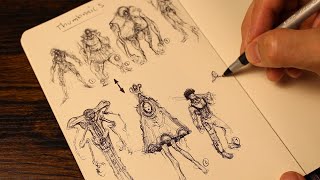
your gut and go to the book smarts when you run into a problem you can't quite solve now my process usually starts off with really loose sketching and this would be whether i have a story or don't have a story yet because sometimes a random character doodle can spark and launch its own entire world so if i'm just sketching like usual i try not to think too much if there isn't a story yet then i just go wild play with different shapes proportions big torsos little leg giant head small body big forearms little forearms tiny
fingers big wrists tiny wrists and just see if any spark forms from these designs now if we already have a story or at least a morsel of a story we can do our designs a little bit more deliberately now this might be easier if we just do an example so let's say we have a world where it's kind of near future dystopian there's military everywhere and our story is going to be about a group of mercenaries who are sent in to take out this dictator and we're going to design one of the characters in that
story let's say her name is tweek she's in her late 20s she's a hacker she's a mercenary and we're going to use that as the basis for our design so to start off we're just going to go over to google or pinterest and search for some keywords like soldier mercenary military and then we can start throwing on some qualifiers like sci-fi soldier or futuristic female mercenary another helpful way to do it is by tossing in the word concept art so you can do concept art soldier or concept art future soldier it lets you see how
other artists were able to translate those visual indicators that we're seeing but in a more artistic illustrative way now that your brain is revving just start sketching play around with head shapes and hair body shapes or just vague suggestions of an outfit and tech don't get too attached to any one of these and don't worry about anatomy like at all anatomy does not exist in our world right now we don't care about it we just care about design try different hairstyles different races if you have an image of a character being thin try one with
muscle another one overweight don't be too constrained to a certain visual image at this point once you've got some ideas cooking around in your head it's time to do a character sheet this will help you solidify your ideas so open up a new canvas i usually do 17 by 11 because that's just what i'm used to and i sketch in a basic standing human form straight on no fancy perspective no foreshortening nothing then you can do one for the profile for the arm you can just draw this circle with a cross through it so the
arm doesn't block the view of the outfit you can always draw a arm just floating in mid air if you need to add details or design for that arm and then we're going to do a 3 4 view once you do this for the first time you want to save this as a template for yourself so you don't have to do this every single time and you can also have a different template for different things like a muscular character or a thin or a small or a heavy you can do ones for male and female
if you want to now for the straight on forward mannequin that's where we're going to start just start drawing your character in here i usually keep it pretty loose i don't focus a lot on head details i don't worry too much about the hair now if this design is for a client or an employer you might have to be a little bit more clean add a little bit more detail once you're done head back over to google or pinterest and start looking at all those references again is there something that you're seeing in that ref
that you really like but you didn't actually add to your design because you forgot about it now you take those go back to your character and update your character with those elements once you have that front view set then you can go back and do the profile view and the three quarter view and if you want you can throw down some simple colors once you have all of that in place now that we have our design we actually want to see if it works so at this point i would take my design and start drawing
it in a bunch of different poses action poses dynamic angles does the costume still look cool is it fun to draw is there anything that feels off or that is annoying to draw make a list go back and change your character sheet you can add notes like only draw the character from this angle if you draw the character from the front view you need to do this with the hair otherwise it's going to look weird etc now that we have our character outfit designed we're going to want to do something for the head as well
so we're going to do a head sheet or head turn around and we start the same way we start with that forward facing view draw the character get the eyes the hair the nose looking the way you want it and then we're going to draw these guidelines running across from the hairline the eyes the nose the mouth and the chin so that we're able to translate our character into the profile and three quarter view now i did this in more detail in another video about drawing consistent characters so make sure you check out that video
if you need more information now as you start creating more characters for your world you're going to want to stick all of your characters into a single sheet just the straight on view of the characters that way you can see if the characters are working together do all the characters work together are the sizing and proportions working across all the characters do they look like they live in the same world this guy probably needs a shirt on because it looks weird because everyone else has a shirt on and you probably want to wear a shirt
when you're going into enemy territory also while you're looking at all of them on the same sheet you want to make sure that they all look distinct from one another different sizes hairstyles attitudes you don't want to just have a bunch of clones because that is going to get boring and also confusing for your reader there's a bunch of comics i've read where i'm not sure if that character is one character or another character usually i start by designing the main character the most important character the one i'm most excited about once i have that
character designed i will copy that front view and paste it into a new sheet for the next character so while i'm designing that second character i can use the first character as a guide to keep things all in line otherwise it's pretty much rinse and repeat for every single character you have in your story now i would be remiss if i didn't at least briefly gloss over some of the more traditional teachings of character design so there are three elements to this shape color and silhouette so for shapes we have round boxy and pointy round
shapes are for cutesy cuddly characters boxy shapes are for strongy wonky characters pointy shapes are for mean weenie characters and colors we have blues and reds blues are for calm peaceful serene characters royalty red is for dangerous and fast and energy action characters and then of course you have fuchsia and teo which is for just badass characters at least i think so those are my favorite colors now i think color and shape are fairly intuitive even if we're not thinking about it like we're not gonna design an evil monster and color him baby blue and
give him round cotton ball claws because that's just not what an evil monster looks like we know what that looks like we know what claws are they're sharp and pointy and you know evil things are like darker reds and shadowy you know they're not baby blue and they don't have round claws but another teaching is silhouette now a silhouette is just a solid black shadow version of your character and i think silhouette is really important because it means your character is easily recognizable with no detail now this goes back to what i was saying earlier
about making all of your characters look distinct even if they're standing next to each other silhouette makes it really easy to see if designs are too similar because you're not getting distracted by all the details but don't feel the need to make them insanely different unless you're doing something really cartoony and then it makes more sense that all the shapes and the characters are very distinct and different from each other side note silhouette is also great when you're drawing dynamic poses and doing compositions to make sure that all the different elements are reading easily for
the viewer and that's my process for designing characters the big takeaway should be trust your gut you know what your characters look like at least in your head if not in your heart and the other thing is to focus on character design and not on making good drawings if you're trying to design your character while also drawing a great illustration with dynamic poses and forced perspective you're going to be juggling too many things and it's going to make it a lot harder on you now the best way to get better at character design is to
design a lot of characters because the more characters you design the more problems you're going to run into the more problems you have to solve therefore you're going to learn a lot faster now there's a lot more that goes into character design a lot of creative stuff this video was more about my specific process technical process for designing characters so if there is a aspect of designing characters that you're having a problem with let me know in the comments and i will make a video that focuses more on that singular aspect of character design now
if you want to help me out and help this channel and help me make more videos please share this video with your friends and your family force them to subscribe and hit the like button you should also hit that like button show this video to your cat cats like me they might want to subscribe themselves and if you want to keep making comics easier be sure to like link love hug and hit that sub button for more sweet sweet goodness peace
![WHAT BEGINNER COMIC ARTISTS DO WRONG! [I Went from 100 Readers to 50,000+]](https://img.youtube.com/vi/kp8t-D6fddk/mqdefault.jpg)