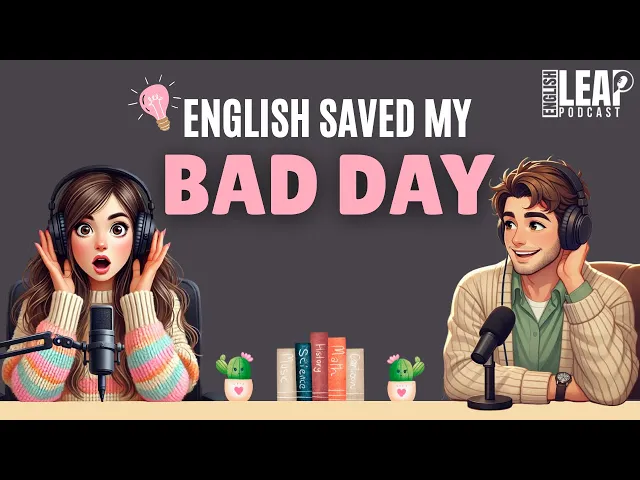
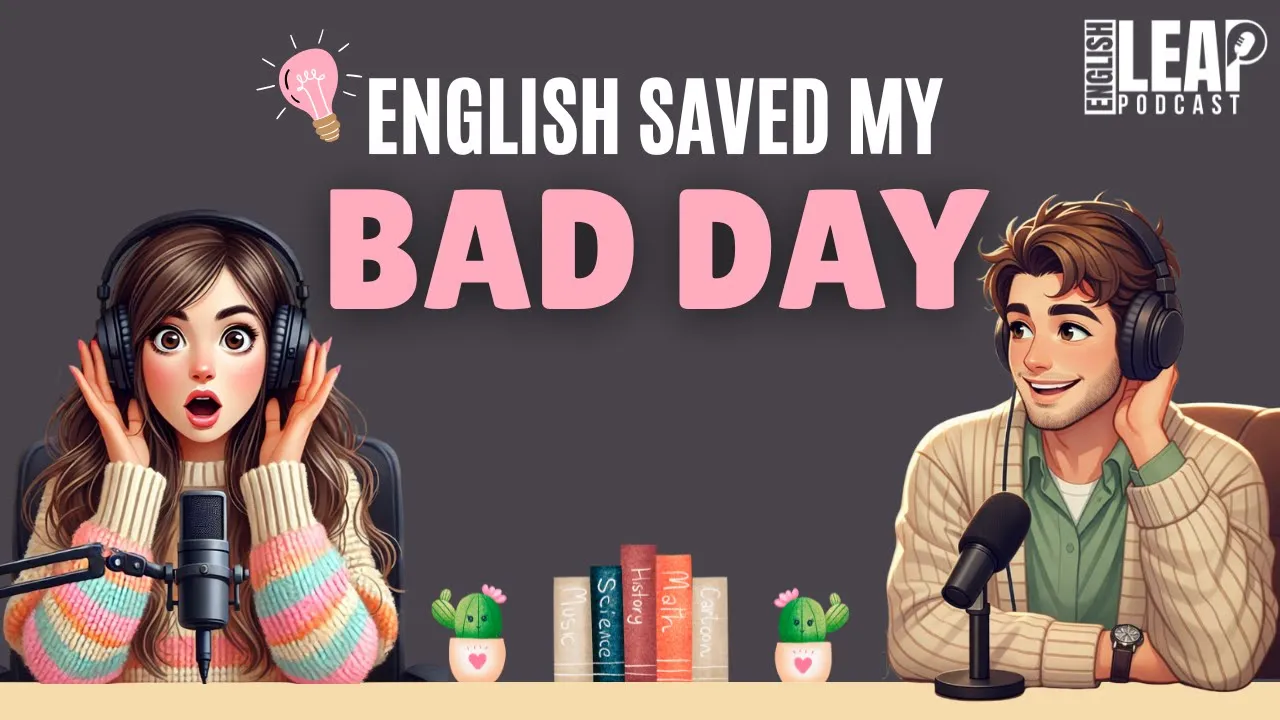
English Leap Podcast >> from Speak English with Claus. Hey English learners, welcome back to the English Leap Podcast, your cozy English podcast to learn easy English through real daily life conversations. I'm Anna.
>> And I'm Jake. And yes, today is going to be fun >> because we're not doing the boring I woke up, I ate, I worked. Nope, not today.
Not today. Today we're doing a day that went wrong. >> Wrong.
Wrong. Like everything went sideways. >> Sideways.
Like a shopping cart with one broken wheel. >> Yes. And the best part, every disaster becomes a tiny English lesson.
>> Yep. Every moment you'll learn one real phrase that native speakers actually use. >> Like, I overslept.
I was slammed. My Wi-Fi is acting up. I needed to decompress.
>> And we'll also give you a rescue line after each scene. One sentence you can steal to save the situation. >> We love stealing politely.
>> Steal it. Use it. Sound natural.
>> By the way, this is a B1 B2 level episode. So, if you're intermediate, you're in the right place. >> And if you're a little lower than B1, don't worry.
We'll keep it clear, slow, and super practical so you can still follow. >> Okay, quick quick before we jump in. If you enjoy this kind of real life English, hit like, subscribe, and share this with someone who wants to speak more naturally.
>> Yes. And don't just listen, jump in with us. >> Right.
Tell us your panic level today from 1 to 10 in the comments. >> Just type panic level 6 out of 10. Simple.
If you're a one out of 10, wow, teach us your secrets. >> And if you're a 10 out of 10, breathe. This episode is basically first aid for your English and your mood.
>> Oh, and stay with us because we're doing a word tour at the end. >> Yes, our word tour is where we collect the best phrases from today, explain them simply, and give you ready to use examples, >> like a highlight reel, but for your English. and we'll finish with a tiny challenge so you can practice immediately.
>> Okay, Jake, quick question. Be honest. Is your day going well so far?
>> M normal for now, but I'm nervous because you're about to confess your chaos story, and I can already feel the secondhand stress. >> Confess? Excuse me.
This is not chaos. This is educational drama. >> Educational drama.
That's literally your genre. Stop. Okay, listeners, get ready because this episode is like a mini Netflix series.
>> Yeah. Five mini scenes. In each one, you get a real life disaster, a real phrase, and one rescue line to save your dignity.
>> And we're rating it, too. >> Yes. You'll hear two fun things every time.
The panic meter, how bad it feels, and the recovery meter, how well we fixed it. So, you're not just listening, you're collecting useful English like powerups. >> Yes, English powerups.
Okay, deep breath. >> Here we go. Scene one starts with the most dangerous button on Earth, >> the snooze button.
>> Yeah. And I pressed it again and again and again. >> Three times.
Anna, you didn't press snooze. You signed a contract with your bed. Okay, panic meter check.
Be honest. What was your panic level? >> Nine out of 10.
Because when I finally opened my eyes, I looked at the time and my stomach dropped. >> Your stomach dropped. That feeling when your heart jumps and you think, "Oh no, I'm late.
" >> Yeah. That, "Oh no, my whole day is already late feeling. " >> H What time did you want to wake up?
I wanted to wake up at 7:00. I woke up at 7:45. >> Ouch.
That's not a bit late. >> I know. I jumped out of bed still half asleep.
My body was running, but my face was like, "Wait, what is happening? " >> Half asleep is the worst mode. You're walking, but your soul is still in bed.
And your brain instantly starts doing fake math, right? Like, if I move at lightning speed, I can still make it. Yes, fake math.
And I started scrambling like toothbrush in one hand, phone in the other, sock missing, hair doing violence. >> Half asleep, full disaster. >> Right.
And Oh, I was so flustered. Like nervous and confused at the same time. I almost put my t-shirt on backwards.
>> No, you didn't. >> I did for like 5 seconds in my room. Then I looked in the mirror and fixed it.
Don't worry, I didn't go outside like that. >> Okay, good. Confused in your bedroom is fine.
Confused on the bus is another level. And in the middle of all that, you still had to think, "Okay, how do I tell my manager I'm late? " >> Yes.
So, I stopped for 2 seconds, took a big breath, and thought, "Don't write a long story. Just say the truth. I overslept.
" >> Simple and honest. I like it. Okay.
Hidden English of this moment. Say it with us. I overslept.
>> Yes. Not I slept more. Not I slept extra.
Just I overslept. >> And you don't say it like a poem. You say it like a problem.
>> Right. Okay. Mini dialogue.
Ready? Hi. I'm so sorry.
I overslept. >> Okay. How long do you need?
>> Give me 20 minutes. I'm on my way. >> That's your rescue line, guys.
I overslept. Give me 20 minutes. I'm on my way.
>> Short. honest, no drama, even if your life is drama. >> And please don't send the long apology essay.
No. Dear sir, I would like to explain. >> Not the apology essay.
>> Please, one calm sentence looks confident. Even if you're panicking in your kitchen. Okay, Anna, what about recovery meter?
>> M 7 out of 10 because I didn't panic text a paragraph. I sent one calm sentence. One calm sentence.
That's power. >> And after that, I did the fastest get ready routine of my life. >> Fastest routine meaning you skipped something important.
>> I skipped peace. I skipped breakfast. I definitely skipped good hair.
>> Breakfast said, "See you tomorrow. " >> Mhm. And then I ran out of the house like I was being chased.
>> Okay. And that's exactly how scene two begins. Because when you leave the house like that, you start making interesting decisions.
Okay, so Anna runs out of the house like she's being chased. Scene two, the commute. >> Yep.
I'm speedwalking like I'm in an action movie and I see my bus. >> The hero arrives. >> No, the villain arrives.
>> Ah, the secret villain. The bus you think is your bus. >> Exactly.
I see the number. I'm not 100% sure, but my brain goes, "You're late. Just get on.
Don't think. Move. " So, I jump in.
>> Classic. No thinking, just panic. >> At first, everything feels normal.
I'm standing there fixing my hair and my phone camera, trying to breathe like a calm office worker. >> Outside, I am a professional. Inside, ah, >> yes.
But after a few minutes, I start looking out of the window and I think, hm, I don't know this street. Oops, the first red flag. >> Then I see more new buildings and I think, wait, I really don't know this street.
So I open my map and the little blue dot is going far, far away from my office. >> Away from the office. >> I just close my eyes and whisper, "No, please no.
I got on the wrong bus. " >> Oof, that sentence hurts the soul. >> My heart did a mini scream because I was already late.
And now I was late in the wrong direction. >> Late in the wrong direction. That is a special kind of pain.
>> Right. I felt completely frazzled, tired, stressed, and with almost no patience left. >> Frazzled is that feeling when your brain and your energy are both like, "We're finished.
No more. " >> I pressed the stop button, got off at the next stop, and stood there like, "How did my life become this? " And the truth is, it started with that cute little snooze button.
>> Exactly. One tiny five more minutes became a whole domino effect. I woke up late, rushed out, didn't check the bus number, and now my whole morning was moving.
>> Domino effect means one small thing knocks over everything after it. Like one falling domino hitting all the others. >> Okay.
Hidden English of this moment. I got on the wrong bus. Simple, natural, and then you can add, I had to get off and backtrack.
>> Backtrack means you go back the way you came. >> Yes, because I literally had to do the walk of shame back to the bus stop. >> The walk of shame.
>> Not shame. Shame. Just Why am I like this?
Shame. >> Okay, mini dialogue. This is the one you need when you message someone.
>> Hey, uh, I got on the wrong bus. >> Oh, no. So, what now?
I'm backtracking. I'll be there in 10 minutes. >> Okay.
Thanks for telling me. That's your rescue line. I got on the wrong bus.
I'm backtracking. I'll be there in 10 minutes. >> It sounds responsible even if you're not.
>> And recovery meter. >> Eight out of 10. Because I didn't make excuses.
I just told the truth and the plan. >> The truth and the plan. That's the secret recipe.
After that, I finally sat on the right bus, watched the right streets go by, and told myself, "Okay, maybe my day can still be saved. " But the universe said, "Wait, we still have the office wifi. " >> Yes.
And that is where scene three, the tech meltdown begins. Okay, I finally arrive. I'm thinking, "All right, the worst is over.
" >> And that's when life says cute. Exactly. Scene three.
I sit at my desk, join an important online meeting, and my manager says, "Anna, can you share your screen and walk us through the update? >> Share your screen. " The modern boss sentence.
>> I click share, my slides open, I start talking, and suddenly nothing moves. The mouse stops, the slide stop, all the faces on my screen freeze. Oh no, >> I'm clicking like crazy and I just think no, no, no, it froze on me.
>> That moment when your computer becomes a picture. >> Yes, a very expensive picture. I leave the meeting, try to rejoin, and now it says connecting forever.
>> So it's not just the app now, >> right? Then I realize my wifi is acting up. My Wi-Fi is acting up.
Supernatural sentence. >> And I'm not just stressed about the internet. I'm thinking about the repercussions.
Like, what if they think I'm not serious? What if I look unprofessional? >> Repercussions means the results after something happens, often negative results.
>> Exactly. My brain is screaming about the future, but I know I still have to sound calm on the call. >> So, you need to sound >> composed.
Calm and in control, at least on the outside, even if inside I'm on fire. >> Nice word, composed. Calm voice, crazy Wi-Fi.
>> Hidden English of this moment. It froze on me and my Wi-Fi is acting up. >> Both are very common.
People say them all the time in online meetings. >> It froze on me means my screen or my app suddenly stopped working. and my Wi-Fi is acting up means your internet is not working properly.
It's being strange or unstable. Okay. Mini dialogue online meeting version.
This is what you say instead of just disappearing. >> Hi, sorry, my Wi-Fi is acting up and it froze on me. >> No problem.
Do you want to try rejoining? >> Yes, I'll rejoin now. I'll be back in 2 minutes.
>> Okay, we'll wait. That's your rescue line. My Wi-Fi is acting up and it froze on me.
I'll rejoin in two minutes. >> Short, clear, polite. No long drama about your laptop and your Wi-Fi story.
>> And you still sound professional even when your internet is a disaster. >> Exactly. I used that line, restarted my Wi-Fi, came back to the meeting, and tried to sound composed, even though inside I was still shaking.
All right, panic meter time. >> For me, this was n out of 10 panic. Tech problems in front of people feel very personal.
>> N out of 10 panic. >> But recovery maybe also 9 out of 10 because I didn't just disappear. I explained the problem.
I gave a plan and I came back. >> And that's the lesson from scene three. When technology fails, your words can still make you look strong and professional.
So after the tech meltdown, I tell myself, "Okay, breathe. The worst is over. " >> And the calendar says, "Hi.
" >> Yes. I open my calendar and just stare at it. Every box is full.
Backto back meetings, no breaks. My day is completely overooked. >> Over booked.
Too many meetings. Too many things in one day. >> Exactly.
I had emails, chats, calls, reports, all at the same time. By lunchtime, I was slammed. >> I was slammed means you were extremely busy.
Like the work is just hitting you again and again. >> That was me. I was trying to answer a message while reading a document while listening in a meeting and suddenly my manager says, "Anna, can you explain the new process to everyone?
" That moment >> in my head I'm screaming, "No, not now. " But out loud, I just hear Anna. >> So, what happened?
>> My brain did this little pause. I knew the process, but I did not expect to explain it right there. In my head, I just thought, "Wow, I was put on the spot.
" >> That means you had no time to prepare, but they suddenly asked you to speak. >> My first words were a bit messy. I started talking too fast.
Then I realized I wasn't clear. >> Which is normal when you're tired and over booked. >> Yeah.
So, I stopped and thought, "Okay, I need to fix this and still keep my dignity, my self-respect, so I don't sound lost. " >> Nice word, dignity. You want to correct yourself, but still sound confident.
>> So, I took a breath and said, "Sorry, I'm going to backtrack a little and start again from the beginning. " backtrack, go back and correct or change what you said. >> Then I added, let me gather my thoughts.
And I gave myself one small pause to think and explain it properly. >> That's such a good combo. >> Hidden English of this moment, I was put on the spot, backtrack, and let me gather my thoughts.
>> All three are super useful, especially for work meetings. Okay, mini dialogue meeting version. Imagine you're tired, over booked, and suddenly you have to talk.
>> Sorry, I wasn't expecting that question. I was put on the spot. >> That's okay.
Take your time. >> Thanks. Let me gather my thoughts and backtrack a little so I can explain it clearly.
>> Sure. Go ahead. So, that's your rescue line.
Let me gather my thoughts and backtrack a little so I can explain it clearly. >> It sounds calm and professional, even if inside you're like, "What is happening today? " All right, panic meter for this scene.
>> For me, this was 8 out of 10. I was tired, over booked, and then suddenly talking in front of everyone. >> Eight out of 10 panic.
>> But recovery, maybe nine out of 10 because I didn't freeze. I didn't panic laugh. I used my words, fixed my answer, and kept my dignity.
>> And that's the lesson from scene four. You're allowed to slow down, correct yourself, and still sound confident. So, the meetings are finally over.
My brain feels like overcooked pasta. >> Soft, confused, and not useful. >> Exactly.
I pack my bag, leave the office, get on the bus home, and suddenly all the small things start to hit me. >> What small things? >> The snooze button, the wrong bus, the Wi-Fi, the surprise meeting.
All day I felt like things were going sideways. Not totally broken, but always almost wrong. >> Sideways, not forward, not backward, just weird.
>> I sit on the bus and I feel this heavy, tired feeling in my chest. Not just sleepy, mentally tired, emotionally tired. >> Yeah, that I'm done with today feeling.
>> Exactly. At first, I take my phone out to scroll and answer more messages, but my body is like, "Please stop. " And I just realized I needed to decompress.
>> Needed to decompress. >> Decompress means to slowly relax after a lot of stress. Like opening a busy suitcase and finally letting everything out.
>> Nice image. Your day was an overful suitcase. >> Yes.
So I make a small decision. No emails, no messages, no thinking about work on the ride home. I put my phone away, look out of the window, and just breathe.
>> That's a strong move, actually. >> Hidden English of this moment is, I needed to decompress. >> You can also use it when you talk to people close to you.
>> Yeah, this is your evening rescue line. Hey, today was really intense. I just need to decompress for a while.
>> Okay, no problem. Take your time. >> Thanks.
I'll talk properly after I rest a bit. >> That sounds healthy. Clear, but kind.
So, what did decompressing look like for you when you got home? >> I came home, changed into comfy clothes, made some tea, and sat on the sofa with no screen for 10 minutes. Just me, the cup, and the silence.
>> Wow. No phone. Brave, >> I know.
But after a few minutes, I felt my shoulders slowly relax. My breathing slowed down. My brain was like, we're safe now.
Sometimes that's all we need, a small reset. >> Yeah. And then I did one more thing.
I took out a notebook and wrote one line for each scene of my day. >> Oh, like a summary. >> Scene one, I was late but honest.
Scene two, I made a mistake, but I fixed it. Scene three, tech failed, but I stayed professional. Scene four, I was tired, but I kept my dignity.
Scene five. I chose to decompress instead of explode. >> That's beautiful.
Actually, you didn't just see a bad day. You saw a strong day. >> Yeah.
Same day, different story. >> Okay. Final numbers.
>> Overall, panic maybe 8 out of 10. Panic day. >> 8 out of 10.
Panic day. But recovery also eight out of 10 because even when it felt bad, I used small sentences to save my day and my mood. >> And that's the big lesson.
Your day can go wrong in many small ways, but your words can still help you recover, repair, and relax. >> And now we want to help you decompress, too, by collecting the best phrases from today. >> Yep, it's time for our word tour.
We'll go through the key phrases and words from this day gone wrong and show you how to use them in your own life. >> So, don't go anywhere. Take a breath, maybe grab a tea, >> and let's jump into the word tour together.
>> Yeah, we'll go one by one, slow, simple, and with examples you can steal. First word, half asleep. >> Half asleep means you're not fully awake yet.
Your body is moving, but your brain is still sleepy. It's that moment after you wake up and everything feels a bit slow and foggy. >> For example, I answered the phone half asleep and didn't understand anything.
>> Next, flustered. >> Flustered means nervous and confused at the same time. >> Maybe you're late, people are watching you, and your brain feels messy.
>> For example, I got flustered when they asked me a question in front of everyone. >> Next, frazzled. Frazzled is very tired and stressed with almost no patience left.
>> Like your energy is at 1% and even small problems feel big. >> For example, by the end of the day, I was completely frazzled. >> Word for domino effect.
>> Domino effect is when one small thing starts a chain of other things. >> Like one falling domino knocking down all the others after it. For example, snoozing my alarm created a domino effect for the rest of my morning.
>> Next, over booked. >> Over booked means you have too many things in your schedule, too many meetings or tasks. >> Your calendar is full and there's no real break.
>> For example, my day was over booked. I didn't even have time for lunch. >> Next, repercussions.
Repercussions are the results or consequences after something happens, often negative. >> It's what you're afraid will happen because of a mistake. >> For example, he was worried about the repercussions of being late again.
>> Next, dignity. >> Dignity means your self-respect, how you value yourself. >> You can admit a mistake, but still keep your dignity by how you speak and act.
For example, she apologized but kept her dignity by speaking calmly. >> Next, decompress. >> Decompress means to slowly relax after stress.
>> Like taking the pressure out of your mind and body. >> For example, after work, I needed to decompress with some music and tea. >> Next, backtrack.
>> Backtrack means to go back and change or correct what you said. You realize your first version wasn't clear, so you start that part again. >> For example, let me backtrack and explain that part more simply.
>> Last word, composed. >> Composed means calm and in control, especially on the outside. Even if you feel stress inside, your voice and face stay steady.
>> She stayed composed even when the presentation went wrong. Now, let's look at some phrases from our bad day story. Real sentences you can use.
>> You don't need to memorize all. Just choose a few that feel useful. >> I overslept.
>> I overslept. In other words, I woke up later than I planned. >> Example, sorry, I overslept and I'm running late.
>> My stomach dropped. >> That feeling is when you suddenly feel scared or shocked. Example, my stomach dropped when I saw the time.
>> I got on the wrong bus. >> Basically, I took the wrong bus by mistake. Example, I got on the wrong bus and ended up far from my office.
>> I was put on the spot, >> which means they asked me to speak or decide with no time to prepare. Example, I was put on the spot in the meeting and had to answer quickly. >> It froze on me.
as in my screen or app suddenly stopped working. Example, sorry, it froze on me while I was presenting. >> My Wi-Fi is acting up.
>> So, my internet is not working properly. Example, my Wi-Fi is acting up, so I might drop from the call. >> I was slammed, >> meaning I was extremely busy.
Example, I was slammed all day and forgot to eat lunch. >> Things were going sideways. In plain English, things were starting to go wrong.
Example, from the morning, things were going sideways at work. >> I needed to decompress. >> That is, I needed time to relax after stress.
Example, after that day, I really needed to decompress. >> Let me gather my thoughts. >> Give me a second.
I need a moment to think clearly. Example, let me gather my thoughts and then I'll answer. >> I'm backtracking.
I'm correcting myself because I want to change or fix what I said. Example, I'm backtracking a bit because I want to explain it more clearly. >> So, these are your words and phrases from our day that went wrong.
>> You can't stop every bad day, but you can choose calmer, clearer English in the middle of it. >> Maybe tonight, think of one moment in your own life when things went sideways. and try using just one of these words or phrases to describe it.
You can even share it in the comments if you feel brave, just a short one. We really love reading your stories. >> We really do.
And if this episode helped you feel a little less alone with your messy days, hit like, subscribe, and share it with one friend who is always running late but trying. >> And if you want more easy English through real daily life stories, make sure you don't miss the next episodes. We have many more beautiful disasters to talk about.
>> This is Anna >> and this is Jake >> and you've been listening to the English Leap podcast. >> Take care of your English >> and take care of your mind. Bye.
>> Your progress doesn't end here. To continue advancing your English skills, click on the next video or explore the additional videos we've thoughtfully selected for you.