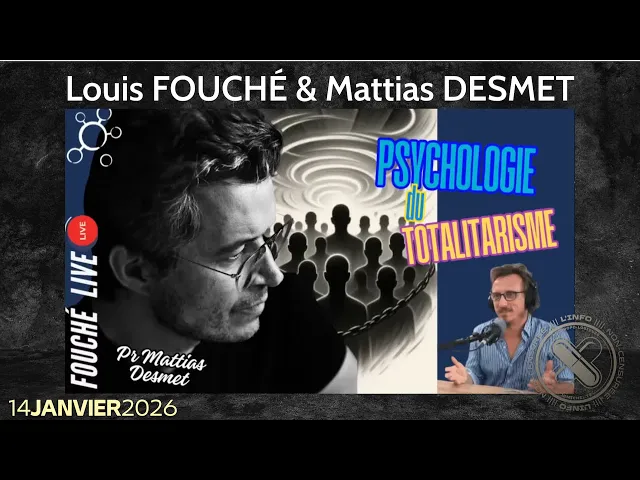
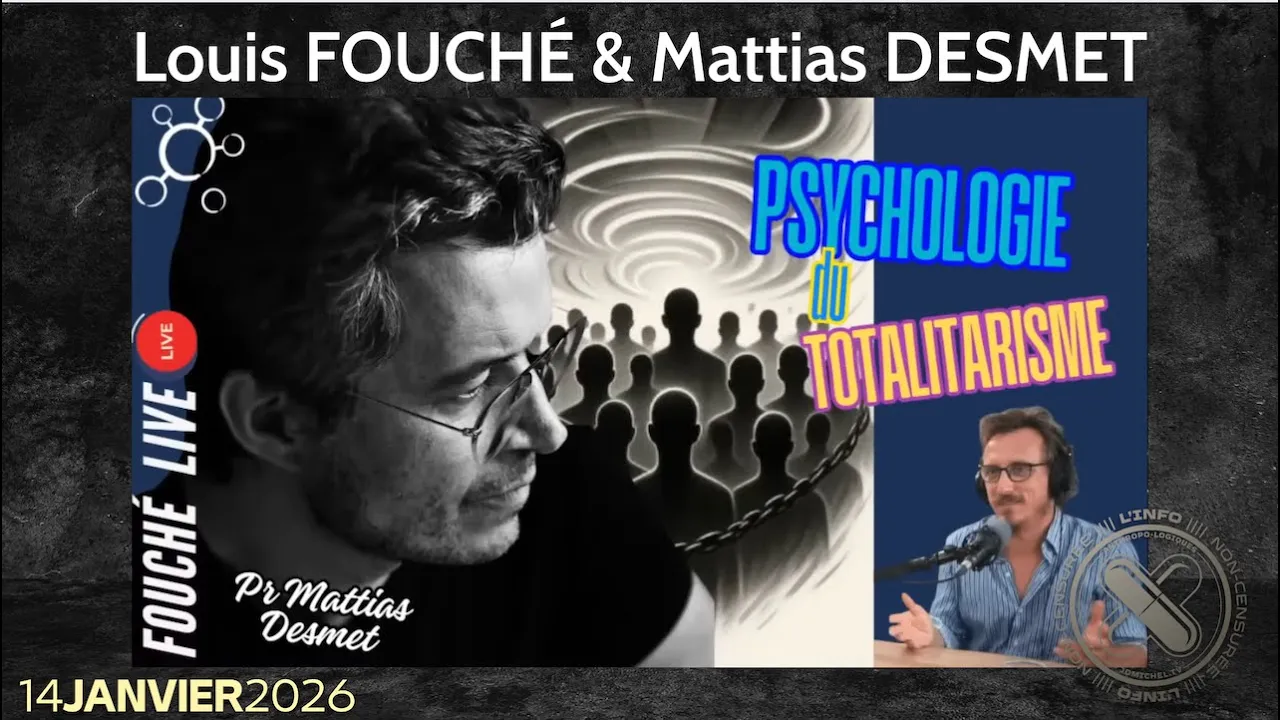
Hello everyone. I'm happy to meet you again. I'm Dr Louis Fush.
I'm an aestheologist and intensivist in France and I'm trying to do a live show and broadcasting about the people I admire or uh um who whom I think the the work should be uh um on the scene and shown to everybody because it helps us understanding better the the world we're living in. And today uh I have the pleasure to to invite a friend and somebody I admire much much uh who is Matias Desmet. Hi Matias, how are you doing?
Hey Lou, doing well and thank you for having me on. >> Thank you very much. Uh it's an important uh moment for for us in France because uh your book is finally published and translated in France.
Uh which is uh uh something really important. It makes uh years that French people want it to be translated and um I'm going to show it to the to the public. It's there.
It's uh with Michelle edition in French and if Michelle is a friend also uh and um he he dared to publish this book and I say he dared because um this book has u has made no made noises in the g university in Belgium. No. >> Yes.
Yes, it was. It uh well it it has been banned actually from uh using it at Gant University. Um, which is a strange thing I believe because the book is very how how would I say it's written in a in a very friendly and kind tone I believe but um certain things in the book uh make certain people a little bit scared.
Uh the the book is is all about a what I believe to be a newly emerging uh totalitarian system which is like a globalist and technocratic totalitarian system. uh which we see for instance in Europe when um something like uh the digital service act is introduced or the European shield for democracy. Like at first glance all these initiatives seem to be very democratic as the names mention but uh on a closer consideration you can see that they actually show all tendencies of a totalitarian a newly emerging totalitarianism which will be like a globalist surveillance transhumanist uh totalitarianism.
So that's why I I wrote a book as you know Louie in the during the corona crisis. Uh but years before the corona crisis I was already studying uh the psychological mechanisms in newly emerging totalitarian systems. But when the corona crisis started, I saw so many things that were reminiscent of uh totalitarian dynamics that I decided to speed up the process and uh finish the book and publish it as fast as possible.
>> Yeah, I put the reference of the book in French there at Michelle edition. And um uh it's it's an occasion to introduce you to the French public who who didn't know you. uh you're professor in the university of go in psychology and clinical psychology and soci social uh psychology and a lot of your work has been inspired by Gustav Leon and psychology of the crowds.
How do crowds react? Um not only the individual but when they they are gathering together and kind of a find a um a common framework, a common way of of uh of being and may you you shall explain us um to explain to us uh about that and what you call mass formation. But just before um I wanted to react on what you said of the banishment of your of your book and the fact that most of the people were really afraid during the COVID and afraid by the sanitary crisis but there was something else something more something behind the scene that was that could be felt by the people who had intuitive vision of the world and felt that there was something nasty with the way the governments were dealing with the people.
uh the the way the media were telling us what's what's going on and this word of totalitarianism appeared in a lot of different places in the world and uh uh it reminded us of the work of Anarent about Nazism and about the Nazi and the Sovietic system but what I saw is around surrounding me most of the people didn't want more fear they already have the fear of the covid and when we I was talking about totalitarianism or telling them to to go and see your work they were more afraid and they said no you cannot say that we're not in uh in North Korea Korea or thing like that uh just like if there was kind of a protective mechanism in their psychology trying not to see the whole framework not the whole pattern because it was too too scary. >> Absolutely. Yes.
you know, um maybe the the most remarkable uh characteristic of newly emerging totalitarianism is the fact that the narratives um in which people start to believe uh become utterly absurd. And the strange thing is that no matter how absurd the narrative becomes, people will continue to believe in it. And that's something that Hana Arent uh described in her very important book, the origins of totalitarianism.
Like in a strange way, people are not capable anymore of taking a critical distance of the narratives that circulate in society. And um that's where my work begins. I think uh as you said I I uh uh referred to to um this the the madness of the crowds the um as it is known in in France the work of Gustaf Leon who describes exactly this.
He he describes this strange phenomenon which I coined the term for uh of mass formation like um mass formation is a the typical kind of group formation um which which has very specific effects at the level of individual mental functioning and like for instance once people are in the grip of of of of a mass formation uh they typically will become incapable of taking a critical distance of what the mass the group believes in. Secondly, very important, they typically will be willing to radically self-sacrifice. It's something very strange.
We could see that for instance in the Soviet Union when the the massation started suddenly the leaders of uh of the communist party uh they when when when when Stalin condemned them to death uh or or usually without any reason they just accepted it saying such things like oh if that's what I can do for the communist party I'm very happy to uh to do good. So please um uh do what you want. So the strange willingness to self-sacrifice is very strange in a mass.
And then thirdly, the most important thing and the most dangerous thing is that people who are in the grip of a massformation typically uh uh uh become radically intolerant intolerant for dissonant voices. So everyone who thinks differently should be first excommunicated and later on exterminated. And like this this this can go uh quite far like uh there is a conversation of me on the internet with Shore Etali, a woman who lived in Iran during the revolution in Iran.
um and who had to witness. She was the daughter of one of the uh the mayors of uh a major city in Iran. And she had to witness uh on Friday evening uh how people were hung uh people who were supposed to be traders were hung by the regime.
And one evening uh she she witnessed how a mother who reported her own son to the state uh hung the news around the neck of her son when he was on the scaffold and once after he died on the scaffold she was very proud to receive a medal of heroine for heroineship. So that's that's the that's a dramatic end stage of a massformation and once you understand the mechanism you understand why mothers start to report their sons to the state and children start to report their parents to the state and you also and that's of course the most important thing you start to understand what the only thing is that you can do when confronted with a massformation >> um I I emphasize what you what you just told us um first point is no distance no critical distance from the wholly observed uh things told by the system. Um secondly uh a self-sacrifice uh for the for the dis uh to maintain this collective hypnosis and to maintain the system.
And third, uh, the sacrifice of the others and the the the excommunication and then the murder of the people who are trying to warn about the absurdity or the the incoherence or who are trying to fight the to to fight the different hierarchy of this new uh new framework of this of the civilization of of the society. And I I can hear with those three points, there is kind of a loss of the moral uh reference, the usual moral reference when you tell us that a mother can can uh say his son is guilty and watch him being hung and and receive a medal and being proud about that. Uh it reminds me of the red kmare um um teaching the kids to kill their own parents uh and and as a new normal as we owed it during the co >> exactly you know uh in a certain way uh there is a moral awareness in the masses but it's a it's a it's only a collective morality.
So um that's a strange thing like all the this is the as if individuals completely lose their awareness of their individual interests and also their individual ethical awareness but at the same time there is like a a group awareness uh which becomes extremely strong and which in which in which people are willing to sacrifice everything uh for for for the collective So that's that's a strange thing. It's extremely important to understand that like many people talk about totalitarian systems as if they are a kind of dictatorships which is not true. They are completely different.
In a classical dictatorship uh the psychological mechanisms are very simple. It's like so people people are scared of a small group of people who whom they experience as having a huge aggressive potential and consequently they just accept that this small group of people unilaterally imposes its social contract to society. That's the classical dictatorship and like in a totalitarian when a totalitarian system emerges something completely different is happening.
First you have this mass formation this this this process through which a certain part of the population usually something like 20 25% becomes so fanatically convinced of a certain narrative and a certain associated ideology that uh they are willing to to to to uh uh destroy everyone who doesn't go along with that narrative. So that makes and and once once this massformation happens and once um uh it sees it ceased it ceased control of the state apparatus then um something typically at that at that moment like once once a massation uh uh happens and seized control of of the of society or of of of the of the structure the state structures then it typically um uh will be able to to impose like a much more suff suffocating doctrine to society than a classical dictatorship just because the totalitarian state has a huge secret police at its disposal namely this part of the population that is willing to report everyone to the state who um who doesn't buy into the narrative like that is that that that explains why that why like in former Eastern Germany like it turned out after the collapse of the communist system it turned out that up to 30% of the people had joined the secret police and like almost everyone had been people could could uh look in their in their files in their files after the system collapsed and almost everyone could see that he was reported to the state by a family member. Yeah, almost everyone.
So that's what happens in a total state. So that's why it is so important to understand what this massformation is and how it starts. And maybe we can take some time like few minutes to to go into it um to to to to talk about this this uh how a massation emerges like >> yeah ju just before you speak about that I I tried to rephrase to just check that I understood it well.
You you make a difference between usual dictatorship and totalitarianism. Usual dictatorship is a kind of a story of balance of power. You have weapons, you take the power and the people are bowing in front of you because you can kill them but that's all.
They don't need to buy into your narrative into your ideology, your religion or anything and don't they don't they don't enroll you in their own ranks. Um you are fighting against them. So this is dictatorship.
But totalitarianism is kind of a pervert way of of taking the power because it it makes you get into the power at the same time as it uh it makes you um uh it puts you into jail and and in all the fields of your life. So you you told us that the family were uh were um were involved into into making another one another member of the its own family being guilty. And uh we saw in France like five or 10 years ago appearing uh the idea of vigilant neighbors uh you know uh in every neighborhood you had an eye a very uh um disturbing eye.
This was the symbol of it and it it it told the people you are connected to the police and among you there is one person who is responsible to give the information to the police and it's for your security. we are checking all your neighborhood and and we are reporting everything which is happening and you can make part of it. I don't know if it exists in in Belgium but um when I saw that appearing in France I saw that it was not it was really a um the borders between the different categories of the society were collapsing the usual citizen were turning into into policemen or secret services as you as you said.
>> Yep. That's a that's something that is one of the main characteristics of a of a totalitarian state which which is not there in a in a dictatorship and which emerges everywhere. So that's that's very important like um to understand like the complexity of a totalitarian system uh in in a classical dictatorship for instance um it can be a solution to kill a part of the dictatorial regime because the point of gravity in a classical dictatorship is situated in a dictatorial regime.
The problem with a totalitarian system is that the point of gravity is situated in the masses who are in the grip of the propaganda of the of the totalitarian regime. Meaning that even if you eliminate uh a major part of the totalitarian regime, usually nothing will change. Nothing will change because you still have the masses who were who are in the grip of the of the of the of the of the propaganda.
So you tell all our all the people who are listening to us that it's really useless to go and kill any member of the parliament or of the government. It's not it's not the the point of gravity as you say it uh to change things >> to to to the contrary. uh violence always fuels totalitarian dynamics.
Um and that's that's that's why it is important to understand how it emerges like the the the most crucial thing we have to understand or the most important psychological phenomenon of the last 200 or 300 years is what Hegel the German philosopher Hegel called the atomization of society. Society is falling apart. People start to feel more and more disconnected.
people start to feel more and more lonely and just before the corona crisis uh the percentage of people feeling lonely was like somewhere around in between 40 and 60% worldwide like Theresa May appointed the minister of loneliness because she acknowledged this problem the US surgeon general mentioned that there was a loneliness epidemic I said very important and then once people feel disconnected and lonely they will typically start to struggle with uh lack lack of purpose and meaning in life. And we could see that that was also very clear like up to 60% of the people worldwide reported that they considered their own job to be a so-called job, a job without any purpose or meaning. And thirdly, once they were in this state, disconnected, lonely, lack of meaning making in life, something typically happens at the effective level, at the emotional level.
People are confronted with so-called with what I called three floating frustration, aggression and anxiety. Meaning a kind of anxiety that people cannot connect to a mental representation. People feel anxious but they don't know what they feel anxious for.
And once people are in this state, it's in this state and that's I could refer to the wonderful work of Jacqu Elu uh in this respect once people are in this state or that's a state where propaganda is very effective. Jacal didn't really go into the psychology of it but uh uh I I believe that's what it all boils boils down to. Once people are lonely, disconnected, uh lack of meaning making and develop high levels of free floating anxiety.
If at that moment someone distributes a narrative through the mass media indicating an object of anxiety and a strategy to deal with the object of anxiety like lockdowns to deal with the virus, there is a very good chance that all this freely floating anxiety in society connects at once to the object of anxiety which is indicated in the narrative and that people will be willing to buy into the strategy to deal with the object of anxiety even if that strategy is utterly absurd. So that's what happened and so >> from the moment on they they buy on the on the propaganda and uh they they have a reason for this free floating anxiety. It's not free floating anymore.
There's a reason for it. There's a a sense and a meaning into their and what they're doing. They're fighting against an infection.
they're fighting against uh Russia or whatever. Uh they are they have an enemy and and they are they they kind of solve the problem of insolation and loneliness because um they are connected to the others repeating the same ritual uh um narration. So >> exactly exactly.
So it's actually it's exactly the same mechanism as what happens at the individual level. Uh when when when an individual is confronted with free floating anxiety uh he might very well develop like an obsessive compulsive symptom or or or one or another hysterical symptom or something exactly because the symptom connects the anxiety to a mental representation. Well, in a mass exactly the same happens but at the collective level.
So massation is like the formation of an of a collective symptom which in this case means for instance in the corona crisis suddenly all the anxiety was connected to the virus and people were willing to buy into these in my opinion rather absurd uh corona measures which like from the first week of the crisis onwards you know I'm a I'm a clinical psychologist but I'm also a statistician and from the first weeks onward I I could see and I published a paper about it in the first week like these statistics are absurd And no matter how how much or how many times you you you could you showed you I tried to show that to people most people absolutely didn't want to see it. So that's that that this this this process of mass in the beginning stage it shows us in a in a baffling way uh that people are not rational beings in the first place. people or emotional beings and what they are looking for in the first place is not a narrative that is correct or uh uh from a rational point of view it's a narrative that allows them to handle their emotions and their anxiety.
So that's that's the first stage. The first stage of a massformation is this is this process in which uh uh uh uh um emotions are controlled in a in a more efficient way uh because of the manformation. And then the second step which you refer to already spontaneously.
The second step is indeed that uh because so many people at the same time participate in a strategy to deal with the object of anxiety, people start to have the feeling of fighting a a collective heroic battle like the war with the virus, the war with Russia, the war with the Jews, the war with the aristocracy and the Soviet Union. People start to have the feeling that they fight a heroic collective battle and they feel connected again. It seems as if they escaped their loneliness.
I said it seems that's crucial because they didn't really escape their loneliness like the very famous solidarity in the masses is actually not a solidarity not a kind of love between individuals. It's a solidarity of an individual to the collective. The longer a massformation exists, the more it sucks away all the love, all the solidarity between individuals and injects it, replaces it by a solidarity between the individual and the collective.
Meaning that after a while the solidarity with the collective, the bond with the collective becomes much stronger than even the strongest bonds between the between individuals. For instance, the bond between a mother and her child. So that's what happens in a mass mage.
It's a terrifying process where all the energy is sucked away from the bonds between individuals and injected in the bond to the collective. That's why in totalitarian states when Stalin died millions of people were weeping and lining up at his funeral even when they knew that he killed one two three four of their family members. That's a very it's a very strange very strange phenomenon which is and and um it's so important to see that in the final analysis and that's what my book is about to a large extent in the final analysis the only remedy against totalitarianism in massformation is the act of sincere speech.
the people who are not in the grip of the mass which is the majority because it's only 20 to 30% which is really hypnotized like massformation is identical to mass hypnosis it is mass hypnosis I could go into that in a technical way but it would take us too far I think but once you understand that that it's technically speaking a mass hypnosis uh uh and that only 20 to 30% of the people fall prey to it then you could see that the only solution is that the people who do not fall prey to it continue to speak out in a sincere way. Like not in an aggressive way, not trying to convince the other because that doesn't work. Much more important than trying to convince the other is just testifying to what you feel inside.
Saying like, look, you do believe in this narrative. Okay, you can do that. But to me it feels wrong and I will try to articulate what I feel inside and why to me this doesn't feel right.
So Gustaf Labour in the 19th century mentioned that already that when a major mass formation emerges in a society there is always a part of the population that doesn't fall prey to it a major part and of this like 70 80% of 80% of the people who do not fall prey to it a very small percentage one two three four five up to 10% is willing to speak out because they feel it's dangerous and only a small percentage of the people is willing to speak out. And when these people speak out, when these people try to wake up the masses, Gustaf Leon said, they will typically notice that they don't succeed in waking up the masses, that the masses continue to weigh into the narrative. But he said the fact that they do not they cannot wake up the masses doesn't mean that their their voice has no effect.
It has an effect. It makes sure that the masses do not go to the last stage of the mass formation where the masses typically destroy each and everyone who doesn't go along with them. So that's why it is so important to continue to speak out.
If you continue to speak out if enough people a few percentage don't have to be that many continue to speak out they will prevent the masses from going to the last stage where the masses destroy each and everyone who doesn't go along with them and finally also themselves. So when people continue to speak out the last very destructive phase will be avoided. That's an important point because a lot of persons told us during the COVID and that's all all what we did to resist the narrative was uh was useless and the agenda was still going on and um I can't help but thinking but if we hadn't done what we did it would have been much worse and and uh we knew this moment where uh um maybe the army could enter in the schools and and um mandatory vaccination for all the kids was that close.
I think uh >> it was that close. >> Yeah, >> they were really building camps. They were they had these plans to build camps for the nonvaccinated.
Like a lawyer in New York showed me all everything about that and he uh he said like we were we were that close to the point where where the people who didn't want to go along with what happened were referred to camps. No. And so the demonstration on Saturday morning, all the people trying to sing together, make music in Quebec, in France and in Germany, in Belgium, I think it was pretty much important and and we should not uh think that it was useless.
U most of the there's a kind of a natural history in this mass and total totalitarianism and there's a a very close connection between this mass hypnosis and totalitarianism. It's not two different they cannot live together separated I mean and um what's the natural history of the end of totalitarianism is there kind of a natural collapsing of it um is it at one moment uh it's disappearing the the narrative is is over nobody dies it anymore or uh or because for the moment we can see kind of a an echo of the first mass formation And just like in um when you have a movement of earth, you know, or volcano, you have replic it's it's doing it again uh several times. And we we saw COVID, we saw Ukraine, we saw Gaza, we saw there's um climate change and things like that.
Um the mass formation is continuing whatever the narrative is. It doesn't depend on the narrative. It's just a pretext.
But the the the the mass hypnosis is still going on. >> No, of course. Of course.
So, uh and it's very from a psychological point of view, it's clear why it's continuing like bec because uh in order for a major mass to emerge, you need a lot of lonely people. Okay, that's what you need like a lot of disconnected people. That that's why the mass like massations have always existed like the crusades and stuff were examples of massation or the witch hunts in the 17th century um were examples of it but they were much smaller and uh shorter lived like they didn't last that long and now uh since the 19th century mass formations became bigger larger stronger lasted longer and that's exactly why uh why they could become the basis of a completely new state system, the totalitarian state.
So totalitarian states did not exist before the 20th century because the mass formations didn't didn't last long enough to build a state system on it. Uh so uh and now they they last longer and longer and the point is like uh um that's because of the the the the percentage of lonely people that is increasing. There are more and more lonely people more and more profound disconnectedness and that's why the massations become stronger.
Uh but the problem is that every mass formation creates even more loneliness. Okay? So it prepares the ground for the next mass formation which usually might be a little bit stronger and more aggressive and um that's what you could see like in 2022 uh suddenly the war in Ukraine started and like from one day to the other the corona narrative lost its psychological power.
it was replaced by a new narrative. Psychologically speaking, all the anxiety that was first connected to the Corona narrative was switched and was was attached to to Putin or the Russians. Uh and um uh so that's that's why so and when when will it stop?
Of course, it's a good question. But you know uh massations in totalitarian states are always intrinsically self-destructive. Okay, so that's a good news.
They are intrinsically self-destructive. But of course, the challenge is that the point is that they should destroy themselves before they destroy the people who do not go along with them. And that's the that's the the the fatal mistake that happened in Germany and in Russia.
uh uh uh the people who who who resisted the system at a certain moment 1930 in the Soviet Union 1935 in Nazi Germany at a certain moment they decided to go underground and to stop speaking out in public space and that's the point where the totalitarian system becomes completely destructive because there is no dissonant voice anymore that disturbs the hypnosis. So that's happened in 1930. The resistance stopped to speak out in the Soviet Union.
Within 6 months, the destruction campaign started. In 1935, exactly the same in Nazi Germany. So at there were there was emerging totalitarianism at many other places in the world.
And there it didn't continue. It didn't develop into a fullyfledged mass totalitarian state. probably, you know, there are several reasons like uh countries have to be large enough for a totalitarian system to be able to emerge.
But uh but uh even in countries that were large enough sometimes or usually the the totalitarian system did not really go to the the final stage or did not really emerge and probably because there were people who continue to speak out. So that's what we have to learn from history. uh stopping to speak out and going underground is not a solution.
Of course, you can go underground to a certain extent and that's good to form parallel networks. Perfect. Something that has to happen, but not in a way to hide what you are doing.
Strangely enough, it's the most important thing is that and definitely it should it should definitely not lead to a situation where people stop to speak out in public space. That's the most important thing. continue to speak out in a polite, calm way.
Uh not trying or at least everyone, you know, everyone has his own style. But usually usually um aggressive behavior also verbal behavior will be counterproductive. It's like a unwavering, stable, determined, sincere speech from the soul that is most effective against against authoritarianism.
Um um so um that's uh probably you know you can if you look at it from from from a a different perspective like for instance massations and totalitarianism in the end or the logical consequence of our rationalist materialist view on man and the world. Yes. And this materialist view of man in the world which believes that the human being is merely a material biochemical entity which it absolutely isn't.
But in the materialist view of man in the world people believe that that's what this view on man and the world says. There is no space for ethical awareness there. Like ethical awareness is just stupid.
It's like when when the human being is a merely biochemical entity, the in most cases people will conclude from that ideology that life is a relentless struggle to survive at the material level. And and this relentless struggle to survive, ethical awareness is just something problematic. You don't need it.
It will make you weaker on the battlefield if you have ethical awareness. And uh so what we actually the solution to totalitarianism is at the same time uh the solution to materialism it's finding an an alternative way to look at man in the world which is not materialist and which places ethical awareness in the center of our existence where it belongs. In the end, in the final analysis, contrary to what the materialist F man believes, I believe we are ethical beings.
And I believe that uh our existence will only make sense if we acknowledge that we are ethical beings. If we get out of our bed in the morning, the first thing we have to ask ourselves is not what is the smartest thing I can do today. The first thing we should ask ourselves is what is the best thing I can do today in an ethical sense?
Where can I do something good today? Where can I do where can I mean something to other people for instance? And that's the first question that's and the and when I'm talking about ethical awareness I believe that the first and most important ethical principle for a human being is the ethical principle of speaking sincerely.
That's the beginning. That's the beginning. That's why I give all these workshops.
Hundreds of people have followed them by now on the act of sincere speech. I believe that's the essence. And that's what we lost.
We lost during the enlightenment culture last centuries. Propaganda became the organizing principle of society. If you read all the founding fathers of propaganda, uh this that's what they all stress.
We have to manipulate people. We have to if we want to organize the society, we have to manipulate the population. And and at all levels, not only at the level of the leaders of society, but also at the level of the population.
Like people lost touch with sincerity and truthtelling. And that's what we have to rediscover. That's what we have to rediscover.
What does it mean for a human being to speak the truth? And at the moment and then we will see that the act of sincere speech and truth solves all the major crisis at the same time like it will recreate a true bond between a human being and its fellow human beings. It will recreate a new bond with nature with society with our own body with our sexuality and so on.
It's the act of sincere speech that puts things in the right perspective and that connects things again each time. For instance, when you are in a group of people, small group of people and someone speaks sincerely that means that means someone finds the courage to show something that makes him or her vulnerable. Someone shows something that we usually hide behind what I often call the veil of appearances.
At that moment you will feel connection. You will feel that you can see another human being. You can you will feel that someone gave a part of him or herself through his words to you.
It's that what creates connection. And that's it's that what makes us feel for a moment that we really exist. And it's that what in the end is the only remedy for loneliness, massation and totalitarianism.
Sorry uh I lost my my my microphone. Thank you much for this uh beautiful message Matias. I think it's a important and a precious uh take-h home message for all the people listening to us.
And um they can find your book not only as a a workshop about how totalitarianism is uh is setting up and what what are the the frameworks of it but how to solve it at the same time and to uh get back our um our true speech our sincere speech which make us feel connected to each other and and being a human again. And the precious thing about thing about that is that uh we feel in peace and and joyful when we start to speak to to have a sincere speech. We're not pretending anymore.
We don't wear a mask anymore. We don't work social uh role. Uh we're not a daughter, sister, father uh uh bus or anything.
We are ourselves and we we speak with our soul sel. Um thank you for this um for this how to do message. I have a last question before we we leave u each other.
Uh now in France is happening kind of a crisis with the farmers and the cattle is slathered um massively by the authorities and so we can find that this mass formation and this mass hypnosis is going on with the sacrifice of the cattle. They're not sacrificing sacrificing humans but they are killing all all the all the cows. Um and we can feel that a lot of people we who didn't see um how how wrong it was before are starting to see it in in plain plain light now.
It's obvious because it's absurd because it's nonsense and the mass formation I think is not working there. the people are not buying it and it's and and the farmers are revoling. They are the rebelling and but you said that the the violence and the rebellion were fueling the the the totalitarianism.
Um would you have any advice or any any reflection about what's going on in France now for the farmers and the people surrounding them? Yes, I I I you know uh um of course nonviolent resistance is the best strategy. I believe nonviolent resistance.
So definitely resistance and definitely refusing to participate no matter where you can is extremely important. But the violence is almost always used by the system uh to create more uh uh support for the totalitarianism itself. When when when when the people who resist use violence, they make it actually very easy for the people who make the propaganda uh uh to to to justify uh aggressive repressive measures against the people who uh who protest.
So the point is Louie it's ex resistance is crucial uh but but nonviolent resistance is more efficient than violent resistance. >> Yes. And maybe it can be a two the two parts of the same coin.
Some people are resisting to protect the cattle and they they need to to resist uh also with violence because they they receive violence very harshly. and the other one should bear the message with nonviolence. So I think we we need to help our farmers anyway.
So for the French people listening to us uh it's an important point so that we could still uh have a connection to nature and be fed by people uh who have um an intention of doing well in in what in their job. It's not agroindustrial industry who is going to feed us with something good but the the real patient and and family farmers and so thank you much for uh whole what you're doing. Uh how you do you plan to pass in to to spend time in France and do workshop there or conferences or uh how do people can find your job um and your work?
There's this book uh translated in France but I I I know there is a substack also. There is a substack. Yes, there is a substack indeed.
French substack. Um. Um.
Yes. And you know, at this moment, I still don't have a website. It's a little bit strange, but uh I'm I'm not very much into technology, but I'm constructing one at the moment.
So, there should be a website soon. Uh there is no workshops yet in France or abroad. Um uh I uh only give the workshops in Belgium and Holland but I would love to bring them to France one day and uh I will let you know Louie if it's a >> with pleasure if we if we can share that and maybe you can try and speak in French because I know you understand it but but you're shy and and with the concept in France maybe and >> it's easier in English.
I think that's that would be important that you come in France and and have speech there have sincere speech there. So Jodon is helping a lot. You can see there the name of Jodo there who is helping translating the Matias works and uh publishing it its own substack and also on his website and uh you can find the book there at Eve Michelle edition.
Um I think it's important to share that with everybody around because we heard a lot about totalitarianism but I think you're the one um giving one of the um most efficient uh framework of it because it's not only about complaining and saying oh poor of poor us we're going to all die in the totalitarian storm but you you you open ways of resistance and and and so solutions. Thank you very much. >> Bye-bye.
>> Thank you very much, Louie. And hope to see you soon in the new year. >> Yeah, we pleasure.
>> Bye-bye.