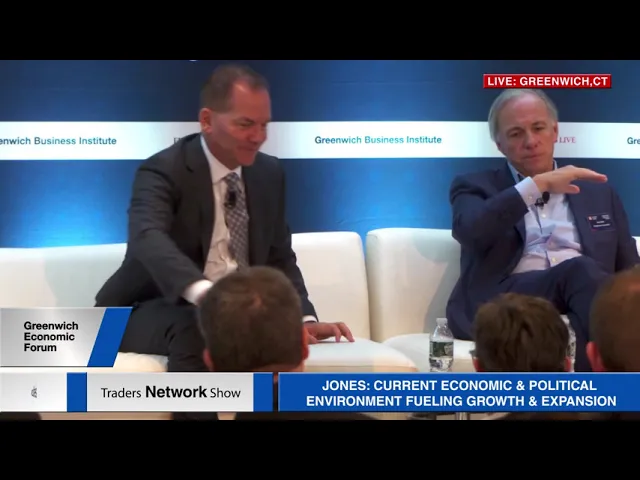
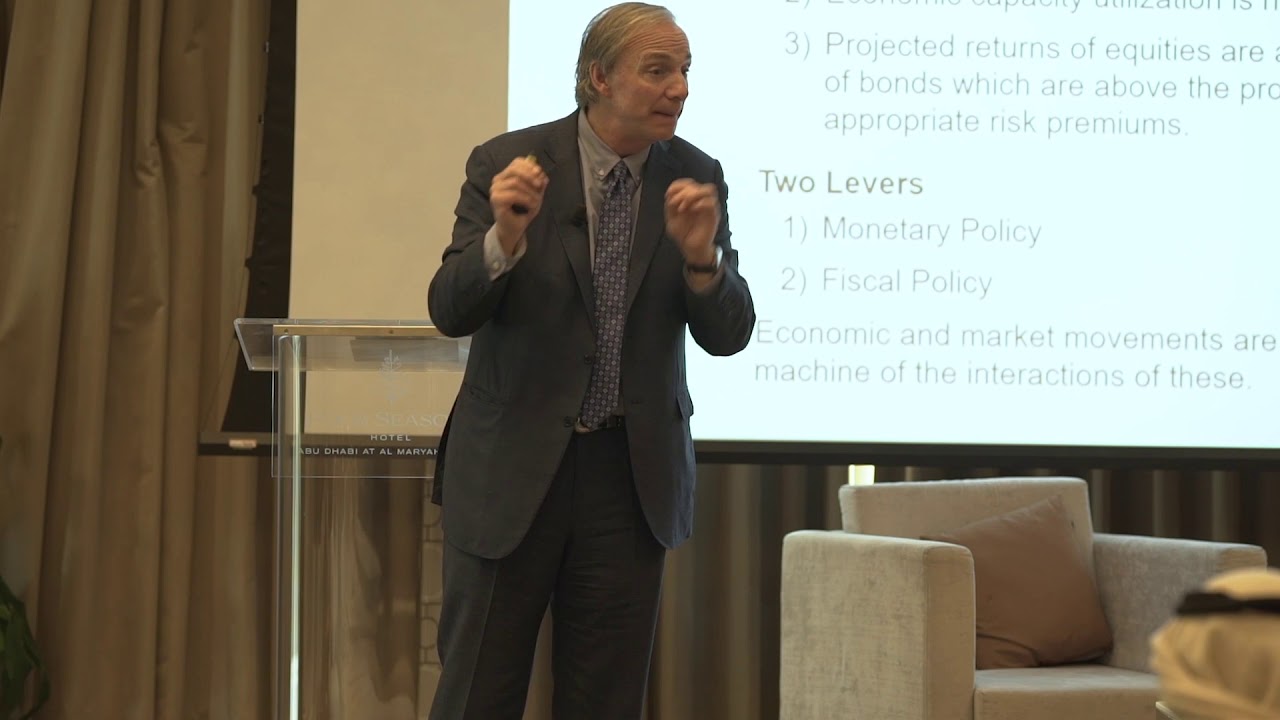
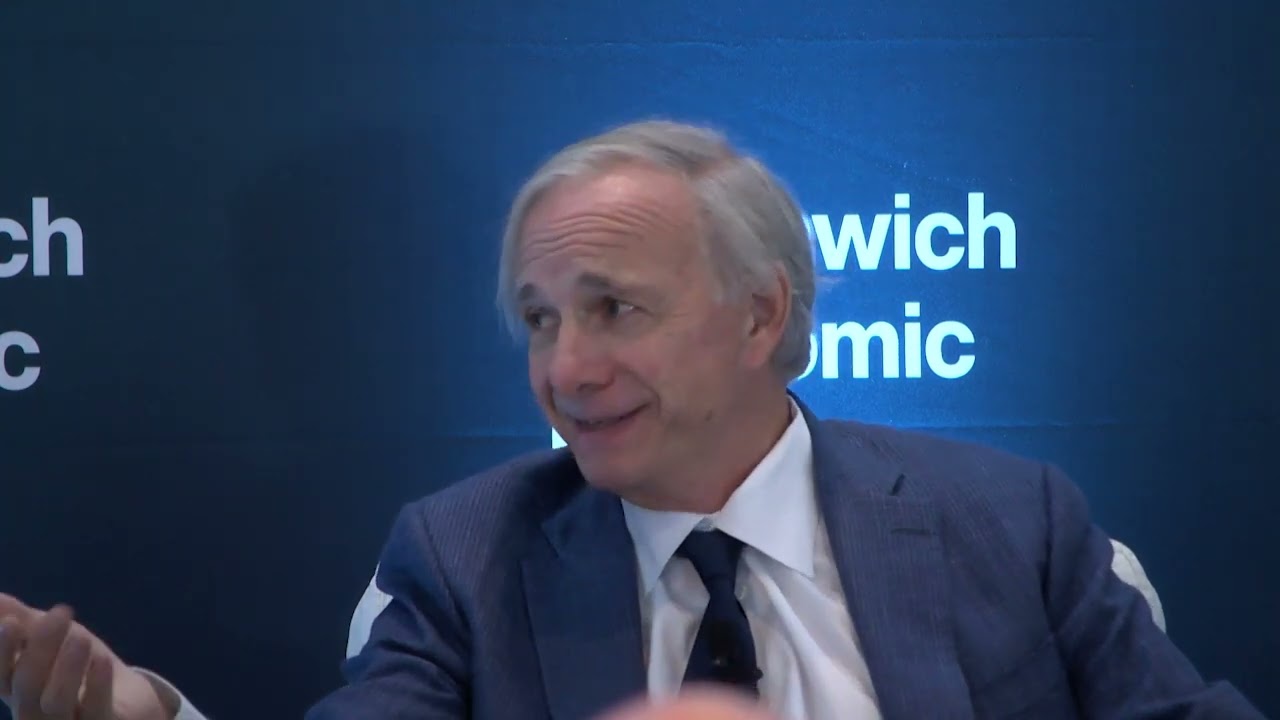
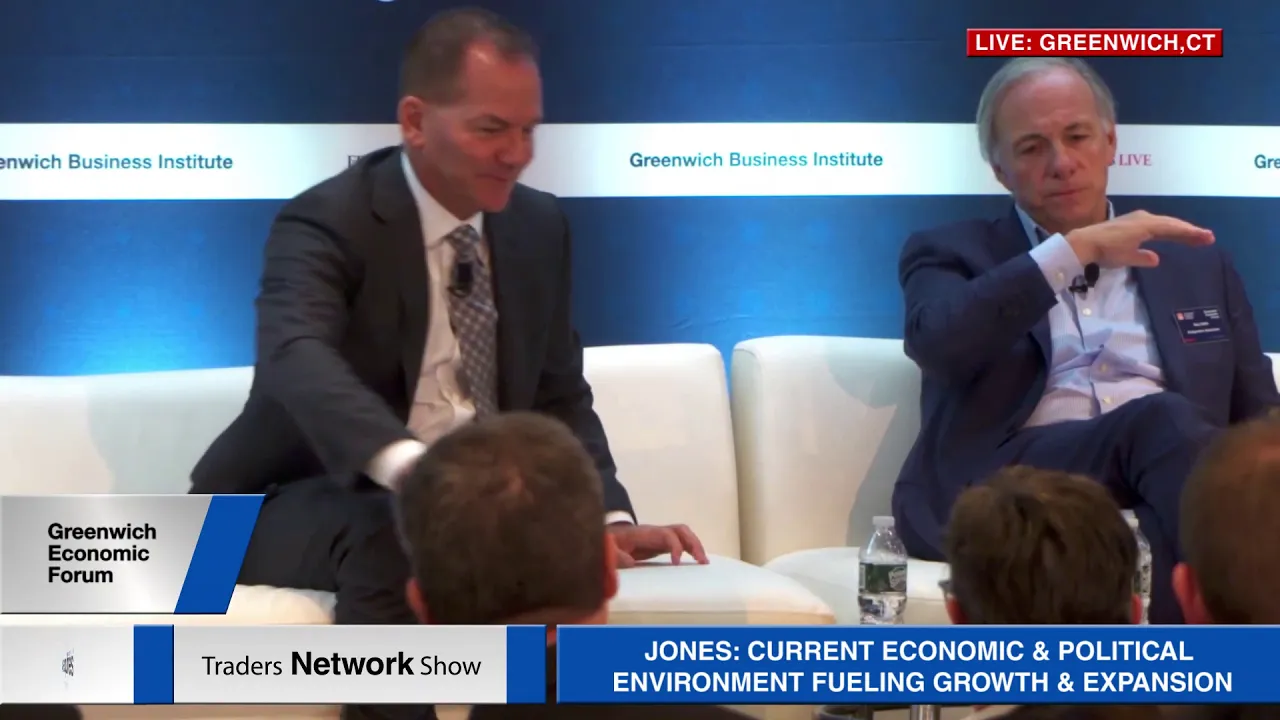
thank you governor lamont and first selectman peter tessie it's an honor to serve as your master of ceremonies today for the second grenich economic forum so thank you bruce and jim for inviting me to represent yahoo finance here now our first panel of the day is a real treat we have two returning keynote speakers joining one another in a fireside chat they need no introduction it is ray dalio the co-cio of bridgewater associates and paul tudor jones the cio of tudor investment corporation two legends in the industry in conversation hey um i've got to just say one thing my as you know my third daughter dottie is graduating from uh getting a masters in data science in december and so the question is what is she going to do is she going to go she's probably going to come into our business the hedge fund world and so i'm trying to figure out she's trying to figure out do i try and teach her myself my craft which may be outdated because the future might be some would say might be machines and models or does she go the quant route as opposed to the macro discretionary route either way she's probably going to be involved in macro what i've told her i said listen because she had a a undergraduate degree in psychology she got a master's in psychology so she doesn't have the economics training i was economics major you're an economist and i said here's what's going to happen no matter what you do when you graduate you're going to go to the bridgewater website and you're going to get on economicprinciples. com where there are over 2 000 pages and i said you're going to read every single page because if you want to truly understand macro economics there literally is no better education than what's available publicly on that website and just as someone who consumes virtually everything that's written on modern economic theory macro etc i would kind of liken bridgewater to the charter school movement in education where you had traditional public education and then 30 years ago practitioners by doing created a new way of teaching in classrooms that has been extraordinarily successful and you can see the side-by-side metrics and there's not even a comparison so i would say uh that i'm so thankful to be having this conversation with what i think is uh certainly the greatest uh one of the greatest economists living today who's made economics understandable and comprehensible and relevant and it's because you are a practitioner as opposed to a theorist living in academia and um all i've got to say is is that you're really good now but i actually think that when you die you're going to be really famous oh i can look forward to that yeah there's good news there right paul and i uh paul and i have known uh each other for about 30 years you were clerking on the uh cotton exchange um and so it was about 30 years ago yeah and so um anyway you can tell we've fallen in love with each other since so um and you know i won't take the time to give you to give the back at you because we got a little bit of time and um and we talked about that we um like i just uh wrote a piece i'm now at a stage of my life which i'm sharing some thoughts and so yeah i put those things on a website and i also do linkedin and so um i just wrote a piece for bridgewater and also a piece for linkedin that'll come out today which is titled the world has gone mad and the system is broken and so uh paul and i talk about that but can i just say one thing it was so funny because over the last couple of days ever since we decided to do this i kept thinking okay you've got to control yourself because i know this is going to be on uh yahoo finance you've got you've got to be careful what you say um because you don't want to have it come back and be a problem for you down the road because when you look i can't wait to read your newsletter to see just how how actually honest you were because when you look at it you're going oh my lord this is not even real right so so i think we should talk about why it's not even real um so how about you get you give it the first go i'm gonna just start with saying uh donald trump is the greatest salesman in the history of this country he has somehow been able to move the republican party into believing that a five percent budget deficit adjusted for the economic strength that we have right now is a reasonable proposition and one that is a good government policy and then similarly he has through and i'm being charitable here great moral suasion convinced the federal reserve board that running negative real rates with a 50-year low in unemployment is also reasonable monetary policy with no consequences what i what i really loved in chairman powell's last fed meeting when they asked him are there any excesses are there any bubbles because no no i i i really can't see any uh i think that you know we don't have the problems that we had in 2008 etc and um it's like asking somebody uh why they're driving funny and not mentioning the fact they had 10 shots of vodka beforehand because clearly the low interest rate policy that we're pursuing is creating an excess and the excess is in our public deficits which you know in the at the current pace in less than 10 years we will have exceeded that threshold where greece had its issues so i look i just look at the fiscal monetary mix it's the most stimulative that i think i've ever seen again economically adjusted and it is no wonder the stock markets at new highs it's it's it's literally i think the most conducive environment certainly in the short run for economic growth and strength that i've ever seen and you add on top of that a consolidated 11 budget deficit in china the second biggest economy three percent in japan wow it's it's a it's a it's a heady brew it's a heavy economic brew that we're all consuming ah thanks paul uh i'll give you my thoughts uh there um i have a template which is that there's productivity over a period of time raises our living standards and so how you invent and change and improve is what is one of the things over a long period of time and then there's a short term debt cycle which we call a business cycle which we're now 10 years into and it's long and then most importantly there's a long-term debt cycle um and the long-term debt cycle means that you can always hit the economy with stimulation you can always give it a jolt um and so um the way that we used to do that was with interest rate cuts but when you hit zero like in 19 2008 and 2009 we hit zero just like in 1929 and 32 we hit zero the same thing happens in terms of the need to print money and buy financial assets and that printing of money and buying financial assets about 15 trillion dollars has created a the mechanics of it is you couldn't not print the money but the mechanics of it is that there is the purchases of those financial assets by the central bank who gives money to the central bank to investors who sell their bonds now they have 15 trillion dollars more money and so we now that's created the paradigm that we have and so anybody who's in the investment business right now or an investor knows that the world is awash with money and the reason that is is because investors take that money and they buy other investments and so there's an abundance of money for those who have credit worthiness they can borrow that produced a mechanical reaction in which the interest rates were low in relationship to the return on equity for companies so they would buy their equity back they would merge and there would be acquisitions and it pushed the interest rate so low that we have such low interest rates and negative interest rates in some countries and near negative interest rates here and so the world is looking for a yield and because the world is looking for a yield for something um companies also can sell dreams rather than earnings so we're living in a world now where you no longer really as much need earnings so the number of companies that produce earnings is the lowest since the dot-com bubble in terms of their need because you can sell a dream and so there's a reaching for the yield and we have a negative and this um as a result of the accumulation of the money at the top and technology we have a situation in which naturally those who have money have a lot of money in credit and those it doesn't trickle down it's not going to trickle down because we also have a system where at the at the lower end the balance sheets the income statement the nature of lending is not the same and so it doesn't trickle down and as a result we have a large wealth gap and so we have a situation with a large wealth gap so there are three things that exist today that haven't existed at any time since the 1930s you know one of the main things in my life that i've learned is that whenever i've been surprised it's because uh of things that haven't happened to me before and mostly and haven't happened in my lifetime so that i've had it to study history and because if it's happened before and those three things that are happening today um are last happened in the 1935-40 period and and what i mean is first there's a large wealth gap it's a big thing it'll change it'll affect markets it'll affect our society in a very important way so at that wealth gap produces populism of the left and populism of the right and there's a war that is going on and that war has a big effect on markets and it has a big effect on on economies has a big effect on markets so if we were to say what would be the impact let's say of a um a democratic election and how taxes will change as a result of that corporate taxes and so on they'll be unwound and so that will be an issue in pricing of markets and so on but there's a large wealth gap that's not being dealt with so the large so there's a large wealth gap at the time that there's not effective monetary policy so number one large wealth gap and political gap and polarity that we are at each other's throats and and it is not functional the combination of how the media and the political system works or doesn't work together is a major problem number two very much like the 30s number two is the absence of the effectiveness of monetary policy because you can't make it go further europe is dead in the water japan is dead in the water and so you can't just print more money and put in the hands of investors and that system just is not going to work so now you have to deal with the mechanics of do you have political coordination i don't think so do you have political coordination working with monetary coordination politicians can't be coordinated with each other and they can't be coordinated with monetary policy so you don't have the stimulant now let's imagine you have a downturn and you don't have a good stimulant very similar to 1930s okay it's not a pretty picture if we have a wealth gap that we're at each other's throats and this is when times are good when the stock markets are high and the unemployment rates are low imagine what it's going to be like when we get a downturn and a downturn will come when we get a downturn we don't have effective monetary policy and number three in that time is the um the important thing is the change in um the world the world order um meaning what we have now is not a um unipolar world we we don't have history has shown that um periods of peace follow periods of war because there becomes a dominant world power and you create a world order and no one wants to fight the dominant world power and that's been the nature of what we've had since essentially world war ii and then when there's a rise of a uh a power to challenge an existing power then there is conflict there's going to be conflict there's going to be certainly lots of things to disagree with and so when we deal with the let's say the rise of china or other countries or perhaps the decline of the united states in some ways we have things to argue about so there's different kinds of wars we call them wars but there's there's a trade war there's a technology war there's a geopolitical war and um there could be a capital war the capacity of that war to is is a material thing so when we look at that analogous position i would say um you you're at the end of the the a cycle meaning the force that drove us from 2008 to 9 the bottom in 2008-9 to where we are today which was quantitative easing and the lowering of interest rates and corporate tax cuts cannot push us farther we can't go farther and from there we have those elements of risk so when i look at it is yes it's crazy it's crazy that we have negative uh bond yields where in my opinion we're near the end in late stages of a reserve currency system we have a fiat monetary system so when you talk about let's say the that not only um we have negative rates but yes we're going to have much larger deficit we need to have because if you because how do you get the money spent so there's going to be much bigger deficits you're talking about the next downturn well we're going to have bigger deficits if we didn't have a downturn right because we have record deficits and then when you put a downturn on it and you take it cyclical and that's not half the story that's not half the story it's not half the story because the larger story are the unfunded liabilities there those unfunded liabilities are pension liabilities and they're health care liabilities those are promises to deliver so we're living here in the state and we understand that and so you have you could call it debt or you can call it pension liabilities but we have pension liabilities we have a lot of ious that are either going to be funded by tax increases or they'll have to be spending cuts and we in the state of connecticut know it's not humane to cut any expenditures anymore and you can't raise taxes anymore either and so then you're dealing with that's a country problem and then you're going to need to how you're going to deal with that you're going to print money because what you're going to do is you run a deficit you're going to have to spend it that's the difference between what you face governor and what the federal government is they can print money so they can run deficits and they can then print the money to do it and that's what classically happens at the late stages that's your that's your that's your modern monetary theory that is what we call what is called recently it's been called money modern monetary theory there's nothing modern about this um there's not there's nothing modern about it so if what i'm saying is if you look at history nothing is new in history you go back in in history and what we used to call it is pushing on a string and so when you have pushing on a string in other words you can't no longer can you print money no longer can you lower interest rates you go to what i call monetary policy three monetary policy one is you lower interest rates and that stimulates you when that runs out you go to the second type of monetary policy which is you buy financial assets with printed money when that runs out which is out um then you go to monetary policy three it has every forms and that form has to do with governments running deficits or they can also call it helicopter money in various ways running deficits that the central bank monetizes and it can take all different forms but that's what you get and that is a classic you know reserve currency question in a fiat monetary system i think and so isn't it mad that that when the next down here we're going to have lower interest rates we're going to print the money and that you're holding that because the negative interest rates and then and it's also so the system doesn't work this uh it's gone mad and then the reason the system is broken is because there is not it's not an equal opportunity system it's um there's justifiable complaints about the failure of that system to produce education to do those things these people are justifiably saying this is broken because the system is broken it needs to be reformed in a way that works better works better in other words let's increase the size of the pie if it's done smart you can increase productivity with the increasing the size of the pie at the same time as you could divide it better anyway i'm going on too long but yeah it means i'm going to let you breathe a second um modern monetary theory i love it because when i hear people talk about it and attach some formality to it i can't help but think about the evolution of its acceptance it's kind of the same way that if you think about marijuana its acceptance has changed over time because 50 years ago it was illegal reprehensible reprehensible so modern monetary theory can you imagine paul volcker even considering modern monetary theory then then about 30 years ago we just said no same thing with marijuana then 20 years ago all of a sudden we medicinalized it and japan actually began to implement the equivalent of modern monetary policy when they began to buy their own government debt and then about 15 years ago uh because it was medicinalized we then had to decriminalize it and then 10 years ago it got widespread adoption because the united states did europe did a variety of countries did and now we're at a point where it's so widely accepted that we sugarcoat it put it in gummy bear form uh and it's just this wildly accepted next stage when there's a problem because the next deficit the typical recession means that the budget deficit is going to increase somewhere between 10 and 30 can you imagine adding can you imagine a 10 or 15 budget deficit in the united states the next downturn so uh it's it's incredible to me because again i i look at where we are i mean if you just think about the divisiveness that we have in this country now think about we have a five percent budget deficit say normalize if we just went back and normalized it at two so you take off three percent 600 billion dollars if we subtracted that from where we are economically today that works out to about 10 of an average family's income so imagine if we didn't have that three percent that we're borrowing from our children that we're fast forwarding on consumption but we're not going to pay it back i'm just saying uh and and i hear you and um and that's why i look at i look at the world right now and um and i look at the asset pricing and the whole thing's just uh it's so it's so incredible to me if i think about just this next election and the difference between donald trump and elizabeth warren we did this uh poll internally about where the s p would trade if elizabeth warren became president uh and then we took the bet and then biden and buda gedge and uh uh cole bachar et cetera and then we took the election probabilities and so our poll said if the if elizabeth warren was elected the s p would trade around 22. 50 i think it's at 30 50 now uh but i'm just saying her policies probably would would would assuming that they were implemented probably would give you something like that and then if you just take election probabilities that would imply uh and apply what would if you anchor that i think beauty gauge binding were like 2700 because again they're going to come in raise taxes that's going to cause probably some economic contraction uh so that would imply that donald trump if he gets reelected the s p is worth 3 600.
so as an investor you have to have a view on the election because the outcomes are so extreme i've never seen this kind of polarity uh in the elections as we have now and they always say oh well don't make any difference who the president is you know the markets were rallied 53 percent of time under democrats and 52 percent of the time it does make a difference ronald reagan when he became president was a huge difference to the stock market and i would say who the next president is is also going to have a huge impact on the economy the stock market particularly asset pricing because clearly asset prices today whether it's u. s stocks whether it's interest rates whether it's the dollar it's all priced off of in my opinion a five percent budget deficit with this incredibly overly stimulative uh fiscal policy combined with this overly stimulative monetary policy is creating this u. s exceptionalism that one day like if we normalized our deficit to where europe is right now would have a completely different valuations for the stock market valuations for the dollar dollar would be substantially lower i believe so this next presidential election and what policies they pursue afterwards i think this one is going to be more meaningful than anyone certainly in my lifetime so it's going to be really i i i agree with you so i'm i'm um mechanistic i'm not ideological i'm um just mechanistic so i do go through the calculations and um if you take the way corporate taxes would change the undoing of that um that's worth seven or eight percent if you take um the changes in gap accounting that so changes in the tax taxes for corporations that's worth about 15 percent of earnings and will therefore would drop it on the basis of that alone if you take then the wealth tax is 2.