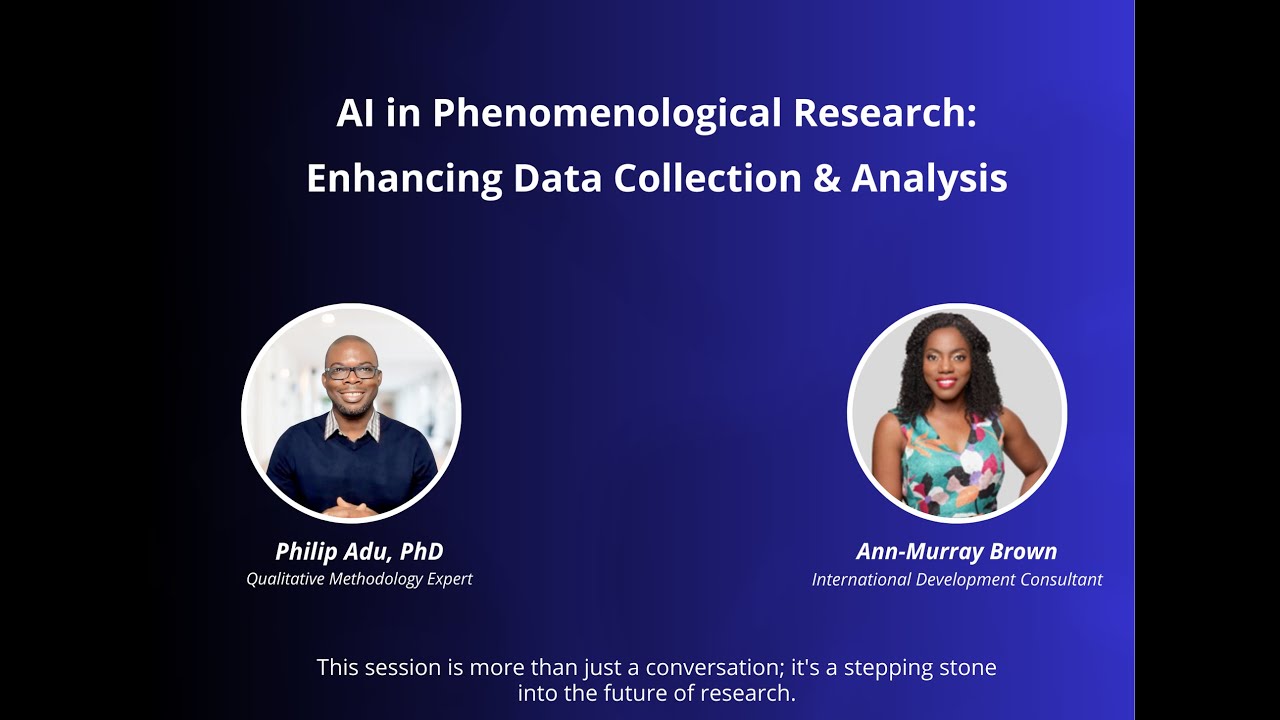
Hi, my name is Philip Adu. I'm going to talk about qualitative research. So what is qualitative reset?
But before I talk about it, let me give you a little story. I received an email from a senior editor from a very reputable academic publishing company. She said something like, "Hi, Philip, I saw your wonderful video online, and I want to find out whether you are interested in writing a book on qualitative analysis".
I was so excited to receive that email, but before I replied to the email, I switched to my 'research' mode. So I thought about, What is the problem the book going to address? I was reflecting, finding out what kind of problem that my proposed book can address?
Who are my audience and what are their needs? So thinking through all things, I was able to identify a specific problem that my proposed book can address. After I've gone through all this and I email her and I said, yes, I'm happy to write a book.
The reason why I'm telling you this story is that. We all pass through life and face some challenges. We face problems.
And sometimes we want to understand a problem. Sometimes we just want to find a solution to the problem, right? So a way of finding solution to the problem, we gather information, we talk to people, we search for good information, we develop strategies to help her to solve the problem.
So indirectly we all engage in research. In an academic research, it's all about identifying a specific problem, trying to collect data that will help you to address the problem, analyze the data, and then use the findings to address the problem that you have identified. So that's all about research.
You are systematically collecting data, analyzing and coming up with a solution or findings to address the problem. And at the end of the day, you'll be able to contribute to the body of knowledge. So that's all about research, but what makes your research a qualitative research?
There are three things to think about. The first one is, the purpose of the study. So the purpose of study is more of an exploratory data.
You are exploring. You want to find out what is going on. If your study is more of an exploratory in nature, you are getting closer to doing a qualitative study.
And also the questions that you want to answer. Most of the time, your research question is more of open ended. It can start with what, how or why.
It's more of trying to collect non-numeric data to address the open ended question that you have. You're collecting words, audios, videos, artifacts to help you to address your research question that you have, as you are addressing your research question, you are solving the problem. You are addressing the problem that caused you to do the research.
And at the end of the day, you are contributing to the body of knowledge. So that's all about qualitative research. It's all about engaging in inquiry process, where you collect rich information from participant or from your data source and the data you are calling is non numeric data.
And to help you to address your research question. So that's all about qualitative research, right? So it's very different from quantitative research where you're going to call it numbers, right?
Sometimes, you end up developing a theory, right? So when you develop a theory, Quantitative researchers can take the theory and develop hypothesis, and then they can do research to test the hypothesis. So you see how qualitative study can inform their quantitative research.
So quantitative study is more of the deductive process, trying to test a hypothesis or test a theory that is existing. Qualitative is more of exploring the issue, understanding so that the end of the day, you can develop a preposition, a model or a theory to help to explain the phenomenon or the process that you are interested. I hope this one was helpful.
If you want more of a simplified way of doing research, please subscribe to my channel and you'll learn a lot. So thank you for your time.