the present unit deals with the prohibition against the use of force in international law it contains two lectures on the topic which uh look at the development of the prohibition against the use of force in international law the scope of the prohibition and the exceptions that have been generated uh Visa the prohibition the prohibition against the use of force uh constitutes one of the most important um principles of international law in fact prohibiting the use of force and encouraging a peaceful settlement of dispute is the lynchpin of any legal system uh and that apply applies
even more forcefully with regard to the international legal system where the use of force could have catastrophic uh implications and where uh history has shown us that states are often inclined to use Force against one another hence the um prohibition against the use of force that has developed in the post 1945 era has been and is considered as the Lynch pin of the international legal order and to a large extent also the litmos test to the effectiveness of this order so we will be discussing in this unit how uh the prohibition against the use of
force uh came about but also how uh it has been actually applied and we will see throughout this unit uh how uh the ambiguity of the law uh has been on the one hand a source of constant abuse but also uh a source of some flexibility that enabled uh the law to meet uh new challenges that have uh come before it in terms of its historical Evolution uh the the prohibition against the use of force which is referred to in Latin as use ad Bellum is often Associated uh in modern international law with the writing
of the Dutch jurist Hugo grus who lived in the uh late late 16th and early 17s century and is broadly regarded as the father of modern international law and grus in his writing uh introduced some uh important ideas about uh how force can and should be used in international law one idea which is very Central to uh gruse thinking is that there are two separate uh sets of norms that regulate uh the use of force uh or the use of violence in in Interstate conflicts one is the use ad Bellum that is the body of
uh rules and principles that governs the decision to go to war and then there is the use in Bellow which is the body of rules and principles that governs the actual application of military force when a war or an armed conflict is already uh raging uh and this distinction as we will see still constitutes a very uh prominent and important uh aspect of modern international grus was also uh um Central in developing the the notion that not every use of force in Interstate relations is a Justified use of force and that one has to distinguish
between just Wars namely Wars that are uh designed to uh address uh a rightful cause which is by and large to address a grievance that has been uh inflicted on the force using State and unjust Wars wars that do not have a moral underpinning behind them and as we will see although the just War Theory uh is significantly reduced under uh modern international law in the UN Charter there are there is still a notion that there has to be a proper cause for violence uh to be exercised lawfully on an interstate level so this these
uh very uh Central ideas by grus were very dominant in international um relations thinking in the 17th and 18th century but by the uh 19th century uh these ideas have um grown out of uh fashion and out of favor with the rise in international law of what we uh currently refer to as legal positivism and the idea of voluntarism namely according to this line of thinking international law only binds States if they have actually agreed to be bound by very specific norms and since there was no treaty and no clear prohibition on the use of
force and in fact states were during that period uh using Force extensively and uh we we uh we are familiar with Von kovich the the the Prussian General's notion that war is simply the continuation of diplomacy through other means uh it was increasingly viewed in the 19th century that states actually have uh a sovereign prerogative to use War to to go to war and that international law doesn't really limit the very decision to go to war but only regulates uh the formality associated with going to war such as issuing a declaration of war and subsequently
uh regulating the um uh relationship the legal relationship between the Waring parties and between the Waring parties and third States these are sometimes referred to as the laws of neutrality now this state of affairs throughout the 19th century in which violence is uh legally tolerated and uh occasionally applied uh was viewed by International lawyers increasingly as a legal regime that generates intolerable consequences and that is because the wars of the 19th century while there weren't many they were extremely destructive given the fact that uh technology has made uh has made Weaponry uh more devastating in
its implications Transportation reforms in transportation has increased the scope of hostilities allowing militaries to move relatively quickly from one uh scene of hostilities to another and because in terms of military Doctrine armies which used to be relatively small in size and professional in nature have become much more popularized involving large L uh numbers of individuals with very basic training who are sent on the battlefield creating very uh significant harm and Devastation and it was these insights that the wars are becoming increasingly risky increasingly costly that has generated some calls for regulating Wars for limiting the
ability of states to go to war and substituting law uh uh the resolution of grievances through Wars with the resolution of grievances through peaceful uh peaceful settlement Avenues and this is a topic we will be discussing in a separate unit in parallel there has also been um an effort around the uh middle of the 19th century to develop uh more specific rules that would limit the actual conduct of hostilities what we refer to before as use in Bell and we are seeing the first Geneva Convention regulating the conduct of hostilities being concluded in 1864 but
the war itself throughout the 19th century despite the efforts uh by certain lawyers despite the uh development of alternative methods for dispute resolu resolution despite the growing prominence of uh uh rules on conduct of hostilities War itself was not outlawed there was no sufficient political will on the part of states to renounce War as an as an instrument of national policy hence we reach the 20th century uh without a clear legal prohibition on the use of force in Interstate relations this state of affairs in which uh the use of Interstate violence is is by and
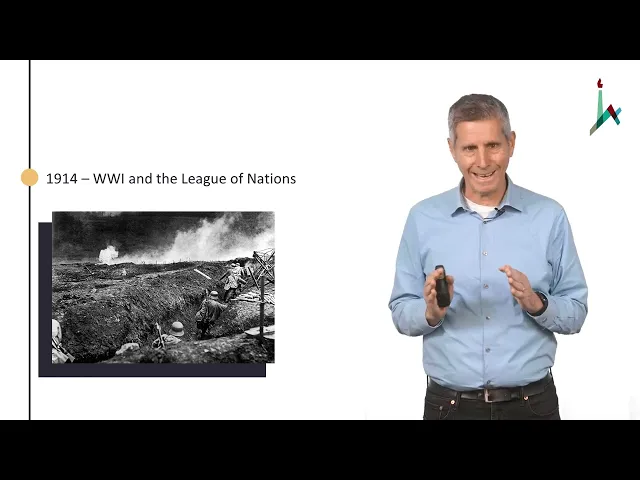
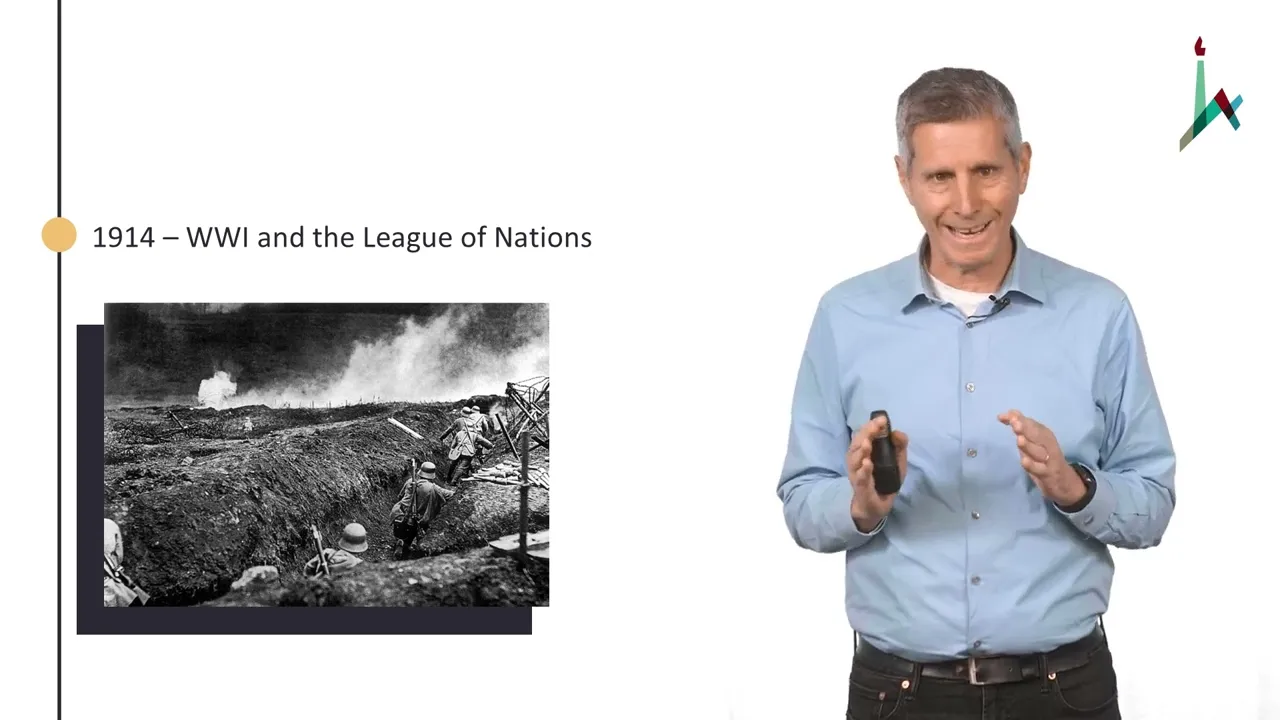
large not regulated by international law has started undergoing significant change in the aftermath of World War I World War I uh of course a very uh dramatic and devastating War resulting in more than 10 million casualties uh the war that was described by some as the war to end all wars uh resulted in the aftermath of World War I with the first uh International um permanent and general organization the League of Nations uh whose mission was uh largely to stabilize international relations uh with the view of preventing Another War and the League of Nations for
the first time introduces in its um constitutive treaty the Covenant of the League of Nations uh a system which uh is designed to limit the legal prerogative of states to go to war and article 12 of the League of Nations does create a certain Avenue that is designed not to completely Outlaw uh their uh the the prevalence of Wars but H to to significantly limit uh the likelihood of this scenario by requiring member states of the League of Nations that have grievances uh Visa one another to first try to pursue uh a resolution of these
gri es uh through either uh judicial means by taking it to arbitration or subsequently to to judicial settlement or to uh try to resolve this politically through approaching the Council of the League of Nations which is roughly the equivalent of today's Security Council uh and uh during the time in which the uh the conflict is being discussed legally or politically states are prohibited from actually res resorting to uh Interstate violence only if in the end of the process there is uh a legal or political decision and the the losing party refuses to comply with that
legal and political decision namely to satisfy the grievance only under these circumstances can force uh be uh lawfully uh uh resorted to and this uh is is is actually an important predent in first thinking about legal political uh very clearly legal political Avenues as alternatives to violence which really shows the interplay between these different channels of resolving conflicts it is also um uh the idea of time is also very important here because the the the notion that underlies article 12 of the League of Nations is partly that uh Wars often result as as out of
uh Heat of the Moment kind of decisions uh and uh and time could actually allow tempers to cool down uh and reason to Prevail and I think this is very much um a lesson from the uh from the events that led in August 1914 to the uh eruption of World War I which was largely conceived uh at that point in time as as as as a war which could and should have been avoided if there would have been more sophisticated uh mechanisms of communication uh between parties and if more time was spent on using these
mechanisms now the League of Nations also had a very interesting idea and that is that if a state actually violates this regime uh namely it goes to war outside the framework of article 12 then the League of Nations uh May punish that state namely uh that it could be subject to two types of sanctions and this is again something which is still very dominant in our thinking about uh about the use of force in international relations even now first it could be subject to economic sanctions uh against it so uh States uh that are breaking
the law could be punished by other members of the League of Nations the League of Nations could decide to actually punish the violating State and secondly every state could actually uh come uh and support the agre the attacked state by by a in a way standing by its side uh against the aggressor uh state so you have centralized uh enforcement through uh sanctions and decentralized enforcement through what we would today call Collective self-defense the ability of states to stand beside the attacked State now as we know this uh regime uh didn't uh work very well
in practice uh it did not work very well in practice for a variety of reasons but perhaps the two most important reasons are that uh the League of Nations didn't have Universal uh membership and in fact uh the the the strongest country in the world during the inter War period the United States was never a member of the League of Nations uh and States uh other states who were uh subsequently involved in in the events leading up to uh to to World War II once they felt that the league of n membership in the League
of Nations didn't serve their political interest they started withdrawing from the League of Nations one after the other and by that they basically shed of their of themselves the legal obligations associated with membership so uh Germany withdrew Italy withdrew Japan withdrew Soviet Union withdrew so on the eve of World War II the legal regime that was put in place was almost uh meaningless now add to that the the second explanation uh which is perhaps even more important and this is one of the lessons that we draw from the League of Nations era is that in
order for this uh regime to actually work well uh one needs to uh identify significant political and military power that is willing to back it up and this was simply not the case in the interstate War so when in the 1930s Japan violated this by invading China uh this regime and Italy violated this uh this regime by in in by uh invading uh what we today call Ethiopia the League of Nations response was on the whole weak there was no military response uh the sanctions imposed on Italy uh were actually never uh effective so the
lesson that uh aggressive states have uh learned from that period was that they can get away uh with violations of article 12 of the League of Nations so uh the story of the League of Nations is ultimately a story of a failure but I think the lessons that were drawn from that were important in the process leading up to the UN Charter which represents a more comprehensive and a stronger uh system of prohibition against the use of force now in the interstate uh period there is one development which is uh worth mentioning although again I
mean its impact on developments on the ground was quite limited but in terms of the it was important in in in a way identifying the dire direction in which the International Community would uh would tread after uh 1945 and this is the 1928 Kellogg Bria pact which is named after the uh us uh Secretary of State Kellogg and the French Minister of Foreign Affairs Bria I mean but this was an an an an agreement that was at the time adhered to by all the major Powers uh in the world uh and that agreement was quite
short but essentially what it provided that unlike article 12 of the League of Nations that limited the right to go to war but didn't completely renounce that possibility under certain circumstances the 1928 agreement actually renounced the notion of going to war it basically uh provided that states would not use War as an instrument of uh National policy so this is actually an important step now we know that this was never an enforcable treaty in the sense that there were no sanctions for violating it uh there were also legal problems uh the the word War itself
was never uh tightly defined uh neither were exceptions uh to the to the norm uh spelled out but it actually uh was an important Landmark on the on the road to outlawing war and indeed in the 1945 1946 nurenberg trials where the Nazi leadership was uh put to trial for for violating a variety of international La Norms the Kellog Brian uh agreement was actually a very central part of these proceedings and the Nazi leadership was put uh to trial for perpetrating crimes against Peace by violating the terms of the 1928 agreement and that in a
way paved the paved the road for the Post 1945 uh outling of war in the uh un Charter so the failure of 1919 of the League of Nations Covenant and the failure of the 1928 kog briia act uh of course uh they failed uh in that they didn't prevent World War II but these failures were very important pieces of information that the drafters of the 1945 un Charter uh had before them when they were actually deciding the terms of uh the new peace after the war and the UN Charter does draw important lessons from these
uh past experiences and one lesson is that you have to be comprehensive so uh once you uh you create a Prohibition uh but you still live out some loopholes so if war is not Outlaw war is outlawed but for instance uh armed hostilities falling short of War are not outlawed or if uh war is outload but self-defense is still available and poorly defined then this is really um uh opening a certain loophole in the regime which could be abused so one lesson was that you have to go uh you have to be very specific and
you have to be very comprehensive in the way you define the prohibition against the use of force and we we are seeing after 1945 in the UN Charter uh in article 24 of the charter a very broad uh formulation of the prohibition against the use of force it reads all members shall refrain in their international relations from the threat or use of force against the territorial Integrity or political independence of any state or in any other manner inconsistent with the purposes of the United Nations so force is prohibited all Force but also the threat of
the use of force so so in terms of uh developing a comprehensive prohibition this is as comprehensive as one could get in the field of the prohibition against the use of force and secondly uh the chter also defines the self-defense exception in article 51 nothing shall imper their inherent right of individual or Collective self-defense if an armed attack occurs so actually tying between the right to deviate from the prohibition on article 24 and a very specific set of Circ circumstances which is if an armed attack occurs then a right to self-defense emerges so by uh
formulating so specifically and so broadly the drafters of the UN Charter have drawn from the experience of the failures in the interstate in the interwar period uh moreover and we will see this uh as we continue our discussion after the break uh the um the drafters didn't just introduce a norm as their predecessor predecessor the involved in the Koga and the League of Nations Covenant have introduced but also introduced a a rather strong mechanism to uphold uh these Norms so that would involve uh the uh availability of sanctions like the League of Nations uh had
before but also the avail a ability of military sanctions namely the ability of the security Council to use military force in order to uphold the Norms of the charter this is something that we did not have in the League of Nations and of course and as we will see the the security Council and the United Nations have achieved something that the uh League of Nations did not achieve and that is almost Universal membership and a strong correlation between membership and political power in the world namely all the big players are part of the system all
the big players have rights and uh Powers within the system hence when they come together and decide to enforce the charter there is significant political power which underlies this of course as we will see this the fact that everyone was brought in is both an Advantage but also a disadvantage because in order to facilitate this uh the institution of the veto power was introduced and that uh is actually the ailles heel of the mechanism that was developed in the charter era after uh this uh the short break that we will now have we will resume
by discussing the Contour of article uh of the article 24 and 51 framework namely the extend the scope and EXT of the prohibition on the use of force and the exception on the prohibition and then we will talk about Collective self-defense and collective security two principal exceptions besides self-defense to the prohibition against the use of force