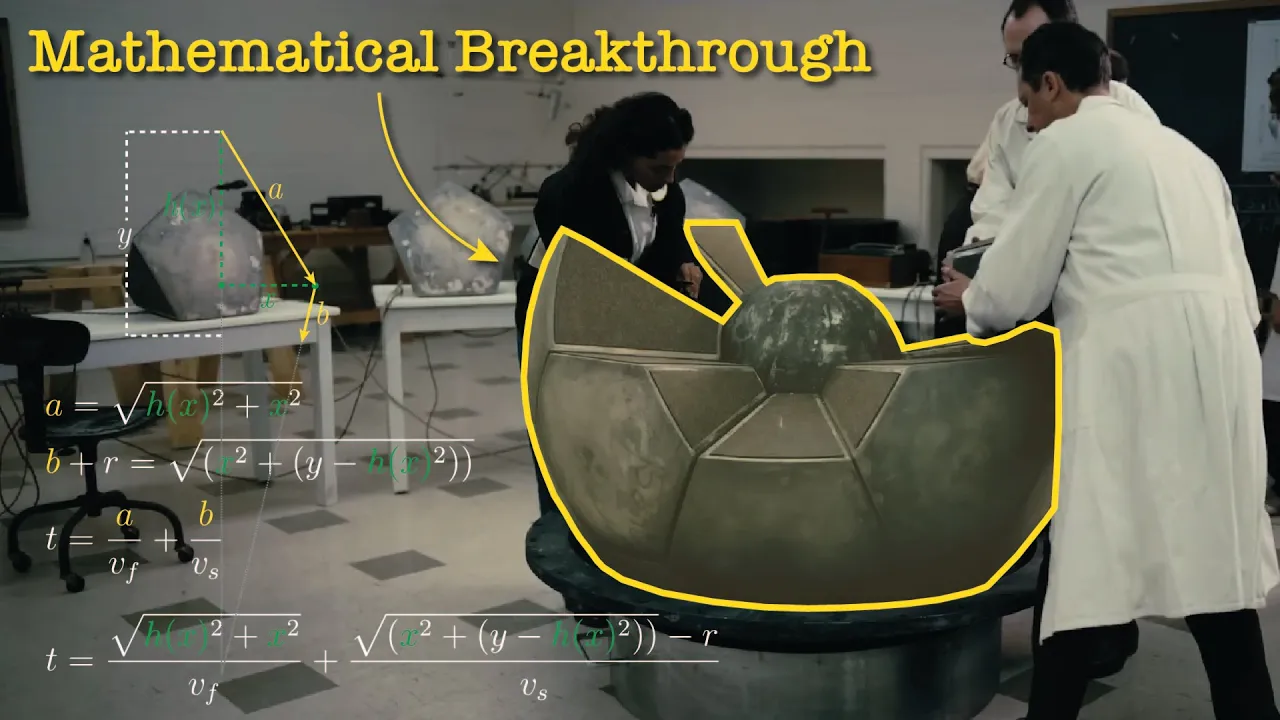
they won't fear it until they understand this design is the result of a mathematical breakthrough in the face of a crisis a year earlier the first reactor bred plutonium samples begin to arrive at Los Alamos in a forest service cabin in Pito Canyon away from the main laboratory to avoid stray radiation the scientists began counting alpha particle emissions from these new samples up until that point only microgram quantities of plutonium had existed anywhere on the planet the tiny samples the scientists had were created in the Berkeley cyclotron it didn't take long for them to realize
that there was something terribly wrong with these new larger samples from the x10 nuclear reactor in okd Tennessee a 20 microgram sample of the cyclotron generated plutonium would register around 1 count per month these new slightly larger samples were wildly different registering eight counts in just the first 3 days of measurement the implications of these numbers were catastrophic for the Los alos project Oppenheimer called an emergency meeting the gun type bomb design that most of the labs hundreds of scientists had been developing was not going to work the design was supposed to work by firing
one mass of plutonium into another rapidly forming a critical mass plutonium is otherworldly as soon as you have enough of it in one lump a critical mass it's basically impossible to keep it from exploding a single strain Neutron is all that's required to set up the nuclear chain reaction that detonates the bomb the alpha particle emissions these scientists were measuring are a result of the spontaneous splitting of unstable plutonium atoms these fision reactions are the same mechanism that drives the bomb they release neutrons that are capable of triggering detonation the higher spontaneous fion rate meant
that the gun type bomb simply could not bring the two plutonium masses together fast enough a maximum muzzle velocity around 1,000 m a second means that it would take around 100 microsc to join the two plutonium masses a spontaneous fion would likely trigger a predetonation before the mass was fully assembled making the bomb a billion dooll dud Oppenheimer proposed a risky Way Forward a small group of scientists at Los alos led by Seth netm had been quietly working on an entirely different way to build the bomb it turns out that adding masses together is not
the only way to reach criticality in plutonium the growth rate of the neutron chain reaction that drives the B it depends on overall Mass but also density if a subcritical mass of plutonium could be rapidly squeezed to a higher density it could reach criticality to squish a plutonium mass in microseconds nm's group was developing an implosion bomb design the idea was to create a controlled explosion around the mass inside a rigid container directing the force Inward and squeezing the plutonium until it reached criticality however early experiments were not going well using steel to simulate the
plutonium Mass NE Meers group would surround the mass with TNT inside of a cylindrical container and ignite the TNT from multiple points iterating through various designs they would invariably end up with mangled and twisted pieces of Steel by the force of the explosion the explosion wasn't symmetric enough to compress their masses when hearing nme's approach the Los Alamo scientist compared it to squeezing water in your hand and expecting it not to squirt out during nm's presentation Richard Fineman is reported as raising his hand from the back row and simply announcing that it stinks months before
the crisis with brilliant strategic foresight Oppenheimer reached out to the genius mathematician John Von noyman to help with the implosion bomb always have a backup reviewing the problem and building on the work of others V Norman proposed a brilliant new design the detonation waves of each of NE Meyer's ignition points propagate in spherical wavefronts the problem is that when these wavefronts converge on the mass they don't apply even pressure all the way around resulting in parts of the mass squirting out as it liquefies not overall compression mon noyman saw a way to redesign the explosives
such at the detonation waves from each ignition point would be shaped to match the spherical plutonium Mass borrowing from Optical lens design vanorman realized that he could shape the wavefronts using an arrangement of high and low velocity explosives he divided the explosives into individual lenses and within each lens placed a cone of low velocity explosive inside of a region of high velocity explosive explosive the key idea here is to slow down the more direct paths taken by the detonation Wave by just the right amount so they arrive at the same time as the Less Direct
paths mathematically the total travel time between the ignition source and the mass should be equal for all paths the exact cone shape can be computed by solving for cone height as a function of position and depends on the detonation wave velocity and the slow and fast materials to make all this work in 3D Von Norman basically designed a huge soccer ball with Pentagon and hexagon shaped lenses fitting together in a 3D Puzzle around the plutonium core Oppenheimer knew that Von Norman's design would work in theory however he was all too aware of the huge engineering
challenges in actually building this complex design the geometrically complex 3D lenses would have to be formed from new types of high explosives the lenses would need to be ignited with synchronized microsc Precision diagnostic equipment would need to be designed from scratch to determine if experiments were compressed the core is expected and even the theory was not entirely sound vman's design assumed that the detonation wave velocity was constant in a given material Oppenheimer knew this was not true detonation wave velocity is nonlinear and nonlocal it depends on the shape of the boundary and the overall scale
of the lens it would take the full force of the Los Alamos lab to solve these problems within 2 weeks Oppenheimer completely reorganized the lab to work on implosion testing was a huge challenge how could the scientist measure how symmetrically and quickly a given design compressed the core when the explosion was over in microseconds and destroy the test material the newly formed X and G divisions simultaneously pursued seven different testing strategies high-speed x-rays allowed the scientist to see inside the bomb as it imploded capturing the density changes as the detonation wave propagated through the explosive
however x-ray methods didn't give good visibility into the compression of the core itself and could only provide a few snapshots as the bomb imploded Robert server proposed a clever Improvement instead of having an x-ray radiation Source sending x-rays through the bomb what about moving a radiation Source into the core itself cber proposed placing a sample of radioactive lanthanum 140 inside of the core of the bomb the gamma rays emitted by the lanthanum could be measured at multiple locations outside the bomb using ionization Chambers and plotted on oscilloscopes giving continuous data instead of a few snapshots
as the bomb imploded as as the core compressed the higher material density would absorb more gamma rays reducing the detected values by comparing the various oscilloscope traces the timing and symmetry of the core compression could be measured known as the rala experiments these tests provided some of the most reliable data to guide iteration on bomb designs actually running these tests was a different matter the lanthum sources emitted very unsafe levels of radiation cber commissioned two military tanks to protect scientists as they captured data each implosion would destroy the ionization Chambers and in the first test
cber forgot to account for the fact that the entire Forest would catch on fire and the scientists had to flee the scene in their tanks these tests revealed a myriad of problems with the bomb design the firing of each lens was not well synchronized slight manufacturing differences between the explosive detonation wires connected to each lens led to problematic timing differences on the order of microseconds or more Louise Alvarez led a redesign of the ignition system switching from explosive wires to a new electrical Detonator design ultimately bringing synchronization within a few hundreds of a microsc manufacturing
explosive lenses presented a huge range of challenges 3D complex molds had to be designed and the high explosives were prone to cracks Bubbles and other imperfections over an 18-month period the lens production facility delivered over 20,000 lenses to test sites with many times this number rejected due to poor quality at the heart of many of these problems was a poor mathematical understanding of Deton wave hydrodynamics no analytical Solutions were known for the governing equations Von noyman proposed an iterative numerical approach to a lran formulation of the problem where the bond was modeled as a set
of small masses connected by springs for each time step the position of each Mass depends on its previous two positions and the pressure on the mass a half step away in each Direction starting with boundary conditions based on the lens shape and ignition Source the path of the detonation wave can be computed this process is en normous L time consuming and was initially performed at Los Alamos by groups of human computers using mechanical desk calculators led by Richard finman and was later performed on IBM punch card accounting machines Von Norman's methods were improved by other
scientists but were still Limited in their predictive abilities leaving a painfully slow iterative trial and error approach as the primary path to a working implosion design months of development led to hardfought improvements and by the summer of 1945 the Los Alamos scientist had a design that appeared appeared to be capable of compressing the core quickly and symmetrically enough although not all testing methods supported this conclusion testing the full device was set for the morning of the Potsdam Conference potentially giving President Truman valuable information in his negotiations at 5:29 a.m. on July 16th 1945 all of
the Manhattan projects science mathematics and engineering came together in a blinding flash of light in the New Mexico desert followed by the most violent explosion humans had ever created equivalent to the detonation of 20,000 tons of TNT oppenheimer's gamble on the implosion bomb had paid off Humanity now had the power to destroy itself