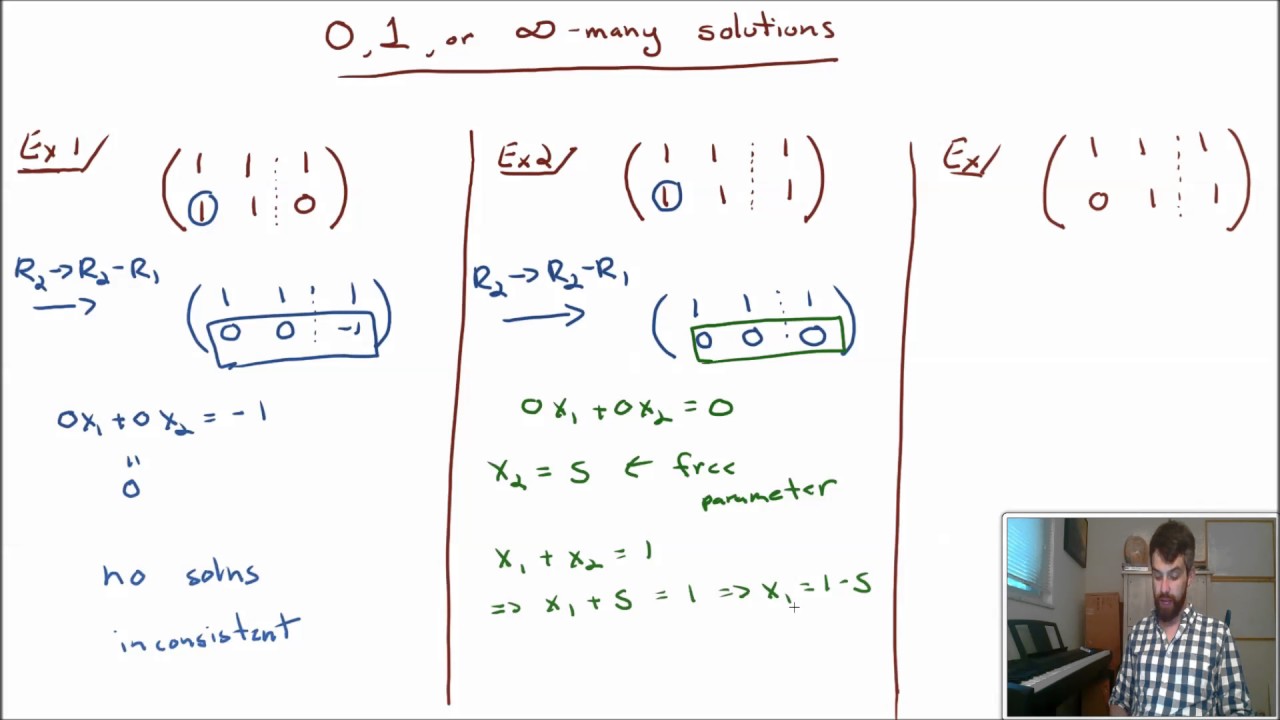
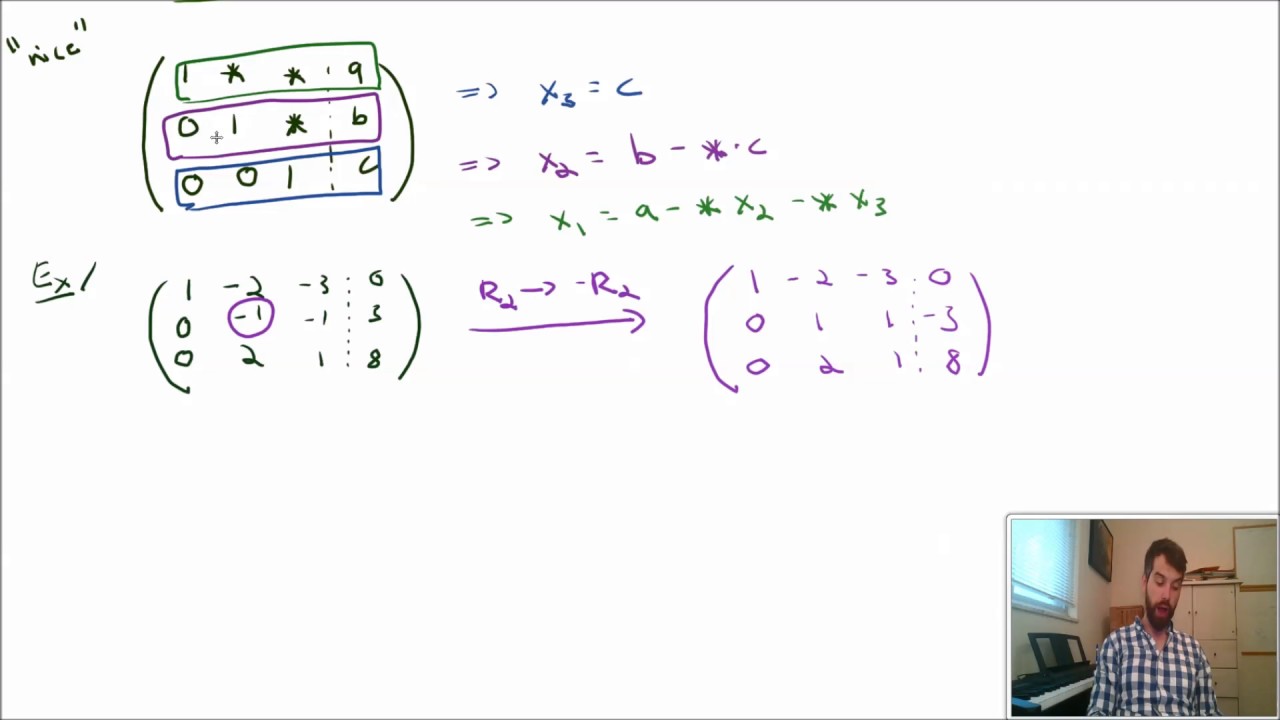
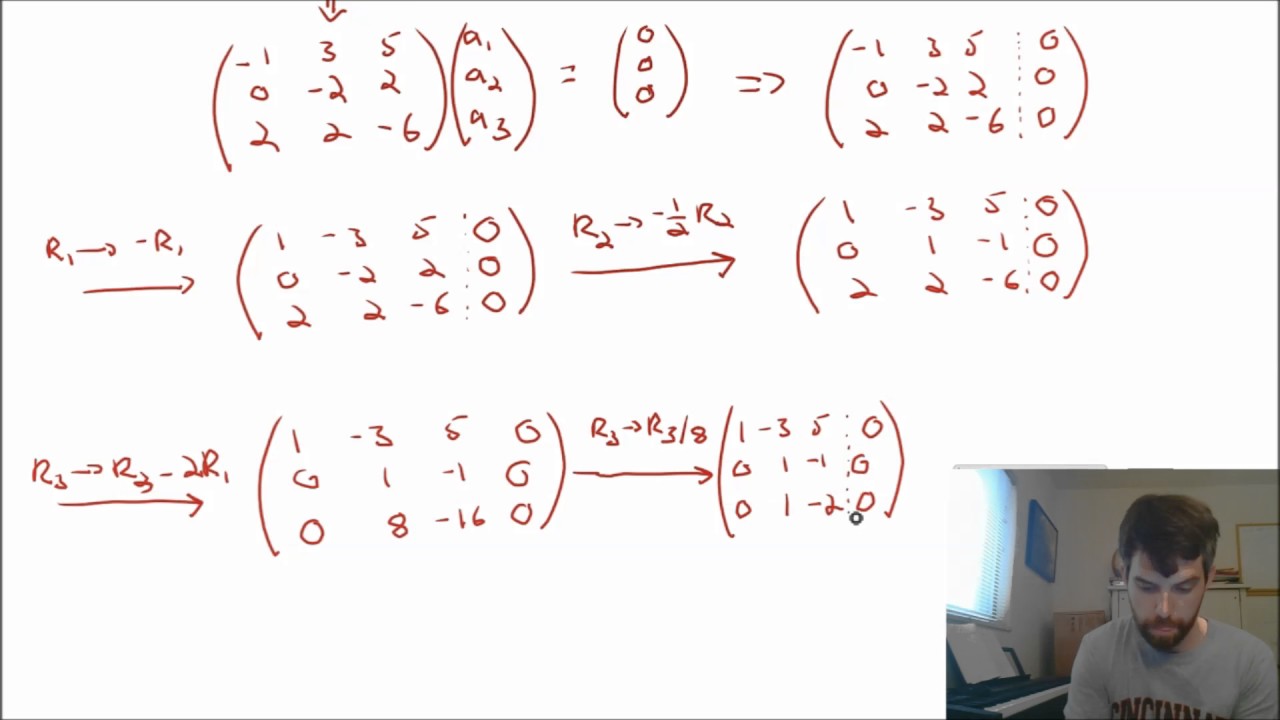
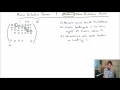
so far we've been a little bit vague with what our goal is when we're doing Elementary row operations in the 3X3 case I gave this sort of Ideal this upper triangular Matrix where along the main diagonal it was all ones and it was Zer beneath that and then who cared above that that was sort of our ideal situation but imagine I have a really big Matrix with lots of variables and lots of equations I want to know what is my goal cuz I might not be able to have that per perf diagonal of all ones
it might not even be a square Matrix so what we're going to do in this video is we're going to State precisely what is our goal when we're doing row operations what is the form that we want to put our system into and then we're going to be able to use this form and there's actually two ones that are very related row Echelon form and reduced row Echelon form once we have those we're going to be able to very easily figure out what the solutions are if they exist or whether there are not Solutions so
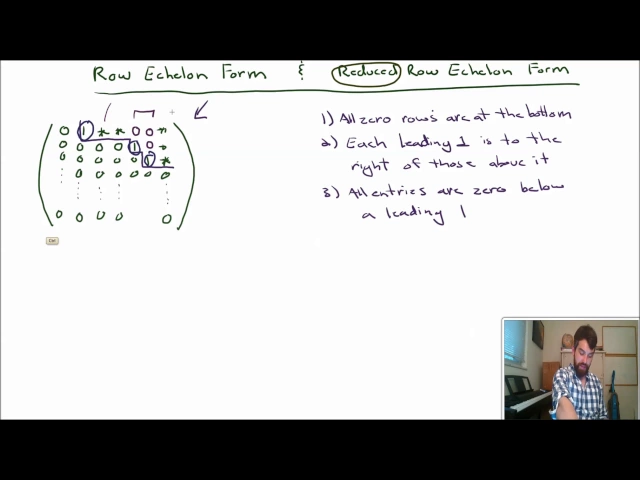
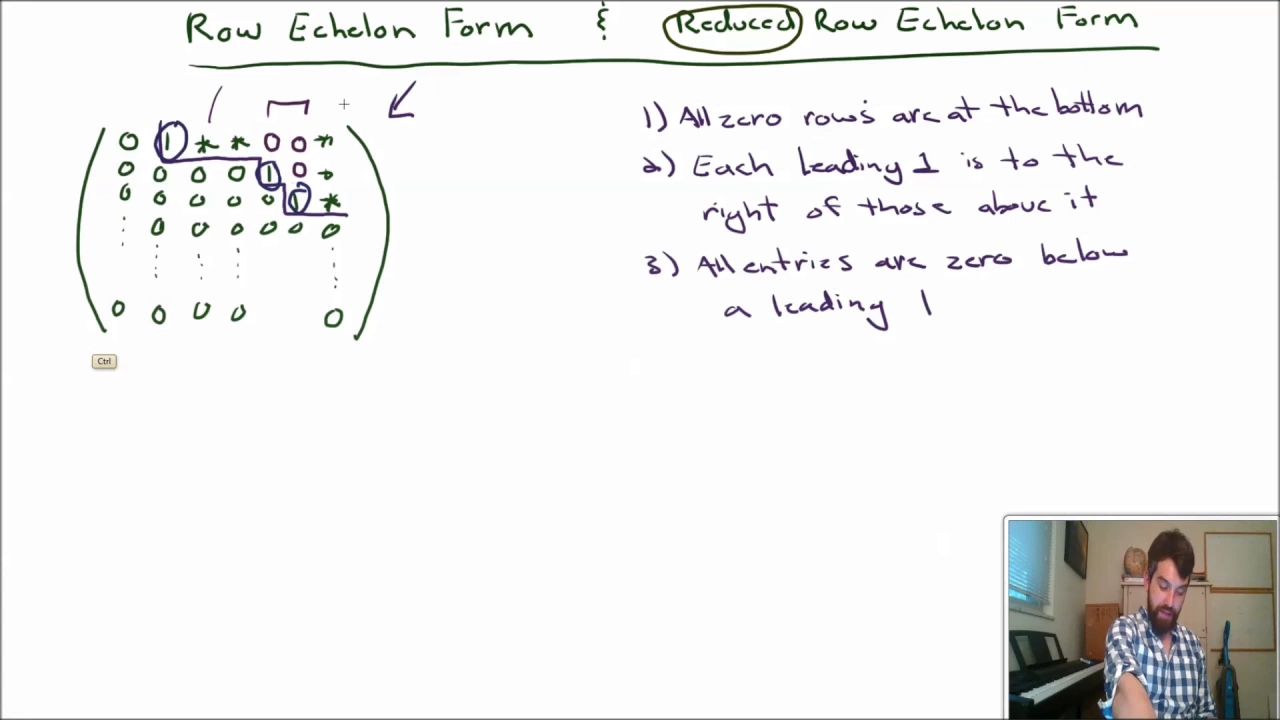
the idea is something like this I'm going to imagine a nice big Matrix it might be initially that I have a column of a whole bunch of zeros however at some point if I'm going along on the on the top row here at some point I'm going to have a one and then underneath this one I'm going to again demand that I have a whole bunch more zeros and then to the right of this one I I don't care it could just be whatever it is now I'm going to look at the second column again
I'm going to have a whole bunch of zeros going to go 0 00000000 0 and then finally hit a one but I don't care if the one is exactly in this next spot I could have it sort of skip one or two maybe this is where the next one is all that matters is that the is that this one is to the right of the prior one and then after I hit my one I don't care it could be a whole bunch of stuff 0 0 01 don't care longer maybe 0 0 0 0 and
maybe you know what maybe all of these zero I have a whole bunch of just pointless zero rows down here at the bottom so this is a sample row Echelon form and the the big idea here is that I'm going to have this sort of staircase and I'm going to look at these so-called leading ones and it forms this staircase in this case it's something like that but my stairs sometimes they can be long sometimes they short but they but they have this sort of diagonal way of they're working up so the the the first
one in the first row is the furthest off to the left and then the second one is the next furthest to the left and the next furthest to the left and so on beneath the ones are all zeros and above the ones I don't care it can be anything that is my claim for row Echelon form I usually just sort of have this this picture in my mind but if we wanted to write out some specific conditions it' be something like this so I have first of all all of the zero rows that had to
be at the bottom the the leading ones that's what I'm referring to when I when I look at these guys the one there the one there the one there all of those leading ones have to be to the right of the ones that are above it and then it's all zeros beneath it those are my three different conditions now I can go a little bit further and look into what it means to be reduced row Echelon form it's row Echelon form everything I've said here but I also want to have zeros above the ones so
in this scenario what I would do here is I'd say look okay there's a one there there's a one there and there's a one there so I'm going to come here and I'm going to put in for just those few specific ones a zero a zero and a zero note by the way that there's a little bit of an asymmetry here the idea with the zeros beneath it is that I've got my whole staircase and everywhere beneath the staircase is going to be zeros if I'm going to the reduced row Echelon form it's only in
these spots directly above the ones not in not in a column like this one I don't care about those columns here those do not have to have zeros above them but they do have to have zeros beneath them so I'm going to write this condition as well and the idea is that for the first three properties I'm going to get to RF and then for all four properties I'm going to get to reduced row Echelon form or rrf so our task for the future is I'm giving a linear system you use your three different Elementary
row operations and you put it into this kind of form now I have two different forms here so so I told you that I want you to convert your your given system into RF or RF but but which of these two should we do now it turns out that that reduced row Echelon form has a really interesting property namely it is unique so this is a theorem and it says that RF is unique and what I mean by this is that you and I may disagree on how we go about putting it into RF you
might do bunch of row operations I might do a different bunch of row operations cuz we have choices in how we go about it I might be really inefficient for example I might decide to alternate two rows 100 times just for the fun of it you might think that's ridiculous so it's not like there's one and only one way but it doesn't matter at the end of it there is only one reduced R Shalon form for R Shalon forms however that's not the case if you do a different way than I do we might both
get a row Echelon form but they'll be a little bit different and in practice this is not going to make any difference for solving Solutions but for some like really theoretical claims it's nice to have a unique reduced Ro Echelon form where you and I are cannot be different and that they really are the same things so in practice I typically only go to row Echelon form some questions in the textbook might ask you to go all the way to reduce but in most cases I just go to row Echelon form it's never a problem
to go further as we'll see in a little bit if you go further on this step it saves you some time later on but I personally when I'm doing my own computations mainly just go to row Echelon form