hello in this lecture I shall take a look at the rules in international law for acquiring territory international law is based on the concept of the state which in its turn lies upon the foundation of sovereignty territory is the most widely accepted and understood char istic of a state the central role of territory in the scheme of international law may be seen by noting the development of legal rules protecting it in its inviability the principle of respect for the territorial Integrity of states is well founded as one of the lynchpins of the International System as
is the norm prohibiting interference in the internal affairs of other states boundaries treaties whereby either additional territory is acquired or lost or uncertain boundaries are clarified by agreement between the states concerned constitute a root of title in themselves they constitute a special kind of treaty in that they establish an objective territorial regime valid against all such a regime will not only create rights binding also upon on third States but will exist outside of the particular boundary treaty and thus will continue even if the treaty in question itself ceases to apply the reason for this exceptional
approach is to be found in the need for the stability of boundaries accordingly many boundary disputes in fact revolve around the question of treaty interpretation it is accepted that a treaty should be interpreted in the light of Articles 31 and 32 of the Vienna convention on the law of treaties of 1969 in good faith in accordance with the ordinary meaning to be given to its terms in their context and in the light of its object and purpose essentially the aim is to find the common will of the parties a concept which includes consideration of the
subsequent conduct of the parties since many of the boundary treaties that need to be interpret long predate the coming into force of the Vienna convention the courts have taken the view that the convention in this respect at least represents customary international law well generally the difficulty in seeking to interpret both general concepts and geographical locations used in early treaties in the light of modern SCI d ific knowledge has posed difficulties in the batana Namibia case the court faced with the problem of identifying the main channel of the river chob in the light of an 1890
treaty emphasized that the present day state of scientific knowledge could be used in order to illuminate terms of that treaty in the Eritrea Ethiopia case the boundary Commission referred to the principle of contemporaneity but why by which it meant that a treaty should be interpreted by reference to the circumstances prevailing when the treaty was concluded in particular the determination of a GE geographical name whether of a place or aever depended upon the Contemporary understanding of the location to which that name related at the time of the treaty however in seeking to understand what that was
reference to subsequent practice and to the object of the treaty was often required in interpreting a boundary treaty in particular in seeking to resolve ambiguities the subsequent practice of the parties will be relevant even where such subsequent practice cannot in the circumstances constitute an authoritative interpretation of the treaty it may be deemed to be useful in the process of specifying the frontier in question however were the boundary line as specified in the pertinent instrument is clear it cannot be changed by a court in the process of interpreting delimitation Provisions like boundary treaties boundary Awards may
also constitute the basis of legal title to territory a decision by the international court or an arbitral tribunal allocating title to a particular territory or determining the boundary line as between two or more States will constitute establishment or confirmation of title that will be binding upon the parties themselves and for all practical purposes upon all states in the absence of maintained and sustained protest it is also possible that boundary allocation decisions that do not constitute International judicial or arbitral Awards may be binding provided that it can be shown that the parties consented to the initial
decision accretion describes the geographical process by which new land is formed and becomes attached to existing land as for example the creation of islands in a river mouth or the change in dire direction of a boundary River leaving dry land where it had formerly flowed where new land comes into being within the territory of a state it forms part of the territory of that state and there is no problem as regards a change in the course of a river forming a boundary a different situation is created depending upon whether it is imperceptible and slight or
a violent shift avulsion in the latter case the general rule is that the boundary stays at the same point along the original riverbed however where a gradual move has taken place the boundary may be shifted if the river is navigable the boundary will be the middle of the navigable Channel whatever slight op alterations have occurred while if the river is not navigable the boundary will continue to be the middle of the river itself this aspect of acquiring territory is relatively unimportant in international law but these rules have been applied in a number of cases involving
disputes between particular states of the United States of America session involves the peaceful transfer of territory from One Sovereign to another with the intention that sovereignty should pass this has often taken place within the framework of a peace treat following a war indeed the orderly transference of sovereignty by agreement from a colonial or miling power to representatives of the indigenous population can indeed be seen as a form of session because session has the effect of replacing One Sovereign by another over a particular piece of territory the acquiring State cannot possess more rights over the land
than its predecessor had the island of Palmer's case in 1928 emphasized this point it concerned a dispute between the United States and the Netherlands the claims of the US were based on an 1898 treaty with Spain which involved the session of the island it was emphasized by the arbitrator and accepted by the parties that Spain could not thereby convey to the US greater rights than it had itself possessed the basis of session lies in the intention of the relevant parties to transfer sovereignty over the territory in question without this it cannot legally operate whether an
actual delivery of the property is also required for a valid session is less it will depend on the circumstances of the case although in instances of session usually occur in an agreement following the conclusion of hostilities it can take place in other circumstances such as the purchase of Alaska by the US in 1867 from Russia or the Sail by Denmark of territories in the West Indies in 1916 to the United States it may also appear in exchanges of territories or pure Gifts of territory whether such methods of acquiring ter are possible today is indeed open
to question how far a title based on force can be regarded as a valid legal right recognizable by other states and enforceable within the International System is a crucial question ethical considerations are relevant and the principle that an illegal act cannot give birth to a right in law is well established in domestic law and is an essential component of an orderly Society however international law has sometimes to modify its reactions to the consequences of successful violations of his rules to take reality into account the International Community has historically accepted the results of illegal aggression in
many cases by virtue of recogn Miss Conquest the act of defeating an opponent and occupying all or part of its territory does not of itself constitute a basis of title to the land it does give the Victor certain rights under international law as regards the territory the rights of belligerent occupation but the territory remains subject to the legal title of the oued Sovereign sovereign as such does not merely pass by Conquest to the occupying forces although complex situations may arise where for example the legal status of the territory occupied is in fact in dispute prior
to the conquest conquest of course may result from a legal or an illegal use of force by the Kellogg Bon pact of 1929 1928 war was outlawed as an instrument of national policy and by article 24 of the United Nations Charter all member states must refrain from the threat or use of force against the territorial Integrity or political independence of any state however force will be legitimate when exercised in self-defense whatever the circumstances it is not the successful use of of violence that in international law constituted the valid method of acquiring territory under the classical
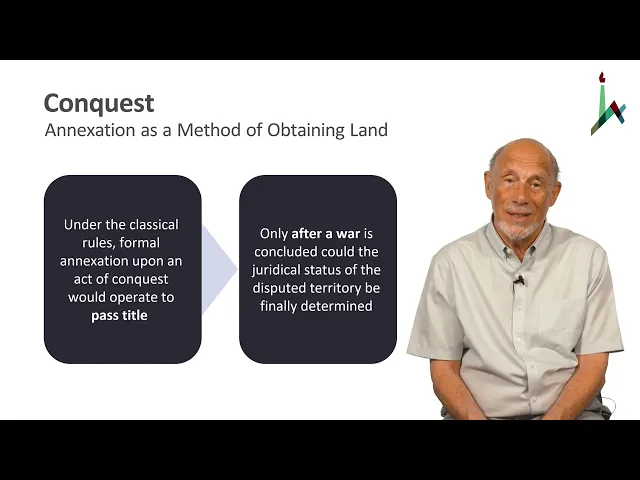
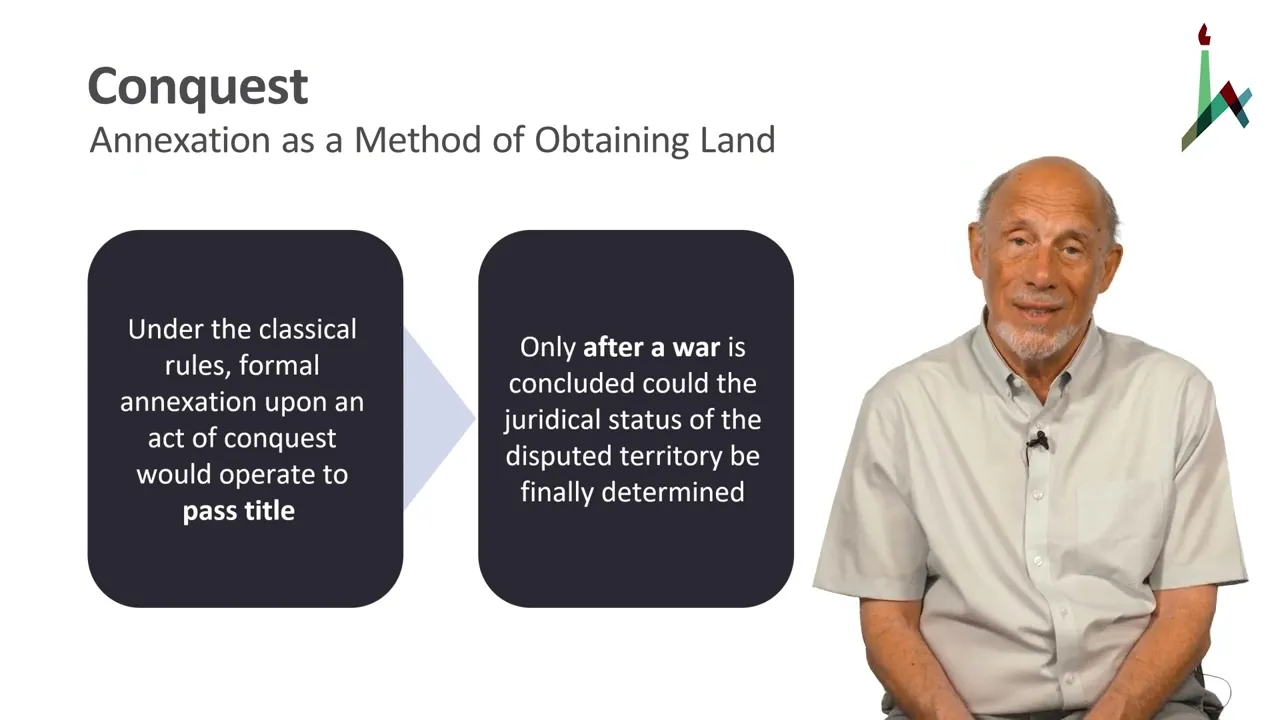
rules formal annexation of territory following upon an act of Conquest would operate a pass title it was a legal fiction employed to mask the conquest and transform it into a valid method of obtaining land under international law however it was doubtful whether an annexation proclaimed while the war is still in progress would have operated to pass a good title to territory only after a war is concluded could the juridical status of the disputed territory be finally determined this follows from the rule that has developed to the effect that the control over the relevant territory by
the state purporting to anex must be effective and there must be no reasonable chance of the former Sovereign regaining the land however it is clear today that the acquisition of territory by force alone is illegal under international law this may be stated in view of article two of four of the UN Charter and other practice Security Council resolution 242 for example emphasized the inadmissibility of the acquisition of territory by War while the 197 Declaration on principles of international law adopted by the general assembly provides that the territory of a state shall not be the object
of acquisition by another state resulting from the threat or use of force no territorial acquisition resulting from the threat or use of force shall be recognized as legal in Security Council resolution 662 of 1990 adopted unanimously the Council decided that the declared Iraqi annexation of Kuwait under any form and whatever pretext has no legal validity and is considered null and void all states and institutions were called upon not to recognize the annexation and to refrain from actions which might be interpreted as indirect recognition acquisition of territory following an armed conflict would require further action of
an international nature in addition to domestic legislation to Annex such further necessary action would be in the form either of a treaty of session by the former Sovereign or possibly of international recognition it is customary in the literature to treat the modes of occupation and prescription as separate categories in the acquisition of territory however there are several crucial factors that link the concepts so that the acquisition of territory by virtue of these methods based as they are upon the exercise of effective control is best examined within the same broad framework occupation is a method of
acquiring territory which belongs to No One Teran nullius and which may be acquired by a state in certain situations the occupation must be must be by a state and not by private individuals it must be effective and it must be intended as a claim of sovereignty over the area the high seas for example cannot be occupied in this manner for they are raised communist common Heritage but vacant land May subjected may be subjected to the sovereignty of a claimant state it relates primarily to uninhabited territories and Islands but may also apply to certain inhabited lands
the issue was raised in the western Sahara case before the international court of justice in 1975 the question was asked as to whether the territory in question had been tanelus at the time of colonization in the mid 19th century in an important state statement the court asserted that the state practice of the relevant period the period of colonization indicated that territories inhabited by tribes or peoples having a social and political organization were not regarded as Terror nullius further International case law has recognized that Sovereign title may be suspended for a period of time in circumstances
that do not lead to the status of Teran nelus such indeterminacy could be resolved by the relevant parties at a relevant time in fact the majority of territories brought under European control were regarded as acquired by means of sessions especially in Asia and Africa there were instances of Title by occupation for example Australia and many SP ly inhabited Islands though prescription is a mode of establishing title to territory which is not tanelus and which has been obtained either unlawfully or in circumstances wherein the legality of the acquisition cannot be demonstrated it is the legitimization of
a doubtful Title by the passage of time and the presumed acquiescence of the former Sovereign and it reflects the need for stability felt within the International System by recognizing the territory in the Undisputed possession of a state for a long period of time and uncontested cannot be taken away from that state without serious consequences for the international order it is the legitimization if you like of a fact if it were not for some such Doctrine the title of many states to their territory would be placed in question the international Court in the bwana Namibia case
of 1999 while making no determination of its own noted that the two parties were agreed that acquisitive prescription was recognized in international law and further agreed on the criteria to be satisfied for the establishment of such a title these were that The Possession must be atit by virtue of sovereignty peaceful and uninterrupted public and endure for a certain length of time the court did not contradict this position of the parties prescription differs from occupation in that it relates to territory which has previously been under the sovereignty of a state in spite of this both concepts
are are similar and that they may require evidence of sovereign acts by a state over a period of time and although distinct in theory in practice these concepts are often indistinct since sovereignty over areia May lapse and give rise to doubts whether an abandonment has taken place thereby rendering the territory Terron elus thus acquiescence in the case of prescription whether Express or implied from all the relevant circumstances is essential whereas in the case of occupation it is merely an evidential Point reinforcing the existence of an effective occupation but not constituting the very essence of the
legal claim precisely what form the protest is to take is open to question what is clear is that anything less than sustained and credible protests May well risk the title of the dispossessed party the requirement of a reasonable period of possession is similarly imprecise and it is not possible to point to any defined length of time it will depend as so much else upon all the circumstances of the case including the nature of the territory and the absence or presence of any competing claims in the binker Andros case of 1953 concerning disputed sovereignty over a
group of eyelets and rocks in the English Channel claimed by both France and the United Kingdom the international court of justice exhaustively examined the history of the region since 1066 however its decision was based primarily on relatively recent acts con concerning the exercise of jurisdiction and local Administration ation as well as the nature of legislative enactments referable to the charity in question and upon these grounds British sovereignty was upheld The Sovereign acts of the UK relating to these isets far outweighed any such activities by the French authorities and accordingly the claims of the latter were
dismissed both occupation and prescription rely primarily upon effective possession and control control the element of time here is also relevant as it affects the effectiveness of control the general rule intertemporal law as to time is that in a dispute the claim or situation in question or relevant treaty for example has to be examined according to the conditions and rules in existence of the time it was made and not a later D date this meant for example that in the island of palus case the Spanish claim to Title by discovery which the US declared it had
inherited had to be tested in the light of international legal principles in the 16th century when the discovery was made this aspect of the principle is founded also Upon A presumption of and need for stability but it was also noted in this case that while the creation of particular Rights was dependent upon the international law of the time the continued existence of such rights depended upon their according with the evolving conditions of a developing legal system although this stringent test would not be utilized in the case of territories with an established order of things this
Proviso has in practice been carefully and flexibly interpreted within the context of all the relevant rules relating to the acquisition of territory including recognition and acquiescence however the international Court in the GNC continental shelf case of 1978 declared that the phrase disputes relating to the territorial status of Greece contained in a Greek reservation to the 1928 kog Brion act had to be interpreted in accordance with the rules of international law as they exist today and not as they existed in 1931 in certain situations they may there may exist a determining moment at which it might
be inferred that the rights of the parties have crystallized so that acts after that date cannot alter the legal position such a moment might be the date of a particular treaty where its Provisions are it issue or the date of occupation of territory it's not correct to say that there will or always should be such a critical date in territorial disputes but whether is acts undertaken after that date will not be taken into consideration unless such acts are a normal continuation of Prior acts and not undertaken for the purpose of improving the legal position of
the party relying on them the concept of a critical date is of a special relevance with regard to the doctrine of idais which posits that a new state has the boundaries of the predecessor entity so that the moment of Independence itself is invariably the critical date this does not preclude the possibility that the relevant territorial situation or rights had crystallized at an earlier time in the sense of having become established and not altered subsequently the importance of the critical date concept is relative and Depends entirely upon the circumstances of the case the exercise of effective
Authority therefore is the crucial element as judge hu argued in the Ireland of Palmer's case the actual continuous and peaceful display of State functions is in case of dispute the sound and natural Criterion of territorial sovereignty however control although needing to be effective does not necessarily have to amount to possession and settlement of all of the territory CLA claimed precisely what acts of sovereignty are necessary to found title will depend in each instance upon all the relevant circumstances of the case including the nature of the territory involved the amount of opposition if any that such
acts on the part of the claimant State have aroused and international reaction for example the court noted in the Eastern Greenland case that it is impossible to read the records of the decisions in cases as to territorial sovereignty without observing that in many cases the tribunal has been satised ified with very little in the way of the actual exercise of sovereign rights provided that the other state could not make out a superior claim this is particularly true in the case of claims to sovereignty over areas of thinly populated or unsettled countries however the arbitral tribunal
in the Eritrea Yemen emphasized that there must be some absolute minimum requirement for the acquisition of territorial sovereignty in the island of palus arbitration the arbitrator judge Huber declared that the Netherlands possessed sovereignty on the basis of the actual continuous and peaceful display of State functions evidenced by various administrative acts performed over the centuries it was also emphasized that manifestations of ter territorial sovereignty may assume different forms according to conditions of time and place indeed the intermittence and discontinuity compatible with the maintenance of the right necessarily differ according as inhabitant inhabited or uninhabited regions are
involved and additionally geographical factors would be relevant this and other cases such as Easter green case reveal that the effectiveness of the occupation May indeed be relative and May in certain rare circumstances be little more than symbolic such activity in establishing a claim to territory must be performed by the state in the exercise of sovereign powers or by individuals whose actions are subsequently ratified by their state or or by corporations or companies permitted by the state to engage in such operations and thus performed on behalf of the Sovereign otherwise any acts undertaken are of no
legal consequence however the significance in law of State activities or effectivity will depend upon the existence or not of a legal title to the territory the international Court in the book Kino Faso Marley case of 1986 declared that where there is such a valid legal title usually by way of a treaty this will have preeminence and practice effectivity may play a confirmatory role however where the effectivity are in contradiction to the title the latter will have priority in the ABS absence of any legal title then the effectivity must invariably be taken into consideration while where
the legal title is not capable of exactly defining the relevant territorial limits effectivity then play an essential role in showing how the title is interpreted in practice accordingly examples of State practice May confirm or complete but not contradict legal Tittle established for example by boundary treaties in the absence of any clear legal title to an area State practice comes into its own as a law establishing mechanism but its importance is always contextual in that it relates to the nature of territory and question and the nature of competing State claims relative State practice would include the
legislative Acts or act of administrative control acts relating to the application and enforcement of civil law criminal law acts relating to immigration acts regulating fishing and other activities Naval Patrol search and rescue operations as well as the conduct of a series of other uh activities we will take a break at this point