**[Music] [Music]** Hey everyone! Welcome back to Mike and His Whiteboard. My name is Mike, this is my whiteboard, and today we're going to talk about one of my favorite steps, and that's managing winners.
There are a lot of good things that can happen when we manage winners, and there are a lot of things that we can avoid that can hurt us as well. So, we're going to talk about all those things today. Let’s get right into it.
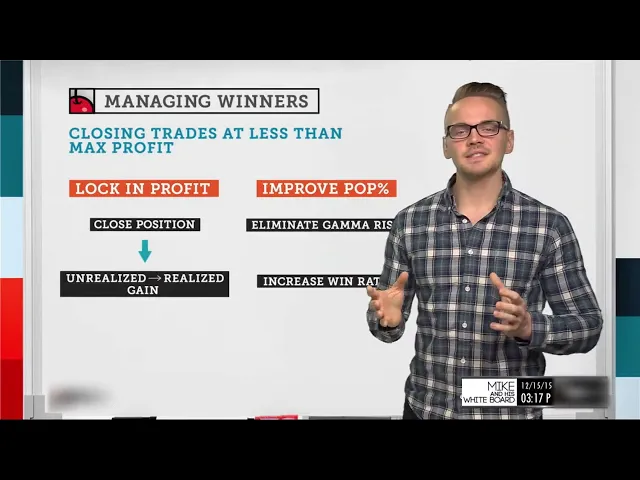
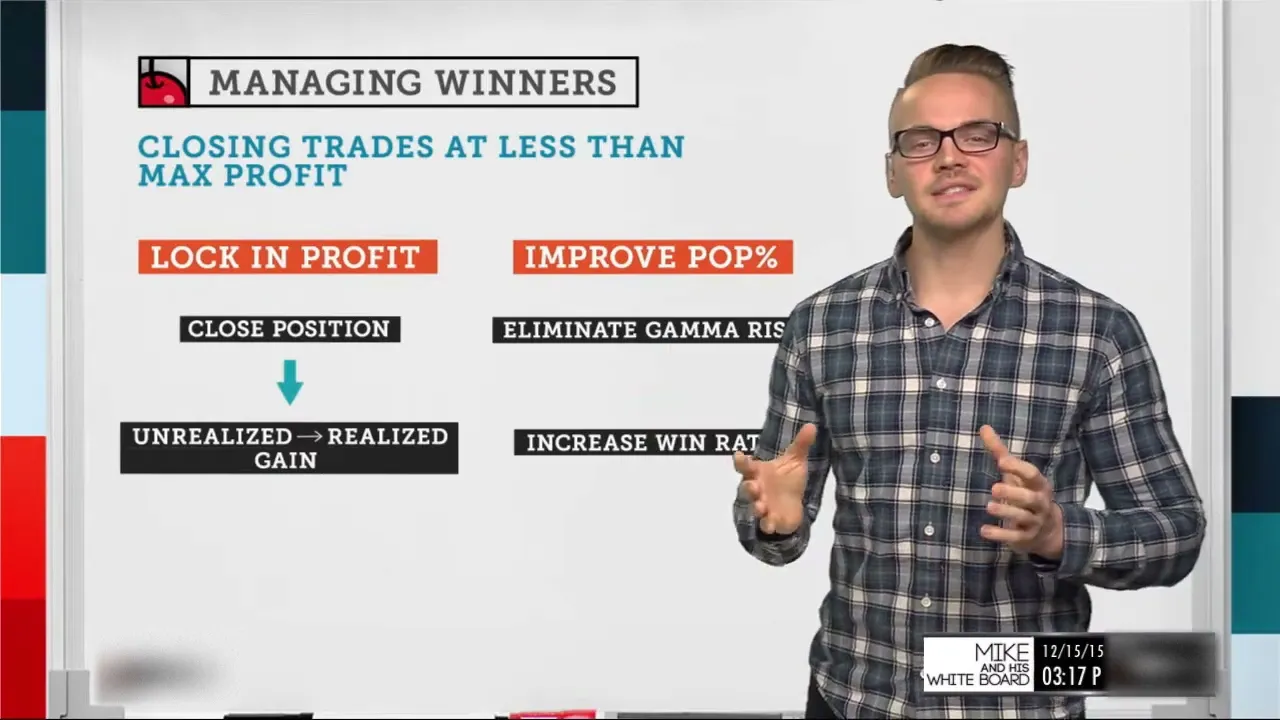
When we talk about managing winners, essentially what we're discussing is closing a trade for less than max profit. Whether we sell an option, buy an option, or buy a spread, we look to capture a certain amount of profit prior to expiration. For example, if we're selling a put, we usually don't hold it until expiration; we'll typically manage it at a certain point.
When we talk about managing winners, we're usually looking at the 50% range, but we'll discuss that a little bit further. One thing we do is remove risk from the table, and we'll talk about that in more detail shortly. We can also lock in profits by managing winners.
Essentially, that's what it is: closing the trade prior to expiration, which locks in those profits, increases our probability of profit, and allows us to generate more occurrences. It can be a bit hard to see at first, but we’re going to discuss how this is possible. Let’s get right into it and talk about removing risk from the table in the next slide.
Understanding how we remove risk from the table is a great concept, and this is really what got me interested in this idea when I started trading. Let’s say we have a short put spread that is two points wide. If we’re looking at a 50/50 shot and just getting our feet wet in trading, we’re selling a put spread that is at the money, risking one to make one.
Our max profit on this trade, let’s say, is one dollar. If it's a two-point wide spread and we collected one dollar, that means our max loss is also one dollar. Let’s say this trade goes along and the stock price ends up going up, which would decrease the price of the spread and result in us being right around a fifty percent profit.
If we reevaluate the trade and I’m now at fifty percent profit, that means I’m seeing a profit of about fifty cents. If I know my max profit is one dollar and I’m already at fifty cents, my new max profit, if I reanalyze the trade, is only fifty cents because I've already seen a fifty-cent gain. I haven’t locked it in yet, but I see that gain.
If I have a fifty-cent gain and my new max profit is only fifty cents, I can lose that fifty cents that I already saw in addition to my max loss of one dollar. So, my new max profit is fifty cents, and my max loss is one hundred fifty. What does this tell me?
Basically, if I have this trade that was originally risking one to make one, now I'm basically risking 1. 5 to only make 0. 5.
So, we can break it down a little further. I’m risking one to make one. Initially, I reached my fifty percent max profit, so the most I can possibly make now if I reanalyze the trade is only fifty cents.
So, I'm no longer risking the original one to make one. Instead, I’m actually risking more to make less in this scenario. Now, there is one thing to be said: it's going to be a higher probability whatever we're seeing when we look at this trade, but many things can go wrong.
So, we’re happy to take the risk off the table as opposed to leaving it on. This is one of the most crucial concepts of managing winners: removing risk from the table by taking a risk one to make one scenario and creating a new scenario where we’re taking that risk off once we see a certain amount of profit. We’re no longer happy with risking more to make less.
Let’s go to the next slide, and we’ll talk about another concept of managing winners, which is locking in profit and improving probability of profit. When we lock in profit or manage our winners, we’re basically locking in that profit. As I mentioned in the previous example, if I see a gain on the position, it's an unrealized gain.
If I don't close the position or roll it, and I just leave it on my portfolio, it's nice to see that gain, but it’s not realized because I still have that risk on the table; I still have the trade active. By closing my position, I transfer my unrealized gain to my realized gain, which you might also see on the Analyze page on Doe. If you ever look at the order chains feature, you’ll find it’s a fantastic tool that tracks all of your rolling and closing positions along the left side of the Doe platform.
You can just click on Analyze, and it’ll prompt you for the order chains feature. What you’ll see is an unrealized side and a realized side. So, if you have a trade that’s open, you’re going to see the unrealized gain there.
But when you close it or roll it, that value will be transferred into. . .
The realized side, and that's because we're either closing the position or we're rolling a position, which is essentially closing the old position and opening a new one. So, when we're closing a position, we're locking in our profit, and we're also moving that gain from unrealized to realized. What we're also doing is improving our probability of profit.
In a previous whiteboard, I talked about gamma and how we avoid gamma risk. If you missed that one, you can go to the top and find shows, then scroll down to Mike and his whiteboard, and you'll see it there. What gamma risk is, is essentially the accelerated rate of change of delta.
So, when we get closer to expiration, our deltas can fluctuate very drastically, which can drastically affect our probabilities and also our P&L. By closing out of our winning trades prior to this happening, we're basically taking off the unwanted risk that we don't want to be associated with when it comes to gamma. So, when we're closing our trades at about 50 percent, we're improving our probability of profit because we're avoiding these risky situations when it comes to gamma risk.
What we're also doing is increasing our win rate, because if we take off a trade prior to expiration, we're not holding it for that entire time. We're going to see an increase in our win rate. If you check out any of the market measures that we've done on managing winners, you'll see that if we have a theoretical probability of success of, let's say, 70, if we manage our winners at 50—so we’re taking the trades off for less than max profit—we generate a higher win rate, which is always good when we're looking to generate a number of occurrences.
That's actually one of the concepts we'll get into further here, so let's go to the next slide and we'll discuss this further. When we're generating more occurrences, this is one thing that was really hard for me to understand originally, but when I kind of laid it out this way, it helped me understand. Let's think about a trade and how it is affected over time.
Let's say we start a trade on the left side, and the timeline just goes on and on until expiration here. So, if I place a trade and I hold it to expiration, there's really not much I can do. I see one trade here.
So, I place this trade, and I'm holding it to expiration; you can see that I only have one trade. However, what we've shown with our market measure studies, again, is that when we manage trades at 50, usually we can take them off a lot sooner than the expiration date that we've chosen. So, if I'm able to do that, I can place a trade, and if I'm managing my winner at 50, that allows me to take the trade off, and now I have capital to use.
What I can do is either redeploy in the same underlying if I have the same assumption, or I can take that capital and put it into a different trade and a totally different underlying. So, if I'm able to manage my profits at 50 and effectively reduce my time in my trade by 50—which is usually what tends to happen—now, instead of having one trade, I can place two trades in that same amount of time. This helps us generate a larger number of occurrences, which is always what we're looking for here at Tastytrade.
So, let's wrap it all together with some takeaways here. Managing winners refers to closing trades at less than max profit. So, I'm going to jump right to the next one, which is 50 percent being the goal.
Fifty percent is the goal for most trades, but it's not necessary. When we talk about managing our winners, we're usually talking about closing it at 50 percent profit. However, when we place trades like straddles or some other strategies where we're comfortable with a lower max profit percentage, or if we reach a quick max profit in a few days, we'll be comfortable with taking off the position lower than 50 percent.
One great study that we did was called "Optimal Management," and we did it for a number of different strategies, but it pretty much breaks down where we expect to see our probabilities of success and where our profit percentages should be over a certain amount of time. We measure that against what our reality is. So, let's say if I'm expecting to make 20 percent in four days, but I reach 20 percent in two days, then I would usually take that off because I'm ahead of the curve there.
It's a great study; I would check it out. Again, it's called "Optimal Management. " I believe it was a market measure.
Lastly, when we're looking at takeaways for managing winners, this tactic increases our win rate and removes risk from the table. Increasing win rate is always going to help us, and it's going to help us take risk off the table as well because if we have a higher win rate percentage, we're going to be exposed to less risk overall, assuming that we're taking that risk off the table and we're not holding it until expiration. So, those two kind of work hand in hand together, and finally, having a target close percentage and a backup plan is going to be a best practice.
It's always good to have a target percentage when we go into a trade. So, let's say if I'm looking at a straddle, for me mechanically, maybe I would look at closing at 25 percent instead of 50, or if I have a strangle, which is going to have a higher probability of success usually. I might look at closing it at 50, so it's always good to have an entry plan going in and also a closing percentage in mind.
It's always good to have a backup plan just in case the trade goes against us. So, what are we going to do to manage that trade as well, so we don't do anything rash or brash? This has been managing winners.
Hopefully, you enjoyed it. Thanks so much for tuning in. My name is Mike.
If you have any questions at all, you can shoot me an email at support@doe. com or support, or you can shoot me a tweet at @dotradermic. We'll see you next time.
[Music] Thanks for watching! If you like this video, give it a thumbs up or share it with a friend. Click below to watch more videos, subscribe to our channel, and last but not least, go to [Music].