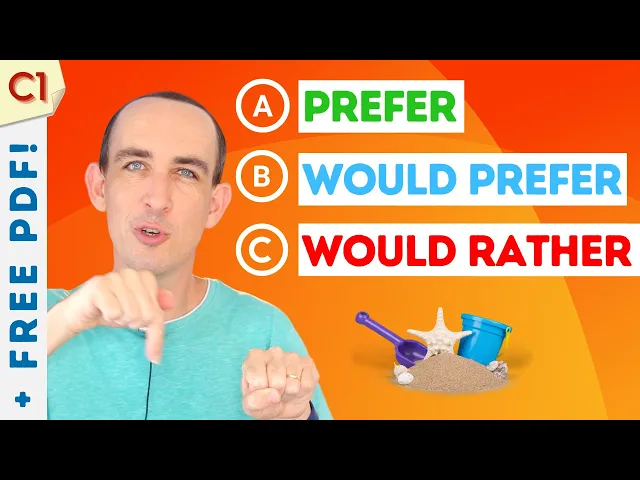
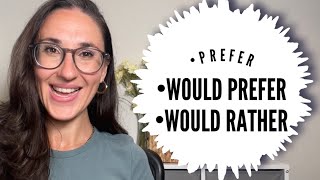
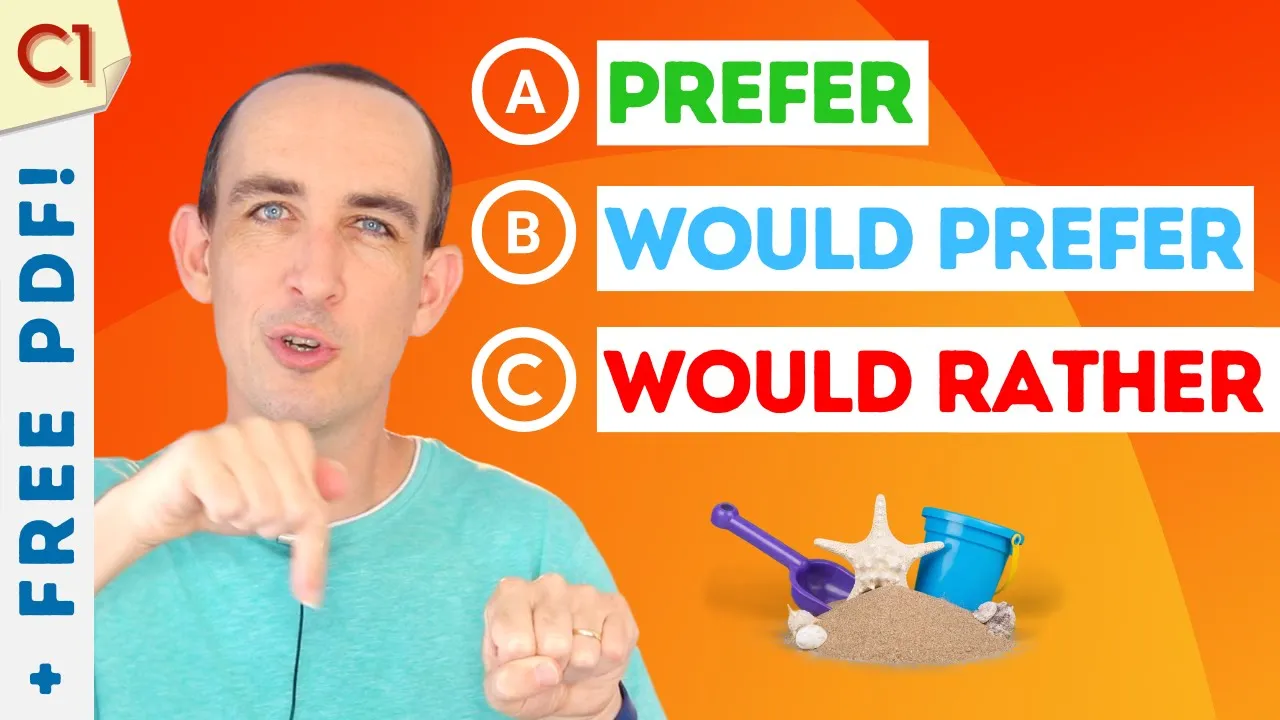
Look at this I'd rather be with you, or I'd prefer to be with you. Are they both correct? And what about this?
I prefer working in the evening, or I prefer to work in the evening. Do they both mean the same thing? Let's find out.
OK, listen, we have four different grammar structures for would rather and six different grammar structures for prefer. So you're really going to need today's worksheet. It's free.
You can download it by clicking up there or in the description and that comes with a summary of all the structures, the examples and a test to see if you've mastered this topic. Okay, so is there any difference between these two verbs would rather and prefer? Well, before we answer that, let's first have a look at how we use each one.
And we're going to start with would rather. Now, I said that there are many different structures for using would rather. And the reason is that it depends if we're talking in the present or if we're talking in the past.
Are we talking about present preferences or are we talking about past preferences and regrets? It also depends on whether we're using the same subject or if there are two different subjects. What I mean by this is, for example: I want to go.
This has one subject - I. Or: I want you to go. This has two subjects - I and you.
So let's start by looking at how to use would rather to talk about present preferences with just one subject. Let's start with the easy one. And the structure for this is would rather plus the verb with would rather.
Just pay attention because we often use the contraction instead of I would rather we normally say I'd, I'd rather. Instead of you would rather, you'd rather. And instead of he or she would rather we say he'd rather, she'd rather, we'd rather, they'd rather.
So with that in mind, let's have a look at a couple of examples using would rather in the present with one subject. I'd rather work from home than in an office. I'd rather work from home.
I'd rather work from home than in an office. I would rather or I'd rather visit Chicago than London for my holidays. I'd rather visit.
. . easy!
Now, when the subject changes and there are two subjects in the sentence we need this structure: would rather, then the new subject, then the past simple. So it looks like this: you can cook if you want, but I would rather we went to a restaurant. I would rather we went - here the two subjects are I and we - I'd rather we went to a restaurant.
I would rather they emailed me than sent me a letter. I'd rather they sent me an email. They sent is the past simple.
So a tiny bit more complicated, right? Okay, let's look at how to use it to talk about past preferences and regrets when we're using just one subject, and the structure for that is: would rather plus the perfect infinitive. Perfect infinitive.
. . what is that?
Well, basically, it's the word have and then the past participle - always have not has or will have. No, it's always have. So have spoken, have eaten, have danced.
So that museum was okay, but I would rather have visited the Eiffel Tower. I'd rather have visited the Eiffel Tower. I didn't mind going to McDonald's in Paris, but I'd rather have eaten something French.
I would rather / I'd rather have eaten something French. I'd rather have eaten something French. Now we're talking about the past when we are changing the subject, and the structure for that is: would rather, then the new subject and then the past perfect.
The past perfect is had and the past participle - had spoken, had eaten, had taken. I would rather we hadn't gone there. I'd rather we hadn't gone there.
It was quite boring. I'd rather you had chosen something more interesting. I'd rather you'd chosen something more interesting.
So there are so many ways we can use would in English, right? We can even use would as a past tense. That's a really advanced structure, so I recommend after this video, you watch that one, because if you can use that in your spoken English, you are really going to impress people.
Okay, now let's have a look at prefer. Prefer really comes in two different parts. Prefer and would prefer.
Let's start with the easy one and get more difficult. The easy one is prefer. Let's go!
We can use prefer followed by the gerund, which is the ing form of the verb. The infinitive, like to go, to eat, to play. Or a noun.
So, for example, with a noun, I like tennis, but I prefer football. I prefer football. With a gerund: I prefer watching football to playing football.
Just pay attention there of the preposition 'to'. You prefer one thing 'to' another thing. I prefer watching football to playing football.
And with the infinitive: I prefer to eat healthy food rather than junk food. I prefer to eat healthy food. So when do we use prefer and the gerund?
And when do we use prefer with the infinitive? Well, it depends. They're both used quite interchangeably by native speakers, but prefer plus the gerund expresses that you like that verb.
You like doing the verb. You enjoy it. I prefer watching football to playing football.
I prefer watching it. I do it because I like it and I enjoy it. However, I would prefer to do something.
This is more when we're talking about a life choice or a habit. Like, I'd prefer to eat healthy food. I prefer to eat small meals rather than two big meals every day.
Okay? It's a habit. It's a life choice.
And that's when we use prefer plus the infinitive. And the same general rule applies when we're talking about whether you like doing something or whether you like to do something. Okay.
Now let's have a look at would prefer. And with would prefer, you always need 'to'. You cannot say would prefer plus the gerund.
So I would prefer going is incorrect. It's wrong. You have to say, I would prefer to go.
I would prefer going alone. No. I would prefer to go alone.
Yes. I would prefer pasta to rice. Yes.
Okay, so let's start with the easy one. Present preferences with just one subject. The structure is: Would prefer plus the verb.
I would prefer to work from home than in an office. Okay. When the subject changes with this, it's actually quite easy.
Remember, with one subject, it's: I would prefer to verb. Well, when there's a different subject, it's I would prefer, then the new subject, to verb. The only thing we are doing is separating the two parts and putting the new subject in the middle.
So one subject: I would prefer to cook. Two subjects: I would prefer you to cook. I would prefer them to cook.
Now, there's another little structure we can use here if we're talking about our preference of someone else's actions, the expression is: I would prefer it if. . .
. then the past simple. So I would prefer it if you cooked.
You cooked is the past simple. I would prefer it if you cooked. I would prefer it if she sent the letter, not me.
I would prefer it if they chose a nice restaurant and not McDonald's. Okay, now let's look at past preferences with one subject and the structure is this: I would have preferred to verb. Okay, I would have preferred to eat, to go, to take.
When we're using the contraction, I would have sounds like this I would've, would've. Two syllables. Would've.
I would've preferred to go, to eat, to take. For example, we went to the museum. I didn't like it.
I would have preferred to visit the Eiffel Tower. I would have preferred to visit the Eiffel Tower. Okay, and as before, it's not too complicated to add a different subject to this structure.
Instead of: Would have preferred to do something, it's would have preferred someone to do something. I would have preferred you to take me to the Eiffel Tower. I would have preferred them to cook for us.
So do prefer and would rather mean the same thing? Let's find out. They gave me an orange, but I would have preferred an apple.
I would rather have had an apple. Do those two things mean exactly the same thing? Yes.
There's no change in meaning, so choose your favourite, but just make sure you get the structure right. And for that, I definitely recommend you download the summary of this lesson. As I said, there's lots of structures, so you can get that free PDF by clicking there or clicking in the description.
And after this video, watch that one to learn how to use would as a past tense. Thanks for watching this video. Like and subscribe, and blah, blah, blah, blah, you know how YouTube works, and I'll see you in that video next.
Bye for now.