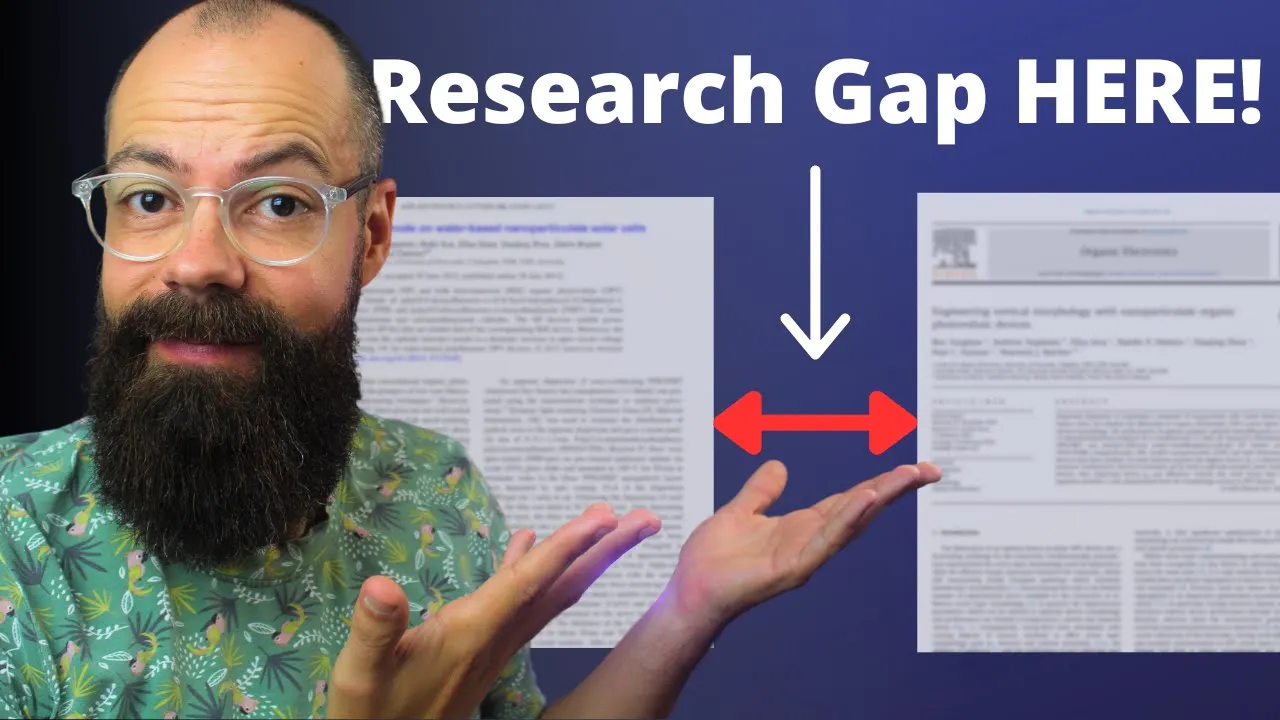
no matter what field you're in I think there are four types of research gaps the first one is this type where you have a particular goal you may be heading towards like a particular new technology a new sort of understanding but you've got this edge of your current research field so the research field adds information one on top of the other we got this sort of like adding up but the problem is is there's a gap between what the current research field can do and what it understands versus where you want to go and so
this is one type of research Gap that was what my PhD was based on when we had um solar cells that could only get this amount of efficiency and I needed to get it all the way to this type of efficiency so there we are there's the first type but there's three more I did four on my hand Bo that's better the second type of research Gap is when there is a certain outcome that you just can't explain and this is essentially a lack of understanding so here we go we've got an action here so
we've done something and we have an outcome that we're not expecting so it could be that you've sort of like done a particular study and people aren't sure why a particular result happened or you've done this questionnaire but you're not quite sure why people believe a certain thing or do a certain activity because it doesn't line up with your hypothesis and so this is a research Gap here where you think that there's a certain action but the outcome is completely different to what you think so here we are here is a research Gap that you
can fill with your research get it in there this is arguably one of my favorite research gaps and that is for the Humanities and social sciences when certain people disagree this is a great way for you to be that person that works out why they disagree so let's say that like 95% of people believe this but then 5% of people believe this this disagreement here can be a research gap for you to fill so it could be that two very similar experiment ments had very different results that means that you can now use your research
skills to find out why there was a difference why there is a disagreement between two things it could also be that there's a disagreement within your field one expert believes one thing one expert believes another thing and that will allow you then to say okay why do they disagree I'm going to fill that Gap and Bridge their disagreement great and the last sort of research Gap that I think we're all familiar with and it's kind of more traditional the way that we think about building up knowledge and the peer reviewed literature is this we've got
this bubble and this is the Leading Edge of the bubble here of what we know everything inside this is what we know and what we're doing is we're growing it out but the thing is is we're not growing out evenly it looks even because we're looking at all the knowledge but on the surface there's these little kind of like improvements where we get this bit's a little bit of an improvement this bit's a little bit of an improvement this bit but the problem is is that because this is not an even surface it looks more
like this we then got gaps to fill so gaps in between here is what we can sort of like fill with our research I'm going to write Gap so we all know what we're talking about and it's essentially these gaps in knowledge which sometimes are the most important but they seem the most uh stupid because you could take a particular experiment that yielded a certain result and change one thing one parameter and then you filled out that little Gap next to it so we may change just like there we go we'll make this a bit
bigger we may just change one parameter and then all of a sudden we've just oh we've just filled in this Gap here because it's very very close to that understanding that we've got but it's slightly different and that means you've got a plethora of different variables to change if you want to sort of like find a research Gap so overall there are so so many different gaps those are the four main types that you should know now let's talk about the nitty-gritty of how we actually find research gaps I think you're going to like this
little trick the first way to find research gaps really is just Reading literature and having questions pop into your mind and seeing if the literature answers that question but that can get a little bit boring and it's a little bit uh long- winded if you ask me we've got tools now that we can actually find research gaps really easy and the one thing I really like to do is use this technique on Google Scholar so I head over to Google Scholar and then I type in something like this your research question and then a key
word you have to put and so that they're closely related and then you've got this promising results we'll talk about more of these key phrases in a minute and I'll put a list in the description for you lucky you but here 3D printed food and promising results and as we go through what we're doing is looking for these key phrases that tell us that hint to us that there is a research Gap that we could potentially fill so down here you can see promising results are obtained above all textual properties and qualitative measurements are helpful
tools to speedify through 3D printed food so there we are textural properties that could be a research Gap that you could help fill with your research if 3D printed food is your thing there's loads of these phrases here's another one you've got smoking sensation which means stopping smoking and then I've put in these preliminary studies preliminary studies are great to look at because what they're saying is Well we only had funding to do like this amount of research but this could go much much further this is where you could come in so preliminary studies and
we can including this and preliminary studies and you can see down here by the treatment strategies interaction blah blah these preliminary studies underscore the need for additional research in smoking sensation in ethnic or racial minorities so if your study is on stopping people smoking you could hone in on particular ethnic racial groups there's a nice little Gap to fill here's another one of my favorite terms requires deeper understanding academics are so lazy when it comes to sort of like coming up with new terms to describe that well we run out of money and we really
don't understand what's going on but uh this requires deeper understanding also when you get papers reviewed it's easy to sort of just say to the reviewer like oh this just requires deeper understanding rather than trying to sort of like address it in your paper it's a little sneaky trick that academics use all the time and it can give us a great idea of where the research gaps are they're so easy to find they're actually just screaming at you like hey hey I'm over here hey figure me out so that's how we find them you may
be wondering where do you get all these phrases and what other ones can I put in well this is where my favorite tool chat GPT comes in and all I've set up here is I'm trying to find research gaps in my research field what sorts of phrases are used in peer-reviewed papers that I can search for and then I put examples of the sort that I'm look after promising results preliminary studies show and then it says further research is needed remains unclear more studies are required all of these you could put in to that simple
formula your research field capital and and then in quotation marks these phrases it is so very easy to find research gaps and then you can kind of just explore a little bit further go check it out for your research field and see what you come up with and the third way that you can find research gaps is by talking to researchers that are currently in a research field the thing about the literature and the stuff that's already up online is that the weird system that we've got ourselves in is that the literature sometimes is like
up to 6 months to a year out of date to the current research field the only people that really know what's going on right now in a research field are the people actively researching in them so speak to your supervisors speak to PhD students speak to postdocs all of these people will be able to help you because they've been to conferences they're speaking with collaborators it's just so easy to find research gaps in a field if you just go up to someone and say excuse me what is a challenge in your research field that you
think needs to be answered easy and they'll happily tell you because we love to complain so here are some research Gap examples where I think you could go a little bit deeper so the first one here we've got that smoking sensation thing and look I've searched for the word preliminary so down here the last sort of sentence of the abstract is this these preliminary studies underscore the need for additional research and that's what we're looking for additional research in smoking sensation and ethnic racial minorities brilliant we've also got this one promising results so I've got
here variables affecting the printability of foods I'm looking for promising results I'm going to go down there and find that and here given these promising results the interest in the application of 3D printing technology in food science is increasing and so promising results that was this Extrusion speed traveling speed layer height all of that stuff there's so many variables on here that you could use to create a research Gap and uh yeah this is just the perfect example of finding those bumps those tendrils that are coming out and looking in between them saying well we'll
just do something a little bit different there's our research Gap brilliant now I'm not saying that this is perfect by any means you need to go much much deeper for example what I would do if I wanted to go much much deeper is I would go here and I would look at uh connected papers I'd put the paper in the top and then I'd look for derivative works so once the paper was in and we produce this lovely little map i' click up here to derivative works and Bob's your uncle all of these I'm going
to order them in terms of year all of these will tell me whether or not that Gap is actually been filled since the time the paper that I was looking at was published so simple if you like this video you're going to absolutely love this one where I talk about how to easily identify research gaps as sanity saving tool and it's really old school I've got a really long beard go check it out if only for the beard





![Things you don't say out loud in academia [9 open secrets]](https://img.youtube.com/vi/sgAlFPMugWw/maxresdefault.jpg)


![How To Use Google Scholar [Cutting-Edge AI Techniques To Unlock Hidden Research]](https://img.youtube.com/vi/U38m6yA8qgQ/maxresdefault.jpg)