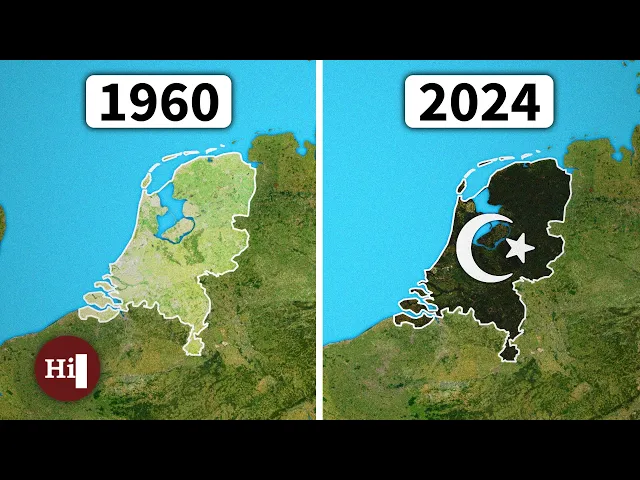
The Dutch are famously tolerant regarding soft drugs, prostitution and cultural diversity. But that is changing. Geert Wilders used to be a fringe figure in Dutch politics.
He has been convicted and was put on al-Qaeda's most wanted list. But in 2023, he won the national elections in a landslide. Whether you love him or hate him, the Dutch do have a problem.
Wilders’s main talking points are Islam and the people who bring it. Which are primarily people from Turkish and Moroccan origin. These groups have crime rates that are 5 times and 2,5 times higher than those of native Dutch, and many don't share the Dutch values.
One study showed that 52% believes that Dutch women have too many freedoms, whereas reversely 45% of Dutch citizens feel that Muslims are incompatible with the Western European way of life. The fact is that there are major challenges. There have also been major improvements, but this topic has become so sensitive that it's almost forbidden.
This is that forbidden topic with. . .
Hindsight. Wilders has been around for a long time, and he's mostly known for his remarks on Islam. In his early campaign videos, he filmed these hit and run monologues.
You can see his driver still parking the car. He's surrounded by security, and he's always in or in front of a mosque. This kind of criticism had long been absent in the Netherlands.
The public debate on immigration was always generally optimistic. Even when some of the challenges of their multicultural policies came to the surface. Now he's leading the biggest party in the Netherlands, and he's tasked to turn his vision into reality.
But let me start with a bit of historical context. The Dutch were already famously tolerant in the early 1600s. They were themselves religiously divided, mostly between Catholics and Protestants, and they administered vast colonies in Southeast Asia and the Caribbean.
They realized early on that it would be better for business if they developed a tolerance for each other's differences. By the 1960s, this culture of tolerance had become a national trait, and they were going to take it one step further. They were fighting for gay rights.
They made cannabis available for recreational use. All these progressive developments happened as the Dutch were losing their faith. But like many other countries, they had a shortage of low skilled workers.
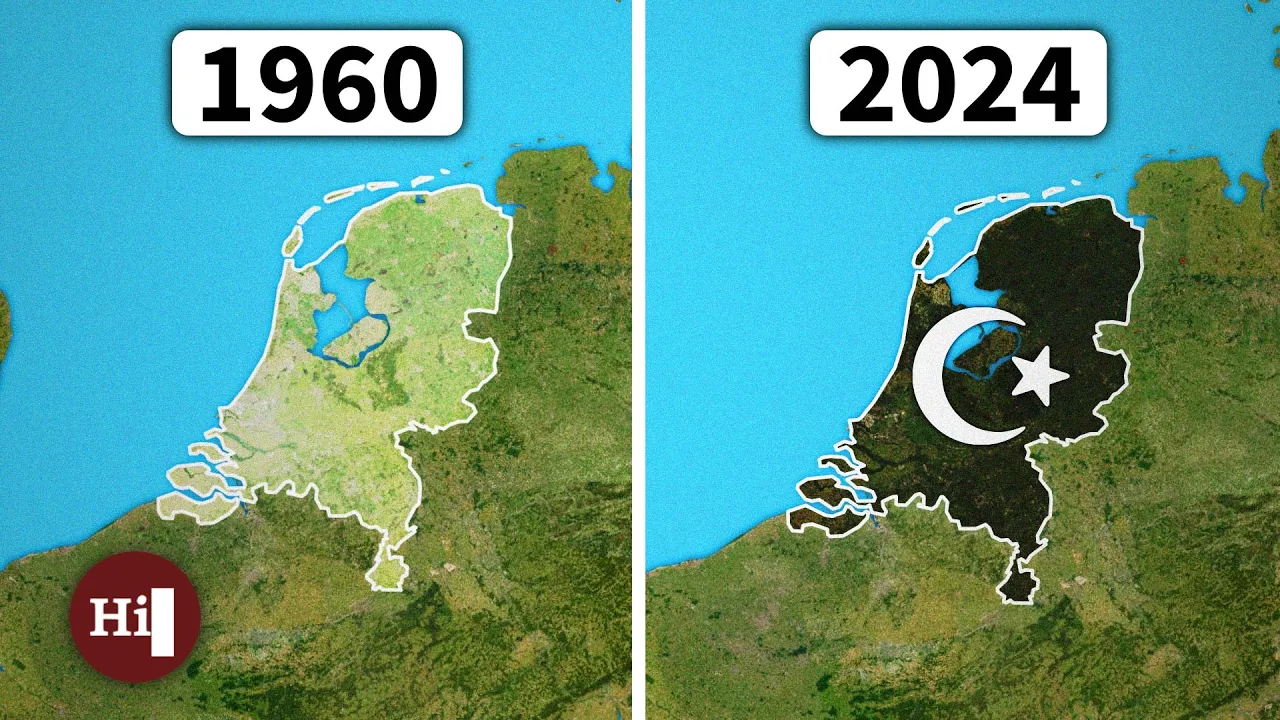
They recruited thousands, most notably from Turkey and Morocco, to work these jobs. And in their spirit of tolerance, they encouraged them to practice their faith and to maintain their cultural identity. The Dutch thought that they would return to their country of origin after some time, and saw no need to integrate them into society.
They lived parallel lives and this is where problems started to emerge. I've had the idea for this video for some time already, but I kept postponing it for, well, it's obvious, right? A friend of mine recently had a guy show up at its front door in response to a video that he made, like, how did he even know where he lives?
The truth is that all your data is out there and is sold to scammers and marketeers. That's why I'm so thankful to partner with Incogni. Incognito is a service that goes out on your behalf to take your data off lists that data brokers are using to send you spam, to call you with offers, and this can get nasty very fast.
I just signed up and within minutes they managed to get my data from 16 lists and 31 are in progress. You can see exactly where your data is deleted and which brokers have an iffy reputation. Go to incogni.
com/hindsight, and apply to code “HINDSIGHT” at checkout to get a 60% discount on a yearly plan. Thank you again, Incogni, for sponsoring this video and for supporting the channel. Now let's go back to the Netherlands.
In the 1960s, waves of guest workers came to the Netherlands to work low skilled jobs. In Morocco, they were recruited primarily in rural areas in the north. In Turkey, they came mostly from smaller cities in central Turkey and on the Black Sea.
When they arrived in the Netherlands, almost all settled in the four biggest cities. They were often housed in special residential areas or found rental apartments in low income neighborhoods. This is where parallel societies emerged.
The first generation worked long days for little money, and their crime rates were well below the national average, but their kids started causing trouble. The most problematic group were the so-called 1. 5 generation of Moroccans.
These were the children of the first generation of immigrants that moved to the Netherlands when they were very young. They often felt stuck between two cultures, and a worrying 65% of them were charged with a criminal offense before the age of 23. At that time, there was an unchallenged consensus amongst politicians that their multicultural policies worked brilliantly.
One author said that politicians had a gentlemen's agreement to refrain from using the issue in electoral campaigns. This created a bias. Positive integration results were emphasized, while negative aspects were downplayed.
Many of these people lived in poverty, segregated, and in disadvantaged neighborhoods. By 2005, crime rates were much higher. Native Dutch had a crime rate of 150 for 10,000, while Moroccans had a rate that was five times higher and Turkish three times higher.
Many of these kids spoke the language poorly, which gave them a disadvantage at school. Over time, there emerged so-called “black schools” Schools where over 50% of students had a non-Western immigration background. By 2006, almost half of all high schools in the four big cities were attended by at least 50% non-Western students.
In a quarter of schools this figure was over 80%. The first critique on poor integration results started in the late 1980s and 90s, but in the 2000s, it really heated up. A politician who voiced vocal critique on Islam, was murdered just nine days before the election.
Shortly thereafter, a well-known filmmaker was shot in cold blood. This was at a time of a heightened global anxiety about terrorism associated with groups that identified with Islam. In this context.
Geert Wilders started his party. He made Islam his key talking point. But he was much more extreme than his predecessors.
In his first election, he won nine seats, which was considered an impressive result, but it was still far less than the largest party. The harsh critique from Wilders resonated with segments of society. And he doubled down on this approach.
He published this article with the title: “Ban the Quran, also in Mosques” and he published Fitna, a provocative short film that vilified the religion. This gave him international attention. This earned him a spot on al-Qaeda's most wanted list.
Dead or alive, it read. By 2009, Wilders was firmly established as a politician, and his critique on Islam cost him all his freedom. He was known for being provocative.
He was considered extreme and outlandish, like his proposal for a headscarf tax. This would cost €1,000 per year. It earned him some laughs in cabinet and some attention in the media, and the public loves it.
In 2010, he won an impressive 24 seats, just 7 shy of becoming the largest in the country. The public debate on Islam and the migrant communities that bring it to the Netherlands was no longer ignored. It was now widely discussed in the media, and more voices entered the debate.
Wilders, in one of his first interviews, said that he entered politics for one reason to fight Islam, but he was now facing more political competition. 2017 was a consequential year in the Netherlands. Thousands of Turkish people took to the streets to show support for President Erdogan of Turkey.
After the Dutch refused entry to a Turkish minister, they clashed with police. Reports broke about how Turkey is using mosques to spread messages that could be interpreted as politically motivated. This led to widespread concern about Turkey's influence to control its diaspora in the Netherlands.
Well, many Turkish people felt that the Dutch government didn't have their backs Wilders shared a tweet showing Erdogan with the text “terrorist. ” And Erdogan sued Wilders for insulting the president, a crime that's punishable in Turkey for up to four years in prison. Religious freedom is a constitutional right, and it's firmly part of the Dutch sense of national identity.
But some Muslims had values that contradicted other key values in the Netherlands. This study from 2013 questioned Muslims in six countries, amongst which the Netherlands. To the statement “I don't want homosexuals as friends” 56% of Muslims agreed.
To the statement “Jews cannot be trusted” 45% of Muslims agreed To the statement “The rules of the Quran are more important than the laws of the country. ” 65% agreed. The author clarified that there's nothing intrinsic to Islam that explains these problems.
It was not a critique on the religion, but it showed how religious fundamentalism is much more prevalent than was previously assumed. And that deserves attention. Despite the debate about Islam and immigration now entering the mainstream, Geert Wilders wasn't performing well in elections.
He lost significantly in 2012 and struggled to recover in the subsequent elections. Muslims in the Netherlands are feeling increasingly alienated and Geert Wilders isn't helping. If you continuously hear that your culture is backward and your religion is bad, it only makes sense that it leads to feelings of alienation and resentment.
Wilders would share tweets saying things like these. Most Muslims in the Netherlands now consider their faith their primary social identity. They feel Muslim first and Dutch second.
The percentage of Dutch women of Moroccan origin that wear a headscarf increased from 75% to 89%, while it remained stable around 50% for women of Turkish origin. The number of people that pray five times per day also increased by about 10%. Wilders realized that in order to grow his party, he needed to tone down his rhetoric and adopt more policy standpoints.
And that's what he did. He had always been a euroskeptic. And he now positioned himself as a champion of the poor.
He expanded his persona to appeal to a larger group of people, and he became less provocative. He talked about the economy, health care, asylum seekers and the relationship with Russia. If you take away some of Geert Wilders what remains is a charismatic man with a good sense of humor.
But it still came to everybody’s surprise just how many seats he won during the 2023 election. he had now become the leader of the largest party in the Netherlands. And the question on everybody's mind is who is he really?
His old self, or what the media dubbed “Geert Milder. ” Wilders maintains his stance on Islam, but he showed a willingness to compromise. Some of his most controversial ideas, such as a ban on mosques and the Quran, were put aside, and his priority became to lower the number of non-Western immigrants that arrive in the Netherlands.
He advocates to make the Netherlands as unattractive as possible for asylum seekers, taking inspiration from Denmark. He wants stricter border controls, and less involvement from the EU. The Netherlands is becoming increasingly polarized on issues like immigration and Islam, and Geert Wilders has contributed to this divide.
But he also helped bring the debate to the political mainstream, and that’s a fundamental step towards solving these issues. Subscribe to my channel if you want to see more or if you want to support my work. You can also visit my Patreon for exclusive content and make sure to check out Incogni.