[Music] when learning the rules that govern a particular cause of action it's important to learn not only the individual legal elements upon which liability is contingent but also to pay attention to which litigant has the burden to establish the existence or non-existent of each element as a general matter the moving party the plaintiff or prosecutor will have the burden of establishing each of the elements but often the defendant will have the burden with regard to affirmative defenses and as we will see the type of Burden can vary in important ways for elements at different times
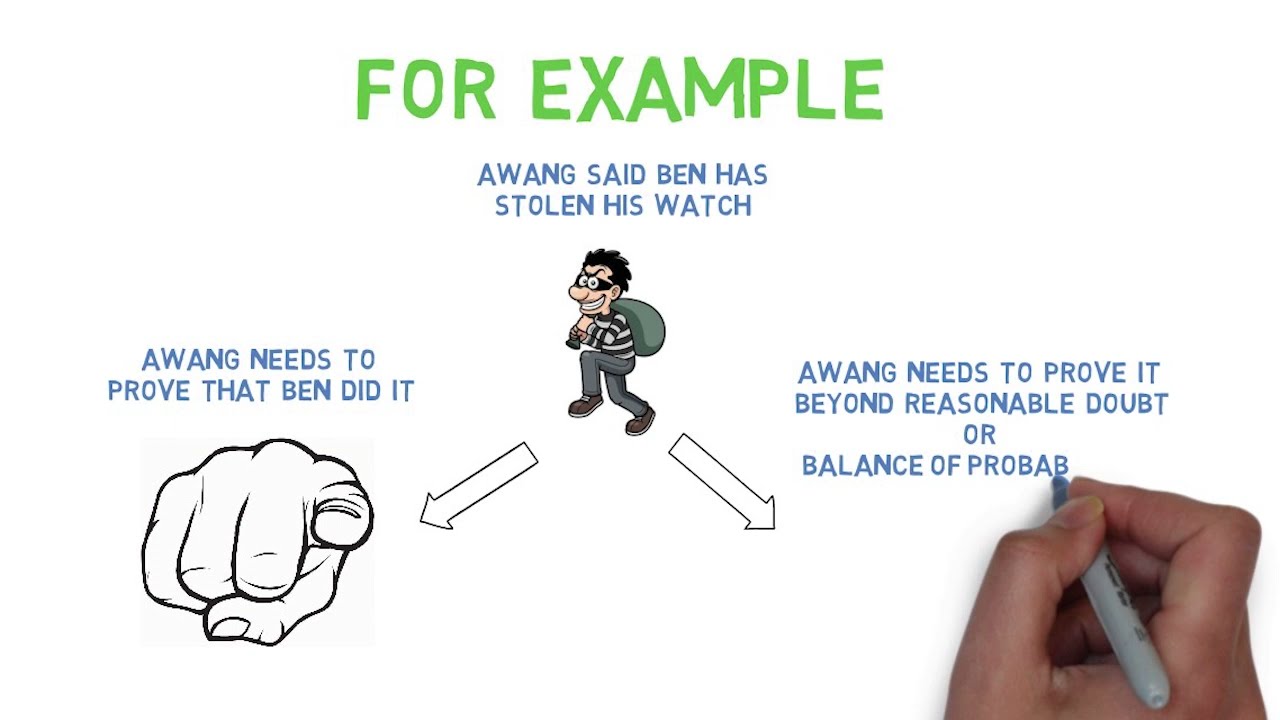
of trial to begin it's helpful to keep in mind the difference between the burden of production and the burden of persuasion a burden of production is the burden to come forward with some kind of evidence a party fails to satisfy this burden if he or she fails to introduce any relevant evidence on the subject in contrast there are traditionally three different burdens of persuasion the most difficult burden to satisfy is proof Beyond Reasonable Doubt this of course is the standard in criminal cases we place this heavy standard on prosecutors because our society would to paraphrase
William Blackstone rather have 20 guilty people go free than have one innocent be convicted Blackstone BT dubs was the first great legal Treatise writer uh an economist might similarly say because the harms of false positives are far greater than the harms of false negatives uh we make it harder to convict courts annoyingly have res resolutely refus to express proof Beyond Reasonable Doubt as a particular probability but if you had to you might think of this as requiring prosecutors to prove guilt by more than a 99 or 95 uh perc likelihood the most lenient burden of
persuasion is the preponderance of the evidence standard here the requisite element must be proven to be more probable than not this can be Quantified as a requirement of something more than 50% likelihood in between the preponderance and Reasonable Doubt standard is the third and final burden of proof the clear and convincing evidence standard in many ways we don't know much more than that this standard requires more than a preponderance and less than proof Beyond reasonable doubt it has been used in a handful of circumstances where the defendant might bear a stigma from being found civil
liable or where there are irreversible consequences of a court action for example courts have sometimes required clear and convincing evidence from a plaintiff before finding a defendant civil liable for fraud or in paternity cases and courts require clear and convincing evidence of intent before removing Hospital life support however recently the Department of Education has required universities in non-criminal disciplinary actions regarding allegations of sexual assault by students to cease using a clear and convincing evidence standard and only require complainants to establish sexual assault by a preponderance of the evidence indeed this figure is taken from the
University of Pennsylvania's office of student conduct and says that clear and convincing evidence quote is when it is highly probable substantially more likely than not reasonably certain that the alleged incident occurred it does not mean that there is not some other possible explanation it means that the explanation put forth by the university is convincing unquote let's now use stylized civil suit to think about how these burdens of production and persuasion play out even before Discovery or or introduction of evidence the moving party usually has what might be called the burden of allegation for example if
a civil cause of action has four elements and the plaintiff's complaint fails to make an allegation that the fourth element is present the defendant can demur uh or in modern Parliament move to have the case dismissed for failure to State a claim by the way be sure to pronounce deur with two syllables and without palletizing the u the legal term deur can be used as either a noun or verb she filed a demur or he demurred the non-legal word demure is an adjective which means modest or shy now imagine that a civil plaintiff is satisfied
what I think of as her burden of allegation by satis satisfactorily making allegations with regard to the requisite elements in her complaint then at the close of Discovery but still before trial the defendant can move for summary judgment if the defendant can show that the plaintiff has failed through Discovery to produce sufficient evidence to show that a genuine issue of material fact exists with regard to one of the elements that the plaintiff has the burden of establishing at trial it's important to remember that summary judgment can also be brought by uh the plaintiff with regard
to issues that it bearss the burden of establishing at trial and with regard to affirmative defenses that the defendant has the burden of persuasion of establishing a trial there will analogously these uh motions for summary judgment will analogously be granted if the plaintiff can show there exists no genuine issue of material fact with regard to the uh issue that the plaintiff is moving on so then during the Civil Trial if the plaintiff during its case in Chief fails to introduce sufficient evidence so that a rational juror could conclude that the plaintive had met its burden
of persuasion usually preponderance of the of the evidence with regard to a particular element then a court may direct a verdict for the defendant for such failure introducing sufficient evidence to preclude a directed verdict on each of the uh required elements is sometimes described as establishing a prima fascia case uh sometimes this shifts the burden to the defendant to establish some affirmative defense uh at other times the burden of persuasion remains with the plaintiff but the defendant is allowed by int introducing its own evidence to rebut or negative the persuasive power of the plaintiff's evidence
to give a more detailed example of how shifting burdens can play out consider the McDonald Douglas standard for establishing disperate treatment discrimination the framework as currently applied by courts is as follows in the first stage the plaintiff must first establish a primacia case by preponderance of the evidence that the defendant discriminated against the plaintiff uh in some adverse uh employment decision because of the defendant's race then in the second stage the burden of production shifts to the employer to rebut this Prim ofaa Case by quote articulating some legitimate non-discriminatory reason unquote for the defendant's decision
this is not a burden of persuasion but merely a burden to articulate and produce some evidence of non-discriminatory reason or reasons for the decision at that point the plain and this is now stage three the plaintiff employee may prevail only if he or she can show that the employer's non-discriminatory reason is merely a pretext for the Behavior Uh and that and that the behavior was actually motivated by uh race discrimination even though the employer Bears a burden of production in the Second Step courts say that the plaintiff Bears the burden of persuasion at all times
and now for discussion in a university disciplinary setting for sexual assault what are the relative harms to the complainant and accused of type one false positives and type two false negative adjudicate uh adjudication errors and do these justify a preponderance of the evidence standard [Music]