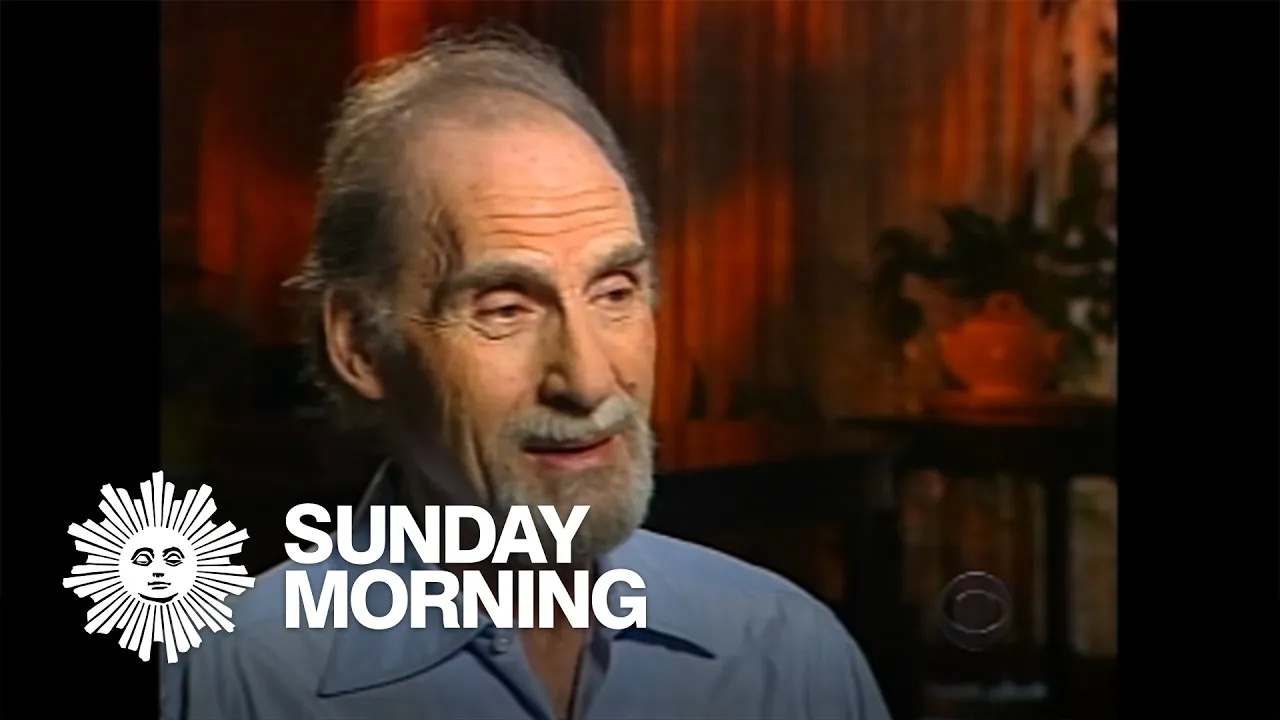
in the cool of the you have to go back a bit to what seems now to have been a simpler time. Television was very young. And if you were fortunate enough to own a set, odds are on Saturday night you were watching Sid Caesar.
What is your name? John Baxter. John Baxter, you're fired.
Isn't it true that jazz originated in New Orleans before World War I? There was a war. Somebody drove a car right through his front window.
You drove the car sooner than the car window. There was no star bigger than Sid. He shared space in the pantheon with Lucille Ball and and Milton Burl, but not many others.
Perfume spritz and perfume. He was a magnificent performer in the eyes and he burned out very quickly, I think, because it was so highowered. Everybody watched him weekly with, you know, fanatic devotion.
And then you grab it like this. Yeah, it was a ritual. And then go.
Caesar was a former saxophone player who'd gotten his comedic start doing sketches in the Coast Guard. It's a heavy plane. Then in 1950, when Sid Caesar was 27, NBC tapped him to star in a new television program.
Your show of shows, an hour and a half of top-notch entertainment. It was live every Saturday night, 39 weeks a year, co-starring Immigene Koka, Carl Reiner, and Howard Morris. The comedy was smart.
What they'd call today cutting edge, timely. It's a wonderful feeling when the audience laughs. Oh, that's like that's the payoff.
What is that like? What was it like to be such a big star and be oh 29 30 years old? I didn't know.
I was too fast. It really I didn't really appreciate it. I really didn't because I was so busy doing shows.
Many of Caesar's finest moments like the couple fighting to Beethoven's fifth haven't been seen since they were broadcast live nearly half a century ago. Only now have the old grainy kinoscopes been pulled from a vault where Caesar had kept them and digitally restored on DVDs and videotapes, making it possible once again to try to decipher Caesar's famous double talk. Today, at age 79, he still speaks perfect gibberish.
What did you just say? Nothing. Everything was gristed for their comedy mill.
This is your story. Even their own young medium. This is your story.
Take off. This is your life. Lol.
Remember me, Uncle Goopy. You can't watch that sketch without laughing out loud. It's It's actually It's impossible.
You know that. It's You know, we never rehearsed that. Many of today's television comedies, from sketch shows like Saturday Night Live to situation comedies, can trace their roots back to your show of shows.
Just want to say I love you. After four years of your show of shows, Koko went off to do her own program and was replaced by Nanette Febra. The show, now called Caesar's Hour, ran until 1957, continuing a diet of sketches and parodies like Aggravation Boulevard, the story of a silent screen star on the verge of talking.
Do you realize what talking movies will mean for you? at last. The sketches were the work of perhaps the most extraordinary group of writers ever assembled for one broadcast.
What I think that Sid had was a remarkable eye and ear for the writers. Playwright Neil Simon was one of those writers. Almost everyone who came out of that show went on to write theater and films and television and be successful in all of them.
Mel Brooks and Woody Allen wrote for Sid Caesar. So did Larry Galbart. It was a very charged room.
A lot of very gifted people, a lot of very neurotic people. And um uh there was a lot of electricity there. Galbart, who went on to write the TV show MASH and the movie Tootsie, created one of Caesar's most memorable characters, jazz musician Progress Hornsby.
66. On the bongos, we have the incredible Johnny Schwinko. On the siren, we have pop screaming yo-yo.
On radar, we have Nikto Barada. You have radar. Oh, is Trey necessary?
Oh, is Trey necessary, sir? Whenever we play, we must be warned in case we approach the melody. I see.
The writer's room has attained a kind of mythical status. What was it really like in there? You had to know your business because these guys were they were geniuses.
When I first sat down with these fellas, I said, "Check your egos at the door. There's no egos here. It's what's good is good and what's no good is no good.
" I should have been impressed, but I wasn't because I I was I was a cocky kid and I was filled with hubris and uh and this marvelous ego and I thought I was God's gift to creative writing and turned out I was. You know, Carl Reiner used his experience in the writer room when he created the Dick Van Dyke Show. One more joke, we can call it a week.
Yeah, one more week joke, we can call it a month. Do you smell something? Mel Brooks did too in the film My Favorite Year.
Oh, it's your monologue. Oh, what a stink burger. It is called Stella.
And so did Neil Simon in Laughter on the 23rd floor. Stella, a hit play that was made into a movie for Showtime with Nathan Lane in the role based on Caesar. That's good.
Good joke, Kenny. What do you mean, Kenny? It's my joke.
Who cares? I think I came pretty close to at least paraphrasing the truth. Sid was both the funniest man that I've ever worked with and the angriest.
What he was angry about, I don't know. I remember walking into his dressing room on the night of uh the show on a Saturday night and putting on his makeup and he was talking to the mirror and saying, "Go make us a fool of yourself in front of America. " I think that's what he was afraid of.
There was such a mixture of laughter and terror because you knew that 9:00 Saturday night you had to be there. Rain or shine. That's it.
Not all the sketches went as planned. Like the spoof of the film From here to Eternity. Tonight I can forget the dance hall with all the smoke.
Now the guys are throwing pales of water. The staging. Well, the first pale of water was Ooh.
chilly. Then we got another pale of water. Another pale of water.
And finally it got the bit was coming in so fast that every time he open our mouth to talk a mouth full of water tonight. In real life Caesar was having a rough time with his own success. Sid after every show would go backstage and have a tumbler of scotch like that.
It was heartbreaking to us because we all loved him. You had it all. You were famous.
You everyone knew you and loved you. You had a ton of money, making a million dollars a year, which was a lot of money back then. Those days.
Yeah. Why did Why did it fall apart for you? Because I couldn't keep it up.
I was fooling myself and I was getting more tired and more tired. I would take starting to drink. I was starting to take sleeping pills cuz I couldn't sleep.
It wasn't his addictions though, but the very popularity of television itself that came to bury Caesar's hour. Sketches about foreign movies and opera and jazz all appealed to the television viewers of the early 1950s because they were more educated, more affluent, and could afford to buy one of these, a television set. Once the prices began to come down and everyone began buying TVs, the networks decided to program more to the mainstream.
I don't think we were too smart for the room. I think the room got bigger and um um this was just kind of a boutique show and and and couldn't survive. ABC put an accordion player from North Dakota up against Caesar's hour.
Lawrence Welk was the guy who uh who knocked me out of the box. He outdid me. Caesar was just 34 when the bubble burst on his weekly program.
After that, he did some movies like Greece and It's a Mad Mad Mad Mad World and television specials and theater. It would be many years before he could give up his addictions. I was doing a play in Canada and I came out and I couldn't remember my lines, which never happened to me.
And that's when I stopped drinking and I stopped taking pills just like that. Oh, you shake a little bit. And while he continued working for years, never did his flame burn as brightly as it did when Caesar ruled Saturday nights.
From here, here in the front, from the back, the back coming here. Do you think that what was being done back then would simply not be seen as funny today? Some of the better sketches we did would still be hilarious, but I don't think that's a test of the material or or Sid Caesar.
I mean, nothing is meant to last except maybe the Mona Lisa and a few other great thousand paintings. He had a fantastic run. I just wish it had gone on a little longer.
What's the legacy of Sid Caesar? The legacy is of uh comedy. I made people laugh.
When you make people laugh, they're getting better. That's a wonderful thing to feel.







![Cozy Spring Morning Picnic 🌸 Acoustic Lofi | Relaxing Study & Work Music [ACNH]](https://i.ytimg.com/vi/3xnUcQhAzBI/mqdefault.jpg)