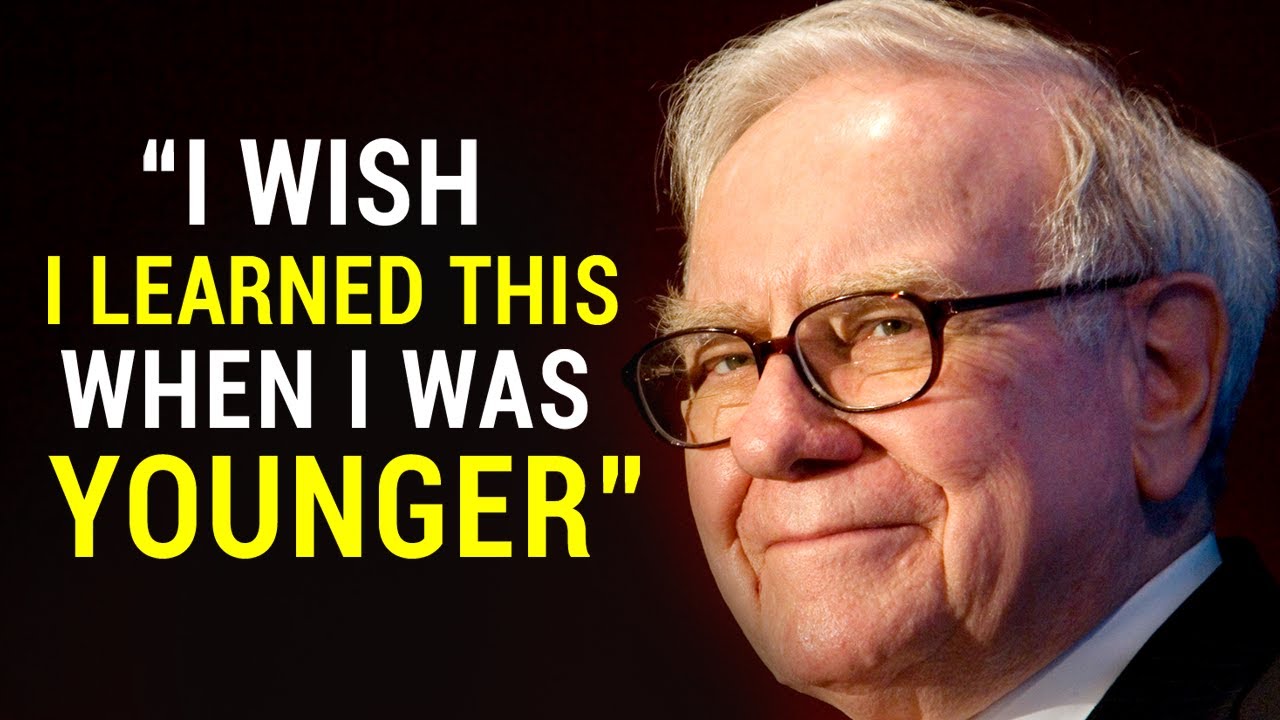
Did you know that Warren Buffett, one of the richest men in the world, began his journey to wealth at the early age of six by selling cans of Coca-Cola to his peers? He earned more than half of his current $7 billion fortune after 50 years. Such a seemingly short and very surprising fact proves the incredible range of human capabilities, regardless of age.
And now, thanks to Warren Buffett's outstanding advice, you will learn how to fundamentally change your life and financial situation for the better. Whether you are 20, 35, or 50, be warned: some of the tips may even shock you and make you act immediately, as it happened to me. This is the Money Channel—subscribe and start getting rich with us!
Warren Buffett once said, "You only need to do a few things right in your life if you don't do too many things wrong. " The essence of this quote is that you have to make the right and smart decisions every day. It is only through making the right decisions daily that a person can dramatically change their life for the better.
What decisions are worth making today? More on that later. Define success by your internal scorecard.
When you set goals for yourself, don't fall into the trap of evaluating them from someone else's perspective. Evaluate yourself using your internal scorecard, the one Warren Buffett has always used. In essence, do not do what is right for society, but what is right for you.
The internal scorecard defines your own standards, not what the world imposes on you. This is a principle that Buffett learned from his father. We often fall into the trap of basing our next steps on other people's opinions.
Use your own view of the situation and the world in general, based on your values and beliefs. According to Buffett, this is the true path to success. When you set a goal, evaluate it carefully for yourself.
Think about what you will gain from achieving it and how satisfied you will be if you achieve it. If you start thinking about how other people will judge your plans and actions—what will they say, and how will they react? —get rid of those voices in your head immediately because they will stop you on your way to prosperity.
Surround yourself with mentors. Warren Buffett has often cited the importance of mentorship in his career development. For example, when he was a student at Columbia University, his teacher and mentor was Benjamin Graham, an economist and 20th-century investment guru.
In the preface to Buffett's book *Security Analysis*, he writes, "Graham changed my life. " Success depends on surrounding yourself with the right people. Warren recommends choosing colleagues and friends whose behavior is better than yours.
In this way, you will seek to improve yourself by looking back at those around you. Connect with those who can potentially help you learn new things, grow, and advance your career. The other half is the key to a successful career.
Essentially, this advice is complementary to the previous one, but it is more specific about what you need to do in the area of relationships. Studies confirm that people with relatively reasonable and reliable partners tend to be more successful in their careers, earn more money, and feel more satisfied with their jobs. Of course, this doesn't mean that you should go looking for the right partner right now or dump the person who might be dragging you down.
But take a good look around you and think about what might be demotivating you in a relationship and how it's affecting your professional success. Perhaps it is you who can help your loved one become a better person and thus have all your activities—both at work and home—move in the direction of improvement. It is not for nothing that Warren Buffett recommends marrying the right person.
Associate with the personality you would like to be; the billionaire assures it will change a lot in your life. Protect your reputation at all costs. "It takes 20 years to build a reputation and five minutes to destroy it," says Warren Buffett.
He believes that if you think about your actions in this way, they will take on very different forms and meanings. According to the billionaire, anyone seeking financial freedom should stay true to their values even in the most difficult and stressful situations. Buffett recommends that people evaluate every move they make.
In this way, you will be in control of your actions and your reputation, and you will be able to remain a respected person, business partner, or colleague. Sometimes, it's worth the wait. Another great tip that complements the topic of protecting your reputation is this: more than 40 years ago, Warren Buffett was given this advice by former Capital Cities media executive Tom Murphy.
According to the billionaire, he has long considered it some of the best advice he has received in his life and shares it with others. Here's what Murphy told Buffett: "Warren, you can always send them to hell tomorrow. " In tense situations, the smartest thing you can do is often to keep quiet.
If you don't hold back and lose your temper, you're likely to do something you'll regret later. Unfortunately, you can't take back what you say. The billionaire says that you should not think about the fact that you might miss an opportunity; just forget about it for a day.
But if you feel the same way the next morning, then speak up. Don't act on your anger. Buffett isn't saying you shouldn't express your feelings; on the contrary, he advises you to stop and sort out your feelings.
Doing so will give you time and space to think, which will help you make better decisions. Write your obituary—a rather unpleasant task, you’ll agree—but Warren Buffett is sure it will spur you into action. A text dedicated to yourself after you die: how you want it to characterize you, what will be written about your activities.
Think carefully about what will be your literally the last text of your life, and now is the time to start living up to your obituary. Buffett reminds us that we have very little time; it is our most important resource, and it is in no way replenishable. Periodically open your obituary and evaluate your life.
If you realize you've taken a wrong turn, get back on the path described in the text. The billionaire is convinced that this will open your eyes to many things. Find the meaning.
Buffett once said that in business, the greatest success is achieved by those who do what they love to do. Set a goal to find your favorite thing to do—a craft to which you give yourself wholeheartedly. A favorite business gives a person a purpose that fuels the desire to get up in the morning.
Find meaning in what you do, or find a business where you can all find meaning. To be fully engaged and happy, you need to feel that your work matters and that your contribution is making a difference. Warren Buffett said, "I know a lot of people who have a lot of money, throw big dinner parties, and have hospital wards named after them, but the truth is nobody in the world likes them.
" That is the ultimate test of how you live your life: the more love you give, the more love you will receive. Find a favorite thing to passionately love; surround yourself with the best of the best, both at work and at home. Appreciate every second of your life and reach new heights.
To start living in prosperity, the WebWisePad platform can help. It's a service that allows anyone to start investing in promising projects at the stage of private rounds under exclusive conditions, similar to venture capital funds which are not available to ordinary investors. The difference between WebWisePad and other similar platforms is the maximum simplicity of participation conditions.
To invest in private rounds, you just need to make a few clicks in WebWise Telegram Wallet, a secure cryptocurrency wallet integrated into the increasingly popular Telegram messenger. The platform independently searches for and selects the best startups, has partnerships and discussions with dozens of venture funds, negotiates, and achieves the most favorable conditions for users. As you can understand, you just need to grasp the mechanics of investing.
In addition, WebWisePad offers a unique opportunity to invest in primary wallet offerings at the private round stage. The strength of this offering lies in the openness of the investment process and the security of the investments themselves. In March, the platform hosted the first closed sale of the Plan of Finance project, which was completed in less than a day.
The next sale is planned for the near future, with a well-known project that has strong investors and partnerships selected. In addition, you can participate in a contest on the Ze platform, where you can share a prize pool of $4,000 for completing simple tasks. WebWisePad is already being talked about by the world's famous media, and you can also find more information by following the links in the description.
Warren Buffett's financial advice has inspired hundreds of millions of people, and not for nothing. Buffett is 93 years old and has seen hundreds, if not thousands, of different money-related situations in his life. One thing is clear: Warren Buffett is still among the top 10 richest people in the world, and what he knows is how to become the man he is today.
The following five habits will lead you to the financial abyss, but once you learn them, you will be on your way to wealth. The first bad habit is not having a budget. A budget is a financial plan that outlines your income and expenses.
It helps you set financial goals and make informed decisions about how to allocate your money. Without a budget, it is easy to overspend and get into debt. If you set a goal now to create and maintain your own budget, you will begin to improve your wealth in a significant way.
According to Buffett, first and foremost, a budget helps you understand your financial situation. By tracking your income and expenses, a person can clearly see where money is going and identify areas where you can cut back on spending. A budget is the foundation for achieving financial goals; by setting them and allocating funds to achieve them, you can make significant progress on items such as saving for a down payment on a home or paying off debt.
In addition, by setting spending limits in your budget and sticking to the goals you set, you can avoid overspending and the financial problems that come with it. Most importantly, by referring to your budget regularly, monitoring it, and adjusting it as needed, you will know that you are on the right track to achieving your financial goals. The next unhealthy financial habit is rewarding your neighbors or keeping up with the Joneses.
The latter is when you compare yourself to others and try to match their financial status and lifestyle. Buffett asserts that this leads to great financial difficulties because when you think about the welfare of others, you will constantly feel the need to buy the latest products or use expensive services to keep up with colleagues and acquaintances. For example, Warren Buffett himself still lives in a house that he bought in 1958 for $31,000.
Competing with others financially leads to several major problems. First, it results in overspending and debt. By trying to keep up with others, all your real spending will go to waste because you will be spending more and more money, which will eventually lead to debt.
Second, such competition puts your personal. . .
Financial goals on the back burner because your primary goal becomes keeping up with the Joneses. Finally, feeling like you have to keep up with others affects your mental health. It's important to find your own exceptional financial path.
Warren Buffett advises that way you can focus on your financial goals and priorities and live within your means, which will ultimately lead to greater financial security and stability in the long run. Like the video if you want to achieve total financial freedom! Let's see how many of us there are and motivate each other to achieve even greater success.
Not having an emergency fund is another habit that will lead you to financial ruin, says Warren Buffett. An emergency fund is a savings account set aside for unexpected expenses. It is an important part of any financial plan because it provides a financial cushion in the event of an emergency, for example, a sudden job loss or health problems.
Warren Buffett says his company, Berkshire Hathaway, always has a large capital reserve for emergencies. Having an emergency fund helps avoid debt, provides financial security and peace of mind for unexpected expenses, and most importantly, helps weather financial storms. When building a reserve fund, Buffett advises following a few key tips.
First, set up a goal for the fund; determine how much money you want to have in it and plan to set aside certain amounts to reach that goal. You don't have to save a lot at once, but start small and increase your savings gradually. Then, consider setting up automatic transfers to an emergency fund to make saving easier and more stable.
Always look for ways to save and put that money into an emergency fund. Most importantly, be patient; building a fund takes time, but it's worth it for your own stability, peace of mind, and financial success. Warren Buffett considers impulse buying to be one of the worst habits.
Although it is very tempting, it often leads to financial difficulties. When you make this type of purchase, you do not think well about your decision and its possible consequences. However, the lack of impulse buying is a huge advantage in personal finance, because it keeps most of the money in your wallet.
Buying impulsively exposes you to overspending and debt. By buying without evaluating the situation, you spend more money than you can afford, which can lead to debt. When you make impulse purchases, you don't think about your financial goals, which can prevent you from achieving them.
In addition, such purchases can often be disappointing over time; you'll regret them when you realize the purchase wasn't necessary or didn't reflect your values. To avoid impulse spending, follow Buffett's advice: take a step back and think about whether this is the right financial decision. If you go to sleep with these thoughts, you're more likely to change your mind about the purchase in the morning.
When you create a budget, include these types of expenses first; that way you will allow yourself to make them, but you can still put limits on them. Make shopping lists before you go to the store. This is another effective way to avoid impulse spending.
Also, try not to shop when your emotions are running high, as they can cloud your mind and make you more prone to impulsive buying. Not having a financial plan is another equally important habit to get rid of. Warren Buffett recommends that a financial plan is a road map that outlines your plans and the steps you will take to achieve financial success.
Without one, progress toward financial independence can be hindered. Warren Buffett's financial plan as a child was to become a millionaire by age 30, and it worked. A financial plan helps you understand your true financial situation; by creating one, you will get a comprehensive look at your income, expenses, assets, and debts, as well as determine what you want to accomplish and set specific goals.
By creating a financial plan, you will also be able to outline the specific steps you need to take to achieve your financial goals, including savings and investment strategies. Only by working together on this plan will you be able to stay on track. Prioritizing your financial goals, making decisions based only on hard numbers and data, and regularly tracking your progress will motivate you to do even more.
All of this is possible with a financial plan that will help you reach your goals faster. Harness the power of compound interest. For those who don't know what it is, let me explain.
Compound interest is the accumulation of interest on the principal amount invested and the interest already earned on it. With compounding, your balance will grow faster over time as you earn interest on a larger and larger amount. As a seasoned investor, Buffett probably knows what he's talking about.
Even the smallest amount of money, if allowed to grow—albeit at a negligible annual percentage over a relatively long period of time—will eventually turn into a decent amount of money. This is Warren Buffett's way of emphasizing the tremendous impact that compound interest can have on your wealth. Avoid debt.
If Warren Buffett could give people one piece of advice, it would definitely be about debt. Of course, the modern world beckons with interesting loan and installment offers, and besides, having extra money in your pocket always makes you feel more confident about the future—at least at first. And then, when you have to pay off that debt, you will remember Buffett's advice.
Here are a few actionable tips to stop living in debt: First, get your finances under control. If you already have debt, calculate its total amount; for example, determine how much money you owe to friends and family and how much you need to set aside to pay off the loan. Then, set a goal to pay off all your debts in a certain amount.
Of time, soberly evaluate your options. At the same time, learn to distinguish your real needs from those imposed by aggressive advertising. Before you buy something, think about the importance of that service or thing, whether it can be replaced by a cheaper option, or whether there is an option to wait and make the purchase later.
And perhaps most importantly, make the decision to stop right now. You have borrowed or lent for the last time—don't do it again. Be skeptical of get-rich-quick schemes.
Warren Buffett knows from personal experience that trying to get rich quickly is one of the two most common financial mistakes. For this reason, the famous billionaire recommends always taking the long view when it comes to investing. Look into the distance and analyze what will happen in one, two, or even seven years.
Buffett is sure that getting rich slowly is quite easy, but getting rich quickly is not easy and is usually risky. That's why the billionaire is very cautious about modern financial tools like cryptocurrencies, and he never invests in areas he doesn't understand. Understand accounting principles.
This advice may seem too complicated to understand, and even more to apply in everyday life, but believe me, it is thanks to accounting that Warren Buffett and all of the investors of his company, Berkshire Hathaway, have been able to make millions and billions because they know how to analyze companies and choose which ones are most likely to become good investments in the long run. Where to start learning? First of all, with the understanding that you can do it for free, and do not break into the first courses at exorbitant prices.
There is enough information on the internet, both for beginners and for those who understand some accounting principles. The main thing is the desire and understanding of the importance that this information will bring you. When you are sure of the opportunity, take full advantage of it.
Once you are fully convinced of the reliability of the tool for enrichment—having understood its financial details, figures, and data—that is, having decided that you should take advantage of this opportunity to get rich, use it to the maximum. For example, almost half of Warren Buffett's investment funds are invested in Apple. Shares of the tech giant were first bought by the businessman in 2016, and since then, this process has continued.
From time to time, has Buffett missed out on such a purchase? Undoubtedly not, but everything was thoroughly analyzed before committing. However, remember that you should not put all your money in one place.
Diversifying your portfolio, i. e. , investing in different sources of profit, will help minimize the risk of losing money.
Commit to personal development. Businessmen often talk about the importance of brain and body improvement. If you want to have enough strength and energy throughout your existence, it's important to improve yourself every day.
It requires, first of all, a desire to change, and then a plan to maintain that change every day. It is the constant pursuit of development that is not an easy thing; to stay energized and on track, ask yourself the following questions: What is important to me? What do I want to achieve in my life, in my well-being, in the spiritual aspect?
What improvements do I need to make to reach these goals? What do I need to do to be healthy in body and mind? Find a key question, or better yet, several that will motivate you to take action.
Use your time wisely. Remember that time is our most precious resource, says Warren Buffett. It can be wasted, or it can be used to your advantage.
Manage. If you have extra free time, try to make the most of it—study, learn new skills, gain experience; in short, increase your opportunities, not sit around watching TV shows. Here's how to improve your use of time: make a to-do list for each day.
Also, determine how much time you will spend on a particular task. That way, you will know how much free time you have left, and you'll be able to allocate it intelligently to tasks that will increase your income and overall development. Keep money circulating because it is endowed with energy.
Money feels your attitude toward it. This may seem like something out of fiction, but trust me, Warren Buffett knows what he's talking about. If you spend money on nonsense, money will come to you in large quantities.
Being cheap doesn't count either, so differentiate your income and spend money on different but useful activities: buying things you really need, investing with interest, setting aside money for expensive and important purchases, giving to charity. This will keep the money circulating and bring you more serious amounts. Take a good nap.
On your way to the top, you need to rest. Don't forget to get a full seven, eight, or possibly nine hours of sleep, Buffett advises. If you can carve out some time for naps during the day, according to scientists, napping is actually a good idea.
Researchers believe that a short afternoon nap has numerous health benefits. Sleep experts believe that such a habit supports overall brain health, improves memory and concentration, and even prevents the development of a devastating disease. Change your mindset.
Many of us have grown up with the attitude that being rich is shameful, bad, and almost unrealistic. Literary works and movies often portray a wealthy person as greedy, evil, cruel, and inhuman—always getting into some kind of trouble. And since the psyche tends to associate itself with a positive hero, the idea that having a lot of money is bad and dangerous is literally hammered into the head of a child, as well as an adult.
Parents in the immediate environment can contribute to this. Buffett says that if you want to increase your own income, you need to do a lot of. .
. Independent work: you may sincerely believe that you can't make a lot of money, that wealth is only available to a select few and to those who were born into a wealthy family. Believe me, these psychological blocks can be more serious than the difficulty of determining your passion, so try to fight them and deactivate them.
Remember two key words: Warren Buffett may have one more principle that he has followed over the years: live modestly, which is exactly how the billionaire believes anyone trying to get rich should behave. For Buffett, frugality is important because it allows you to save and invest more, which will greatly affect the path to wealth creation. By living a frugal lifestyle and avoiding unnecessary expenses, you will be able to devote more resources to investments and financial goals.
For example, Buffett still drives a 2014 Cadillac XTS that he has owned for about a decade. The same goes for where he lives: Buffett lives in a house he bought in Omaha in 1958. Yes, Warren probably owns other properties as well, but his primary residence is in that particular house he bought over 65 years ago.
So, living modestly is definitely about Warren Buffett. If you enjoyed this video, please like it. Write the phrase "I can get rich" in the comments—just those words: "I can get rich.
" By doing this, you will anchor a process in your brain that is already in motion. You are giving yourself a signal that it is time—time to take action—and you will be able to reach new heights in the near future. This is the Money Channel.
Subscribe and get rich!