This video is part 2 of a series of videos on the research and writings of a US non-profit called Strong Towns. If you haven't heard of them yet, you might want to watch part 1, but it’s not strictly necessary. If you travel to cities all around the world, you’ll start to see surprising similarities in the way they’ve been built.
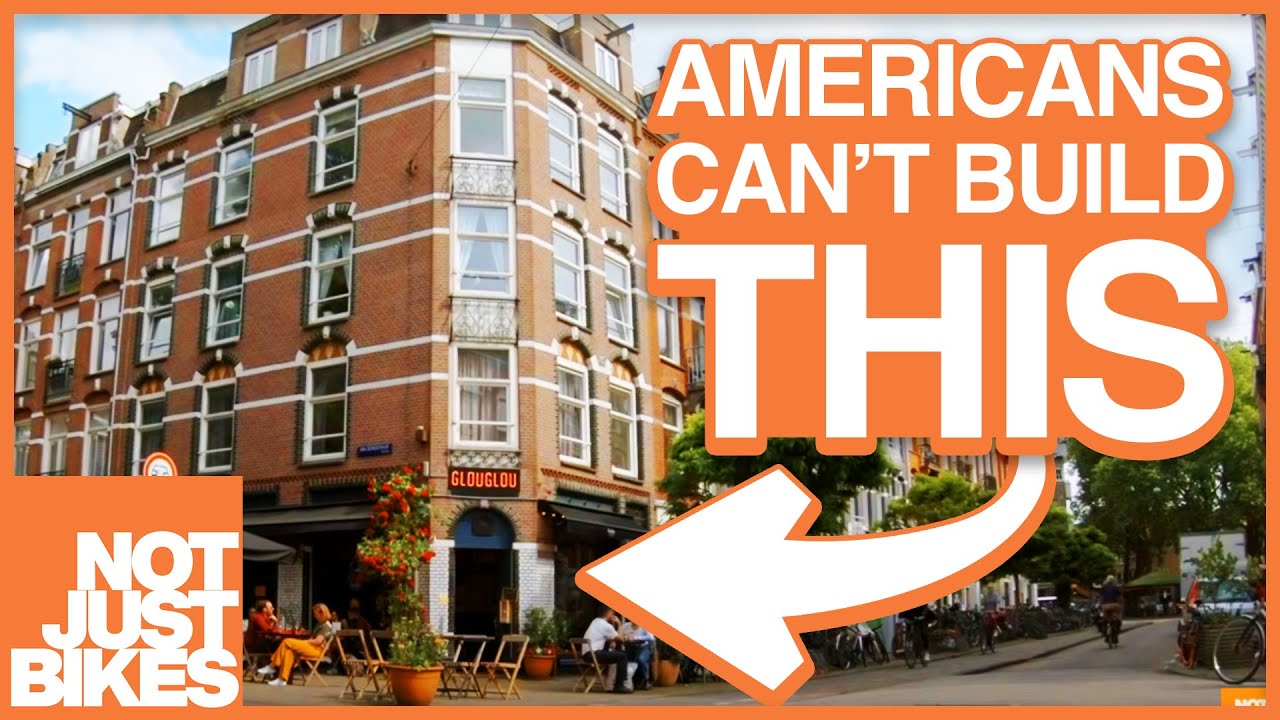
For centuries, cities were designed such that everyone had what they needed within walking distance. There may have been horse, rail, or streetcar connections between places, but once you got to where you were going, you could access everything you needed to on foot. Streets and public spaces were designed like an outdoor room, places that feel comfortable to be in, and enjoyable to walk in.
These are the kind of places Americans go to on vacation, and then return home to their depressingly soul-crushing dystopian car-dependent suburbs. There’s always a fine-grained mix of uses. A very typical configuration is commercial properties on the ground floor, with apartments or offices above.
Most critically, these properties are flexible: a shop might turn into a house, and a house might turn into an office. These are places that could flex and change depending on how the city evolved over time. And it’s no surprise that even when you look at ancient Roman cities, the same pattern was there, as well.
In the late 1940s, America started on a very different path. What Strong Towns calls “The Suburban Experiment”. [This is the american dream of freedom on wheels.
] [An automotive age, travelling on time-saving superhighways. ] [Futuramas. ] [Free-flowing channels of concrete and steel] Instead of incremental development around existing infrastructure, huge neighbourhoods were built from scratch on the edge of town.
And instead of a mix of uses, residential neighbourhoods were completely separated from commercial buildings, requiring a car to get between them. This probably seems normal to most people living in the US or Canada today. Since the Suburban Experiment began, several generations of people have grown up not knowing anything different.
I certainly didn’t, until I moved overseas. But understand this was a drastic change from thousands of years of city evolution that we’ve had to date. We’ve now had over 70 years of the Surban Experiment.
And we now know that the experiment has failed. And it’s not just because these suburbs are ugly, devoid of life, and soul-crushingly sterile. It goes deeper than that.
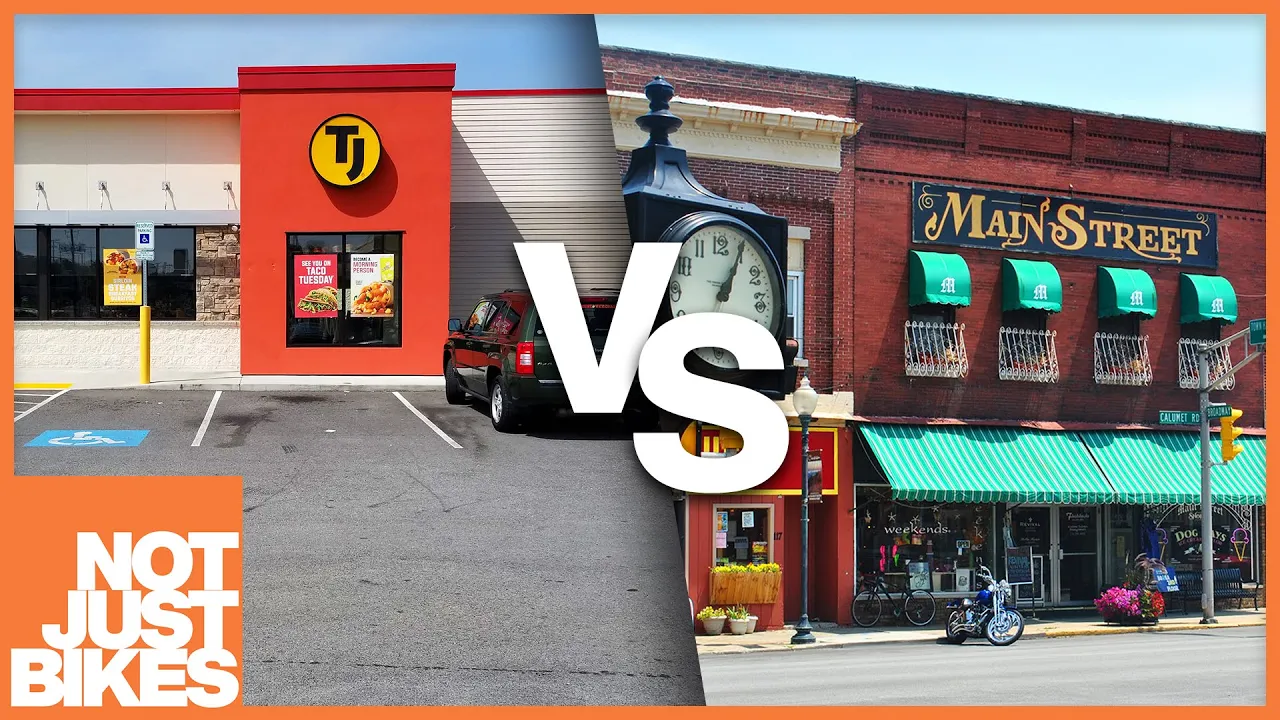
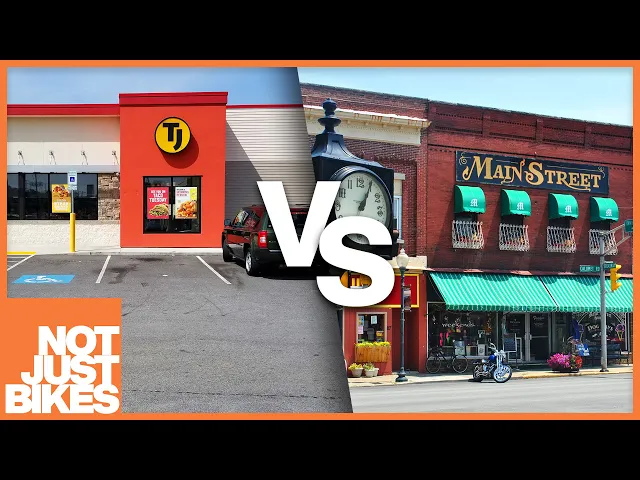
Strong Towns has dozens of case studies showing why this is true, but I’ll share one of their most prominent ones here. Now, Strong Towns actually explains this beautifully on their own YouTube channel, so if you’d rather hear it from them directly, instead of listening to some random YouTuber, you can click on the link in the top right corner. These are two identical blocks in a small town called Brainerd, in Minnesota, the hometown of Strong Towns.
They are exactly the same size, they are on the same road. They are serviced by the same infrastructure, they cost the city the same amount of money to maintain. They are identical in every way, except in their development style.
The first one was built in the 1920s, using the traditional style of development. It is a series of extremely basic structures, effectively the cheapest thing someone could build in this place, in the 1920s. It’s not exactly pretty.
But it’s functional. And it’s flexible enough to meet the changing needs of the city, whether you need warehouse liquor, freedom firearms, or antiques & collectables. But these buildings were never improved upon.
Instead, after the 1940s, the city expanded rapidly outward, like every city in America, building into the suburbs, instead of improving the places they already had. Two blocks over used to look exactly the same. The city labelled it blight, which is urban planner speak for crappy and useless, and they bulldozed it.
Then, a shiny new taco restaurant was opened in its place, using the modern suburban style of development. This development made everyone happy. It was a nice, new-looking building.
It no longer had on-street parking, which improved traffic flow. The sign met the new code, it met the setback requirements, it even had pretty native plants and “greenspace”. [angelic singing] Plus now you could now get Santa Fe burritos and bowls, Pork Street Tacos, Flame’n hot cheetos burritos, and even honey habanero chipotle bbq bold buffalo wing sensations!
Furthermore, local guide Cynthia Endriss said the lettuce didn’t even taste funny. Why would the lettuce taste funny Cynthia? Is this a common problem in Brainerd?
This is literally the American dream. But nobody looked at the financial impact. That first block.
The old, ugly, 1920s-era mis-matched buildings, had a total taxable value of 1. 1 million dollars The taco shop, on the same sized lot, with the same amount of public infrastructure spending, had a total taxable value of 800 thousand dollars. Think about this for a second.
That old, decrepit 1920s block brings over 40% more tax revenue for the city. And that’s after over 90 years of neglect. Meanwhile, that taco shop is new, and it will literally never get any more valuable than it is right now.
It’s only downhill from here. This brings us to a harsh reality: suburban-style development, even at the beginning of its life, cannot outperform traditional development at the end of its life. Strong Towns has many other examples as well, such as this 19 acre double big-box store development, compared to 19 acres downtown.
Despite the fact that the downtown is old, and most of the upper floors are empty, it still brings in almost 80% more tax revenue than the big box store in the suburbs. If you’d like to read more, I’ll link to some content by Strong Towns in the description. We do developments like this all the time in the US and Canada.
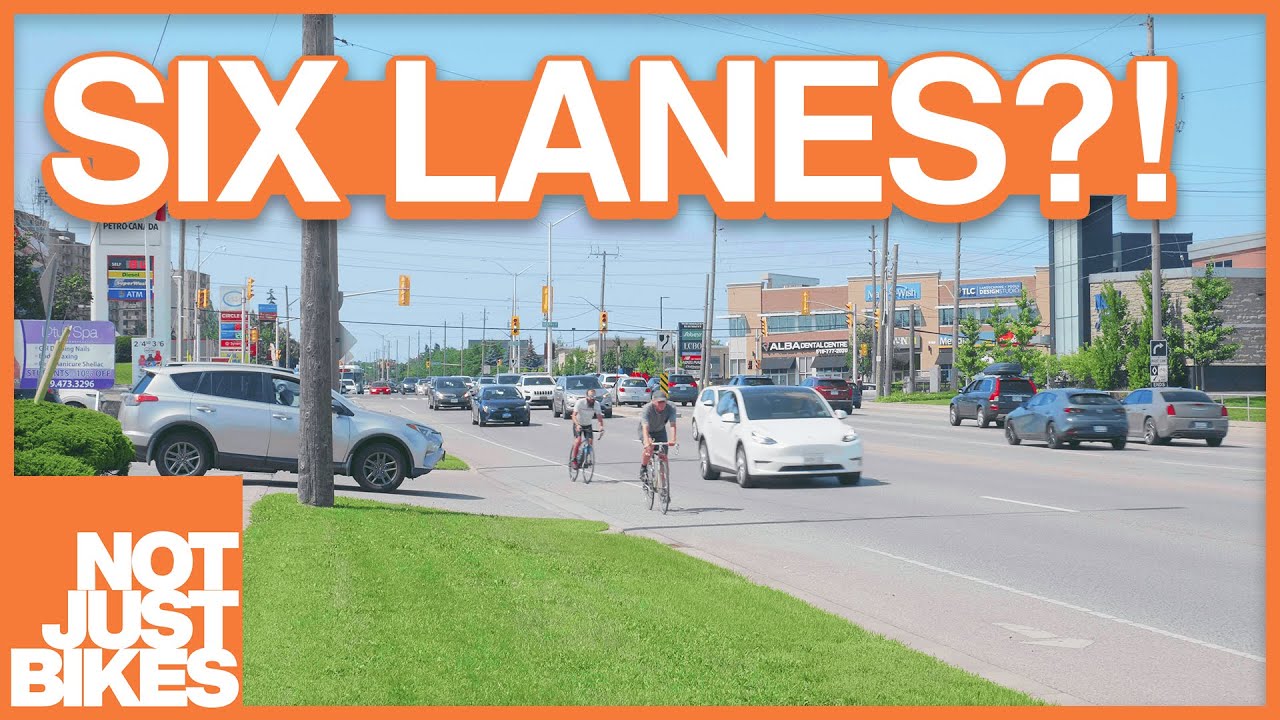
We’re building car-centric developments, often at the edge of our cities, and letting our productive traditional buildings rot away. But here’s where we get back to flexibility. What happens when a big-box retailer moves or goes out of business?
We see the results of this all over America and Canada, especially in the case of Wal-Mart, who typically only occupy their buildings for 15 years. The big box retailer moves on, and the city is left with a giant empty site. Meanwhile, there are hundreds of different tenants in a typical downtown.
What happens when one of them goes out of business? Literally nothing. A small shop might stay vacant for a while, but the area is flexible.
A retail store could become a coffee shop. An office could become an apartment. A liquor store could become a cannabis dispensary.
But in any case, there is almost no scenario where all of these businesses disappear at once. To add to this problem, commercial properties are supposed to be the moneymaker. Suburban houses are even worse.
But I’ll talk about that in more detail in a future video. The American suburban experiment is trading a centuries-proven development pattern, and replacing it with something that is not only financially unproductive, but also extremely fragile. On this channel, I don’t hide the fact that I love walkable places.
I believe that they are more enjoyable to be in, they’re more efficient, and they lead to a better quality of life for the people who live in them. But I now know that car-centric suburbia is not just sucking the soul out of its inhabitants, it’s making them poorer as well. In the next episode in this series, I’ll talk about how these financially insolvent suburban places have propped themselves up for so long, and what that means, for the future of North American cities.
I’d like to thank my supporters on Patreon, who pay me to find restaurants where the lettuce doesn’t taste funny. If you liked this video, consider a donation to Strong Towns, to give me more material to work with. Or if you’d just like to support this channel, and get access to bonus videos, visit Patreon.
![Why American Cities Are Broke - The Growth Ponzi Scheme [ST03]](https://img.youtube.com/vi/7IsMeKl-Sv0/maxresdefault.jpg)
![Suburbia is Subsidized: Here's the Math [ST07]](https://img.youtube.com/vi/7Nw6qyyrTeI/maxresdefault.jpg)
![How Bankrupt American Cities Stay Alive - Debt [ST04]](https://img.youtube.com/vi/XfQUOHlAocY/maxresdefault.jpg)
![Would You Fall for It? [ST08]](https://img.youtube.com/vi/n94-_yE4IeU/maxresdefault.jpg)

![The Truth about American Cities - Part 1 - Strong Towns [ST01]](https://img.youtube.com/vi/y_SXXTBypIg/maxresdefault.jpg)