Forces Association and most especially DAV uh we are so proud and privileged to partner with DAV and it is daav support uh generosity and and commitment to the series that makes uh today possible um we are um so grateful that we've had a long-standing partnership with DAV and uh we encourage as many of you as possible if you're not already familiar with daav um to familiarize yourself With D's amazing programs it's more than one million strong members um and a real inspiring example of um the kind of services and supports that our nation's veterans um
need and have earned through their service um today's event is the 10th uh convening of the daab speaker series and the goal of the series is to bring together important leaders and Advocates to shine a spotlight on the unmet needs of veterans and disabled veterans and Their families and Society um on a large scale to create a platform for both conversation but ultimately action and uh we very much hope that today's theme and our distinguished lineup will fulfill this goal uh we have a terrific uh lineup of of distinguished leaders um from California and Massachusetts
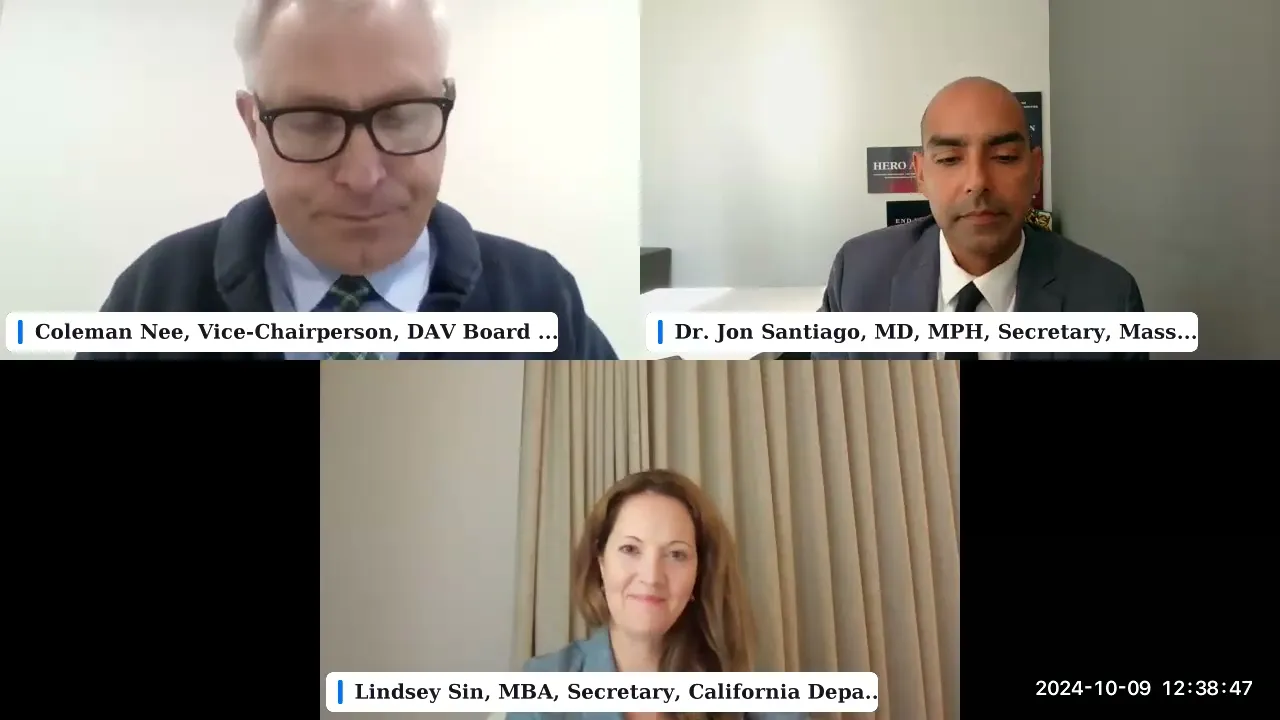
to talk about their work and Innovations happening at the state level focused on veteran services and supports uh our uh moderator will be Coleman NE whom I'll introduce in a moment and uh uh Coleman will then introduced our panels uh our panelists uh but for the moment let me just do a little bit of administrative uh note for everyone which is that we are going to have a Q&A period at the very end uh and you can submit uh your questions uh through the Q&A function not through the chat function but through the Kate Q&A
function in the webinar and the link is at the bottom of your screen and if you Click Q&A you'll be able to submit uh your questions which we'll try to take up as many as we can uh at the end of the program so let me just introduce quickly our good friend uh and uh incredible champion of of veterans everywhere Coleman NE a distinguished graduate of American University from 1987 to 1993 uh Mr n served as a member of the United States Marine Corps Reserve rising to the rank of Corporal where he Also served during
Operation Desert Storm in 2008 uh he was named under Secretary of veteran services here in massachus where he oversaw the creation of a really important program called Statewide advocacy for veterans empowerment which supports veterans and their families coping with the stresses of reintegration uh from military uh service focusing on critical issues like suicide prevention Financial stability and Health in 2011 uh he was named Secretary of our State Department of Veteran Services what is now known as the executive office of veteran services by then Governor Deval Patrick and and as then secretary NE uh he was
an incredible and Powerful leader to bring change and programming and support to Veterans across the Commonwealth innovating uh creating new opportunities and new services and really created a wonderful Legacy that our current Secretary secretary Santiago has now inherited to carry the torch uh forward and importantly uh Mr n is also the vice chair of the DAV board of directors so we could not be more pleased uh to have this esteemed group group together and I would like to turn over the proceedings uh to Coleman please yeah thank you very much Dan uh Professor nean uh
thank you also for your efforts um in convening these important Conversations as well as um as well as for the veterans Legal Clinic at Harvard um I uh uh I would be remiss if I didn't thank not only you and and your staff for for for organizing this and keeping this initiative going uh but most importantly uh to the students the student at Harvard Law School that are participating in the veterans Legal Clinic uh your your your admission into Harvard law says uh says a lot about your academic achievements and your Desire to work hard
and and and your your intellectual capacity but I can tell you the work that you're you're doing with the veterans Legal Clinic veterans um speaks a lot to your integrity your character and your uh and and your your patriotism too support those who've served in uniform and their families so to all of the students who are involved in the clinic please on behalf of DAV and myself as a veteran thank you very much uh it is uh A tremendous honor to be here today uh we have two amazing panelists I'm going to uh I'm going
to give you a brief snapshot of uh who they are and and their as distinguished careers uh I'll start uh uh with uh uh the West Coast uh we will go to secretary Lind sin um secretary sin was appointed Secretary of calvet by Governor Gavin Newsome in May of 2023 after having served several roles of calvet since 2011 uh including deputy secretary of communications and Deputy secretary of women's Veterans Affairs she's the first woman to serve as secretary calette since the appointment of V Virginia May days as director in 75 uh secretary said after graduating
from high school in our hometown of sacr and listed in the United States Navy and served from 1997 to 2005 as a cryptologic technician interpretive in the Arabic language uh she completed two flight tours in Ro to Spain during which Time she supported and support she deployed and support of operation Northern watch Southern watch anduri freedom and Iraqi freedom and achieved the rank of petty officer for cl first class with Naval Aviation and Naval Air crew designations after separating from the Navy uh the secretary returned to Sacramento worked as a lead certifying official for veteran
services at American River College she continued to Work with veterans at Sacramento State as the veterans benefits advisor focusing on developing programs for student vets uh the secretary has a ba in history Magna klaui from sa Sacramento State and an MBA from Drexel University and she resides there still with her family in um in uh California and Sacramento um additionally um we also have uh as as was noted uh secretary John Santiago who Uh was sworn in by Governor Healey and lieutenant governor Kim Driscoll as the first Secretary of the executive office of veteran services
on March of 2023 um secretary Santiago is a lifelong public servant who brings an unwavering commitment to ensuring that mass veterans have access to services and benefits worthy of their service to our nation uh prior to this he was the state representative for the Ninth suffk District in Boston where he advocated to increase funding and services to address the substance abuse uh epidemic affordable housing issues and Tackle Health disparities amongst uh uh varying populations uh he is also a b board certified emergency medical physician who Medical Center which is the city safety net Hospital in
New England's busiest Trauma Center uh when Co 19 pandemic kit he doubled his hours in the emergency room and served as a member of The House of Representatives covid-19 working group and vice chair of the covid-19 committee to advise policymaking and ensure state government accountability uh prior to completing medical school at Yale University he spent five years abroad as a uh including Service as a Peace Corp volunteer in the Dominican Republic and a full scholar in Paris he is currently a major in the United States Army Reserve and he has deployed overseas Twice uh so
welcome to uh to both of our guests um it is an honor to have both of you here and you have such distinguished backgrounds uh a little bit about how uh the distinguished uh speaker series uh it uh really comes about uh is due in part to uh to significant and generous contributions from DAV Disabled American Veterans uh which has a strong and and vibrant partnership with with Harvard Law in the veterans Legal Clinic uh DAV for those who are may be unfamiliar is a Nonprofit that provides a lifetime of support for veterans of all
generations and their families and survivors every year our no cost Services help nearly 1 million veterans access the benefits and Healthcare they've earned uh while connecting them with meaningful employment and representing their voice forcefully on Capitol Hill and at various State houses and State legislatures um as one of the leading vet service Organizations uh DAV has been focused on keeping the promise to America's Veterans for more than 100 years and and I can tell you that many of the topics that we're going to discuss here today uh are issues that are of great import to
daav nationally and uh you can uh if you want uh read some of our latest reports which are uh really comprehensive and uh very fast very interesting and very relevant uh we've uh done three reports on women veterans Including uh our latest report uh uh the journey home which looks at women veterans and Mental Health Care access um we have uh recently released a report on the weight for toxic exposure um presumptions uh amongst veterans who've been exposed to toxins uh while they were deployed uh and that was in conjunction with a partnership with the
military offices Association of America and then you know a few years ago we released a very comprehensive Report on the challenges and inequities facing veterans caregivers um so uh these are all available at dav.org if anyone wishes to read them or any other information um but you know in short uh I think we're all aligned with uh with the fact that there are significant challenges for a uh very diverse V that exists in our country today and I and and in addition to what we're doing at the federal level I think what we'll hopefully hear
today is some of the Unique and um and Innovative uh uh programming and and Outreach efforts taking place uh at our state level as well uh there's a few challenges that we're highlighting number one uh this is a new generation of veterans and all volunteer Fighting Force and and uh and we've also uh through that engaged in in arguably America's longest uh Wars over uh over the past two decades kids um and because of the nature of these conflicts and the diversity of these conflicts uh A new generation of veterans have come back with distinctive
experiences and needs uh long-term physical and psychological vulnerabilities uh for this new generation of veterans are really just beginning to be understood and much research still needs to be done uh in order to help us to be able to care for these veterans quickly and uh and and at the right time uh to help them uh not only re integrate back in our civilian Society but get the care and support and resources they need to be able to grow and Thrive uh we have aging veterans I know uh one of our uh big um big
issues that we look at constantly is is our demographics and our population uh and and it is uh particularly in areas like um like uh Massachusetts uh where we have uh a majority of our veterans who are 65 years and older uh presenting complex heal financial and social needs uh looking at uh uh the future and in Terms of Aging in place versus assisted or long-term care Living uh understanding the health impacts of earlier Wars uh and uh and and and also realizing that there is a concerning Trend that increasing number of older veterans are
experiencing housing insecurity for the first time uh in many ways because housing has become so expensive and I think Massachusetts and California being on here uh is is very apt uh given the uh given the housing uh Issues that are facing the general population in in both of our states um there's also been dramatic shifts over the last few years in in veterans and and and and the various populations within them which I think give our panelists here uh a a a unique opportunity to address but also I would say uh they are probably uh
uh engaged in in probably the most difficult challenge that any veteran service government official has has ever faced Uh since uh really since the start of uh of our VA and our in our in our current system and network uh specifically the fact that when we see veteran population we see that women veterans are the fastest growing segment of the population we see large increases in our African-American and Latino veterans we know that many veterans in the lgbtq plus Community uh have experienced um have experienced uh varying issues and challenges especially with the regarding Don't
ask don't tell and how many of them uh are working with uh with less than or other than honorable discharges which uh which for no reason other than just they they for being who they are and uh and how are we addressing that issue and also how are we getting those uh those veterans into the resources and benefits that they've have earned just as much as anyone else um to uh to help them in in in terms of their uh their lifestyle and in terms of how they are Hoping to grow and and Thrive uh
and get issues addressed that are related to their military services and we still see a lot of uh shifting employment barriers and opportunity uh you know as well as opportunities but hurdles to financial stability um especially when we look at the relationship between service connected disabilities and work opportunities uh transitioning smooth smoothly from military service into uh into the civilian realm uh utilizing and And and improving on our GI Bill benefits to ensure you know success for the veteran as well as success for their family and and and as we've talked about before housing and
and other issues that um that uh that those veterans may be uh may be facing so with that as a as a backdrop you know we're really going to focus on these and and and some other challenges today but we're really going to look at the this not from a standpoint of a national standpoint but From the Innovations taking place at the state level um where you know we're we have a partnership with the VA which is obviously a very critical and important part of our veteran service system but I think in a lot of
ways sometimes the state level gets L out um um because of the the size of VA and a lot of people don't realize that at the state level many veterans are receiving the services and benefits uh that they've earned uh because of unique initiatives and unique Partnerships and we are doing better at the state level uh more and more of as the years go on to uh to make sure that we're caring for those veterans that those veterans are connected to all of their Federal and uh and and state resources and benefits and uh and
and making sure that um that those Innovations uh are being measured and and and as well as hopefully being shared uh amongst other state veteran secretaries so we can uh we can have Best practices as kind of a Common Thread throughout uh throughout the country and so be just to put a point on this and get to the our panelists and get some questions uh I guess I would quote uh a very famous Harvard Law School alum uh early 20th century Supreme Court Justice Lewis brandise uh who said that the individual states are our Laboratories
of democracy the place where examin experimentation and Innovation most naturally takes Place and moreover because our veteran population is of course different in each state requiring different approaches in different public policy choices is vital so with that uh I am uh and with the help of our distinguished speeches uh distinguished speakers we're going to turn the spotlight onto those Innovations taking place at the state level and ensure that our veteran Community is receiving the best care and possible support regardless of where They access any of these systems so uh I'd like to uh take a
moment to uh go to secretary sin um and and ask her uh you know just a basic question and and secretary Santiago I'll ask you to answer the same question give us a sense of the veteran community that exists in your state is it how big is it what are the primary demographics and key characteristics that you're focused on and and I'll start with uh Madam Secretary with you First uh well thank you so much uh Vice chairperson NE for having us um having me here today I really appreciate it um Dr Santiago it's always
nice to see you and I appreciate getting the chance to speak with um uh students at Harvard Law uh really think this is a great collaboration between daab and Harvard and um just appreciate any um education or information that we can provide from our perspective here in California so thank you um well first of all I would Say up until very recently California held the top spot for the most veterans of any state in the nation so when I started this work in um probably 2008 2009 we were nearly at 2 million veterans uh just
counting veterans not counting active duty not counting reserve and guard or family members of uh veterans and military communities but we've always held the top spot as far as number of military bases number of people enlisting in the military um and Then for um up until very recently uh the number of veterans so our veteran population in California continues to be in Decline as it is across the nation we are now second to Texas unfortunately um and and we will continue to see this decline over time although we um are doing our very best to
keep as many veterans here in our state in the great state of California um among the demographics of our current Population um and I would say our number is somewhere between 1.4 and 1.5 million veterans uh we do typically rely on VA population data models to kind of give us a picture of veterans by state and that model sometimes changes because things change there's different factors that they look at um in kind of uh laying out what the population's going to look like in the future so that's why I give an estimated number um but
among that population we do see an Increasingly female and an increasingly diverse set of veterans which makes sense because uh the majority of of our older veterans were um drafted into World War II Korea or Vietnam and tended to be male and white and of course since uh the military went to an all active duty force that gave the military branches the opportunity to recruit individuals who were looking for um opportunities to serve their country and maybe that was because they needed Economic and job training opportunities because they wanted to go to college on the
the new GI bill at the time but it really opened up um of course with additional policies as well allowing women and minorities to serve in greater numbers it opened up opportunity for a lot of people and I think you all know that but um it means that about 10% of our population here in California 10% of our veterans are uh women veterans uh we have an increasing and probably the Largest ethnic demographic population of non-white Veterans as well including Native American veterans Asian and Asian Pacific Islander veterans and black veterans and Latino veterans we
also have a high percentage of lgbtq plus veterans um although I don't have the specific numbers or percentages we know that we uh that we do occupy some of the top spots in the nation for that as well so what that means is our programs and services and really our mindset need to Adjust and change to make sure we're meeting the needs of all veterans in California and so that's something that our governor is very focused on making sure we create a California for all it's something that um we are very focused on in our
own department and a lot of our newest programs um and the way we even talk about our veteran population have really been built to reflect this changing demographic um so right now about uh 53% Of our current veterans are over the age or I'm sorry are under the age of 65 so we still actually have um the majority of our veterans uh not quite into retirement age still in in working age um we we are going to see that continue to increase up to almost 65% by 2020 uh by 2050 65% of our veteran population
will be under the age of 65 so that means that um the Gulf War era and post 911 era veterans will be occupying the majority of veterans in The state as uh as our World War II of course uh Korean War veterans and Vietnam ARA veterans pass away that said we'll still have a pretty significant population of Vietnam Arab veterans and some interesting things about our demographics um mean that the needs of our veteran population is really stratified across different kind of life stages so our Vietnam AA veterans are um unfortunately presenting with more um
mental health and um physical health uh Needs and ailments as compared to our World War II veterans in particular which means that our services need to adjust to meet their needs in long-term care whether that's uh aging and place at their homes or um where we would care for them in our eight long-term care facilities across the state so those are all things that are kind of top of mind for us when it comes to the demographics here in California e excellent thank you very Much that's really interesting the data particularly around the younger veterans
too that's uh that that creates I'm sure a lot of challenges uh secretary s Sago I know you you might have a a different demographic population you might have different things that you're looking at uh specifically uh how are you uh how are you recognizing those and then also uh outreaching to uh to make sure that they're getting what they need great well thanks to everyone for Having me on this uh Mr Vice chair it's good to see you again um you know I think as you said you were the former secretary here and I
think all the work that you started all the Innovations you put forward uh we're effectively building on them so I just want to thank you for that and the folks at the veterans lingal clinic at Harvard Dan Nan you guys are a source of guidance I met with you early on in my tenure here I've been here for about a year and a Half now I think the message that you put forth the inclusivity the just the Good Will um that your organization alongside us have really brought forward to the veteran Community I think it's
it's very much welcome and so we look forward to continuing that relationship and working closely together to serve veterans in the Commonwealth and secretary saying good to be with you good to see you again I look up to California I mean I think first of all Your website is fantastic um and so it's nicely organized and and me in my kind of detail oriented kind of um ways uh look up to different secretaries and and how they operate and how they innovate and I think California is really A Cut Above there and the record you
have working yourself working in that office and the variety of roles you play it's U really something that to to behold as someone who wasn't really active in this space I mean I'm a veteran troyed a Couple times but it's nothing I never really thought about getting involved with until I was selected to be the first Secretary here about a year and a half ago well I will say with respect to the question a lot of the trends that secretary s put forth are in alignment with what Massachusetts has I mean at a at a
grossly different scale of course I mean Massachusetts is nowhere near the size of California but on the whole I'd say I'd put a number at about 240 260,000 veterans but that also has been declining significantly as secretary sin said for iy of reasons mean people are passing away there's also some um some reasons to suggest people might be moving out of the state for a variety of reasons here the last time we've had a a an assessment to look in that I think with some accuracy was about 2017 was an organization by the name of
Rand that did a pretty comprehensive study to look into not just the number of veterans but Their demographics the services they need and to do A needs assessment and that hasn't been done in whatever seven eight years never mind a a global pandemic that took place just a couple years ago and how that's changed the the name of the game here in Massachusetts so with that said we've actually partnered with rant to look into to that uh study how do we redo it how do we figure out where we're at as a physan we're always
trying to you know look at The data and let that guide us and that's the same approach we're taking here at the executive office of veteran services so with that said there's about 230 40,000 veterans we think a declining population not very diverse right 90% are white and about 8% 7.4% are women and so what does that mean that means that we as as the secretary said need to be having programming operations that really reflect that population but not the current population necessarily but Also its Trends we know that more women are becoming veterans we
know that more people of color are becoming our veterans we know that we should be more inclusive and Progressive in terms of the programs and offerings that we are giving veterans across the Commonwealth and that's not just a mission that we have here at the executive office of veteran services but from the governor uh on high who believes in this message and this commitment to supporting our Veterans I think two things that the secretary said that I want to highlight on it's just the age difference that we're seeing here over half are still over 65
years of age in Massachusetts and so what does that mean how are their physical needs being taken care of they're long-term care needs which it's it's incredibly expensive right I mean these veteran homes they they are a miracle for some families they can't really afford the private sector right But their physical needs how they connected to the VA for those types of things but below that at about 22% almost a quarter you have the you know the the the gwat veterans and that number is significantly increasing at a pretty rapid clip here and their needs
seem to be different here right how do we connect them to the service to transition them effectively how do we get them the mental health services that they need how do we make sure that we're Caring for their families as well one of the things that we try to do here in our office is to make sure that we're not just working with the veteran but their family as well right I think we all know as veterans when we deploy we let family back at home they're having their issues and their challenges as well and
so how do we look at this and approach this from a family unit perspective and that's one of our goals as well so I think that's we kind of that's the Top Line uh here in Massachusetts things are changing um and we need to evolve with that change excellent excellent I I uh you know and and certainly all of that is uh all of that is completely relevant very on point um and especially as we look at um and I I'll kind of set this up as the basis of my next question when you look
at previous generations of veterans uh uh when you look at the at the age population and the bulk of them they Tended to come back um relatively the majority of them being the same age so you know if you look at World War II I think the average age of a deployed service member was 26 years old and it it's about 22 to 23 years old in Vietnam which means when these veterans came back by and large they were making generational leaps together so that you could serve those the unique challenge I think from uh
from the last 20 years uh for oif and O is because of the over uh Uh um or or extensive use of of our garden reserves as well as multiple deployments the average age of our veterans that that serve there is like 34 and A2 to 35 years old so uh uh as you look at that and you see wow I mean I don't have one group of people that are generationally college education buying homes building families you have veterans now that half of whom might now be applying for long-term care and Aging Services and
half of whom from the same Conflict are getting uh are getting access to uh you know home loans and and GI Bill benefits and building their families so uh given that they all served in the same place are there any unique specific programs that you're using to to kind of reach certain targets of that veteran population and and and how are those coming together I I I'll give that to uh secretary sin first sure I think you're bringing up an excellent point and this is something That um I was just talking to people about yesterday
I'm down in San Diego right now we do an annual um Statewide Leadership Summit once a year uh here in San Diego and the reason we come down here is because the bulk of our um veteran population as well as a lot of our um kind of Veteran leaders are down in the Southern California area um that said it gives us an opportunity to kind of share best practices and to really understand what's happening throughout The state and that's the point that was brought up yesterday which is that um even calling someone a younger veteran
um isn't isn't really the correct terminology because someone transitioning from the military could be doing so after 20 25 years of service they could be doing so after a long stint in uh one of our garden Reserve units where they qualified for active duty service at some point um it could be somebody like me who served less than 10 years or somebody who did one stint you know for two to four years which means that the um the ages and stages of someone's life after they come out of the military are all over the map
so uh here in California we've emphasized over the last probably nine years um a program called California transition assistance program calap which really was um the state answer to working directly with um transitioning service members or soon to be transitioning Service members um into veteran status all throughout the state so uh we're all familiar probably with tap program which is run um kind of in collaboration between VA and uh Department of Labor and DOD um and that program happens on Military basis all across the nation and even overseas really allowing service members to get some
basic information about that transition um and that program has gone through a Number of iterations lots of investment I would say um to change it because it needs to be more effective bottom line than it has been so California's response to that uh around nine years ago was to create the Calta program and um we are happy to say that you know we're in on every single military base we're um on every Community College campus here in California offering service members more information um about their transition program about Their transition and the program can be
accessed online it can be accessed in person obviously during the pandemic we shifted heavily to webinar format um and we really have calap staff going out uh regularly every single day of the week pretty much um to provide this type of uh direct connection with these transitioning service members or new veterans and the intention is that we're reaching people at all stages of their lives um giving them an opportunity to Learn about education benefits here in California how to get a home loan with us how to just make that transition mentally um out of the
military and what that might mean uh behavioral health issues they might want to look out for um how to get connected with their community-based system of care regardless of the region they live in in California so I think that's um one probably overarching way we've really leaned into the issue of understanding That our service members are going to need to to uh transition into the veteran status at some point in their lives and that that is really going to vary across their their kind of life stages and that we want to be a resource for
them regardless of where they are it's not just a OneTouch okay here's some information from calette sign up for your benefits and done you know we hope to see them again when they want home loan from us we hope to see them Again when they have questions about long-term care even when they want to be interred in one of our state cemeteries um it's an opportunity for us to really build a relationship over their lifetimes with our department but it's not just our department it's also a community- based system of care that exists among our
County Veteran service officers with our nonprofit partners that help us uh with local VA medical centers and um Community Based Outreach Clinics in their areas it's really a whole Suite of Partners um as represented by what we're doing here down here in San Diego right now um that that are supporting uh service members as they come out and turning into veterans um but that all starts with the recognition that this is a really diverse population that that has you know um served at many different eras ages and stages and we can't just make a one-
siiz fits all for Them oh you're muted I'll get this right after for you yeah right um secretary Santiago would you like to weigh in on that sure I think taking the 10,000 foot view I agree uh with what secretary was saying but I just want to focus on what what you said uh Coleman you talked about data right understanding the population that we're working with right you gave some very specific numbers for what the World War II Vietnam era looked like Visa what we're seeing today right and because you did the research you understand
the backgrounds of folks how how that implicates the the operations the programming um that's the key there as often say you don't know what you don't know right and so as we started this new office here at the state level first Secretariat we needed to understand what the the makeup of the veteran Community is here right so we talked about that Rand study but numbers Are just numbers right and so we thought it was Central to our goal really to engage veterans right if I've ever read a study from the VA or the state services
at the state level Municipal level talking about veteran benefits program Services the Gap is always the engagement piece right we must do more about that right so we've sign invested significantly when it comes to engagement we've created a whole Chief engagement office to do just that put You know 16 17 FTE really focused on engaging in very classic ways whether it's you know phone calls showing up to the VFW the American legance also very innovative ways right but working in Partnerships with the VA and with the nonprofit Community as well and the cities and towns
and our veteran service officers to me that's been a key and really a focus of our agenda here it's engagement engagement engagement and that's what we Preach across the entire agency no matter what we do and it's not just an engagement internally within our office it's externally as well in state government right because we have a variety of programs just like any state does whether it's uh transitional benefits for for social economic challenge families whether it's the Department of Children of families whether it's Medicaid you name it that are interfacing with Veterans Day in day
Out who might not be connected to the system so how do we in government operating from our space in the veteran space coordinating our efforts across state government to find those veterans and engage with them in a very real way and that's what we're committed to doing and uh as someone who tries to channel his community organizer background and former role in elected office it's really a very personal touch you know if I could door knock on everybody's door And say hello my name is John we're to help you serve you I would do it
obviously I can't do that so how can we recreate that uh virtually on the road town halls I mean one of the first things I did as secretary is I visited every County within 90 days to reset those relationships with communities to say listen we're here we're present we want to engage with you we're investing in resources across the state now Massachusetts has a very off often times The reputation where folks who live outside Boston feel like all the services and resources are within Boston right and so we wanted to make sure that that wasn't
the case so how does a secretary in his team get out of Boston right part partly and I know Coleman feels the same way that was the idea of the safe program get out of Boston get out of the offices go to the veteran be as externally focused as you possibly can be customer service oriented and That's what we're preaching here right so we've decided to focus resources staff and other parts of the state I think the Dividends are showing people are engaged people feel like they're part of the solution here and they want to
be part of the movement that we're creating here in Massachusetts yeah no that's that's really important Mr secretary and I and I think it brings up uh when we talk about other parts of other parts of the State or the Commonwealth um you know one population that um is uh is significantly uh isolated from a lot of these is our rural veterans and um whereas you know California obviously being much bigger you have a probably a bigger uh uh space of rural Veterans for you to outreach to but it shouldn't be lost on people that
despite uh uh the size of Massachusetts once you get past the middle of the state into the western Part of the State uh it is very rural and very isolating and and people don't always have access to Internet people don't always have access uh readily to uh to VA services in their area um could you uh maybe secretary Santiago then I'll go to you secretary s can you talk a little bit about how you're trying to how you're trying to reach that population and get them engaged so outside of the engagement office right and I'm
telling you we're talking about Engagement where I can tell you since October 11th of 2023 you know we've answered 3,355 phone calls and answer 95% of them with an answer referral right so and I get a spreadsheet every week about what we're doing because I really mean it and that we have to really engage these folks speak with them and learn from them right um investing in these resources other parts of the state but I think capitalizing and leveraging on the ground resources In Massachusetts we're unique in that every city of town of over 12,000
people I believe is statutorily required to have a veteran service officer right so we have over 200 across the Commonwealth of Massachusetts now what this person does is that they're a municipal hire they work for a city or town and they're the veteran person there right supposed to connect them to state benefits Federal benefits now they don't work for me they work at the city and town and Oftentimes they are one or two people in their offices sometimes bigger cities have more folks but making sure that they are connected to us in a very um
uh real way not just like listen they're the folks in Boston we'll let them know if they need a state benefit here and there but how do we support them how do we encourage their um their efforts how do we provide them resources you know we just came out with a a gr for a couple million bucks to do just that how do we Improve their training right and how do we make them feel part of the team here again they don't work for me right but the more that I empower the Frontline service provider
as I like to say and again they're everywhere there's 200 plus stats trally required if you're a city or town of 12,000 people the more that we're getting Buy in from the local community and from the veterans there right who can't make the trip to Boston for a variety of reasons right Particularly in the western part of the state where there are vsos these Municipal hires that are covering large areas right how do we partner with them and share the load of doing the Outreach but how do we do it in coordination with one another
I think that is unique part of the Massachusetts experience and that's one that we need to leverage and build on yeah absolutely uh secretary sin do you have any uh do you have any thoughts on this oh absolutely but first Um secretary Santiago I just think it's really exciting to hear what you're doing um I really commend you for getting out and visiting you know every every part of your state that you can and I think that's really sometimes the key is just letting people know you're there that's it means so much I see to
our veterans when we can get out and connect with them directly um answer their questions listen to them and and I am amazed always at how sometimes it Really just takes a phone call or two to be able to connect somebody that quickly with a benefit that they either didn't realize they had or they just for some reason could not access um definitely rural California um makes up a good part of our state and while the bulk of our uh veteran population resides in the kind of more populous cities and kind of hubs of our
state it's certainly not lost on us that per capita more veterans live in rural areas because for whatever Reason that tends to be a place where they want to be um so of course our challenge is uh balancing um that consistent and I like the word engagement better than Outreach here too um uh engagement with veterans to make sure that they know where their resources are so a couple things things we leverage here in the state um would be first we have um a program called our local inter agency Network coordinators at calette and these
are um seven Individuals who are embedded in different communities um kind of regions of the state early on WE divided our state up into seven regions and they are really the boots on the ground that go out and connect with our County Veteran service officers we have 56 County Veteran service offices um for the 58 counties in California and those offices often can comprise anywhere from two to many many more people depending on the size of the county and their whole Mission is to work with veterans directly at the county level to connect them especially
with benefits like disability compensation aid and attendance pension but they do a lot of things uh to get veterans connected with their benefits so our links are responsible for really developing relationships with those folks relationships with our community based systems of care uh whether that's nonprofit organizations Universities um uh VA Outreach workers Etc so that um in each of our communities anytime we get a phone call from a veteran anytime a veteran calls our office it's really a link who's picking up the phone um and directing them to those services or connecting them directly in
fact I regularly get um uh emails and phone calls from my colleagues Across the Nation other secretaries who say hey we've got a better that is not getting connected for Some reason or it's a you know friend of a friend or relative of a friend can you help out and immediately um our links just pick up the phone and connect with that person and and I've seen this happen in real time especially over the last few months and it's it's really remarkable the kind of relationships that we've built Across the Nation and then here in
California so with rural veterans that presents very unique challenges because of course these are Folks who uh just like secretary Santiago said may not have reliable access to Internet they may be in pretty far flung rural areas uh where it's hard to travel we know that even vaare may be difficult for them to get so um our our Partnerships with our community- based providers are really critical um our Partnerships with our County Veteran service officers um whom we also um fund a portion of their activities in order for them to go out and do some
of this Kind of far-flung work um those are really critical and and our County Veteran service officers this last year um we we Supply about a m $1 million a year to them in subvention funding it it equates to about a quarter of their um of their funding in their offices um they were able to submit 300,000 claims on behalf of veterans across the state and that was about uh $550 million this last year that came down to one-time Awards and ongoing awards for veterans In California and that's the highest um volume of claims and
dollar amounts we've ever done but often that comprises our rural areas as well and so uh those County county offices were really critical to US during the pandemic because they quickly shifted to remote work they were taking Tor appointments for veterans they were um and any veterans they could connect with um via reliable internet they did um and they kept those offices open and where they Couldn't um continue to be open because they had to work from home and didn't have that Rel able infrastructure it was our link program and our our engagement and Outreach
workers through the calap program that really stepped in and started answering those phone calls from veterans directly so I think a lot of the the rural um engagement and Outreach that's needed comes down to us working uh with our partners on the ground in those areas and that also includes uh um Populations such as veterans on tribal land um that are sometimes harder for us to reach so often times we try to go to where they are uh we work with those County offices again or with our um minority and under represented veterans unit to
really engage um in the way that um our uh veterans in tribal areas and just that Native American veterans want to be engaged with um we actually um I'm excited to say we just got a grant Actually from the VA to study suicide among tribal Veterans as well so we'll be kind of rolling something out here soon um and a bigger announcement about that as well but that really means we've got to look at what resources we need to direct into those rural areas and leverage things like Financial grants from the VA when they come
about and back to secretary Santiago's point also work with across state government with all of the other resources that we have To bear that that are not necessarily veterans specific but really impactful to Californians and so I sit on a number of um advisory boards and committees uh with my colleagues across state government including um inter agency Council on homelessness and the jobs First Council and and the intention of all of that is for us to work better together so that we can meet the needs of more Californians especially those in harder To reach areas
wow yeah it it really sounds like for both of you that uh you've taken sort of a not a one-size fits-all approach and also that uh that in order to do this particular at the state level there has to be some sort of a force multiplier amongst other agencies and services to to be able to do wraparound I um I know um uh we have some questions here uh from the audience and I want to get to those uh basically and this was actually this Good because this question actually uh was going to be something
I asked if I had time uh Harvard recently did a study that shows that um or some research that shows that post 911 veterans uh are getting um you know what's commonly referred to as a bad paper uh more often right so bad paper would be a discharge characterization Which is less than uh honorable or under honorable conditions and we know many of those um from the past came from the lgbtq plus Community Um for for you know the don't ask don't tell uh policy being enacted uh but we also know today that we see
a lot of veterans with um great time in service in terms of their accomplishments and what how they were able to succeed while they were deployed uh but T but but have struggles and challenges when they come home whether it be with substance abuse or other issues which then affect their military service which then sort of gives them uh Other than honorable or or a less than honorable discharge um secretary Santiago let me go to you um what do you what do the state doing to support veterans like that yeah I think this is really
a Cutting Edge issue I think there was a report I think it was brand I think that was came out with a I was not knowledgeable to the extent that I mean I was under the impression that 99% of people get an honorable discharge and that wasn't the case at all these are Complicated cases right and these are the people that need the most help often right um you know maybe they were enlisted maybe not enough years um but they need the most help right and so we should be doing our best efforts to make
sure that they get the care and Services benefits that they deserve as well and here in Massachusetts you know we have first of all let me credit the VA for really moving forward in a more inclusive approach to this right that Leadership from the Biden Administration secretary mcdna to do just that and so what could we do at the state level to match that if not push that a bit further here so one of the things that we did here in Massachusetts is that we passed the hero act it's the most comprehensive piece of veterans
legislation passed in masses history and a big part of that was looking at this definition of a veteran here prior to the hero act we had very strict Standards for this you have to have an honorable discharge for so and so such and such benefits right and we said let's be a little bit more inclusive when it comes to that so for state benefits that my office provides you no longer need that high bar of honorable discharge right and so that is one thing we're looking forward to seeing the course of next year how many
more people will be eligible for import benefits that we offer whether it's our our Chapter 115 program which is effectively is a safety net benefit program for veterans which has been around since the Civil War actually um but you couldn't get access to it if you were you know a less honorable uh um veteran uh more so than that we've actually gone above and beyond that um thanks to the leadership of Governor hey we've put forward What's called the veterans equality review board effectively that's a review board that says listen if you've had a less
Armal discharge because of don't ask don't tell and you feel like your benefits at the state level were denied to you let us know talk to us explain the situation send the paperwork and we have a v a verb commission effectively of five people that will look at that and we will be able to really grant you your state benefits that you were denied because of this unjust policy and not only do we see some folks getting back to us contacting us letting us know About it but we decided to expand that right because if
folks were discriminated because of their sexual orientation as you said Coleman when they come back from uh deployment or what have you they be experiencing a whole host of issues so if there's a class that you belong to whether it's race uh uh know uh um mental health situation or what have you feel you've been discriminated against if you're a protected class the verb has been Expanded in the hero act to include those protected classes as well so that was just instituted a couple months ago with the signing of the hero act so our hope
is to get the word out let veterans know that you feel if you've been discriminated against um without having to go through the you know upgrade and discharge paperwork that can take a while at the federal level at the state level at least we want to let you know that we hear you we see you we want to Work with you to get you the benefits that that you were denied particularly because you were wrong for a certain a certain circumstance that you know may not be your fault excellent um I do uh I do
want to give uh secretary sin a little an opportunity to weigh in a little bit on that um but I'm going to put you guys a little bit on the hot seat now not too much but a little bit um and ask uh uh you know you work and I know this for a Fact because you you work with VA you work with Congress but you see the the the decision implications of of those those decisions and those systems at the very local level so for both of you um and secretary s please feel free
to weigh in on the last question as well too but I I am curious if you could convince Congress of va to change just one federal policy what would that be h I have to start with that One uh well gosh it's it's hard to say there's one policy that that needs to change but um if anything it is you know definitely along the lines of um access to Quality Care access to benefits in any way that we can make that easier for veterans in recognition of their service we have to do it so going
back to the first question and the issue of um bad paper veterans this is nothing new this has been around for decades and decades and decades um but I Think it actually warrants attention now um or gets the attention that it has for so long absolutely needed because of um a variety of factors for one I think um to the va's credit um they seem to be U more proactive about their understanding of what access to benefits should really mean and I think that is a mindset change among um the VA leadership right now I
think the Biden Administration and previously the Obama administration had a lot to do with that um but prior to That when VA had to make changes it was because they were forced troop usually through litigation and that goes back to toxic exposures that goes back to uranium depletion Gulf War Illness that goes back to um a variety of ways that VA would consistently over the years um kind of limit what veterans had access to based on what their character of discharge was um or um or their character of service and so now you have a
VA that is much more understanding of Of what reality really is which is that the military doesn't always treat its service members well by any means and when people uh leave the military service for an other than honorable discharge or Breakin service early um you know it is usually derived from and can be derived from a variety of factors that happen to that person while in the military whether that was trauma military sexual trauma trauma related to um identifying as Lgbtq um retaliation for their sexual orientation their gender identity retaliation for reporting an assault harassment
discrimination of some kind you know this is nothing new to the military unfortunately um but we are in a place now where in recognition of that we have opportunities because the VA has built systems for discharge upgrades or the military has built systems for discharge Upgrades and obviously that is pursued through the legal process um or the ba now grants um a a status where benefits can be reinstated through character of discharge changes because the discharge upgrade takes so long um uh we we can now kind of tackle this issue and start ident identifying more
and more veterans who really have been left out of benefits so I really commend what you guys are doing in Massachusetts I think that's huge um in California it started With um changes years ago in our military and Veterans code and how we really looked at and perceived that definition of veterans um we made it clear after I and I would say a lot of this is the um over the former leadership of um the leadership of my former boss Dr veto and basiani who um who uh is LGBT um or uh so he being
the first um openly gay Secretary of the California Department of Veterans Affairs and one of the few openly gay Secretaries in the governor's cabinet really kind of LED this charge to us for us to change um how our definition of veteran may impact people inadvertently and that meant that um we would allow um spouses regardless of um gender and sexual orientation into our state veterans homes for example um we also looked at changing our military and Veterans code to make more inclusive language when we talked about um the original language was a widow you know
a Veteran and their Widow for example uh we we made concerted efforts to change that so even though um processes have to be in place to actually um open up benefits to veterans that have uh not received those benefits for some reason we also have to look at our mindset change and language and how that is really important and and the way that we start with kind of recognizing that we need to be more inclusive is sometimes very simple it's it it all comes down to The language we use and how we talk to people
and how we listen to what their needs really are I think that has started in California um a number of years ago and was kind of the first steps that we took to really looking at how we can open up um this kind of world of benefits that veterans had not had access to so with with that uh We've also worked closely with our partners at different nonprofits and you know different schools like Berkeley and now Hopefully Stanford um and um uh University of San Diego to um support those legal clinics where they are actually
students are pursuing um discharge upgrades on behalf of veterans and I think that's really impacted people's lives in immeasurable ways so I hope we can continue to see that here in California a lot was recently passed in California that does establish a program for us at the department to pursue discharge upgrades for veterans it is Unfortunately not funded right now so um we're hoping that we will see changes to that in the future so that we can make this a permanent part of our programming as well but right now there's a lot of good work
happening um you know at the University level among law schools in California and that's exciting um and then of course VA has just announced uh they'll be publishing some stuff in the Federal Register for comment um that will be more Grant opportunities um for State entities and others to be able to to get Grant funded to do this work and so we hope to be a part of that as well that that sounds amazing uh uh both of you and uh I I really uh I I lament that we've uh we've kind of exhausted our
time here because uh and I don't mean to show my uh my policy nerd flag too high but I I could have this conversation for about four or five hours and never get bored with it um but I do want to uh I do want to get back to and I do want to Say this is uh this has been a very powerful conversation I think uh I think some really great ideas and it's uh amazing as well as heartwarming to know that uh that that the people filling these roles at our state level are
are uh are smart dedicated and and really Forward Thinking uh individuals like yourselves who uh who do believe in a in in an inclusive and Broad uh approach to all of our veteran services so uh and and we've heard so much so thank thank You so much for that um again would love to continue this conversation uh nudge nudge wink wink Dan nean if there's ever uh additional opportunities but with that I'm going to uh I'm going to pass it back to uh professor nean and I do want to thank both of you for your
time as well as thank all of our audience members for uh for their uh their interest in in tuning in so Professor Nan thank you so much uh to our distinguish guest secretary sin and Secretary Santiago very inspiring uh words and uh your dedication to the veterans communities in your state and Across the Nation um know that uh you have our most respect uh and gratitude for your work and uh to our moderator uh the distinguished Vice chair of the DAV board of directors uh colan thank you so much for leading such an interesting and
compelling conversation I do want to close by saying that the purpose of one of the purposes of the daav Distinguished speakers here series is is to uh move from discussion also into action and I think that both of our secretaries here have described action steps that are being taken at the local level um and innovations that are being taken and I think there are lots of opportunities for others to contribute to this work whether they're in other states or in California or Massachusetts to partner with their state agencies to Parker partner with their local vsos
uh We will post the video of this conversation on the Harvard Law School um YouTube page we will also make sure that word has gotten out about the important conversation that you've had here and so I want to bring this to a close by thanking you again and also thanking our audience um for caring about this topic and uh as I said we will all try our best to carry the torch forward and thank you for providing such an inspiring message Today hope everyone has a good afternoon or morning


![Visual Calculations in Power BI - DAX Made Easy! [Full Course]](https://img.youtube.com/vi/JITM2iW2uLQ/maxresdefault.jpg)