On the morning of June 22nd, 1839, three men were murdered in three different locations in Indian Territory, and all three killings were technically legal under Cherokee law. The men who died had committed the same crime. They had signed away the Cherokee homeland with their own hands.
One of them was named Boudinot, one was named Ridge, and the man they tried and failed to kill that morning, the one who escaped, who would spend the next six years hunted by his own people, was named Watie. Here's what should stop you cold. Boudinot, Ridge, Watie.
If you search the Cherokee Nation's enrollment records right now, tonight, for free, from the phone in your hand, those exact surnames would appear, documented, verified, citizens of the Cherokee Nation going back nearly 200 years. And they are not the only ones. Smith is in those records.
Johnson is in those records. Brown, Jones, Walker, Martin, Rogers. Some of the most ordinary last names in America sit inside Cherokee government documents that have been sitting online, free, for years.
Most Americans with a Cherokee family story have never once looked, not because the records are hidden, because nobody ever told them the records existed, or where to find them, or what they'd see when their own name appeared on a 120-year-old federal roll. That story your family always told, we're part Cherokee, somewhere back there, there is a paper trail that can prove it or disprove it. And by the end of this video, you'll know exactly where it is, exactly how to search it, and the 25 surnames most worth looking for first.
But to understand why a Scottish name like Ross could belong to the most Cherokee man who ever lived, you have to understand the lie at the center of how America remembers this nation. Let's start with a number. In 1835, the Cherokee Nation in the American Southeast contained almost 22,000 Cherokee citizens and nearly 300 white people connected to them by marriage.
They were not a scattered, vanishing people. They were a nation with a written constitution, a bilingual newspaper, a capital city, a Supreme Court, and a writing system invented by a single man named Sequoyah that took the Cherokee language from spoken sound to printed page in a matter of years. And then, in the space of 3 years, the United States government moved almost all of them west at gunpoint.
That federal census of 1835 has a name. It's called the Henderson Roll, after Daniel Henderson, the man who directed the enumeration in Tennessee. Federal agents fanned out across Alabama, Georgia, North Carolina, and Tennessee and counted 16,542 Cherokees, heads of household, family sizes, farms, property.
For one cold bureaucratic reason, the government needed to know how many people it was about to remove and what their land was worth. Think about what that document actually is. It is a snapshot of an entire people taken at the last possible moment before the Trail of Tears scattered them.
If your ancestor was Cherokee and living in the homeland before 1838, the Henderson Roll is where their name may still be waiting. And it is free, indexed by surname, and searchable right now on familysearch. That's f a m i l y s e a r c h {dot} org.
And I'm spelling it because a lot of guides online get this wrong and send you to a dead website. Now, here's where it gets strange. When you open that 1835 roll, you do not find a list of names that look Native American.
You find Ross. You find Vann. You find Adair, Rogers, Gunter, Hicks.
You find names that look like they belong in a Scottish church registry or an English county court. And the reason why is the first thing most people get completely backwards about the Cherokee. If your family has ever said there was Cherokee ancestry somewhere back there, and you've never known where to even begin, stay with me because the next 60 seconds is the part nobody explains.
And if this is already the kind of history you wish someone had told you straight, subscribe to Stone and Bone. We dig into the bloodlines America tried to bury, and we don't make them up. Here is the fact that breaks the whole European surname puzzle wide open.
The Cherokee were matrilineal. Identity, clan, belonging, all of it passed through the mother, not the father. There were seven clans, and you were born into your mother's clan.
Your father's ancestry, by Cherokee law and custom, did not determine who you were. So, follow what that means. Starting in the late 1600s, Scottish and English deerskin traders pushed inland from Charleston and the Carolina coast into Cherokee territory.
They married Cherokee women. And under the Cherokee system, the children of those marriages were not half anything. They were fully Cherokee, members of their mother's clan, raised in Cherokee towns, speaking the Cherokee language.
But, they carried their father's surname. A boy born to a Cherokee mother and a Scottish trader named Ross was a full member of the Cherokee nation, >> [music] >> and his name was Ross. His children kept it.
Their children kept it. By the time the federal government started compiling rolls in the 1800s, families named Ross, Vann, Adair, and Rogers had been Cherokee citizens for four and five generations. The European surname wasn't a sign of being an outsider.
It was a fossil, a trace of one trader generations back sitting on top of a family that was Cherokee all the way down. And that brings us to the single greatest irony in this entire story. The man who fought Cherokee removal harder than anyone alive, Principal Chief John Ross, the leader who stood against Andrew Jackson and the United States government [music] to the bitter end, was, by blood, only 1/8 Cherokee.
The rest was Scottish. The most stubbornly Cherokee leader in the nation's history had the most European name and the least European looking bloodline math you could imagine. Because under Cherokee law, blood fractions were never the point.
Belonging was. So, when you search these records and you find a Smith or a Walker, do not assume it's a mistake or a white neighbor. That name might be sitting on top of a family that was Cherokee for 200 years.
But to know which it is, you need the records and there's more than one. So, let's walk through every single one. What it contains >> [music] >> and exactly how to search it.
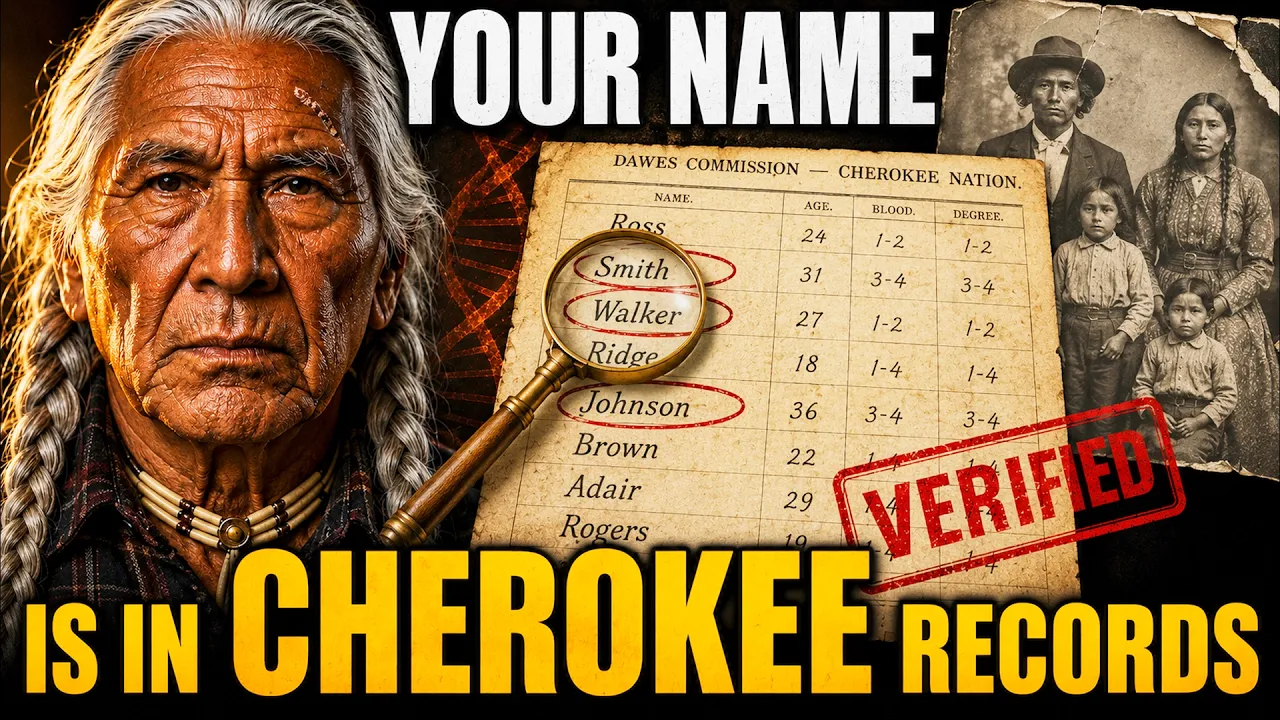
If you remember only one record set from this entire video, make it this one, the Dawes Rolls. Between 1898 and 1914, a federal body called the Dawes Commission enrolled the citizens of the five tribes, Cherokee, Chickasaw, Choctaw, Creek, and Seminole, in what is now Oklahoma. The reason was brutal in its purpose.
The United States was dismantling collective tribal land ownership and carving it into individual allotments. And to do that, it needed a definitive list of who counted as a citizen. Roughly 41,000 people were enrolled under the Cherokee.
Each Dawes entry records a name, age, sex, relationship to the head of household, degree of Cherokee blood, and a census card number that links to a full enrollment application. The rolls are divided into categories: Cherokee by blood, Cherokee by marriage, Cherokee Freedman, and Delaware Cherokee. Now, here's the part that makes the Dawes Rolls different from every other historical document we'll talk about.
They are not just history. They are active law. Right now, today, to become a citizen of the Cherokee Nation, you must document direct lineal descent from a specific person enrolled on the Dawes Rolls.
The Cherokee Nation processes over a thousand citizenship applications every single month, and every one of them traces back to a name on this roll. A line written by a federal clerk in 1902 still decides who is and isn't a citizen of a sovereign nation in 2026. And it's free.
You can search it on FamilySearch, and you can search it through the National Archives at archives. gov. I'll give you the exact step-by-step in a few minutes, but first I want you to understand why some of the names you'll find there are going to surprise you.
If your family ever named a specific state, "We're Cherokee out of Oklahoma, out of North Carolina, out of Tennessee," hold on to that. Because geography is the key that turns a surname match into actual proof. Drp your family's surname and the state they came from in the comments right now.
I read them, and you'll be surprised how often two strangers in the comments discover they're tracing the same family line. The Dawes Rolls give you a name and a number. The next record gives you something almost no other genealogical document in America gives you.
Your ancestors in their own words. In 1902, the Eastern Cherokee won a lawsuit against the United States government. A case arguing that the US had violated the Cherokee treaties of 1835, 1836, and 1846.
On May 18th, 1905, the Court of Claims ruled in the Cherokee's favor, and over a million dollars was set aside to be paid out to eligible Eastern Cherokee and their descendants. To distribute that money, the government had to figure out who actually qualified. So, a special commissioner named Guion Miller was appointed to build a roll of everyone eligible.
And here's what happened. 45,847 applications poured in, representing roughly 90,000 individuals from all across Appalachia, Tennessee, North Carolina, Georgia, Alabama, and beyond. After all the investigation, 30,820 people were found eligible.
But, the applications are the treasure. Because to apply, you couldn't just write your name. You had to document your family, parents, grandparents, sometimes great-grandparents, names, places of birth, the Cherokee ancestor who connected you to the treaty era.
People wrote out their family histories in their own handwriting, affidavits, sworn statements, letters, three and four generations deep. So, where a Dawes card gives you a skeleton, a name, an age, a number, a Guion Miller application can give you a living family tree written by someone who actually remembered the people in it. It's free on FamilySearch under US Eastern Cherokee applications, 1906 to 1909.
And the full application images live at the National Archives on microfilm M685. And buried in those 45,000 applications is one of the hardest truths in this whole subject. Because for every family that could document the line, there were others who were certain, absolutely certain, that they were Cherokee and could not prove a thing, which brings us to the myth, the one your family might have told you.
If you grew up in an American family with any native ancestry story, there's a good chance you heard this exact sentence, "We're descended from a Cherokee princess. " I need to be honest with you, because being honest is the entire point of this channel. The Cherokee had no princesses.
There was no Cherokee royalty, no kings, no line of succession passing crowns to daughters. The Cherokee princess is not a memory. It's a story that got attached to thousands of American families over the last century.
Sometimes to explain a dark-haired ancestor, sometimes to claim a connection that felt proud and safe. Sometimes simply because it got repeated until it felt true. This matters for your search in a very practical way.
When the Guion Miller Commission processed those 45,000 applications, a huge number were rejected. Not out of cruelty, but because the family story didn't match a paper trail. People believed deeply and sincerely in an ancestry the records couldn't confirm.
So, when you go looking, go in with open eyes. The story might be true and documented. The story might be true but undocumentable, lost in the gaps of a system that wasn't built to record everyone.
Or the story might be a beautiful myth that traveled down through your family for reasons that had nothing to do with genealogy. All three happen. And the only way to know which one is yours is the records.
[music] Be honest in the comments. Did your family pass down the Cherokee princess story or some version of it? Drp it below.
[music] You are not alone. And the reason that exact story exists in so many families at once is its own fascinating piece of American history. But there's one more major record set and it covers the Cherokee who did something almost no one else did.
They refused to leave. Not every Cherokee walked the Trail of Tears. When the forced removal came in 1838, a group of Cherokee families in the mountains of Western North Carolina did not go.
They hid. They resisted. They held on to the high country.
>> [music] >> And eventually, they secured a federal land trust called the Qualla Boundary near present-day Cherokee, North Carolina. Their descendants became the Eastern Band of Cherokee Indians, a separate federally recognized tribe distinct from the Cherokee Nation in Oklahoma. In 1924, an act of Congress created a commission to finalize the membership of the Eastern Band.
A federal agent named Fred A. Baker went household to household recording names, birth dates, and degree of Eastern Cherokee blood. The result is called the Baker Roll, and it listed 3,146 people.
To this day, citizenship in the Eastern Band requires direct lineal descent from someone on that 1924 Baker Roll, plus a blood quantum of at least 1/16 Eastern Cherokee. And this is the distinction that trips up almost everyone. If your family traces to the mountains of North Carolina, not to Oklahoma, the Dawes Rolls are the wrong document.
The Baker Roll is your record. Searching the wrong roll for the right family is one of the most common reasons people conclude there's nothing there when there's actually plenty. The Baker Roll is free on FamilySearch.
And the fastest single tool of all, the one that searches the Baker Roll, the Dawes Rolls, and the Guion Miller Roll all at once from a single name, is a free website called cherokeeroots. com. That's c h e r o k e r o o t s .
com. Type in one surname, and all three major rolls get searched simultaneously. It's the best first pass you can possibly make.
Now, watch how this comes together, because I'm about to give you the exact search process, step by step. Here's the exact process. Follow it, and you'll find whatever there is to find.
>> [music] >> Start with the fast pass. Go to cherokeeroots. com.
Enter just the surname, >> [music] >> last name only on the first try, no first name. It searches the Baker, Dawes, and Guion Miller rolls at once. If your name appears in any of the three, you'll see it instantly.
This tells you in 30 seconds whether there's anything to chase. Then go deep on the Dawes rolls. Go to familysearch.
org and create a free account. It takes 2 minutes. Search the collection called United States, Dawes Commission Enrollment Records, 1898 to 1914.
Type your surname into the last name field. Leave the tribe field open at first. Search the surname across all five tribes, then narrow if you get too many hits.
Each result shows the person's name, age, tribe, blood degree, and a census card number. Write that census card number down. It's the key to everything that comes next.
Because that census card number connects to the full enrollment application, the document with the entire household listed, spouse, children, parents, ages, relationships, blood degree for every person on the card. Some of these are digitized on FamilySearch. For the ones that aren't, go to archives.
gov and search the enrollment cards for the five civilized tribes by the person's name. Then do the same for Guion Miller, where the real family histories live. Search US Eastern Cherokee Applications, 1906 to 1909 on FamilySearch.
Note the application number and pull the full application from the National Archives microfilm M685 for those handwritten multi-generation family statements. One critical tip that saves people constantly, spelling. The federal enumerators wrote phonetically.
They misheard names, Anglicized them, abbreviated them, guessed at them. >> [music] >> If your surname returns nothing, do not stop. Try every variant, alternate spellings, dropped letters, phonetic cousins.
The same Cherokee ancestor shows up spelled three different ways across three different applications. A no results might just mean a clerk's bad ear in 1902. All right, you've got the records, you've got the process.
Now the part you came for, the 25 surnames. We'll start with the five that aren't just on the rolls. They're at the center of the most dramatic chapter in Cherokee history.
Ross, John Ross, principal chief, 1/8 Cherokee by blood, and 100% Cherokee in the fight of his life. He led the National Party, the majority who refused to give up the homeland. The Ross name runs straight through the center of the Cherokee government.
Ridge, Major Ridge, his son John Ridge, leaders who came to a different devastating conclusion, that removal was inevitable, and the only way to save the people was to negotiate before it was too late. Watie and Boudinot, brothers. Born to the surname Watie, the older one, born Buck Watie, took the name Elias Boudinot from a benefactor, and became the editor of the Cherokee Phoenix, the first Native American newspaper in history.
Stand Watie kept the family name. Vann, a wealthy, prominent family woven through Cherokee leadership and the same treaty party circle. Now here's how their story ends, and why those four surnames, Ridge, Watie, Boudinot, Vann's allies, carry so much weight.
In December 1835, a small faction signed the Treaty of New Echota, trading the entire Cherokee homeland for land in the west. They had no authority from the elected government to do it. Major Ridge knew exactly what he'd done.
He had personally written the Cherokee law making it a capital crime to sell tribal land without consent. As he signed, he reportedly said, "I have signed my death warrant. " He was right.
On the morning of June 22nd, 1839 in Indian Territory, the sentence was carried out. Major Ridge, John Ridge, and Elias Boudinot were all killed the same day. Stand Watie, the brother, was warned in time, slipped out of a store mid-conversation, and rode away.
He survived. He'd spend years as a hunted man, later become a Confederate general, and outlive nearly everyone in this story. Those surnames, Ross, Ridge, Watie, Boudinot, Vann, appear in the Henderson roll of 1835 and the records that followed.
They are the names of the people who built a constitutional nation and then tore it apart from the inside, and they might be in your tree. The next group is less famous, but just as documented. Names that entered the Cherokee Nation through intermarriage, the missionary era, and assimilation across the 1700s and 1800s.
Adair, Scottish in origin, deeply assimilated into Cherokee families for generations. Rogers, connected by blood to Cherokee leadership. The entertainer Will Rogers descended from this Cherokee line.
Hicks, a prominent early Cherokee leadership name. Ward, tied to one of the most famous figures in Cherokee history, Nancy Ward, the beloved woman of the nation. Gunter, German origin surname, long documented among the Cherokee.
Foreman, a well-established Cherokee family name. Fields, documented across Cherokee records. Martin, common and present in the rolls.
Bushyhead, an English translation of a Cherokee name carried by a line that produced a principal chief. Chisholm, Scottish origin, woven into Cherokee and broader frontier history. Some of these you'd never look at twice.
Adair, Martin, Ward, Fields. These read as ordinary American names, but every one of them is documented in Cherokee enrollment records. And for a researcher tracing a family line, documentation is the only thing that matters.
Fame is irrelevant. The paper is everything. If even one of these names is in your family, Adair, Rogers, Ward, Hicks, that's your starting thread.
And if this is the first time anyone's connected your surname to a real, searchable record, subscribe to Stone and Bone. Next week, we go deeper into the bloodlines hiding inside ordinary American family trees, the names you'd never suspect. We go where the records end and the genetics begin.
And now, the ones that surprise people most, because these are not exotic. These are the most common surnames in the United States. Smith, Johnson, Jones, Brown, Walker.
And alongside them, names like Sequoyah's legacy line under the surname Guess. [music] Sequoyah, inventor of the Cherokee syllabary, was known in English as George Guess. Sanders, Downing, a surname carried by more than one Cherokee principal chief, Taylor, Cornsilk, and other translated names that anchor families in the records.
Wait. Let me be precise here, because precision is the whole brand. >> [music] >> Smith, Johnson, Jones, Brown, and Walker are in Cherokee records for a simple, almost mundane reason.
They were the most common surnames in the entire English-speaking world that surrounded the Cherokee Nation. As Cherokee families adopted European-style surnames to navigate American commercial and legal systems in the 1800s, they drew from the same shallow pool of common names everyone else was using. A Cherokee family choosing a fixed hereditary surname in 1850 had the same short list of ordinary names to pick from as their white neighbors.
So, a Smith on the Dawes Rolls is not a clerical error. It's a Cherokee family that, like millions of American families, ended up with the most common name in the country. The ordinariness of the name tells you nothing.
Only the record tells you the truth. That's the full 25. >> [music] >> Ross, Ridge, Watie, Boudinot, Vann, Adair, Rogers, Hicks, Ward, Gunter, Foreman, Fields, Martin, Bushyhead, Chisholm, Smith, Johnson, Jones, Brown, Walker, Guess, Sanders, Downing, Taylor, and Cornsilk.
[music] Everyone documented somewhere in the Cherokee record system. I'll be honest about the limit of that claim. I'm not telling you these are ranked by exact frequency, because no one can verify a clean ranking.
I'm telling you they are real, they are documented, and they are worth searching. That honesty is the difference between this channel and the dozens of other versions of this video. Before you do anything else, understand this, because it will save you money and heartbreak.
A consumer DNA test cannot tell you that you have Cherokee ancestry. It cannot. Here's why.
These tests work by comparing your DNA to modern reference populations, and there is no Cherokee reference population in any commercial test. Because the Cherokee Nation does not permit its citizens' DNA to be used in those reference panels. What shows up on your results as Native American is a broad, ancient signal.
It is not specifically Cherokee, and its absence does not prove you have no Cherokee ancestry, because the ancestor might be too many generations back to register at all. The Cherokee Nation has said this directly and explicitly. DNA tests are not accepted as proof of citizenship or ancestry.
Not for the Cherokee Nation, not for the Eastern Band, not for the United Keetoowah Band. The DNA can hint, only the records can confirm. And the three tribes don't even agree on the rule beyond that.
The Cherokee Nation requires documented descent from a Dawes enrollee with no blood quantum minimum at all. The Eastern Band requires 1/16. The United Keetoowah Band requires 1/4.
Same word, Cherokee. Three different legal definitions. So, if you've been waiting on a spit tube to answer your family's oldest question, stop waiting.
The answer was never in your saliva. It's in a federal roll, indexed by surname, >> [music] >> free, online, tonight. Here's where it all lands.
For 100 years, your family may have carried a single [music] sentence, "We're part Cherokee. " Passed mouth to mouth, generation to generation, with no proof attached to it. And the whole time, sitting in federal archives and now glowing on a free website, was a document that could answer it.
The Henderson Roll of 1835. The Dawes Rolls of 1898 to 1914. The Guion Miller Roll with its 45,000 handwritten family histories.
The Baker Roll of 1924. All of them searchable, free, tonight at familysearch. org, archives.
gov, and cherokeeroots. com. And here is the universal truth underneath the surnames.
Every American family is a sealed archive of decisions made by people who are gone. Who they married, where they moved, what they wrote down, and just as often, what they chose never to say out loud. A name like Smith or Ross or Watie isn't just a label.
It's the last surviving fingerprint of a story someone either preserved or buried. The records don't lie. The family stories sometimes do.
And the only way to know which is which is to look. So, this is the question to sit with. Your surname, >> [music] >> the one at the top of your own birth certificate, what is it actually hiding?
A trader from Charleston 300 years ago? A Cherokee grandmother the records can finally name? Or a beautiful myth your family told because the truth was lost?
Or because the truth was dangerous to say? There's only one way to find out. The records have been waiting.
The question is whether you're finally ready to look. If you searched your name during this video, or if you're about to, tell me what you found in the comments. The surname, the state, and what the roll said.
>> [music] >> Those comments help the next person know what's possible. And if this changed how you see your own last name, subscribe to Stone and Bone. We go where the records end and the genetics begin.