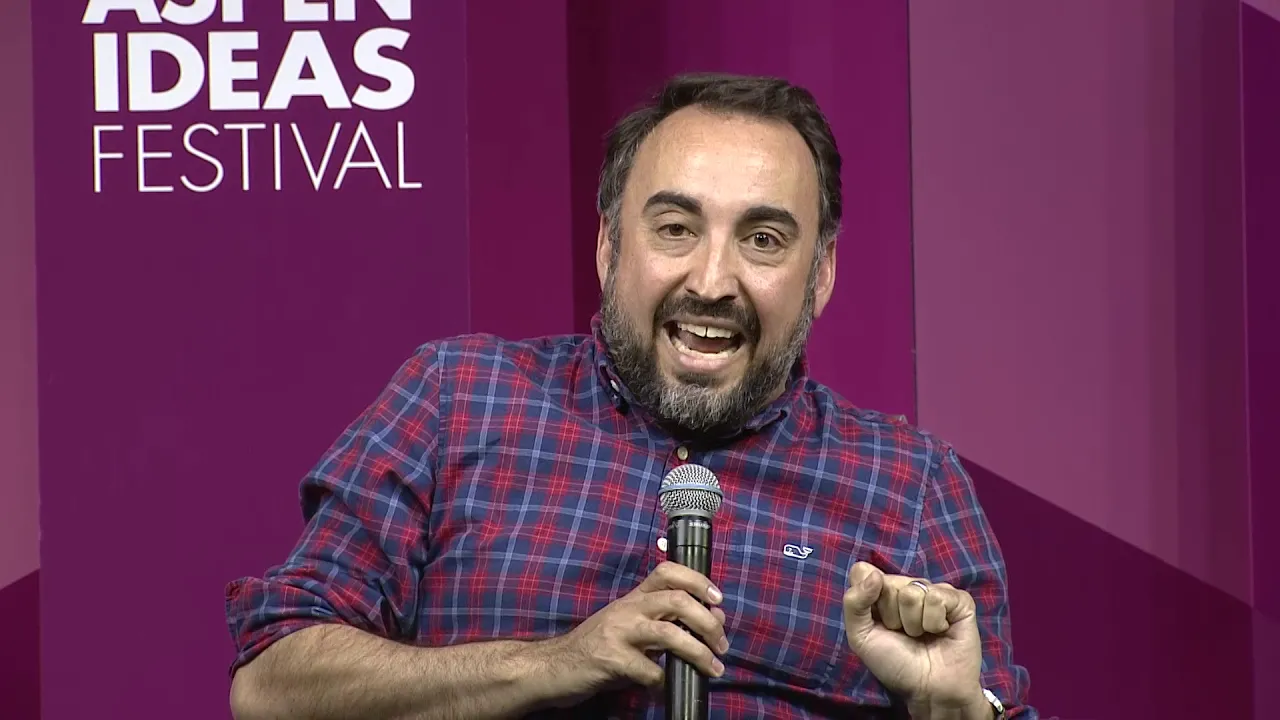
yeah just quick comment I'm a district judge in LA so I sort of practice in the First Amendment world and you know it seems to me we're dealing with the marketplace of ideas versus the fact that propaganda kills and I just would like your opinion about whether you think that the sort of new social media model we have now presents an existential threat to our democracy so let's sort of see at what level this discussion really belongs and the other thing is you know what do you do in a situation where you know when you
read that 20% of Americans or some number around that they don't understand cause and effect they don't know if they went to a public or private school and don't we need to sort of take it down in terms of basic issues about education may be fun public television 24 hours a day so we have competing news cycles and just sort of work on core issues let me just summarize the question and ask you both to quickly answer because it's a great question the existential threat one is can this problem be solved both of you very
quickly no it cannot be solved it can be managed right because when it be sufficiently addressed that democracy will survive how about that yes yes you can look back and find New York Times articles about how radio and television and everything else is destroyed democracy our society adapts and that's the benefit of it's an old-person problem is that young people are already adapting to this kind of multipolar media universe in which they have to be less trustworthy of this things they see so I think I think in the long run our democracy should be stronger
because again me too black lives matter these were things that were happening in the 80s but because there are a handful of gatekeepers who did not represent those equities they did not happen so I think we're gonna take the good with the bad and I think we're going to adjust as a society we're gonna survive the global context though is what really is different here right which you know yes there's there's prior you know times of disinformation on the like but thinking about how you have new international structures that are not you know simply for-profit
companies that are going to be regulating the speech marketplace is the key questions do we need those yes well what you know and that then how do you you know the whole idea of globalization is politically polarizing right now so if you start thinking about international organizations that are gonna be setting the rules for political speech around the world right that has a particular political things I'm gonna do indeed move into a cult internet cold war where everybody in the world is using platforms that are either made by Americans or by the Chinese right and
so you can't discount the fact that we chat and ten cent and Weibo and Baidu uh-huh tick tock tick tock tick tock has a massive child safety issue it's incredible it's the fastest growing one that's why I keep mentioning and and a number of US companies wanted to buy them and the Chinese blocked it because the Chinese are smart about using million accounts in the US on tick tock which is owned which is a Chinese huge mechanism for gather it's a short video social media platform that's primarily used by young teenagers any young teenager you
know knows all about it no sense anybody in this room and it's a massive intelligence gathering operation by the Ministry of State Security and in some country and in some countries it has already been specifically identified as a political manipulation vector so it is not just something that kids play around with but yeah let's go to this is why we're mostly focusing on non Western nations because everybody's looking in the US and Europe like Taiwan January 2020 is gonna be a crazy online election for this kind of stuff it's a not a 50-minute topic