and I wanted to devote the rest of this session to the Juris Prudence of the Israeli Supreme Court focusing on two special features of its entire Corpus of judgments the first feature relates to the manner in which the Supreme cour Court protects the protected persons are the Palestinians when the Supreme Court actually intervenes in favor of the Palestinians it does so on the basis of private rights let's say propriety private rights or right of free movement occupation and the Supreme Court is reluctant to base its intervention base its judgments on the collective right of self-determination
so even in the cases in which the Supreme Court would actually intervene and would face the government or the legislator holding the government to act illegally doing that in favor of the Palestinians that would be done on the basis of private claims of private Palestinian individuals and the court because of the very sensitive aspects of the right of self-determination would refuse to base it judgments on the collective right of self-determination and this approach should obviously be contrasted with the approach adopted by the scj in its advisory opinion in 2004 in which it held Israel to
act in breach of of the laws of eligent occupation basing its opinion interia on the collective right of the Palestinians to self-determination I think that the Israeli position of the or the position of the Israeli Supreme Court is only natural in the sense that when it wishes to intervene in favor of the Palestinians basing the intervention on private rights as opposed to Collective rights is much less sensitive and hence the chances that such verdicts would be considered to be legitimate are much higher the second feature relating to the jurisprudence of the Supreme Court is that
when the Supreme Court reads and construes the laws of bent occupation it doesn't do it in a very static manner but the Juris Prudence is is actually very Dy dynamic or evolving and and my argument would be that the the evolution of of the jurist Prudence of the court is influenced by political realities on the ground and my colleague professor yanan and myself attempted to analyze this Dynamic development of the Juris Prudence of the court in an article in which we published in the Israel law review in 2010 and we argue that the entire Corpus
of of the judgments of the Supreme Court should be divided into three different Generations the first generation relates to judgments by the Supreme Court delivered during the 1970s 80s and early 90s and in this first generation judgments the court the Israeli Supreme Court provided us with a very conservative narrow reserved reading of the laws of deligent occupation the Israeli Supreme Court insisted that when the military commander exercises authorities under the laws of beligan occupation it must do so in order to attain one of the two following objectives the first objective are the security interest but
the security interest of the implementation of of the military occupation I not the general broader security interest of the state of Israel but the narrow security interest of the military commander when it implements its occupation Visa the West Bank the second objective is is the need to cater for the evolving security and civilian needs of the local population I the Palestinians I the protected persons so the court insist Ed that the military commander may only exercise authorities either for the purpose of attaining those narrow security interest or for advancing or protecting the interest of the
protected persons the Palestinians and hence the court reinforced the fact that the military commander may not exercise its authorities under the laws of vent occupation in order to serve the broader social economic and other interests the Strategic interest of the state of Israel such an attempt the Supreme Court held would be ultra virus and hence nen void so the first generation is characterized by a narrow construction of the authorities under the laws of bigant occupation insisting that the military commander may use those authorities either for the narrow security interest of of the military regime in
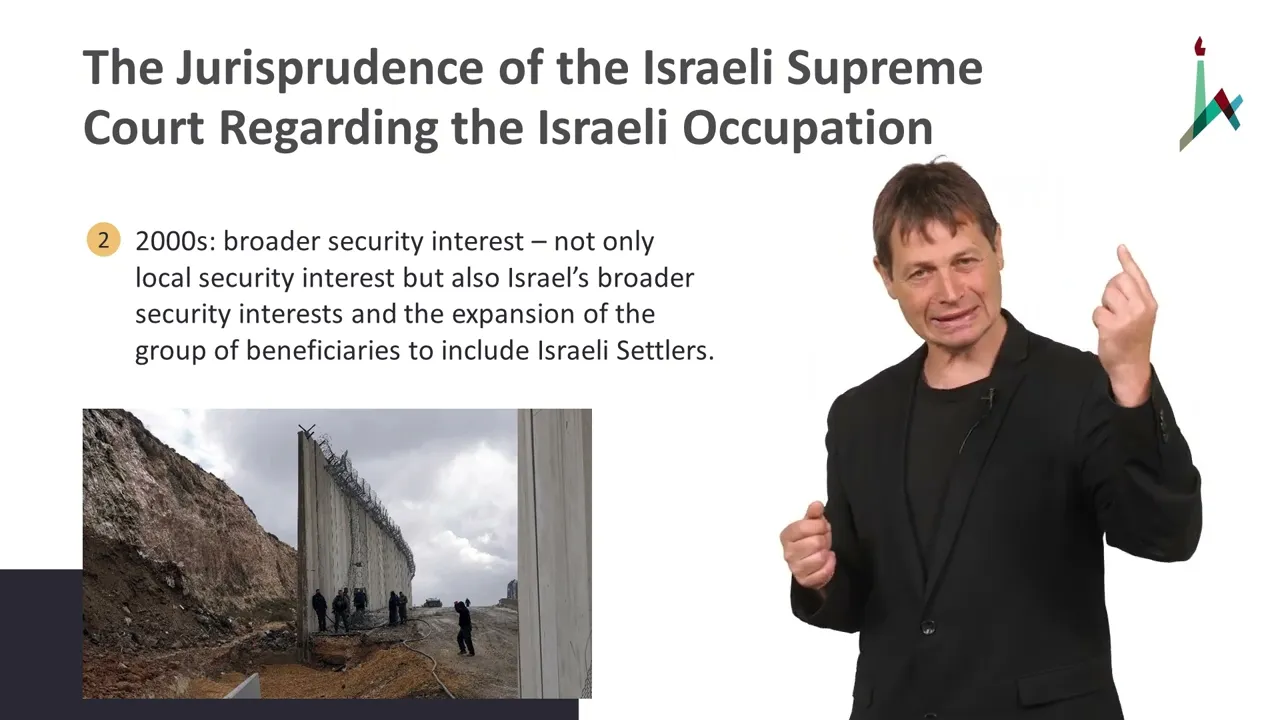
the occupied territories or for the civilian and other needs of the protected persons I the Palestinians the second generation of judgments relate to judgments delivered by the Israeli Supreme Court in the early years of our current Millennium and I'm in particular referring to the judgments dealing with the legality or illegality of certain segments of the wall or the security fence during the second generation the court expanded its reading of of the laws of eligent occupation and it expanded the way it perceived the authorities of the military commander with respect to the first objective I the
security interest the court came to the conclusion that the military commander May exercise its authorities under bigant occupation under the laws of bigant occupation also to serve the broader security interest of the state of Israel and not only the narrow interest of the implementation of the military regime in the occupied territories and hence the court came to the conclusion that the expropriation of private Palestinian property in order to erect a wall that would or fence that would protect the state of Israel is legal under international law and in that respect the court deviated from the
first generation judgments in which it insisted on a narrow reading of the concept of security interest in addition the court came to the conclusion that when the military commander exercises its authorities it may cater not only for the protected persons but for all inhabitants of of the territories or put differently for both the Palestinians and the set settlers the court came to the conclusion that the settlers are also beneficiaries of the laws of vent occupation not withstanding the fact that they are actually Nationals of the occupying power that they are not considered to be protected
persons under the laws of bigant occupation and that is true even if the initial establishment of the set settlements was illegal under international law the CT came to the conclusion that all inhabitants of the territories are entitled to protection and the entitlement of the settlers for military protection imposes a legal obligation on the military commander to pursue acts that would protect the settlers rights so we see here in the second generation two different means to expand the reading of the laws of religion occupation the first is a broader reading of the term security interest and
the second is the expansion of the group of of beneficiaries under the laws of bent occupation if the first generation was focused on the protected persons the Palestinians the second generation added another population namely the Israeli settlers and the court insisted that the question of legality or illegality of the settlements under international law should not affect the fact that the military commander is bound under the laws of eligent occupation to cater for the settlers rights including security interest and this position of the Supreme Court of Israel should be contrasted with the icj that came to
the conclusion in its advisory opinion with respect to the wall that the fact that the settlements were established in conscious with article 49 of the for Geneva Convention should mean that no territorial expropriation can be allowed to cater for the needs of the settlers with the respect to the third generation that pertains to judgments delivered by the Israeli Supreme Court as of 2009 and onwards the court further expanded its reading of of the laws of bent occupation and came to the conclusion that the military commander May exercise its authorities in order to cater not only
for the Israeli settlers but for each and every Israeli present in the occupied territories so in in one case dealing with Road 443 the court came to the conclusion that the military commander May exercise its Authority authorities in order to safeguard all users of roads in the territories including us Israeli users who are are not actually inhabitants of the territories or put differently they are not set Les so if first generation focused on the protected persons the Palestinians the second generation added another group of beneficiaries namely the settlers and the third generation added yet another
large group of beneficiaries under the laws of bent occupation namely each and every Israeli was in was present in the occupied territories and the court came to the conclusion that the military commander is actually under a legal Duty under the law of elit occupation to protect those Israeli users settlers and nons settlers and this Duty May entail placing restrictions on the Palestinian population IE on the protected persons yat Shani and myself criticized this Dynamic evolving interpretation of the law of religion occupation because we are of the opinion that the expansion of the group of of
the beneficiaries of the laws of beling occupation to include all Israelis actually erode it erods the very special privileged status conferred by the laws of bent occupation on the protected persons and this erosion of of this very privileged group of protected persons is contrary to the spirit and arguably also to the letter of the laws of bent occupation so that was our analysis with respect to the dynamic evolving nature of of the Juris Prudence of the Israeli Supreme Court one must underscore the fact that in recent years the Israeli Supreme Court is is more and
more reluctant to rely on the laws of religion occupation in order to scrutinize actions conducted by the executive and you know to scrutinize Israeli primary and secondary legislation pertaining to the to the West Bank so if in in the second and maybe also third generation the court was actually very accustomed to rely on the laws of religion occupation in order to scrutinize the legality of Israel's actions and omissions in recent years we see a much more reserved Court Which is less willing to rely on this body of law with a view of scrutinizing Israel's legality
under international law one very Vivid exception to this argument relating to the more reserved nature of the Supreme Court is a very interesting very comprehensive judgment delivered by the Israeli Supreme Court in 2020 and the Judgment related the related to the legality of a very detailed legal framework adopted by the Israeli KET by the Israeli Parliament primary legislation what we call theas the regulation law and this body of legislation attempted to regulate the use of private Palestinian property in order to cater for Israeli settlements and the legislation purported to provide a cous certificate to this
settlement of Israelis on private Palestinian land and the Very legality of this legislation was brought before the Israeli Supreme Court and the Supreme Court in a majority Judgment of eight judges against one judge judge Solberg the Israeli Supreme Court came to the conclusion that this legislation is illegal and hence its n and void I must emphasize the fact that the verdict is mainly based on Israeli constitutional law in the sense that the court came to the conclusion that this legislation prejudiced Palestinian human rights including the right of equality non-discrimination dignity and propriety rights to so
the willingness of the Israeli Supreme Court to hold this piece of legislation to be illegal was mainly based on Israeli law but when the court read the case in accordance with Israeli law it was heavily influenced by the laws of bent occupation the court referred to the fact that the L of bigant occupation provide significant protection to private propriety rights of the protected persons the court questioned whether the military commander has the authority to use private Palestinian land for the purpose of establishing or allowing or enabling Israeli settlements and in any event the court came
to the conclusion that the use of of the military commanders authorities for the purposes of establishing Israeli settlements in the West Bank over private Palestinian land is a an inappropriate and illegitimate purpose and hence the laws of bent occupation assisted the Israeli Supreme Court in finding the legislation to be illegal the Israeli law so the laws of religion occupation enter the court room but in through the back door as OPP opposed to the front door in addition the court criticized this legislative scheme from the perspective of the temporary or perpetuated nature of the possession of
the land by the Israeli settlers the Israeli government claimed that the entire scheme is only temporary in the sense that it only confers on the The Settle as the temporary right of possession as opposed to ownership but the court answered in cynical terms that we are here in a scenario of of more than 50 years of occupation without the Horizon of determination of occupation and the transfer of possession to the Israeli settlers is done with no time limits and hence the factor the entire scheme does not conform with the idea that we learned in the
session devoted to the of religion occupation the idea that EV every conduct of the military commander must be based on the principle of temporary Poss as opposed to perpetuated ownership so if I may conclude the session Israel like any other country in the world is bound by international law and Israel is bound by the laws of religion occupation this is the position of international law and this is the position of the state of Israel Israel in principle is a Contracting party to the main legal instruments pertaining to the laws of religion occupation including the four
Geneva Convention Israel is a central player in the arena of the laws of eligent occupation both as a subject matter of the law and also as a a Creator and developer of norms of of international law in the in this very particular branch of international law so generally speaking Israel is like any other country that finds itself in a position of occupation having said that in this session I attempted to share with you some of the very very special features pertaining to Israel including the unclarity of of Israel's borders under the international law they issue
set settlements that prolong nature of occupation and the very special features relating to East Jerusalem the Golan heits and Gaza to come to the conclusion that one may not apply the laws of religion occupation to the Israeli case study in a very systematic or clearcut manner in the sense that those very special features render the applicability of the laws of religion occupation to the Israeli case study much more complicated much more nuanced and much more challenging from a legal perspective thank you very much