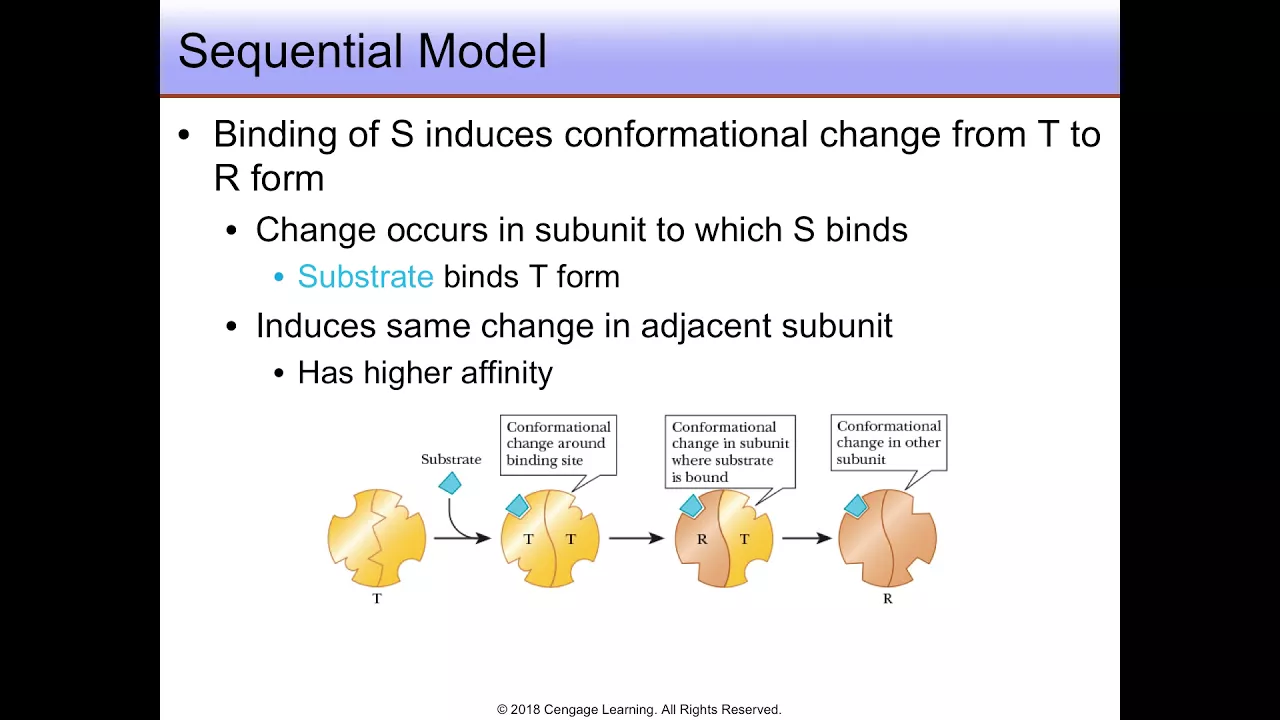
let's now consider the sequential model of alice theory and see how it compares in contrast to that of the concerted model let me just take a moment to remind you that in the concerted model the conformational change to either T or R occurs first for the molecule binds whether it is the substrate an activator or an inhibitor also recall that all subunits change conformation simultaneously in the sequential model the molecule binds first then the conformational change occurs note that this means that the substrate binds to the T form of the subunit as shown below and
this induces the change to the R form the cooperative nature of binding means that a conformational change in one subunit induces a change in an adjacent subunit notice that in this model the subunits changed conformation in sequence rather than occurring all at once let's see what happens with inhibitor binding in this model the inhibitor binds to the T form of one subunit and that makes substrate binding in the subunit more difficult this conformational change in one subunit induces a change to the R form in an adjacent subunit even if it is not bound to inhibitor
a similar pattern is observed in the presence of an activator except that it binds to the r form this is an excellent example of the induced fit mechanism where binding induces the conformational change a unique feature of this model is the evidence for negative cooperativity where the binding of the first ligand actually makes it more difficult for the next to bind this means the influence occurs in sequence the concerted model cannot explain this behavior since all subunits change simultaneously we will find that Alice Terry is a vital part of controlling metabolism by influencing enzyme activity
hence the relevance of this topic



![I Replaced ALL my ADOBE APPS with these [free or cheaper] Alternatives!](https://img.youtube.com/vi/5EfqHg49kMk/maxresdefault.jpg)