At the end of a great continent sits a land of deserts, scrub, grasslands and savannah. Having the greatest number of proto-human fossils anywhere, it has been dubbed the cradle of humankind. In more recent times, it is a land where native and foreign cultures clashed, and in that clash, laws formulated to segregate and discriminate.
Today, freed from that past the country now sees itself as the Rainbow Nation of ethnic diversity. This is a land of incredible riches… of stunning landscapes, exceptional plant biodiversity and the safari. This is a land of gold, of diamonds and the greatest concentration of mineral wealth anywhere on earth.
Only one country can claim to have all of these. Only one country is South Africa. South Africa is a medium sized country located at the southern tip of Africa, and is home to a diverse set of peoples derived from three continents.
Its name is unique among all the countries in the world in that it defines its geographical position with respect to a continent. It simply states, this is the southernmost part of the continent of Africa. Humans, and their hominid ancestors, have lived in South Africa for millions of years.
In fact, the UNESCO World Heritage Site, the Cradle of Humankind, just 50km west of Johannesburg, has the largest and oldest collection of hominid fossils found, dating as far back as 3. 5 million years ago. Our species, Homo Sapiens has lived in this area for at least 170,000 years.
Direct descendants of this first wave of human migration are still present in the area today in the form of Khoisan peoples, formerly referred to as Hottentots, or Bushmen, notable for their superb hunting and tracking skills. Bantu speaking peoples, who were farmers proficient in the smelting of iron, migrated south from Central Africa as early as 3,000 years ago, and reached the eastern part of South Africa as early as 500AD, and among other groups, are the ancestors of the Zulu peoples of today. European contact with the region began with Portuguese exploration in the late 1400s, as part of their sea-route around the Cape of Good Hope to their trading posts in India.
But it was the Dutch who were the first to settle here, with the Dutch East India Company establishing a colony in Cape Town in 1652, with the intention of creating a sustainable local farming economy that could ultimately supply the ships passing to and from the Netherlands to the spice islands of Indonesia. The Dutch farmers, who brought over slaves from Indonesia rather than enslaving the local populations, moved north and east, and soon encountered the Xhosa, a Bantu-speaking people, where a series of wars followed in the region of the Great Fish River near today’s Port Elizabeth. The British occupied Cape Town in 1795, to prevent it falling to the French during the Napoleonic Wars, and at the end of these wars in 1815, the Cape Colony was ceded to Britain formally with British settlement beginning as early as 1818.
Many of the independently-minded Dutch settlers resented British rule and migrated north in The Great Trek from the Eastern Cape Colony starting in 1836, to found new independent republics of the Orange Free State and Transvaal. During these treks, these armed settlers, known as Boers, fought an inconclusive war with the Bantu speaking tribes in this area, most notably the Zulus, whose kingdom had been rising under their King Shaka to become the dominant indigenous power in the region. The effort to further establish European control of the Transvaal increased with the discovery of diamonds in Kimberley in 1867 and gold in Witwatersrand in 1884.
By 1898, the region was producing almost a third of the world’s gold. In 1905 a large diamond was unearthed near Pretoria. Weighing 3,106 carats (1.
37lbs, 0. 62kg), the Cullinan diamond, as it became known, is the largest diamond ever found, and the largest cuts of it now reside as centrepieces of the British Crown Jewels. With these mineral discoveries, and the inability of the Boers to deal with the Zulu threat, the British were motivated to bring the power of their empire to bear in 1879.
While the British ultimately defeated and dissolved the Zulu kingdom in this short war, the Battle of Isandlwana, which saw a Zulu victory, is notable in that a small African power armed with primitive weapons was able to defeat a force from a global empire. With the British now in force in the area, they then turned to subduing the independent Boer republics with a view of creating a federation of South African states under British rule. The first Boer War between the British and Boers of 1880-81 was inconclusive due to the successful guerrilla tactics of the Boers.
Relentless in their pursuit of goals, however, the British returned in greater numbers and with different tactics, twenty years later, in the Second Boer War of 1899-1902. They ultimately defeated the Boers, ending their independent republics, and absorbing them into the British Cape Colony that now spread across the whole region of South Africa. This second Boer War was notable for the British use of camps to round up and imprison Boer civilian women and children, that later went on to infamy in the Second World War by the Nazi regime of Germany.
Over 27,000 Boer women and children died in these camps. Nominal independence from the British Empire was given to the Union of South Africa in 1910, but full independence from the British Parliament in London was not formalised until 1931. Segregation and discrimination between Blacks and Whites was present during this period, but it wasn’t until 1948 where the system of Apartheid was formalised in a series of laws.
Apartheid, in the Afrikaans language that derived from Dutch, literally means “seperateness” or “the state of being apart”. The apartheid laws were prompted by an influx of blacks into urban areas during the rapid economic development of World War II, leading to tensions with the minority whites. The laws categorised the population into four groups: Whites – being British or Afrikaaner - Blacks, Coloureds (or mixed race), and Indians, the latter of which had migrated with British Empire trade from India in the preceding decades in large numbers.
The groups were required to live in separate areas, while beaches, hospitals, schools and other public areas were reserved for each group, with whites receiving the best share. Marriage between the groups was prohibited and, in order to ensure their grip on power, only whites could vote in government elections. At the same time, the government created “Bantustans” or homelands for the black population, which were ultimately intended to become independent states as a concession to the more liberally minded Afrikaner intelligentsia, and as a justification for the policy of apartheid within the main towns and cities where whites lived.
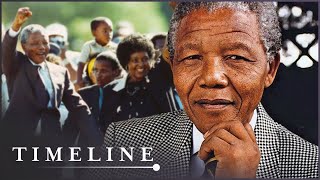
Whilst four of these homelands were given full independence by South Africa, none were recognised by the international community. The system of apartheid was condemned by the outside world, and over the following decades, increasing sanctions as well as unrest within the black townships fomented by an openly declared armed struggle by the African National Congress, meant that the system was ultimately unsustainable. This mounting pressure forced the ruling National Party to lift the ban on the ANC, with their leader, Nelson Mandela, freed in 1990.
In the years that followed, an ultimately peaceful transition to majority rule occurred with the end of apartheid coming in 1994 with universal suffrage for all South Africans, regardless of race. For the last three decades, since the end of apartheid, the ANC has been in power, winning every election. In this time the fortunes of some in the black majority has improved but unemployment rates remain high with most still living in relative poverty compared to whites, Asians and coloureds.
The country has been particularly hit by the ongoing AIDS pandemic, leading to average life expectancy falling from 62 to 52 years between 1992 and 2005. But the biggest issue affecting all South Africans has been the high level of violent crime in the country. South Africa has five times the global murder rate, and is ranked 6th highest in the world in this respect, although the rate has halved from its peak in the 1980s, when South Africa was second only to Colombia in terms of rate of homicides, when the latter was at its height in the drug cartel wars.
The country has the largest private security industry in the world, bigger than the police and army combined. Geopolitically, South Africa has been non-aligned since World War II, with what would have been a traditional “Western” power being isolated by other developed countries due to its apartheid policies. Today it is the “S” in the BRICS group of non-aligned near-developed countries, the others being Brazil, Russia, India and China.
In the Cato Institute’s Human Freedom Index, South Africa ranks about mid-table, let down by security and safety issues, the justice system, size of government and red tape. South Africa is highly unusual among countries in that it has no official capital. Parliament sits in Cape Town, the Executive Branch is located in Pretoria, and the Supreme Court sits in Bloemfontein.
Parliament is bicameral, meaning two houses, with the National Assembly lower house of 400 members elected every five years by proportional representation from constituencies sized by similar population. The National Council of Provinces upper house comprises 90 members with 10 from each of the country’s 9 provinces chosen by the respective provincial legislatures. The head of the executive branch, the President of South Africa is chosen by an election of the National Assembly’s deputies and not directly by the people.
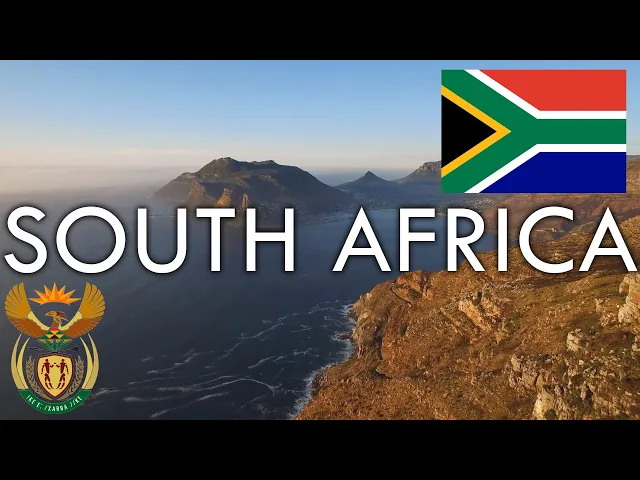
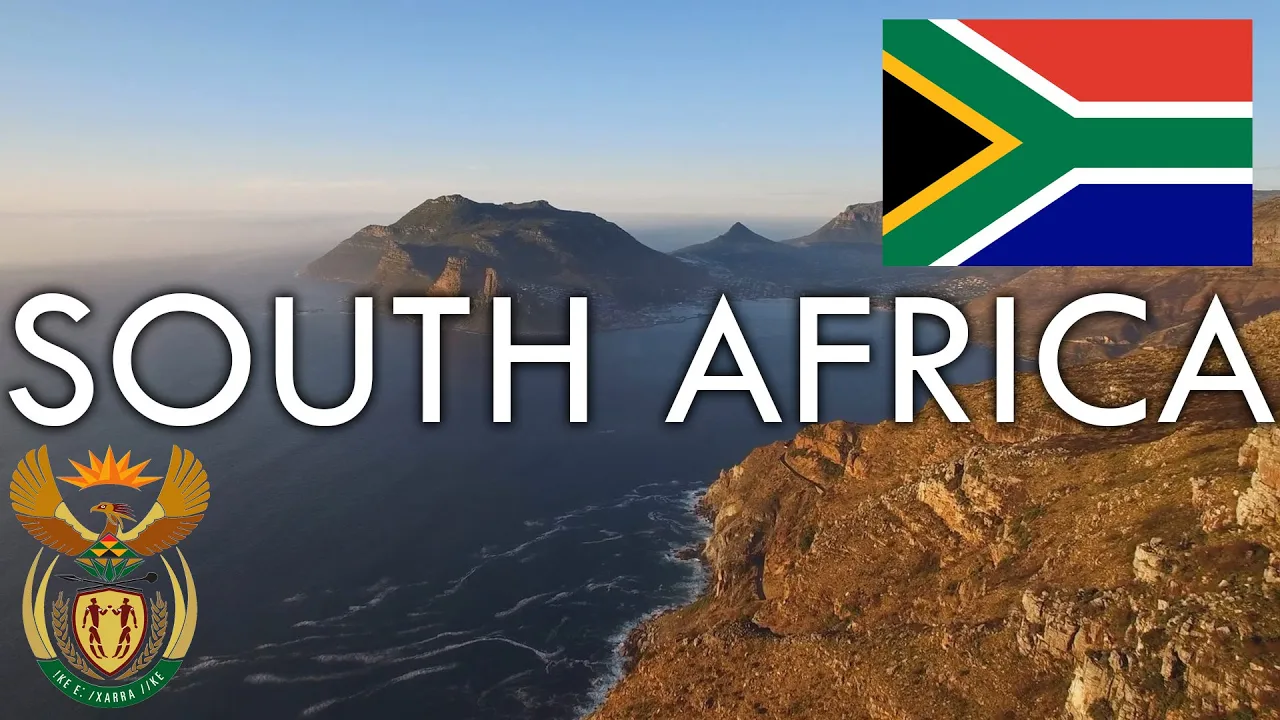
The country is split into nine provinces with limited powers of self-governance, and with each having its own legislature. The provinces are further subdivided into a total of 52 districts and 205 local municipalities nationwide. The current flag of South Africa has been in use since the end of Apartheid in 1994.
The “Y” shape represents the coming together of the various ethnicities and traditions of the country. The red and white bands are the same in colour and position as that of the Netherlands, and the same c olours as that of Great Britain, and represent the European influence, while the black, yellow and green are taken from the flag of the ANC and represent the native African elements within the society. In 2000, the coat of arms replaced the older version that had been in use since the 1930s to reflect the new post-apartheid era.
In general it is representative of a bird rising out of an egg to symbolise a new beginning for the rainbow nation. The motto, which I will not try to pronounce since I have not mastered consonant clicks, is in the native Khoisan language, and translates as “Diverse People Unite”. South Africa’s geographical situation is distinctive in that it occupies the whole southern tip of the continent of Africa.
The Atlantic and Indian Oceans take up the western, southern and eastern boundaries of the country, while from the north-west to north-east, Namibia, Botswana, Zimbabwe and Mozambique act as the country’s land-borders. Eswatini, formerly known as Swaziland, is almost encompassed by the country to the north-east, while the nation of Lesotho is entirely within the country’s borders. It is the world’s 24th largest country at just over 1.
2 million square kilometers [1,221,037 km2 (471,445 sq mi)] in land area. The almost 2,000km car journey along the country’s longest axis from south-west to north-east would take you about 21 hours, with a journey across the width of the country being about half of that in terms of distance and time. Its physical geography is dominated by an extensive plateau ranging from 1km to over 3km in altitude, leaving only a relatively narrow strip of lower lying land around the coasts.
This plateau ends suddenly in what is known as the great escarpment, and provides for numerous spectacular landscapes, particularly on its eastern side, where it is known as the Drkensburg. Not to be outdone, the southwestern coast features a series of steeply sloped ridges known as the Cape Fold Mountains, of which the iconic Table Mountain of Cape Town is a part. It is South Africa’s varied geology that defines its rich mineral heritage.
The base rocks of the north-east of the country are a part of the Kaapvaal craton, a very ancient block of rock that is billions of years old, having survived countless continental collisions and breakups, and consequently holding onto an extensive array of minerals that would have otherwise fallen much deeper into the earth. The climate overall is relatively dry, and is drier the further west one goes, leading to a mix of grassland, shrubland and desert biomes, which are surprisingly highly biodiverse. The warm Agulhas current coming down the coast of the Indian Ocean readily evaporates bringing moisture to the eastern side, while the cold Benguela current in the Atlantic results in low oceanic evaporation and desert conditions on land.
The wettest section is therefore along the narrow eastern coastal strip, which experiences a Humid Subtropical climate of rain year-round, along with hot summers and mild winters. This is the only part of the country where forest is found. The wet conditions extend, albeit drier, when one rises up the Great Escarpment and onto the section of the plateau known as the Highveld, where a subtropical highland climate of warm summers and cool winters extends over a wide area.
The area was naturally a form of savannah – mixed grassland and trees and shrubs, but is now extensively farmed. Moving north from here, and the altitude falls down into the Bushveld and Lowveld, where semi-arid conditions occur leading to drier grassland and shrubland. It is in this area where we find high concentrations of wildlife and most of the safaris that South Africa is known for.
Heading west from the Highveld, and we encounter the large semi-arid region on the plateau known as the Great Karoo. West and north from here and the aridity increases into the Bushmanland and Namaqualand, areas that have hot summers and mild winters, and very little rain leading to desert conditions. In the extreme south-west of the country, we find a slice of Mediterranean climate where westerly winds and ocean storms in winter bring rain, but where summers are dry.
It is both here, and along the southern coast, where easterlies also bring rain in summer, but where temperatures remain mild year-round, that we find the fynbos, a narrow belt of shrubland that has exceptional plant biodiversity, with as many as 6,000 species found only here. These plants are in their own floristic kingdom, one of only 6 globally, and is the smallest in land area. In terms of Human Geography, South Africa has a relatively large population of just over 60 million, similar to that of Italy, France and the UK, and is the 23rd most populous country in the world.
This population is mainly found in the north-east and east of the country, with the greatest concentration around the conurbation of Gauteng province that includes Johannesburg. Apart from the city and surrounds of Cape Town, the western half of the country is sparsely populated. It is one of the most ethnically diverse countries in the world.
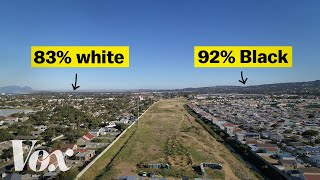
About 80% are native African peoples, while 9% are the descendants of Dutch and British settlers, 9% are coloureds, or mixed race, and 2. 5% Indian. It is notable that the white population has declined as a percentage from 22% in 1911 and 16% in 1980.
South Africa has 11 official languages, with Zulu and Xhosa being the largest native first-spoken languages. Afrikaans, derived from Dutch, is the third most first-spoken, and while English is fourth in these terms, it is the language used throughout the country for business, industry and academia. In terms of religion, the vast majority identify as Protestant Christian, with no religion, traditional African beliefs, and Catholic Christian forming significant minorities.
South Africa has 5 cities of over a million people. The largest of these is in the Highveld - Johannesburg, the centre of the mining industry, having over 10 million population in the greater metro area. Cape Town, the oldest city in the country, in the western cape, is next with almost 5 million in the greater metro area.
Durban, in the country’s eastern coastal belt, is home to about 3. 5 million in its metro area. Pretoria, just north of Johannesburg is home to about 3 million, while Port Elizabeth, on the South Coast is home to just over a million.
With a GDP of around $419 billion in absolute terms, the South African economy is placed 32nd globally. Although behind Egypt and Nigeria in terms of size, it is the most complex and advanced economy in Africa. Exports accounted for about a quarter of the economy, with gold and other precious metals leading in this respect.
No discussion of this country’s economy can be without mentioning its mining sector. If there was ever a country whose development and growth was defined by mining, it is South Africa’s. For most of the twentieth century, South Africa was by far the largest producer of gold.
But with the productivity of the mines in decline, it now ranks only 11th in terms of global supply. But because of the rich geology of the country, it is not just gold that is found in vast quantities here. It is the dominant producer of platinum globally, holding over 70% of the world’s share, number one in production of chromium and manganese, number two in titanium, palladium and zirconium, 6th in iron and 8th in diamonds.
But this once dominant mining sector now only comprises about 7% of the South African economy as a whole, with the service sector having grown dramatically in the last few decades, and financial services in particular being notable. Manufacturing makes up about 13% of the economy, with the largest of that sector being in car production with Ford, BMW, Mercedes-Benz, Volkswagen, Toyota, and Nissan having plants here. Tourism accounts for about 10% of the economy, with the country’s natural beauty and safaris being strong attractors.
Due to the general aridity of the country, however, agriculture makes up only 5% of economy, one of the lowest in Africa, but it is notable globally for the fine wines produced in the Western Cape. Since the end of apartheid, there has been a significant brain drain from the country, with hundreds of thousands of whites leaving to pursue careers in the developed world. The number one cause cited for this emigration is the security situation, and this most likely corresponds to South Africa having one of the highest income inequalities in the world.
The other key reason cited for white emigration is the positive discrimination, or affirmative action policies enacted by the South African government that puts the white minority at a significant disadvantage when it comes to employment and business ownership. The nation’s currency is the Rand, named after Witswatersrand where the gold mining industry began, and was introduced in 1961 shortly after the country became a republic. Before 1982 one rand was worth more than one US dollar, but inflation since that time has significantly eroded its value, and at the time of this video is trading at around 16 rand to the dollar.
The rand is perhaps most well known as used in the Kruggerand, a 1 oz gold coin that depicts former president Paul Kruger on the obverse and a springbok, the national animal of South Africa, on the reverse. At one time, these coins accounted for over 90% of all gold coins on the global market. South African culture is a blend of European and African elements that reflect the diverse population of the country.
As a former British colony, the architectural influence from Britain is strong, and a visitor familiar with Australia and New Zealand will see common influences in the culture of the white population and indeed the popularity and international success of the games of rugby and cricket brought here by the British. In addition to sporting success, it is the music of South Africa that is perhaps where the country has left a significant global mark. Fused from native Southern African rhythms, jazz, classical and rock, it has many different and diverse strands today, and those with an ear for such things will recognise South African music immediately.
And famous South Africans? Well there’s a lot more than you’d imagine, and in closing this presentation, I’ll leave you with some, to the sounds of the townships. And that’s South Africa.
Please like and share this video if you enjoyed it or found it useful, and please let me know your thoughts in the comments, especially if you’re from this country, and if I missed out anything you feel is important. If you haven’t done so already, then please click the Subscribe button so you don’t miss future episodes. You can also support future development of this channel, by becoming a Patreon supporter, for as little as $2 a month.
Thanks again for watching, and I’ll see you in the next episode.