hello everyone and welcome to the fifth session and American English live teacher development series for my name is Lauren and I'll be with you today along with my colleague behind the scenes moderator Amy who will be serving as moderators to help answer your questions and respond to your comments during the session today our host Kate will be talking with our presenter Spencer Lamia about how providing opportunities for creativity and personal expression during grammar instruction can have a positive effect on language learning and student motivation so let's go ahead and get started hello everyone welcome as
Lauren said I'm Kate and I'm part of the American English social media team I'm happy to be your facilitator and hopes today we'd like to extend a warm welcome as always to our first-time viewers and we'd like to welcome back all of you who have been with us for several sessions please let us know how many times you viewed one of our webinars we'd love to hear from you let's start with these great photos featuring teachers from Maharaj Gama Sri Lanka and sucre Bolivia who participated in past American English live events we love to see
teachers learning and sharing ideas so please share your photos by e-mailing them to american english webinars at al programs org it's there on your screen or by sharing them on social media if you share them on social media be sure to tag us at American English for educators so we can see the great photos you post we may feature one of your photos in the next session as you know our topics for this series are increasing learner motivation content-based instruction and communicative grammar teaching today is our fifth session in series four after today we only
have one session remaining and we hope that you'll join us which topic have you enjoyed the most so far share your ideas in the comments or checked speaking of the last session in this series daylight savings time begins in the United States on March 10th this means that on that day we set our clocks forward one hour so the final session American English live for point 6 will take place at 8 a.m. and 1 p.m. Eastern Daylight Time in Washington DC you might find that the webinar is a difference scheduled at a different time in
your region maybe one hour later in your local timezone so please be sure to check that conversion link that we've provided here on this slide and be sure to enter the session date March 20th when using the converter this information is also on the Ning american-english webinars comm and in the announcements section we don't want you to miss our final session so make sure to check your clocks for that important change so here's a little bit about what to expect during today's session each session is approximately 60 minutes long and is often related to an
American English a teacher massive open online course or a teachers corner theme on the american english website the presenter will present the material and i as your host will ask questions and make comments too but we really hope to hear from you our audience so that we can address your ideas questions experiences and comments please do share your thoughts using the comments feature or chat box when our session comes to a close in about an hour you will have an opportunity to receive a digital badge for your participation at the end of the session we'll
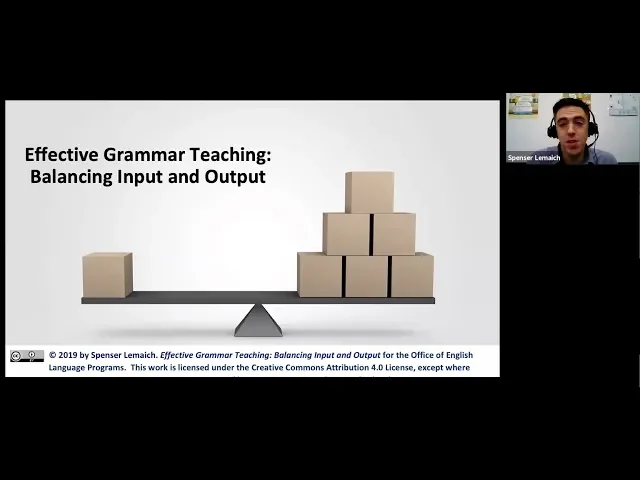
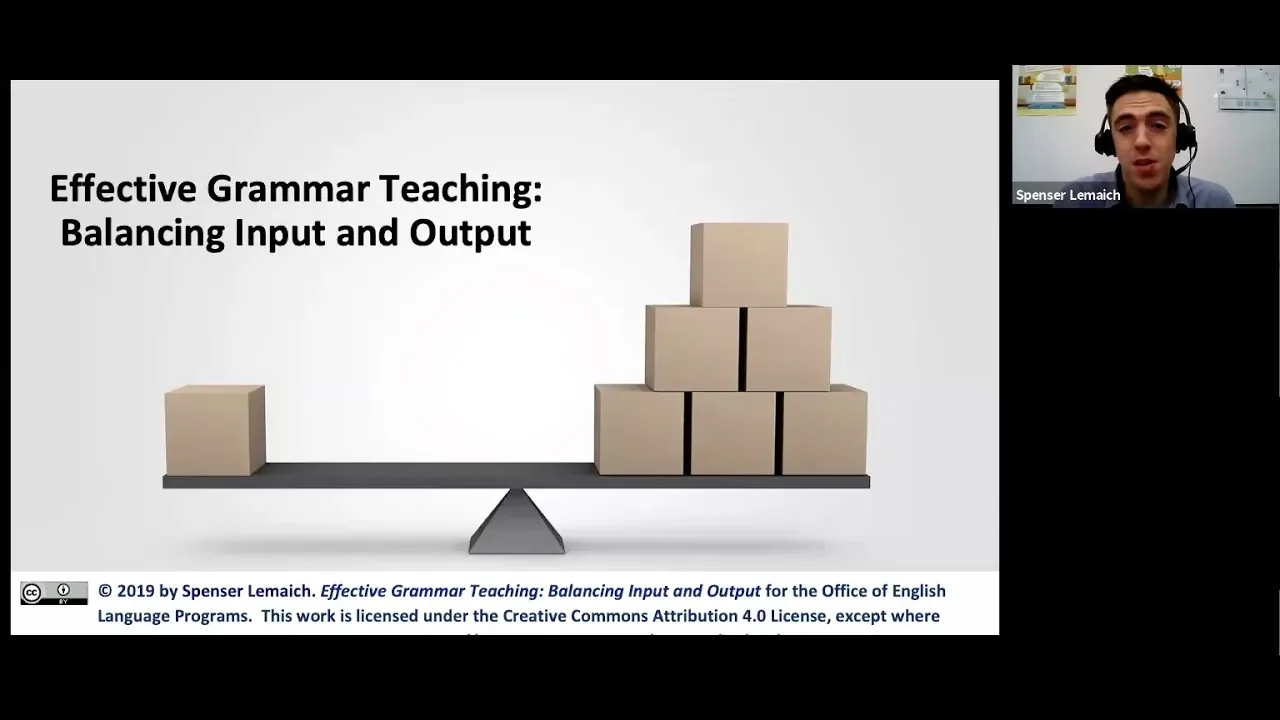
share a link in the comments and at the top of this post click on that link and complete a short quiz about today's session you must answer two out of three questions correctly once you've successfully passed the quiz you can expect to get your badge by email from badger at badger i/o in about a week and now for today's session effective grammar teaching balancing input and output this presentation will help you enrich classroom time by examining how to incorporate the practice of real language into grammar lesson the session will consider what real communication means and
examine the motivating impact that creativity and opportunities for personal expression have on successful language learning participants will work with sample lesson plans and communicative activities that balance language input and output the activity ideas and practical steps outlined in this session are applicable for classes of any age ability level or level of access to technology and now it's my pleasure to introduce our presenter today Spencer Lamia Spencer works as an English for academic purposes and exam preparation instructor and teacher trainer and he was previously director of studies at a private language school he recently served two
years as a u.s. Department of State English language fellow teaching linguistics and TEFL methodology courses Spencer has spoken frequently on ELT methodology second language acquisition and culture instruction and classroom teaching he's a strong advocate for engaging students through critical and creative thinking and through the use of learners mother-tongue in language instruction he has a master's in Teasle degree from Biola University welcome Spencer we're so happy to have you here today thank you thank you for that introduction and welcome to this AAE live four-point-five I'm Spencer and I'm very happy to engage with you today in
this interactive to professional development session one of the reasons why I really enjoy teaching English is because you get to engage with students as individuals and there's such a variety of topics that you always get something different from every student no two students are alike and they always have unique ideas and ways of expressing themselves today that's part of what we're going to talk about we're going to talk about the importance of having a balanced class that supports learners by giving them the opportunity they need to use language and express themselves let's look at a
rundown of today's topics first we'll talk about the importance of having balanced balance between input and output and the role that plays in communicative teaching then we'll talk about how that balance can be achieved in the lesson plan and finally we'll look at some more activity ideas for how we can get students that all-important output and support them to express themselves creatively as we get started here I'd like to ask the participants a question first we'll show them two pictures on the upcoming two slides these are pictures of two different classrooms I want the participants
to consider elements of effective grammar teaching what does it look like in practice let's go ahead and look at these two classrooms which classroom do you think would be more effective great we're looking to be looking at classroom a and classroom B and if we could look at them sort of back and forth a little bit and as you're looking at these think about which classroom would be more effective for grammar teaching and please let us know why you feel that way as well which classroom is more effective for class for grammar teaching and why
we'd love to hear your reasons why as well looks like a lot of people are putting a classroom beat we're getting all sorts of answers for classroom beyond vonlee being a Corella Zahira bus why do you think so everyone let's see table says it's an interactive session the students are more engaged there's more interaction they're discussing and communicating with others let's see what else it's more a lot of people are saying it's more engaging it allows for interaction there's more communication great responses what do you think Spencer great it's definitely the same thing I have
in mind the the when we think about what the teacher is doing and what the students are doing and we look at the first classroom it's more of a lecture style the second is more interactive as many people have pointed out so is one of those necessarily better for studying grammar I would say of course as most so the word discipline said that we advocate for the communicative side the trouble with a lecture style and many many times the classroom is not in such a big room as we saw in that first picture but a
small room can still use a lecture style the trouble with the lecture style is that it's just the teacher transmitting information to the students and they're trying to get their idea across to those students but it doesn't mean that the students will internalize what the teacher is saying so this is our first point here is that input alone will not produce fluency especially in those productive skills if students have if we want students to be able to speak and we want students to be able to produce English they need that opportunity for output we focus
on communicative classroom a lot and a quick definition of that would be learning by sharing and using language rather than simply being told about it it's deep brown the author of some textbooks on teaching English as a foreign language has an interesting insight about this in his book principles of learning and teaching his insight here is that teaching doesn't always cause learnings if you think of teaching as what the teacher does to transmit an idea and learning as the time when students receive an idea internalize it and take it home so we have as teachers
just have to change our perspective from teaching as a transmission of knowledge or teaching about language to teaching as facilitating learners acquisition of knowledge and that happens by students practicing using the language we have a lot of people in our audience today who are agreeing with you and I just want to share a couple of comments so nausea Mohammed says in classroom B there is direct interaction between the teacher and the students and in classroom a the lecture method is being used and the teacher just has to speak and those students are sort of passive
so I think she's sort of echoing some of the things that you're saying and then Diane Kumar says classroom B looks more informal and hence learning happens students like that informal approach and feeling more comfortable in the classroom so great comments great comments I would say with that informal bit the the reason why that's so powerful is because it people let down their guard so that they call it the effective filter where you resist you know speaking up and trying to take a risk and interact yeah yeah thanks so much everyone for your comments keep
them coming one of the things that we want to get across with this presentation is this idea of balance in input and output so this is kind of a framework that's originally meant for a course but it could also apply to a lesson and it's a framework suggested by a SP nation and John McAllister in their excellent book language curriculum design they talked about how we need a balance between these four aspects meaning focus input language focus learning meaning focused output and fluency activities so it's worth pointing out that a lot of grammar classrooms focus
too heavily on that second part language focus but we want it to be a combination of all these things so that we can achieve a balance we're gonna come back to this idea of a framework a few times during this presentation I'd like to ask the participants another question this question is from a joke although not everyone's going to think that it's a funny joke this is an old joke from a language classroom and it starts with a teacher and a student the teacher says give me a sentence that starts with I maybe they are
talking to their class and and one of braver student speaks up the student says I is and the teacher cuts him off oh don't just start with I is you should never say I is you should always say I am now try again what does you want to say the student is a bit ashamed but speaks up again and says I am the ninth letter of the alphabet apologizing because this didn't think she made a mistake right but did want to say I the letter I is the ninth letter of the alphabet right thank you
didn't even see that one coming what is the mistake there that's what we want to hear from our participants what mistake did the teacher make great what mistake did the teacher make what should this teacher have done instead of what they did do let's see lots of great response is already tie up says the teacher has to listen first XO says their context they didn't wait for the context let's see Helen T says that the teacher overreacted and Norma also says the teacher did not hear the student first the or the or kia says the
teacher should have listened until the end of the student's sentence great responses what do you think Spencer great responses it's great to hear the way that people say it with such different expressions everyone has their own way of saying it my thought here is just in line with what everyone says this is a grammar classroom out-of-balance so we're talking about the idea of balancing input and output in this case the teachers giving input about what language is appropriate which structures are appropriate but the input is not appropriate so the classroom is already out of balance
the main issue here is there's too much focus on language forms the teacher didn't give the student a chance to really say what they're trying to say of course in this joke it kind of seems trivial I mean there's no emotional significance of a student saying the letter i' is the 9th letter of the alphabet but sometimes if a teacher doesn't listen to their student and give them an opportunity to share something it could have a more significant impact on the relationship students have in the class or something like that what if a student shared
something more personal like I don't feel I can make friends well the teacher is in a unique place to interact with that student about what what they're sharing definitely yeah we have another couple good comments here from JP says that most of the time in a typical classroom the teacher has mental models and expects to hear what's on his or her mind rather than waiting for what the student would say that's a really good point let's see and to what you just said Spencer it's the C awful said interrupting the students in such a way
is intimidating and therefore might inhibit the students effort to try out a new language really great points everyone what excellent comments thanks so much and keep them coming keep going mmm wait to hear what everyone has to say and I think it fits in with what I'm trying to say which is that even if someone is leading a presentation or leading a discussion we want to hear what everyone says this is one of the main points that we're trying to get from this presentation is a point that I hope listeners will take away teachers need
to include activities that allow students to express themselves creatively most of the time this happens through some kind of personalization I just want to say really quick I saw a comment if somebody said we have more than 50 students in a class and definitely this different set of challenges in listening honestly to a student when you have a larger class but I think what we're talking about here is just the perspective of do we want our students to have a voice have an opportunity to share personally about themselves and this is part a large part
of the output that helps to balance a grammar lesson is students get to share about themselves they're an individual and they've got their own things to say this is real communication what is real communication real communication is when a student shares something that no one else knows what can I students share that no one else knows well they can share about themselves because nobody else knows them exactly as they know themself so if we believe that English or any kind of language learners learn by interaction and communicating what a great opportunity we have if we
let students personalize the material and express themselves absolutely let's go to our third question here for participants this question comes from a story I was teaching at the University in Borneo a few years ago and I taught a group of lecturers from different faculties at the University it was a general English class and we enjoyed our time and we did some grammar lessons but then they told me teacher we've studied these same grammar lessons year after year but we still have trouble with them and we still make mistakes using them so the question for our
participants is why what might explain this situation that these students are in great question so maybe that's true for some of your students maybe they've studied the same grammar year after year and they're still not able to use it correctly so Wyatt what what might explain this we'd love to hear from you let's see maybe there's no context from one person maybe they are not given the grammar in the context of meaningful language John she says not maybe not enough practice a lot of people are saying inadequate practice Adnan says maybe the teaching is too
traditional let's see maybe the teacher is focusing on the rules too much from vivo not enough output Sola says maybe the class isn't fun that's actually a great point even so they're not really engaged with it here all else says they learned grammar but they didn't learn it in context wonderful responses everybody great great keep your comments coming thank you it's great to hear I want to pick up on a few of those points the point about context definitely ties in with this presentation a lot as well as the point about practice so so the
point that I'm making mo us from this story is they had a lack of communicative skills practice they might have these ideas about what grammar is or what grammar structures work but they never got to use it and I think someone said something about no language environment which sometimes the language environment happens outside of class students to get this extensive practice they have contacts who speak this language and they get to practice this language you know on their own time but I would argue that this kind of skills practice has to start in class and
that's much of what we're trying to say here is that after students get some language they need to use it personally and to communicate and interact with their friends and that's again real communication let's recap what we've discussed so far here again we wanna touch on this idea of balance the importance of balance our first point was from the lecture class input alone is not enough students need to be able to communicate our second point was about the teacher who cut off her student from the joke and the point there is that students have to
be able to express themselves whether doing this output it needs to be personal and have meaning and and they can be creative and the third point is that we want students to get this kind of skills practice speaking interacting sharing ideas that starts in the grammar class not grammar on its own but combined with these skills wonderful thanks so much for this great recap that really helps to make all of those points clear from our great discussion at the beginning of this webinar Thanks well we're moving along through this presentation and we've talked a bit
about the importance of balancing input and output so we want to look at how can we put that into a lesson it's all great to have this theory of input and output but how does it really work so of the easy way to think about balancing input and output is to kind of break the lesson up into these different parts these different parts I put it as three parts just just to have a different way to think about it it's on the next slide here these three parts are entering a topic or exploring that topic
a lot of people from our participants talked about this in terms of providing a context so that's what I mean by entering a topic instead of just jumping straight to talk about the grammar structures we have some reason to talk about them because there's a situation that would use them then we do need a time to focus on the language itself to explain the way the rules work it could be teacher-led or it could be student-led this part of the lesson and then on to the output part where students respond to that topic they personalize
it they get to be creative interact with others so these are actually just different words different this is a different wording of the framework we looked at before let's consider a lesson then the first lesson that I'm imagining is a lesson for lower-level class and the teacher is teaching about there is and there are there is for singular describing objects in a room let's say it's the topic there is for singular things and there are for plural so maybe the lesson begins with some brainstorming brainstorming of vocabulary things in the room things in the house
it might even start more simply than that it might be where do you live how many rooms do you live in a house or an apartment is it similar to the place where other people live great and this is the part this is step one this is exploring the topic right so at that point I'm saying we're thinking about what vocabulary the students can use later on when they get to practicing there isn't there are so maybe we're showing them some pictures maybe we've got like this picture of a living room here and they're thinking
about the items in the room table sofa pillows a lamp but they might be making a list comparing with their friend what's in your living room what's in your house after they've sort of thought about the topic a bit the teacher can can model the language and provide a sample of what it is there is a sofa there are two green pillows on the sofa and the teacher is probably writing it on the board or in some other way giving it to the students that they can look at it so this is the part where
they're focusing on the language number two exactly so right then that's the input so we had topical input and language base input and then it goes to output so maybe the students will describe their own house or their own room but this time they're using the language at first when they're exploring the topic they're just using any way that's possible to communicate so far yes so far right but now that they've talked about there is and there are they're using that to describe their own reality great and this is the part where they respond and
develop the topic right mm-hmm or as I put it on this slide it's number three personalize this topic of furniture and items in a house by describing their own house great and then what I'm imagining for this lesson although there's lots of options of course is that the students would write a description and then put it up the teacher would put it up on the wall and other students could move around read that description and think about whose house or whose living area they're reading about they might even ask someone Oh this house has a
hammock this house has some very unusual furniture and then they they go around and ask their friends their classmates whose that is they try to find the author it's just a different level of interacting about what the students have shared personalizing their topic great and we have a great comment from Ron Elias agama she says personalizing is great as students can definitely relate and give their ideas and insights thanks for the coming so just to flesh out that last part of the lesson a bit more maybe some of our participants have heard of this idea
before of a gallery walk is a way it's like if you imagine you're at an art gallery and people are walking around looking at the pictures but in this case they're not looking at painted art they're looking at word art or what the students have written they're written where it goes up on the wall so this goes beyond just presenting or a PowerPoint it's about contextualizing the language activating their prior knowledge and involving the students also a great comment it shows that yeah a lot of people are really agreeing with your suggestions today thanks for
the comments I just want to share one extra idea about this gallery walk thing so we had that comment before about a class with 50 students there's other you might have a large class or you might have other reasons why a gallery walk like this is difficult maybe the way the room is set up or there's not space to move around or something like that but students can still interact through their written work using technology if you have that kind of technology available it could be on phone or through a computer in a lab great
so there are many ways to sort of differentiate this gallery walk idea for your context and depending on how many students you have the technology you have that kind of thing right great let's sort of recap this lesson here I want to refer to this lesson sorry on the next slide I want to refer to the the framework that we've been using here so meaning focus input language focus learnings in this lesson the meaning focus input we kind of already said it is really describing the lesson is about exploring the items in the house right
exploring the vocabulary and describing the house the language focus learning as you pointed out is the focus on there isn't there are the meaning focus output is when students write about their own house or a room in their house and then the fluency is when they move around and read what other people have written and perhaps discuss to find the author of something they've written it sounds great one other quick comment I'll mention Jose Gregorio says I always try to make students personalize the topic I prefer that they relate their prior knowledge and background to
grammar use by applying rules to their environment so great great idea and thanks for sharing and I think he's just sharing how much he agrees with all the wonderful ideas you're sharing with us today Spencer so thank you I feel like I want to join this class I think I've got a picture here of what I I wanted to share for the idea about a gallery walk that happens in an online space so this is just to flesh out the idea of it is it could happen in a Google document it could happen in different
kind of collaborative space or website this is an example here is from padlet and this is a screenshot of something that my class produced a few months ago the students were exploring a topic and the topic was about personal achievement individuals they admired and personal goals they had for their lives in the future some of the language that we'd focused on in that unit was about present perfect for experience and achievements and past simple for things that had happened in their life so we went into the computer room which we had available to us and
the students were able to type out their answers sorry I'm still on the padlet there the students were able to type out their answers and share their ideas and read instantly what their classmates were writing about because it's like this real time interaction anyways great just wanted to show yeah that's a variation on the gallery walk place we do have a question about the gallery walk from Irene how can we do the gallery walk in the class where the chairs are fixed and the devices cannot be found except for the board and check markers and
chairs well there's a few strategies you could try but basically you want paper to be moving in front of people's eyes so if there's a space outside the room where students could walk around in the hall that might work or you could just try passing papers around but you have to keep them moving at a certain speed so tell people that they might not read the whole description you're just gonna give them a certain amount of time otherwise they wouldn't be fair the paper might get stopped up at someone yeah great ideas yeah it's all
about adapting and using these great strategies in your context so thank you so much Irene for that question and thanks for answering Spencer let's continue alright well we're gonna look at another lesson idea in this lesson idea what what the students want to come away with is an understanding of the difference between using present perfect to talk about experiences and past simple to talk about something that happened at a specific time and how those can be combined but also the difference between them so I decided on a topic that I want to use to introduce
the language and the topic is unique life experiences or more specifically world travel and I've put up this picture of a map here before I share this full plan I want the acts the participants for some ideas in the previous lesson with the reason there are we introduced the topic by reviewing vocabulary so the question is what's another way that we could introduce this topic yeah world travel or maybe travel in general even if students have only been through a few places yeah so what what could we what what other ways could we explore the
topic in the there is there are listen we had students sort of think about their own context look at pictures brainstorm what's another way that this topic that a topic could be introduced or that we could explore great ideas already coming through we have a lot of people saying visuals and pictures showing travel pictures that's a great idea maybe some flashcards showing pictures maybe playing have you ever have you ever been to may be talking about their experiences watching videos about travel reading a passage and highlighting the specific tense that maybe on the topic of
travel giving pictures or a scenario to students really great ideas everyone wonderful great can I just pick up one last comment that is easier telling them about Marco Polo as a history fan I would love to start a story history story in my class yes well thank you for all of those ideas the the idea that I have in mind is similar to the one about looking at a text or looking at a passage so it could be a traditional text like an article or I'm thinking of since it's about world travel or travel I'm
thinking of how about an interview a text of an interview with someone who's a world traveler sounds good so here's just this simple text and I imagine it would be longer than this but we've made it short to put it up on the slide here it's a text conversation between a journalist and a world traveler and so at first the students can read through it the teacher can read it with them they might have some students come up as volunteers to act it out but they're just thinking about the ideas they're not thinking about the
language and that's the point is entering into the topic without the language focus but after they've entered into that topic they can use this text as someone commented to explore the language at that point students would analyze this dialogue to find examples of the present perfect and the past simple so they could find examples of positive negative question forms and then the teacher would ask them what time are we talking about is it a specified time specifically and says I swam with crocodiles in Botswana two years ago so we're trying to get the students to
identify specific event with specific time using past simple but present perfect with these different forms for we've also got a negative form she says I haven't ridden on the trans-siberian railway I've never seen the statues on Easter Island so it starts with a topic but then it goes into this language focus in the output part of the lesson I imagine that students would first work individually to think of some unique experiences that they have then they work together in a group of three or four to compare and find out which unique experience they have is
so unique that no one else has had the same experience and then there's kind of a fun way to interact with the whole class that group of three or four students can come up in front let's give an example for example one of the three members of the group has swum swum with dolphins so at this point all three group members take turns claiming that they are the ones who had this unique experience I have swum with dolphins I have swim with dolphins eyes from exhaustion everyone makes the same claim and other class members tried
to test the claims by asking them past simple questions like how old were you when you swam with dolphins where did you swim with dolphins and of course because only one person has really had this experience the other ones have to think quickly and come up with an answer that's convincing and also not break character and show that not the one mm-hmm and then the students get to vote on who they think it really is who had that unique experience that sounds really fun too and having that little secret where the students are trying to
figure out something I think really creates a meaningful and engaging activity sounds really fun well I like it because I feel it goes back to that kind of personal expression you have something that you want to share about yourself and the other students want to see if they can judge a book by its cover if they can figure out who it was who had that experience so that was our second lesson let's give a quick recap of that lesson and we're going back to our framework the meaning focus input came from the original dialogue with
the world traveler then students analyze the dialogue and that was the focus on language the first output part was when they personalized it and wrote about their unique experiences and finally they made their claims in front of the class and the class had to kind of test those claims with true or imagined stories and that was this fluency part of the lessons to be creative sounds great yeah and we have let's see a couple of nice comments Jenny Perotti says good way to have students use their own unique experience everybody likes sharing their personal experiences
and one quick question about the interview part from PC did you show the dialogue directly or how did you show the dialogue did you give a the students a copy of it or there's some different ways that you could do it if you think that they're strong enough to just hear it you could have it read first but I would definitely give them a copy before they have to analyze it right maybe if they're weaker and need a little support then I would just give them the dialogue from the beginning even though we want to
read through it first sounds good Thanks well I'm moving through the Jen for this presentation we've looked at the importance of balancing input and output and now we've thought about how input and output could fit into a lesson plan so we want to talk about one more thing here in our list of topics and that's what are some other activities that we could use to give students more of a chance to produce so you have this output and how can we support them so that they can express themselves because as many of our participants said
it's that personalizing and expressing their own ideas and sharing about themselves that we really want to give them a chance to do ok so the the main principle here for choosing activities and thinking about what activities we can use is that we want activities where students are able to think to produce or to communicate why do we want them to think what we want them to think because that's analyzing the world around them understanding the world around them and everyone has a different way a different take on on what they see and what the world
is so that's part of this personalizing and individualization thinking could be as simple as considering a topic or analyzing the language to understand why it's being used but they'll be able to explain it in a different way from someone else so it's personal thinking is personal why would we want students to produce something we want them to produce some things to express themselves creatively this is kind of the theme of what we've been talking about for output and it generally helps students to remember better what's been covered if they don't respond they don't have this
output it's just like somebody talking at you the whole time and of course to communicate is giving students this chance of using their productive skills learning about their friends using the language so a few activity ideas and Helen T says these are all ways to internalize the input which i think is a great point great definitely so the first activity idea I want to talk about is developing this idea again of building a topic or entering into a topic connecting with this last comment from Helen T is internalize the input like we can even set
students up to remember it better before the input happens so any of these activities are still helping students to have that take away the thing that they remember from the lesson in this case it's by exploring the topic one of the ways and we mentioned it a bit in the first lesson plan with there is there are but one of the ways to enter a topic is by brainstorming so let's imagine connected to that world travel lesson again the teacher doesn't have to explain it or introduce the topic themselves they can get students to think
about it maybe students are working in teams and the teacher says with your with your team think about three experiences that a world traveler might have a famous world traveler really yes someone who's really done a lot of traveling or something like that who's really had lots of opportunities what are some things that they might have done and of course it doesn't matter if the students themself have that experience because they're just in their mind entering this world of this other person this world traveler there's different ways that you can do this if if the
class enjoys competition it could be who's the fastest to think of the ideas and you give them a point or who can think of ideas that no one else can think of and you give the team a point for a different idea or it can just be to share the ideas and think about the ideas let's say that the students think of some ideas of things that a world-famous traveler has done at that point they might not be using the language correctly that the teacher wants them to use but the teacher can formulate it in
the way that they want they want it to be modeled we're thinking of this world famous traveler maybe it's an like from our dialogue but the students don't know and she's hiked in the Himalayas she's cruise on the Nile she's toward Europe so when the teacher moves into the language focused part of the lesson they provide these model sentences she has visited Europe many times for general experience she went to France in these specific years past simple great another way that brainstorming could be used would be after they read the dialogue so here I'm thinking
instead of the dialogue but they could still get the dialogue and then think of more things that they think she's done great this is sort of an extension of that original activity that you gave us so maybe they've already gone through that the dialogue that you shared with us before and they've done that first activity and this is another activity that would extend their output even more it could be we could replace it to just enter the topic or it could be to further enter into the topic and think about it more gotcha the point
is really want them to be creative I want to talk about another activity for focusing on language in our sample lessons before we we had two ways to focus on language in the various there are lesson the teacher modeled the language and in the past simple present perfect lesson the students found examples in it mm-hmm I want to ask our participants what they think how else what's another way that we could have students focus on language great besides modeling and besides the text analysis so what are some other ways that we could have our students
focus on language so we saw those two great examples from lesson one with there is there are and lesson two with presence present perfect and past simple but what are some other ways that we could have our students focus on the language explain explicitly from Helen carefully design communication activities Raja G says through models and presentations let's see maybe by listening to their peers maybe reading with comprehension questions using a graphic organizer from sark ADA through games from ma Elena great wonderful ideas everyone what do you think Spencer some great ideas there the one idea
that I do want to share more about is games so we got someone who came up with what I'm thinking about let's give one example of a game I'm calling this language focus through competition so instead of the teacher just giving all the rules maybe they've looked at the dialogue already and they're making sure that they understand those rules in this game this game is often called something like grammar gamble so in this game you might have students in different teams I'm imagining there's a Red Team Blue team and orange team at first each team
gets a hundred points then we show them a sentence and they have to secretly find the error in the sentence with 13 don't tell the other groups so let's imagine sentence on the board maybe it says I have ever visited the Taj Mahal in India and this is relating to our present perfect lesson again each team has a hundred points so then after they think they find the answer they've got some idea of what the mistake is here then they decide if they're confident that they found the right mistake if they're confident they can offer
a large number if not they can offer a small number so in this case let's imagine the red team is very confident they found a mistake and the blue team and the orange team are less confident red team says 25 and blue team says 10 orange teams it says 5 they're not really sure and then finally if they found the mistake what's the mistake here Kate I have ever visited the Taj Mahal well that word ever I guess right you could either say I have never or take that word out if they actually have visited
it depending on mm-hmm sure we don't want to use ever in a positive sentence mm-hmm let's say they found some of them found the right mistake and some of them didn't and then if they found it it's added to their score if they didn't it's taken away so it's kind of a fun thing because you never quite know how it's gonna turn out in this case orange team wasn't sure but they got it right and blue team got it wrong that is a really fun game thanks for sharing that with us I think I'm seeing
a lot of people in the comments saying what a great idea that was one take one quick question from Irene what's the maximum score when do they win the you can play it that way if you like you can play it we're achieving the score is how you win but then if they get it if they get it wrong too many times you'll never achieve the score I actually wear have a certain number of sentences maybe it's expenses or something and then with there up whoever has the highest is the winner just one quick point
to make there is if you encourage your students to discuss the mistake in English oh I think it's ever why do you think it's ever well I think the teacher said that we're not supposed to use ever you know it's just another opportunity they have to use English naturally in trying to you know achieve this goal of winning the game sounds good I want to just say we have about four minutes to go want to make sure we get to all of your great activities alright well the next activity I'm sure most of our participants
are familiar with its roleplay activity and I'm thinking of that present perfect lesson again so maybe the roleplay is about an interview between an employer and an employee there's lots of opportunity there for a present perfect past simple questions have you ever worked in this field before when did you work in this field before so the question for participants here is about how they can support learners in in doing this roleplay but for the sake of time sorry about that we've given the answers here some learners need the support of having time to brainstorm thinking
about what they're gonna say in this roleplay thinking about what they'll talk about thinking about what usually comes up in a interview with it's job job interview or we're putting the grammar explicitly on the screen so that's a great way because students have the freedom to say whatever they want to say but they have a reason to use the language within practicing in class and the last two activities one is this kind of mingle where you move around the room and try to find someone who fits with a question that we have let's say we're
doing this present perfect lesson in so find someone who has a certain experience they've swum in the ocean maybe or they have done they've never traveled abroad so they're moving around trying to find someone who fits with this particular experience if we want to make it harder for the students they can ask a follow-up question maybe it's a past simple or they might make the questions themselves these original questions it's a great way to have the students interacting sorry about the short time there but no our last thing our last activity is similar to this
except there's only one one question students have one question one card they have to move around and talk to as many people as possible still with the present perfect theme the question might be have you ever eaten something unusual so again we're just trying to get that opportunity for students to interact using the language that we've practiced in class letting them practice it first by speaking and really learning something new about other people in class wonderful there are so many these are all such great ideas and I think based on the comments today I think
a lot of people will be using some of these ideas in their classrooms this coming week but I think yeah what I think is so great is there are so many ways that we can provide opportunities for our students to be creative and really use the language in a meaningful way and you've just shown us how we can be creative in doing that as well so thanks so much well I hope that what people take away besides any particular activity idea is just this sense that we need this balance balance between input for what these
rules are and also output where they can be creative they can share their ideas they can use the language and I hope that this conversation will be continued where people will share with us how they use the ideas and what they're gonna do from to balance their own classes absolutely thank you so much Spencer for that really great presentation thanks so much I think you I think we all have learned a lot about really balancing input and output in our grammar instruction and I can tell that so many people in our comments and in our
chats are really excited about this presentation and really enjoyed it and will be able to use it the principles and the ideas and activities in their classroom very soon so thanks so much and thanks also of course to our wonderful audience