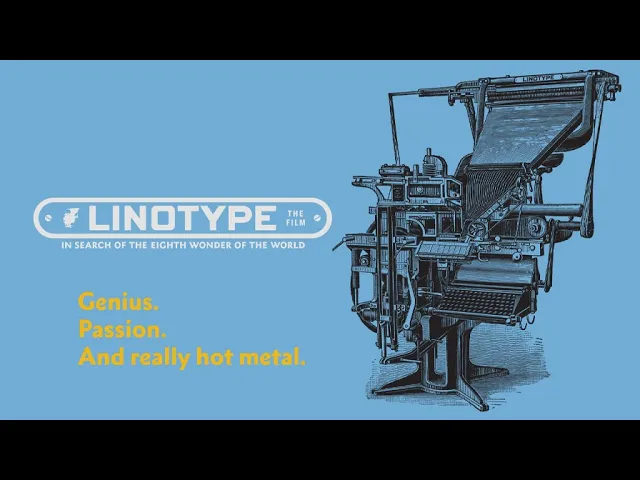
So what is a linotype well we we just called it a typesetting machine to start with because that's what it does it's called a line type because it makes one line of type at a time [Music] try to harken it back to those rube goldberg contraptions [Music] It is a two-ton contrivance that stands seven foot tall the absolute pinnacle of late victorian engineering where like the canary pops the balloon and they're insane you couldn't explain to them what it is they say that's a big typewriter the bowling ball rolls down and scares the cat cross
between a typewriter and a backhoe and a pop machine canary pops the balloon the balloon cracks the egg and then i have my breakfast it's terribly complicated it was Invented by a german watchmaker it has cams and levers there's just a lot going on there's belts and pulleys and everything's flying around in circles things that would totally baffle most modern day mechanics and yet strangely enough it works it requires you know the machine and you understand its limitations and you understand that it can kill you it burned me pretty good yeah it is very intimidating
i do sort of live in fear Of it because it can be kind of rattle trap at times it gets to be your friend or your enemy depending upon how it's working [Music] it's a fascinating machine a and b it's a complete career dead end and i tell people that once you get ink and type metal in your blood it never comes out it's like a love affair it's one of the most complicated Machines i've ever seen and it's one of the most fun things i've ever been around [Music] the great inventor thomas edison saw
that machine and he says hey this is the eighth wonder of the world [Music] a line of type is a great means of speeding up the production of typesetting instead of the old cumbersome method of setting type by Hand where you're using one hand to pick out a piece of type at a time and put it into a composing stick you're instead able to sit at a keyboard type as fast as you can and as fast as the machine will let you go and compose type that can then be printed from you hear about people
picking things up by osmosis i kind of think that's true because this is a case where i watched and observed and a lot of what i learned about the line of type i learned from my Dad oh yes i taught him i taught him some of the some of the basics of the printing operation and you can see has expanded since then [Music] i tend to set maybe a few more mistakes than my dad would but uh he has always been willing to proofread for me and correct those mistakes i can spot a mistake a
mile away i can spot a misspelled Mile away [Music] it takes a special breed of person to run it yeah i think that i'm that person just crazy enough to think it's fun and just smart enough to keep it operating once the operator is done casting his slugs casting the page he will take the slugs over to the proofing area here we've got some of the type that we set over on the large type today I'm going to put it in the bed of the proof press and the slugs will be locked into the bed
of the press here and inked and printed to determine if there are any flaws lock it into place with some miscellaneous furniture [Applause] hopefully it's a clean proof so i don't have to go back and reset anything any mistakes any errors would go back to the composer he'd recast that slug come back To the proofer and so on until it was signed off on and ready to go on the press and when it went to press they wanted to press something like over here later on they learned that if you have multiple additions or multiple
presses in major urban centers like new york city or boston or chicago it's kind of a pain to proof uh multiple lock-ups of type when you're running four presses six presses eight presses at the time so make a cast of an entire Form and put the identical cast on all of their presses so that way they could meet the circulation demand and that's how they printed newspapers in volume in the day [Music] ever since i've been very young there's been some tendency for my family to at least my mother on my mother's side she wanted
to show off her kids [Music] my brother and myself and we were she liked to sing and dance around the house and so we wound up being singers and dancers [Music] when i was nine years old i was running a little printing pass in my own house for i think my circulation of my newspaper was 20 20 people all Tenants in the building i spent 35 years working for the new york times and that was my my life [Music] and i guess i was just built for that kind of work as the other people were
as well they didn't think much about it maybe it was just a nice work to them but i may be more sensitive and i could see This was a story every night the story of our lives the story of the world's life the world is being made new for tomorrow what happened today you'll find out tomorrow but we're doing it to get you that to that stage by means of printing the fund of knowledge accumulated through the ages is available to everyone rich and poor alike printing is essential to all education All the other arts
rely on it religious movements depend on it business could not function without it nor could government the only thing available in people in the 1400s anywhere was handwritten manuscripts books are falling apart as fast as people were reading them so the scribe was just recreating the book because they were they were disintegrating monks in an Abbey writing a bible for months and months and months for for one bible and once you wrote a handwritten bible it took you one or two years to produce one or two bibles that's all you know you were you were
reduced to the work of art but you hadn't produced anything for mass culture or for mass med education a lot of people uh think that johannes gutenberg invented printing and technically that's not true people Printed for centuries before gutenberg came along but they're just never very good at it gutenberg what gutenberg did was invent the way to do it which was the most efficient way that involved making a press one not unlike this press here so all the kind of sudden came the printing press and shortly thereafter there were hundreds of printing presses thousands of
printing presses in europe and thousands upon thousands of people were reading We're getting information so this huge explosion people thought probably my god how can we possibly absorb more the next big one was the linotype linotype is the embodiment of a different age the age when letterpress flowered when it was in in its it's grander and and the problem is very few people know about it and i still believe that one of my roles in life is to help the memory of the industry [Music] you had to have the liner type machine because you had
an army of people setting type by hand type setting used to be done this way by everybody one line of type at a time one letter at a time it was slow it was cumbersome you have a case in front of you you take one letter at a time so the first thing is you've got to find the letter and select it then you have to assemble it into a line then you have to Return all that type back into the case and that was tedious slow hard work if you have a drawer of type
and you're making a book and you run out of lowercase e you got to make more type or you got to break down pages you've already made so that's what they call being out of sorts a piece of type is called the sort out of sorts you're screwed there was money to be made in mechanized Typesetting because newspapers had a phenomenal investment in the number of people required to set type by hand so there had to be some method for mechanization and that's what they were looking for and so they began to look at the
the various processes and try and think of ways of of speeding them up they tried all kind of schemes they tried having a funnel and dropping the letters in trying to align all kinds of all kinds of ideas anything they Could think of and so from the 1860s to the 1880s there must have been 50 or 60 different attempts to mechanize typesetting i'm standing in front of the page compositor a machine that had a very big role in mark twain's life the most famous investor was the american novelist mark twain who invested most of his
fortune in the page compositor which did not work and forced him to go bankrupt but generally speaking all through the 19th Century hand composition was the norm and it wasn't until the the final years about the 1880s 1890s that serious attempts were made but none of the people who started down the road to invent the mechanized type city machine succeeded the one success came by accident [Music] it all starts because a stenographer wants to transcribe his notes faster James ogilvy cleffain was a stenographer he had worked in lincoln's cabinet was the fastest and most accurate
stenographer of his day he's so famous because of the fact that he can get his notes done fast and get them to all the lawyers and to the judge and the way he did that was to use something called a litho stone a polish stone using lithography where the image is backwards and then you could reproduce as many Copies as you wanted and he saw one brilliant way of using the typewriter why don't i take the paper after i type on it the ink is still wet i'll turn it over and i'll rub the ink
onto the lithostone so now it's backwards what a phenomenal idea the problem is the ink dries at different levels on the paper [Music] so he has the idea but the typewriter is not going to do it for him so he finds An engineer named charles t moore moore comes up with an idea for a device with a cylinder a typewriter keyboard with a ribbon and instead of doing a page it does a line you cut it apart and then you rub the ink down onto the lithostone this machine is not quite doing what cleffane wants
so they go to a machine shop called holland company and there they meet a german immigrant a new american named ottmar mergenthaler [Music] Mergenthaler helps them develop some of the ideas for this machine but says it's really not going to work it's not going to do what you want it to do he helps them develop another version of it but it doesn't do it either he says no the only way is you're going to have to find a way of using actual type well clefain has another brainstorm he says when you use the typewriter it
impacts the paper there's pressure there why can't we use this new material Called paper mache they raise money and they develop a machine which we call the first band machine and all the letters are on a metal band and they're all sticking out they're all in relief you hit the keys and they line up all the characters in the line you force the paper mache into it and then you get an impression you then put it down put molten metal into it and you get a line of type okay great idea doesn't really work [Music]
they raise more money and they develop the second band machine and this time all the letters are recessed into the bands so you line up all the bands you have one line you force molten metal in no more paper mache you get a line of type out okay it works but every letter is the same width so the capital m is as wide as a lowercase i so typographically it's not very good [Music] So mergenthaler realizes at that point that every letter has to be an individual unit so it can be whatever width is appropriate
for the design of the character but he has to take the band and cut it into pieces so that every letter is an individual unit they can move those units around the machine and then assemble them into a line so they now raise more money at that point morgan dollar creates the blower machine which uses the individual Matrix that moves the matrix around the machine and actually can work [Music] the liner type machine changed the world and it all started because the stenographer wanted to transcribe his notes it was in fact a modern feat of
engineering hard metal moles for letters of the alphabet called matrices could now be brought into contact with molten tight Metal the result a metal bar of type a linotype the inventor's name was ottmar morgentaler otto morgenthauer omar murgan thaler ottmar ludwig mergen tyler the th is not pronounced it's just megan tala [Music] he was a watchmaker i think by profession watching clockmaker so he was Used to dealing with precision engineering work if he built pieces and parts for a wristwatch they had to be exactly right you couldn't have him a little too big a little
too small you're not going to keep time that way he takes night courses in electricity and mechanics and starts to realize that he's going to be drafted into the the prussian army he did not want that to happen his parents Didn't want that to happen and they finally made some arrangement where he was sent out of the country he comes to the united states in 1872 in fact he comes off the ship called the ss berlin where he came over in steerage with a wooden suitcase and it was at a place called locust point in
baltimore where um some years later he would have his own factory he made something that was right And you could repeat it exactly the same and and there's a lot of watchmaking qualities in that long type machine he was the creative genius behind this somebody else gave him the the germ of the idea but it was his genius that made the line of type and made it successful son of humble parents apprentice clockmaker immigrant skilled craftsman inventor in 1886 of a machine that revolutionized an industry a machine That pulled the mind of humanity forward a
thousand years in the space of a generation the line of type gave you the mechanization so that one person could do the work of six it could set type six times faster than a man could and you didn't have to throw the type back into a type case when you were finished the hand compositors the typesetters when they heard oh there's a machine going to come and replace you They started to worry i'm sure because they thought oh we're going to be out of a job but no such thing because the liner type was such
an effective device and it replaced all these people within a decade after the liner type they were up to the same number of people they had with handset type because the liner type generated so much need for typesetting for books and magazines and newspapers the way that this machine transformed information Is probably its most significant achievement if you look at literacy in the united states before the line of type and after the liner type there's a gigantic jump because now you can set type faster and because you can set type faster you can print faster
so you look then at the number of books published in the united states after the line of time look at the number of magazines look at the number of new newspapers that started it was important because it made Printing that much more affordable to the masses not just in america but around the world without the linotype machine and the speed that it came up with you would not have the communication system that you have now it's really it's really something to think that just a a machine that makes letters from a german immigrant from baltimore
could have such a deep effect on on people and society [Music] [Applause] davin quincy i'm 34 years old i'm a line of type operator i have people come in to to see the shop we have students come in from schools all the time and they just they they're in awe they have no idea what this thing is or how it works and i show them how the type is distributed back into the magazines and it's magic i like the fact that it's old i like the fact that it worked the Way it works it's not
like a computer that i look at and i don't understand how the circuit boards are you know making stuff do what it does i'm incredibly happy i know how it works it's very impressive to the women the operations necessary to produce a slug or line of type are divided into three groups composition of the matrix line casting of the slug distribution of the mattresses The operator depressing the keys releases mattresses from the magazine channel the mattresses are delivered to the assembling elevator in the correct sequence here's a close-up of some mats you can see the
letter that has been punched or engraved into which the molten tight metal is going to be injected the line of mattresses is sent to the casting unit against the opening of this mold the mat will fit perfectly The plunger injects the molten type metal into the mold the slug is ejected into the galley at the same time the mattresses are transferred to the second elevator and raised to the distributor here they are returned to their respective channels in the magazine [Music] [Music] i mean it's incredible and it's incredible the thought power that went Into figuring
out how this machine works i can't even wrap my head around it reading the manuals let alone try to figure it out we would call this a type matrix and it is this is of course a size to explain to people because it has to be seen the math is a little massive all things like this and they come in all different sizes the heart and soul of the liner type machine Is the matrix this small piece of brass performs a vitally important job it's a matrix a mold for a latter it forms together with
other matrices a word in type and then a line of words and type a line type [Music] this is what sets the type this is why it's a type setting machine everything else is to make this work this is a mat that actually went through 60 different Processes to be manufactured the tooth combination in every matrix matched up to the channel in the magazine so as the matrices went to the top they went along a distributor bar and then fell back into the proper channel i'll sometimes be setting line after line of type and then
i just stop and kind of stare at the return and watch them drop down And then realize i'm supposed to be doing work a steel wedge known as a space band is assembled between one word and the next at one point when the line goes over to be cast it forces the the wedge up and as it goes up it expands the space between the words justifying everything to the left and right hand margin strange keyboard if you don't know i think about the keyboard has 90 keys on it it starts out with the most
used letter which is a lowercase e And it goes e t a o i n s h r d l u c m f w y p v b g k q j x z so atmar put all the lowercase letters on one side based on frequency of letter use all the caps on the other side and everything else in the middle so you look at the keyboard it's e t a o i n s h r d l u e turn shirt blue now the reason that became famous was there's no backspace key or
delete key on a liner type if you made a mistake when you started typing you made a mistake you Started in the wrong line or whatever you couldn't abort easily so what you would do is run your finger down the first two rows of keys and then when the slug came out and it said eat ensuredly you'd throw it back in the pot no one would know what was going on but what would happen as fate would have it is that that would wind up in print and so all through the twenties and thirties and
forties that was a big joke in the printing industry who is etoin cherdlou [Music] the lana type machine was important on several aspects on the most important of all of them is its contribution to journalism because whether things are looking nice or not the ability to have a newspaper coming out every day is is non-negotiable this is a shrine to the first amendment and part of that is the history of news that's where we are right now we're in The news gallery at the new zealand [Music] right behind me you'll see things from 19 front
pages from 1940 to 1945 we're seeing the all of world war ii right here and every one of these papers was set with a liner type machine by a guy probably in a very hot room really squinting to get every single word right so linotype was able to to take the words of a few people and make them available for a larger audience Because it made newspaper production possible it's this machine that made it possible for newspapers to print two sometimes even three editions a day the newspapers went from eight pages to 48 pages like
almost overnight the cost of newspapers was driven down used to be a diamond and nicola piece pretty soon you saw the new york paper selling for a penny a piece you can take longer stories you can take more stories you can print more often you can print Faster they had to have content that would attract readers therefore the stories became more salacious the headlines became larger if it involved a murder or sex or gambling it was sure to draw readers in even today with the gossip channel tmz.com twitter they gotta know now the latest joke
the latest have you seen it the latest web video viral or what have you i mean it's the instantaneousness of the fact that drives the business [Music] the need to read which serves the very souls of men is more evident in the present era of progress than ever before publishers bookstores and news fans pour out thousands of books magazines and newspapers every day to inform instruct and amuse the greater part of these printed materials are made possible by various types of mechanical type settings machines which set type up in line Cast from molten metal first
introduced at the close of the last century are now the most widely used line of type was one of the most profitable companies you can possibly imagine newspapers had to buy machines they had to buy new fonts they had to buy mats that wore out they had to buy parts for the machine they had to buy service for the machine where it was necessary The linotype company had it was a cash cow beginning in 1886 the line of type spread rapidly through the united states and canada but almost simultaneously in western europe and the english-speaking
world because of the british empire and by 1928 the linotype brain supreme is the primary typesetting device throughout the world [Music] but merganthal's biggest problem is he Can't stop inventing he keeps improving the machine he keeps coming up with new ideas and the problem is the investors want to be able to ship machines and make money from them he ruled with an iron hand just the way he ruled his workers at the newspaper he ruled everybody at the company with wall reed wanted to make money very fast ottmar didn't want to build the machines that
fast there's a picture of whitlow reed standing next to Mergentella he was listening to what morgenthaler said but mergenthaler was not an equal to him so they start to become at loggerheads it gets to a point where reed starts really hitting the machine as being banned the machine's not doing what it's supposed to do what he was doing that for was basically he thought the stock price would go lower he would buy more of it he wanted to control the whole thing himself And all the records that are still out there are very ashamed you
should be ashamed of what he was doing atmar was a perfectionist and again he couldn't stop inventing this is another thing that drove reed crazy reidman has his own set of problems he was a task master he was demanding he wanted everything immediately he put a lot of pressure on merganthal but merkenthal put a lot of pressure on himself but he also Had the problem of working very very late at night he had a family to take care of and afford and with all of those things uh his health began to go out my mergen
thaler unfortunately died of tuberculosis when he was about 44 he didn't live to see this the great success that the linotype eventually became if he deserves anything he deserves the respect of being the person that we should be Thanking thank you for what you've done you put the world 300 years ahead by inventing the line of time machine it's it's almost the story of the american dream he comes to america with nothing he goes on to invent the machine that will change the world and yet almost no one knows who he was [Music] [Applause] [Music]
That's the first question people ask me when they find out on the public printer they want to know if i if i print money and i say no and then they say well can you get me my passport and i say no and then they just move on we print the congressional record the federal register we print the code of federal regulations we've printed every significant historical document in the life of the nation since 1861. so that our first big historic job was Probably the printing of the emancipation proclamation in 1862. the stumbling block in
terms of efficiency and speed was that we said everything by hand and when we really turned the equation around from minutes per line to lines per minute our work here just exploded well the lante battery gpo as far as i know was probably the largest in the world i think there was about 150 in total Throughout the building and it was just something to see all of those machines lined up all the way full length of the building and the noise was pretty loud all those machines running at one time pinging away and men shouting
and moving around and it was almost like a ballet of machinery and men moving around trying to get this thing done because every night the record you know had to get out [Music] it's just fascinating how every piece is an integral part of one action leads to another action and i just found that to be interesting as hell i was a land type machinist i repaired them worked with a head machinist who was a little reluctant on teaching me at first because he knows they had two fingers going so he didn't ever figure i'd be
Able to do it he used to go out for lunch every day and while he was gone for lunch because i had to cover the 11 machines i'd make sure i took one of them apart and when he came back he'd see that i had taken it apart and he'd hit the roof but that was okay he had to put it back together again in the meantime i was looking over his shoulder getting you know garnishing all of his knowledge What's really nice is when you come across some of the old-timers that used to run
these machines and stuff they just you know they love it when they see a running machine they they they'll be out in the in the vestibule or in the hallway and they'll you hear the click click click click click and all of a sudden they're retracted Like mice to cheese okay coming in the door because they hear that sound you've got the clink of the matrixes as they fall down into the assembling tray you've got the sounds of the mold disc being pushed up against it you've got all 13 cams spinning at the same time
you're adding all of these different sounds to the whirring sound that's been going reassuring you that the machine is on and that it's working right the work when you hear Just a little tap noise click click there's a clink which is the space band click the elevator moves down you hear it called clink and then you hear the sound of a sh and then that last line comes out and goes clunk and drops in place and then that's followed by the cascade of mats as they fall back down into the distributor down into the magazine
and you hear that brass against brass sound As the mats hit each other you'd hear clean clink clink clink clink clink clink clink clink wherever that bat was going to drop it's just a cacophony of sound but it's it's in its own alana type symphony and that's the sound that they grew up with something that they did for years [Music] if your mouth keeps your hands from Working keep it shut so that's pretty good model these people that ran them were really irreplaceable i mean you just couldn't put anybody down at a machine and say
you do this it took you know it took several years to really become a a decent printer at a lot of type machine and really many many more years to become really a good a good operator linotype compositors were the preeminent laborers of their day This wasn't just a job this whole thing in this newspaper age it was a calling it was it was something bigger they were the artists they were the people that created this wonderful beautiful typography that we're trying to emulate today digitally the people who operated them were talented artistic people posing
as industrial types in dirty coveralls you know they saved you from Making stupid errors especially those guys in the compositors really saved you from making stupid errors from upstairs and sometimes the guys in composing would find an error in the story while they were putting it in and say did you mean to say he was guilty because everything in this seems to say he's not guilty you know what did the jury say was he guilty oh i forgot to put knot in and it went through everybody and they never caught it but you know who
caught It the guy down there that with the with the cigar that's putting it in the goal was pick up your your paper at the door of your house seven o'clock in the morning that's the goal and you wouldn't care how you worked it or how you did it at night or when you when you went to press that's your problem our problem is we want a paper there in the morning first thing you had a deadline on thursday and You didn't dare miss that deadline because if you missed that deadline they couldn't print the
paper and if the paper didn't get printed it couldn't couldn't get in the mail it'd get in the mail the prescribers wouldn't get their paper till late and they wouldn't like that so it was a vicious cycle [Music] was not easy but it was fun [Music] i was sitting there in my type my machine doing some classified advertising i guess and along came some people i could see them from a distance the foreman of the composing room then came over to me and he said carl he says we have some visitors he brought all the
people over and then there was this woman and he says oh yes this is and this is uh marilyn monroe He could be knocking me out of my chair if he wanted to but i i took the shock i said okay marilyn monroe and anybody else you still all have to learn something about the machine at once and i set up a line of type in her name and i said it in boldface so she said no she would like that and i gave it to her and i said this is your name on the
beast and she looked at it And everybody else was looking at it and looking at me i guess and she said thank you very much and she kissed me on top of my head because i'm sitting down here and she's standing over me and i said to myself there goes the day that's all i'm going to talk about now today is my head [Music] in memoriam City of boston printing department 1897-2010 [Music] all right good morning ladies and gentlemen welcome to the city of boston graphics art printing equipment auction today we're going to be auctioning
off the assets of the printing department all right here we go lot 101 the heidelberg four color perfector and how much let's start off with about 200 uh Let's 20 thousand dollars 20 000 to get it going 20 000 on bidder now 22.5 an interest in the liner type machine 500 in the liner type 500 quickly a couple hundred dollars any interest at all an interest in the liner type hundred dollars one one sixty four hundred dollars ten dollars ten dollars ten not twenty ten not twenty nine twenty dollars ten are now twenty ten not
twenty not twenty This accident is killing me i'm here to attempting to and successfully acquiring a lander type machine for the museum in waltham ten dollars now 20 any for 10 20. you want them both you can take both of them right take them both i think i spent ten dollars for a machine whether i bought one machine or two machines as a matter of conjecture this gentleman is from one of the Museums i want to go visit the equipment they were sold for 10 bucks to the museum of industry and innovation out in waltham
mass and so they are going to be setting up some sort of demonstration um to to show people how liner types work thank you very much i appreciate it very much good luck you'll enjoy these all right now 166. i know what the machine does and i know why it does it as far as the operation and maintenance i'm very much in the dark on that but i guess i'm going to have to learn can you get that of course i got my name and address i would i maybe you shouldn't be photographing that do
you anybody wants a second machine offhand i don't but dave seed because he Travels the country why don't why don't you get the word to him because i don't i don't i definitely do not want a second machine they're going to skin me for the first one you really really should make uh touch base with dave well let me give you my name and i'll give you my phone number and my email address and he can get to me any way he wants to i'll be very blunt you're gonna have to get to him [Music]
i'd say since 95 i've probably worn out four vehicles and over a million miles i would say beth and i will get in our vehicle and we'll start in tennessee and we'll make a whole circuit of the west coast or the east coast and might work on anywhere from 20 to 100 jobs we want to teach everybody in their own print shop how to take care of their own equipment because there is Nobody else that's going to travel like we do it's good that we both get along with each other fairly well otherwise i'd be
hanging outside the window sometimes basically we're going up to see a customer at white star named tim trower and he wants a mouthpiece put on his line of type that went ahead and dug out screws your choice of mouthpieces okay Probably how big and when do you how big a type do you say these are not mouthy screws oh nope that's f this is f65 that's a mole screws i don't see any mouthpiece screws in there okay let's go to the second location looking for f 2791 is the part number okay 308 is the gas
equivalent when i look at the part sometimes i know the number sometimes i don't Uh there's a spring down there on the left that's a bb479 the rubber rollers are part number h-2601 for the smooth one the keys are 874 sometimes they go bad plunger is an f-898 what we're going to replace is this piece right here it's called the mouthpiece that's the old used one this is the brand new one we're going to be putting on to run the machine the puppy dog tail Needs to be up now we're going to partially cycle the
machine stop it right there most slide will come all the way out of the machine one of the things if this throat is dirty you'll get bad slugs they won't look good they won't fill up i've seen him work on a machine on a project that would have me literally cursing and tearing my hair Out and he breaks the sweat and that's about it this is a throat saw for a line of type you want a saw on the way out so you're pulling the dirt out with and you don't want to push the dirt
back in good flow what i just did was i pushed the plunger down again so that the metal would squirt out all the holes and you could see if you had a good flow to every hole And a good stream and it looks like we had plenty of stream plenty of pressure on all holes so looks like we're good right here squirt number two well what i like about dave is that he shows you all of his secrets he is a great teacher he wants you to learn what he's doing so that the next time
you have a problem and he's in england on a service trip or in new england you can take care of it Yourself [Music] it's a big industrial machine um and the uses today are not in that industrial setting anymore they're in studio settings they're in small shop settings my name is john christensen and i'm the first among equals at firefly press in boston massachusetts we are a commercial Letterpress printing shop letterpress has of course long since disappeared as mainstream commercial commerce but it has come back in recent years as a craft at one point it's
just how things were done people weren't too precious about it but i think given the way that technology has evolved i think there is a certain amount of integrity in the process that i respond to letterpress is increasingly being seen as something Quite special not because it's changed but because the rest of the world has changed and now the bite and the use of the nice papers and the brilliance of the colors and the physical presence of the printing is something that people now know to appreciate and to desire i love the fact that sitting
down at a keyboard i have only so many typefaces and so you know it's my responsibility to use Them with intelligence and and here here then is an element that enters into letterpress that simply does not play so large apart in any of the more modern printing technologies and that is craft the simple knowing of a technique craft means you care and you know about what you're doing i think anybody that's going to study typography needs to get rooted first in the letterpress method Whether they set type by hand or use a line of type
for a ludlow they need to know how to use type before they use it i had a romantic notion of letterpress when i was uh a young fellow and and uh began collecting the stuff because i never had much of a budget to work with and the stuff was all free [Music] i studied journalism in in college and i always wanted to publish my own journal Or or magazine the almanac tackles a lot of land issues environmental things um sort of the cultural health of the state i don't think there's another publication in america on
this scale that's done hot metal eldon is one of those angels who happened to be around when i was starting out and His career because of the technology his career as a linotype operator was winding down because there just weren't any left and he started working for me and he's always worked part time just he comes out when i need him there would have been no optopennic and almanac at least in its current incarnation without eldon one of the reasons that newspapers like To employ deaf people is because they weren't bothered by the noisy working
conditions and yet strangely enough even though they couldn't hear the machine they could sense what was going wrong with the machine and we're able to respond to it just about as quickly as a as a hearing person [Applause] [Music] [Music] do [Music] he says i'm not a show-off [Music] it's very easy to to to go into a lot of print shops and see hand printers working very few of them have the experience of seeing a full working liner type machine that we have here with our line of type operator mr ray loomis who comes here
every saturday As a as a volunteer my name is raymond loomis born in baltimore maryland uh 82 years ago so i've been around a while our machine is 75 years old and it still runs and it runs well it was well maintained over over its lifetime and we we try to keep it running too when i was working by myself which is a bad thing on a machine like that be by Yourself and i was checking to see if the blower coolant blower was on and i put my hand down and then and the machine
came back on my hands and and held it i turned it off quick enough since i felt it but i was stuck i couldn't move i couldn't i couldn't reach anything i didn't know what to do and then i thought the only thing i can really do is to pull that advanced lever and let it go do its thing and i did and I pulled it and squinted and it backed right off it didn't come any further than my fingers were already caught and they were black and blue for a while it was two or
three those fingers there [Music] operating a lot of type can be a little frightening you don't hurry on the line of type you clear your head before you start and You can't be thinking about a lot of other things there's a lot going on a lot you have to watch for this is all pre-idiot proof all pre-osha equipment the assumption was you knew what you were doing there's so many moving parts and there's metal that's 550 some odd degrees that could explode on me at any minute there's something we call the squirt ladle squirt out
and you're used to when you hear a certain sound you shove back that meant that There was something wrong in the in the setting line where there was a gap of space that space was going to be filled with hot metal and it was going to come at you and when lead comes out of that thing it's got to it's got to be right on the button you get so attuned to the machine that you can hear it getting ready to squirt and if you're good you can get out of the way otherwise you get
a pant leg full of metal but then a lot of Times i jump out of the chair before i would you know while i was casting just in case i didn't do it right i saved my first squirt i have it somewhere i'm not sure where it is [Music] good morning i asked the guy one time is there anybody teaching this and he says no Not anymore they used to do it all the way around the world but i said well i'd like to start lightning type university one and uh pretty good idea if you
read the word that says line of top university you're thinking of a campus with a big buildings or something well that's not the printing business this line of type university 8 class this is where people come to the united States to denmark iowa to learn how to operate a line of type i probably learned more about the machine this week than i ever had in the 15 years or so that i operated machine people all over the country in the world that is interested in it like this week we've got one fella from australia and
then one one from england we have a very good range of professional or ex-professional liner type engineers who are very very generous with our Advice and help land of type university is a unique corner of america um run by a guy named larry raid this gentleman that runs this museum here and welcomed me here is mr larry jay wright and i've got to say we say in australia right good on you mate and he from what i could gather is just a fanatic for the machine and Taught himself how to use it his two passions
are vastly different line of type machines and locomotives the train it's a a davenport locomotive an 0.60 diesel mechanical with a cat v8 engine in i rebuilt six miles of railroad track with that ford eight in had a little boom on the back i mean he Bought a train and laid track for it and i mean who does that kind of thing larry's a collector it's very hard for him to part with anything as you can see most of the places that have them are museums and if they have one liner type they don't need
two of them if they have one printing press they don't need a third or fourth or fifth one and i'm not that way these are a couple Line type inner type that i'm using for parts and as we go down there's another line of type over this way i've just been a collector and i just keep collecting and keep collecting and now i've got something over 90 of them all together what some people don't understand about larry is his dad owned a junkyard and so larry Grew up in a junkyard so having machines sitting outside
or resting or whatever doesn't surprise larry larry oh yeah we'll get that running oh we'll fix that and so it's just sitting there waiting to be restored again because to larry nothing is ruined it's all still good it's metal it'll it'll fix i've also encountered people that sort of Belittle the whole program and i can see why he's not classically trained he wasn't trained by linotype to do this but in his own way he's a total genius there's so many people that have called and said well larry reid says call you or larry rate says
this or larry says that and uh it's because because larry's excited other people get excited too he's the kind of prophet That i think this sort of thing needs you know this this gospel if you will needs is somebody who's passionate and and maybe a little bit crazy you need that i think [Music] people change products change everything changes and every change adds to the problem of communications The rate of change is accelerating faster faster faster stop but you can't stop you can't hold back the surge of change or the growth of information it will
continue in spite of you and you're going to have to cope with it otherwise the death knell for the liner type and All type setting machines that use metal started in 1945 when the inter-type company showed a machine called the photo setter a photo center mat doesn't cast hot metal at all but it shoots a beam of light through a small photo negative in the mat onto a specially prepared piece of paper which is then photographed and prepared for offset production so it Looks like a line of type acted like a line of type did
everything online detected but photographically here okay here we have um and i don't know if you can get in on that it's from the new york times it's the last standing times or standing type as times went Uh from hot metal to cold metal type but i believe this is a page of the obituaries which is kind of sad isn't it one way you felt sadness you had to because you knew it was going to be it was coming eventually like a dying patient [Music] [Music] and they came to work one day And it was
all over i'd been a printer now for 26 years i've been in this place for 20 years six years apprenticeship 20 years journeyman and these are words that aren't just tossed around all the knowledge i've acquired over these 26 years it's all locked up in a little box now called a computer [Music] i had some guys around me i reported a couple of glasses out And he said to yesterday [Music] so we said goodbye to the past and hello to the future [Laughter] [Music] we had these machines on the back of a big truck a
dump truck and i stopped at a junkyard a salvage yard and i just Turned my head and pulled this lever and it it slid those machines slid off and i just couldn't even look at it because i knew there was good machines but nobody would run them anymore as far as i knew and the wreckers and i just smashed it up with a big 12-pound hammer and i thought oh that's that's the sad part of it all at the end of of line of type's usefulness here there was no market for the machines And the
only way they could really be gotten rid of was to scrap them as far as i know they were all surplused and they were let go and unfortunately they were probably jumped they opened up a window at the back of the of the floor where the largest of the line of type batteries was and just pushed them out into the parking lot Pushed them out to be piled up and hauled off for scrap they're scrapped in two ways the machines are hauled to the junkyard and melted and the skill sets and the expertise of the
knowledge of the people that ran them is also hauled to the junkyard all the presses the line of type the proof presses all of that disappeared all that iron scrap went out in the back and rusted there For this it's a cathode ray tube phototype setting system called linotron 505. it produces high quality topography machines like the photon the very first phototype setting looks like a combination of a steel case desk a typewriter and something from star trek this was the future back in 1985 and as you can see the future is passed well this
is the end of the tour and this is kind of the Unresolved thread of our tour this is the computer room the digital type setting room and it's it's very old this is from like 1990. [Music] farewell farewell and one should lose [Music] the best years of my life i've spent with you now our printing days are at an end you've set your final type my friend Are the thing that finished you [Music] this is what the line of type company looked like in in brooklyn at one time two blocks two square blocks were the
factory one square block was where they made the machines the other square block was the headquarters and the matrix manufacturing it's now a storage facility for some moving company it's very sad you've got to go No more hot lead the type we love to set that way is dead computers and cathode tubes replaced us but by god they'll not erase us cause we taught them everything they know when merger sort of moved out of the old grass and street building i walked through the building with the old building supervisor and i found a few things
including this rather nice side i Don't know where it had been on the walls and sort of asking employers to keep the place clean but i i thought it was kind of nice and i saved that and some reason have kept it ever since i'm matthew carter type designer former liner type employee there was a huge amount of work involved i mean particularly for the letter drawing office in adapting the metal types for film my job was to explore Uh certain advantages that there might be in this new technology a sort of liberation from the
constraints of of of metal type casting at mergenthala we make a tool for the graphic arts industry a sophisticated tool using modern electronics to perform one of the most vital functions in printing and publishing high speed photo type set i think there are some qualities that did get lost i Mean there's often something very beautiful about the impression of type on good paper and so on as as was done in the past if you look through the history um so you know there may have been some losses along the way for me the gains outweigh
the losses is all i can say i mean if i put them in the balance the gains win Um but again other other people sitting here could could disagree with me violently about that and then i suppose the other very significant development since then has been the web i mean screen fonts and so on [Music] the linotype gmbh has taken over is the responsibility for the typefaces but not for the mechanical parts So we have sometimes customers asking here for spare parts or whatever to the machine we have no material and we have no solution
for that liner type of today the current company has no relationship at all with the liner type machine the machine is no longer used in use or whatever and the other liner type machines which line it up has developed also disappear from the market but what we See is the heritage to continue with our typefaces the linotype machine had a really good contribution to type design this is secondary in terms of the overall population but for the type design world this is really important because the fact that the liner type machine became so popular in
around the globe gave it enough capital to be able to invest in good typography [Music] Here you have one of the most amazing archives that anyone has ever known about it is every drawing for every glyph or character or symbol that was ever made into a matrix for the liner type machine this is a nine-point caslon old face italic and here you can see the drawings for the uh italic a in caslon they did alternate characters as well so here's a beautiful cafe with a swash on it this is a an example of a drawing
of the kind that was made Atlanta type for many decades for metal type it wasn't just sort of this nuts and bolts let's get black stuff down on white paper and and you know and that's all that was necessary linotype and monotype were committed to fine typography as you go through here you actually see the history of typography here's century schoolbook right now in front of me i've got cloister I've got garamond uh memphis memphis is a square sarah here's devin augury that's the first font i ever worked on by the way i mean when
we talk about typefaces everybody knows the canon of the linotype type faces you know but they never really think about where they came from or how they came to be his primer which was used for textbooks metro lite which was very popular for newspapers for display advertising opticon which was one of the newspaper Typefaces this is very interesting his bengali bold so again to sell a machine or machines in india they had to create a font for the bengali dialect even when the line attack machine is not there its legacy continues because it made possible
for us to have these sub faces and we still use them today and that's amazing to me that the designs are so strong for this Machine that they've transcended the transition into a digital face [Music] if the 90-some machines are gone the junk man all my endeavors have gone down the tube after i pass away so someday i will uh my wife is probably going to throw The machines in the hole right after me the only way you're going to keep me down hopefully they'll go on to somebody else that will take them and learn
how to use them hopefully i'll find somebody that wants to learn the machine and i'll be able to teach them then the best case scenario if that doesn't happen is that they go to a museum where they're at least preserved as a static display of what they used to Be able to do worst case scenario somebody's going to come in here look at them and go man that's worth nine cents a pound uh a scrap metal man would want what would want money to break one up and remove it for you but that's why those
guys are usually measured by the size 17 shirts size 17 shoes and a size 17 iq uh they weigh about 4 000 pounds so i think scraps going right off 280 a ton In this area someone told me today so you know 560 total value if you took it to the scrapyard it is a damn shame that so much is being pushed out of of you know the back of factories you know just crashing to the ground or being broken up most line of types got thrown out um my dad said he's probably thrown out
a thousand line of types in the scrap because they have no use for them that should Give a sense of urgency to the maintenance and the the you know the salvaging of the stuff that's that's already out there there's just too many it's like you'd like to save a save save some but it's too many you have to do something with it it would cost me maybe four or five thousand dollars to get it operating again we've offered the machine to a number of Museums most museums already have a line of type but they too
are just sitting there they're not doing anything most of these machines now are headed for salvage yards and i wish it were otherwise [Music] and so we have made the decision to take this to the salvage yard with a few tiers it's not what i really prefer to do but i want to be here carefully to Document the fact that that's the right decision and it's not an easy one as we say goodbye to this today i guess i'm glad not to have to watch it because uh i know how finely machined this thing is
what what a fine tool it is and to see it just destroyed uh i ca i my mind keeps going my mind kicks going back to the inventor hotmar mergenthalen and uh that hurts well that's pretty devastating but it also Shows you the durability of the machine it was emotionally tougher than i expected it to be a little twinge of regret but not really because hey everything's got to make way and even not morgenthaler's line of type has to make way over the next few decades without dave's seat and people like him these machines will
just stand here idly after a while because they're doing Nothing they will sell them for scrap metal being a young operator and learning this stuff from people that are 80 years old is also feels like a bit of a responsibility that i should learn as much as i can while i can if it's to survive if it's to be appreciated and if it's to endure i think someone's going to have to pass it on [Music] the machines themselves were put up at Auction in boston they were purchased by one of our founders and trustees a
man named howard goran who in turn asked if he could donate them to the museum we expected to only receive one however when the riggers left this afternoon there were two here [Music] we have two linotype machines delivered they still need to be connected electrically a lot of electric wiring has to be replaced They are going to need some mechanical attention a lot of the drive belts have to be replaced and from there on we'll just see the accomplishment is seeing them not go to china as at scrap metal i was looking for home for
the second one and if we can find a home with the second one i i would not feel sorry about finding a good home for it but i'll be god damned i'm going to see this thing cut up for Scrap and that's what it boils down to i think for most commercial purposes you have to say yes it is a dead machine you can do it all much more quickly in other ways on the other hand i think it's it's not a dead machine in that there are enthusiasts around and i hope there will continue
to be enthusiasts who find them sufficiently interesting anything that i get into that's new is Going to be obsolete soon so why not get something that's already obsolete and make the best of it it's a closed system it has become what it will now always be so that there's though there's a lot to learn a lot to learn one lifetime isn't enough at least the technology stands still for you somebody had to say something what the future was like and who was being affected by it so I said i'll take the voice of the liner
type machine and i'll be the poet this atma mergent dollar chop the liner type he did unwrap qued created quite an awful flap within the marketplace type foundries trembled then they went under printers jobs were rent asunder investors bellies blue rotunda and linotype replaced the case Books and papers multiplied in an ever growing tide making wings for thoughts to ride up to outer space now linotype has said farewell right there computer type it did foretell but it let out one final yell i've served the human race That's it [Music] [Applause] [Music] so [Music] [Music] so
[Music] so [Music] you want to do this one for me oh yeah All right take four [Laughter] you