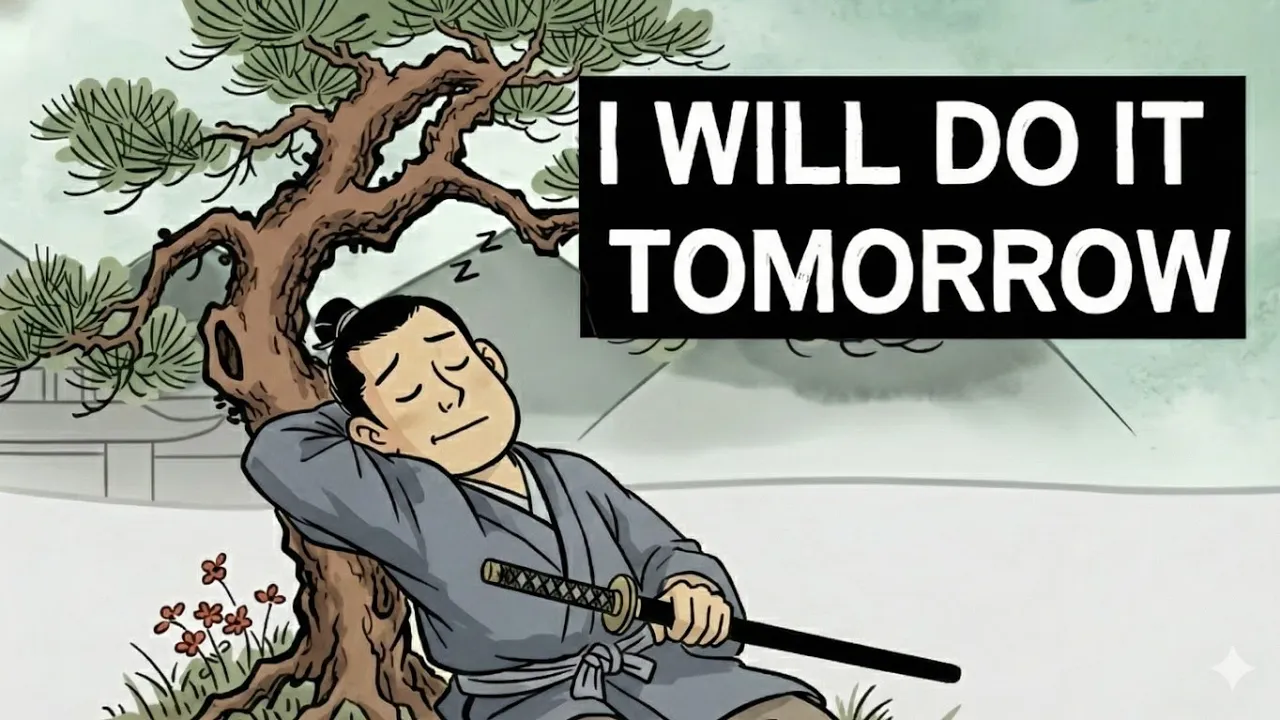
[Music] Once upon a time in feudal Japan, there lived a young samurai named Yuki who dreamed of becoming the greatest warrior in the land. He would spend hours speaking about his plans, reading stories of famous battles and imagining himself winning great victories. Yuki dreamed of mastering many weapons, learning advanced strategies, and earning honor for his clan.
He truly believed that having such strong ambition would naturally lead him to greatness. Yet, when the time came to train, Yuki always found excuses to avoid the hard work. He told himself the weather was not right or that he was not feeling well, or that he needed to plan more carefully before beginning.
Years passed and while Yuki's dreams grew larger, his skills remained small. Younger warriors who trained everyday soon surpassed him and Yuki came to realize a painful truth. His dreams had not lifted him higher.
They had made him weaker. His ambition without action had left him frustrated, unprepared, and full of regret. This story reveals a truth about human nature.
Yuki believed that strong ambition and clear goals would naturally push him to act. But his identity as a dreamer created a gap between what he desired and what he was willing to do. He found comfort in imagining his future rather than enduring the discomfort of daily practice.
He discovered, as many do, that motivation cannot bridge the gap between wanting and doing. In fact, the more he spoke of his plans without acting, the more his mind rewarded him as if he had already achieved something. His dreams became a trap and his inaction became his downfall.
The samurai understood how dangerous this gap between wanting and doing can be. Drams without action quietly waste time, and time once lost can never be reclaimed. The larger our goals, the easier it is to feel overwhelmed by their distance and the more likely we are to delay the small steps that bring them closer.
We tell ourselves that preparation is progress, but in reality, we are simply drifting further from the work that matters. Centuries ago, the great swordsman Miiamoto Mousashi grasped this truth. Unlike those who try to transform their lives in a single moment of inspiration, Mousashi devoted himself to small steady actions performed every day.
He knew that greatness was not built in sudden bursts of energy, but through the quiet rhythm of repetition. The samurai, though known for their dramatic battles, became strong through the humble discipline of daily practice. They trained not when they felt ready but because training was their way of life.
To wait for motivation before beginning is like waiting for perfect weather before starting a journey. You may wait forever while others who are willing to walk even in the rain reach their destination ahead of you. The truth is that motivation is not the spark that creates action.
More often it is the flame that follows it. Action brings momentum and momentum gives rise to the energy we mistake for inspiration. Those who achieve the most are not the ones who feel inspired every day but the ones who act even when they do not feel like it.
The samurai captured this principle in the teaching of Kaizen Nomi, the way of small improvements. The mountain is climbed one step at a time, they said, not by staring at its peak and wishing to be there. Even if the steps seem small, they lead to strength because they are repeated.
Even if the progress seems slow, it builds into mastery because it does not stop. Imagine a samurai student who feels too lazy to train yet chooses to practice a single sword form each morning. His friends laugh at the tiny effort and tell him it is useless.
But he continues. Over time, the movement becomes automatic. His body grows stronger, his technique sharper, his discipline deeper.
Months later, he realizes he has built a foundation that allows him to learn advanced skills with ease while his friends who waited for motivation remain at the beginning. In this way, the smallest step can carry greater power than the grandest plan. The lesson is clear.
Preparation without practice is simply disguised procrastination. Talking without doing creates the illusion of progress while leaving us unchanged. Waiting for motivation is nothing more than handing control of our future to our emotions.
The samurai knew that strength lies not in feeling ready but in acting despite resistance. Yagyu Munanori, one of the great samurai teachers once said, "The sword that waits for perfect conditions never leaves its sheath. " "If you wait for the right moment, you may wait forever.
" Our need for motivation often comes from fear. We fear the discomfort of starting when we feel tired, the resistance of continuing when we lack energy, or the possibility that our efforts will not feel rewarding right away. Yet, discipline is not about avoiding these feelings.
It is about moving through them. True strength is not the ability to act when conditions are perfect, but the ability to act when conditions are not. The samurai way to break laziness is therefore simple, but profound.
Begin with small daily actions, no matter how insignificant they may seem. Do not wait to feel ready, for readiness is an illusion. Do not place your trust in emotion, for feelings are fleeting.
Instead, place your trust in habits and commitments, for they built the foundation of all achievement. As the warriors once said, "I am not controlled by my feelings. I am guided by my commitments.
" Strength does not mean saying I feel like doing this. Strength means saying I will do this whether I feel like it or not. The power to act without waiting for motivation is the power to shape your life.
Thank you for watching.