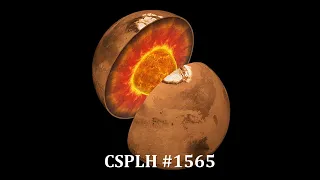
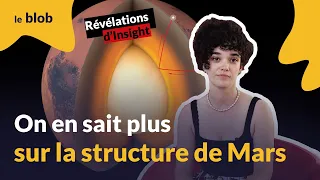
My name is Henri Samuel, I'm a geodynamicist, CNRS researcher at the Institut de Physique du Globe de Paris. What is the recently published model of the internal structure of Mars? Mars, like other differentiated terrestrial planets, is a planet composed of of a silicate envelope that overhangs a metallic core.
What we have been able to discover is that this silicate mantle which we thought was homogeneous is in fact heterogeneous because it contains at its base a layer, still silicate, but enriched in radioactive elements This layer is molten, and partially molten, just above the Martian core. How was this model built? This structure model is obtained essentially thanks to seismological observations, in particular those recorded during a meteorite impact that took place here, as shown in this diagram, which generated various waves, and in particular compression waves that propagated along this path.
And we realised that the propagation time of these waves was abnormally slow and could not be be explained by a mantle which was homogeneous. And so we had to re-explain the interior of Mars by taking into account the presence of a layer with seismic velocities sufficiently slow to slow down the path of this compressional wave thanks to slow seismic velocities due to the presence of material very hot and molten. How does this model change our understanding of the structure and evolution of Mars?
So Mars, like other terrestrial planets, has probably experienced a magma ocean stage where everything was molten, and the solidification of this magma ocean gave rise to this layer that we still observe today. And this layer has influenced the history of Mars from the earliest stages to the present day, and in particular the fact that we have a silicate layer on the surface of the Martian core prevents the core from cooling and generate geodynamo therefore calls on external sources to generate the magnetic recordings that have been recorded in the Martian crust during the first 800 million years of Martian evolution.