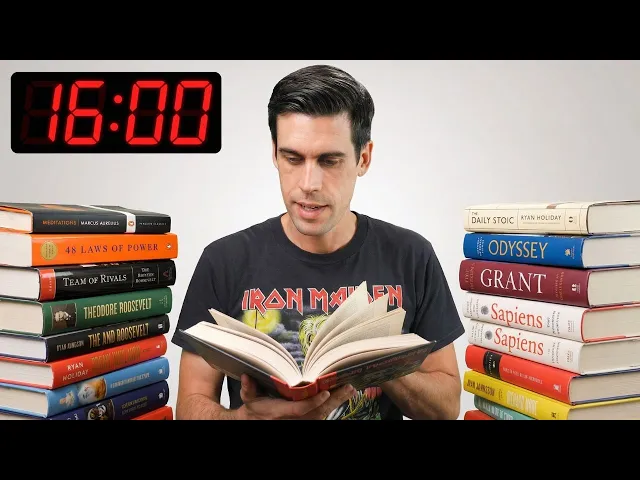
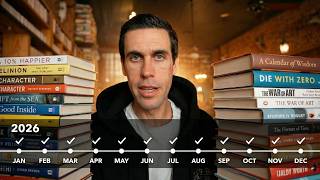
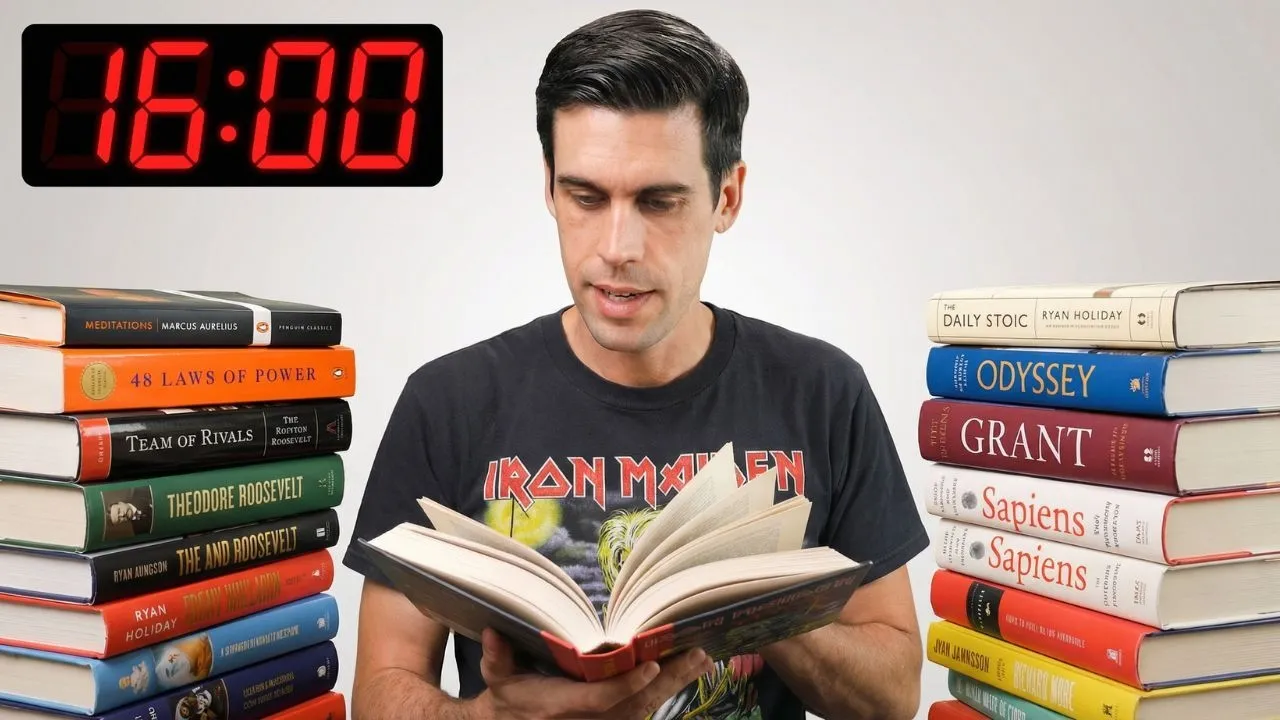
So, I read a couple hundred books this year, as I do most years. And I did this while running multiple businesses, one of which is a bookstore. I did it while writing a book.
I did it while being the father of two young kids and a husband and [music] many other things. I read this many books this year without speedreading, without audio books, without summaries, without shortcuts, without hacks. [music] No, reading is a lot of work.
And I do that work page by page on physical books that I read. And while I said that there's no shortcuts, there are some strategies that great readers that professional readers like myself use not just to read more books, but to get more out of the books that they read. And that's what we're going to talk about today.
And here are my rules that will transform your life. First off, although I do read a lot, it's not just about quantity. One of epictitus the so philosopher's great line was it's not that you read it's what you read and so as we think about these rules we're going to be talking about reading great books we're going to talk about reading the right books and we're going to talk about processing and retaining and ultimately applying what we read it's not quantity it's quality that counts I mean this seems basic but one of my rules is I just always carry a book with me there's a great Adam Sandler song >> I just add a book to that phone, wallet, keys, book.
Carry a book with you. Or if you want to read on your phone, have one loaded on your phone. So you do that instead of checking your email or scrolling social media.
Have a book with you and read it wherever you are. I've read on airplanes. I've read in doctor's offices.
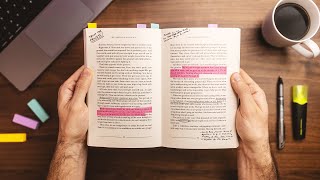
One year I won a Grammy and I read while I was sitting in the audience waiting for the awards to be given out. Have a book on you and read. If you're not reading with a pen, you're not really reading.
If you're not taking notes, if you're not doing what they call marginelia while you're reading, you're probably not reading the right books. They call reading a great conversation and it should be an exchange. It is a conversation.
When people ask me to sign one of my books and they say, "Oh, it's one of my favorite books. " And I see that they haven't written in it. I know they're just blowing smoke up my ass.
If you are not writing and marking up the books that you're doing, you're not really reading. That's another one of my rules. Books are not precious things.
It should look like you read the book. I just bought a an old out of print book that I wanted to read and it came all wrapped in bubble wrap and tissue paper. I'm going to take great pleasure in writing in it, folding pages, spilling food on it.
Books are not precious things. Books are meant to be read. That's how you pay respect to an author by really engaging with the text by making it a part of your life by bringing it with you.
It should not be this pristine fragile thing you are trying to protect. Honestly, I think spilling food on a book is a sign of respect. Some of the best meals of my life occurred over a book and the stains will prove it.
I'll show you some of mine. But the point is like there's like a meme about making fun of people who who sit at a bar and read or sit alone at a restaurant and read. I love those people.
Those are my people. You should be one of those people. One of the great conversations that changes the life of Zeno, the Stoke philosopher, is when he's told that reading is a way to have conversations with the dead.
And honestly, when you are reading and eating alone, you are not alone. You're having a meal, with a great person from history, with a great thinker, with a hilarious person, with a beautiful person, with a tragic person. I love to read while I eat.
It's one of my favorite things. And it's a great way to take some time that I otherwise might have spent scrolling on my phone or just staring off into space, and I use that time productively. Look, stop watching the news.
The best way to understand what's happening in the world right now is by reading books. Truman famously said that the only thing new in the world is the history you don't know. Obviously, it is important to be an informed citizen.
But watching real time breaking news is not the best way to be an informed citizen. Study the past, study history, study psychology, study human nature. Or if you are going to read about contemporary events, try to find a really great author that writes fast.
The medium of long form content put between two covers is the best way to understand what's happening right now. A lot of people read, but not enough people reread. Right?
The Stoics saying, "We never step in the same river twice. " The book might be the same, but you're different. You bring something different.
My relationship with The Great Gatsby is almost 25 years old now. And even though I'm reading the same book that I read in high school, I still have that same copy with food stains and things that I underlined. I take something new out of it.
And in fact, this year, I also picked up a new edition of Gatsby. There's a 100red-year anniversary edition that came out that's got illustrations and little aides in it. And I took something new out of that, too.
Right. The Stoics were right when they said we never step in the same river twice. And honestly, my relationship with Marcus Aurelius's Meditations is the same way.
This is a book I have read literally hundreds of times. But when I picked it up off my bedside table last night, I found something in it that struck me very much of that moment that I've obviously seen hundreds of times before. But that was the moment that I needed it.
And that's why we reread. I also think that rereading is a great way to get out of a a slump or a dry spell. If I'm finding myself, I'm not reading enough.
I haven't read anything good recently, I want to go back to a book that I know is amazing, that reminds me why I love literature, that reminds me why I love history, that reminds me why I love philosophy. Right? If you want a guaranteed good read, go read something you've already read before.
One of the worst habits you can have as a reader is to be a snob. Right? Sometimes I find myself reluctant to pick something up because it's really popular.
And I catch myself doing this. So, I'll find myself reluctant to read something cuz everyone else is reading about it. I see it in every airport.
I hear people talking about it. And you know what I find most of the time when I pick up one of those books, I go, "Oh, this deserved all the attention it was getting. That snobbishness never serves me well.
" Even when I'm reading it and I I find that it's not that good. What I'm getting out of it, where that's helping me as a writer and as a thinker, is it's forcing me to consider why it's good for other people. What are they getting out of it?
What are they responding to? Right? Life is too short to yuck other people's yums.
Read the bestsellers. Read the popular stuff. And even if you don't appreciate it, it can help you understand why that writer is reaching a large audience, and that can make you better at whatever you do.
Look, most bestsellers are bestsellers for a reason. They're doing something for someone. You should never read without taking extracts.
Ply the Elder said that 2,000 years ago. He was talking about keeping what we call a commonplace book. For thousands of years, people have read and take written down passages and quotes.
They write them down in little journals. I do mine on note cards, quotes, stories, ideas, observations, things that inspire, things you want to look up. You got to keep a commonplace book.
One of the reasons I don't read a lot of ebooks and I don't do audiobooks is I feel like it's just going into a black hole. I go, "Oh, I like that. That was interesting.
" But I'm not recording it anywhere. There's no process by which I'm downloading it from one medium to another. If you want to learn how to keep a commonplace book, I'll link to a video where I do just that.
Look, life is too short to read bad books. If a book sucks, stop reading it. The best readers quit books, right?
You turn off a TV show that's boring. You walk out of a movie that sucks. You stop eating food that doesn't taste good.
You unfollow people on social media who aren't adding to your life. Life is too short. The best reading rule here in this regard is 100 pages minus your age.
As you get older, you got less time to read shitty books. I give more time to books that I'm not enjoying than my 95-year-old grandmother does. And I think that makes perfect sense.
I would say that great writers and good books are not hard to read. A student once bragged to to the philosopher Epictitus that he'd made his way through the dense writings of Chryus. And Epictitus looked at him and said, "You know, if Chryus was a better writer, you'd have less to brag about.
" [music] The point is the job of the writer is to make their ideas understandable, is to make their story interesting and compelling and exciting. And if they can't do that, find someone who can. My view is that a long book has to justify itself.
Robert Caro earns every page that you read. And I think I've read something like six or 7,000 pages of his writing. Ron [music] Chernow does the same.
I think I've read something like 4,000 pages of his writing. And I'm I'm not bragging. It's a credit to them.
It was a joy to spend those hours with them. But I've picked up other big biographies of historical figures I really wanted to learn about and I quit, right? Because life is short and the writer should have done a better job.
A question that will change your life is, "What's a book that's changed your life? " Ask that question to people you admire. Ask that question to people that you meet.
That was Emerson's line. He says, "If we encounter a man of rare intellect, we should ask him what books he reads. " If you only read the books that people you admired said had changed their life, that'd be a pretty good reading list.
I will say generally cool titles make for crappy books. I I wish this wasn't true, but it is. If there's anything to be skeptical of, it's books with great titles.
And then conversely, some of the best books I've ever read have had terrible titles. We did a video of this not too long ago. By the same token, you shouldn't judge a book by its cover.
And at the same time, you you kind of should. As an author, I tell you, you spend a lot of time thinking about the cover. And if you don't, that says something about the author's process, right?
It tells you something about the leverage they had over their publisher. It tells you something about who they think will like a book like this. You know, when you're reading, you should look for wisdom and not facts, right?
We're not just reading for random pieces of information. We're not preparing for a [music] test. We are not preparing for trivia night.
We're reading to accumulate wisdom and insights. We're reading to learn and grow and be changed as people. I think this is an important question to ask yourself when you're reading.
What do I plan to do with this information? One of my strategies when I read is I try to find my next book in that book. I read the footnotes.
I read the bibliography. I read the acknowledgements. I want to read like a monkey swinging from vine to vine.
I want to plan out where I'm going next based on where this subject is taking me, what it's exposing me to, what I'm learning about as I'm learning. There's something profoundly wonderful about finding an author you love and then just reading everything they've written. Really going backwards and forwards in their whole body of work, getting to know their strengths and their weaknesses, seeing how they evolved and grew as a thinker and as a writer.
So, when you find someone you like, go all the way. A basic rule of life, when you see a book you're interested in, buy it. Don't sweat the price.
Don't wait for it to come out in paperback. Don't wait for it to be on sale. If you're worried about what it costs, go get it from the library.
I'm saying this as an author, even though it's not in my interest. Go pirate it on the internet. If you're interested in reading something, you should read it, right?
Books are one of the best investments you can ever make in your life. Warren Buffett's entire fortune can be traced back to a book recommendation he got as a young man. Benjamin Graham's the intelligent investor.
My life was changed when someone recommended the Stoics. Imagine if I said, "I'll get to that later. " Or imagine I said, "Oh, I'll I'll wait to see if that ever goes on sale.
" Right? For $10 or $20 or from a library for free, right? You can change your life.
It is an incredible return on investment. If there's a flicker of interest in a book, go for it. Speed reading is a scam.
If you want to read a lot, you have to spend a lot of time reading. The only way to speed up your reading is to know a lot about the subject that you're reading about, right? And how do you do that?
You have to have spent a lot of time reading about it. There's no shortcuts. There's no hacks.
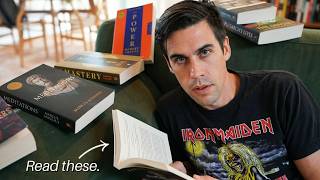
There's no way getting around it. If you want to read a lot, you got to spend a lot of time reading. Your nightstand should be ambitious.
It should have a stack like mine does of books that I am reading and also books that I want to read. Right? You should be building not just a library but as Nim TB says an anti- library.
A book that humbles you that that embodies what you don't know about yet, what you haven't got to yet, but you know that you should. A reminder of how much there is left to learn and how many books there are left to read. If you see a book, if you're thinking about reading it, grab it.
Put it on your nightstand. put it on your desk. Have it there as a reminder, as a nudge that as you're wasting time on your phone, as you're wasting time on TV, as you're wasting time doing whatever, that there is a big stack of unread books that you need to get to.
Senica said that we should read like a spy in the enemy's camp. He was saying that we should be familiar with the ideas of people that we disagree with, of schools of thought that we don't subscribe to. We should take wisdom wherever it comes from, whoever it comes.
You should read books and writers that you disagree with. If all you're doing is underlining things that you like, things that confirm what you already believe, you're not doing a good job as a reader. Read people you disagree with.
Read like a spy in the enemy's camp. If you're only finding stuff that you like, if you're only finding stuff that supports what you already believe, you are not reading diversely or critically enough. You should be arguing with the authors that you read.
You should be disagreeing in the margins of the books you read. You should know enough about a topic that you should be able to spot that sometimes the author is incorrect that they don't know. Reading is a conversation.
It is also an argument. Look, good things happen in bookstores. I know this as someone who owns a bookstore, but so many of the books that have changed my life are just random things I grabbed off a table at a bookstore that I chanced upon on a shelf.
I I didn't know I was looking for them, but I was. Right? That's how I built my bookstore is that all the books are face out.
that they're only books that we've loved and raved about that we think have the potential to change your life. But the point is, a bookstore is a better discovery engine than any algorithm. Serendipity is a wonderful thing.
Whenever you see a bookstore, pop your head in. Be open. If you see something that piqus your interest, grab it.
You don't have to read it right away. Let it sit on your nightstand for a while. But the point is, go to bookstores.
Wonderful things happen there. And when you see a book, grab it because you never know what effect it's going to have on you. Look, prefaces and forwards are there for a reason.
Don't skip them, right? They often have tons of helpful and interesting stuff in there. Stuff that you're going to recognize now for the second time when you actually get to that part in the book.
I even add to this. I I try to read reviews of books that I'm reading. I read the Wikipedia page.
I read summaries of the books that I'm reading. I want to have the context. I want to be able to wrap my head around the subject.
I don't care about spoilers. I don't care about preserving the mystery. I want to download what's in here.
I want to be able to wrap my brain around it. I don't want to be lost. I want to understand what's happening.
And that's what all this stuff is for. Look, you can never pay someone back for recommending a book to you. But you can pay that forward.
If you read something good, tell other people about it. Be a fan. Be an advocate, right?
Press it into people's hands. I started my reading list newsletter 15 years ago just recommending books that I love that I thought other people would like. And now something like 200,000 people from all over the world get this recommendation every single month.
It's why the painted porch my bookstore exists. Be an advocate. Be a supporter.
Be a fan. If you find something good, tell people about it. I think it's this reading rule that I'm proudest of the most.
I I'm proud to have been able to champion books. Turn some of them into bestsellers. Bring them back from obscurity.
Take books that were out of print and bring them back in. I'm trying to pay forward what these books did for me. I'm trying to tell people about Marcus Reis's meditations which changed my life.
So, those are just some of my reading rules. I'm sure you have your own. I'd love to hear about them.
You can put them in the comments below.