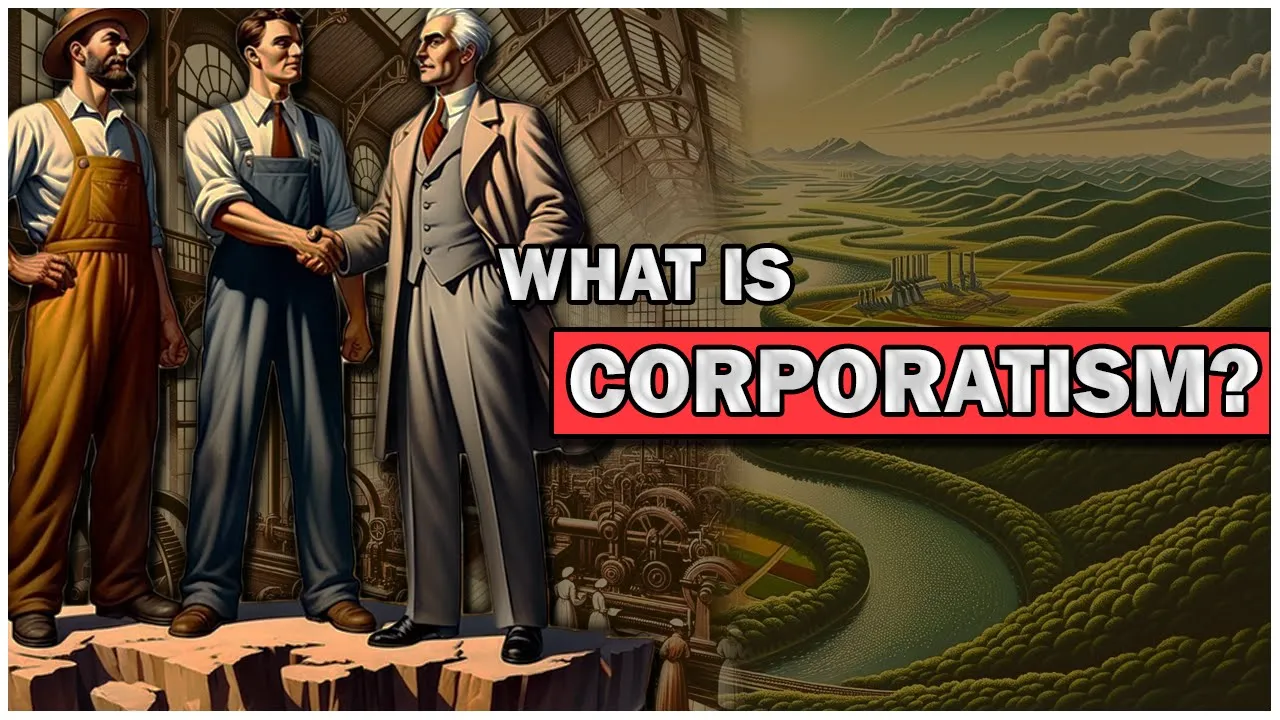
[Music] over a year ago I made a video discussing corporatism explaining the basics of corporatist philosophy and how it was an alternative to both capitalism and socialism truth be told despite believing in corporatism at that time I never really knew that much of it in detail and the video clearly shows that in it I just explain how corporatism is all about class Unity but never really give an in-depth explanation about for example what makes it so different from capitalism which is a common critique I received and this can also be seen across all other videos
on YouTube discussing corporatism they always delve into the theory of class Harmony and collaboration but never really addressed the exact details and what makes it so special and distinct from either capitalism or socialism and as I said I was guilty of this as well but ever since making that video I have acquired a lot more knowledge on corporatism whether that would be through books or conversing with other likeminded corporatists who were a lot more educated on the subject than I was because of this I feel ready to dive into this topic again instead of making
a single video on the subject of corporatism I am instead going to be making an entire series around it my aim being to deliver the most in-depth document m in corporatist economics YouTube has ever seen in this first part I am going to be discussing the theory of corporatism or how one can come to Define it all the while comparing it to capitalism and communism while one may Define corporatism with class Unity it's actually much more deeper than you may think I would highly recommend everyone to First Watch my previous video on corporatism while it
may not be as in depth it certainly is a good introduction to it I also recommend watching monio Z's video on corporatism since he also gives a fair introduction without further Ado it is time to ask ourselves what exactly is corporatism during the past 50 years ever since the second world war there have been two great rival alternative approaches in the field of economics and society as a whole these two approaches are are liberalism and Marxism these two systems dominated the world during the Cold War always being at each other's throats on which system was
the best one however there has always been a third approach one that is an alternative to both liberalism and Marxism and that is corporatism for a long time liberalism Marxism and corporatism have offered competing perspectives on society governance and state Society relation ations even though corporatism presumably died out after the second world war there were not that many studies about it and more time and focus was invested in studying capitalism and communism in liberalism interest groups like for example labor business Farmers religious bodies Etc are free unfathered and completely independent from the state these interest
groups can organize on any issue in the modern liberal state there are few if any restrictions on interest group activities this is why in the United States and in other parts of the Western World there are thousands of interest groups all competing amongst each other and according to Liberal and free market theory the state plays a relatively minor if any role at all under Marxism the exact opposite rules apply the state is powerful and absolute dictatorship of the proletariat as Marx put it while interest groups are are completely subordinated the word totalitarian itself implies total
control no groups or associations are allowed to exist freely or apart from the state and these interest groups have no Independence or autonomy apart from the government unlike liberalism under Marxism it is the state that makes all the important decisions while the interest groups serve as window dressing to the regime in power at times also helping to implement the state's policies and now we come to corporatism corporatism is an intermediary position between liberalism and Marxism making itself comfortable somewhere in the middle corporatism as I previously stated represents a third way an alternative route to modernization
that tries to avoid the disadvantages of the previous two systems on one hand corporatism advocates for a strong guiding and directing state but not one of is totalitarian lik in Marxism on the other corporatism is usually characterized by state structured and regulated interest groups but not by total control like in Marxism nor the completely unfathered and free interest group struggle in liberalism at the same time corporatism Advocates class and interest group Harmony over conflict and seeks to accomplish this by integrating interest groups that represent all sectors of society into the decision-making structure of the state
so to sum it up under corporatism we have a strong but not totalitarian state structured interest groups neither totally controlled nor fully free and interest groups are integrated into State decision making to give a clearer picture we need to think of this as a spectrum on one hand we have liberalism a weak State and usually strong interest groups on the other we have Marxism a totalitarian state and weak totally controlled interest groups and in between that we have corporatism a strong but not totalitarian state structured interest groups that are partly free partly controlled however it
is also very important to remember that corporatism is not a unified idea that only has one Doctrine just like many systems corporatism has its Fair share of variations that can vary in their approach to interest groups like for example the Nordic model followed by Scandinavian countries the Nordic model is actually modeled after corporatism it allows relatively free interest groups permits widespread public participation and has a limited State this is usually referred to as Social corporatism Democratic corporatism or open corporatism other corporative systems such as those seen in Franco Spain or or cazar Portugal had a
strong State and strict control over interest group activity these regimes mostly Verge on authoritarianism so we must therefore remember that there are hard as well as soft versions of corporatism secular as well as religiously based corporatism more on that later in the series not every corporate estate is going to be the same and at times they may even add their own twist to it so even though considerable their variations exist among corporatist regimes the distinguishing characteristics are still those three points that I brought up previously in his work corporatism and comparative politics which is one
of the sources used for this series author Howard J wearda would say that there are four forms of corporatism specifically the four stages corporatism has gone through and evolved throughout history those are natural ual corporatism ideological corporatism manifest corporatism and modern neocorporatism let's take our time to analyze and examine each one first off we have natural corporatism this type of corporatism is seen in many old societies like Africa or Asia that value community and group identity over individualism by natural corporatism I mean the way groups like Clans tribes or communities are Central to politics and
societ Society in many parts of Africa East Asia and South Asia even in Western Europe before major changes brought by the Renaissance Enlightenment and inustrial Revolution there were similar Community Focus setups examples include extended families neighborhoods religious groups and guilds these corporate structures have been around for a long time and grew naturally within their societies natural corporatism often acts as a bounding force in early premodern societies it highlights B basic long-standing social structures often existing before modern countries were formed this corporatism is usually rooted in the society's historical political culture which is why some may
even say that there is a link between corporatism and the local culture leaders of emerging or new States might use these traditional corporate structures to strengthen their power they can help keep Society together and United during the challenging initial phases of modernization and forming a nation or to promote local values and traditions as a defense against foreign influences in the early stages of modernization there's often a struggle between the central government trying to gain or strengthen its power and traditional group structures wanting to keep their independence if the central government takes away all the autonomy
from these groups it usually leads to tyranny or dictatorship on the other hand if there's a balanced and legally recognized relationship between the central government and these traditional groups it's often seen as a form of constitutionalism or even democracy in Asia Community Focus structures remain strong contrasting with American style individualism which can be confusing for westerners especially in places where confusion values are still influential the central government either has to work with these groups or try to eliminate them which is becoming less favored this leads to a form of corporatism that often looks quite different
from what's seen in western or european contexts so to sum it up natural corporatism can be found in premodern societies that value community over individualism in these societies corporate groups can be families neighborhoods religious bodies or even other tribes and the central government or what could be described as one needs to reach a compromise and balance between these corporate groups to keep Society together and functioning up next we have ideological corporatism the focus on individual rights grew in the west during the 18th century Enlightenment and the French Revolution in 1789 further pushed this idea reducing
group rights like those of the Roman Catholic church and guilds this shift made the individual the center of society moving away from the old system of natural corporatism however many people particularly Catholics and conservatives missed the community focused society and group rights of the past initially they just wanted to go back to the old way but by the mid 19th century some thinkers and religious leaders started developing a new idea to address the societal disconnect of the modern Industrial Age they called this idea corporatism which gained popularity alongside liberalism and Marxism becoming another significant ideology
in the 20th century around that time corporatism suggested the organizing society around its main groups like families neighborhoods workers Farmers business and others instead of focusing on individuals these groups would have a say in economic and social decisions and along with the government they would manage their own members they would acquire their own special Parliament on these matters instead of the usual one person one vote system in corporatism representation in this Parliament would be based on groups for example a certain number of seats for the military another for business and so on and all these
interest groups would nominate their representatives there will be quote unquote corporations formed representing both workers and managers to help set wages prices and production in different Industries this way the focus shifts from Individual interests as SE in liberalism to group interests it also aims to replace the class struggle idea of Marxism with a more harmonious class relationship in the early 20th century corporatism became popular in places where extreme liberalism was causing chaos like Spain and Portugal where there was fear of escalating class conflict or a potential Revolution like in Germany and Italy or where governments
needed to control the economy during tough times like depressions or unchecked capitalism which was the case in many countries especially during the 1920s 1930s and early 1940s before World War II ended corporatism was a widely accepted idea in Europe and Latin America it was a Hot Topic with a lot of books articles and news stories discussing it up next we have manifest corporatism corporatism seemed good in theory promoting community and class Harmony but its reputation was very damaged in the 20th century at least in the short term based on the types of corporatist governments that
came to power countries like fascist Italy which adopted the principles of corporatism into their economic system and other countries quickly turned authoritarian or totalitarian once in power instead of creating class Harmony these regimes used harsh methods to control all groups especially organized labor representing a much harder version of corporatism that they previously brought up after World War II with the defeat of Germany and Italy corporatism lost its appeal as it was associated with these regimes this is in stark contrast to the criticism Marxism gets when discussing communism and why it is a failure we bring
up its practices like famines and causing the deaths of millions of people but the criticism of corporatism doesn't come from how it was practiced in fact for the vast majority of these countries corporatism worked pretty decently or in the case of Portugal it made it incredibly prosperous and modern but rather the criticism comes from the assumption that because a lot of authoritarian and fascist regimes used it that corporatism is inherently fascistic in of itself but there were also other reasons why corporatism was unable to make its great debute in the early 20th century firstly the
looming threat of war in the 1930s made it hard to carry out the social changes corporatism aimed for secondly the Great Depression during the 1930s meant there wasn't enough money for reshaping Society in a corporatist way thirdly these governments realized they needed support from big businesses to keep their economies going so they often let the business sector avoid corporatist changes and fourthly the corporatist governments tried to control organized labor heavily fearing it could lead to revolutionary movements which at that time was a serious threat this went against the corporate's idea of class Harmony as trade
unions were harshly suppressed instead for these reasons Salazar's Portugal could be considered the most successful corporatist economy in history lifting a previously underdeveloped corrupt country into a regional and industrialized power and because Portugal didn't really have that many of those previous worries I brought up they could focus a lot more on reshaping their country to the corporatist system but again this does not mean other corporatist countries were failures they were at most pretty decent and finally we have modern neocorporatism this type of corporatism is very much different from the kind of authoritarian top- down and
saddest corporatism many inter War countries practiced neocorporatism also sometimes called societal or Democratic corporatism is present not in develop in Nations but in already modern industrial and social welfare oriented countries neocorporatism incorporates societal or interest groups directly into the decision-making Machinery of the modern State on issues such as industrial planning social welfare pensions and so forth usually the groups involved in such incorporation are economic trade unions employers and farmer groups though depending on the policy issue cultural social and professional groups may also be involved neocorporatism is mainly present in advanced European countries where business labor
and state have often reached a tripartite agreement or what is often called a social PCT usually these social packs are carried out with government guidance like for example labor giving up its right to strike in return for employers granting wage increases and expanded benefits and these packs can be very much mutually beneficial labor gets more money and benefits business gets stability and Contin productivity and the state quotequote buys social piece the exact details and explanations on how this social pack works I will be explaining in a later part where I will dedicate a video solely
on how industrial management and distribution of the means of production work under corporatism but you get the point it is a system in which groups affected become themselves a part of the state agencies responsible for carrying out their programs neocorporatism May thus be present in the the modern era over a variety of issues and also in a variety of forms strong corporatism as I will explain in more detail later on in the series in Austria Sweden and Switzerland and weaker corporatism in France Germany and Great Britain but all of them have this in common the
formal incorporation of interest groups into the actual decision-making apparatus of the state rather than the free willing independent interest groups as we see under liberalism and free market capitalism corporatist ideas and actions are now found everywhere in both developing and fully developed countries and under different types of governments whether they are authoritarian or Democratic corporatism has spread so much that could be seen as a unique model in social studies for this last part let's change how we talk about corporatism instead of talking about a specific government system in a particular place or time I will
look at it as a general approach or a method to understand political behavior in various places and times this isn't about reflecting the corporatist views of a country it's about creating a broad picture or model to help understand corporatism better corporatism can describe an existing government system and also serve as a general model much like liberalism and Marxism when we label a system as liberal or capitalist we think of Elections competing groups democracy and personal freedoms which are all part of the liberal model on the other hand talking about Marxism brings up ideas like the
labor theory of value class conflict historical materialism similarly we need to identify the key elements in the corporatist model to better understand it a main feature of corporatism is a strong guiding government alongside this strong government various group interests exist in developing countries these groups might be the military religious organizations Elite circles or tribes while in developed countries they include organized labor big business professional groups and modern interest associations in a corporate system the government aims to organize regulate and sometimes even take full control of these groups to prevent excessive competition and to better coordinate
State policies meanwhile these groups strive to keep some independence from the government and negotiate with infiltrate or even take control of it to promote their members interests the interaction and struggle between the government and these groups is Central to the idea of corporatism just as individual freedom is crucial in liberalism and class conflict is key in Marxism the main idea in corporatism is the interaction between the government and Society so how does this corporatist idea help us understand politics and public policies in different places by looking looking at this interaction corporatism becomes a useful tool
for analyzing public issues like Social Security Labor Relations industrial and wage policies neocorporatism also helps in studying Health Care education housing programs and many other public matters Beyond these issues corporatism helps explore the balance of power in society relationships between workers and employers changes in government power and how different groups interact with government agencies it shows which groups are gaining or losing influence and how societal changes and developments linked to modernization industrialization and major societal shifts in simple terms corporatism provides a helpful lens to study significant political issues in both developed and developing countries considering
everything we have talked about so far what is the best way to define corporatism corporatism would be considered a system that advocates for society to be organized along corporate lines where these corporate groups are directly involved in decision making that involves their own respective group interest and needs under the guidance of a strong but not totalitarian state these interest groups would work together in class Harmony to further the development and advancement of the country through consensus and compromise but the truth is because there are different kinds of corporate ISM that can vary in their approaches
is the reason why a universal definition of corporatism can be difficult to give but putting all the different approaches and methods aside this is in the end what every kind of corporatism strives for and aims to achieve so now we come to another great question is corporatism a capitalist or socialist system and in my personal opinion it could be considered both a mix of both capitalism and socialism although again this can vary for example modern neocorporatism can be more capitalism leaning while the original core doctrine of corporatism from the late 19th century could be considered
more socialist leaning but in the vast majority of cases it doesn't really go over too much into one side capitalism and socialism are all about having one class D ating and being more powerful over the other in capitalism that is the managers and property owners and in socialism it is the workers and this idea of one class being more influential goes against corporate's Doctrine because in corporatism all interest groups are on an equal playing field let me explain in capitalism if a CEO suddenly decided to want to cut the salaries of his workers all he
has to do is discuss discuss it with the board members and that is it your pay is reduced and there is nothing you can do about it and you were never asked hey it is the CEO's private property and he can do what he wants with it if you're not satisfied with the pay then just leave the company but in corporatism if a CEO wants to cut salaries he is now going to have to go through the process of negotiating with the trade unions in this case the group that will be affected will have a
say in the matter so a representative from the employers and the trade unions sit down and negotiate with a representative from the state acting as a mediator so now if salaries are going to be cut negotiations are going to begin and the representative of the employers needs to perhaps give concessions to the workers if he wants to go through with it and the same applies to the trade unions if they want a companywide raise in this way no matter how much influence or money an interest group has they are worth the exact same as the
other interest groups because just like in a human body if the body is to be healthy all organs need to function with each other in this case the body is the country and the organs are the interest groups and if one fails to do its function the whole body will suffer in corporatism no interest group is superior over the other because their work is just as important as the other managers are basically useless without labor to guide and labor is useless without management to tell them what to do so this is why I see corporatism
as a combination of capitalism and socialism because it doesn't seek to give privilege to one group over the other but rather gives them all in equal playing field and the same rights and the state just acts as an intermediary between them and this can be seen in the criticism corporatism gets Libertarians for example will call corporatism socialist and point out all its socialist characteristics while a communist will call corporatism capitalist and point out all its capitalist characteristics but this just proves that corporatism is both neither Libertarians nor Communists can comprehend that A system can have
a bit of both but they only choose to see the world as either capitalist or socialist nothing in between in the next part I am going to be discussing much more in detail about the history of corporatism and where it came from does corporatism emerge out of the history and culture of the society out of political or institutional needs from a crisis or from some combination of these and other factors that will all be discussed in part two