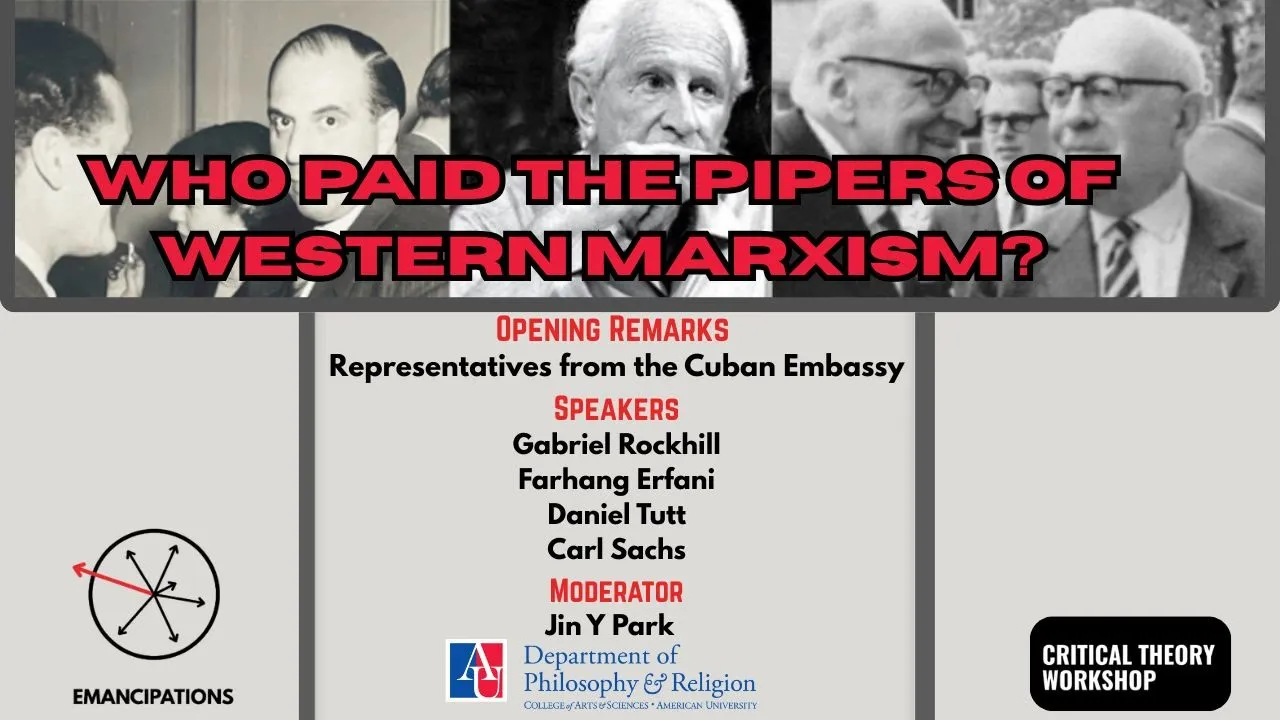
Heat. Heat. Heat. Heat. Heat. Heat. to introduce our speaker and the rest of the program. We were supposed to have three visitors from the Cuba embassy. Unfortunately, a last minute emergency has taken them away for now. They may join us at the very end. But what you see there and there is a QR code that we will pass around as well. These are in solidarity with Cuban and it's for academic purposes. It's something that I think everyone here should care about. But let me start with traditionally at AU I have heard so many welcomes so
many different forms of acknowledgements including the fact that Our founding father as it were Bishop Hurst was a theologian and a slaveholder and we have at our library a wonderful dis a wonderful set of collections to discuss the past of it to discuss this history of slavery, its connection to this university. There is something that as far as I can tell a library doesn't have a special collection on, but I think it's more appropriate for today's acknowledgement. American University in 1956 uh welcomed a program called Sorro, a special operations research office, not to be confused
with Soros. which is a different kinds of conspiracy these days. But this one was not a conspiracy. It was to the to the people running it. Apparently, it was known that this was a funded fully by the US Army. And it was a project that lasted until 1964 until It was discovered that it was basically sending US scholars to Latin America to study counterinsurgency to learn about it and report back. So this is our history of collaboration with secret services of sorts. So that's my preferred acknowledgement for today. Now today's event is entirely centered around
our guest Dr. Gabriel Rockhill. I am going to introduce him briefly. There is a lot to be said. Dr. Rockhill Is the founding director of the critical theory workshop. We have quite a few flyers about the event as well. We'll put it on the table. Feel free to take one if you want to participate in the summer program in Paris. He also happens to come from an incredible university. I'm somewhat biased. Villanova University, my alma mater. And he's the author, editor of 12 books As well as numerous scholarly articles and general public articles. He's also
the director of cultural studies at Fenova University, research associate at the laboratory politic, one of the editors and chiefs of world marxist review and the co-editor of the book series anti-imperialist Marxism which is the perfect theme for today. Dr. Rock Hill will present first his book to you and it will be on slides as Well and afterward three of us panelist will give our remarks our comments on the book and then we hope to have a lively session of question and answers. It's a very big audience. It'll try to get to people as fairly as
possible at this point since we are sure about the Cubans right there. >> Any Cuban? >> All right, then I will give you the Floor, Dr. Rockill, please. Everybody can see this. Great. Thank you so much all for coming out. Uh really special thank you to Daniel Tut and the Emancipations podcast. I know there's a lot of work that goes into these events. Much of it goes unseen and often unthanked. So I'm my gratitude is hereby publicly expressed. And I'm also very thankful to the American University of Paris, the other panelist members, and all of
you for participating in the Conversation. I am dismayed by the fact that the ambassadorial staff from the Cuban embassy couldn't make it today because unfortunately, you know, there is a war going on and that war is targeting all peoples around the world, but much more aggressively the Americas in trying to turn back the clock and make the slaves of the colonies go back to where they belong. And it was important in my own book to frame the work that I'm doing in terms of a Support not only for the struggle of workers against the capitalist
ruling class, but the struggle of all peoples everywhere in the world to break the chains of imperialism, which is the global capitalist system whose chains unfortunately have an impact on all of us. And right now, Cuba is absolutely in the crosshairs because what they represent in the Americas is the possibility of liberation from imperialism and the establishment of True sovereignty. So the book that I'll present here in a moment is entitled Who Paid the Pipers of Western Marxism? But it's the first in a trilogy, and the trilogy is The Intellectual World War: Marxism versus the
Imperial Theory Industry. The intellectual world war that I outline in the book though is part of a much broader fight over the very nature of human life on planet Earth. And so the connection to the immediiacy of political struggle should Be apparent immediately within the book's framing and hopefully within the broader conversation that we're going to have in a moment. What I've done for today is prepared a very brief overview based on some internal documents that I'll run you through in a moment. But I wanted to open with a few comments concerning the methodology because
of the fact that we're dealing with a particular environment that is uh slightly more academic than some of the Other environments that I touch on and the methodological approach in the book is important for elucidating how it's situated in relationship to some dominant academic discourses in particular the way in which the humanities have been developed in the capitalist core as well as the social sciences. The main point that I'd like to highlight is that the book engages in what I refer to as dialectical hermeneutics. That means a few things. The first is that if you
want to understand the cultural or intellectual production of a particular subject, Adorno, Horheimer, Xjek or anyone else, you need to situate them in relationship to other subjects. You need to engage in an analysis of how they are materially situated in relationship to subjects as well as in relationship to the overall system of the material production and dissemination of ideas within which they operate. No subject thinks in a vacuum, Writes or publishes in a vacuum. They all operate within systems. And it's important moreover from a dialectical vantage point to insist on the organic totality. So it's
not just that there's a subject and that there's a system. It's instead that there's a dialectical relationship between the two that makes it such that there's no system that operates without specific subjects within it and there are no subjects that operate outside of any system Whatsoever. So the book's approach is not saying there's a determined structured system out there in the world that has conditioned the ways in which all intellectuals think, speak, approach the world. Nor is it saying that intellectuals are absolutely free to think in a vacuum and make up any ideas that they
want. On the contrary, it's rejecting the liberal ideology that unfortunately has framed a little bit of the online approach to the book, which Is largely by people who admit that they haven't read it and yet it's unsophisticated. And I don't know a lower level of sophistication than someone who would criticize something that they haven't even studied. And a lot of what these I don't even know if the word criticism is appropriate. These uh pathetic hottakes engage in is an attempt to take a dialectical hermeneutic framework in which subjects operate within organic Systems that themselves are
evolving and changing over time. And the book attempts to chart that evolution and that changing so that you look at subjects and not just pin them to the wall like dead butterflies, but you follow their trajectories. How were they acting in the world? Global class struggles going on. What was Adorno writing about? What was Horheimer doing at that point in time when the Nazis were invading the Soviet Union for Instance? That organic system is essential to understand. And unfortunately, what liberal ideology attempts to do is take the organic social totality within which cultural and intellectual
subjects operate and reduce it to a binary pre-diical framework in which it's assumed either that there are absolutely free intellectuals who are thinking on their own and coming up with genius ideas that transcend humanity or connect to the Great history of ideas in some ethereal domain that's inaccessible or at least only limonally accessible. or they claim that everything is determined and reduced to socioeconomic forces or a conspiracy on the part of the CIA or something along these lines. It's absolute freedom or complete determination. This binary is non dialectical. It does not capture the material complexities
of the world. We have agents who are sculpted by and Shaped by the material system of intellectual production within which they operate. They make choices. They can swim downstream. they can push back and they do this to varying degrees. The system has different forces operative within it. It has socioeconomic forces, state forces, different state agencies, actors, etc. And it's that complex nexus of the subject dialectically operating within a system that's changing over time that the book attempts to chart in As much detail as possible. So with that general kind of methodological framing, I'd now like
to turn to a kind of overview and what I'm going to do is walk you through a series of internal documents that will give you at a very high level the kind of constellation within which the book is situated. The first thing that I wanted to highlight is NSC68 which was published in 1950 which highlights the fact that the principal war is the war of ideas Because it is the fundamental conflict. You can win military operations but that doesn't mean that you win the ideological war. And what the imperialists and in particular the United States
as the leading imperialist power in the world since at least World War II wants to do is win that fundamental conflict. The war for hearts and minds as so many internal documents attest is absolutely essential to everything that they do. Which does not Mean that somehow ideas drive reality because the intellectual world war is driven ultimately by the socioeconomic forces of imperialism. for the imperial project to win based on a costbenefit analysis. An intellectual war that wins is much easier than a military war because of blowback, because of resistance, and for many, many other reasons.
And so what the book does is it mines down into some of the postworld war II architectural framing of this Intellectual world war. One trove of documents that has proven particularly important to me is the uh psychological strategy board documents that are collected at the Eisenhower Library in Abalene, Kansas. And the psychological strategy board was set up in 1951 and it was to oversee the psychological warfare operations of the entire intelligence establishment. It was to coordinate and centralize US intelligence. One of the programs that they run that is very Important to understand is that doctrinal
warfare program. The goal was not simply to win a few small skirmishes in the battle of ideas. They wanted to own the doctrine which is the overall ideological framework within which all ideas are situated because they recognize something very important. You can have an ideology that if you own it at the level of its doctrinal framing can resist empirical contradiction. So that if somebody Points out that your ideology is incorrect because an empirical fact contradicts it, if the doctrine is secure enough, they can deny the empirical reputation and nonetheless maintain the overall ideological framework. So
one of the goals was this kind of highlevel ideological war that wanted to encase people in a particular mindset that served their interests. And the basic doctrines were the doctrine of the so-called free world and the Doctrine of what they'd call, you know, the Soviet world, the Marxist world, the Eastern world, etc. Within this overall framework, uh the there's a 1953 PSB memo, the psychological strategy board that outlines what they were really aiming for was full spectrum dominance. They wanted to uh not only intercede uh I'm sorry intercede kind of politically and philosophically. They wanted
to do this in every discipline in every domain. They wanted they they wanted to And did focus on the production of ideas, the distribution of ideas and the consumption of ideas. And they did it in the media. They did it in the academy. They did it in broader cultural production with artists and writers in every aspect of society. They wanted to and they aimed to control the mindscape of the masses. One particularly important document that I reproduced in the appendix to the book is a memo that points out, I don't know If people can read
this from where they're sitting, but the highlighted uh passage says, let's see, we cannot expect to subvert the enemy if we cannot even speak his language. We must employ Marxian terms of reference. They understood and when you really know the material history of US empire building in the 20th century, you need to recognize that it inherited imperialism on its heels when communism had just defeated fascism. That's the true History of World War II. And the anti-fascist war continued across the third world and the vanguard of that struggle were the revolutionary socialists. Therefore, the United States
inherited an imperialist war world in which socialism was on the rise globally since at least the mid-40s to the end of the 70s. Anti-fascism was a given across at least a broad swath of global consciousness and Anti-colonialism was being more widely accepted. They needed an empire that presented itself as anti-fascist, anti-colonial and nonetheless beat back the socialist forces that were diminishing the power of empire. They had a fundamental problem on their hands. Marxism had a level of global legitimacy that is hard to imagine today. Right? Pablo Picasso was a self-proclaimed communist, the most famous artist
in the world in the Mid- 20th century. And there are many, many others. They knew they couldn't do the hard cell of making Marxists into reactionaries. So they decided to do the soft cell. Let's make Marxists into accommodationists who become social democratic enough to accept the capitalist imperialist world as ultimately preferable to actually existing socialism. And so this is one of the things that the PSB memo outlines. They say that we should have Attacks against communist ideology developed in Marxist terms. They wanted Marxist critiques of actually existing socialism. And they also wanted attacks um I'm
sorry, a defense of western society in Marxist terms. What they wanted was what we now call western Marxism or what I elucidate in the book is ultimately a form of imperial Marxism. Within this framework, it is important to notice that the Frankfurt School of Critical Theory, which has Played a foundational role in Western Marxism, was a school that gained its global prominence through its service to Washington. So, there were seven affiliates of the Frankfurt School who worked for the world's leading imperialist government for a combined total of over 50 years. So it would be more
appropriate at least during World War II and the immediate postwar era to refer to them as the Washington School. They worked for the Office of War Information which is a propaganda agency, Voice of America, OSS, State Department, etc. Their service to Washington was the springboard to their academic careers. Prior to World War II, much of what the Frankfurt School did was they published in German and they had connections to Columbia University. In the wake of the war, many of their leading figures through the contacts that they developed within the US National security state found positions
at some of the leading universities in the United States on the eastern seabboard and in California. And uh some of them including someone like Herbert Marcusa was still a state department operative when he began his academic career meaning he was under contract with the state department when he went to uh he went to Colombia and Harvard. Regarding Marcusa more specifically, I detail in the book that he has Unfortunately claimed in a number of interviews that he had no relationship whatsoever to the Central Intelligence Agency and misrepresented the history of the agency, which is hard to
believe for someone who was on the inside. His job description is here for you to read. It's from 1948 when he was working for the State Department. Referred to in internal documents is one of the State Department's leading global experts on communism. And according to his job Description, you see him here in the center. He's the acting chief of the central European branch of the state department's division of research. He was responsible for meeting the intelligence requirements of the department of state in the formulation and execution of foreign policy and the intelligence requirements of the
central intelligence agency and other authorized agencies. This is only actually the tip of the iceberg. Uh, according to Tim Mueller's research, who in my opinion has done the greatest deep dive into the Marcusa archives, Marcusa actually had his hand in the drafting of at least two national intelligence estimates, which are the were the highest level of intelligence for the US government. Marcusa was not a small fry. He wasn't a liinal figure. He wasn't only hanging out in Washington fighting fascists. He was actually a very important operative within this broader intellectual world War including working handinand
glove with state forces. Another thing that I wanted to highlight and I I'm going to speed it up because I think we only have five minutes left, but any of this we can come back to in the in the Q&A is that a lot of the archival work that I've been engaged in is the result of consulting obviously internal documents, but also reading firstperson claims and testimonies, material history, government revelations, etc. And what I Always do is I try to cross reference as many claims as I can so that I don't just base my assertions
on what one person said, but instead I try to flesh out the broader material context. And it's important for people reading the book, particularly given the kind of slanderous claims that have been made against it by people who haven't read it, that the idea that the ruling class would engage in a conspiracy to advance its own interests isn't some outlandish Idea. I mean, I don't know if people have heard of the Epstein revelations or anything along these lines, but it's clear that the ruling class and their state managers regularly engage in conspiracies. In fact, the
very definition of the CIA is a conspiratorial agency. What they do is covert operations. That's their very definition of their charter. And the revelations that I draw on often come from first person testimony. And so to Say that the CIA wasn't doing this, you'd have to claim that the CIA agents themselves who were involved in these operations spoke out about these operations spelled out what they were doing were somehow lying about it and then advance you know contradictory evidence that would uh you know corroborate your claims. Thomas Braden spoke out and published a very important
article about this, which is actually a limited hangout because I found in the Archive that he shared this article with the CIA prior to it going public. I'm going to burn through the rest of this rather quickly just to give you a sense of the architecture. Here we have uh two of the CIA officers who oversaw the Congress for Cultural Freedom, which is referred to by the leading historians as the largest patron of art and culture perhaps in the history of humanity. the we're talking about millions and millions of dollars, 35 uh offices in Countries
around the world running prestige magazines, publications, major conferences, translations, etc. They had an enormous impact that according to Francis Steiner Saunders likely affected every single intellectual writer and artist in Western Europe. At the bottom half we have French philosopher Raymon Narung not very well known in the United States but he's a titan in France and he was the philosophical uh kingpin of operations in France. He was the rival To Jean Paul and he was also the point person for the Frankurt school in France deciding and vetting what articles from the Frankurt school would be published
for the French community. There are many others involved. Sydney Hook and uh well, James Burnham isn't situated here, but they're both NYU philosophy professors who moonlighted for the National Security State. Uh Arthur Kler is a well-known operative. Again, I'm going to move very quickly. Theodore Adorno, I could get into this, but he had numerous ties to the Central Intelligence Agency and in fact continued to collaborate with the Congress for Cultural Freedom after 1966 when it became public knowledge that it was a CI front organization. The uh other figures that I just like to get very
quickly on the board is uh the man that you see here in the back uh Philip Mosley is very important because he was a highlevel long-term CIA adviser Who worked with the Russian institute at Colombia where Herbert Maruza was hired. The first two area studies programs in the United States were set up at Harvard and Colombia and they were Russian area studies programs to develop US American sotology. They were stocked with US national security operatives and they were a cutout meaning you basically took uh the research and analysis branch of the Soviet Union from Washington
and you displaced it to the universities. You Gave academic cover to state operatives and Marcusa was one of them. But then Mosley and the others went on to collaborate on uh very important work done by funding from the Rockefeller Foundation under what is referred to as the Marxism Leninism Project in which they funded an entire international network of institutions, researchers, PhDs, translations, publications in order to shore up a western Marxist tradition over and against the Anti-imperialist Marxist tradition. ition of the global south. I'm going to again sorry this slide doesn't exactly relate to what I
just said but uh just in the interest of time because I'm coming up on my 20 minute mark I'm going to jump to uh a final series of points uh so I might just go one or two minutes over but it's very important to recognize that Philip Mosley the gentleman I was just speaking about close personal friend of Herbert Marcusa They regularly dined together their families got together Mosley would invite uh Marcusa back to Colombia to lecture give him very lucrative honor honorary for doing so. Mosley was also involved in supporting and promoting the Rockefeller
Ford funded school in France that's known as the EPA the sixth section of it. And if these institutions get too complicated, you can bracket that and just think about the principal bastion of French Structuralism where the phenomena known as French theory later was cultivated, nurtured and promoted. This was Rockefeller money, Ford money and the idea that the foundation world is somehow separate from the public world of government is a liberal myth. These work handin glove. There's a CIA liaison in Ford and Rockefeller. They regularly communicate about and collaborate on the exact same projects. The reason
this is important Is because the way in which they did these operations is they had different kind of concentric circles of collaboration and one very important one was the Frankford School for Social Research which the Rockefellers funded for its return to West Germany as a bull work against the Marxism from the east. But they also funded and supported the bastion of French structuralism. And if you go through the CIA archive as I have, you'll find that the Central Intelligence Agency identified French structuralism or French theory as an ally in the intellectual world war because it
was waging a significant war against Marxism. Uh here's a picture of Fuko and one of the statements that they make. Bringing this full circle just so that you see it and then I'm going to close. It's that the Frankfurt School for Critical Theory was part of a broader attempt to shore up a version of Western Marxism and the very essence of Western Marxism is it obscures the principal contradiction of imperialism doesn't allow people to understand how life on planet Earth is materially organized so that you underdevelop the global south to hyperdevelop the global north and
line the pockets of the financial ruling class. And it is anti-communist meaning it rejects the struggle on the part of the victims of imperialism to leverage themselves out and develop sovereign projects of Development. That's the real core. There are other features of western Marxism. But they identified the state operatives and the operatives the managers of the financial ruling class also identified French theory as an absolutely essential ally in that project. And the very last thing I want to highlight is that they also pointed out the absolute importance of shoring up these traditions for their impact
on the global south. They wanted a cutting edge, super sophisticated, Very fancy, rhetorically savvy, sexy, and salailable version of radical theory that would make it look like the tools that the people in the global south are using to liberate themselves, like Marxism, when it's actually applied in practical circumstances, are p retrograde, part of yestery year. One of the documents that spells this out quite clearly is the 1986 document that I have and I'll just conclude on this note. Quote, "No third world intellectual Wants to concern himself with what the Paris intelligencia considers p." So here
we have at least a very quick overview of the intellectual world war which is trying to shore up a version of imperial radical theory as a weapon of struggle against the principal theoretical tool by which people have successfully broken the chains of imperialism and begin began to or begun to build a socialist world as an impediment to what Albert Einstein Refers to as the predatory phase of humanity. meaning the phase during which part of humanity feeds off of the rest. Sorry for the Epstein reference, but I think in the current context it's probably inevitable. So,
thank you very much and I will turn it over to our next speaker. Thank you. For those who haven't read the book, there is an impressive appendex of the work that Dr. Rock Hill has done all the Freedom of Information Act, all the archival work he's done, it's all the more aggravating to see people not read the book and criticize it because the book itself has so much that is basically devastating to anybody who cares about these thinkers. It's something that you can't take back. What I'm going to do here and what we are we
promise to do is to not engage not only in those kind of salacious stupid misreadings of the book but to Engage this work philosophically. I'm going to start with where the book itself begins which is the story of how Chaguara was killed. it. The book goes in quite a bit of detail about how the CIA was chasing him. He was everywhere hunted. He knew it. And ultimately in Bolivia, he was finally caught. And Dr. Brock Hill describes the difficulty that the Bolivian soldiers had, but ultimately killing him And how Washington initially wanted his head severed,
sent back in order to just literally have the head of Marxism and rebellion cut off. Instead of going into that angle of the story, I want to talk about the man who killed him. Apparently, most Bolivian soldiers refused to carry the order. There was one younger man and by most reports he was quite drunk that day. His name was Mario Terron who accepted the deeds and He went ahead and indeed killed Chaguara alone. What matters to me about that story is how Mario Treron 40 years after the fact went to Cuba under a pseudonym with
false papers, fake papers because he needed to get a free cataract surgery that Cuba provide. And not only the irony was completely lost on him, but this notion of just seeing it was apparently not enough. My remarks I'm going to follow at least on the question of sight and I'm going to cluster them around three different versions of sight. I'll begin with the unseen mostly these agencies the seen the state apparatus and the blurry part which is ideology. I think one of the greater merits of this book is to put these secret agencies such as
the CIA As a topic that philosophers have to take seriously. It is a very difficult task actually because most of our political philosophies such as our theories of democracies that we have have no room for such thing. Philosophers typically ignore those. It's something that factually we may acknowledge as saying that's bad, that shouldn't be there. But the fact is they are constitutive of modern power. So When we have theories about a democracy internally, we never deal with these stuff. But that's there. It's the dual governance that Dr. Rockill talks about in the book. Or when
we talk about a democracy, we never talk about the external factors that come and disrupt it. all these countries that try to be autonomous try to have sovereignty and get disruption part philosophically we consider that bad but we don't theorize it so I think that's one of the merits Of the book is to put this philosophically as an unavoidable task that we cannot ignore these agencies just because they are not democratically elected or it's not part of what our greater philosophers talked about that's my first point about these unseen agencies and the merit of talking
about them philosophically eventually but now I'm going to raise the issue that it is indeed very difficult to address them Especially in the way that the book is oriented there are two main thesis of the book that I found incredibly valuable The first one is around the political economy of knowledge production or what you just saw in the presentation which is all the material conditions that produce knowledge especially in institutions like universities. Political economy of knowledge is telling us that we cannot ignore these Backgrounds that we cannot ignore these forces that we have to account
for them. But the problem is not only they are not seen, they are hidden. They influence us in ways that we don't have a vocabulary for. And I wish that in the next volumes we would know more about how we should proceed with them because what we end up having is conspiracy which actually is legitimate. the Epstein case alone, but to Michael Parenty, the late one who just passed Away, he cited and he's the one who told us when they are actually doing what the conspiracy says, you can't just ignore it anymore and say this
is crazy. We have evidence that they do this. But how do we on the left as we organize as we think and as we write how are we to look at it other than perhaps question the funding look at the organizations behind it? Frankly, anybody on social media who has a double-digit following and a hammer And sickle in their username, as soon as they disagree with someone, they call him a fed. Everybody's apparently an expert at finding infiltrators. Everybody thinks that they know who the federal agents are. It is actually splintering the conversation. It is
killing part of the discourse because people are suspicious of each other in ways that are not productive. And as much as I hate how people have taken up this book in terms of Conspiracies, I also think that it's a legitimate question at this point of how are we going to handle knowing this having figured out that these organizations indeed are influential. Now I want to turn to the question of something that we do see the states in particular. The second part of the thesis that I valued after the political economy of knowledge production is the
call for Return to what often is referred to as DHM dialectical historical materialism. And to Dr. Rockel's credit this is not a call to reverting back to just something from 19th century flat it is a living process it is a actual philosophically rigorous process one that for instance if you just stuck to the 19th century it wasn't just Marx just about anybody socialist communist anybody on the left was could not trust The hate and they were right in so many ways. But dialectical historical materialism the way it's done in the book shows us that the
states especially these socialist existing socialist states do a significant task that theoretically has to be taken seriously. So it seems that we have at least three types of states. We have the most common one which is the capitalist one where the state is an an Enforcer of capitalism. It represents the values of the upper class and it is forcing the US case bullying other states into submission. And I count the client sta client states the failed states that are basically under their dominion as still part of this capitalist model. The second type is we we
unfortunately don't have our Cuban representative are the few countries that are resisting in their way as much as possible by adhering to a Long tradition of emancipation that is Marxist, communist, socialist. These countries have to be taken more seriously. Not just because they are being harassed, waged war on, but because of the work they do, because they provide free cataract surgery to killers even. But there is a third type of state. In the book, there is a wonderful acronym called ABS that Dr. Rockill uses And it's refers to anything but socialism. It's basically an approach
that all these thinkers such as Adorno Horheimer and so forth, they would do everything to analyze power except deal with actually existing societies that had socialism. I'm going to piggyback on that ABS one and I'm going to say that the third type we should call it ABW, anything but Washington. What I mean by that and I'm going to use another contemporary example, one that is very close to me as an Iranian. It's the threat that currently is hovering over Iran as we speak. They say that this weekend could be the weekend where a war could
start against Iran unprovoked, unnecessary, and it's going to kill thousands of people once it starts. Anyone, not just on the left, anyone with some basic sense of decency should Be against that war. And what's fascinating is that even Republicans apparently as a majority, they don't want this war. It doesn't matter because this government does what it does evidently. So in no shape or form would I ever embrace such a thing. But at the same time in the category of western Marxism that the book delineates so well there is a problem with the ABW Which is
that Iran has been not only defended online against this war. It has been championed in that language of axis of resistance. It's been taken up as anti-imperialist. It has some history of that. It has some elements of that. But this is a problem that I think western Marxism has. As long as it's against Washington, it becomes good. And that government Is not anything good. It's one that kills in late 80s early 90s Humeni the founder of it wrote a letter to Gorbachev saying that look I love the work you're doing keep killing the Soviet Union
he was very adamant about it he said you are finally realizing that Marxism only belongs to museums and from there he they proceeded from 88 to 91 one to kill in the upward of 30,000 Iranian Marxists and communists. The rest of us got exiled or left. It is baffling to me that a country that Moses down kills its own Marxist, we have Western Marxists defending it as virtuous just because it's against Washington. That to me is a level that dialectical historical materialism has to deal with. We cannot simply revert things like euroentrism by flipping them
on their head. You do that you still retain the binary To be anti-imperialist has to move away from that binary thinking. And that's something that I believe dialectical historical materialism that is proposed in the book has to take up more seriously in the future. I'll move to my last point, the blurry one. Between dialectical historical materialism and the knowledge production, there is ideology as well. Everything about the book in a way is showing you how much they're manipulating us ideologically. Ideology is a very serious problem. One that Markx started but didn't go very far with
it. He actually underestimated it. He thought that we should be able to show people here are the facts. Here's reality. You should not think the opposite of it. You met you have met MAGA. There is even worse blue MAGA. There are ways that people keep twisting everything in order to make it work. That is not even at that level of intellectualism against Marxism. But there is one figure that doesn't appear in the book that is associated with western Marxism in a sense of cultural analysis and that's Antonio Grahamshy. Grahamshy cannot be accused to be like
Adorno as somebody who's not only on the pockets of the CIA but also is trying to undermine radical politics. And yet Grachi was the one who told us that the fight is never without the superructure or to put it in more simpler terms that the fight against capitalism belongs at the cultural level as well. The way the western Marxism of this book used cultural criticism was indeed a form of defanging Marxism. But I want to insist in Graham's name on the value of cultural critique from a Marxist perspective, including Adorno. Again, my favorite piece of
his that I teach often too. It's called Stars, Stars Down to Earth. What Adorno did, he went to the Los Angeles Times, the newspaper, and analyzed for a month the astrology section, the horoscope. He showed in a in a very meticulous, wonderful, devastating analysis how Astrology is used in order to let everyone alienated by capitalist labor to feel slightly better, to have a illusion of a future. A midweek boost by Wednesdays usually about some good things are happening. So you keep going for the rest of the week. Adorno for all his fault I think provides
these tools and absolutely to Dr. For Rockill's credit, he never says don't read Adorno anymore. Absolutely not. He says we have to situate them and I want to situate them in a lineage of Grahamshy in a way where cultural criticism still should matter because it's a blurry line that one. It's not a simple yes or no. And the last figure in the Gshy line that also appears only once in the book fortunately because it's devastating when they appear several times. It's one of my favorites ever is Ernesto Llaw who goes from the Grahamshin approach and
shows us that what happened to Marxism is not purely a factor of from the outside but a form of fragmentation of Marxist base that itself needs to be theorized. to be taken seriously as a counter-honic move and that and he brought in a lot of these French theorists, German theorist and he put them to a use that clearly the CIA would never appro appreciate. So in my mind the blurry line is still a very important side of struggle. Thank you. Those are my Our next speaker, I am so glad to have him. He's We have
lived in the same area. We had never met until now except on Facebook. That's how the world goes these days, right? Let me Sorry, I need to finally find my papers. We have too many papers here. Daniel, do you have the running shirt? Sorry, I can't find it. Thank you. Professor Carl Saxs. He's a professor of philosophy at Mry Mount University. He's the author of intentionality and the myth of the given, route 2015. He's a scholar of sellers niche adorno roardi. He's the co-editor of Marxism and the Pittsburgh school of historical materialism and is currently
writing a book about pragmatism, naturalism, Liberal socialism and he is because of Facebook I can tell you a very very sharp critique of politics as well. Please Dr. C. All right. Uh, so it's a pleasure to be here. Um, I want to thank Daniel and uh, Farhang for inviting me. Um, the uh, don't believe the hype. The book is absolutely worth reading. uh the book signing uh you know get get your copy today. Um okay so um I want to begin by just endorsing one Of the many important lines of thought in uh Gabriel's book
um sort of I think the central line of thought to the the first sort of third or so as I understand it right so right uh Gabriel lays out a very convincing case that um first of all it's got to be the case right that agents acting on behalf of state capitalism. Uh will use private foundations to to and think tanks to channel funds from intelligence Agencies all the way to fund artists, intellectuals, scientists, um and other groups that will promote very sanitized western conceptions of democracy and freedom and all those, you know, good things.
And of course it's going to be the case that universities are fully incorporated into how this process takes shape, right? Um and there's just no there's no way if we should pretend that the humanities or social sciences are Somehow immune to this general process, right? U certainly not even radical or left thinkers. So okay, um complete agreement there and that doesn't seem right to me. Um so that means that we have to pay attention. um as Dr. Reco does to the political economy of the theory industry, right? To what Richard Rudy referred to as the
leisure of the theory class that just can't be separate from the political economy of academia and generally it can't be separate from Political economy superructure and how capitalism uh reproduces itself. Um and so we just we should we should avoid any kind of liberal idealism that says that these people are freestanding agents just trying to you know think thoughts. Um and especially because that we are all embedded in the system. It's certainly possible um for a well-paid professor um of literature of cultural studies um to be what we used to call back in grad school
we call people Neman Marxists right because they teach Marxist cultural criticism but they shop at Nean Marcus um okay and and also um seems totally right to me to say that sure there are it's just gonna be right that there are some versions of Marx and Marxism that are taught in academia because they are more or less compatible with um how global capitalism reproduces itself and other versions of Mark merchant just won't be taught um and that will be as Threatening right like sure yeah you're going to find uh Luc and Marcusa taught much more
often then you'll see Lenin and Mao taught um and I think we have to sort of absolutely pay attention to the ways in which academia is structured by a series of very perverse iverse incentives that lead us to simply teach the canon to our undergrads and the lead hotness is in theory to our our grad students and just not much else. And that leaves out a lot of things Including a lot of things that could be very useful tools for really understanding um not just how capitalism works but also what can be done about that.
Um, okay. So, I've uh I want to turn now then um a little bit to um sort of my my take on the Frankfurt School and this one we're going to sort of maybe would give uh Dr. a little bit of push back. I'll talk about that a little bit and then I'll sort of move on from the um Frankfurt school specifically to thinking about Western Marxism more generally. Okay. Um, now I I think there I think there's a tendency and I don't I don't want to necessarily I'm not accusing Dr. Wilco of this tendency,
but I think it's tendency that's often you often see articulated in how people do and don't talk about the Frankfurt school. Um, that I think we often think of these theorists as committed to something like the following three Claims implicitly, but still in their practice committed to following three claims. Uh, claim one, we've got to do something about fascism. That's the first. Claim two, fascism is caused by capitalism. Claim three, we can't do anything about capitalism. Um, and I think that's a very crude high level simplistic characterization of what is really driving this grand hotel
abyss sort of theoretical and practical Paralysis of which they've often been accused. Um, so the question then is okay well what is this really driving this commitment to three? What's really driving the commitment to making them capitalism? Um, Dr. expressed the idea that their commitment to Cap to three is what made them central to the compatible left, right? The idea that there's a version of Marxism that um is acceptable in the academy precisely because it really Doesn't frame any serious uh challenges um to capitalism and to imperialism. Um I want to urge um a distinction
within the three. Um I think it consists of two different uh prongs or dimensions. Um one of which I think is warranted, other which is unwarranted. And I think making the distinction is important for assessing the the legacy of the Frankfurt school. Um okay. So first the the warranted problem the part that they that was warranted. Um I think they were warranted um in their rejection of what Servian communism simply became under Stalin. And I think it's also very important to bear in mind that for the fierce for these people Soviet communism was Stalinism right
when Stalin assumed power Adorna was 21 years old. Marcusa was 26. Right? So for most of their uh lives as they're coming into political consciousness, Stalin is what they thought both of them Was. Now I can absolutely happily agree with Dr. Wilco that Adorno should not have agreed with liberals like Arent in regarding Stalinism and Nazism as many different species of the same totalitarian evil. Right. Um I can no I'm not g not not going to not adorn on that particular point. Um although I do want to uh uh point out that uh Marcusa did
not share that view. Um although he was not quite sympathetic to Stalinism As uh his friend Paul Baron uh uh appears to have been. Now I also don't I don't think we should just single out the Frankfurt school for their hostility to what um the Bik Bo program simply became under Stalin. Um I think we should read the Frankfurt school as belonging to a much wider tradition of western Marxism that was often critical of Soviet Marxism whether that was Lenin where you have Rosa Luxembourg Kosh and Tan Ponk also uh offering very pointed Critiques of
Lenin. Um you also then had people such as Paul Matic, Gabul, um Rya Dunas Skyla, Sar James all offering very pointed critiques of Stalin. Um so one point I think I want to emphasize here is that the Frankfurt school belongs to a very specific moment within the larger history of Western Marxism. And it's a moment that is marked by um the betrayal of the Russian revolution, The rise of fascism in response to the contradictions of capitalism um and the absence um as they as they saw it of really any general alternatives to Hitler and to
Stalwit right and here I think it's really important to underscore that for Adorno Herkimer or Makuza they were absolutely 100% aware that the same tendencies same contradictions that led to the rise of the Third Reich that led from the VHR Republic to the Third Reich could happen in United States. Right? MAGA would not have surprised them at all. They might have been a surprise that it actually took this long, right? Um so their their their framework is not well it's either the American liberal system versus um Stalinism. It's you've got Stalin and you've got fascism,
right? And they were very acutely aware that the United States could go f just as Much as Republic did. So I think that's sort of one sort of warranted problem. That is unwanted prong. The prong where I think that I think that uh right we have to understand really where I think the Frankfurt school um just made a tremendous uh tremendous error. Um, and it's simply this. It was their sheer ignorance, as I see it, of how the importance of state building socialism During their own lifetimes throughout the imperial periphery throughout what we now call
the global south, right? That would include Guatemala, Cuba, Angola, uh, Bkina Faso, Ecuador, Chile. Um, and now of course you do have Horimer weighing in on Vietnam on the side of imperialism, but for the most part they just didn't, this is not really on their radar. And I am inclined to see this as of a piece with Adorno's ignorance of black jazz. Right? We all know that Adorno was very dismissive of jazz. What is not often noted is that he was dismissive of jazz based on the German jazz of the van republic. Adorno's failing is
that when he came to United States, he never listened to the jazz being produced by African-Americans. That's his failing. And I see this a piece where the Charles Mills calls the epistemology of ignorance. Right? The Frankfurt Schoolos came from privilege that was racialized, gendered, and classed. And they never seriously questioned this even when the republic was stripped from them as political and ethnic refugees. Um, for them the psychological trauma of the Holocaust was the idea that their white card could be stripped from them if the wrong kind of or right person white person came into
power. Right? But they never really Systemically questioned their racialized, gendered, and classed privilege. That's much ignorance. And I think that's what's driving their unwarranted commitment to anti-communism. Um, but I do think that is important to make that distinction between the warranted prong and the unwarranted prong and and then maybe you think that well the effects are the same so what differences make but I think if we're Trying to assess Frank school today that does that is something we need to be thinking about. Okay. Um I now want to turn kind of briefly towards the end
here from the French school specifically to western Marxism more more generally. Uh so so Dr. Rockco both his own work as well as uh in collaboration with uh John Bonet Foster um joins with with Perry Anderson and Dominica Lassero as representing western Marxism as a series of retreats right it's a retreat from Political economy to philosophy it's a retreat from the dialectics of nature to dialectics of history it's a retreat from actually existing socialism to a a sort of third way that is neither capital or communist and a retreat from engagements with proitarian struggles to
cultural critique. Now, I want to say at the outset, right, I absolutely agree with Dr. Walco that Marxists today should not endorse any of these retreats. We should still study what motivated those retreats, understand them, um but not take them as a basis for what Marxism needs to be today. Um in that light I want to offer two sort of general topics for consideration for conversation. Um right first um this bit about the dialects of nature and the retreat from the natural sciences. Um right I think it's fair to say that western Marxists generally speaking
have followed the early loss in Just withdrawing from donics of nature and disengaging the natural sciences and I think that has been a tremendous sort of unforced error. Um, one thing that's worth thinking about here is what is driving that particular uh move and it might be helpful to bear in mind that Lucatch right before he became a Marxist even before he became a Hegelian was uh a neocontian of the Southwest school. Um and at that at that time for the neocontians the divide between natural And human the human sciences and the natural sciences was
of the utmost importance for their understanding of what it is to be engaged in academic philosophy. Right? And as a consequence of that commitment, it made perfect sense, I think, for Lukos to say, well, dialectics, yes, but only for the guys, right? We're not going to have any dialectics for the two of us in Jaftton because we need this divide. And I mention that because if you understand then some historical context for what is driving Luc to be so dismissive of Engles, it might be more inclined to say, "Oh, wait a minute now. Okay, that
makes sense. But what's that got to do with us?" Right? Those are debates that were very important over a hundred years ago in Germany that we today might have say well inter first of all you ask a philosopher of science today if they believe the unity of Science and they'll be like what are you talking about right these debates shaped our history but understanding how that context gives us very reasons for thinking well okay maybe that that's not something we need to worry about anymore. Um, so by all means, yes, a dialect of nature, it
should be one that is informed by whatever debates we need to take seriously in the epistemology and myths of science. Um, but you know, I think that we should Not be sort of we should not uncritically accept angles just because we should not same way we should not uncritically accept uh Lucatch. Um but you know the fact is John Belly Foster is an amazing work showing the importance of uh dialect of ecology building on work by Richard Lewanton and Richard Levens from the 1980s. Um so I think that yes this is these are things we
need to be thinking about. We should not be so uh dismissive of science and Technology certainly not in age when science and technology are driving um so much of the sort of global political horrors that we're trying to sort of cope with um all the time. Um now there's also then moving on from that there's this other issue that I think we want to sort of uh think about here which is this question of this sort of the retreat from actually existing socialism uh the the the retreat from anything from abs um to some sort
of Magical third way between capitalism and and communism. Now here I just want to say like sure it is absolutely true that the history of western western Marxism is by and large it's a history of failures. It's a history of defeats. Um in Germany in France in Italy throughout Europe western Marxists were ostracized humiliated imprisoned executed. So okay then the question is going to be okay so well so what like what should we learn? Can we learn from them? Um now Look I'm perfectly happy to agree with Dr. Morocco um I think quoting U Pari
um that we've only ever known socialism under siege right um never not once has socialism even been permitted to fail on its own strengths weaknesses but like that's just as true for the USSR as it is for Red Vienna or for Alendes Chile now if Red Vienna had lost lasted longer than a few months Maybe they would have had to make the same kind of hard choices um for which The liberals have condemned the boleviks and maybe they wouldn't have. We don't know. I also want to end on this further point of agreement with uh
Dr. Rockill. Marxism is a learning process. It is a process of trial and error. We learn what works in situations and we learn what doesn't. But I think precisely for that reason um we should study the defeats just as much as the successes being neither ashamed of the Former nor admiring of the latter. Right now it is certainly true that we have even more in theory than in practice some fairly specific ideas about what a third way might look like between North Atlantic capitalism and Soviet communism. Right? We have ideas such as the um bottomup
economic planning that Otto Noyl deployed in in the few months he was doing economic policy for Vienna. We have the anti-b communism of Paul Matek right we have the Italian Autonomous Marxism which fueled the very short-lived but actually quite interesting and important wages for housework movement. And we have the cybernetic economy envisioned in Front Cyersen. um under Lende these were all failures. So what? Eventually everything ends in failure. In the long run we're all dead. Entropy comes for us all. Our task is not to pre success nor to Condemn failure. Our task is simply to
do whatever we can to discover within the cold ash of pessimism the warm glowing embers of optimism. Thank you. Now on to our final speaker, an exemplary public intellectual, an AU alum, I insist. Daniel Tuts, a friend, a wonderful philosopher whose focus on psychoanalysis, Marxism, is the author of two books, Psychoanalysis and the politics of the family with Paul Grave in the Lon series 2022 and how to read like a parasite from repeater book 2024. He is the host of emancipation. Hello to all. And the study group collective. And it's an incredible community. I can
vouch for that. He has published essays in historical materialism, European journal of Psychoanalysis, philosophy now in analysis, Jacob and other venues. Please welcome Daniel Tuck. All right. Well, happy Friday. It's wonderful to see you all here. Um this is really a special night and thank you all for being here. There's still too many snacks by the way so we need to work on that later. Um so Gabriel's book has been very very um it's initiated a dialogue and part of my Remarks I think want I want to focus on how we can initiate that dialogue
on the Marxist left in ways that are perhaps more robust but also more productive. Um the first thing is how to situate this text in the history of Marxist critique of ideology and I would situate it as coming out of the tradition of the German ideology the early text by Marx and angles which incidentally I don't know if you all knew this only became available in the Early 1930s which is pretty remarkable if you think about it because what was happening in the early 1930s the rise of fascism Now the Frankfurt school usually is known
as what's called the grand hotel abyss. This is uh Stuart Jeff has a book by this title and it comes from an essay by Lucatch the Marxist philosopher who was in Germany at the time of the rise of the Nazis and he was one of the first Marxist intellectuals to analyze the German ideology. Also in Japan, you have Tosaka Sunoon, who was writing a book called The Japanese Ideology, concurrent to the rise of fascism. It was not until 1984 that Lucatcha's text, The Grand Hotel Abyss, was finally released in German, and it still doesn't exist
in English. In fact, Colin Bodell, who's here, is working on translating that text. But in this text, Lukatch develops a Marxist account of the petty bourgeoa intellectual in times of fascism and capitalist crisis. I would contend Lukatch gives us what you might call a transhistorical analysis for how the Marxist intellectual becomes caught within the machine of capitalist interest and their whole project becomes dete. That is why it has a transhistorical veilance because it can be applied in Different contexts in different states in different regions. And I think that part one of who paid the pipers
of western Marxism is applying it in the post-war period to the Frankfurt school. And in that sense, Rockill's giving us uh a certain gift, a certain opening. And of course that opening has ruffled the feathers of many Marxists precisely because and I know this as somebody who wrote a book who's critical of Nietze when you ruffle the feathers of a adored And dear philosopher you you you invite a certain pmic the challenge we have and Farhang addressed it is that the social media context for which that debate and dialogue happens is very arcane is very
um uh liidinal. regressive um forces determinate which are far from our interests. So part of what I want to do is understand a way to take this critique of the Frankfurt school that that Rockhill is giving us and slightly reposition it so as to open Up more discussion. So the first point that I want to make is that in Gabriel's conversation of Adorno and Horheimer, I think we find something very different than the case of Herbert Marcusa. And I want to spend a little bit of time elaborating why I think this difference actually matters. In
his untransated book on Emanuel Kant, Dom Domencoin Lero uh has the subtitle of self- compromise and selfcensorship in the thought of Kant and his basic Argument is quite beautiful which is that Emmanuel Kant developed a political philosophy which had an implicit support of robes Pierre but once Kant became Kant and integrated into the machine of academic philosophy that radicalism was taken away from Kant which we should never forget many Marxists wrote great texts like Lucian Goldman in defense of Kant as the initiator of socialism in fact Adorno and Horheimer first hit the United States through
the publication of Adorno's lectures which became a book called the eclipse of reasoning text in this text. Horheimer is forced to remove his support for the rational tradition of European socialism. He's literally forced to remove this. He has a critique of John Dwey which is extremely robust. Carl and I have talked about how precient and interesting Horheimer's critique of Dwey is. He has a critique of Sydney Hook and James Burnham, two Troskyist intellectuals who turned against Marxism in very uh terrible ways. And so you have this figure who is trying to with a Dorno, what
were they trying to do? They were trying to find a legitimation within the American academic philosophy world. And I want to read a letter between the two of them because you see what happened in 1947 when the Eclipse of Reason was Published. American philosophers hated the book so much that they said we are not allowing these people any support, any funding in American philosophy. This is why Adorno and Horheimer were forced to go into sociology. And with the American Jewish Committee, they were basically forced into a type of nonprofit foundation world/national intelligence uh uh line
of work. They were not happy about this. Let me read a a letter. I think it's from Horheimer to Adorno. quote, "If we could devote our whole time to the work to which we've dedicated our lives and which nobody besides us can do, we could present in a year's time a volume which would justify our whole existence. Now, not you alone, but also I are splitting up our time and living under an almost senseless pressure." So again this idea of selfcensorship and compromise in the context right of Forces that kind of reroute the radicalism of
the Marxist intellectual is exactly what Gabriel is trying to push out. Now to be more critical of Adorno and Horheimer what they actually end up developing apppropo their thesis on Marxism I think we have a number of problems in this not reducible like Frederick Jameson has a book which is very interesting the late Frederick Jameson one of the great American Marxists on Adorno on Adorno's Marxism and you'll notice at the very first opening of the book he says we know very well that Adorno completely supported the Vietnam War that he was an imperialist that he's
basically a kind of neocon but negative dialectics gives us a sort of way into understanding reality in the times of quote unquote late capitalism right and moreover if you take Horheimer's book on the family which was very central to my first book What does he argue well he actually argues something quite paradoxical which is that late capitalism admin what they called administrative society is eroding bourgeoa values and these bgeoa values allow for a certain healthy form of subjectivity to emerge that can more adequately contest power. What we now have is a society of a kind
of regressive pre-ediple individuals, right? Who are kind of caught within this liberal kind of uh imp space of Impossibility, a kind of apolitical impossibility. So you see there's a problem there which is Horheimer has a kind of implicit support for cultural conservativism. Now this is a very interesting point which means that how does a Marxist relate to a thinker who shares these compromised kind of self-censored quai radical views chopped down but also is showing us something about the nature of culture in its everchanging present. For That reason, I think Adorner and Horheimer are somewhat exceptions
to the case of Marcusa, who I'm going to come to in a moment, precisely in the sense that they give us a critique of culture. And of course, by the way, the whole conspiracy of the cultural Marxism apparatus. There's a wonderful new book by AJ Woods on um how the right-wing has boxed the Frankfurt school into this false picture that they are the ones responsible for the kind of ubiquity of Marxism. that even Kla Harris is a secret Marxist. Of course, now I always like to say that Lukatch when he was writing his own critique
what he called the new German ideology concurrent to the rise of the Nazis, he noticed something very interesting, which is that the Nazis developed a strategy to conflate liberalism with communism. And if you think about that in a certain strategic point of view, it makes a lot Of sense because you take your enemies and you take the antagonism that exists between them and you make it homogeneous. It's a beautiful tactic and I would say the Republican party still does it to this day and it's one that we must stridenly avoid as socialists. We must avoid
that conflation, right? And that actually becomes a big contention between contemporary Marxists because a lot of contemporary Marxists want to embrace certain forms of liberal values In an uncritical way and I I for one do not. Could Adorno and Horheimer help us think the waning of liberal values? I think in some sense they can. And as Farhang mentioned, Rockhill's objective is not to shut down Adorno and Horheimer. It's rather to be very precise regarding the inadequacies of Adorno and Horheimer. And one of them that I want to focus on that's been talked about fair amount
in literature is what's Called the replacement proletariat thesis especially in Marcusa but also in Adorno and Horheimer we have the development which is somewhat concurrent to the new left and the rise of social movements that the revolutionary agency of the working class is defunct and that in fact the revolutionary agency of the working class precisely because the working class has become almost hopelessly Culturally conservative. This is a thesis they develop in the early 1950s uh means that we must rely on new conceptions of the revolutionary agent. Now, one of the great contributions of Gabriel's book
is that he digs out a late work of Herbert Marcusa towards a new synthesis where Herbert Marusa argues something that has not stood the test of time in my opinion, which is that he develops what's called a practis, which is just a Sort of fancy Marxist word for everything we do as philosophers that's not contemplation how we think about the changing of the world that's practis some Marxists will have a practice which they see as indistinguishable from theory so theory and practice becomes not a dichotomy but it becomes a question and especially with the Frankfurt
school it becomes a question because we have contemporary Marxists like Chris Okain defending Adorno at the level of his practice is and I think that one of the ways to kind of improve the dialogue that Rockill's book has brought out for all of us is also to bring these questions about practice and theory to the level of theory to the level of theoretical exchange and debate because often when we keep them purely as intelligence agencies uh manipulation spying conspiracy etc we have a tendency to bring out this kind of lipidal dialogue. So I'm more interested
in irrational dialogue and in that sense um I would contend that Adorno's negative dialectics against Frederick Jameson's insistence has actually very little to offer in terms of practice. But I'm saying that purely as a theoretical point. Now Marcusa is a thinker for me that I find so fascinating. I mean, especially after what Gabriel has been able to reveal in the archives, the extent of His commitment, we have to recognize that in 1966, the Congress for Cultural Freedom, it was revealed, was funding basically the largest uh uh sponsorship of the humanities, academic life, the arts, etc.
on a scale we couldn't even comprehend. Now, you know what happened? Many liberal American academics when they heard about that that they had received funding that was ultimately from the CIA, they renounced the funding. They Publicly renounced the funding and they said this is this is an abomination. I do not support this. Even liberals. Now imagine at that time if Marcusa who was the guru literally the guru of the new left in the student movement was outed as not only a recipient of that fund but a strategist. That is an that is a remarkable that
is a remarkable fact. In fact, Gabriel makes a funny analogy or maybe it was a story you told me. In ' 68, uh many of the French students uh Thought that Marcusa was responsible for the breaking of the union between the workers and the students, which is a whole that actually is a conspiracy, I think, even though he was based in Paris. But again, that's a sort of slight danger of the conspiratorial mindset because we assign too much causality to the individual in a certain way, right? But I want to I want to sort of
make some final points about Marcusa's Practice that I find interesting but also deeply problematic. Now Marcusa is known as one godfathers of what's called Freudian Marxism. What is Freudian Marxism? The basic idea concurrent to the release of the early Marx material which by the way this 1930s German ideology also had the 1844 manuscripts of Marx. What's the focus of the early Marx? It's a kind of spiritual liberation from the death throngs of Capitalism. Highly attractive to the new left. Highly attractive to the student movement in the United States. It was not trans. It was translated
by Johnson Forest Tendency with CLR James and Ry Duniskaya in the 1950s for the first time. In fact, they were bringing it into Ford Motor Plants to do study groups with workers on the 1844 manuscripts. Marcusa has the same kind of spiritual Erotic theory of liberation that he develops. And for my in my youth when I read Maruza I could not have been more enamored with his thesis for this type of liberation until I read Rockill's commentary on the later Marcus synthesis. What does he do here? He has this conception what I would in my
review of Rockill's book which is coming out in science and Society I call an inverted Leninism. So Marcusa argues that revolution is still possible. The working class has nothing to do with that. In fact, they are going to be a deterrent to revolution. Revolution is only possible by technicians, professionals, and scientists in elite vanguard because they can tap into not class consciousness but what he calls surplus consciousness. And in this sense it's a strange Inversion of Leninism because as we know in Leninism Lenin has the thesis of the vanguard which is a kind of you
could call it elitist but that's a bigger debate. Now, in my con contention, after we see the second Trump presidency, after we've seen the horrors of this Musk Doge activity, after we've seen the failures of the left, one of the things we as leftists, as Marxists should take note of critically, is that that Marusian Elitist theory of revolution has in fact been influential in the halls of academia. People have different ways of waging that critique. The professional managerial class is one of those ways. I think some of those debates also create the libidinal problem where
we start killing each other as leftists because we can't. But you see the problem is that Marcusa has taken away the central weapon that Makes Marxism Marxism which is the revolutionary possibility of the working class. You could blame that on Pollock and state capitalism and his analysis of political economy and you should and in fact that would be a productive way to analyze the shortcomings of the practice is to actually say okay well if it's true that the working class is completely defunct as a revolutionary agent. How did you make that Determination? Right? What's the
political economic basis by which you made that determination? And I think that if you study the Frankfurt school's conclusions, we can come up with a completely different way to rejuvenate Marxism back into a class project, which is just as a side point uh and I I hope that Gabriel in his text part two on French theory introduces the work of Michelle Kluskard because Kluskard had the good sense to Combine a critique of Marusa's practice is with Doo and Guati practice in a very interesting book that's not translated called neofascism and the ideology of desire and
in that book Kluskard argues that the main problem of Freudian Marxism really as such revolves around this excision of the working class as revolutionary agent. Now all of that is to say that the practice of a maruza intentionally or Unintentionally becomes funneled into the compatible left. What is the compatible left? I think this is a way for us to understand the meaning of the compatible left. If bourgeoisi, of course, bourgeoisi would prefer an elitist liberal theory of practice that actually does not produce any material change in the mode of production. In a sense, what Marcusa
is arguing is precisely that he's basically saying That capitalism in a sense cannot be reformed. In a sense, he's basically a kind of fatalist for the Keynesian welfare state. And I think in certain ways, this is this cuts generationally. I will say one thing to the Marusa scholars in the audience, I know there's many, including our friend Joseph at GW and others. I I will say this. I will say this. Many Marcusa scholars including Charles Reits who wrote a book a book review of Rockhill's text They reject the late Marcusa's synthesis that I'm that I'm
also critic critical of. So again, I think this is a way for us to sort of open a productive debate about the actual legacy because you see at I think and I'll close with this. This is the beautiful contribution of this book which is that there's something germanal in theory itself. There's something germanal in the production of theory so long as we can create the conditions And I think this is what academic institutions and paracademic institutions have the duty to foster to get out of this kind of libidinal uh excessive form of exchange but to
actually drill into the thesis that are developed here and to critically interrogate them. to critically interrogate them because these thesis of social change, of social reality, of culture, of politics, they have immense influence. The intellectuals still may Be dead. Maybe dead in some sense. We always say there's no intellectuals, but I think that Rockill's conclusion actually is that in fact intellectuals have bequeathed a huge legacy. and uh I'm very much looking forward to the conversation. Thank you so much you all for being here and I will close with that. Thank you. There is a lot
of you a lot of people have questions. We will and you're probably tired of the panel But we're going to give Dr. Rockill a chance to respond if anything to the panel first and then we'll open it to the floor if that's okay. >> It'll only take about an hour. So I hope you're okay. There was a I think Middle Eastern North African dance class going on next door. So if anybody wants to go and stretch, get your blood flowing. I first and foremost want to thank everyone for seriously engaging with my work. uh it
is an honor to have scholars From different fields open up different vantage points on it. I think given the late hour and probably the uh large number of questions, I'm going to be rather quick, but I'm also going to highlight some disagreements that uh are probably already imminent in what was presented. I'm going to have to be so brief that maybe we'll, you know, be able to follow up and have further conversations about them. I'll just go sequentially. So, and there is some that I'm going to I'm going to focus on the most salient points.
So, regarding the approach to Iran and what's referred to as the axis of resistance, my book's not on Iran, you know, of course, but my book is defending a position of anti-imperialist Marxism that analyzes the principal contradiction of imperialism. And imperialism needs to be understood very specifically as the systematic organization of global capitalist social relations that Extracts value from the overwhelming majority of planet earth and drives it towards the financial ruling class in the imperial core. It's not just about militarism. It's not about gangsterism. It's about value flow and global accumulation within that overall structure.
Given the current class and state dynamic that we have, the question that needs to be asked if you are approaching it from the point of view of the primacy of practice is how do you Break those chains? We don't have a global socialist movement. We do not have anything near like two-fifths of the world's population living under socialist countries like we did a few decades ago. What we do have is a slowly emergent multipolar world and in particular the rise of China as a self-declared socialist state whose economic development is outstripping and terrifying the west.
In that particular context, I think it's very important not To engage in a moral analysis that says this state is good or bad, this leader is good or bad, but instead to engage in a strategic systemic political analysis in which you recognize the difference between tactical agreements and strategic horizons. The strategic horizon is the overall goal which is breaking the chains of imperialism so that humanity can free itself from that global system of accumulation before it kills all of us and before it destroys The conditions of possibility of human life. The stakes are very high
and we didn't choose this situation, right? We inherited it. Within this specific situation, I think it makes absolute sense to recognize that there are very valid criticisms of the current government in Iran. Many of which I have myself and I know that you have many of them as well. There's no reason to not have those criticisms. But what you have to do is situate those criticisms within The strategic horizons of breaking the chains of imperialism. Who has been supporting the Palestinian resistance movement? Who has been supporting Venezuela? Who has been supporting Cuba? who has been
allied with Russia and China and other countries to develop a multi-polar world. Right? We can do two things at once. Tactically recognize the support for resistance while strategically identifying and understanding very important things that You highlighted which is they're not on a socialist path. Obviously not. But we don't get to choose that. We inherit a world and the problem is how do we break the chains of imperialism regarding cultural criticism? It's interesting. I'm not sure I fully understood the analysis because I see my book as contributing to the Grochian heritage of cultural critique. But I
don't understand Grochi as a western Marxist. I think Ernesto Llau Shantel MOF and an Entire industry has attempted to defang Grochi, defang Lucotch, turn them into cultural commodities and make them into thinkers who are only interested in culture. That is not the case. Grochi was a Leninist. Lukatch was a Leninist when he moved into his mature political phase. Right? These are members of the Marxist Leninist global tradition. The reinterpretation is an attempt to culturally commodify them. And Llau had a very big part in that. Llau himself is A radical democrat and an anti-totalitarian. Very clearly
he spells this out. and he was involved in forward- funded counterinsurgency research in Latin America that helped instigate the forms of, you know, counterinsurgency that were rolled out in the uh ongoing US war against the Americas. The last thing that I'd say, and I'm sure Faring, you would agree with this, the war on Iran already started, Sanctions are a form of war, and they kill in many cases more people than direct warfare. They are killing Iranians as we speak. They're killing Cubans as we speak. It is an ongoing uh war on on humanity. The second
point concern I'm sorry just the second speaker and again I'm going to be I almost feel bad because I'm being too concise. I know there are very rich comments so bear with me. Uh concerning the rejection of Soviet communism being Justified but maybe not the rest being justified. So if you're a dialectical materialist and you engage in systemic analysis of the totality and you always center the primary contradiction of imperialism, it means you don't traffic in moral critique and you don't say things like, well, I don't like Stalin or I don't like the Soviet Union.
Who cares about what you like or what you don't like? It's not a moral critique. It's not subjectivism. We're engaged in An objective process of analyzing the social totality and trying to move it in a direction that is more liberatory. Within that framework, you can have critiques of actually existing socialism and of Stalinism. But you would be very well served if you would recognize some fundamental facts like who defeated Nazism? Who defeated it? The US didn't defeat it. The Western Europe were in Europeans were incapable of defeating it. Do you know how many People died
defeating Nazism? 35 million is the most reliable number that we have. And 35 million Chinese. The reason that fascism did not globally more or less conquer the world was because of communism. That is a historical fact. And who oversaw that? Stalin oversaw it. Have all your critiques. It's fine. It was a terroristic regime because of the incredible pressure. Stalin knew we have to develop in five years to catch up with the west Otherwise they will crush us. And the plans in the Soviet Union as Mikuel Rome has pointed out 6 million is a standard number.
I know it's debated but it's a standard number that's used for the gas chambers. You know what they were planning in the east? They were planning 60 million. It was the warm-up routine. That's what would have happened not to Soviets, not to Chinese, not to communists, but to people, to our brothers and sisters that would have Been gassed and eliminated. So, let's have a little bit of balance in our reflection and who supported the anti-colonial struggles around the world in fits and starts. There's plenty of valid criticisms of certain choices like a support for Israel
at one point in time when they thought it was a wedge of war against British imperialism, things like this. That's fine. But you would not have had the incredible anti-colonial liberation struggles of The 50s and 60s if Nazism had genocidally eliminated 60 million in the east. You would not have had it. And again, these are our brothers and sisters. These are our people on planet Earth. So, I'm fine with critiques of Stalinism as long as they're situated within a material and rigorous systematic history that recognizes the positive gains for humanity due to the defeat of
fascism and the incredible support for the anti-colonial movement. Moreover, Adorno lived until he was 1969. And so, the little bubble that he lived in happened to be during a time in the world when the Chinese liberated themselves from a century of humiliation. when the Vietnamese fought a world historical struggle against the greatest imperialist power in the world and defeated them. Okay, that only happened in 1975, but it was already well begun in uh during his lifetime. Cuba happened during his lifetime. The Korean liberation struggle at least kept part of the island outside of the military
dictatorship basically that was uh you know propped up in various ways uh across South Korea. And so the ignorance that he manifested was not simply a rational ignorance due to his own subjective privilege. It was an objectively shaped form of imperial ignorance in which he in his subject position received uplift from a system that Wanted intellectuals who ignored the plight of the overwhelming majority of planet Earth. who thought you and your human struggles for anti-colonial liberation, your liberation from fascism, you don't matter. What matters is me and my relationship to Hegel or these other kind
of, you know, arcane or at least uh ideal philosophic kind of forms of reflection. And so I think that we can't simply say, well, he was ignorant of these state building Projects. Yes, he was. But it was a fashioned and constructed ignorance that comes out of the history of the imperial institutions within which he was and continues to be promoted. It's also important that he was a Zionist, right? Uh like Horheimer and Marcus's position on Israel, you know, moved. He did accuse some of the Zionists of being fascists early on. He also said that he
had a kind of personal identification as a Jew with the uh uh Israeli project. The other thing that I wanted to touch on is the third way orientation. Now, the reason that people, Marxists in particular, highlight the limitations of third-wave politics is not because it's a theoretical problem. It's because it's a practical reality. There is capitalism, which is a world system that dominates as much as it possibly can. The primary form of material real world resistance to capitalism is socialism when it has a state form so that it can Actually exercise sovereignty. There are islands
of resistance. There are ways of pushing back. There are communities and things like this and this can all be good. But if you're talking about real power on the global stage, this is how world history has played itself out. If you like it or you don't, there are two camps objectively speaking. Subjectively, you can ignore it, but it doesn't matter because you'll be one of part of one of those camps in any case. And so, the critique of third-wave politics is a critique of the petty bourgeoa radicalism that consists in saying that well, there's a
magical way out of the objective world that we live in. And it might be some social democratic solution or some new idea or something that was tried and could have succeeded if only somebody had done x y or z. But in the reality that we live in, we really are faced with a very stark choice. It's imperialism and the End of the world as we know it, or it's the development of a multipolar world that creates enough space for the developed articulation of ongoing socialist projects that right now are in their baby phase. We're at
the beginning of all of this, right? We're only about a hundred years in. Capitalism is at least what, four, 500 years in, right? So we can't expect from socialism that it's going to be perfect. It's going to solve all problems. No, it's just going To eliminate extreme poverty for 850 million people, which is greater than the entire population of Latin America. One country on earth has done that in history. It's China, right? One country on earth, and that's only one of the accomplishments of socialism in its baby infant stage while everyone's all the imperialists are
trying to strangle it in its crib. And so my position on everything ending in failure, not on my watch. Not on my watch. No. If we want to fight for a solution to the problems that we're facing, I want to fight and I want to win. I do not want to fight and have the glory of being right on the sidelines or thinking if only people had followed my ideas. I want to work with all of you and I want to collectively solve the problems that are facing humanity because if we don't we are all
doomed. Those are the stakes that we're facing. Was I clear enough on that? Uh Daniel, finally, I really appreciate the fact that you're opening up the discussion. I think it's really important. There is such a small left in a country like the United States. Uh the academic world has plenty of different camps and silos and debates and whatnot. One of the contributions of my book hopefully is just opening up the spectrum of debate. If we're interested in a democratic debate, then why don't we put actually Existing socialism on the table and we'll see how it
lines up against all these other options? Why is it that when I was educated, I was never taught anything that I learned? Anything that I learned. I learned it all outside of the academy. Why can't we just bring some of that information in? Can't we read Michael Parent, Walter Rodney? Can't we bring these people in and have rich, robust debates? Why don't we read Whiteskin and Sarzoto who demonstrated Based on World Bank know World Bank data that socialism outperforms capitalism in almost every single comparison in terms of physical quality of life index meaning people live
longer fewer children die and people are more educated and have higher literacy rates why doesn't everybody know that instead of knowing llau or dereda or deconstruction or other things that I was taught in great detail >> um the the point that you brought up About the theory industry, I'm sorry, about the culture industry. And this uh uh overlaps with um Farang's point as well. I see the work that I'm doing as contributing to a Marxist analysis of culture that is from an anti-imperialist and not a western or imperial Marxist perspective. And part of that means,
and I point this out in the book, I do think that Adorno and Horheimer in analyzing the culture industry provided us with some tools in a particular optic, if you Will. But it's really interesting to raise the question of not only what they saw, but also what they didn't see. They didn't see that there's a theory industry and that they're part of that industry. And they didn't subject the theory industry to the same critical analysis that they subjected the culture industry to. Why is that? Well, in part it's because they were invested in bourgeoa ideology
that elevates a certain realm of cultural and Intellectual production over and above the realm of culture that is used to either indoctrinate, entertain, or distract the masses. So why is it that you'd be critical of that form of cultural production but not high cultural production? What we need is a materialist analysis of the culture of all classes, not exonerate the the theory and culture of the highfulutant professional managerial class from critique and only subject the culture of Workers to criticism. Regarding Marcusa, this is just a minor point, but it's an important thing to tie up
some of what I was saying earlier. So Marcusa, the 68 references are he was there in ' 68. there's no doubt him splitting the movement like a single individual can't do that and there's a lot of other factors that were operative but he did go to France in 1958 and I I believe that's the date the exact dates is in the book um >> no he was there in ' 68 but he was also funded in I believe it was 58 I think it was the end of the 50s >> that he was at in
' 68 >> that he leazed with right >> uh not to my knowledge in ' 68 not to my knowledge in in 58 though he was funded by the Rockefeller Foundation working with Philip Mosley the gentleman I mentioned before who's a CIA operative among other things and he went to the six section of the uh aultikitude which Is the uh stronghold for French structuralism or French theory his mission on the part of the Rockefeller Foundation was to convert the Marxist intelligencia in France to accommodationist positions with capitalism and imperialism without making them give up on
their Marxism. That was his mission. What's interesting is some of the secondary literature on Marcusa suggests that he was partially radicalized by his encounter with some Of the French intelligencia which is also an important factor. He was clearly radicalized by Angela Davis, Abby Hoffman and some of his other students. Right? So Marcusa was a subject dialectically involved in history and changing over time. The very last thing that I'll say and this is again just in the interest of opening up as quickly as possible is because of the I know all you've done a lot of
work on uh Lan and you brought up the Freudian Marxism. I Think it's also important to diagnose the extent to which western Marxism has developed or at least certain versions of it have claimed that Marxism historically didn't have an adequate account of subjectivation or subjective experience. They just describe the objective world and therefore we need to supplement it with psychoanalysis particularly the Freudian tradition. I think this is fundamentally false for a number of reasons. One is that you have To ignore the entire history of the Marxist account of ideology to think that there's no account
of subjectivation and you have to basically sideline so much of Marx and Engles writing let alone later figures in this tradition. But it's also the case that Freud operated within the parameters of liberal ideology and there are excellent critiques of him for his colonial framework, for his misogynistic framework. You know, he was very very Much a man of his time. And so the idea that you would improve Marxism by first misrepresenting it and then combining it with a figure and a a kind of framework of analysis that is saturated with liberal ideology and that somehow
that would enhance your Marxism. I think is a very misguided project which is not to say in the least that psychology is somehow unimportant or drives or libido or anything like that. It's that instead we have to tap into the very rich Tradition of psychology that has been developed within a materialist framework that has been in dialogue in many cases with Freudian psychoanalysis but also very critical of it. Um Vigotki comes to mind and his entire school but there's lots of other references that one could point to. I'll leave it at that just in the
interest of time but thank you all. If you for those who have questions, I have a mic, but if you could come up so other people can hear you. >> Hello everyone. Thank you so much for your presentation and and your comments. Um my name is Andrea. I'm uh looking forward to reading the book. Haven't yet, but yeah, looking forward to that. Um, so I study 20th century Chilean history and um, one of the the things that well, you know, Sorro, the Sorro project, one of their projects was called Project Camelot and it it was
a huge controversy in Chile in the 1960s when um, it was discovered or suspected That it was taking place in Chile. Um, another thing that, um, I study though is, um, simultaneous to a lot of the things that you discussed in your presentation was, um, the AFL CIO here in the United States was working with the State Department and the CIA to promote in Latin America and much of the third world a ideology of like a labor politics that was anti-communist, anti- um, anti- anti-imperialist, so pro- US and class collaboration. erationist. So It was pro-
capitalist. Um but in Chile and in many places in Latin America, this idea was completely rejected. It was very strongly rejected by the workers among whom the um AFL CIO was trying to promote the idea. And so I guess my question is um are you interested at all in exploring either in this book or in future books in this trilogy um the way that these ideas were were um actually received by the populations that they were promoted in? Like in other words, you know, in a in um you know, I guess are you interested in
in exploring the idea that, you know, these ideas are maybe more easily um received in a place where, you know, in the imper in the imperialist first world, maybe they're more easily embraced um where even, you know, the the working class to a great extent, you know, uh benefits from imperialism. um whereas you know in the third world uh perhaps these ideas are are less easily Received by by the society. So I guess I'm I'm interested in whether you're thinking about um the way that these ideas are received based on you know a particular society
or population's place in the global capitalist um economy. >> Thank you. >> We're gonna have Dr. Rockill answer, but please prepare your question. There's a long line so we have to be brief. Would you >> take more than one over >> because we could take two or three or three questions. >> Oh okay. Uh okay I'll try to make it brief. Uh one thing that was raised was a question of tactics and strategy. Uh and in the interest of brevity I'll kind of truncate the historical example I was thinking of because the Iranian left was
raised and the Iranian left uh was raised just now. So I was thinking about the relationship of you have to excuse my my Persian the the Tud party and There's there's a variety of leftist parties of various degrees of alignment with the Soviet Union and leading up to the 1979 revolution uh Jackman conducted an interview with a a leftist that was involved in that and she noted how many of the leftists fell behind the imams and and the Islamism in the name of anti-imperialism. only to lead as as you pointed out to these these massive
purges of leftists. So it's almost as though like the the Tactics appear to align >> but the strategy for the leftists of you know world revolution was not the same strategy of the Islamists right. So how do we how do we reconcile that idea of like okay we can support resistance tactically until the strategic point comes when history is also kind of littered with these problematic examples. >> Thank you so much. >> Okay. Cool. Um, brevity, I don't know About that, but we're working on it in this degree program. Um, I think the thing I
want to take up is um, Dr. Rockill, your um, I guess articulation about uh, especially in your response of like doing this work, doing it with all of us. I think that there are a couple of characterizations across this panel about you know um I guess a western doctrine like internal fracturing amongst left or whatever we're calling our movement right is like um that I Think like even like pressar fonny like in articulating um I guess the way that the the hammer and sickle social media communist is like you just always charging people of being
a fed. Like I think that there's a charact particular characterization of like one the role of social media and technology. I forget who who said it but just that we have to reckon with technology given its role as an instrument of like imperialism. Um and I think um I'm Curious to hear like like in the context of Iran for example, right? like the role that social media played in terms of maybe like just connecting people to some of the situated material realities of people's lives. Um, I think that there's um, yeah, I don't know. I
guess I just would call upon um, either either Rockill or the panel to articulate what it means to coalesce a particular coalition across fragmented ideological lines across fragmented situated Material realities either within the global north and south or, you know, at a local purview. um of like what are our right if if we truly are upticking this question of the tactical and the strategic like what are those ways to resonate coalesce operationalize technology to reach people as they're being you know crushed by boots of fascism and capitalism like what are the tools we're using to
reach people um and I think um the last thing I want to Highlight is maybe this articulation of like inheritance and I that a lot of young people uh a lot of yeah a lot of people living in the imperial corps who don't want to live under that system are facing the effects of that through the climate crisis through the displacement of labor right like do I have a job after this MA I don't know and I think this question of just like right when subjected to the oppressive economic forces of living in the imperial
corps And being able to reckon with that of reconciling the dsichotomy of theory and practice like what is one to do what are the strategies in which we're communicating that and how do we coales into a coalition that's actually politically mobile and effective um okay cool thanks >> as you wish >> yeah Dr. Rockill's dialectical abilities are not in question he'll manage to answer them so let's have the question Feel free to just say read the book um because I haven't yet and you may well have already addressed this. Um but given that this is
sort of focused on the 20th century um and we have four academics and probably more in the room. Um, I was wondering now with people like Curtis Yarvin being propped up by Peter Teal and other luminaries like Ezra Klene um being propped up by the New York Times and editorial board Um and Washington's new cold war on China. Uh what forces do you see shaping academic academia currently and in what direction? and are there any foundations that are strongest? Um, what's the new frontier for Western imperialist Marxism? And sort of in Michelle Ruff Trio's idea
of historic silences, what's being silenced? >> Thank you. >> Should I take a shot at some of >> All right, one second. I think we have Some answers already. >> All right. You want to >> Well, yeah. Maybe just in the interest of uh making Yeah. In the interest of time and anyone else who wants to participate by all means uh I'll just take them with in in order. So uh Andrea or or Andrea I very much within this book and the other two in the series. I wrote them as one book and then it
was just too long because there was too much material. So I have drafts of the other Two versions and the second volume is basically complete at this point. I'm very interested in the impacts of the imperial theory industry on the mindscape of the global masses and in particular the way in which it has been mobilized in order to invisibleize, denigrate, sideline what you could call global south Marxism or anti-imperialist Marxism across the third world. And this is a kind of through line through a number of the different vignettes Particularly in the second volume. And that's
important because a lot of the issue of reception in the third world has been about propping up a comprador intellectual labor aristocracy. So what we have in the core is the intellectual labor aristocracy. Some professors make you know half a million dollars a year. They have research budgets at junkets. They have uh grad students doing Yeah. Not us. Um that's why we're yeah I when you do this kind of work you Don't get paid that much. Um they have graduate uh students doing work for them. They get all of this support through the institution and
and whatnot. And the material conditions of their intellectual production are better than any other intellectual in the world. And that also has formed a comprador class within the periphery of intellectuals from around the world who want to get that value flow from the north both economically and symbolically. It's very Important to diagnose that as a world system so that you see it for what it is because there's a lot of people who find that global south stuff is cool and I'm kind of doing stuff that's you know on the border or whatever and a lot
of it is just about creating that economic and symbolic value flow so that the northerners look really global southy and the global south people then get the benefits from the global north both both symbolically and uh intellectually I'm Sorry symbolically and economically. So I'm very interested in that issue of reception. And just the final point that I'd raise on this and I'll try to be quicker on the other questions is that I often get the question of like well can't we still read Adorno? Can't we hold on to Marcusa? Yeah sure if you want to
but there's so much to learn you know like why aren't you reading Fernandar? Why aren't you reading Neestor Kohan? Why isn't everybody like Falling over themselves to get to the next Atilio Baron book? You know why aren't these figures informing all of us? Because what they're doing with the imperial theory industry is they're severing the red thread and they're trying to destroy the collective knowledge produced by militants and intellectuals around the world that can actually help us solve some of the problems that we're facing. So read it if you want, but if you want something
Really useful, open your horizons and get to the the real deal. The second question, you know, I I do not doubt at all uh the importance of criticizing if it be Iran and there are many other cases that one could point to purges of the hard left and it's very important to be extremely vigilant about exactly what happened, why it happened, when mistakes were made, etc. Within the current framework of what's going on in Iran, we know CIA and Mossad are there running Operations. We know that they have been bringing arms in. They brag about
it openly. We know that they've been operationalizing terrorist groups like Mujahedin and uh others in order to commit heinous acts of terror targeting in particular state forces, some of which are unarmed. And we know that the propaganda apparatus is absolutely unbridled. and that there's not a strong enough left force currently in Iran that you could point to and say, "Well, this Is the left, and if we overthrew the current government, then this left could take power." What we see is that if the current government is overthrown, we're going to have a case like Libya, like
Syria, or other such instances. We don't choose the world. What we have to do is act consequentially in relationship to the material reality that's facing us. I would love it if there was a powerful left force in Iran today that could serve those purposes. Given the current Play of forces, I don't want to see Iran turned into Syria, Libya, or some other version thereof. Um, regarding the the larger issue of the role of technology and what is to be done, there's a seminar happening later today, you know, down by the docks where we're going to
address this more uh overtly. But for the time being, I would say that in the imperial corps, we are dealing with one of the most propagandized populations Perhaps in the history of the world. We're dealing with a labor aristocracy that profits both symbolically and primarily economically from the structures of imperialism. It's a very difficult ambiance to organize in. It is infiltrated at an extremely extremely high level if you actually know the history and we are the rear guard of history. Our country is holding back the global development of humanity. It is the greatest purveyor of
violence in the World today. What Martin Luther King Jr. said in the 60s is still absolutely true today. and they're holding back human development. So in those circumstances, I think the most pressing organizational question is how can you bring people together around a common project in those conditions with the recognition that the hard organized left is very very small. This requires and Lenin is a great guide in this regard because in addition to Being intellectually brilliant, he was one of the most insightful tacticians ever to have walked planet Earth. He recognized we have to work
with regressive unions and parties and backward organizations. We have to get involved in them and we have to try to turn them in the direction that will allow us to build power. We also have to bring people in and recognize that we need to do the work collectively. If you study the history of Bolevik organizing, They weren't raising a red flag saying, "We know everything. You're all wrong." Haha. No, they were making compromises and tactical alliances in order to build real practical power. That's very different than the primacy of theory or one thing that you
see all the time on social media is, "Hey, I went to the protest. I got a quick selfie. It's done." You know, I'm a real lefty. That's not what organizing is about. It's actually about doing the hard work Of building up organizations, doing invisible work to bring people in to do political education. We need a lot more of that and a lot less of the opportunism and the spectacle culture and everything else. The final question, you know, the trajectory of this book project is that the second volume mainly focuses on French theory and the third
volume focuses on contemporary radical theory. And so it addresses a lot of these issues and there's a ton that Could be said. Uh one basic mechanism that allows us to identify some of it is that in the 1960s it was the kind of N70s it was the two decades of revelations concerning the Central Intelligence Agency. And so there's a reorganization of some of how the US state operated and it moved partially from covert ops to overt ops. It uses the National Endowment for Democracy which is basically a front organization for the CIA. It uses NOS's.
It relies Even more on the foundations and it does much more openly. A lot of what the CI did covertly in the past. In fact, Encounter Books exists today. I don't know if anybody knows this. Encounter magazine was funded by the CIA for years. Now we have Encounter Books that openly celebrates the tradition of Encounter Magazine. And I don't think they've disclosed their funding, but it wouldn't be surprising where it would come from. Ford and Rockefeller were Really big players in the early war. uh Soros and the Melon Foundation in particular. If you follow the
Melon money, you'll find a lot of interesting work that they're doing supporting radical liberal theory uh in various different ways. There's a lot more they could say about I could say about this. The Chsky revelations of late are quite interesting in that regard because they bring to the four the kind of compatible left uh orientation that he had as a Resolute anti-communist who nonetheless did some important critiques of US foreign policy but always within a doctrinal framework that drove people towards a support of political liberalism and capitalism uh with anarchist twists and anarosynicalist twists but
never towards the direction of supporting actually existing socialism. >> I don't know if other panelists have other things to respond but I'll give it Back to the moderator for >> interesting. All right, we have five people left. Let's have those questions and then we'll have the final answer. >> All right, I was just going to basically ask you on a more practice level about what you thought about uh you know the cont the compatible left right now, right? the the theories of Adorno, the notions of critical theory, the notions of cult the cultural turn and
how that is currently undergoing attack within You know the institutions of America within the political institutions have turned against them and with within your own you know ideology about like situating the strands of knowledge as what they are. Do you think there is role in defending them right now in in seeing you know these this uh intellectual push to like eliminate you know academics you eliminate funding within departments that focus on these ideas is is worthwhile while at the same Time expanding towards more you know radical theorists that you had in mind. >> Um the
far-right cultural Marxism discourse was mentioned in passing. I was wondering if you had any more comments on the role of uh right-wing intellectuals like uh Pat Buchanan or Breitbart in this space where the interest of capitalists is to promote this kind of like toothless Marxism interested in aesthetics and culture but from within the idealistic framework of The right-wing intellectuals. That's actually what they're the most terrified of. And they seem to think that like Marusa was solely responsible for the like sexual revolution and it pushed quote unquote degeneracy that has been like destroying the culture since
then. So do you think this is a kind of like productive alliance or fracture between the capitalists and the right rowing intellectuals? Uh my two favorite orthodox Lenin Leninists Adorno and Horheimer had this uh private unpublished correspondence about um you know writing a manifesto on strictly Leninist lines. And in that they come again and again to a question that hasn't been raised yet which is the question of the party. And what Adorno and Horheimer say in this correspondence is that in the absence of the party, in the death of the party in Germany, in the
United States, in France, um both theory and practice are impossible and One can't kid oneself, right? To to say that, oh, I'm going to keep on publishing papers and books and it's all good when those papers and books are not, you know, published by the party press, debated in the party journals. instead they're debated in knife fights on Twitter as you're as you're very familiar with and we're all kind of suffering from the absence of that. So I wanted to ask what do you how do you understand the status of a kind of Marxian theory
um after the death of the mass uh social proletarian socialist parties in the capitalist corps that once seemed to give that theory a kind of political meaning and purpose. So, the the previous um person just asked almost exactly the question I was going to ask. Um yeah, that's that's a big subject. Um I know you mentioned a little bit about the theory of the vanguard. There's a few competing certainly ideas or models of the party, How to build it um within the revolutionary framework. Um so I was just wondering um do you see any strategic
weak weaknesses in party building today? And is there perhaps a new role for socialist parties that have been overlooked historically? >> Thank you. And the final question, please. >> Hi, thank you so much for um your book and for this incredible conversation. So I have a question I guess both for you And also for the audience as well. Um, and so to you I ask um I think we've had the language of fascism thrown around in this conversation and I think what your book um calls us to and the kind of political lineage that it's
situated in would problematize the language of how we're a lot of us are talking about fascism and um if we're pulling from Amaz thinking around um how we understand something that is not um unique in this moment and how fascism is Kind of the um modus operandum of imperialism and we can promatize that um and how we're thinking around the rise of the right right now and a way that I think um lets Democrats off the hook. So I'm sorry this question is longwinded and my question to everyone else is um hi sorry um I
actually was going to say so like this something that Dr. Burton always talks about is that these are fundamentally polit fundamentally political questions that cannot be Answered by individual theorists and cannot be answered in the academy. And it requires us to be mobilizing and organizing um both within these and and more importantly outside of these structures. And so if you're a student or a staff member and you want to continue talking about what does organizing on these fronts look like, I would love to chat with you afterwards. This is work that we're doing on the
local front with many organizations and I'm going to shut up there. I know I'm talking too much. >> Thank you. >> Thank you. Uh thank you all so much and thank you for the rich conversation and spending your Friday evening uh with us. Uh the first two questions are are somewhat similar or overlap a little bit because the way I see the history of the left in the imperial corps since about World War II is that there were all of these endeavors to shore up a compatible Left that would acquies or accommodate capitalism and imperialism
because the socialist alternative was considered worse than that. And that what you see and this is spelled out in project 2025 and a lot of other uh you know actions and discourse on the part of the current administration and other governments within the western uh European world is that they're now since they have basically succeeded in making the left into a compatible liberal left that's Down with imperialism and capitalism. The real project is coming out more clearly and that is that they want to drive it even further to the right. And so what they identify
as the real threat is what they see to be the most prominent leftist position which is this kind of compatible left what they call cultural Marxism and whatnot. Within that particular context there was the question about funding and things like this. I think that there should still be Support for programs that are doing work that is, you know, uh, supporting types of ideas like these as opposed to, for instance, just teaching white supremacy and, you know, abolishing anything related to, uh, questions of race, class, imperialism, etc. But we have to be very clear about what
the stakes of the struggle are. It would not be a win to just shore up a compatible left that is accommodationist towards capitalist and imperialist. This is a moment and a Very important moment for rejuvenating the real left which has always been the primary danger that they're concerned about and that is a left that's anti-imperialist and anti- capitalist. It's a left that believes in the human project of emancipation. That's what the true left is and always has really been. Concerning the death of Marxist parties in the capitalist core, I don't know if I'd frame it
quite like that. I do think that internationally, I know that wasn't The exact question, but you know, there happen to be 100 million members of the Communist Party of China and they happen to be developing a whole series of things that aren't happening in the West. They're not doing extrajudicial killings. They're not kidnapping presidents. They don't happen to be running a global pedophilia ring that they're trying to cover up. They don't eat children. You know, they're they're not doing a live stream genocide. There Are things that people should investigate about China that are very different
than what's going on in the United States. And there are many other examples one could point to like Cuba, Nicaragua, and others. But it is very clear that within the imperial corps due in part to many of the operations that I study in the book, but also due to internal dynamics of revisionism on the part of communist parties within the European Corps, there has been a shift Away from the revolutionary core of the Marxist tradition towards a kind of evolutionary social democratic version of Marxism that has practically proven itself incapable of really fighting and winning.
And so this should also be a material lesson that we need parties that really struggle for the masses of people and don't accommodate the interests of capital and imperialism. And if you look across the eur the uh imperialist corps and you've seen this Now for decades there is a process of attempting to in fits and starts and at different levels depending on the context engage in a project of reconstruction of rejuvenation and there are parties across the imperial corps many of them are quite small but they recognize that we need anti-revisionist party platforms that are
aligned on an anti-imperialist uh orientation and that I think needs to be further developed. supported and Advanced. Um because the party form at the end of the day there I am not familiar with another organizational form that's been able to fight and win against the most organized, wellunded and most developed armies in the world. You can't do this if it's just unorganized or horizontalism. Like I've you know had a lot of experience in occupy movement, the square movements, a lot of you know public mobilizations. If you don't have real power, you're not Going to be
able to advance. And the party form has a level of power with enormous complications. It's very very difficult. Uh but it has proven itself materially to be a force that can fight and win. And therefore, I do think that there needs to be a continuation. And this relates to the fourth qu four fourth question of the role of socialist parties in bringing people together in order to have the forms of orchestrated orientation that's necessary. And Another thing that parties can do very powerfully is develop cross-class alliances. One of the things that Lenin insisted on is
that you actually can't make a revolution without bajgeoa intellectuals. You need a theoretical framing to orient yourself in practical struggles and you need the masses because intellectuals they can't make revolutions. You know they they can contribute to them but you need mass power. And so one of the many things That a party does is it brings together the masses and the intelligencia in a more of a united front in order to steer the ship but also have the full power of the ship which is extremely important. The last question is very large and I'd second
precisely what you said. We're having a specific conversation in a very particular material space. It's not one intellectual who's going to save the world. As much as I would love to believe in the Messiah or traffic in Some, you know, benol forms of vanity or self-promotion that would make me think that I am it or something like that, I recognize full well that the real force is always collective and it's based on organizing and that's what we need to do. We need a collective response and we need many minds on deck. That's why I really
appreciated Daniel's comments about we need an open dialogue. If there are things that are wrong about my book, I want to see the evidence. I want People to work through it and say this is wrong and this is why and here's the evidence and let's do this like let's move forward collectively both intellectually and practically it's absolutely essential the current world order and it's a good point to end on is that very clearly the rise of the global south and in particular China and the east is terrifying the imperialist powers and what we are potentially
seeing is the beginning of the end of The colombian era the colombian era is the predatory phase of human life on planet Earth under capitalism when the imperialists drain the value, stealing the labor and natural resources from the global south for their profits and the overdevelopment of the north with the chains or certain links in that chain beginning to break or loosen in various ways what is the capitalist solution. They have two primary tools of political management. One is rule by consent and The other is rule by repression. And so the rise of a more
and more anti-democratic, more and more fascistically oriented political class within the imperial corps makes perfect sense from a dialectical and historical materialist analysis. If you cannot get the colonial rewards abroad, you're going to squeeze people at home. You're going to wage a war on the most oppressed and exploited members of the working class, the immigrants, to drive Wages down for all workers. You're even going to wage a war against the consumer class and the middle class by the tariffs because who's paying for that? All of us are paying for that. And you're going to double
down on a regressive colonial project in order to try to generate the super profits necessary to develop the United States to the point that it could possibly defeat China in a global war. That I think is what's going on. And so the Fascistic elements are increasingly visible. And that's one of the reasons that we have to get very well organized. When fascism arose before, we had very strong socialist states and we had a very organized working class. We're not in that place at all. So we have to get organized. We have to do it quickly
and we have to understand what's going on if we want to fight and win. In our current situation, that also means the left is predominantly liberal and some of it Social democratic. We have to work with these people. They are the dominant orientation. We have to figure out how to bring everyone who's anti-fascist, everyone who's anti-war, everyone who wants to avoid nuclear apocalypse. We all have to work together at least to buy ourselves time to stave off a true and absolute turn to a complete version of fascism so that we can build up the powerful
left organizations that we need to push in a much more liberatory Direction than we currently are capable of doing. >> Thank you. >> Please join me in thanking Dr. Rock. There are the flyers for the critical theory workshop here and the QR codes. There's food left. That was an incredible showing for a Friday evening. Thank you guys. Heat. Heat.

![Understanding Marxism: Q&A with Richard D. Wolff [June 2019]](https://img.youtube.com/vi/eU-AkeOyiOQ/mqdefault.jpg)