hello in this lecture we shall look at the law relating to International responsibility focusing upon State responsibility but noting in passing that there is an analogous International responsibility of international organizations State responsibility is a fundamental principle of international law arising out of the nature of the international legal system and the doctrines of State sovereignty and the equality of states it provides that whenever one state commits an internationally unlawful act against another state International responsibility is established between the two a breach of an international obligation give rise to a requirement for operation accordingly the focus is
upon principles concerned with second order issues in other words the procedural and other consequences flowing from a breach of a substantive rule of international law thus for example the absence of a court or tribunal with jurisdiction to resolve a particular dispute does not affect the existence or binding force of the obligation in question this has led to number of issues concerning the relationship between the rules of State responsibility and those relating to other areas of international law the question as to the relationship between the rules of State responsibility and those relating to the law of
treaties arose for example in the Rainbow Warrior arbitration between France and New Zealand in 1990 following the incident in which French agents destroyed the vessel in Harbor in New Zealand the ation award held that while the law relating to treaties was relevant the legal consequences of a breach of a treaty including the determination of the circumstances that may exclude wrongfulness and the appropriate remedies for breach were subjects that belong to the customary law of State responsibility in the Gap chova Nimar project case the international Court reaffirmed the point that a determination of whether a convention
is or is not in force and whether it has or has not been properly suspended or denounced is to be made pursuant to the law of treaties on the other hand an evaluation of the extent to which the suspension or denunciation of a convention seen as incompatible with the law of treaties involves the responsibility of the state which proceeded to it this is to be made under the law of State responsibility in addition to the wide range of State practice in this area the UN international law commission has worked extensively on this and draft articles
were finally adopted on the 9th of August 2001 and commended by General Assembly resolution 56st 83 of the 12th of December 2001 International responsibility hinges upon certain basic factors first the existence of an international legal obligation in force as between two particular States secondly that there has occurred an act or Omission which violates that obligation and which is imputable or attributable to the state responsible and finally that loss or damage has resulted from the unlawful act or Omission these requirements have been made clear in a number of leading cases in the choso factory case 1928
for example the permanent Court of international Justice said that it is a principle of international law and even a greater conception of law that any breach of an engagement involves an obligation to make reparation article one of the international law commission's articles on state responsibility reiterates the general rule widely supported by practice that every internationally wrongful Act of a state entails responsibility this was reiterated by the international Court in The choth Advisory opinion in 2019 Article 2 provides that there is an internationally wrongful Act of a state when conduct consisting of an action or a
mission is attributable to the state under international law and constitutes a breach of an international obligation of the state this principle has been reaffirmed in the case law it is international law that determines what constitutes an internationally unlawful act irrespective of any provisions of domestic or Municipal law article 12 stipulates that there is a breach of an international obligation when an act of that state is not in Conformity with what is required of it by that obligation regardless of its original character a breach that is of a continuing nature extends over the entire period during
which the the ACT continues and ref and Remains Not in Conformity with the international obligation in question while a breach that consists of a composite act will also extend over the entire period during which the act or Omission continues and Remains Not in Conformity with the international obligation a state assisting another state or directing or controlling or indeed coercing it to commit an internationally wrongful act will also be responsible if it so acted with knowledge of the circumstances and were it would be wrongful if committed by that state state responsibility May coexist with individual responsibility
the two are not mutually exclusive imposing upon the state absolute liability wherever an official is involved in encourages that state to exercise greater control over its various departments and representatives it also stimulates moves towards complying with objective standards of Conduct in international relations State responsibility covers many fields it includes unlawful Acts or omissions directly committed by the state and directly affecting other states for for instance the breach of a treaty the violation of the territory of another state or damage to State Property for example in the Nicaragua case in 1986 the international court of justice
found that acts attributable to the US included the laying of mines in Nicaraguan internal or territorial Waters and certain attacks on Nicaraguan ports oil installations and the Naval Base by its agents in the coru channel case of 1949 Albania was held responsible for the consequences of M laye in its territorial waters on the basis of knowledge possessed by that state as to the Pres presence of such Minds even though there was no finding as to who had actually laid the mines the state may also incur responsibility with regard to the activity of its officials in
injuring a national of another state and this activity need not be one authorized by the authorities of that state article four of the ilc Articles provides that the conduct of any state organ including any person or entity having that status in accordance with the internal law of that state shall be considered as an act of the state concerned ENT international law where the organ exercises legislative executive judicial or any other function whatever position it holds in the organization of the state and whatever its character as an organ of the central government or of a territorial
unit of the state this approach reflects customy law the international Court in the genocide convention BOS against Serbia case regarded it as one of the cornerstones of the law of State responsibility that the conduct of any state organ is to be considered an act of the state and international law and therefore gives rise to the responsibility of the state if it constitutes a breach of an obligation of the state it was a rule of customary international law it would clearly cover units and subunits within a state Article Five in reaction to the proliferation of government
agencies and parastatal entities notes that the conduct of a person or of an entity not an organ of the state and Article 4 but which is empowered by the law of that state to exercise elements of governmental Authority shall be considered an act of the State under international law providing the person or entity is acting in that capacity in the particular instance this provision is intended into Alia to cover the situation of privatized corporations which retain certain public or regulatory functions examples of the application of this article might include the conduct of private security firms
authorized to act as prison guards or where private or state-owned Airlines exercise certain immigration controls or with regard to a railway company to which certain police Powers have been granted this would also cover the use by a regular army of mercenaries Article 5 issues may also arise where an organ or an agent of a state are placed at the disposal of another International legal entity in a situation where both the state and the entity exercise elements of control over the organ or agent in question this occurs most clearly where a military con contingent is placed
by a state at the disposal of the UN for peacekeeping purposes both the state and the UN will exercise a certain jurisdiction over the contingent the question arose in baram against France before the European Court of human rights as to whether troops from certain NATO States forming part of K4 and concerned in the particular instance with de mining operations in the province of Kosovo could fall under the jurisdiction of the court or whether the appropriate responsible organ was Kay for operating under the authority of the US then a body not susceptible to the jurisdiction of
that Court the Court held that the key question was whether the UN Security Council retained ultimate Authority and control so that operational command only was delegated and that this was so in the light of resolution 1244 accordingly responsibility for the action in question was attributable to the UN so that Juris did not exist with regard to the states concerned for the European Court an unsatisfactory situation one might think however in the Netherlands and nanovic 2013 the Supreme Court of the Netherlands did hold that the Netherlands bore responsibility for the Dutch peacekeeping force in stonich Bosnia
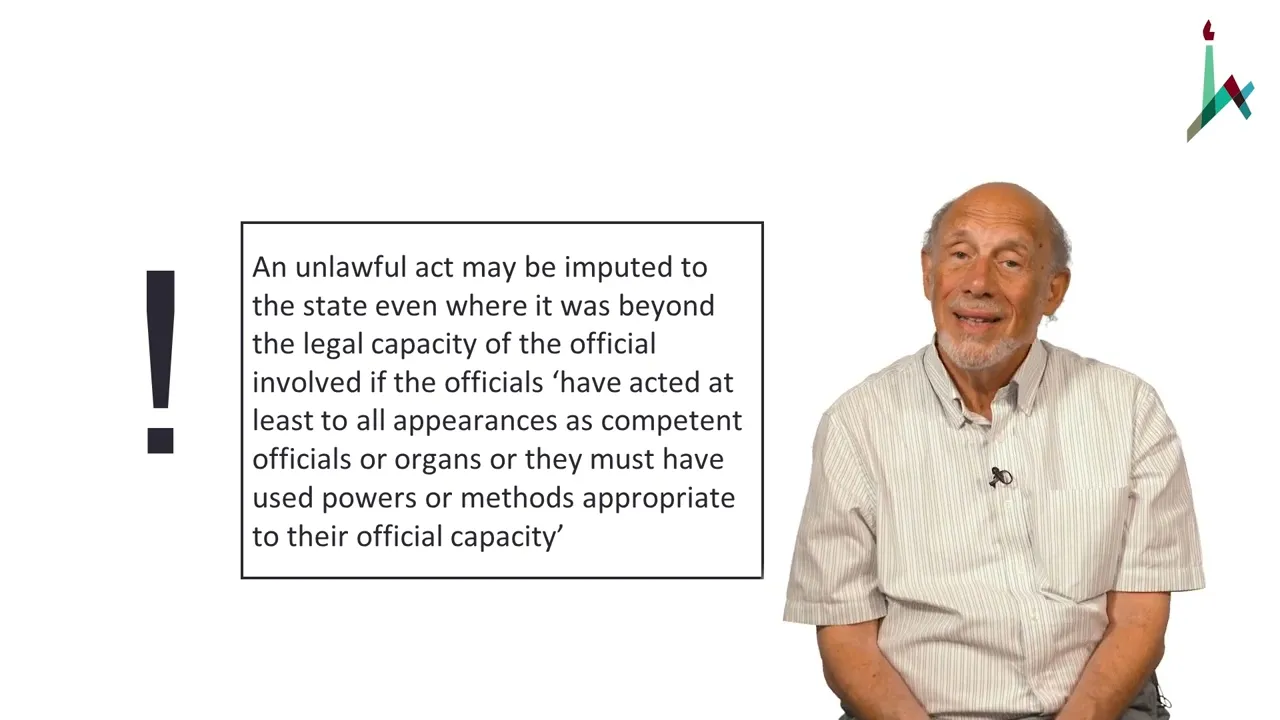
in 1995 which was deemed to have resulted in the massacre of thousands of Muslims an unlawful act may be imputed to the state even where it was beyond the legal capacity of the official involved providing that the officials have acted at least to all appearances as competent officials or organs or they must have used powers or methods appropriate to their official capacity article 7 of the ilc article rul provides that the conduct of an organ or of a person or entity empowered to exercise elements of governmental Authority shall be considered an act of the State
under international law if acting in that capacity even if it exceeds his authority or contravenes instructions this article appears to lay down an absolute rule of liability one not limited by reference to the apparent exercise of Authority and in the context of the general acceptance of the objective theory of responsibility this is probably the correct approach article eight of the ilc Articles provides that the conduct of a person or group of persons shall be considered as an AC of State under international law if the person or group of persons is in fact acting on the
instructions of or under the direction or control of that state in carrying out the conduct the first proposition is uncontroversial but difficulties have Arisen in seeking to define the necessary element of directional control required for the second proposition the commentary to the article emphasizes that such conduct will be attributable to the state only if it directed or control the specific operation and the conduct comp complained of was an integral part of the operation recent case law has addressed the issue in the Nicaragua case the international Court declared that in order for the conduct of the
Contra guillas to have been attributable to the US which financed and equipped the force it would in principle have to be proved that that state had effective control of the military or paramilitary operation in the course of which the Alle violations were committed in other words General overall control would have been insufficient to ground responsibility however in The Tadich case the international criminal Tribunal for the former Yugoslavia adopted a more flexible approach noting that the degree of control might vary according to the circumstances and a high threshold may not always be required if in this
case of course the issue was of individual criminal responsibility further the situation might be different where the state deemed responsible was in clear and and and uncontested effective control of the territory where the violation occurred the international Court in the Namibia case stated that physical control of a territory and not sovereignty or legitimacy of title is the basis of State liability for acts affecting other states this was underlined in the European Court of Human Rights case of Lois zidu and turkey which proclaimed the test of jurisdiction under the Convention as effective control whether exercised directly
through armed forces or through a subordinate local Administration this was reaffirmed in chov against Armenia in 2015 the international Court returned to the issue in the genocide convention bosnov V Serbia case and re reaffirmed its approach in the Nicaragua case it noted that the appeal Chambers judgment in Tadich did not concern issues of State responsibility nor a question that was indispensable for the exercise of its jurisdiction it held that the overall control test was not appropriate for State responsibility and the test under customy law was that reflected in article 8 whereby the state would be
responsible for the acts of persons or groups neither State organs nor equated with State organs were an organ of the state gave the instructions or provided the direction to which the perpetrators of the wrongful acts acted or were it or were it exercised effective control over the action during which the wrong was committed article nine of the ilc Articles provides that the conduct of a person or a group of persons shall be considered as an act of State under international law if the person or group was in fact exercising elements of the governmental Authority in
the absence or default of the official authorities and in circumstances such as to call for the exercise of those elements of authority and where an insurrectional movement is successful either in becoming the new government of a state or in establishing a new state in part of the territory of the pre-existing state it will be held responsibility for its activities prior to its Assumption of authority where a state subsequent acknowledges and adopts conduct as its own then it will be considered as an active State under international law entailing responsibility even though such conduct was not attributable
to the state beforehand in the Iranian hostages case for example the international Court noted that the initial attack on the US Embassy by militants could not be imputable to Iran since they were clearly not agents or or organs of the state however the subsequent approval of the Ayatollah and other organs of Iran to the attack and the decision to maintain the occupation of the embassy translated that action into a state action the militants thus became agents of the Iranian state for whose acts the state bore International responsibility where a state consents to an act by
another state which would otherwise constitute an unlawful Act wrongfulness is precluded provided that the ACT is within the limits of the consent given the most common example of this kind of situation is where troops from one St state are sent to another at the request of the latter wrongfulness is also precluded with the ACT constitutes a lawful measure of self-defense taken in Conformity with the charter of the UN this would also cover Force used in self-defense as defined in the customary right as well as under article 51 of the charter since that article refers in
terms to the inherent right of individual and Collective self-defense article 22 of the ilc articles provides that the wrongfulness of an act is precluded if and to the extent that the act constitutes a countermeasure or a reprisal not involving the use of force the international Court dealing with this situation stated in the Gap chova najim moros project case that in order to be justifiable a counter measure must meet certain conditions in the first place it must be taken in response to a previous International wrongful Act of another state and must be directed against that state
secondly the injured state must have called upon the state committing the the wrongful act to discontinue its wrongful conduct or to make reparation for it in the view of the Court an important consideration is that the effect of a countermeasure must be commensurate with the injury suffered taking in taking account of the rights in question and it's and its purpose must be to induce the wrongdoing state to comply with its obligations under international law and the measure must therefore be reversible the ilc Articles provide that an injured state may only take counter counter measures against
a state responsible for the wrongful act in order to induce the latter to comply with the obligations consequent upon the wrongful act counter measures are limited to the nonperformance for the time being of international obligations of the state taking the measure and shall as far as possible be taken in such a way as to permit the resumption of performance of the obligation in question counter measures must also be proportionate to the injury suffered taking into account the gravity of the internationally wrongful Act and the rights in question the injured state may take such counter measures
as are necessary to preserve its rights Force maure has long been accepted as precluding wrongfulness although the standard of proof is high this is defined by the ilc in terms of the occurrence of an irresistible force or of an unforeseen event beyond the control of the state making it materially impossible in the circumstances to perform the obligation in question the issue of force measure was raised by France in the Rainbow Warrior arbitration in 1990 where it was argued Ed that one of the French agents repatriated to France without the consent of New Zealand had to
be so moved as a result of medical factors which amounted to force mure the tribunal however stressed that the test of applicability of this Doctrine was one of absolute and material impossibility and a circumstance rendering performance and obligation more difficult or burdensome did not constitute a case of force meure article 24 provides that wrongfulness is precluded if the author of the conduct concerned had no other reasonable way in its situation of distress of saving the author's life or the lives of other persons entrusted to his Cur this would cover for example the seeking of Refuge
in a foreign Port without authorization by a ship's captain in storm conditions the difference between distress and force mure is that in the former case there is an element of choice this is often elusory since in both cases extreme Peril exists and whether or not the situation provides an opportunity for real choice is a matter of some difficulty the tribunal in the Rainbow Warrior arbitration noted that three conditions were required to be satisfied in order for this defense to be applicable to the French action in repatriating its two agents first the existence of exceptional circumstances
of extreme urgency involving medical and other considerations of an elementary nature provided always that a prompt recognition of the existence of those exceptional circumstances is subsequently obtained ained from the other interested party or is clearly demonstrated secondly the reestablishment of the original situation as soon as the Reas reasons of emergency invoked to justify the breach of the obligation had disappeared thirdly the existence of a good faith effort to try to obstain the consent of New Zealand according to the terms of the 1986 agreement it was concluded that France had failed to observe these conditions except
so far as the removal of one of the agents on medical Grounds was concerned necessity may not be invoked unless the Act was the only means for the state to safeguard an essential interest against a grave and imminent Peril and the ACT does not seriously ow an essential interest of the other state or states or or of the International Community as a whole further necessity may not be invoked if the international obligation in question excludes the possibility or the state itself has contributed to the situation of necessity while the tribunal in the Rainbow Warrior case
took the view that defense of State necessity was controversial the the international Court in the Gap jakova najim marus project case considered that it was a ground recognized in custom international law for precluding the wrongfulness of an act not in Conformity with an obligation although it could only be accepted on an exceptional basis it is not yet clear whether and to what extent the circumstances preluding wrongfulness May apply to the covid-19 crisis and obligations to which particular states are par we will take a short break here