A man with four wives, 13 children, and a lifetime of running from his own past gathers his sons around his deathbed. He is old. He is blind.
And he is about to speak over each of them words that will shape nations for the next 3,000 years. Every blessing, every warning, every name. None of it is random.
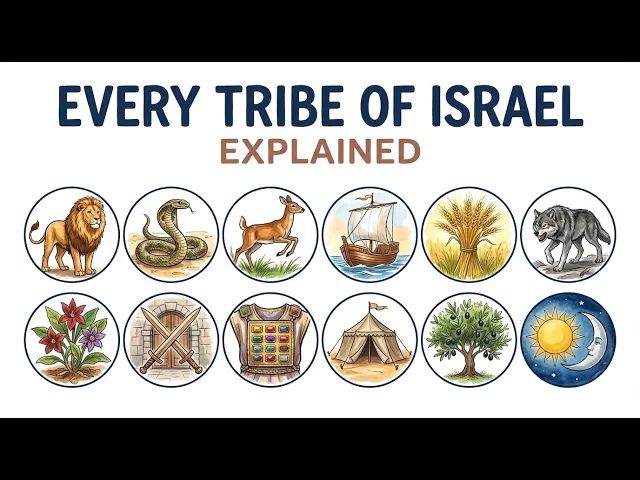
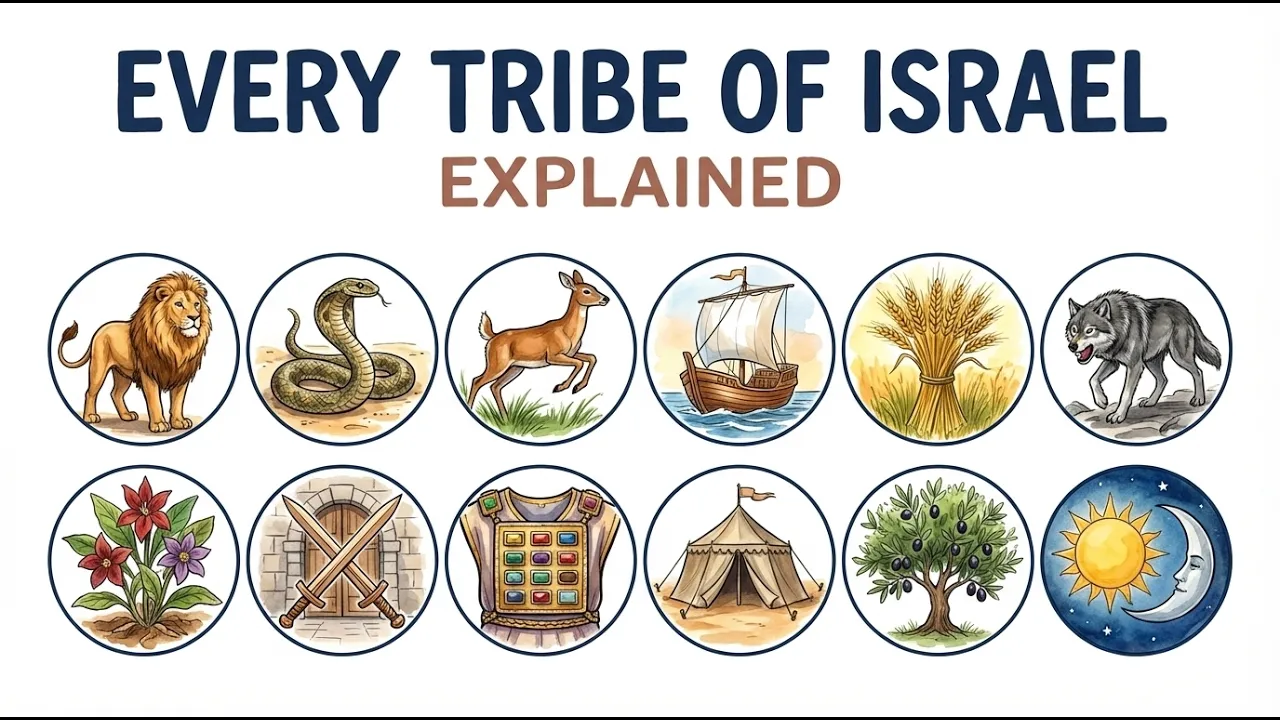
Because when you trace those 12 names from the book of Genesis all the way to the last pages of Revelation, you discover that the 12 tribes of Israel are not just a family tree. They are a blueprint for how God builds a people, holds them together when they fall apart, and writes their names on the gates of a city that has not been built yet. Most people hear the 12 tribes and think it is a list to memorize.
It is not. It is a story. And the story starts not with a nation, but with a marriage nobody wanted.
Jacob, the man whose family would become the nation of Israel, had two wives. And the first one, Leah, was not his choice. Genesis 29:20 says, "Jacob served seven years for Rachel, and they seemed like only a few days to him because of the love he had for her.
But on the wedding night, their father Laban switched the sisters. Jacob woke up married to Leah. And from that moment, the 12 tribes are born out of rivalry, heartbreak, and the desperate prayers of women who felt unseen.
Every single name is a window into their mother's pain or hope at the moment of birth. The names are not labels. They are prayers.
Leah, the unwanted wife, gives birth. Her firstborn is Reuben in Hebrew, Rayuven. It comes from ra to see, and Ben, a son.
Genesis 29:32 gives us her exact words. The Lord has surely looked on my affliction. Now therefore, my husband will love me.
The very first tribe of Israel is named after a woman's longing to be loved. That is not a footnote. That is the foundation.
God built his nation on the prayers of someone the world overlooked. Then comes Simeon Shimon from Shama, meaning to hear. Genesis 29:33.
Because the Lord has heard that I am unloved, he has therefore given me this son also. God saw. Then God heard.
The first two tribes are a testimony that God pays attention to the people nobody else notices. The third son is Levi. Levi from lava meaning to be joined or to be attached.
Genesis 29:34. Now this time my husband will become attached to me because I have borne him three sons. She is still reaching for Jacob's love.
But the irony is stunning. Levi's descendants will not become attached to any one man. They will become attached to God.
The tribe of Levi will become the priestly tribe, the ones who serve in the tabernacle, the ones who carry the ark, the ones who stand between God and the people. Leah wanted attachment to a husband. God turned that longing into attachment to himself.
and then Judah Yehuda from Yada meaning to praise. Genesis 29:35. This time I will praise the Lord.
And the text adds, therefore she named him Judah. Then she stopped bearing. Something shifted.
The first three names are about pain. The fourth is about praise. And it is from Judah, the tribe of praise, that the royal line descends.
King David came from Judah. And Revelation 5:5 calls Jesus the lion of the tribe of Judah, the root of David. The Messiah comes from the moment a rejected woman stopped asking for love and started giving thanks.
Now, pause for a second and look at what just happened. Four sons, all born to the same woman, all born from the same wound, the wound of being unloved. And the names read in order tell a story on their own.
God sees me. God hears me. God is attached to me.
I will praise God. That is not a list of baby names. That is a journey from rejection to worship in four steps.
And it is the foundation of the entire nation of Israel. Before there were armies, before there were borders, before there was a temple, there was a woman nobody chose and a god who chose her. Anyway, the next wave of sons comes from the maidservants.
Rachel, unable to conceive, gives her servant, Bilha, to Jacob. Bilha bears Dan. Dan comes from the Hebrew root den meaning to judge.
Genesis 30:6. God has judged my case and he has also heard my voice and given me a son. Dan means justice.
His tribe would later produce Samson, one of the most famous judges in Israel's history, as recorded in Judges chapters 13-16. But Jacob's deathbed prophecy over Dan in Genesis 49:16-17 is unsettling. Dan shall judge his people as one of the tribes of Israel.
Dan shall be a serpent, by the way, a viper by the path that bites the horse's heels so that its rider shall fall backward. That is not a comfortable blessing. The tribe named Justice will later become one of the first tribes to embrace idolatry.
Judges 18 records how the Danites set up their own unauthorized priesthood and worshiped idols. And centuries later, when the kingdom split, King Jeroboam placed one of his two golden calves in the city of Dan. First Kings 12:28-29 records the moment.
The tribe named Judge became the tribe that refused to be judged. After Dan comes naftily, nahily from the root pathl meaning to wrestle or to struggle. Genesis 38 with great wrestlings I have wrestled with my sister and indeed I have prevailed.
Nahali is born out of rivalry. But in the later history of Israel, this tribe settles in the northern region of Galilee. And that matters because Isaiah 9:1-2 prophesies the land of Zebulun and the land of Nahali.
The people who walked in darkness have seen a great light. Those who dwelt in the land of the shadow of death, upon them a light has shined. Matthew 4:13-16 applies that prophecy directly to Jesus beginning his public ministry in Galilee in the territory of Nahali.
The tribe born from a wrestling match became the region where the light of the world first appeared publicly. Now Leah's maidervant Zilpa enters the story. Her first son is Gad.
Gad means fortune or a troop comes. Genesis 30:11, a troop comes. The tribe of Gad later settled east of the Jordan River and became known for producing fierce warriors.
1st Chronicles 12:8 describes them. Some Gadites joined David at the stronghold in the wilderness. Mighty men of valor, men trained for battle, who could handle shield and spear, whose faces were like the faces of lions, and were as swift as gazels on the mountains.
short name, big reputation. Zilpa's second son is Asher. Asher comes from Asher, meaning happy or blessed.
Genesis 30:13, I am happy, for the daughters will call me blessed. Jacob's prophecy over Asher in Genesis 49:20, bread from Asher shall be rich, and he shall yield royal dainties. Asher's territory in northern Israel was indeed known for fertile soil and olive groves.
And centuries later, a woman from this tribe shows up in the New Testament. Luke 2:36-38. Now there was one Anna, a prophetus, the daughter of Faniel of the tribe of Asher.
She was of a great age and had lived with a husband 7 years from her virginity. And this woman was a widow of about 84 years who did not depart from the temple, but served God with fastings and prayers night and day. She had been waiting for the Messiah her entire life.
And when she saw the infant Jesus, she recognized him. The tribe of happiness produced a woman whose joy was finally complete. Leah then bears two more sons.
Issachar Yesachar likely from Sakar meaning reward or wages. Genesis 3:18. God has given me my wages because I have given my maidervant to my husband.
Issachar's tribe later became known for something unexpected. 1st Chronicles 12:32 describes them of the sons of Issachar who had understanding of the times to know what Israel ought to do. The tribe named reward became known for wisdom and discernment.
After Issachar comes Zebulun, Zebulun from Zaval meaning to honor or to dwell with. Genesis 30:20. God has endowed me with a good endowment.
Now my husband will dwell with me because I have borne him six sons. Still hoping, still longing. And then after six sons, Leah gives birth to a daughter, Dina.
Her name means judgment or vindicated. But Dina's story told in Genesis 34 is one of the most painful in the Bible. She is not listed among the tribes, but her presence in the narrative is a reminder that this family story includes trauma, not just triumph.
So, let's step back and take in the full picture. So far, we have 10 sons born to four different women in one household. Leah, the unloved wife, bears six.
Rachel's servant, Bilha, bears two. Leah's servant, Zilpa, bears two. And every single name is a record of what that mother was feeling in that moment.
longing, rivalry, wrestling, joy, reward. This is not a royal lineage born in a palace. This is a family born in chaos.
And that is the point. God does not wait for perfect circumstances to build something eternal. He walks into the mess, picks up the broken pieces, and says, "I am going to make a nation out of this.
" If you have ever looked at your own family or your own story and thought it was too complicated for God to use, this is the part of the Bible that was written for you. And then finally, Rachel conceives. After years of waiting, years of watching her sister bear child after child, Rachel gives birth to Joseph.
Ysef from Yasf, meaning may he add. Genesis 30:24. The Lord shall add to me another son.
Joseph is the son of longing, the son of the long wait, and his life will mirror that theme. Sold into slavery by his own brothers in Genesis 37, falsely accused in Genesis 39, imprisoned and forgotten in Genesis 40, and then in God's timing, elevated to the second most powerful position in all of Egypt in Genesis 41. Joseph's story spans 14 chapters of Genesis, one of the most detailed narratives in the entire Bible.
Jacob's deathbed blessing over Joseph is the longest of all 12. Genesis 49:22-26. Joseph is a fruitful bow, a fruitful bow by a well.
His branches run over the wall. The archers have bitterly grieved him, shot at him, and hated him. But his bow remained in strength, and the arms of his hands were made strong by the hands of the mighty God of Jacob.
by the Almighty who will bless you with blessings of heaven above, blessings of the deep that lies beneath, blessings of the breasts and of the womb. Joseph is a fruitful vine whose branches run over the wall. That image, a vine so productive it spills beyond its own boundaries, is a picture of what God does with the pain of faithful people.
The archers shot at him, but his bow held. And here is where the tribal math gets interesting. Joseph does not become a single tribe.
Before Jacob dies in Genesis 48, he adopts Joseph's two sons, Ephraim and Manasseh, and gives them each the status of a full tribe. Ephraim from Perah, meaning to be fruitful. Manasseh from Nasha, meaning to forget.
Because Genesis 41:51 records Joseph saying, "God has made me forget all my toil and all my father's house. " So, Joseph receives a double portion through his sons. That is why sometimes the Bible lists 12 tribes without Joseph but with Ephraim and Manasseh and other times it lists Joseph but not his sons.
The number stays at 12 but the names rotate depending on the context. The last son Rachel bears is Benjamin and his birth is the most heartbreaking in the entire list. Rachel dies in childbirth.
Genesis 35:18. And so it was as her soul was departing, for she died, that she called his name Ben Oni, meaning son of my sorrow. But his father called him Benjamin, Benjamin, son of my right hand.
One name spoken in dying breath, another spoken in faith, the same child, two identities. And Jacob chooses the one that speaks life. Jacob's prophecy over Benjamin in Genesis 49:27 is fierce.
Benjamin is a ravenous wolf. In the morning, he shall devour the prey, and at night, he shall divide the spoil. Benjamin's tribe would produce Israel's first king, Saul, described in 1st Samuel 9:10.
And in the New Testament, the Apostle Paul writes in Philippians 3:5 that he is of the tribe of Benjamin, a Hebrew of the Hebrews. The son of Sorrow became the son of the right hand, and from his line came a man who went from persecuting the church to writing a significant portion of the New Testament. So there they are, all 12.
And before we move forward into what happens to them as a nation, take a moment and hear the names together. Because when you line them up, they almost read like a declaration. Reuben, God sees.
Simeon, God hears. Levi, he draws near. Judah, I will praise him.
Dan, he brings justice. Nahili, through my struggle. Gad, good fortune is coming.
Asher, I am blessed. Issachar, there is a reward. Zebulun, he will dwell with me.
Joseph, he will add more. Benjamin, son of my right hand. 12 names, 12 prayers, 12 windows into how God takes the raw material of human longing and shapes it into something that outlasts empires.
These are not mythological figures on a scroll. These are the cries of real women who felt unloved, unheard, and overlooked. And a god who answered every single one of them with a child whose name became a nation.
If this is helping you see these tribes in a way you have never seen them before, help us get it to someone else. Subscribe, leave a comment, share it. That is how more people find this.
Let's keep spreading the word together. Now, here is where the story takes a devastating turn. After the reign of Solomon around 930 BC, the United Kingdom of Israel splits in two.
First Kings 12 records the moment. Solomon's son Riaboam refuses to lower the heavy taxes his father had imposed. 10 of the 12 tribes rebel and form the northern kingdom, which keeps the name Israel.
Only Judah and Benjamin remain loyal to the house of David, forming the southern kingdom called Judah. The tribe of Levi, scattered throughout the land as priests, largely migrated south to Judah after the split since the northern kingdom set up its own unauthorized worship centers. 2 Chronicles 11:13-14 records this migration.
The northern kingdom led initially by Jeroboam from the tribe of Ephraim immediately establishes two golden calves as worship centers, one in Bethl, one in Dan. First Kings 12:28-29. From that point forward, the northern kingdom spirals into idolatry.
And in 7:22 BC, the Assyrian Empire conquers the northern kingdom and deports its population. 2 Kings 17:6. Those 10 tribes scatter across the Assyrian Empire and become what history calls the 10 lost tribes of Israel.
They are not entirely lost as individuals from those tribes continued to identify themselves throughout the biblical narrative. Anna, the prophetus from Asher, is one example. But as organized landholding tribes, they vanished from the political map.
The southern kingdom Judah survives longer but eventually falls to Babylon in 586 BC. 2 Kings 25. Jerusalem is destroyed.
The temple is burned. The people are exiled. But unlike the northern tribes, Judah returns after 70 years as prophesied by Jeremiah in Jeremiah 25:11-2.
A remnant comes back, rebuilds the temple, and reestablishes worship. This is why by the time of Jesus, the Jewish people are called Jews from the name Judah. The tribe of praise became the identity of the surviving nation.
But the 12 tribes do not disappear from the biblical story. They resurface in some of the most important moments in scripture. One of the most vivid is hidden in the wardrobe of the high priest.
Exodus 28:15-21 describes the breastplate worn by the high priest when he entered God's presence. It was called the Hosan, the breastplate of judgment. On it were set 12 precious stones arranged in four rows of three, and each stone was engraved with the name of one of the 12 tribes.
Every time the high priest stepped into the tabernacle, he carried the entire nation on his chest, not on his back like a burden, on his heart, close to his heartbeat. 12 different stones, 12 different colors, 12 different names, all held together in one garment, all carried before God by one priest. And that image echoes forward into the New Testament.
Hebrews 7-10 presents Jesus as the ultimate high priest. The one who does not carry 12 stones on a breastplate but carries every believer in his intercession before the father. The tribes were not just names on fabric.
They were a picture of what was coming. And then there is revelation. The 12 tribes appear twice in the final book of the Bible and both appearances are stunning.
The first is Revelation 7 4-8. John sees 144,000 sealed servants of God, 12,000 from each of 12 tribes. But the list is not the same as the one in Genesis.
Judah is listed first instead of Reuben. Levi is included even though he was usually excluded from tribal lists because of his priestly role. And Dan is missing.
The tribe named Judge, the tribe that led Israel into idolatry, is absent from the list. In Dan's place, Manasseh appears alongside Joseph. The Bible does not explicitly state why Dan is excluded, but the pattern is hard to miss.
Dan's history of leading Israel into false worship, beginning in Judges 18 and culminating in the golden calf at the city of Dan seems to have consequences that echo all the way to the end of the story. But here is what is worth noticing. The inclusion of Levi suggests something has shifted.
In the Old Testament, Levi was separated out because only the Levites served as priests. The rest of the people came to God through the Levites. But in Revelation's list, Levi is back among the tribes.
The wall between priest and people is gone. 1 Peter 2:9 captures what this means. You are a chosen people, a royal priesthood, a holy nation.
The original vision God declared at Sinai in Exodus 19:6 that all his people would be a kingdom of priests is being restored. The list in Revelation 7 is not just an inventory. It is a theological statement.
The priesthood belongs to everyone. Now the second appearance is Revelation 21:12-14. John writes, "She had a great and high wall with 12 gates, and 12 angels at the gates, and names written on them, which are the names of the 12 tribes of the children of Israel.
Three gates on the east, three gates on the north, three gates on the south, and three gates on the west. Now the wall of the city had 12 foundations, and on them were the names of the twel apostles of the lamb. " Do you see what is happening?
The tribes are the gates, the way in. And the apostles are the foundation, the thing everything rests on. Old Testament and New Testament, Israel and the church, not competing, not replacing each other, fused into one city, one structure, one home.
And notice the gates face every direction. Three to the north, three to the south, three to the east, three to the west. Revelation 21:13.
No matter where you come from, there is a gate with a tribal name on it waiting for you. Ezekiel 48:30-34 had already prophesied this arrangement centuries earlier. And in Ezekiel's version, Dan is back.
The tribe excluded from the 144,000 in Revelation 7 has a gate in the eternal city in Ezekiel 48:32. Whatever the exclusion meant, it was not the final word. There is still a door with Dan's name on it.
Think about a family photo that has been torn. Not cut with scissors, just worn and creased from being folded too many times, carried in too many pockets, handled by too many hands. Some of the faces are faded, some of the edges are missing, but someone smooths it out, places it under glass, and puts it on the wall of a house that will never be damaged.
That is what God is doing with the 12 tribes. The family was torn. The kingdom was split.
10 tribes were scattered. The temple was burned. But in the final vision of the Bible, every name is accounted for.
Every tribe has a gate. Every stone has a place. Here is what stays with you when you trace these 12 names from Genesis to Revelation.
The names themselves tell a story. Reuben, God sees. Simeon, God hears.
Levi, attached to God. Judah, praise. Dan, justice.
Nahali, my struggle. Gad, good fortune. Asher, happiness.
Issachar reward. Zebulun, honor. Joseph, God will add.
Benjamin, son of my right hand. Read those meanings in sequence and they sound almost like a prayer. God sees, God hears, he draws us close.
And our response is praise. He brings justice through our struggles, fortune and happiness to those who wait, reward and honor to those who trust. And in the end, he adds what was missing and seats us at his right hand.
And then there is something else hiding in this story that changes how you see the people around you. Every tribe was different. Judah led, Levi served, Issachar discerned, Benjamin fought, Asher provided, Dan judged.
Even when the judging went wrong, 12 stones on the breastplate and not one of them was the same color. God never wanted 12 copies of the same tribe. He wanted 12 distinct expressions of the same covenant.
Your role in God's family is not to be someone else's tribe. It is to be yours. But maybe the part that stays with me most is the gates.
12 gates on a city that has not been built yet. And on every gate, a name. Not the name of a perfect tribe.
Not the name of a tribe that never failed. The name of a tribe that was born from a woman's pain, shaped by centuries of war and worship and wandering, scattered by empires, and yet still written on the entrance to the house of God. Your failures do not erase your name.
Your scattering does not cancel your gate. The God who named you before you were born is the same God who carved your name into a city you have not seen yet. Jacob began this story on his deathbed, blind and old, speaking words over 12 sons who would become a nation.
Revelation ends the story with those same 12 names etched onto the gates of a city that shines with the glory of God. And the most remarkable part is that between the deathbed and the city, between the first blessing and the final gate, every one of those tribes broke, wandered, fell, and was carried home. Every single one.
And still their names are on the doors. If this opens something up for you, help us reach someone else with it. Subscribe, leave a comment.
Even one word helps more people find this. Share it with someone who needs to hear it. Pray for us.
God bless you.