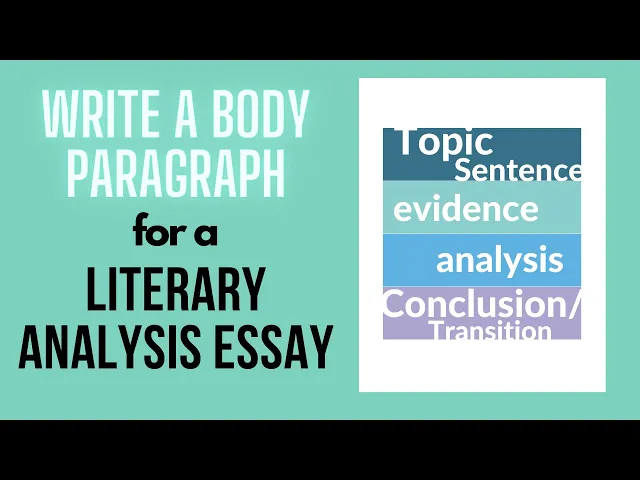
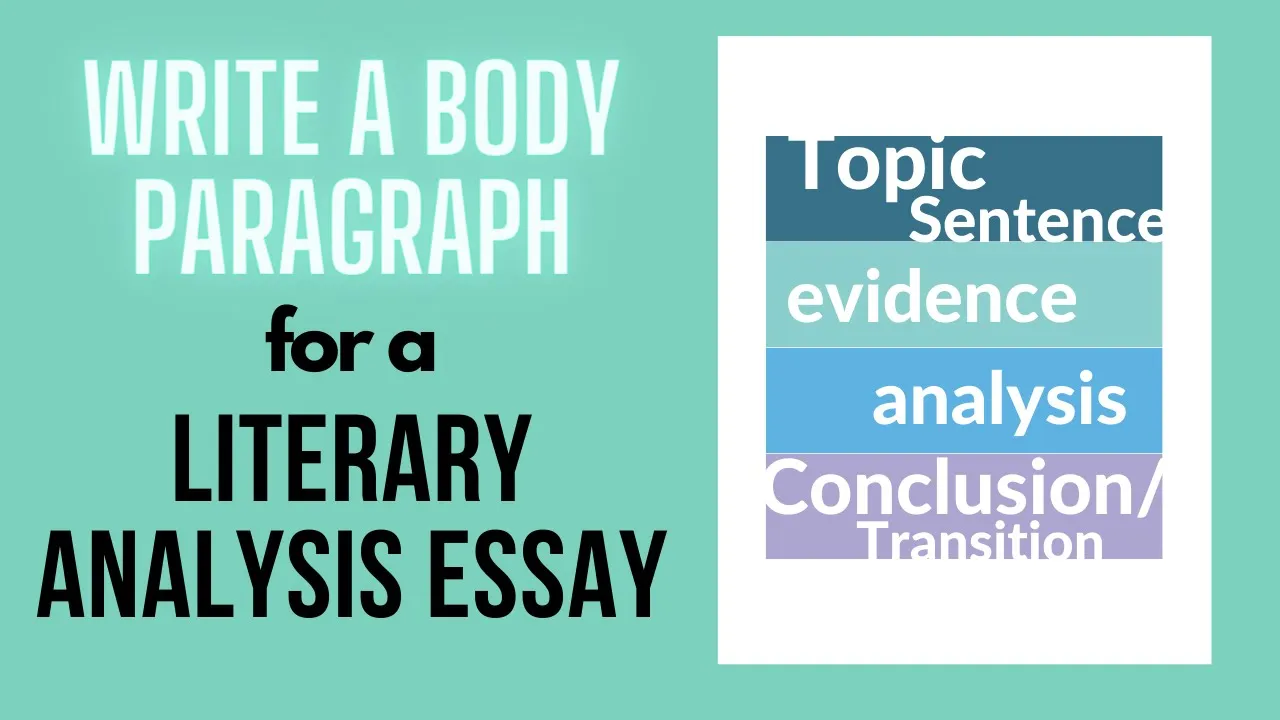
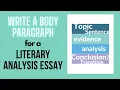
what's up everyone today i'm showing you how to write a body paragraph for a literary analysis essay using an actual paragraph that i wrote for a real essay in class if you want to learn how to write an introductory or concluding paragraph for this same type of essay please check out the links to the videos on those topics in the description box below let's get started the structure of your body paragraphs will look something like this you'll start off with your topic sentence then you'll provide evidence taken directly from the book poem short story or
text that you're analyzing then you'll offer your own analysis on that piece of evidence and you'll repeat that pattern of evidence and analysis however many times you want to i usually only do it once or twice because if i do it anymore my paragraphs tend to be overcrowded but it's really up to you and after that you'll provide your conclusion or your transition into the next body paragraph or the concluding paragraph your topic sentence will include the main claim of your whole paragraph and this should support the thesis statement your evidence can be a quote
event image symbol motif or character's action or any other type of information from that text that you can analyze in some way and your actual analysis is the commentary that examines the evidence and explains its larger meaning in your analysis you should also connect the evidence back to the topic sentence and again you'll repeat the same structure of evidence and analysis and finally your conclusion or transition will have a reference to the main idea of the paragraph and possibly a preview of what the next paragraph will be about before we jump into our body paragraph
let's take a look at the thesis statement for this literary analysis essay on khaled hosseini's book the kite runner don't worry you don't need to have read this book to understand the example i'll walk you through all the information that you need to know here's the thesis amir is resolved to make amends for his ignorance and callousness in the kite runner suggests that individuals develop compassion when they learn about their true origins so you might be a little confused about this thesis statement but don't worry i've included some key plot points to know from this
book i am providing a warning though that this brief plot overview does contain spoilers and this overview is not at all comprehensive so i highly highly suggest that you read the book since it's amazing first off our story takes place initially in afghanistan where amir the main character and narrator betrays hassan his childhood friend amir and his father baba move to america and when baba dies amir learns that baba was also hassan's biological father as an adult amir learns that hassan has died in afghanistan and has left behind a son sorob who is in danger
so amir finds sorab and raises him in america again that was a super super brief overview and it also skips over many many important facets of this novel for example amir is an upper-class wealthy individual in afghanistan and he belongs to an ethnic group that is the majority whereas hassan is part of an ethnic minority group that is persecuted and that definitely has major implications throughout the whole story let's write our body paragraph this paragraph focuses on amir's ignorance and his subsequent journey towards compassion this is our topic sentence amir becomes a more understanding son
and surrogate father when he faces the truth about his father's past notice how i haven't used the word ignorance in this topic sentence but i'm implying that this paragraph will be about the erasure of amir's ignorance because i'm stating that he's had a revelation that he's facing the truth about his father's past and his own past so now let's include some evidence what we'll write is telling amir that hassan is baba's biological son too rahim khan makes amir see how his entire life long before the winter of 1975 had been a cycle of lies betrayals
and secrets and i've included a parenthetical citation at the end there before the period so notice how i've integrated the quote seamlessly into my own sentence i try to avoid using the phrase the character said or the author writes or anything like that and now i'm providing some analysis of that quote which is taken directly from the book amir's remembrance of winter evokes images of frost desolation and darkness emphasizing his own oblivion although amir cannot reconcile his perception of baba's greatness with baba's hypocrisy amir soon realizes that he is more similar to his father than
he initially believed thus amir's journey to find saurabh is an attempt to redeem both his father and himself when amir meets orab the latter's resemblance to hassan is so uncanny that amir sacrifices for saurabh depict what could have occurred had baba accepted hassan openly so in the first part of this analysis i am directly referring to the quo and the image of winter that's explained there and i'm connecting the idea of winter to larger ideas of desolation and darkness and oblivion but then i used that comparison of ignorance to winter in order to lead into
a larger idea which is that amir's revelation makes him realize that his father is a hypocrite because he was supposed to be a great man but it turned out that he had you know lied for his pretty much his entire life but that actually leads to amir's own healing because he realizes that he can redeem himself and his father if he too owns up to his own lies and eventually goes on a journey to help someone other than himself and for once not be so self-centered so again i'm going to include some more evidence which
ties back to the topic sentence and this overall argument and here it is flying a kite for sorab at the novel's conclusion amir sees the first flake melting in a metaphorical spring after saurabh smiles so again i'm including a quote it's very small but it's still a quote from the kite runner itself you don't always have to include a quote as evidence you can definitely include paraphrased material and you definitely should include that in your body paragraph if you can and now we're having some analysis again the image of spurring signals a transformation in amir's
life since spring represents new beginnings the transition from a metaphorical winter to spring indicates that amir finally has matured and has taken responsibility for his actions as a child again we are analyzing this idea of seasons which represent larger ideas so we started off with winter which represents oblivion and isolation or desolation and now we're transitioning into spring which represents amir's new life or his new beginnings since he's now a surrogate father to hassan's child and he's also someone who is redeemed and who is actively trying to become a better father to saurabh so finally
we'll have our conclusion or our transition into the next paragraph and this will be on his journey toward accountability amir discovers that greatness does not mean perfection since those who are truly great try to atone for their misdeeds and this last portion is actually really important when i'm talking about atoning for misdeeds because the next body paragraph will refer directly to amir's misdeeds or his betrayal of hassan which i mentioned in the topic sentence and that second paragraph will focus on amir's callousness as well or his indifference to the feelings of others his cruelty the
big question you're probably asking yourself is how do i come up with effective nuanced analysis for my essay there are five different elements that you can consider to do this and each of these elements are interconnected the first is images events and objects when we're looking at these three things we want to ask ourselves why does the author include these images events or objects in the story does the author want to make the reader consider what they would do in a similar situation immerse the reader in the story represent a theme or another idea reveal
a truth misconception or paradox or make a statement about human rights politics science literature or any other field by asking these questions we can place ourselves in the author's shoes and start thinking about their reasoning for including these items next is language or the writing style of the text why does the author choose specific words to describe a scene what are the tone in the mood and why does the author include figurative language for example these questions will help us dissect direct quotes taken from the text and allow us to see how the author uses
the written word as a medium to convey larger ideas or larger character traits for example and that leads nicely into the next element which is character what's the character's apparent and hidden motivation for taking a particular action and what does a scene reveal about the character's personality or background next we have theme which is a universal abstract concept that the author is trying to convey and theme is connected to all of the other elements listed in this diagram because all of those other elements are usually ways that the author can convey a specific theme or
a specific idea about the human condition in general and lastly we have context time and setting what is the historical time period in place do flashbacks or foreshadowing occur is the story told in chronological order all of these questions definitely affect our analysis particularly the context portion for the example that we were talking about thanks for watching let me know what book you're analyzing for your literary analysis essay in the comments down below and feel free to ask any questions you have about writing body paragraphs if you like this video remember to like subscribe and
tap the bell to receive notifications i'll see you next time