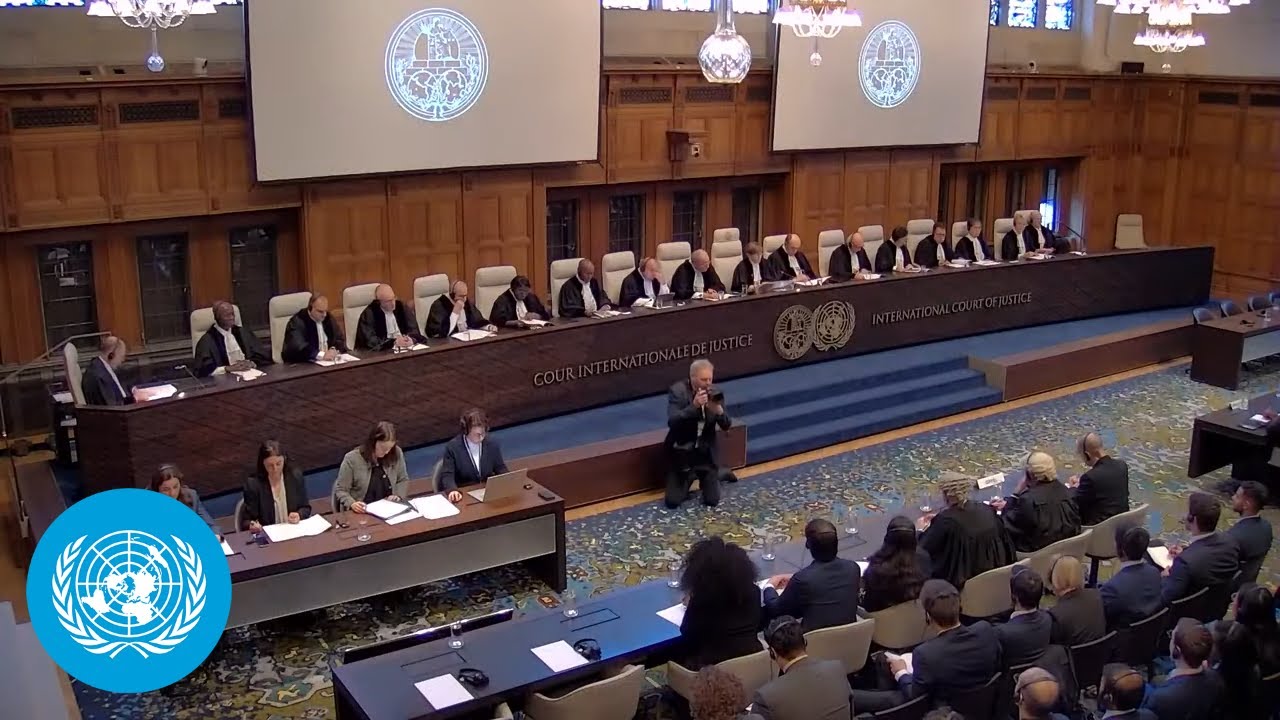
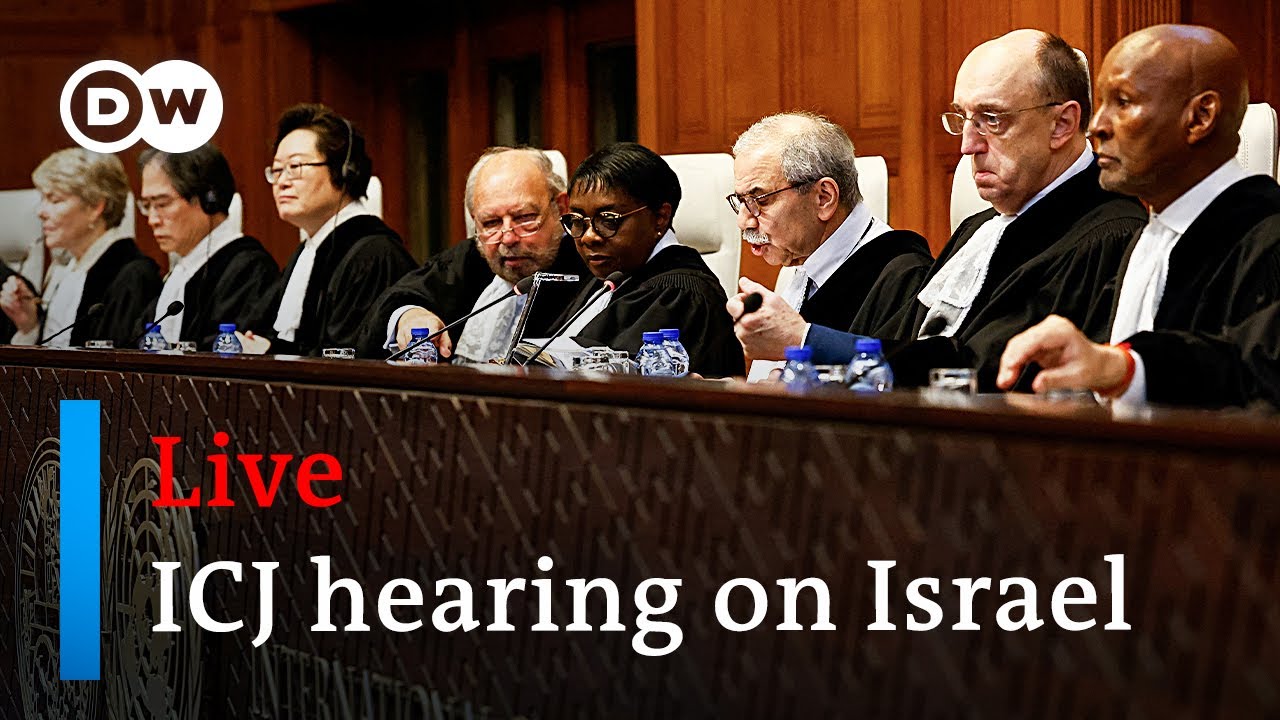
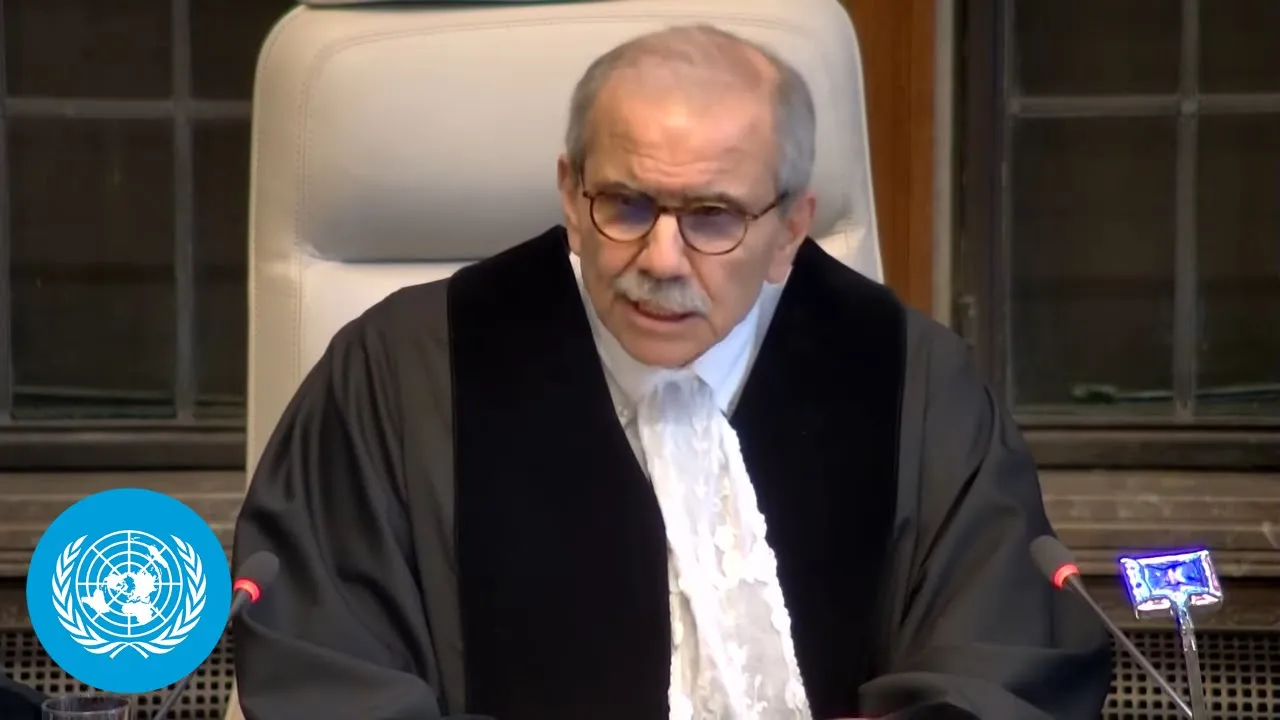
La cour [Musique] [Musique] please the sitting is open the cour meets today pursu to article 67 of the Statute to deliver its advisory opinion on the requ submitted by Assem of the United nation on the and prtic of Israel in the Occupedestinian territory including Jerusalem the questions on which the advis opinion of the cour has been requested are set forth resolution 77 bar 247 adopted by the United nation assembly on December 30 2022 by a letter dated 17 January 2023 and received by the registry on January 19 2023 the secretary general of the United Nations
officially communicated to the Court the the decision taken by the General Assembly to submit these questions for an advisor opinion paragraph 18 of the resolution reads as fellow as follows and I que the General Assembly decides in accordance with Article 96 of the Charter of the United Nations to request the international Court of Justice pursuent to Article 65 of the statute of the court to render an advisor opinion on the following questions considering the rules and principles of international Law including the Charter of the United Nations international humanitarian law international human rights relevant resolution of
the Security Council the General Assembly and the Human Rights Council and the advis opinion of the Court of July 9 2004 a what are the legal consequences arising from the ongoing violation by Israel of the right of the Palestinian people to selfdetermination from pronged Occupation settlement and annation of the palestinan occupied since 1967 including measures aimed at altering the demographic composition character and status of the holy city of Jerusalem and from its adoption of related discriminatory legislation and measures B how do the policies and practices of Israel referred to in paragraph 18 a affect the
legal status of the occupation and what are the consequences That arise for all states and united nations from this status and of in accordance with usual practice i shall not read out the introduct paragraphs of the opinion set out the main elements of the procedural history of theceedings I shall also omit ormar some of the other paragraph of the opinion i shall accordly begin reading the advisory opinion at paragraph 22 the full t of the opinion will of Course be available at the close of the sitting when se with the request for the advisory opinion
the Court must first consider whether it has jurisdiction to give the opinion requested and if so whether there is any reason why the should in the exercise of discretion decline to answer the request the Court must satisfy itself in accordance with the requirement of Article 96 of the Charter and article 65 of its statute that the question on Which is required to give its opinion is a legal question in the present proceedings the General Assembly put two questions to the Court these questions relate first to the legal consequences arising from certain policies and PRAC of
Israel as an occupying power in a situation of bigerent occupation since 1967 secondly they relate to how such policies and practices affect the legal status of the occupation in light of Certain rules and principle of international law and to the legal consequences which arise from this status the Court considers that these questions are legal questions in light of the above the cour concludes that the request has been made in accordance with the provisions of the Charter and of the statute of the court and therefore that it has jurisdiction to render the requested opinion the fact
that the Court has Jurisdiction to give an advis opinion does not mean that it is obliged toc it however onlying use to give opion in resp to a requ falling with jisdiction some participants in the present proceedings have argued that there are compelling reasons for the court to decline to give its opinion as to the argument that the request relates to a dispute between two Parties one of which has not consented to the jtion of the court the cour considers that the subject matter of the request is not only a bilateral matter between Israel and
palese but it is of particular interest and concern to the United Nations and that giving the opinion requested does not have effect of circumventing the principle of consent to judicial settlement as to the arument that theinion not the assembly Ofctions the consid that it canot substitute own assment of the for such an opinion with that of the organ requesting it as to the argument that the opinion of the Court would have an adverse effect on the negotiation framework the Court considers that it is a matter of conjuncture on which the cour should not speulate as
to the argument that the Court does not have sufficient information to Enable it to give an advis opinion the Court considers that it has before it sufficient information to decide legal questions in a matter in a manner consistent with judicial function as to the argument that the questions are formulated in a biased man the does not consider that the assembly end to restrict the cour freedom to determine these issues the Court willertain for itself whether Israel's policies and practices are in Violation of the applicable rules and principles of international law before determining the legal consequences
of any such violations having examined each of these arguments in turn the cour concludes that there are no compelling reasons for it to decline to give the opinion requested by the General Assembly the then records the general context of the case before turning to the scope and meaning of the questions Posed by the General Assembly in this regard the Court notes that the questions define the material territorial and temporal scope of the cour inquiry with regard to the material scope questions a identifies three types of conduct which question B describes as policies and practices of
Israel first the ongoing violation by Israel of the right of the Palestinian people to selfdermination second Israel's Prolonged occupation settlement and annexation of the Palestinian territory occupied since 1967 including meures AED at altering the demographic composition character and status of the holy city of Jerusalem third Israel adoption of related discriminatory legislation and measures the specific scope of each of these policies and practices is determined later at the Court examin them in turn before turning to that Examination the cour limits itself toserving a feature common to all of them namely that the term of the terms
of question a assume that these policies and practices are contrary to international law by virtue of its judicial function however the course must itself determine the lawfulness of the policies and practices identified by the General Assembly in the present case the cour consider that question a requir an Assessment of conformity with international law of those policies and practices of Israel identified in the request the Court considers that in its request the General Assembly has not sought from the Court a detailed factual determination of Israel's polices and practices therefore in order to give an advisor opinion
in this case it's not necessary for the cour to make finding with tofic incid in violation of international law the cour need only Establish the main features of Israel policies and practices and on that basis assess the conformity of these policies and practices with international law in terms of territorial scope question a refers to and I the palestinan territory occupied since 1967 un which encass the West Bank East Jerusalem and the gasa strip the Court notes that the various united nations organs and bodies frequently make specific reference to The different parts of the occupied Palestinian
territory the Court also does so in the present Advisor opinion as appropriate however the cours that from a standpo the occupied palestinan territory constitutes a single territorial unit the unity contiguity and integrity of which is to be preserved and respected th all references in this Opinion to the occupied Palestinian territory are references to a single territorial unit the cour further observes that the question mentions measures pertaining to the holy city of Jerusalem the ordinary meaning of this term is ambiguous and may be subject to multiple interpretations but the context provides useful clarification in the present
case in light of this the is that the by The General Assembly relating to the holy city of Jerusalem is confined to measures taken by Israel in East Jerusalem in terms of its temporal scope question a requests the court to take account of measures adopted by Israel in the occupied Palestinian territory since 1967 however the Court is not precluded from having regard to facts predating the occupation to the ex that this is necessary for the proper disch of judal Function the Court notes that the request foris opinion was adopted by the General Assembly on December
30 2022 and ask the cour to address Israel's i ongoing or I again continuing polies and practices th the is of VI that the and practices contemplated by the request of the General Assembly do not include conduct by Israel in the Gaza strip in response to the attack carried out against it by Hamas and other armed group on October 7 2023 question B has two parts the first part request the court to assess how the policies and practice of Israel identified by the General Assembly affect the legal status of the occupation the Obs that the
use of the verb affect points to the possibility that such policies and practices may bring about changes to the legal status however the scope of the first part of the question depends upon the Meaning of the expression legal stat of the occupation in the overex of question B in the present context the Court is of the view that the first part of question B call on the cour Totain the manner in which Israel's policies and practices affect the legal status of the occupation and thereb the legality of the continued presence of Israel as an occupying
power in the occupied palestinan Territory the Obs that both question a and the second part of question B call upon it to determine the legal consequences arising respectively from Israel's policies and practices and from its continued presence as an occupying power in the occupied Palestinian territory if and to the extent that the Court finds that any of Israel's policies and practices or its continued presence in the occupied PAL Palestinian territory are contrary to international Law the Court indicates that it will examine the legal consequences following from such findings for Israel for other states and for
the United Nations having defined the scope and meaning of the questions posed by the General Assembly the Court must determine thelicable law the applicability of certain international law in the territory concern depends on the status of that Territory under international law the Court first seeks tocertain the status of the occupied Palestinian territory under international law and then determines which rules of international law are relevant for answering the questions posed to it by the General Assembly the question posed by the general assembly are premised on the assumption that the occuped palestinan territory is occupied by Israel
in 2004 advis opinion on the legal consequences of the construction of a wall in the occupied Palestinian territory the Court set out the circumstances under which state of occupation is established the Court observed that in the 1967 armed conflict Israel occupied the territories situated between the green line and the former eastern bound of PAL under the British mateely the West Bank and E Jerusalem the affirmed that subsequent events had not altered the status of the territories in questions as occupied territories nor Israel's status as occupying power in its Advisor opinion the cour did not express
a view as to the legal status of the Gaza strip and the construction of the W did not affect gaz the gazp is inter part of the territory that wasoccupied is 1967 following the 1967 armed conflict Israel as the occupying power the Gaza Strip under effectiveol however in 2004 Israel announced disengagement plan according that Isra was toit and from several areas in thether part of the West B 200 Israel had completed the withdrawal of its army and the removal of the settlements in the Gaza Strip the cour notes that for the purpose of determining whether
a Territory remains occupied under international law the decisive CRITER is not the occupingysical in the territory at all times but rather whether authority has been established and can be exercised based on the information before the Court it consider that Israel remain capable of exercising and to exercise certain key elements of authority over the Gaza Strip including control of the land sea and air Borders tions on the movement of people and goods collection of import and export taxes and military control over the buffer zone despite the withdrawal of its military presence in 2005 this is even
more so since October 7 2023 in light of the above the code is of the view that Israel's withdrawal from the Gaza Strip has not entirely released it of its obligations on the law of Occupation Israel's obligations have remained commensurate with the degree of its effective control over the gazrip the Court then turn to the rules and principles that are relevant for answering the questions put to it these include the prohibition of the acquisition of territory by threat or use of force and the right of people to selfdetermination which are further internation law is of
relevance is Pow and du in occuped Palestinan territory are governed by the Geneva Convention to the prote of civilian of AUG 194 as theth Gena Convention which islicable in occupied palestinan territory and by comary international law per to Article 154 of the fourth Geneva Convention that convention is supplementary to the rules contained in sections two and 3 of the hag regulations respecting the laws and Customs of four and on land Ann to that convention as the Court has observed in itsprudence the hag regulations have become part of customary international law and they are thus binding
on Israel as regard international human rights law the Court observed that Israel is party to several legal instruments containing Human Rights obligations including the International Convention on the elimination of all Forms ofcial discrimination of 21 December 1965 which I shall refer to ASD the international Covenant on economic social and cultural r of 16 December 1966 to which I shall refer to as the ICR and the international Covenant on civil and political rise of 19 December 1966 to which I refer to ICC the cours that international human rights instruments are applicable in Respects to acts done
by a State in the exercise of jurisdiction outside its own territory particularly in occupied territories the cour further recs that the protection offered by human rights convention does not CEAS in the case of armed conflict or of occupation some r may be may be exclusively matters of internationalitarian law others may be exclusively matters of human rights law yet others may concern both these branches of international Law refering to advis opinion the courtserves that Israel remains bound by the ICCPR and the ICR in respect of its conduct with regard to the occupied Palestinian territory in relation
to third the Court knows that the Convention contains no provision expressly restricting its territorial application on thearyever several of its Provisions impose obligations on state parties that are applicable in teritories underurtion or in relation to individuals within the jurisdiction this indicat that third is also applicable to conduct of a State party which has effects beyond its territory and the Court view Israel must comply with its obligations under in circumstances in which it exercises its jurisdiction outside its Territory as several participants in the present proceedings Express diverging views regarding the relevance of the accord signed in
1993 and 1995 by Israel and the Palestine liberation organation also known as the Oslo accords the cour turns to those agreements the parties to the accord agreed to and Ie exercise their powers and responsibility pur to Theord with to intern and principles of humans and rule of law and of the cour that in considered in a opinion that the legitimate rights of the Palestinian people recognized in the Oslo accords includes the right to selfdetermination the Court observed that in interpreting the accords it's necessary take into account article 47 of the Geneva Convention which provides that
the protected population shall not Be depriv of the benefits of the Convention and Ie by any agreement concluded between the authorities of the occupied territories and the occupying power and of course for all these reasons the Court considers that these accords cannot be understood to detract from Israel's obligations under the pertinent rules of international lawlicable palesan TER the then ass theity of Israel's Policies and practices and occupied palestinan territory as identified in question a with its obligations under international law in particular the cour analysis examines in the question of the prolonged occupation Israel's policy of
settlement the annexation of the Palestinian territory occupied since 1967 and its adoption of related legislation and measures that are Discriminatory the Court appraises whether and if so how Israel's policies and practices affect the right of the Palestinian people to selfdetermination after those other questions have been considered with regard to the question of prolonged occup the that a conc in consequencesing Israel againe une prolonged occupation of the occupied palestinan territory in this regard the cour not That Israel occupation has lasted for more than 57 years in order to answer this aspect of the question the cour
must to the rel Israel OCC and pulation of the occupied territory which is governed by the law of occupation by virtue of status as an occupying power stat assumes a set of powers and duties with respect to the territory over which it exercises effective Control in this context the occupying power bears a duty to administer the territory for the benefit of the local population the these and are always pris on the assumption that occupation is a temporary situation to respond to military necessity and it cannot transfer title of sovereign to the occupying power the fact
that an occupation is prolonged does not in itself change the Legal status under international lawough pr the of occup the law of occupation does notor limits that as such al the status of the occupation instead the legality of the occupying powers presence in the occupied territory must be assessed in light of other rules in particular occupations consist of the exerciseate of efftive forign territory to Such of must at all consist with the RUL conc the prohibition of the threat or use of force including the prohibition of territorial acquisition resulting from the threat or use of
force as well as with the of to selfdetermination therefore the fact that an occupation is pronged may have aaring on the jtification under internal law of the occupyingwed presence in the occupied Territory it is against this background that Israel's policies and practices as well as its continuing presence in the occupied Palestinian territory must be examined the Court now turn to these policies and practices beginning with Israel settlement policy question a posed by the General Assembly inquires in part about the legal consequences arising from Israel's settlement policy the Court consider in this regard That the distinction
that is sometimes made between settlements and outposts is immaterial for the purpose of ascertaining whether the communities in question form part of Israel settlement policy what matters is whether they are established or maintained with the further that 1967 and 2005 Israel policy was carried out in the West Bank e Jerusalem and the Gaza Strip since the removal of Israel slement from the Gaza strip in 2005 Israel slement policy has continued in the West Bank and Jerusalem the therefore limits its analysis to Israel's ongoing slement policy in the West Jerusalem at the same time theses that
israelement policy carried out in the gazap until 2005 was not substantially different from the policy that continues in the West Bank and E Jerusalem today in advisory opinion the Court found that Israel settlement policy was In breach of the six paragraph of article 49 of the Geneva which provid that I the occupying power shall not deport or transfer part of its own civilian population into the territory it occupies of que in the cour view there is nothing in the terms or the context of the provision or in the object and purpose of the drafting history
of the for Geneva Convention to suggest that that provision prohibits only the for transf Of the occuping Cili population terit in the presente there exive evidence of Israel policy of providing incentives for the relocation of Israeli individuals and businesses into the West Bank as well as for its industrial and agricultural development by settlers there isidence that Isra regular that have been established in contravention of domestic Israel legislation and that Israel's Construction of settlements is accompanied by special design civilian infrastructure in the West Bank and East Jerusalem which integrates the settlement into the territory of Israel
in L of the above the Court considers that the transfer by Israel of settlers to the West Bank and Jerusalem as well as Isra main of their pres isary to article 49 of the Geneva Convention the cour further not that the expansion of Israel settlement in the West Bank and East Jerusalem is based on the confiscation or requisitioning of large areas of land observing that in the present case the public property confiscated or recition for the development of Israeli settlement benef the civilian population of SL to the detriment of the local palestinan population the call
concludes that Israel's land policies are not in conformity with articles 46 52 and 55 of The hag regulations thee next turn to the question of the exploitation of natural resources record that under the principle of com 5 of the regul up shall as administrator and us of resources in the occupied territory including but not limited to forest and Agriculture estates and it shall safard the capital of these resources there the by occuping of resour occ that had duty to ensure that the local population has anadequate supply of food St including water moreover the use of
natural resources in occupied territory must be sustainable and it must avoid environmental har on the bas of theidence Before is of ig law by diverting a large share of the natural resources to its own population including settlers Israel is in breach of its obligation to act as an administrator or us fructure the cour further consid that by severely restricting the access of Palestinian population to water that is available in the occupied palestinan territory Israel acts Inconsistently with obligation to ensure the availability of water insicient quantity and quality in light of its analysis the Court also
in concludes that Israel's policy of exploitation of natural resources in the occupied Palestinian territory is inconsistent with obligation to respect the Palestinians people right to perman next to the of the ex of Israeli law to the occupied Palestinian Territory the cour that under Article 43 of the HA regulations the occupying power must in principle respect the law enforce in the occupied territory unless absolutely pr prevented from doing so in principle the law of does not deprive the local populations civilian institutions and the occupied territory of the regulatory authority that they may have rather it invest
the occupying Power a set of regulatory power on an exceptional basis and on Specific enumerated grounds based on the evidence before it the cours that Israel has expanded of regulation in the West Bank it's not in particular that Israel has to a large degree substituted its military law for the local law in force in the occupied Palestinian territory at the beginning of the occupation 1967 moreover regional and local councils of settlers have assumed de facto jurisdiction over the settlements In the West Bank in E Jerusalem domestic Israeli law has been Isra jusalem national territory where
Israel law ised in full and the exusion of any other domestical system where Israeli law is applied in full and to the exclusion of any other domestic is and Jerusalem isied under of Article 64 of the Geneva Convention further the comprehensive application of Isra law in Jerusalem as well aslication in relation to S throughout the West Bank cannot beemedessential for any of the purpesated the second paragph of article 64 of the four Geneva Convention for these reasons the Court considers that Israel has exercised its regular authority as an occupying power in a manner that is
inconsistent with the R reflected in Article 43 of the Hague regulations and article 64 of the fourth Geneva Convention the then turn to the effects of Israel cy on the depure of the palestinan people thes that the lar confiscation of land and the deprivation of access to natural resources divest the local population of their basic means of subsistence thus inducing their departure furthermore a series of measures taken by Israeli military Forces has exbated the pressure on the palesan to leaves of the occupied palestinan territory against their will the cours that under the first paragraph of
article 49 of the Geneva Convention i que individual or mass forcible transfers as well as deportations of protected persons from occupying territ to the territory of the upying or to that of any other country occuped not Are prohibited regardless of their motive and of in this regard the cour consider that transfer may be forcible and th prohibited under Article 49 paragraph 1 not only when it is achieved through the use of physical force but also when the people concerned have no choice but to leave further the coures that to be permissible evacuations are conceived as
a temporary measures to be reversed as Soon as the imperative military reasons subside by contrast evacuations of a permanent or indefinite characterach the prohibition of forcible transfer and therefore are not covered by the exception set out in the second paragraph of article 49 the cour consid Israel's policies and practices including its forceable evictions extensive house demolitions and restrictions on residence and movement often leave little choice to Members of the Palestinian population living in area sea but to leave their area of residence the nature of Israel's acts including the fact that Israel frequently confiscates land following
the demolition of Palestinian property for reallocation to is SS indicates that its measures are not temporary in character and therefore cannot be considered as permissible evacuations under the four Geneva Convention in the Court view Israel's policies and practices areary to the pribition of forcible transfer of the protected population under Article 49 paragraph 1 of the fourth Geneva Convention the Court further notes that Israel's settlement policy has given rise to violence by settlers and security forces against Palestinians having examined the evidence before it in light of the Relevant provisions of international law the Court considered that
the violence by settlers against Palestinians Israel's failure to prevent or to punish it effectively and excessive use of force against Palestinians contribute to the creation and againstas ofidence it the is of the that Israel systematic failure to prevent or to punish attacks by settlers against the life or B integrity of Palestinians as well as Israel's exive use of force Against Palestinians is incistent with its OIG in light of the above the courirms as it did its advis Opin that the Israeli settlements in the West Bank and E Jerusalem and the regime associated with them have
been established and are being maintained in violation of international law the Court notes with gra concern report that Israel setment policy has been expanding since the cour advisory Opinion in particular in December 2022 is par estblish of Minister the min of Defense V the governers in the West Bank includingignationsning and coordination ofolition which woulded theal process for the ember 202 to octer 3123 aTIC with apprximately 24300 housing units within existing Israeli slements in the West Bank being Advan or approved including approximately 9670 in East Jerusalem thes that the by the General Assembly refers in part
to the legal consequences arising out of Israel's alleed annexation of the occupied Palestinian territory in order to respond to this aspect of the question the Court must first analyze the concept Of annexation second the Court examines Israel's policies and practices with a view to determining whether they amount to annexation finally the Court discusses the lawful of Israel's polies and practices with regard to the concept of annexation in the present context the Court understand that to mean the forcible acquisition by the occupying power of The territory that it occupies namely its integration into the territory of
the occupying power annexation then presosed the intent to ex perent over theoccuped terit theord in this regard that under the law of occupation the control of the occupied territory by the occupying power must be temporary in consequently conduct by the occupying power that displays an intent to exercise permanentol over the occupied territory May indicate an act of annexation the assertion by the occupying power of permanent control of the occupied territory may manifest itself in a variety of ways in this connection the Court notes that the distinction between the jury and the facto annexation is occasionally
made although differing in terms of the means through which the annexation ised out both types of annation the obje of overoccuped TER against this background theine through conduct Israel establishesol over the occupied palestinan territory in a manner that would amount to annexation the cour first examin Israel policies and practices in relation to Jerusalem that Isra hasedestic law Jerusalem since occupation in 1967 in 1980 is enacted domestic legislation in the form of a basic law proclaiming a Jerusalem as part of its Capital israel has asserted that Jerusalem is part of its territory as evidence by the
notification of the Israeli Government to the secretary general of the United Nations according to which and Ie jerusm is not in any part occupied territory s cap of the of Isra and of the absente property law of 1950 has facilitated the confiscation of absente property and it's use for the expansion Of Israeli settlements in and around the historical borders of the city it's reported that approximately,000 slements established in E Jerusalem the consider that Israel's measures in E Jerusalem create an inhospitable environment for the Palestinian population because Israel treats each Jerusalem as its own territory it's
regards Palestinians residing there as Foreigners and it requires that they hold a valid residence permit Israeli law has also put in place a building permit scheme the violation of which results in demolition through an expedited procedure as well as steepes according the secet of the United Nations Israel process of land ownership registration is pursued in areas of Israeli settlement expansion which would increase Israeli control Over additional territoryus turning to israelement policy in the West Bank the thatu to the basic law of 2018 the State of Israel i view the development of Jewish settlement as a
national value and shall act to encourage and promote its establishment and and consolidation and of que the displacement of the local population from the occupied territory which sustains Israel slement policy Also advances the integration of the territory Israel policies and practices indu the departure of the Palestinian population from parts of the occupied Palestinian territory notably from E Jerusalem and areaa in the West Bank this in turn enables the further expansion of Israel settlement policy and the integration of Palestinian territory into Israel the cour also that Isra practice of exploitation of the natural resources West Bank
is inconsistent with the right of the Palestinian people to permanent sovereignty over natural resources Israel's extension of its domestic law to the West Bank notably to the settlements and and over settlers as well as its assumption of broader regularity powers by virtue of the prolonged character of the occupation inentranches its control over the occupied territory policies practices As constitute acts of annexation having examined Israel policies and practices both in relation to E Jerusalem and the West Bank with a view to determining whether they amount to annexation the com to the conclusion that israel'ses and practices
including the main and expansion of settlements the construction of associated infrastructure and the wall the exploitation of natural resources the proclamation of Jerusalem as Israel's Capital the comprehensive application of Israeli domestic law in East Jerusalem and its extensive application in the West Bank inentrench Israel's control of the occupied Palestinian territory notably of East Jerusalem and of area se of the West Bank the these policies and practices are designed to maintain in place indefinitely sorry to remain in place indefinitely and to create irreversible effects on the ground consequently the Court considerers that these policies and practices
amount to annexation of large parts of the occupied Palestinian territory it is the view of the Court that to seek to acquire sovereignty over an occupied territory as shown by the polies and prtic adopted by Israel in jerusal and the West Bank isary to the pribition of the use of force international relations and its principle of the nonacquisition of territory by Force the manner in which the annation affects the status of the occupation and there theality of the presence of Israel is disced later in the advisory opinion the Court then examin the question of discriminatory
legislation and measures recing the wording of question a and the conclusion it reach with regard to the interpretation of the question it know that it must itself determine whether the legislation and measures identified by the request of The general assembly are discriminatory in this regard the Court first consider that it has to limit its analysis toislation and measures that are closely linked to the polies and practices discussed previously second the question covers Israel's legislation and measures only to the extent that they apply in the occupied palestinan territory third the question is confined to the potentially
discriminatory Character of Israel's legislation and measures having theope of a the turn to the concept of discmination it consid that to all of the relevant provisions of international law the concept of differential treatment between persons belonging to different groups it obser in this connection that the existence of the Palestinian people is not at issue therefore in the cour view differential treatment of Palestinian can give mination in order to answer question a the cour first examines the effects that Israel's residence permit policy in E Jerusalem has on Palestinians and the occupied Palestinian territory the cour then
turn to the restrictions imposed by Israel on the movement of Palestinians in the occupied Palestinian territory finally it examin Israel practice of demolition of Palestinian properties in the West Bank And in East Jerusalem both with regard to the practice of punitive demolition and demolition for lack of a building permit the couras notes that in that connection that it's reported that almost 11,000 palestinan structures have been demolished since 2009 the cour concludes from the evidence presented to it and on the bas of analysis that a Bro array of legislation adopted and measures taken by Israel capacity
as an occupying Powerat palestinans differently on ground specified by international law the Court knows that this differentiation of treatment cannot be justified with reference to reasonable and objective criteria nor to a legitimate public aim accordingly the Court is of the view that the regime of comprehensive restrictions imposed by Israel on Palestinian in the occupied Palestinian territory constitute systematic Discrimination based on interia race religion or ethnic origin in violation of Article 2 paragraph 1 and 26 of the ICCPR article 2 paragraph 2 of the iccr and article 2 of third a number of participants have arued
that Israel polies and practices in occupiedestinan territory am regation orti in breach of Article 3 of Article 3 of provides as follows i que States Parties particularly condemn racial segregation and apartide and Undertake to prevent prohibit and and eradicate all practices of this nature in territories under their juriction this provision refers to two particularly severe forms of ofcial discrimination racial segregation and apti the cour obsed that Israel legislation and measures impose and serve to maintain a near complete separation in the West Bank and Jerusalem between the settler and Palestinian communities for this reason the Court
considers that Israel's legislation and measures constitute a breach of Article 3 of having found that Israel policy acts of annation and related discriminatory legislation and measures are inach of international law the cour turn to the aspect of question a that inquires as to the effects of Israel's policies and practices on the exercise of the Palestinian people's right to Selfdermination the Court has already affirmed in its whole opinion the exist of the right of the Palestinian people to selfdermination in the presented the first the scope of this and then examin the effects if any that Israel
polies and practices have on it exercise in light of its analysis the cour is of the view that the prolong character of Israel's unlawful policies and practices aggravates their violation Of the right of the Palestinian people to selfermination as a consequence of israely and practices which SP decades the Palestinian people has been deprived of its to selfdetermination over a long period and further prolongation of these policies and practices undermines the exercise of this in the future for these reasons the Court is of the view that Israel's unlawful policies and practices are in breach of Israel's
Obligation to respect the right of the palestinan upation of israoccuped territ disced je vais donner lecture de la suite de la vie en français la cour enient ensuite à la première partie de la question B sur laquelle l'assemblée générale solliciter son avis et se penche sur la question de savoir si et dans l'affirmative de quelle manière les Politiques et pratique d'Israël ont une incidence sur le statut juridique de l'occupation à la lumière des règles et principes de droit international pertinent elle commence par déterminer plus précisément la portée de la prère partie de la question B
que lui a posé l'assemblée générale à cet égard la cour considère que la première partie de la question B que lui a posé l'assemblée générale N'est pas de savoir si les politiques et pratiques d'Israël ont une incidence sur le statut juridque de l'occupation en tant que tel elle est plutôt d'avis que la première partie de la seconde question a trait à la manière dont les politiques et pratiques d'Israël influent sur le statut juridique de l'occupation et par la même sur la lisséité de la présence continue de cet état en tant que puissance occupante dans le
territoire palestinien occupé Cette lcéité doit être déterminé àon des règles et principes du droit international général dont celle de la Charte des Nations Unies la Cour a établi que les politiques et pratiques israéliennes ainsi que la manière dont elles étaient mises en œuvre et appliquées sur le terrain avait des effets importants sur le statut juridique de l'occupation du fait de l'extension de la souveraineté israélienne sur certaines parties du Terroire occupé de leur annexion progressive au territoire d'Israël de l'exercice par ce dernier de certaines fonctions gouvernementales et de l'application de ces lois internes dans les dites
zones ainsi que transfère dans celle-ci des nombre croissant de ses propres ressortissants et de l'entrave à l'exercice du droit à l'autodétermination du peuple palestinien la Cour estime que l'affirmation par Israël de sa souveraineté sur certaines parties du territoire palestinien occupé et l'action et l'annexion de celle-ci constitue une violation de l'interdiction de l'acquisition de territoire par la force cette violation a un impact direct sur la lissayité de la présence contenue d'Israël en tant puissance occupant dans le dit territoire la Cour estime qu'Israël n'a pas droit à la souveraineté sur quelqu partie du territoire Palestiniens occupé Et
ne saurait y exercer des pouvoirs souverains du fait de son occupation les préoccupations d'Israël en matière de sécurité ne seraient non plus l'emporter sur le principe de l'interdiction de l'acquisition d' territoire par la force la Cour observe encore que les effets des politiques et pratiques d'Israël tels qu'examiné plusôt et le fait qu'il exerce sa souveraineté sur certaines parties du territoires Palestiniens occupés notamment la sjordanie et Jérusalem Est constitue une entrave à l'exercice par le peuple palestinien de son droit à l'autodétermination ces effets comprennent l'annexion par Israël de certaines parties du territoire palestinien occupé la fragmentation
de celui-ci qui en compromet l'intégrité les pratiques d'Israël consistant à priver le peuple palistien de la jouissance des ressources Naturelles du territoire et son entrave au droit de ce peuple de poursuivre librement son développement économique social et culturel les effets des politiques et pratiques d'Israël qui ont été décrit dessus lesquelles ont notamment pour conséquence que le peuple palestinien se trouve depuis longtemps privé de son droit à l'autodétermination constitue une violation de ce droit Fondamental cette violation a un impact direct sur la lcéité de la présence d'Israël en tant que puissance occupante dans le territoire palestinien
occupé la cour est d'avis que l'occupation ne saurait être utilisée de sorte à laisser indéfiniment la population occupée dans l'expectative et l'incertitude en la privant de son droit à l'autodétermination tout en intégrant des parties de son territoire dans le ire propre de la puissance occupante Elle considère que l'existence du droit du palestinien à l'autodétermination ne saurait être soumise condition par la puissance occupante étant donné qu'il s'agit d'un droit inaliénable au V de ce qui précède la Cour examine la question de la lcéité de la présence continue d'Israël dans le territoire palestinien occupé la Cour considère
que les violations par Israël de l'interdiction de L'acquisition de territoire par la force et du droit du peup palestinen à l'autodétermination ont un impact direct sur la léité de la présence continue d'Israël dans le territoire palestinien occupé l'utilisation abusive persistante de sa position en tant que puissance occupante à laquelle Israël se livre en annexant le territoirees Palestinien occupés et en en imposant un contrôle permanent sur celui-ci ainsi qu'en privant de manière continue le peuple Palistien de son droit à l'autodéamation viole les principes fondamentaux du droit international et rend illicite la présence d'Israël dans les territoires
palestiniens occupés cette illicéité s'applique à l'intégralité du territoire palestinien occupé par Israël en 1977 il s'agit là de l'entité terr territoriale dans laquelle ce dernier a imposé des étique et pratique visant à entamer et à entraver la capacité du Peuple palestinien d'exercer son droit à l'autodéterimation tout en étendant sa souveraineté sur de vastes zones de la dite entité en violation du droit internationale le territoire palestinien occupé dans son intégrité et aussi le territoire à l'égard duquel le peuple palestinien devrait pouvoir exercer son droit à l'ôre de ation et dont l'intégrité doit être respectée répondant à
un argument avancé par quelques participants la Cour Observe que les accords d'Oslo n'autorisent pas à Israël à annexer des parties du territoire palestiniens occupés pour satisfaire aux 10 besoins il n'autorise pas non plus à maintenir une présence permanente dans les territoires palestiniens occupés à cette même fin la Cour souligne que la conclusion selon laquelle la présence continue d'Israël dans le territoire palestinien occupé et illicite ne libère pas cet État des obligations et responsabilité que le droit international et plus particulièrement le droit de l'occupation lui impose envers la population palestinienne et d'autres États en ce qui
concerne l'exercice de ses pouvoirs relativement au territoire en question jusqu'à ce qu'il soit mis fin à sa présence sur celui-ci c'est le contrôle effectif d'un territoire quel que soit son statut juridique en droit international qui Constitue le fondement de responsabilité de l'État en raison de ces actes ayant une incidence sur la population du du territoire ou sur d'autres États la Cour a conclu que les politiques et pratiques d'Israël visaient dans les questions a emportter violation du droit international le maintien de ces politique et pratique constitue un fait illicite à caractère continu qui engage la responsabilité
internationale D'Israël la Cour a cepend a également conclu en réponse à la première partie de la question B que la présence contenue d'Israël dans le territoire palestinien occupé était illicite elle examine donc les conséquences juridiques qui découlent des politiques et pratiques d'Israël visé dans la question a ainsi que au fin de la question B celle qui découle de l'illicéité de la présence continue d'Israël dans les territoires Palestinens occupé pour Israël pour les autres États et pour l'Organisation des Nations Unies sagissant de sa conclusion selon laquelle la présence continue d'Israël dans le territoire palestinien occupé et
illicite la Cour considère que cette présence constitue un fait illicite qui engage la responsabilité internationale de cet il s'agit d'un fait illicite à caractère continu qui a été causé par les violations de l'interdiction de L'acquisition de territoire par la forge et du droit à l'odétermination au palestinien qu'Israël a commise par ses politiques et pratiques en conséquence ce dernier a l'obligation de mettre fin à sa présence dans les territoires palestiniens occupés dans les plus brefs délis la Cour observe en outre que en ce qui concerne ces politiques et pratiques visé dans la question a qui ont
été jugé illicites Israël est dans l'obligation de mettre un terme à ces fêes illicites À cet égard il doit immédiatement cesser toute nouvelle activité de colonisation Israël est également tenu d'abroger toutes lois et mesures créant ou maintenant la situation illicite et compris celles qui sont discriminatoires à l'égard du peuple palestinien dans le territoire palestinien occupé Inti que toute mesure destiné à modifier la composition démographique de quelques partiese de ce territoire Israël a également L'obligation de réparer intégralement les dommages causés par ces faits internationnalement illicites à toutes les personnes physiques ou morales concernées la réparation comprend
la restitution l'indemnisation ou la satisfaction la restitution inclut l'obligation pour Israël de restituer les terres et autres bienens immobiliers ainsi que l'ensemble des avoirs confisqués à toute personne physique ou Morale depuis le début de son occupation en 1967 et tout bien et bâtiment culturel pris aux Palestiniens et à leurs institutions y compris les archives et les documents elle exige également que tous les colons des colonies de peuplement existant soi évacué que les parties du mur construit par Israël qui sont situé dans le territoire Palestiniens occupés soit démantelés et que tous les Palestiniens déplacés durant l'occupation
puissent Retourner dans leur lieu de résistence initiale au cas où pareille restitution se révélerait matériellement impossible Israël ser serait tenu d'indemniser conformément aux règles du droit international applicable toutes les personnes physiques ou morales et les populations de tout dommage matériel qui leur a été causé par l'effet illicite qu'il a commis pendant l'occupation la cour soulligne que les obligations découlants des faits Interement illicites d'Israël ne le dispense pas de son devoir continu de s'acquiter des obligations internationales auquel contrevient son comportement en particulier Israël demeure tenu d'observer l'obligation que lui incomble de respecter le droit du peuple
palestinien à l'autodétermination et les obligations auxquelles il est tenu au regard du droit international humanitaire et du droit international relatif au droits de L'homme la cour envient ensuite aux conséquences juridiques pour les autres États des faits internationalement illicit d'Israël dans le territoire palestinien occupé la Cour observe que les obligations qu'Israël a violé comprennent certaines obligations hergaomnes parmi lesquelles cell de respecter le droit du palestinien à l'aut affirmation et celle qui découle de l'interdiction de l'acquisition de territoire par la force Inti que Certaines obligations incombant à Israël au regard du droit international humanitaire et du droit
international relatif au droits de l'homme s'agissant du droit à l'autodétermination la Cour considère que bien qu'il appartienne à l'assemblée générale au Conseil de sécurité de se prononcer sur les modalités requises pour veiller à ce qu'il soit mis fin à la présence illicite d'Israël dans le territoire palestinien occupé à ce que Le peuple palestinien exerce pleinement son droit à l'autodétermination tous les États doivent coopérer avec l'Organisation des Nations Unies pour donner effet à ces modalités s'agissant de l'interdiction de l'acquisition de territoire par la force la cour prenant note des résolutions du Conseil de sécurité et de
l'assemblée générale et d'avis que les États membres de l'organisation sont tenus de reconnaître euh de ne Reconnaître aucune modification du caractère physique ou de la composition démographique de la structure institutionnelle ou du statut du territoire occupé par Israël le 5 juin 1967 y compris Jérusalem est autre que celle convenue par les partis au conflit par voie de négociation et de faire une distinction dans leurs échanges avec Israël entre les territoires de l'État d'Israël et le territoire palestinien occupé depuis 1967 de plus la Cour considère que compenu de la nature et de l'importance des droits et
obligations en cause tous les États sont tenu de ne pas reconnaître comme licite la situation découlant de la présence illicite d'Israël dans le territoire palestinien occupé ils sont également tenus de ne pas prêter aide ou assistance au maintien de la la situation créée par cette présence tous les États doivent veiller Dans le respect de la Charte des Nations Unies et du droit international à ce qu'il soit mis fin à toute entrave à l'exercice du dooit du peuple palestinien à l'autodétermination résultant de la présente illicite de la présence illicite d'Israël dans le territoire palestinien occupé en
outre tous les états partis à la 4e Convention de Genève ont l'obligation dans le respect de la Charte des Nations Unies et du droit international de s'assurer qu'Israël respecte le droit international humanitaire tel que consacré par cette convention le devoir de non reconnaissance énoncé plusutôt s'applique également aux organisation internationale dans l'Organisation des Nations Unies au vu des graves manquements à des obligations hergaomnè découlant du droit international l'obligation de ne pas Reconnaître comme licite la situation découlant de la présence illicite de l'État d'Israël dans le territoire palestinien occupé au l'obligation de distinguer dans les rapports avec
Israël entre le territoire de celui-ci et le territoire palestinien occupé s'applique également à l'Organisation des Nations Unies enfin la Cour considère que la question des modalités précise pour qu'il soit mis fin à la présence illicite d'Israël dans le territoirees Palestiniens occupés doit être traité par l'assemblée générale qui a sollicité le présent avis consultatif ainsi que par le Conseil de sécurité en en conséquence à ces deux organes qu'il appartienent de rechercher quelles mesures supplémentaires sont requises pour mettre fin à la présence illicite d'Israël contenu du présent avis consultatif la Cour estime important à deigner comme elle
l'a fait dans son habit consultatif sur le Mur je cite la cété urgente que l'Organisation des Nations unies dans son ensemble redouble ses efforts en vue de mettre rapidement un terme au conflit israëlo-palestinien qui continue de pososer une menace à la paix et à la sécurité internationale et d'établir ainsi une paix juste et durable dans la région fin de citation la Cour estime également que la réalisation du droit du peup palestinien à l'autodétermination y compris son Droit à un État indépendant et souverain coexistant dans la paix avec l'État d'Israël à l'intérieur de frontières sûr et
reconnu pour les deux états comme cela est prévu dans les résolutions du Conseil de sécurité d'assemblée générale contribuerit à la stabilité régionale et à la sécurité de tous les états du Moyen-Orient la cour tient à souligner que sa réponse aux questions qui lui ont été posées par l'Assemblée Générale repose sur l'ensemble des motifs Juridique qu'elle a exposé c-dessus lesquels doivent être lu à la lumière les uns des autres en tenant compte de la manière dont la Cour a défini la portée matérielle temporelle et territoriale des questions now read in English paragraphhe 285 which con the
operative Cluse of the opinion one unanous find that JIC to give the opion requ by ves to one decid to comply the Requ foris opinion inv President salam judgeska Abraham bwa gzeveland orcoadi against Vice President by 11 votes to four is of the opinion that the state of Israel's presence in the occupied territory is unlawful in President salam judgeswe Bandarwawa note Charles brand Gomez Robledo clevelandadi against vice presidentue judgeska Abraham by 11 ves to four is of the opinion that the State of Israel is under an obligation to bring an endorry to bring to an
end unlawful presence in the occup ident salam judges Bandar Iawa charw brand GZ Robledo clevel against vice presidentkaaham upes terit salamudgka Abraham youuf bandarawa char brandzoevelco by ves is of the opinion that the State of Israel has the obligation to make reparation for the damage caus to all Natural oral persons concern in the occupi palestinan territory inident salam judges tomka abrahamusofweandarawa te charw brand Gomez Robledo Cleveland urescoadi against VI President by 12 votes to three is of the opinion that all states are under an obligation not to recogniz as legal the situation arising from the
unlawful Presence of the ST of Israel in the occupied Palestinian territory not to render aid or assistance in maintaining the situation created by the continued presence of the State of Israel in the occupied Palestinian territory in favor President salam judges tomka ususof Shwe Bandari Iwasawa chargew brand Gomez Robledo Cleveland tadi against vice presidentnde judges Abraham juresco by 12 ves to is of the opinion that interational organizations including united nations are under an obligation not to recogn as legal the situation aring from the unlawful presence of the State of Israel in the occupied palestinan territory invor
President salam judgeskausof Shwe Bandari wasawa no chargew brand GZ Robledo Cleveland against VI President judges Abrahamco by 12 ves to is of the opinion that United Nations and especially the general assembly which requested this opinion and the Security Council should consider the prali and further AC required to bring to as rapid as possible the unlawful presence of the State of Israel in occupied palestinan territory in President salam judges tomkaofwe barawa charw BrandZ Robledo Cleveland against vice president judges [Musique] abrahamco i shall now call upon urffier par ces motif la cour 1 à l'unanimité dit qu
la compétence pour donner l'avis consultative demandé 2 par 14 voix contre une décide de donner suite à la demande d'avis consultatif pour Monsieur salam Président Monsieur tomka Abraham Youssouf madame monsieur Bandar iwawa note madame charlesw Monsieur brand Gomez Robledo madame Cleveland monsieur orescou tladi juge contre madame cebounde vice-présidente 3 par 11 voix contre 4 et d'avis que la présence continue de l'État d'Israël dans le territoire palestinien occupé est illicite pour Monsieur salam Président Monsieur Youssouf madame choué monsieur Bandari Iwasawa Nolte madame charleswth monsieur Bran Gomez Robledo madame clevelan monsieur tladi juge contre Madame ceboutin D
viceprésidente Monsieur tomka Abraham orescou juge 4 par 11 voix contre 4 et d'avis que l'État d'Israël est dans l'obligation de mettre fin à sa présence illicite dans le territoire palestinien occupé dans les plus brefs délais pour Monsieur salam Président Monsieur Youssouf madame monur Bandar iwawa madame Charles monsieur brand Gomez Robledo madame clevl monsieur tladi juge contre madame ceoutin vice-présidente monsieur tomka Abraham Orescou juge 5 par 14 voix contre une est d'avis que l'État d'Israël est dans l'obligation de cesser immédiatement toute nouvelle activité de colonisation et d'évacuer tous les colons du territoire occupé pour Monsieur salam
Président Monsieur tomka Abraham Youssouf madame chou monsieur Bandar iwawa madame charlesw monsieur Bran Gomez Robledo madame Cleveland monsieur orescou TL juge contre madame ceoutinde Vice-présidente 6 par 14 voix contre une est d'avis que l'État d'Israël a l'obligation de réparer le préjudice causé à toutes les personnes phies ou moral concerné dans le territoire palestinien occupé pour Monsieur salam président monieur tomka Abraham Youssouf madame chou monsieur Bandari iwawa n madame charlesw monsieur brand Gomez rebledo madame Cleveland monsieur orescout lad juge contre madame ceounde vice-présidente 7 par 12 voix contre 3 Et d'avis que tous les États sont
dans l'obligation de ne pas reconnaître comme licite la situation découlant de la présence illicite de l'État d'Israël dans le territoire palestinien occupé et de ne pas prêter aide ou assistance au maintien de la situation créée par la présence continue de l'État d'Israël dans le territoire palestinien occupé pour Monsieur salam Président Monsieur tomka Youssouf madame choué monsieur Bandari Iwasawa Nol madame charleswth Monsieur Bran gomezet madame Cleveland monsieur tladi juge contre madame cebounde vice-présidente mieur Abraham orescou juge 8 par 12 voix contre 3 et d'avis que les organisations internationales y compris l'Organisation des Nations Unies sont dans
l'obligation de ne pas reconnaître comme licite la situation découlant de la présence illicite de l'État d'Israël dans le territoire palestinien occupé pour Monsieur salam président monsieur tomka Yousouf madame chou monsieur Bandari Iwasawa n madame charlesw monsieur brand Gomez Robledo madame Cleveland monsieur tladi juge contre madame cboutin vice-présidente msieur Abraham orescou juge 9 par 12 voix contre 3 et d'avis que l'Organisation des Nations Unies et en particulier l'assemblée générale qui a sollicité le présent avis et le Conseil de sécurité doit examiner quelle modalités précises et mesures supplémentaires sont requises Pour mettre fin dans les plus bref
délai à la présence illicite de l'État d'Israël dans le territoire palestinien occupé pour Monsieur salam Président Monsieur tomka Youssouf madame Chouet monsieur Bandari Iwasawa nolt madame Charles SW monsieur Bran Gomez Robledo madame Cleveland monsieur tladi juge viésidur Abraham juge je vous remciah toion of Thegeend a declaration to the advis opinion of the cour judgeswa andend separate opinion to the advisory opinion of the Court judges and clevelandend a joint declaration to the advisinion of the cour judges and BRC opion of the cour judges gzblo and Cleveland separate opinion to the advisory opinion of the Cour judadiends
a declaration to the advisory opinion of the Court the text of the opinion is available from today in Typescript it will also be available almost immediately on the course internet s the prinint will beilable in the future as the cour has business before it I decl the setting closed