[music] [music] So that for the first time in um a very very long time in centuries I suppose of puzzling about what it is Meister Ehart really means. We have here a definitive lucid explanation of Echart's apehatic neoplatonic Christian spirituality. His spiritual shock tactics, his paradoxical language, especially the language of ground, that hidden ground in which God and the soul are at one.
So if Meister Ehart is the man from whom God hid nothing, then Bernard Mcin is the scholar from whom Ehart hid nothing and to whom Ehart revealed nothing that is revealed his deepest teaching about selfmping. So now we can look forward to having professor McInn reveal it all to us. [applause] Carol, thanks so much for those very generous, I might say, two generous words.
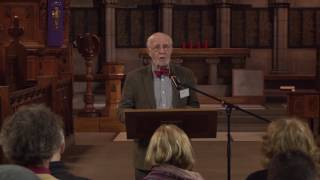
Uh, even uh it's it's really uh very kind of you to be so kind to me. And I must say at the beginning, what a great honor it is for me to be able to be here uh to lead off this series um in honor of John Connelly. uh Meister Ecart brought us together as a matter of fact a number of years ago and uh it was a very wonderful thing because we've been able to share our thoughts and discussion of Ekhart now considerably over the uh over these years and I've learned a tremendous amount from John and especially from this book that he's been working on which I think will be a major contribution uh to Eardian studies and we all hope will appear uh fairly fairly soon.
So to be able to come here to begin this series in his honor and to be able to talk about Meister Ehart really is a perfect kind of confluence of of the stars the astronomical events have made this all possible. So what I'm going to um talk about will be a an a kind of meditation and a distillation of major themes in the thought of Ecart and uh and his followers particularly with regard to the creative use of language in middle high German because Eart is the first great mystic for whom we have the two-fold linguistic uh inheritance both the learned Latin of the schools and the ancient Christian tradition and then the creative new vernacular mysticism in his case German but which was also flourishing in other linguistic camps in the 13th century. One of the things that makes Echart most fascinating for me is to work back and forth between the the German and and the Latin texts.
And I think it's you know if you're going to understand Ehart you need to be able to see both sides of him. This lecture will concentrate more on the Germanic side and the incredible creativity of Echart and and his followers in forming for better or worse the speculative German language that was inherited by theologians and philosophers for the next 700 years. The great 20th century scholar of medieval German mysticism K rule once spoke of what he called the chyros or decisive moment of the evolution of German vernacular mysticism at the end of the 13th century.
Mystical literature which for over a millennium in eastern and western Christianity had been largely confined to the sacred languages of Greek and Latin affected a rapid transition into a host of western vernaculars in the 13th century. Dutch was the earliest language to have an extensive vernacular mysticism followed by German. A more restricted literature was produced in French and provenal in the 13th and 14th centuries.
In Italian, Francis of Aises Kantigumatri Solis of 1224 be can be considered the earliest expression of mysticism in that vernacular. While in England, some of the texts of the so-called Catherine group written around 1230 are the first mystical texts in that language. It was not until the mid-4th century, however, that Italian and English became widely used for the expression of mystical teaching.
So although the timelines differ somewhat, it is clear that a decisive moment, a chyros in the evolution of Christian mysticism began shortly after 1200. The vernacular expressions of mysticism that soon became the dominant modes of attempting to communicate the incommunicable. That is to bring to speech a consciousness of the direct presence of God.
To give a brief survey of the full range of forms of mystical language in the vernacular of the late middle ages is obviously impossible. Given the significance of German language mysticism both in its inherent richness and in its influence, it may be possible to provide an overview of at least some aspects of the complexity of the language and the key themes of the major school of 14th century German mysticism that is of Meister Ehart and his followers especially Henry Suso and John Tower. Even here an adequate examination of the language of Echart and his pupils would be the task of a book or books and indeed a number of such volumes as well as a host of shorter studies already exist.
So what I'm going to try to do is to provide a distillation of what I take to be some of the most original aspects of the mystical vocabulary of Echart and his followers. Echart was not the first to put mystical teaching into medieval German. Whether or not he knew the writings of the earliest major German language mystic, Mechild of Magdabberg, he probably did.
But whether he knew them or not, she who wrote between 1250 and 1280 and is the first major vernacular German mystic, it's clear that there are many interesting comparisons between her writings and his that show affinities of metaphors, images, vocabulary, and themes. The language and themes of Ehart as well as Susso and Tower were also taken over by many other mystics directly and indirectly especially in the period from about 1300 through 1450 and sometimes even later. Many of these sermons and treatises were by fellow Dominicans but others were not.
For example, the most influential mystical preacher of the second half of the 14th century was the Franciscan Marquart of Lindow who was deeply imbued with the language and terminology of Echart but who was more than a mere repetitor. Another example can be found in the popular late 14th century treatis known as the tea Germanica written by a priest of the Tutonic Knights and also using the language of his predecessors including Echart but creating new linguistic possibilities. Nevertheless, the centrality of Echart, Suso, and Towler uh give me good reason for concentrating on these three giants of late medieval mysticism.
Two aspects of the background of the mysticism of Echart and his followers are important for understanding the character of their preaching and teaching. The first is the distinctive nature of what has been called the German Dominican school founded by Albert the Great, Albertus Tutonicus in the medieval period. And the second factor is the vernacular audience of these Dominican teachers and preachers.
In 1248, the Paris master Albert was commissioned by the Dominican order to set up a house of theological studies at Cologne. And the University of Cologne still thinks of that as the foundation period uh of their university. The establishment of this studium general as the Dominicans called it was a milestone in the history of medieval thought.
Although the achievements of the German Dominicans over the next century and and a little bit more owed much to a variety of individuals and teachers, it was Albert's intellectual initiative despite the brevity of his teaching time at Cologne really only about nine years that was a key factor in the establishment of this German Dominican school which made significant contributions to philosophy, theology and also to mysticism. The unification of theology understood as an intellectus fid with philosophy in its etmological sense of philosophia as the love of wisdom. This was the goal of the German Dominicans necessarily also included public preaching and teaching aimed at helping believers realize inner union with God.
In other words, a mystical proxis that fulfilled the Dominican vocation to hand on things attained in contemplation to others. Contemplata aliere in the medieval Latin. It's a theme in Thomas Aquinus and many other medieval Dominicans.
And this fusion of philosophy, theology and mysticism that was central to the efforts of the German Dominicans did indeed reach its acme in Echart. But it also found expression with differing emphases in his contemporaries and his followers. The second factor, the the vernacular audience.
75 years ago, Herbert Grundman first suggested that the development of German vernacular mysticism in the second half of the 13th century was shaped by what he called the new women's movement, the frown, especially found, of course, in the beggines and in the Dominican nuns. who were part of the pestal care the kurammonial of the Dominicans and since that time since Gunmmont's time a large literature has developed on the role of German female mystics like Mechild of Magdabberg Margarita Edna uh the German Dominican sisters who produce the so-called sister books the nonenka as well of course as studies of the possible influence of women on the mystical teaching of Echart Suso Tower and their contemporaries. Over the years, evaluations have differed about the validity of Grunbman's thesis.
To be sure, the audience for mystical preaching was never restricted to women. And it is possible to exaggerate the role that women had in shaping the concerns and expressions of the Dominican preachers. But there is considerable evidence to suggest that the religious women Dominicans beggings and others did play a significant role in the development of German Dominican vernacular mysticism both as audience and at times as authors.
The extent to which these German Dominicans who followed in Albert's way constitute a distinctive group with a coherent agenda is suggested by a German vernacular poem entitled the the sayings of the 12 masters me. This was probably composed by Dominican nuns and it enumerates 12 masters of mystical teaching. The poem begins by praising Meister Echart.
I'll quote you just a line or two. Meister Echart speaks of pure essence. He speaks one simple word formless in itself.
It continues number two in line is a tribute to Echart's contemporary diet of Fryberg who is perhaps the most original philosophical mind of the German Dominicans. But in the poem is singled out for his mystical teaching which unfortunately does not survive. It says Meister Dietrich speaks of self-nowledge.
He places the soul's image in its selfhood. There it knows God in his self-identity. Selfidentity Istikite.
Some of the other masters mentioned in the poem are little known and a few are even identified but the 10th of them is tower even though he never had a formal academic position. Says the tower from Strawber speaks with simplicity. He who gets bare of self and of God stands free from all activity.
this poem, other poems as well as sermons such as the collection of the 64 sermons on mystical themes known as the paradesus anime intelligencia, the paradise of the intellectual soul, which contains homalies by Echart and a variety of other preachers. These also point to a a core of figures in the first few decades of the 14th century who shared common theological and mystical concerns. So although I'll concentrate on Echartusu and Tower, there is a range of figures, some of them uh very little known, others of them just beginning to be studied, who really do constitute a mystical group among the largely among the German Dominicans at this time.
A good part of what made these German Dominicans distinctive was their effort to express deep mystical teaching within the linguistic dynamics of the rapidly developing German language. Most of them wrote both in Latin and in German. A few such as Tower uh did not.
Uh but he's the exception. Even Suso writes both in Latin and uh and in middle high German. While conscious of the danger of homogenizing a group of original thinkers, it is still possible, I hope, to point to some shared teachings and modes of expression that help us to understand the character of the German Dominican mystics of the first half of the 14th century.
A number of these theological positions and even some of the vocabulary were inherited from Albert the great especially from his interest in neoplatonic sources such as the lie de cowzies or book of causes and of course in the dianian writings on which Albert commented exh extensively during his cologne years but certainly the major creator of the new language about the soul's path to union with god was echard himself In summarizing the shared concerns of Ehart and his followers, it may be helpful at the start to distinguish between theological positions and and spiritual practices. Although doctrine and practice are always necessarily interconnected. I'll begin with the doctrine and move on to some of the uh practical themes but we have to see them as really being a part doctrinally.
The German Dominicans are noteworthy for the stress they put on the unknown and hidden nature of God. Now all Christian theologians agree that God is unknowable. But there are significant differences in how theologians express the divine mystery.
Independence on the negative or apehatic theology of neoplatonic thinkers. both pagan and Christian. Echart, Suso, and Tala and their contemporaries were creative exponents of what we might call a strong apehaticism.
A strong apotheticism is what argues that God is not only beyond all that humans can know and express, but he's also beyond all that they can unknow. Let me give you some examples. In one sermon, Echart asks, "What is the last end?
" It is the hidden darkness of the eternal divinity. It is unknown and it never was known and it never will be known. God remains there himself within himself unknown.
In the last chapter of his life of the servant, Souzo expresses a similar negativity about the modeless unity of the trinity. He describes it as the nameless nothingness itself because we can say nothing about what it is or how it is. For Tower, and I quote again, the abyss of the divine darkness is known to itself alone and unknown to all else.
Such uncompromising or strong aphaticism was not new. But what was new were the forms of language the German Dominicans created to point to the inexpressable God. As the quotations above suggest, these authors made considerable use of traditional apehatic images and metaphors that had been developed in the Dian tradition such as the hidden or divine darkness or the nameless nothingness and the like.
What was unusual, what was new in the language of the German Dominicans, however, was the emergence of a striking metaphor that became, at least for me, the focus of their apehatic on saying, and that is the term grunt ground. The middle high German grunt is both deceptively simple and astonishingly complex. At least is used by Echart, Suso, and Tower.
In middle high German, grunt can be used both in concrete or was used both in concrete and abstract ways. That is concretely as the the physical ground or the bottom of some actual object. And it had been used abstractly to describe the origin or the essence of something.
For Echart, however, Grunch signified not only the innermost of the soul, but more fundamentally the hidden depths of the God who is beyond all positive predication, even the trinitarian names of Father, Son, and Holy Spirit. And that ground, that grunt is the goal of Eart's preaching. As he put it in one sermon, all our perfection and holiness rests in this, that a person must penetrate and transcend everything created and temporal and all being and go into the ground that has no ground.
Go into the ground that has no ground. Now note that this ground without ground, the ground that has no ground, gruntlog grunt here in the German, is not specified as either the ground of the soul or the ground of God. Because what was especially daring about Echart's use of this metaphor was his insistence, as he says in many sermons, God's ground is my ground and my ground is God's ground.
or in the formulation of what I call ocular identity found in about five or six sermons. The eye with which I see God is the same eye with which God sees me. This means that in the ground there is no difference or distinction between God and the soul.
All is one. Grunt in so far as we can speak of it is not a state or condition. It's perhaps better understood as an activity of grounding.
That is the fused identity that is the source of all movement but is not itself in movement. Grunt is a term of of tactile immediacy but it's also incredibly complex as used by Echart. It creates what the Echart scholar Ysef Kint called a Mr.
Shiovotz a kind of mystical treasury or a mystical word field. It is a kind of master metaphor that helps us to concentrate echard ceaseless attempts to express the inexpressable mystery of God within a field of expressions. It can also be described in the terms of Hans Blumenberg as a a springmatafa an explosive metaphor an expression that breaks through all the accustomed forms of speaking about God and invites the hero or the reader to make a similar breakthrough in life.
Grunt then is the unccreated something in the soul but not of the soul. That cart that distinction is very important. The uncreated something in the soul and of course also a daring expression because it was these forms of expression that there's an uncreated something in the soul that were condemned as heretical in some of the articles in Pope John's bull inaugural Dominico of 1329 against Echart.
Speaking of God as Grunt created by Echart was also popular with Susso Tower and the other German preachers though he did not necessarily use the term in exactly the same ways as Echart did in Susso's little book of divine truth for example divine truth tells the disciple standin for Susso he says all this multiplicity is in its ground and foundation one simple unity I call the ground that which is the source and the origin from which the outflowings arise. That is the nature and the being of the godhead. Tower actually uses the term grunt even more uh frequently than echart over 400 times in in taller's sermons.
And in one of these he says he expresses it this way. He says, "Bring everything back into the ground from which it flowed out and do not be concerned with the nothingness of creation, but let yourself flow along with things. " Now, in attempting to express this this grounded identity between God and the soul, Echart also explored a range of metaphors, images, and neogisms to bring out diverse aspects of his thinking about the grunt.
For example, the biblical language of the abyss, the abyssus, the depth of the abyss, and biblical language about the desert, the desert of the arimum and its its vast emptiness had both enjoyed a long history in Christian discourse prior and mystical discourse prior to Echart. Although abyss had a generally negative sense in early Christianity, the abyss of sinfulness example, by the 12th century, some cistersians had begun to use abyss more positively, especially in relationship to a text from Psalm 41:8 in the Vulgate, ausum involat. And cistersians had begun to use abyss to express the soul's relationship to God.
the abyss of the soul and the abyss of God. Ehart uses the term abyss a few times but by the time of his uh student John Tower there was a rich theology of the the fused abyss as another way of talking about the ground. For example in his sermon 41er puts it this way.
He begins by quoting the Latin uh textum invocat that is the abyss draws the abyss into itself. The first abyss is the created thing that draws the unccreated into itself. And the two abysses become a single thing, a pure divine being.
So that the spirit is lost in God's spirit. That phrase a single thing is another echardian term taken over by and another way of expressing the grunt. The importance of the desert in both the old and new testaments made the empty wasteland an ideal place for leaving the self and journeying out to find God.
And as early as John Scotas Arugan in the 9th century, the desert also became a symbol signifying God himself. That is the empty no thingness of God. Ehart used desert as a synonym for ground.
to quote another sermon. The soul wants to go into the simple ground, into the quiet desert into which distinction never gazed, not the Father, nor the Son, nor the Holy Spirit. For this ground is a simple silence in itself immovable.
And by this immovability all things are moved. What is more, Echart uses desert like ground to refer both to the hiddenness of God and to the mystery of the hidden soul which he describes as an alien land. This is the soul, an alien land and a wilderness desert.
And it is more unnamed than possessing a name, more unknown than it is known. In sermon 29, Echart invites the soul desert to merge with the divine desert. The spirit must transcend all number and break through all multiplicity and it is broken through by God.
Just as he breaks through me, I break through him in return. God leads the spirit into the desert and into his own oneness where he is pure one welling up in himself. Suso uses the desert motif rarely but Echart is followed by tower in identifying ground and desert and applying desert both to the soul and to God.
example from Tower's sermon 28. He's speaking of the grunt, but he goes on to say, "The grunt, it is an utterly simple, super essential hidden desert and free darkness. The paths of sense knowledge will never discover it.
" Among the more abstract terms or neolisms that Echart created to bring out aspects of the ground, none is more fascinating than the term I used before, the famous term isticite. Scholars long associated this with the verb is and therefore translated it as is something like the toistic sense of essay but recent scholarship especially by Alessandra Beckarisi has shown that the word is actually derived from the Germanistic meaning that so that the significance of the term is more something like thatness or self-identity what makes a thing to be itself and not something uh not something else. Um although Ekart uses istik kite mostly of the hidden divine nature he also can employ it regarding the soul especially the soul as intellect because god's selfidentity god's kite is the nothingness of his intellect and this is also realized in human nature in so far as human nature is the imo day the image of god here's a difficult passage from sermon 67 the soul seizes the pure Pure absoluteness of free being that is there without being there that neither gives nor receives.
It is pure isticite that is there emptied of all being and allisticite. There the soul grasps God purely according to the grunt where he is above all being. Were there being still there, the soul would take being in being.
But there is nothing there save the one ground, the one grunt. Interestingly enough, Suso as well as eight other German mystics make use of Istikite, though rarely in as bold and daring a way as Echart. And my recent writing took me through Yanfon Rusbrook and I discovered that Rusbrook actually uses kite as well in the med medieval Dutch, although only a couple of times.
If Grunt and its cognates can be taken as what I call a master metaphor for the apehatic discourse of the German Dominicans, Eartin as follows were also creative in exploring new ways of expressing how the divine ground becomes fecked in its inner and outer life. That is both with regard to the emanation of the three persons within the trinity and in the overflow of divine goodness into creation. The famous Platonic model of flowing out and returning Exitus and Raditus had appeared in many forms in Christian theology at least since the time of origin.
But it took on new life among the German Dominicans. The very title of Mechild de Magdeberg's vernacular masterpiece suggests this the flowing light of the godhead and terms and images of dynamic movement are central to her book flowing in and out bursting rising sinking etc. Indeed, the theology of Albert and his followers has been characterized by Alend Liber as a metaphysics of flow of fluxus.
That is a view of God in the universe characterized by ceaseless action and interaction, ceaseless outpouring and and returning. This dynamic outlook provides a key for understanding how Albert and the German Dominicans constructed their theology of the inner dynamism of the Trinity as well as their description of the creative activity of the triune God overflowing into the universe. A host of metaphors of flowing, blooming, boiling, and the like were used to express the interactivity of the three persons of the Trinity and the creative relation between God and the world.
often conceived of in a dialectical fashion. That is the more that God transcends the world, the more the divine nature needs to be thought of as identical with it. Because as Eardart says, God's distinction is his indistinction and vice versa.
This linguistic creativity, the language of flowing and returning is found in both the Latin and the middle high German. In the Latin, Echart created the Latin binary paradigm of what he called bulitio and ebulitio to express the difference between the formal causality by which the trinity inwardly boils. Bulitzio in the three persons and then the effective causality creative causality in which the trinity boils over ebulitio into the created universe that therefore of course has a structure mirroring activity of the divine persons.
uh I remember teaching history of Christian thought some years ago and asking question Ehart's doctrine of creation and one particularly brilliant student what creation for uh for Echart is God overboiled which is right on in middle high German there's a rich and diverse field of verbs and nouns signifying this emanative activity found in Echart Suzo and in Taller and I just point to them a whole paper could be written about the variety of that particular form of language. As with other theologians influenced by Dianius, the German Dominicans saw the universe as a theophony or a manifestation of God. From this viewpoint, all things pre-exist in the divine mind.
That is, they have a virtual existence. The Latin here is essay in vert. A virtual existence that is the source and paradigm for their actual existence as created things.
their essay in octu this dual existence is found in a special way in humans who as the only creatures made to God's image and likeness not only exist in two levels but also on the higher level are identically one with God because on that higher level the bare being of the spirit as Echart puts it is placed in the bare being of God for example Echart can speak of the part of the image of the soul by which a person is like God and not according to the part in which he is being created. The notion of humanity is made to God's image had of course again central to theological anthropology for more than a millennium before Albert and his followers as was the emphasis on the fact that the image character resided in human rationality the ability of humans to think and choose between good and evil. But the German Dominicans beginning with Albert found also in Dietrich Fryberg and especially in Echart provided new ways of understanding this this theological paradigm.
Naming God as fersticite or intelle understanding highest form of understanding signifies that God is no thing. That is the God who is capable of thinking and creating all things all particular forms of being is not any one of them is not any thing at all. And if humans are truly God's image, this is because human nature is also fundamentally a capacity for knowing that is one with a divine understanding identical with the divine understanding on the level of virtual existence although not of course on the level of actual existence.
Echart expresses this in many ways. Again, I cite just from one sermon. He says, "The intellect looks within and breaks through into every hidden cranny of the Godhead.
It takes hold of the son and the father's heart and in the ground and places him in its own ground. Just as the divine ground obgrunt or abrant abyss in one sense lies deeper than the trinity of persons so too in human beings the soul's ground or abyss is beyond the powers of knowing and loving existing in a modeless nameless silent oneness with the divine ground a union of of indistinction now the intellectualism of the German Dominicans which I've stressed here doesn't mean that love is left out of the picture. Suso ranks among the masters of love, mysticism, minimiststique, a late medieval period and the place of love in the thought of echart and taller is important though often misunderstood.
But I want to turn in these last pages to from doctrine more or less more to issues of of practice and practice. A similar pattern of diversity and unity is expressed in these theological expressed in these theological themes is also found in the teaching of the three Dominicans concerning the spiritual practices needed to gain awareness of our identity with God. Here again the German Dominicans developed a rich new vernacular vocabulary that I can only point to here.
A set of common concerns is evident throughout their writings especially in their stress on the necessity for five fundamental practices which I'll just briefly uh talk about. The first is interiorization or turning within. The second is total detachment and releasement from everything created abashidenheight and galassenheight.
The third is attaining inner poverty in vendigu arm as ekart puts it in a famous sermon. The fourth is realizing the birth of the word in the soul as a participation in the inner life of the trinity. And finally the fifth is the breaking through the dur breen into the nameless oneness of the divine grunt which is not other of course than the grunt of the soul.
First interiorization again was a basic theme in Christian mysticism at least from the time of Augustine. In this sense the German Dominicans were not so much providing a new teaching as creating a new vocabulary for the language of interiorization and turning within. The range of expressions for this is is quite wide.
But especially interesting here is the case of John Tower who speaks of the highest stage of mystical consciousness as what he called an essential turn a vas an essential turn into the ground of the soul in one of his uh mystical itineraries his three-fold itineraries concludes with this statement he says the third stage high stage the third stage is a lifting up into a godlike being in oneness of the created spirit with the very spirit of God which we can call an essential turn and it's very similar interiorization language and in Echart and uh and Suso. Secondly, the notion of detachment giving up all things for the sake of the kingdom of God. It is of course scriptural in origin and also deeply rooted in the Christian tradition.
What Eckard and his followers did with detachment however was new. The fundamental root of sin for Echart Susso and Tower is false attachment. Attachment to our own particularity, our ownness, our ien shaft.
And it's this attachment that prevents us from becoming free and open to God. So the cure for this attachment, false attachment is detachment. Abashidenheight literally cutting away.
Uh Dennis Turner in his book the darkness of God expresses this I think very well as the aesthetic practice of the apehatic the aesthetic practice of the apehatic and it's not a particular moral practice is a fundamental life attitude eardian detachment the language Eart uses about detachment is deliberately designed to subvert the traditional hierarchy of Christian virtues constantly talks about detachment and in the famous treatise on detachment which is possibly by a close student of Ekart or possibly by Ekart. But this famous treatise on detachment praises such cutting away of all possessiveness as higher than humility, higher than charity, higher than mercifulness. Detachment is higher than love.
The treatise says because the best thing about love is that it compels me to love God. Yet detachment compels God to love me. Detachment compels God to love me as a radical reorientation of life realized through the awareness of the nothingness of all creation.
Detachment achieves the no thingness of the ground. When detachment, I quote again from the treatise, when detachment ascends to the highest place, it knows nothing of knowing and loves nothing of loving and from light it becomes dark. Echart also often spoke about galassin height, letting go, releasing, very much equivalent of detachment.
And Galassenheight becomes an even more popular term with Suso and and Tower. Um, Echart speaks more daringly. Once again, I he speaks of letting go of God and I don't find that language in um in Taler and Suso, but you find very strong language.
I quote here from the end of Susso's life of the servant where divine wisdom says speaking of galassin height a releasement above all releasement is to be released in releasement. You can see why you got to like these people. Thirdly, the desire to practice apostolic poverty following the model of Jesus and the apostles was a key feature of the spiritual life of the late middle ages beginning in the 12th century.
Debates over the nature and practice of poverty, especially involving the Franciscan order, were frequent in the late 13th and early 14th centuries and uh uh certainly part of the spiritual world within within which Ehart lived. But Echart's radical notion of inner poverty is again daring and new, especially as set forth in what has been called his his poverty sermon, the sermon 52 of the German sermons. sermon that has probably been analyzed and discussed and read almost more than any of the other Echart sermons.
In its Latin version, it was translated into Latin. It was very widely read and there was a Dutch version which was criticized by Rusbrook and his followers but used by later Dutch mystical writers especially in the mystical Renaissance of the early 16th century in the Eastern Netherlands. The sermon probes the meaning of the biatitude from Matthew 5'8.
Blessed are the poor in spirit, for they shall see God. And this inner poverty, the poor in spirit, allows Ekar to bypass debates about outer poverty, says no, I'm not interested in that. And home in on the inner poverty that he analyzes in a typically uncompromising way as wanting nothing, knowing nothing, having nothing.
A detailed study of this sermon as well as the many other places where Eko and his followers talk about true inner poverty shows that the theme of poverty provided another semantic field within which the Dominicans could bring to speech the deepest aspects of their teaching about mystical transformation. Fourth, the language of birthing or being born into God based on the baptism that begins the new life of the Christian was again a theme that had been richly developed by in the Petristic period and was later used by the 12th century cisters. But around 1300 there was a revival of interest in the idea of being born of God.
It's evident especially in the emergence of this theme in Ehart's preaching but it's also reflected in the contemporary treatment of true and false understandings of birthing uh in the writings of Ehart's contemporary the Austinian Henry of Fremont. Echart's willingness to use daring formulations about the birth of the word in the soul was another aspect of his mystical language that troubled the inquisitors as well as Pope John the 22nd who condemned several of such passages about birthing in the bull inaugural Dominico. I'll read you just one of them.
This is a famous text taken from sermon six of Ehart. The text states, "The father gives birth to me, his son, and the same son. Everything that God performs is one.
Therefore, he gives birth to me, his son, birth without any distinction. " That's condemned as heretical. The mystical birth theme occurs in Echart's followers and in other German mystical writings of the 14th century, but no one used it as often as Echart or delighted as much in teasing out its daring implications.
And there's a very large literature on the birthing theme in Echart and he almost always uses the notion of birthing in the verbal forms and not as a noun. uh gibort um later on the noun forms are become more common in his followers and that's true of the final and last point that I want to make breaking through I found it interesting in reading echart over the years that echart never uses durb breakthrough as a noun he always uses duren breaking through as an activity so the language of breaking through that is going beyond the god of creation to the paradoxical place where a person's is as free of his own created will as he was when he did not exist is found in the famous poverty sermon and a number of other places in Echart's preaching. Breaking through implies a decreation, an annihilation of the self and more surprisingly a similar death and disappearance of God.
Some of Echart's most challenging sermons take up this unusual language, especially sermon 52. But let me use as an example sermon 109 which is based on the distinction often used in the middle high German sermons between God and the godhead. In this sermon Eart says that as long as he was in the ground, the depth, the flood and the source of the Godhead, it was not possible for anyone to address any questions to him or for him to respond.
This is because while God acts, the Godhead does not act. Therefore, the Godhead becomes God in flowing out into creation. The Godhead becomes God in flowing out into creation.
But God unbecomes. Ent is the verb here. God unbecomes when the mystic is not content with returning to the God who acts but achieves a breaking through into the silent unmoving godhead.
He summarizes in the sermon in this way. When I enter the ground, the bottom, the flood, and the source of the godhead, no one asks me where I have come from or where I have been. There no one misses me.
There God unbecomes. Suso and Taller also make use of the language of breaking through to a level of indistinction to God, but more sparingly. Given Ehart's condemnation as well as their own struggles against mystical heretics who had misread Ehart in the service of their own errors, Suzu and Talor quietly corrected Ehart by insisting that in the final stage of breaking through to the Godhead, though all consciousness or perception of distinction is lost, we do not lose the essential difference between creator and creature.
For example, in discussing true and false releasement in chapter 48 of the life of the servant, Suso puts it this way. Annihilation of spirit with its we withdrawal into the simple godhead is not to be understood as a changing of our own created nature or what we are into the same thing that God is. [clears throat] To summarize in one paragraph, the theology of Meister Echart and his followers, especially Suso and Tower, the great Dominican teachers of the generation after Eart, marks one of the sermons of medi summits of medieval mysticism.
Even a brief survey of some aspects of their language and message demonstrates that this was indeed in Kru's term the Chairos era of German vernacular mysticism. The character of this decisive time also invites reflection on the impossible necessity of speaking about or framing in human words the inexpressable and incommunicable consciousness of God's presence. That is for me the essence of mysticism.
In the case of the great mystics, all language negative as well as positive sinks and drowns under the weight of the task that it is taken on. The mystics of course make use of both positive and negative language cataphatic and apehatic with the mystics who stress the apehatic more than the cataphhatic that is those mystics who dazzle us with their intricate experiments in on saying god such as eartusu and talor the failure of language is perhaps more immediately obvious but the limits of language are no less real with those mystics like Bernard of Clairvo whose rhetorical skills allow them to create sonorous and splendid evocations of the glory of the divine nature. I have a quotation here from Hans Vonbaltazar who once said that the theologian I think especially the mystic theologian quote can clothe the mystery of God in the drapery of a fine style either as an act of homage or as often with Bernard of Clairvo in an attempt to preserve it by veiling it.
The recognition of the failure of language is not only a lesson in humility, but it's also, I think, the beginning of true wisdom. It's not a sign of defeat, but it's a spur to new effort. As one of the premier apehatic thinkers of the past century, Samuel Beckett once put it, "Try, fail.
Try again, fail better. " Thank you. [applause] Thank you guys.