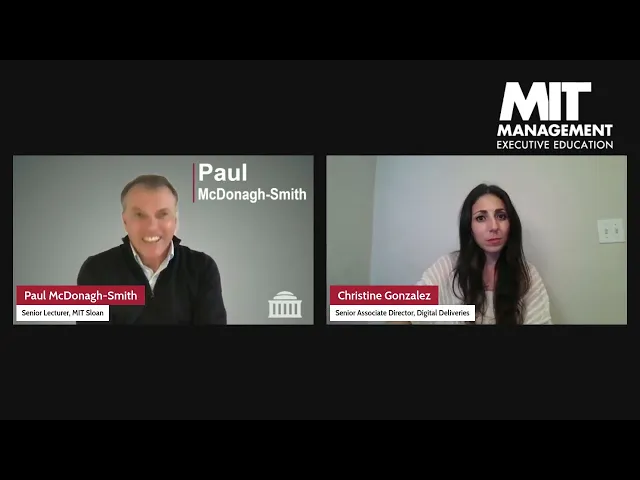
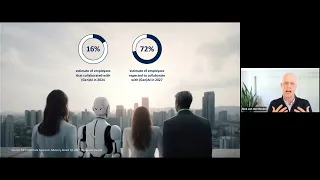
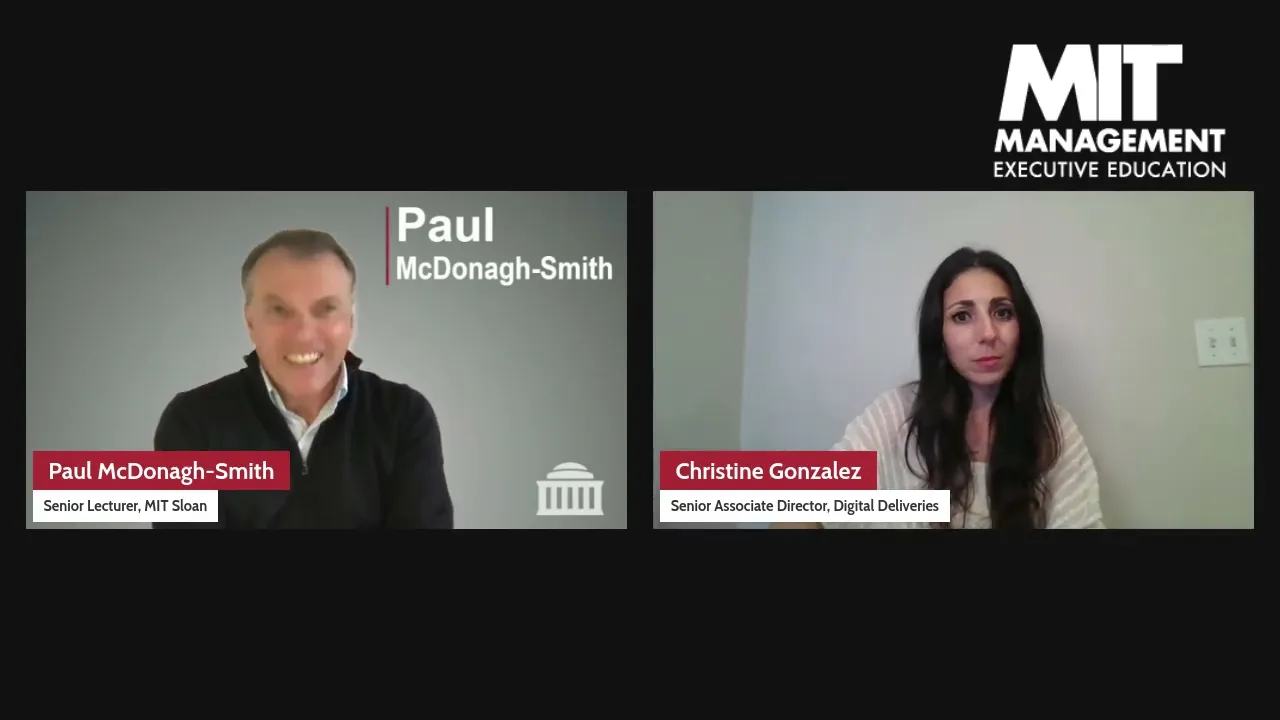
Hi everyone I'm so excited to be here today with all of you and of course our speaker of the day Paul McDonna Smith to talk about Frameworks for capitalizing AI I'm Christine Gonzalez senior associate director of digital deliveries at MIT loan Executive Education and some of you may be familiar with MIT loan exec Ed but in case you aren't Executive Education at MIT offers a wide range of non-degree courses across various Business topics and cuttingedge content coming from MIT faculty Paul McDonna Smith who we have here with us today is a senior lecturer in Information
Technology at the MIT slone School of Management and he teaches in multiple programs in Executive Education and elsewhere at MIT Paul creates key intersection points between technology and business and his many programs in exeed range from AI to Virtual Technology to metaverse Technologies Paul and I have worked together for over a decade on various digital experiments and initiatives and I'm really excited to be talking to him today about this topic so Paul without further Ado I'm happy to hand it over to you to get us started well thank you thank you Christine um as as
you say we've been working together for over a decade now so it's lovely to kind of now today have this conversation to talk about different types of Frameworks and Different types of approaches that will allow us and enable us all to unlock more of the potential of artificial intelligence and the suite of Technologies and techniques that actually sit within its Continuum as well so everybody um some of you out there I'm sure we've kind of crossed paths before so thank you for coming back to to listen to us today for those of you that I
haven't met before um it's a pleasure to have the opportunity to Speak with you and spend this spend this time with you as well so just a tiny little bit about myself um I wear two hats here at MIT Sloan um the first of which kind of Christine kind of uh introduced as a senior lecture in the it and kind of exeed kind of uh groups the the second hat I wear is that of digital capability leader where Christine and I kind of and our digital team work on strengthening maintaining growing uh a portfolio of
digital programs Experimenting with a series of Technologies and business models in in fact to get more from the portfolio and get more from the work that we're doing with digital technology and and also work together with uh colleagues across the institute on questions pertaining to digital strategy and that that that aspect of experimentation of exploration is going to be key to today's discussion um it's also compounded by the other thing that That that I do as well I'm an adviser to NASA Godard working under the supervision of Dr Jim B Garin who kind of leads
up the the Venus work the D Vinci plus mission for 2028 to 29 uh I'm I kind of help out a little bit on that and also help out on something called The Discovery program which again is around business model Innovation so as we go through today's session uh please excuse me or kind of don't be too surprised if every now and then there's A weaving in of some considerations of business model as well as technology driven Innovation so thank thank you lovely to be with you all here today So Christine do you have any
questions for me sure all right let's Jump Right In so um we recently launched the leading uh the AI driven organization course can you share a little bit about the aims the objectives the outputs um of that course with us what what are the Takeaways there yeah but I'll be super pleased to to do that I'll just take a few minutes because there's so many other things that we want to get into as as well so in in in lots of ways I'd probably kind of characterize the leading the AI driven organization uh program as
a five act play so we have five days so it kind of neatly fits that that kind of metaphor and each day we really have a series of sessions that that really look to to push home some Key learning some key insights on particular areas that day one really is all about getting to know Ai and and that's kind of interesting because it's not simply a case of all of the definitions it's also around the differences you know we we have have the Deans of MIT Sloan School of Management and of MIT schwarzman College of
computing kick the proceedings off and and and then we actually kind of begin to explore we pull the curtain back on The Technologies and the techniques themselves recognize the patterns that kind of pull them together in that type of a Continuum but also identify the things that make them different and unique uh within their families so we we start with that then we get into focusing on the business impact uh that's act two Act three is around optimization of applications of AI and its family members machine learning deep learning um generative AI all all of
These on a pathway to artificial general intelligence before in act four we we focus on the human elements of course as you all know working in your organizations it's nigh on Impossible and at the very least kind of perhaps not not very wise to be looking at these Technologies in isolation Okay it's very much a human Centric type of approach that's that's required if we want to unlock the potential and then we finish up in the Fifth Act by talking about the Trajectory of AI so where we are today into where we are reasonably moving
towards in the very near future so in in essence I suppose that that the program is focused on giving us all a suitcase Marvin Minsky in his book the emotion machine uh talks about AI point in the term suitcase word for explaining those types of terms or technology Oles that escape easy or singular types of definition and we think Ai and Marvin Minsky did so if it's good enough for Him to think that we will kind of give it a shot as well um we we think it's a suitcase term so we we take that
metaphor through the program and and really with the participants and all the participants working together as well it's a very very Hands-On type of program we actually pack a suitcase a suitcase of Frameworks of cultural kind of elements so we can activate the right type of mindset in our organization and also aspects of a digital language So there's lots um Lots gets packed into the program and ultimately um perhaps if if if I would try to recognize one kind of consistent pattern it's that of consilience so we we we try to consilience the the the
concept of unity and unification we try to help those in in the class unify the way they're organization was previously or prior to AI being such an important kind of element to the way it will be here in the present and moving forward so we UniFi the aspects of the workforce aspects of the strategy aspects of the considerations around their relationship with data and lot lot lots of other kind of elements as well so that they have an opportunity to kind of create um here in the presence an organization that can be AI forward Christine
that's great Paul so I think um a lot of us would be curious to know everyone is kind of running towards gen Ai and applications of AI and um you Know how do those outputs relate in your opinion you know what do you think how do those outputs really relate to the way in which you're seeing Ai and gen AI being applied effectively today in business yeah I think the first point I would make is um it's it's not strictly speaking kind of of course that the way that I all that I see it but
perhaps the insights I'll share come from the conversations um we fortunate to have uh within the MIT ecosystem and those Clients and those those those kind of organizations that we we visit and spend spend time with as well so I I'll share some perspectives and what what I should say of course is um in a sense I'm preaching to the converted because everything I say here in this context all of you kind of out there or here with us we we'll have your perspectives we'll have your realities and and so I'm very very aware of
the danger of trying to put forward a standardized view when Really there is a great deal of personalization you will have your own realities and you'll be packing your own suitcase with kind of the things that you need for the journeys that you need to go on in order to enable the effectiveness and the sustainability of of of your organizations also um ju just something I should have said at the very beginning in terms of the actual flow of this experience here today with Christine and I um I I'll probably be Talking for somewhere close
we'll be discussing these points for maybe 40 minutes or so and so that'll leave us a good chunk of time for the last 15 or 20 minutes for questions so if as we go through this experience if you want to kind of start putting your questions um into the chat box Christine will kind of start to moderate them and pick pick the easy ones for me or kind of pick the difficult ones let let's see which way that goes and we'll have time at the end To to to ask questions so um of I think
I can remember the question now Christine around the um the outputs um from the Lai leading the AI driven organization I think I'd be wise here to kind of lean on one of my colleagues uh Rama ramach Krishna um who I've heard on a few occasions recently talking about um a three-step process when it comes to the application of generative AI uh the the three steps and uh Rama if you're kind of listening in I apologize for Kind of not speaking as eloquently and articulately as as you do all of this but the the first
step of the process being to actually look at a job or a workflow in terms of its constituent tasks okay so a number of us sitting here today will have uh applied for a job and kind of read a job description a role description and you know there were all those maybe 10 or 15 bullet points um thinking a tiny bit in that type of way but but also taking a Couple of steps back from the role just in your own mind in your mind mind's ey everybody just just think for a moment if you
were tasked to look at the constituent activities within your role what what would it actually look like and the point that Rama makes is that allows us then to actually consider whether each task can be done safely with generative Ai and if it can be done safely with generative AI he he almost implores or suggests that we move Forward and build and launch a pilot of sorts that allows us to collect data and kind of get insights that we can actually and move forward with in our organizations and so I suppose again to kind of
lean on on on Rama's kind of insights there are probably within those three steps three questions as as well the first question being okay um let's ask ourselves what's the cost of using generative AI for a particular task or set of tasks in our Organizations secondly um what's the cost of potentially detecting errors well not potenti of detecting the errors and the mishaps um and thirdly is the cost of a Miss acceptable and and and the reason I really hone in on this third one as well is because if a cost if the cost of
a Miss is unacceptable when well really we're going to have to think whether that's the right type of task or activity to be launching a pilot upon okay we a number of us will have Seen I think it was back in February but we could we could look at any any kind of newspaper in any country On Any Given Sunday yeah and kind of see a similar example of the Air Canada case where Air Canada blamed the chatbot for giving kind of poorly uh expressed information to to to their customers um so in that case
the Miss turned into a very a very precarious and very dangerous kind of PR kind of um debacle and and so really very important for us to think about Those three points the cost of using generative AI the cost of uh defining and caping catching any issues and then really the risk associated to actually moving forward with the use of generative a AI in those tasks and so as as I think about taking that step further as we think about well okay where is the cost of a Miss acceptable perhaps it explains why we've seen
over the last 12 to 15 months uh great uptake of generative AI in those knowledge work Tasks s where you have a human in the loop or you have reinforcement learning from Human feedback or where really if if there is an error it's not going to be so problematic and so what we've seen kind of we've seen from a starting point of um using generative Ai and large language models to to actually help us write simple programs for Creative artistic type of work uh largely in written content so you know HR in job descriptions uh
performance reviews from An e-commerce perspective uh product descriptions um a number of chat bots of of course sales and marketing types of materials but or and as we move forward we're of course going to see AI automating but but but also assisting and augmenting our knowledge work in a number of broader areas as the context Windows uh get get larger as the capabil ities develop as the actual models themselves become um less inclined to hallucinatory types of activities then We're likely to see decisions being made around well okay the cost of a Miss is acceptable
or there are activities we can take that allows us to kind of uh catch the the the error before we actually get to that stage and so as as I think really about the a they leading the AI uh driven organiz a program that's that's a a key element of what we're trying to do I suppose is and in fact with all of the programs that we have in our suite of AI uh kind of Offerings is is to really give people the capability and the confidence to be able to move forwards to be able
to understand key elements and key principles around these these Technologies but to be able to put them to work in our organizations so uh I heard Christine say at the beginning around Frameworks to capitalize on kind of AI in our organizations well the types of Frameworks that that we would put forward in in that type of case is Something like um the double helix U model that that we talk about in in the program where we're actually unifying um the physical and the digital worlds that we all operate in but if you think about a
twisted ladder type of structure what we're suggesting is that the actual rungs of the ladder are actually human Centric genes so the role that creativ curiosity collaboration critical thinking um consilience even play in enabling us to actually get the most From Ai and our organizations but but of course it's not simply a question of Frameworks there there also that cultural element you know where we move from a command and control set of approaches past accelerating past ones that are kind of formulated on collaboration and cultivation to to exploring and engaging approaches and a big a
big point uh in this regard as well around how we actually get value uh from AI in our organizations is Understanding the role of language um Nome Chomsky um has stated on a number of occasions that the principal function of language is not to communicate but rather to link interfaces and we think that's kind of a nice way of thinking about the recalibration of the human and machine Partnerships as we move further and further into this era of AI and generative AI yeah that's really interesting Paul um you kind of talked through a little bit
About like some key steps that Business Leaders can take uh but what guidelines or best practices can organizations follow to ensure they're using gen responsibly and ethically that's that's you know I think that's the question at hand for a lot of folks so it's it's it's very interesting isn't it I mean if we just think take take a step back you know like um almost like those pointer list artists when when you stand in front of a Mosaic it's really hard to Make out the the picture isn't it kind of it's hard to tell what
you have in front of you you're standing up too close to it so I invite you kind of figuratively you know don't want you to kind of fall off uh fall fall off your chair or anything but take a few steps back from this whole kind of discussion or debate about Ai and think about the way that you're working with AI today think about kind of the last meeting or two or conversations or discussions You've had could be in the corridors could be in meeting rooms could be on Zoom types of calls um who was
in the room um what what team of teams are you actually building around Ai and generative AI um what diversity what breadth of opinions are you bringing to the table because you know we we would probably argue I think it's a reasonable argument to make that AI generative AI are part of a a general purpose technology of of of of AI and machine Intelligence that's permeating all aspects of our organizations of society more broadly and and so when we find ourselves in in in that case really everything is going to be impacted in one shape
or form by by kind of the um the developments in the AI area and so acting responsibly acting uh ethically acting with a sense of fairness is going to become very important and it's going to become very important not just to try to counter some of the challenges that Generative Ai and AI provide for example inaccuracies irrelevance of of kind of outputs uh bias although of course bias is in the eye of the beholder not only the model but toxicity questions of of kind of offensiveness of hallucinations Etc so yeah of course we we all
want to counter those or turn the gas down on on on those and I I think to do so we we need to accept the responsibility that we have in our organizations and maybe if I just super quickly kind of Christine share four four or five kind of um practices that I think it useful F firstly and and these are based on the conversations been having with organizations across a broad range of Industries over over the last couple of years F firstly I I would say um ensure that you're working towards leadership alignment okay so
we we often depending on your industry might be more pronounced than than others but I think most of us will have kind of grown up or Experienced um I don't like the word silos but definitely functional kind of groupings within our organizations e even at the um the cxo types of types of levels and I think for CEOs and leaders and and the board Boards of of companies it's incredibly important important today and moving forward that we actually align our leadership around an AI Vision that that reflects the responsibilities of the organization as it stands
today but but also the Responsibilities that they want to take on board as they move forward with their future Visions um also addressing human factors that the second point I would say um addressing human factors from the get-go from the very beginning and by this I mean things including the workforce TR transparency with the workforce to allay their fears to actually spell out the realities of of certain situations yes um not should say no not not all jobs will will kind of Continue in their current shape And format um given the growing capabilities and developments
in nii um history although it's it's difficult to kind of lean too heavily on history when you're talking about kind of human impacts okay it's it's not very consoling for those that do lose the jobs the fact that previous technology revolutions have told us that we always create new jobs and new opportunities what we need to be doing is is kind of helping people today With the roles and the responsibilities they have so we can either um help them with their skill sets and and and training but but also help ourselves to understand what's the
reality of the workforce that we're actually sculpting moving moving forward I I think also it's based on the conversations I have with so many clients and customers um is how important it is to actually build a governance framework um to to not not just to build a governance framework but Also to go a step further perhaps where where I've seen governance Frameworks work very well or relatively well is is where they've had a focal point of leadership so somebody or a particular group and somebody in particular kind of taking accountability have actually been tasked with
kind of spinning this up and bootstrapping it and kind of get getting it kind of up and running and that in itself actually feeds into what what I think a very important kind of um Opportunity around creating sharable content reusable content that explains what the company's vision for AI actually is and where it's where it sits today against that Vision what it's doing and making sure that everybody in the organization that these materials and assets are provided in a way that everybody can understand or different groups can understand and can actually reuse them in their
own internal and perhaps even external Communications so codifying best practice into your platforms I think is incredibly important as we as we move forward so hope hopefully there's some interesting ideas or interesting Frameworks in there Christine yeah certainly there certainly are so Paul pivoting slightly your work in research covers a range of disruptive Technologies um AI ml AR VR how can businesses harnessed these Technologies to convert challenges into opportunities For sustainable growth well I I think um there are a number of tools and techniques that we can take advantage of and again um I'm kind
of beseeching you kind of imploring you to kind of take a couple steps back from kind of the the picture and kind of just to see the colors and the Contours a bit more clearly uh one of the things I'm I'm sure most of you have kind of gathered um from your interactions with MIT is that we we we tend to spend quite A bit of time for formulating and framing the the problems before we kind of pres go and we we tend to look at problems through different lenses we tend to look at um
different types of data sets and and kind of patterns Ju Just to apply different lenses and prisms to help us understand help us ensure that we're actually framing the problem the right way before we press go and start kind of you know rocketing off kind of doing a a lot of work and some Of the techniques techniques and approaches I I think U are very useful today include include kind of recognizing or using tools such as Paradox and dualities to to our advantage this might seem a bit abstract so so let me kind of try
to be clear and explain kind of more in in a better way so Paradox um I think is a very very underrated kind of tool when we find ourselves in challenging kind of new situations um we Can we can kind of rely on Paradox to kind of allow us to look at things from different perspectives so for example when we think about the recalibration of human and machine capabilities Partnerships how we work together how we interact together in our organizations and outside of them um I think we we kind of have an inclination to kind
of think back to maybe something like morex Paradox which kind of tells us that Often times you know what what's what's incredibly difficult for humans can be easier for machines and vice versa you know to to build a robotic unit that has the sensory motor or perceptor skills of a six-month-old human toddler would be or is still incredibly difficult um whilst on the other side of the of the coin that there are so many things in terms of the the kind of pattern recognition capability of AI technologies that humans can just not Get anywhere any
where near so moravec kind of paradox helps us kind of create a sense or an appreciation of what humans and machines might be doing in terms of tasks and of course the lines of blurring because of the the power of AI today and into tomorrow but also palan's Paradox which in a nutshell says that as humans we know more than we can tell really hinting at this kind of and in fact the the panu Paradox takes takes his name from a paper by mit's David out The economist incredible kind of U researcher and kind of
incredible insights but pang's Paradox of as humans we know more than we can tell really gets to the the nub of this question of the difference between explicit and tacit knowledge okay and what we're seeing of course with developments in Ai and generative AI models is that some of the some of the capabilities or the distinction between what was a human type of activity and what was a machine Type activity are kind of changing the the are shifting beneath our feet on this type of stuff to such a degree that I think we need to
take into consideration a third Paradox one one that we we call in my work on algorithmic business thinking we call the potentiality Paradox which really Builds on this idea of the uh the Double Helix of of kind of the human Centric genes and suggests that if you were to think about these disruptive Technologies whether it be AI um AI machine learning extended reality virtual reality augmented reality compute cloud and any of these any of these types of disruptive Technologies think of them as a New York kind of skyscraper and we would say that the potentiality
of these Technologies maybe resides on the 85th floor but in all honesty where does the actual ux or the way that you're building these Technologies into your organizations Actually sit today if we were to be honest it's probably 20th 25th 30th type of floor there's a lot of scope to kind of get closer and harness more of the potentialities the argument being that if we want to create this elevator from the 30th floor to the 85th we're going to have to focus on empowering our our kind of employees and our Workforce creativity is going to
be key curiosity giving people permission to experiment to explore not always to get the results That might have been expected but always to learn from those results to do the very next thing as as well so the potential reality Paradox relies on human Centric capabilities in order to realize the capabilities of the Technologies we have at our disposal then the the dualities I I think that there are lots of kind of very interesting dualities with um with Technology Innovation and the technologies that we have um with us Today and and will have into tomorrow as
well the first one um you know you've heard me say of you've heard me comment upon AI as being a general purpose Tech technology I I would I might even go as far as to suggest that we're actually living through in Steph J Gan terms a punctuated equilibria where these Technologies are actually disrupting the status quo in a way that means the things that made us successful over the last five years are not going to be the Things that make us successful over the next five so what what are we to do and I think
the the the kind of idea of borrowing or leaning on the the metaphor of punctuated equilibrium from Stephen J gold and biological evolution actually links into Technology Innovation and into organizational Innovation and invention as well but what I mean by this is that there's a certain relationship um where fundamentally Simplicity creates complexity and please Stick stick with me for a second on on this while I try and explain what I mean so it's very interesting to me from a a biological or EV evolutionary kind of perspective that we we we know how it works yeah
we we kind of have mutations genes kind of develop those that survive um get absorbed into the into the organism and we move forward in that particular way of natural selection um but it's in what what I find particularly kind of interesting is well The actual algorithm or the the the actual rules are pretty simple but over a period of time them being replayed and replayed and replayed and replayed put pushes or transform the complexity from the actual organism into the model and kind of we develop in that particular way and I think we're seeing
something similar with AI as as well where as we look at the transition from AI into machine learning into deep learning um what we what we actually kind of have Visibility of are are simple rules that kind of played out with um with with neural Nets and deeper neural Nets and kind of other techniques as well actually allows a great deal of complexity to be pushed into the model but the actual outputs continue to improve well and the outputs continue to improve and so it leads me to think that kind of in our organizations we
would be well served to to kind of think about this this duality of simp Simplicity Creating complex complex kind of outcomes and think about the simple rules the four or five simple rules in our organizations that could ALS almost act as our kind of code of uh natural selection what are the simple algorithms that we can keep applying so that we can move forward and and and one of them it's it's another Duality is that of actually this time I'm borrowing on the work of Daniel Daniel Carman you know thinking fast and Slow almost having
a fast and slow Enterprise AI strategy so over the last 12 to 18 months all of us here will have experimented with proof of Concepts and pilots and that that that's great isn't it in the short term doing those experiments running those experiments so we collect data and what I'm getting at here is how does that data then inform the longer term or the slower kind of Enterprise strategy for the next 15 to 18 to 21 to 24 months so there's an Interesting Duality there and I think all of us would be well served to
consider how we might operate a a dual kind of Enterprise strategy in our organizations and and of course U the last example I'd give Chris Christine around this is the duality of of kind of humans and machines themselves working together so we know that humans and machines work effectively we you know humans have used technology as a tool for for for the longest time but how do We actually fine-tune this and recalibrate it in our organizations so that we're developing trust that we're actually developing the confidence so that we actually know which of those tasks
and activities can be better served by the machine than the human or vice versa and what's the process I I I often think when I when I play around with chat GPT uh and and kind of large language models that ultimately the the brainstorming that I do for example at The beginning of a of a project with with those types of tools can can take me sometimes as far as 80% to towards an answer but then we're left with this almost Last Mile engineering question and I think for all of us here this last mile
engineer ering is super important as we think how we're going to use AI generative AI or in fact any of those other Technologies XR or Cloud computes Etc that you talked about Christine yeah that last mile Engineering is a really good uh way to express that um that's very articulate Paul it makes I think it resonates with a lot of people um we're getting a lot of buzz in the chat which is great thank you for your questions Paul if I'd like to take a pause and kind of um answer or address some of the
things that some of the themes that we're seeing being raised in the chat um so there's a lot of um there's a lot going on around governance and standardization towards Regulations on geni can you share some insights on that topic yeah so so again there are a number of different lenses and prisms that we we we might look through here I'm going to pick a couple um Ju Just to be concise um I I think guard rails and guidelines are going to be incredibly important as they were in all of the other technology revolutions or
Evolutions that we have kind of lived through um you know we're living in a in A Time Time of Wonder aren't we really where um the the world of bits and bites has kind of been bridged with the worlds of atoms and molecules um and that that gives us a lot of a lot of kind of potentialities but how are we going to grow grow how are we going to build the foundations of our society of our organizations of our interactions in in in a way that that foundation will actually kind of allow us to
build high and to build strong and so I think you Know spent a lot of time over the last months looking at the various various outputs from the world economic Forum from the European Union of course in in the US as well around different bills and different acts that kind of look look at this and some of the common themes that that they actually see I suppose are actually around almost hyper collaboration okay I I think what what we're seeing uh what We're going to see is no one organization and kind of we can maybe
come back and look at this in a year's time you know it's it's very unwise to get into predictions and all the rest of it but I suspect that um no one organization or no one country necess necessarily is going to be able to find all of the answers um but we have some very pressing questions and problems whether it be the sustainability of our organizations whether it be transport Poverty War climate you know maybe that should have come close closer to the top of the list um that they're all very complex problems and so
in order with AI and fueled and armed and kind of shouldn't use that word of course um enabled by AI we we have the potentiality to actually make massive inroads to all of those problems and move towards Solutions but we can only do so if we're prepared to collaborate and work together so I think some of the Points I made earlier are very important here as well Christina around actually setting up governance boards actually setting up teams of teams in our organizations that cover all the bases that going to be impacted by AI so that
could be for example obviously the technology kind of people in our organiz gation and Technology groups but but also the the HR the finance the legal the marketing functional representation pretty much from everybody and perhaps Even thinking about some of the ethicist or philosopher or social science kind of elements as well is going to be very important for us so Beginning by setting up our own governance boards working then with others in our Industries and across Industries to understand the best practices so we can potentially put forward a series or create a series of shared
kind of positions that will lead into standards and protocols for the way that we work with these Technologies can Can I just say something very very quickly um a year or so ago that there was that letter wasn't there signed by 1300 kind of um ai ai kind of leaders and research scientists etc etc I I don't think that was truly an effort necessarily to pause the development work on AI but really a sh cross the bows to to actually say look we're going to have to take this very seriously and we're going to have
to come together and work together on on this and I think we We can all see the potentialities of AI we need to mitigate the risks where we can but but the only way to do this is going to be with a sense of hyper collaboration where we come together and work together that's great Paul do you have any insights to share on those industries that kind of lag behind a little bit are a little more traditional or slow uh to kind of adapt and um kind of take on some of these Technologies Yes so
I think you know even even as I kind of think about this before I even say kind of a beatitude Kind brings to mind you know that the meek will inherit the earth yeah that I don't think um I don't think there is a single industry or organization that won't be um or can't be positively impacted with AI or or negatively impacted for that matter two sides of a coin um and there isn't any leadership team that can't become Incredibly proficient at navigating the Waters of of AI I think there are certain industries that probably
have a head start yeah because um what we've seen over the last year from a research perspective shows that almost almost kind of a double kind of um Effectiveness or kind of increase in productivity from industries that already had processes that could be reused with AI machine learning so technology companies um Finance uh uh Organizations some cases healthcare because they've been working with a lot of technology and Innovation over over the last periods versus or compared to um Industries such as legal um as aspects certain aspects kind of horizontally of of of HR and other
areas where perhaps they hadn't hadn't had the exposure to Technologies over over a long enough period to create the muscle memory in their Workforce to be able to adapt effectively doesn't mean that the Natural selection can't work Ju Just as well it just means that kind of The Duality of kind of short-term and longterm needs to be kind of recalibrated for those th those Industries so that they can kind of get up to speed more quickly and move forward uh in in a way where they're kind of catching up and potentially overtaking um the kind
of the other industries that might be working with AI yeah are there any concrete AI Applications that Business Leaders should be thinking should be kind of focusing in on yeah I think concrete I I think looking at kind of um the the areas where research is showing kind of big inroads are being are being made so that knowledge work yeah um so thinking about the knowledge work that you do that gets undertaken and done in your organizations decomposing it breaking it down to understand the various Activities and then looking at those those activities and defining
determining which ones could be successfully kind of um delivered with AI or generative AI today is going to be very useful so we see we we've seen a lot haven't we you know I gave a few examples earlier around um in in in in HR or kind of sales or marketing uh product brochures um role descriptions um positioning of positioning of kind of um products and Services to particular P personas so if if you had kind of five personas or five types of groups that generally have been buying your product to be able to personalize
your messaging either in chatbots or kind of through kind of llm types of activities and brochures and all the rest of it to to to actually kind of create solutions to create kind of materials that actually fit those personas a little bit better and and so that allows using generative AI you know Potentially kind of complete those tasks maybe in half the time which gives you an interesting kind of productivity question around what do you do with that extra kind of time or the extra resource that you have um you can use it for cost
saving you can use it for kind of um for for growth purposes as as well so you know we've seen a lot of autom automation of activities we're seeing a lot today uh current frontiers of of generative AI around um assistant types Of models we're going to see and we are seeing kind of the ways in which generative AI can augment our work one one thing I would say as well kind of just a consideration I was I was thinking about this this morning around the way that I truly use kind of generative a and
what what dawned on me is that it's kind of changed over the last 18 months maybe kind of um you know when we were kind of going through the launch of uh Chat GPT and and kind of getting used to it Etc I I kind of probably used it later on in my workflows than I do now I probably use it U more often now at the very beginning of my workflow for brainstorming and a bit of an assistant um you know I'm not I'm not trying to kind of take any shortcuts I promise not
trying to take any shortcuts but more trying to kind of gain some different perspectives to help me frame the problems and almost feel that kind of These large language models are kind of by my side as as we actually work through various projects so if if anything is surprise me over the last 15 or 18 months it might be the degree to which something like chat gp4 or kind of for Turbo or any of these types of models that the way in which they become an assistant to me how early in a process I actually
use them and the actual efficiency of the user interface and the product itself and maybe in this There's an important lesson for all of us is okay so how how do we actually create the value and the impact um how do we create similar or kind of um user interfaces that fit our realities or our customers realities with generative AI how do we create those products and as a starting point I I tend to look at kind of what's happened what open AI has done to me over over that period so I think I invite
everyone on on the call just to think about your own experience with These models and think about where you use them when you use them how you use them and how that can be improved upon but not not really just taking on board other people's kind of use cases and and kind of examples but thinking what fits your reality where can there be used to create value and that might be in a completely different unit of of measurements who that we've used all you know up to this point in our organizations the metrics of value
that We can create with these generative ai ai models for our clients existing and emergent might be very very different and so we need again I think to be able to take a couple steps back so we can reflect on what's going on and I I would very much advise or kind of suggest to all of you and please please don't laugh at this suggestion because I know how busy you all are but to be putting 15 or 30 minutes in your weekly calendars to reflect and just to think about and to Practice and play
around with these types of models just to start to get an increased feel you know more more than you already have up to this point and be asking yourself the question of well what does this really mean for your clients and customers yeah that's great so Paul looking ahead and you know thinking thinking forward a little bit what emerging Trends in geni or AI more broadly do you think leaders should be Aware of and how can they prepare their organizations to stay ahead in this rapidly evolving field yeah so um I I'll just kind of
focus in or hone in on generative AI for for a few minutes on this one okay and then if anybody has broader questions around AI they can kind of please feel free either to ask them here or to approach me via LinkedIn or kind of just send me an email of course so in in fact we we're kind of creating this new program aren't We called um the frontiers of generative AI in in business and what one of the neat things about this Ju Just from a starting point is that we fully recognize and expect
and excited by the fact that we'll deliver this program three or four times a year um and each time I believe that the Frontiers will be different because we're we're we're progressing at such a speed so as as we kind of sit here kind of uh today in the summer of 2024 I think yeah we can fully Expect kind of large language models to continue developing we can very much expect um a lot of increased capability to come via multimodal generative AI so not just language and image but kind of broad range of kind of
inputs creating a broad broad range of outputs and the complexity kind of sitting in the middle there in in the actual in the model um generative AI assistance um I think that's going to be an an area of great great growth and I Think Al also kind of customer experience and I say customer experience in terms of us all being customers of of kind of the large language models and the llm kind of uh vendors and increasingly kind of accelerating open source kind of offerings as well but I I think up to now and maybe
I'm being a bit generous here um the the large language models might kind of be able to take us in the best cases to somewhere kind of close to 80% of of the answer But isn't it interesting to to think well how are they going to actually try to work with the the remaining 20% over the next period so again one one of the things I find myself doing is trying to recognize when I'm playing around with these models what what are the things that they don't do very well okay what are the things that
kind of I'm finding um are still kind of very much sitting in the human domain because I suspect kind of organizations like the ones I've Already mentioned um open AI Microsoft you know all the usual kind of players etc etc uh deep mind uh Googled of course um with within those companies you can bet your bottoms all that they're actually focusing on the things that the models can't do yet as well so I think I think um we we can see those types of Frontiers um how what what what should we do to kind of
um to to meet them or to answer them Well I mentioned something before around kind of Last Mile engineering CH Christine that you you picked up on I think that that's kind of interesting for us to think in those terms or also flipped thinking type of approach because I I found myself often over the last period thinking around well how can generative AI help me yeah it'll help me in my particular tasks and activities how how about though I flip that a little bit and what which are the ways In what are the ways in
which um these generative AI models can be uh ably supported by human activities so you know it's a tool um but we're not advocating any of our responsibility we're finding trying to find the best ways to incorporate into our existing toolkits and our mindsets and all the rest of it so coming at this from the angle of kind of okay so the humans bring this to the party and then kind of the gaps are filled with um These kind of components from the large language models or generative AI or multimodal generative AI etc etc I
think is is is kind of interesting so I I would keep in mind as well this 3A type of model that I've kind of touched upon of automating yep okay uh assistance yes but also or M mentation and none of this is actually going to come to fruition or actually going to be translated to value or an impact in our organizations or systems unless we keep exploring and Give ourselves and everybody around us suitably wise permission to experiment and to potentially fail or at least get results that weren't expected and then be able to work
with those to move forward yeah yep that's great um Paul do you think that organizational leaders are a little too ambitious in looking to generative gen gen AI to facilitate better or faster decision- making and how do you temper that drive to use AI versus selecting the right things that You need so the first first thing I would say is that you know I've um the last couple of years have been really interesting because I've seen something that I haven't seen in my career before you know I was um I was in telecoms kind of
the when the internet kind of happened you know high capacity Optical networking was was was my thing and that kind of turned turn things upside down For Forest etc etc and you know with within months we had people in the garages and kind of in The Lofts and the basements kind of creating apps and doing you know doing kind of super exciting stuff see seeing all of that this time around as well but it's slightly different that maybe maybe it was because I didn't have as many of these conversations back in 199 8 or 97
as as I'm having here in 24 around the impact of this disruptive or eruptive Kind of set of Technologies um I've never seen as many CEOs and cxo teams be as focused and sometimes even nervous as I've seen them over the last couple of years and two common denominators from all of the conversations I've had over the last two years firstly time um senior leaders so so I have great empathy and sympathy and respect for every single kind of senior leader that I've spoken to about this type of thing they feel whether it's correct or
or not is kind of open to discussion they feel they've got 12 to 15 to 18 months to come up with a strategy yeah or actually more than that to actually have an Enterprise strategy that's going to be that's going to deliver sustainable growth for their organizations they feel a great sense of threat from the competitive advantage or differentiation um others in their industry can have if They're able to apply these Technologies quicker than they can that that's Point number one and secondly the the second common denominator I see across all of these conversations is
the concern that they don't possess the technical critical thinking capabilities necessary to make the right decisions or kind of defendable defensible decisions around their their kind of Technology purchases at the moment okay so put it All put it all together kind of the the question of time the question of um critical thinking I I can only suggest that the duality of the short and long kind of play and when I say long I mean kind of 18 to 24 months and when I say short I mean six weeks to three months to kind of you
know four months that that needs to come together that needs to be unified that's where the aspect of consilience comes comes back back in the idea of unity and unification because th Those two components together Thinking Fast and Slow short and long whichever way you want to look at it that that Duality will allow you to get the data build kind of your data strategy and then actually kind of be able to grow from there into your Enterprise strategy and I suppose Christine I should say across all of the companies that I've interfaced with over
the last couple of years all of them are asking themselves through three questions one what's my People strategy two what's my data strateg and three what's my Enterprise AI strategy yeah and that thinking fast and slow that kind of duality of of fast f fast and slow or short and long is is kind of a key component I believe yep great thank you um so Paul we have someone in our audience uh a quick shout to uh Sandra S who's taken Lai ABT and gen Ai and she's looking forward to another inperson course which is
um so fantastic we're really looking Forward to seeing you in another SRA um sorry can I just can I just comment because sat's just shout out but kind of um a big thank you as well to Sandy I didn't know Sandy was was attending this isn't this isn't kind of you know uh set up or anything Ju Just the point I want to make is when we ran the leading the AI driven organization uh that was for the first time back back in April we um we we had a great kind of cohort 5960 kind
of participants and Sandy kind of Was instrumental in making sure that we created a real Network okay of of of Learners to the degree where kind of we still have our WhatsApp thing going strong on our our kind of telephones and we we still have kind of our you know LinkedIn kind of group and I I think this is this is super important that anything that we kind of or anything you all do in this space is around building I wouldn't say alliances but building kind of relationships that allow you to Improve your dexterity with
AI digital language those those types of elements because like like all languages um AI is something that's kind of improved as a result of listening not not not speaking listening and that's way kind of natural languages kind of function of course as well and and so people like Sandy are instrumental and you know big thank you Sandy for everything you contributed to the Lai program when we ran it but but very much The way that you've been able to support it moving forward as well so thank thank you very much so Paul I think that's
a really great segue into um this next question that I have right so we have you you said it earlier but I'm gonna uh say it again we have a new course very exciting uh new program coming out on geni frontiers of generative Ai and business um what can participants expect from that new course what can you share a little bit about it Yeah I think it goes back to the MIT Mission MIT values um surprise surprise it's going to be you know practical kind of application based uh giving we're going to try our very
best um there there's Patrick Winston the MIT AI Pioneer you can check it out on kind of YouTube he's got this presentation around how to speak and um what one of the things he says is very important is that whenever you stand up in front of a group of people to do your thing you Should kind of make an enablement promise okay what are you going to give them what are they going to have the end of this kind of thing that you're doing that they haven't got at the beginning okay and I think I
I I like this idea so thinking about the frontiers of generative AI in business we're going to do our very best and we don't we don't mind kind of taking the responsibility for making a commitment to this that we're going to give You what you need in order to be able to use generative AI effectively not not not in six months time or a year's time but kind of by the time you leave the the the program and so it's this kind of again it's another du Duality I suppose it's this connection of capability and
confidence we of course there's only so much you can kind of teach and so much capability building you can do in a couple of days but you can definitely create a bit of a mindset and an Approach that can be then taken away so that increasingly we can kind of frame our problems we can break them down into the constituent parts we can use generative AI as part of broader toolkit and set of strategies to to to actually kind of separate the the noise from the signal kind of focusing on what we need to do
and build algorithms for want of a better kind of word or sequence of of instructions that allow us to get to the results so we we're really excited about The program all we can say is that we'll try our best to kind of layer the program almost like a neural net I suppose to kind of structure it in a way that we are able to provide outputs and useful kind of impact for everybody who attends so we'd love to see you there and we we'd love you know we we'd love to have you kind of
build ever stronger closer ties with us you know we so grateful for everything you invest with us yeah we're really looking forward to That course Paul so um a lot of interesting things coming from that one um so I'm really sorry we don't have time to answer all the questions uh there was such good conversation happening in the comments and in the chat thank you so much for everyone today we're just about at time Paul are there any closing remarks or anything else you want to impart on our group today before we close two two
quick big thank you everybody thank you kind of The the patience to listen to my meanderings and and and secondly kind of take the the words of my um my my NASA supervisor Jim Garvin never wait to wonder ju just just just carry on doing things just turn the gas up on what we're doing don't wait till tomorrow the the the Futures that we want for tomorrow created by the things that we do today they're not not created tomorrow morning they're created by the things you do before you go to bed okay So just kind
of do the small things and kind of everything else will take care of itself okay and take care of yourselves as well and good luck with everything you do and it's a pleasure to have spent time with you today thank you thanks so much Paul thanks everyone for being with us today