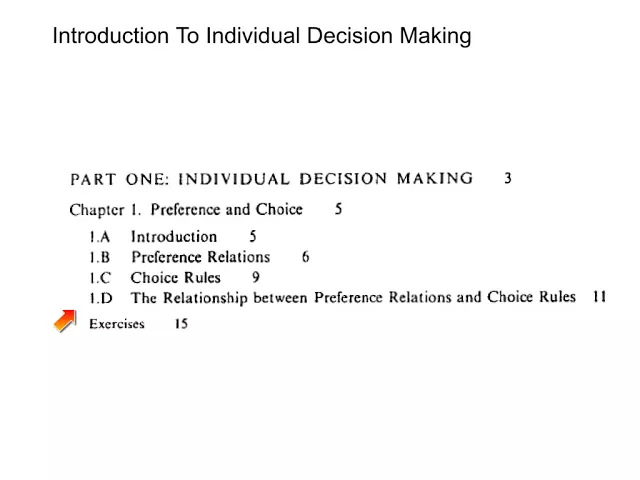
so in chapter 1 we have an introduction to the theory of individual decision making and we have two approaches we have a preference based approach where we define various preference relations over a set of possible choices and we impose some rationality axioms the completeness and transitivity of the preference relations and the choice based approach where we focus on observed behavior and we impose consistency of choice through various axioms of revealed preference so the preference based approach is based upon something which is not directly observable whereas the choice based approach has a directly observable behavioral foundation
now the interesting issue here will be that of the relationship between the two approaches mainly given certain preference relations and specifically rational preferences what can we say about the choices that will be generated and given a particular choice structure given the choices made by the consumer what can we say about underlying preferences now the goal here will be to give consumer theory a behavioral foundation so as to have a scientific status which requires falsifiability so the relationship between the two approaches will be very important if we try to view the theory of individual decision-making as
something which can be falsified the goal here will be to establish that the consumers preference is irrational which is a necessary condition for the ability to model preferences via a real-valued representation mainly a utility functions