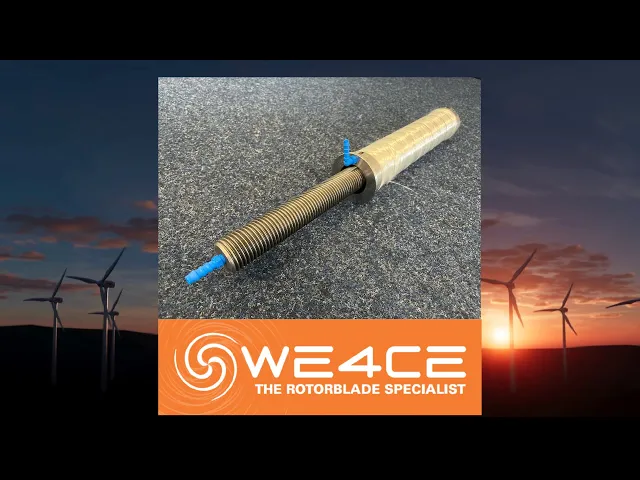
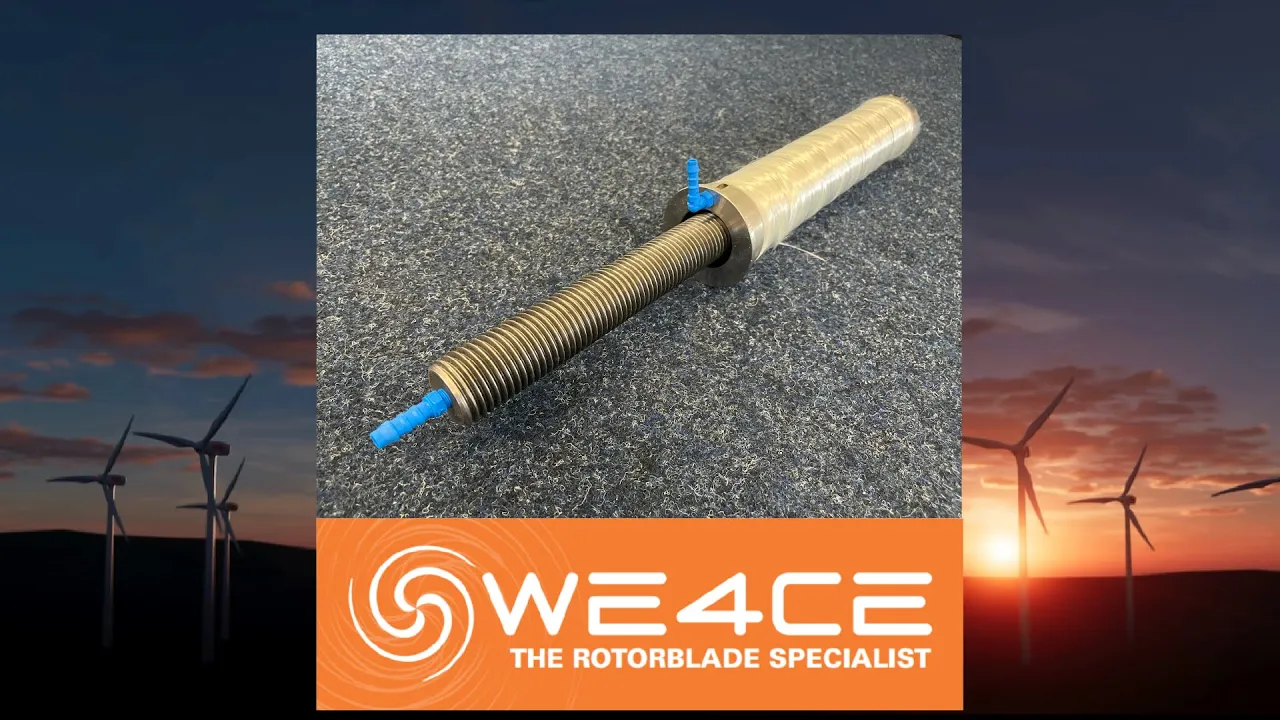
[Music] welcome to the uptime wind energy podcast I'm your host Alan Hall along with my co-host Joel saxum on this episode we're addressing a critical issue that is plaguing the wind energy sector the problem of failed blade bolt inserts and wind turban blades and these failures have a significant concern for wind energy operators leading to downtime costly repairs and the potential for liberated blades Our Guest is kypers owner and engineering manager of w4c and we forc is based in the Netherlands w4c offers a range of services related to the design and Engineering of wind turban rotor blades and they have designed an upgraded blade bolt insert that can be retrofitted in the field and this new insert product could dramatically lower wind turbine operators downtime and blade repair costs Ado welcome to the show thanks for having me me here Alan and Joel so this is a really interesting product but I first I want get to how big of a problem do we have in the industry and Joel and I have been traveling around the United States quite a bit and pretty much every Farm we stopped at had blade bolt insert issues they didn't know why they were having them but they had them and they were deeply concerned about it because of what could happen to the turban and and Ado are you seeing the same thing are you getting a lot of reach out that way yeah more and more we see this I I think in 2021 we were contacted by the Indian market for the first time those were 40 m long blades 1. 5 megawatt platform and those blades were like 13 years on the turbine and then all suddenly started yeah flying off basically and more and more recently this is popping up basically um not after 13 years but after six years for example already on a 2. x platform so yeah we have been contacted first on the Indian side we have seen it in Brazil we have seen it in in in Tha Thailand for example also so it's more and more addressing the problem also from the northern American we have the first context running so I think that if we describe uh basically the the breath of the problem right so there's the when you Bolt the blades on and if you're in if you're wi technician you know this stuff right you've seen it you've done it you've been around these things but for some people that are yeah some people that aren't as technician minded you may not know exactly what the problem is but what it is is basically when you Bolt the the blades onto the Hub there's all these studs right and the studs come through or the studs stick out you stick it into the receptor on the um basically on the Hub and then you bolt them on but if the where the stud connects into the blade doesn't stay true to its design and becomes loose it starts to move well then however well it's bolted doesn't matter at all correct often it's not a bolt problem it's the the connection between the the steel pushing itself this is like a plug in the wall when you hang up a painting for example this plug in the wall is getting loose from the lemonade all right so if the inserts are becoming loose what's the scale the what we think the scale of the problem is do we is it like uh 50% of blades have this issue 20% of blades have this issue it sounds like it's more than 10% at the moment it can be um what we have seen what we've noticed that in the past um blade designs had quite a lot of margin safety margin in them and what we seen is that yeah in time we are as wind energy we are reducing our margins and because we are losing these margins are getting closer to 1.
0 let's say like then where we had in the past like 1. 5 or 1. 6 these margins are getting lower and then the chance of loose bushings is also getting earlier with the let's say the 2.
x or the 3 megawatt turbines if you build it in exactly the same way of course and I'm not sure we don't know if the manufacturer has built it always throughout the whole all these years in in a consistent way we don't know that of course the only what we can do is is observe what we see now and what we see now is is is basically first of all the the the reserves or the mass moment basically the the mass is getting higher with the given bit Circle diameters and longer blades remain on the same pit Circle diameter with the same number of bolts for yeah long longer distances of of of rotor blades so lower lower Reserve Mar that's that's one of them already uh what we then also noticed because we did like three root cause analyzis projects on different locations in the market and what we noticed is that in all these cases it was concerning polyester blades it was concerning aeal uh met which was basically wrapped around the bushing as an interface material and this met had what we have seen an irregular distribution of the polyester resin in it and it had these dark bone shaped yeah it was um pre-fabricated uh Parts in there and what happened there is basically due to this unregular distribution of the um po the resin um we get differences in curing curing cracks basically or curing U features polyester ressin is more sensitive to curing cracks shrinkage cracks basically shinkage cracks at the curing than an epoxy is and if you then have this irregular distribution of your of your resin around these bushings then you can also Imagine That on different location you get these micro cracks already from the start and then it depends a little bit on the reserve factors which you had from the start how long this will last so what happens is due to these micr cracks we are losing a certain amount of the bonding area of the area that has to transfer the loads from the tip to the to the pitch bearing for example if we are losing this this load carrying area that means that the stress levels they are they are they are going up they are rising and when we realize that um there is a nonlinear relation between stress level on the let's say on the vertical axis of your diagram and your lifetime on the horizontal axis of your diagram this is not linear but is let's say a logarithmic and realizing that if you are losing let's say like 10% of your of your area of your load carrying area and or with other words if your stress levels are raising with 10% you can already lose like 50% you can halfen your lifetime already he know if I have a polyester blade how would I know I have this defect in the blade is there any way to detect it before the insert becomes loose when you're a park owner you have always these six month inspection intervals or onee inspection intervals then you go inside the Hub and there's there's let's say like a ceiling done between your blade rout and your pitch bearing this is this is this little line with with ceiling compon filler check check for cracks in that area especially on the trailing Edge for example and on the Leading Edge if you see there are some kind of cracks inside then cut it away uh with a knife and go with a with a with a filler Gat inside check how how how how the distance is and do it on different pitch settings so turn the blade different pitch orientation and see again this distance then you can measure if there is a fa varable cap going on yes or no and if you see a fiable cap for sure you have some some some way a loose bushing there especially check check for the trailing Edge and the Leading Edge is there an audio component to this like can you hear it when the when the turbine is running can you hear the blade shift around a little bit it's such a massive load is it is it making noise no I would I I don't expect that I don't expect maybe maybe a little bit on your T drives you could you could see it in the pitching because you have a little bit more sweeping forward and backwards of your blades if you but then you're already really far and then you really have huge huge Loos and boings but you can imagine that the that the pitch energ changes in that in that respect so you will you will feel it on your pitch drives but I guess okay apart from that the blade has then not not flew off yet but you're already too far it's it's already too far off well that's that's the the question I want to ask I want to get into here a little bit is is okay I'm now I'm asking from an operator standpoint so if I'm an operator if we're doing a yearly inspection end of warranty or whatever that may be and we discover some of these gaps or we have we go oh we're suspecting that there's something going on here what is that basically the the Delta and time between I know you can't say it's 16 hours or you know 22 days but what what does it look like I mean you do you have if it starts to loosen up does an operator have a year or do they have a day like how long before a blade decides to come off you have to ask a blade but depends in the mood when it's when it's maybe when it's Autumn earlier than it's spring not sure about that but no we we have had these monitoring systems also are not not us but our customer have some kind of monitoring system try to exactly what you say here Joe try to to monitor how long do we have it's not years it's not days but it's it's like it's like two three months I would guess that's kind of what I would think too like once it starts loosening because because at the end of the day with you're trying to avoid is catastrophic blade failure blade blade breaks blade takes down the tower the whole thing can come down or you liberate a blade safety for everybody aside from the financial loss in the wind farm so there's a lot of this isn't like um oh we have some Leading Edge erosion and we need to get it fixed at some point in time this is a big problem that like if you if you're seeing the early signs of it you need to address immediately absolutely totally totally right and the sooner you address this the better it is for the repair as well because what we also noticed what we are doing is with one customer this is basically the launching customer here it's in in Asia what we're doing is we're checking at different locations of your blade rout uh what is the capping so what is the far variable capping let's say is it like 0. 2 mm variable capping that's the values where we are starting to talk about or is it also 15 mm variable capping that's also what we've seen so we are trying to desolate the remaining strength of when the bushing is already let's say loose from the uh from the laminate withd 15 mm what is the remaining strength and what is the remaining strength if it's only 02 or 05 mm loose we are trying to quantify that to get a repair um qualification scheme let's say it like that hey guys hey guys if it's like 0. 5 mm yes lower down the the blade it makes sense to repair but if it's already like five or or 10 mm of course also lower it lower it down but there's not such a good chance that there is a suitable repair because there is already so much damage going on in the surrounding area with with all the other materials yeah with all the movement yeah I get it and and I think something important to touch on there for just one bullet point is you guys may you we're talking about a solution that you have but in the at the grand scheme of things what we foresee is and you guys have been working in the sector for a long time you are root bushing specialist so this isn't just like something that you've dreamed up a one-off product you're good at your your consulting firm you've designed blades for Manu or helped put things in manufacturing facilities and all kinds of stuff correct since 2008 early 20088 with the first blade design because we are not only the the the root expert here if I may say so but we are originally we are a blade design company for aerodynamic design structural design etc etc so in our first design we from the start we decided okay when we want to do this we are going to do it with our own bushing development included so and that started with the m30 so the metric 30 mm size of bushings suitable for m30 threaded ends for the 1.