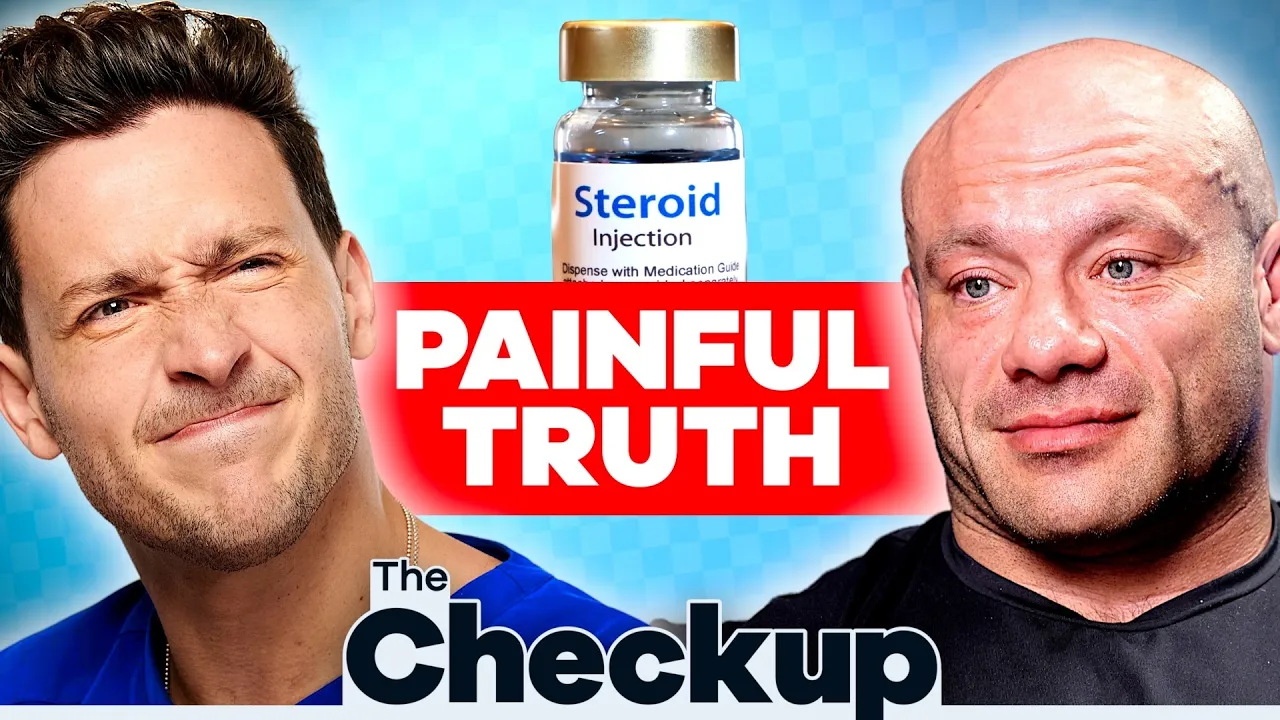
- You mentioned from personal experience being aware of the dark side of anabolic use. What is that? - How long do you have? Anxiety like you would not believe. Every day that I'm on high doses, I wake up in the morning afraid of the rest of my day. Intrusive thoughts. I think about violence all the time. Well, if your testosterone is 25 times what it's supposed to be, What the hell do you think it's gonna make you think about? Another one is a market proximate reduction of IQ. Like right now, as I talk to you,
I'm on contest prep. I'm on a considerable dose of anabolics. I'm not as smart right now, and I can feel it. It's this fog, an inability to perceive a broad spectrum of positive human emotion. I live in a really beautiful area in Michigan, and I walk out and this pond and these trees, and I know that I like looking at them, but it's a memory to me. I go work out every morning, and I look at the pond And the trees and I'm like, (Mike Israetel growling) Like, all I feel is rage and frustration and
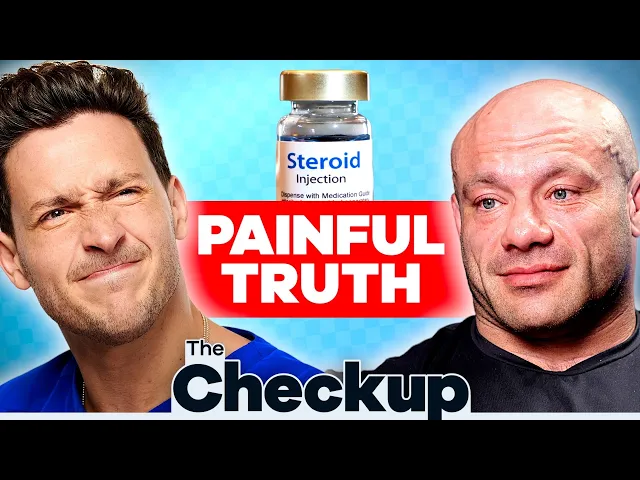
anger and anxiety. That's my daily life. - Welcome to another episode of "The Checkup Podcast with Doctor Mike." Today, I, Doctor Mike, am excited to welcome Dr. Mike to "The Checkup Podcast with Doctor Mike." No, I'm not inviting myself onto my own show. I'm talking about Dr. Mike Israetel, A popular YouTube educator, but also someone who holds a PhD in sports physiology. Whether you're looking to start putting on muscle, restarting a forgotten regimen, understanding the impact of mental health on your fitness journey, or uncovering the harsh realities of steroid use, this conversation covers that and
so much more. We got into some topics I truly didn't expect to address but found extremely interesting, including the fact that he believes AI and gene therapy will get us to the point where exercise becomes completely useless. What? Bottom line, get ready to get re-energized and educated on how to pack on muscle and why it's actually crucial for your health to do so. Please welcome the other Dr. Mike to "The Checkup Podcast". The reason I actually wanted to have this conversation on the podcast is because in the other room right now, we have a lawyer
waiting to hit you with a cease and desist for using the Dr. Mike insignia across all of your platforms. What's that about? - As a Russian Jew... - [Mike Varshavski] There can Only be one Dr. Mike. - I can't wait for a lawsuit. I live in this. I live in it. I love it. Russian Jew versus Russian Jew, round one, fight. You know what, I think the way we would skirt out of that is insanely legalistic. You are fully spelled out Doctor Mike. I am Dr dot Mike. - Oh. - [Mike Israetel] Yeah. - What
about all the other ones? - What other ones? - There's apparently a lot of other Dr. Mikes out there. - Oh, irrelevant people I don't care about. (Mike Varshavski laughing) I consider myself the second most important Dr. Mike. You, of course, first. - You know what's funny? When I created the doctor spelled out thing, I specifically did it in the case of some trademark dispute of someone suing me 'cause I was afraid of getting sued. - Really? - Well, 'cause when I first started, I had no idea what I was doing in the digital landscape.
- I still don't. - I may know a little bit more, but it's weird because now I have a trademark on Doctor, spelled out, Mike. - No way. - [Mike Varshavski] Yeah. - I didn't know that. We were just gonna get sued if we did that with me. Oops. - But we have to protect it 'cause people steal your course, your merch. Like, if we come out - [Mike Israetel] No way. - with a merch design, a week later, it's on websites for sale. - Whoa. - [Mike Varshavski] Yeah. - You're at a very high
level of popularity. People barely know who I am so... - That's not true. - [Mike Israetel] We're just gonna skirt under the radar - In fact, a lot of the comments on Reddit, when people mention like, "Oh, what are your thoughts on Dr. Mike?", they're like, "Not the DO, right?" Saying that they wanna talk about you instead. - Oh yeah, Reddit. Are those real people or robots from China and Russia? - Mix. - Nice. - I feel like that's true. It's a messy place. Do you ever go on Reddit? - God, no. No, I have
real friends in real life. - [Mike Varshavski] Oh. - I'm kidding, Redditers. Don't do whatever you do on Reddit. - They might do something. - They typically do, yeah. All jokes all the way down, of course. Reddit is a combination of an interesting thing. It's an insanely amazing place to get crazy aggregate information about really austere topics no one would ever know anything about. And also a place where the toxicity of insultum goes quite far. - Very far. - And you'll get a lot of people with a lot of feelings, so to speak. And you
say something and they're like, "This guy's wrong. I hate him. Argh." So man, I didn't know the whole trademark situation. I didn't even come up with Dr. Mike. People just started calling me Dr. Mike. - Are you also Mikhail? - I mean, so my American legal name is Michael Alexandrovich Israetel - [Mike Varshavski] Okay. - In Russia is Mikhail Alexanderovich Israetel. - Oh, okay. - So it is Mikhail. I was born Mikhail. - [Mike Varshavski] But in America, you changed it. - In America, I'm Mike, Michael. - [Mike Varshavski] Okay. - Yeah, yeah. - I'm
still Mikhail... - [Mike Israetel] Oh, no way. - on all my paperwork. Yeah. - Oh wow. - So I'm not even technically, like, some of my nurses and staff In the hospital call me Michael, but I'm like, "That's not even my name." - Yeah, don't call me that. - Well, it's funny 'cause they still do, but they don't care. - Yeah, you gotta rotate your name to preference. They're like, "Okay, so Mikhail?" You're like, "Nope, that's not it either." They're like, "Mike?" Like, "Nope." They're like, "I don't understand what to call you. Please help." -
Today, it's this. - Yeah. When you're famous enough, you can just rotate names. - [Mike Varshavski] That's true. - P. Diddy, Puff Daddy. - [Mike Varshavski] You could be like Cher. - Puffy. - Well, hey, that's a bad reference right now. - We can't use him anymore. - [Mike Varshavski] Yeah. - I did see that video. - Yeah, it's a bad video. And he put an apology already. - I don't think you can apologize For something like that that quick. He's like, "My bad." - What's crazy is, I don't know if you saw, this is
so off topic, but the LAPD, no, not LAPD, LADA put out a statement saying they can't charge him for it 'cause it's been over a certain number of years. - It makes sense. I mean, the law's the law. - I mean, it's on camera. - [Mike Israetel] Yeah. - Find a different thing to charge him. - If I ever catch him in an elevator, He'll have more fun court cases... - [Mike Varshavski] Really? - Yeah, absolutely. Why not? - [Mike Varshavski] Would you fight him? - I wouldn't rule it out. Yeah, I think anyone who
beats women is someone who's can't complain - But then what if you go to jail? - Yeah, I'd be all right. I'd do fine in jail. - [Mike Varshavski] You think so? - I mean, look at my face, good God. - Mm. - Like hello, I just wanna make announcement. I'm a Russian assassin. Everyone kinda moves back a little bit, like, but I'm friendly. Everyone moves back a little more, like. - Fair. All right, well talk to me about your social media journey, 'cause right now, you're exploding. You're making jokes about my popularity. Your popularity
is higher than it's ever been. - Yeah. - [Mike Varshavski] What do you attribute that to? - Luck, pure luck. We did bribe the YouTube team a little bit. We're like, "Guys, listen, tough times out here. Here's a dollar." - [Mike Varshavski] Okay. - It was well-received. - Yeah. - [Mike Israetel] It's the intent that matters. - Fair. - That's what they said. You know, it's an interesting question of fundamental attribution in science of what are the sort of principle components responsible For increase in popularity? I have to say I do have a few hypotheses
but nothing I can set in stone. - [Mike Varshavski] Okay. - If you're interested in hearing them, yeah. - Yeah, tell me. - I think that the humor probably goes some way. I can't help but put in bullshit jokes as you can clearly tell. It just pops off. Half of 'em are dumb. - [Mike Varshavski] That makes sense. - The other half are like giggle worthy, And 1% of 'em are hilarious, but you know, it's just a law of averages at that point. - Fair. - I'm decently educated in sports science, so I know some
things. And in the fitness industry, we have a lot of folks who say things that are just not so true. And that upsets me at a deep level. And so I have to make videos about clarifying things. I think people find that to be helpful. I walk the walk. I'm decently muscular and bald, which I think is important Because you're not really seriously into bodybuilding until you lose your hair. Everyone knows that. And then the other one I think that is most responsible is, let's just be completely honest here today, I'm just really good-looking. And
I mean, I'm tall. People love that. So why is that funny? Can't understand it. - You're smiling. - Yes, just smiling at how tall I am. It's just great to be tall. I think on the good-looking part, clearly I'm not. One thing my friend Menno Henselmans told me, he's a very popular exercise science guy, who's actually one of the best-looking people I've ever seen. You know, I tell myself every day I'm the straightest man alive, and when I see Menno, I'm like, oh, just don't know how to make sense of it. But he did say
that I have a very unique look, which is, like, something you tell an ugly person to make it okay in their head. But I guess I don't look like everyone else on the street. - Okay. - I did walk around New York earlier, and people will recognize me and be like... - [Mike Varshavski] Really? - "Oh my God, Dr. Mike." - Wow. - And I'm like, I tried to duck away and run, usually. I'm scared of people, but I do have a unique look. So when you see me on a thumbnail, you're like, "That guy."
And you see me a couple times, you're like, "All right, what does this weird meat head With this weird muscle head have to say?" You get in there, you learn some things, you laugh a little bit. And I think that's kind of it. I will say though, in all due seriousness, most of the credit for my YouTube popularity goes to my YouTube team, specifically Scott, the video guy who accompanied here as also my bodyguard. People don't know that about him, but he's dangerous. He looks friendly, but that's all nonsense. He has a work ethic that,
like, I thought I worked hard at stuff, And then I lived with Scott on business trips, and I was like, "I don't really do anything compared to this guy." He's systematic. It's just flawless execution. And he deeply cares about thumbnails and titles, and video quality and editing. He runs a whole team of also amazing people. And it really is the team. Like, by myself, I would just be some guy in front of a computer, like, yelling at the screen. But with the team, I'm like, yeah, Dr. Mike or whatever, not the real Doctor Mike. Doctor
Mike is you. - The better version, 2.0. - Nonsense, oh, please. - [Mike Varshavski] The more muscular version. - I'll take you up on that. I am the 2.0, but I'm like a regression in software. Like, I like 1.0 better. This guy sucks. - If you had to succinctly, in one sentence, say what your mission is on YouTube, what would you say? - To give people the information they need to make better choices about how to become leaner, More muscular, and healthier. - The current state of social media when it comes to fitness is a
disaster. - Your words, not mine. Wait a minute, am I part of that disaster? How dare you? - I very much stand by it. No, I think you're leading the way in cleaning up the disaster. In fact, I just watched your video where you discussed Dana White's human biologist. - Yes, yes. As opposed to the non-human biologist We all know and love. - Exactly. I can't wait for the next person to come out and say they're an ecology major and they could tell us about the environment and how we need to change it. - [Mike
Israetel] For sure. - I mean, whatever. You know what I'm about to say, that it's a very messy field with a lot of opinions out there. And usually, the inaccurate ones are the ones that become very popular. Because they're contrarian, They're dramatic... - True. - They're extreme, for all those reasons that the algorithm loves them. - [Mike Israetel] Yes. - What's your take on the current state of things? Do you feel like it's a disaster as much as I do, or do you feel differently? - It's a dumpster fire, but it's a dumpster fire that
is declining in magnitude. - [Mike Varshavski] Mm. - And things are getting better all the time. There is a part of the social media fitness space Called the evidence-based social media fitness space. People like Menno Henselmans, Milo Wolf, Dr. Pak, Jeff Nippard, of course, Eric Helms, the list goes on. But these are the folks that they're following. So Jeff Nippard actually has an enormous following. And their followings are growing and really, really getting better and better. It's just one of these things where you look at a situation where it's 1% good, 99% bad. You're like,
"This is hopeless." A couple years later, it's 4% good, 96% bad, and you're like, "This is hopeless." But it's a four-time increase in the good. And so I think eventually, you'll get a situation in fitness where it's much like modern medicine where the preponderance of the information you get is pretty good. I don't know, maybe I'm stepping out of my lane on that one. You're like, "That's not even true in medicine." (Mike Varshavski laughs) But that's how I would summarize the situation. It's pretty bad but improving steadily. And one thing I will say is, and
this is a point of, I guess, post-personal pride, is I'm really happy to be one of the people, that if an individual wants evidence-based information about how to get leaner and healthier and more jacked, there is now a lot of it. Whereas before, five, 10 years ago, man, you would be looking through accounts all day to find that. And when you get into the YouTube community, 'cause the algorithm is so good, once you start looking at evidence-based fitness YouTubers, They just recommend you more and more. Like, ah, you're one of these people. And then you're
just flooded with amazing information. Now, that's if you're looking for it. And one of my big contentions, and I don't mean this to offend anybody, but the vast majority of people are not looking for evidence-based things. I mean, I have close personal friends of mine, members of my family, they're only interested in quick fixes. They're only interested in one-shot deals. They're not interested in understanding physiology to any depth. And so all they want is like, with this, can I do something really simple? Arguably doing almost nothing at all. Get all the results, pay none of
the trade offs, no consequences, super, et cetera. And if you want to be fooled and to BS, oh my God, get ready. It's like taking your pockets and putting $100 bills in and walking in Times Square and being like, "Do me up," Putting your hands above your head. - Sure. - You'll get done, so. - Since you mentioned that you're taking a dive into the philosophy side of things as of late, what's your take on why people are looking for that quick fix now more than ever? - So, how pedantic can I be? I mean,
it's all in good fun. - The world is your oyster. - I don't think it's clear that it's worse than ever. I think in historical times, it was probably arguably much worse. The average education, intelligence, and actually, as measured IQ of the average human on Earth has been steadily increasing over a long time. If you talk to the average person in the 1940s, a level of ignorance that you would find totally baffling. I think the way that we get maybe convinced that things are worse than ever is because social media has a reach that's now
global down to a person who has only a phone. The average person gets to talk about what they like and vote with their phone more than it used to be. So back in the 1980s, the major health dissemination Of information that would occur would be from big media. And there's people there that vet who they have on, and they vet 'em okay. There's still charlatans get through. But now, charlatans get through to people who just have no scientific filter and never had. They just never had a chance to express their preferred demand for people. So
as more and more people are entering the consumer side, they're not all coming in as scientifically educated people, and they're like, "Oh, quick fix." The other thing is, I never fault people ever For wanting and desiring a quick fix. I mean, like, look at what ChatGPT is right now. Like, can't I just ask a super intelligent machine any question in the world and get an answer instantly? You think five years ago, you're like, "You're an idiot. That's nonsense." Now it's like, "Well, of course, it's a thing." It's amazing that people want quick fixes, because I
fully believe that in, oh, 10 to 15 years, we'll have genetically engineered most disease And most aging, and everything out of the human population, period. And then it'll seem like, "Oh my God, what great easy quick fix." Like, one shot, and then over the course of 10 weeks, you de-age back to 22. They're already doing that in animals by the way. And it's kind of like, if people didn't look for quick fixes, innovation would be kinda stifled. Because if you tell people, "Look, there's no other way to get in shape other Than hours a week
of resistant training, controlling your diet." An interesting example here are the modern anorectic drugs like Ozempic and tirzepatide. People are calling them quick fixes, and they kind of are. Thank God they're around. Thank God somebody developed them. And the pharmaceutical companies, once they got wind to the fact that these drugs are effective and relatively safe, they're upping the development of them like crazy, Precisely because they know people want quick fixes, and it's good that they do. But there's a very big distinction to make. There is wanting a quick fix and pretending you have one, and
there's wanting a quick fix and actually getting one. The pretending is the bad part. The charlatans get in. They go, "Oh, you want a quick fix, huh? Well, here's this make-belief nonsense we can give you." And you're like, "Hey, it's working." And then 10 weeks later, you're like, "I feel and look the same. And my doctor says I'm still dying in my blood work." So that's my thoughts on quick fixes is that it's great that we want them. The big thing is we have to know as consumers, what is really a quick fix? What is
a more intentional fix that's gonna take some time? And what is the illusory quick fixes that are supposed to be quick fixes but don't work? It's like a luxury car. You want a Bentley? I own 20 Bentleys currently. - Because of the trillions of dollars. - It's getting annoying. Like, I don't even count the money. I don't know how rich I am at this point. It's difficult to see a number that big 'cause I have to read across multiple lines, yeah. - Link in bio. 50% off. - The trillionaire method, it's great. Yeah, well, no,
it's actually 125% up because we upcharge people. - Ah, okay. - That's how you make the most money. You don't give discounts. Nonsense. In any case, I can tell you're not a trillionaire, but you're close. - One day. - One day, someday maybe. Basically, the onus is to get folks to recognize, hey look, there are people out there that will propose a quick fix to you. You gotta figure out is this really a quick fix or am I being bamboozled? And it's difficult to do that Without some baseline of education, of expectation. And I think
that's a super important part of why my channel exists, a huge part I think why you're out there on the medical side is to get people to understand, like, here are the kind of fundamentals of how medicine works. So that when people are like, "Hey, like homeopathy, you drink this drink and you're good to go." You're like, "This is not how the body works." But if you don't know that, hey, look, why wouldn't you try? - Yeah. Do you really believe that a quick fix exists for health? And I'll preface it by saying that I
don't think this exists because health I feel like is so unique in that the body is very difficult to trick. Even some of our most miraculous inventions that have extended life: antibiotics, vaccines, while they sound like quick fixes, they're so imperfect. They have downsides. They create new problems. So the idea of a quick fix, The idea of perfect in healthcare, or even fitness, largely escapes me as someone who practices medicine. Do you feel that or do you believe that quick fix is possible? - Is it possible in the future? Unequivocally, yes. - [Mike Varshavski] Hmm.
- I think genetic engineering will make all of us essentially flawless to the extent that we would like to be. - Interesting. - And before that, pharmaceutical-based interventions will get us real close. Do we have that now? No. Does everything have trade-offs? Absolutely. So for example, Ozempic and all the related class of drugs, the main effects are unbelievable. Even the secondary effects like insulin control are amazing. Do they have downsides? Yeah, oh yeah. Can you misuse them? Oh my god, yeah. Is it not the right fit for everyone? Oh good God, for sure. Now, there's
a bit of a difference, I think, in terminology between a quick fix and a near panacea that requires some effort. So I would say that for most people, substantially reducing their body fat and, thus, body weight, substantially elevating their muscle mass and increasing their daily physical activity Comes real close to being a near panacea. And I don't mean it heals and cures everything, but it's a thing that if you take any body and reduce their body fat by 20 pounds, increase the muscularity by 10 pounds and get them from walking 3,000 steps a day to
11,000 steps a day, you're gonna see across the board improvements that are quite radical. If you saw those improvements with the drug-based therapy, you'd be like, "Dude, call Pfizer. Holy crap, we're trillionaires now." It really is a thing. But I wouldn't call it a quick fix 'cause it's like, "Well, how do I get these benefits?" Like, "Gee whiz, you gotta train with weights twice a week, and you gotta walk every day, and you can't just throw food down your gullet that just, like, shows up on the newsfeed." So not a quick fix but definitely a
huge main effect with, I would say, few downsides. There are downsides. You can get hurt in the gym, wear and tear on your joints. - Opportunity cost. - Oh, huge opportunity cost. That's why, again, I'm shooting myself in the foot here 'cause I'll be arguing myself out of a job, but I think in the future, non-androgenic anabolics, eventually with genomic intervention, but first with just oral drugs and injectables, I think, have such a huge potential to increase people's muscle mass and can confidently decrease body fat, that they're gonna be insanely panacea-like As far as general
health is concerned. And I think that is gonna be a pretty quick fix. Now, of course, they're gonna come with their downsides, but the thing with downsides, and this is something I've been big on trying to say about Ozempic and the class of related substances, people take a look at a generation of drugs. Now people think Ozempic is a first generation, it's not. It's actually a third generation GLP-1 agonist. They now have, in the approval process, fifth generation drugs, like retatrutide, for example. Every time they do a new generation of drugs, They purposefully turn down
the negatives and turn up the positives. So I think a lot of people, when you get something like Ozempic that comes out and people are like, "Well, you know, it's got downsides," they're completely correct. Holy crap, does it have downsides? But some people wanna write off the whole thing. It's like, "You know, none of this. It's all nonsense. You gotta diet and exercise." And diet and exercise, of course, is amazing, But with further developments, you really start to crank down on the negatives. So for example, today, and this is much more up your alley than
mine, but I don't even know what generation of blood pressure drugs we're on. I mean, it's gotta be like eighth or ninth gen by this point. - I mean, it depends which one specifically. - For sure. But just in terms of, like, when did they make the first blood pressure drugs? - Well, we have like the JNC 8 guidelines that we use for blood pressure management so it's the eighth generation. - There you go. - [Mike Varshavski] For your information. - Hey, I guessed correctly. - So a lot of these drugs, if you talk about,
like, side effects and risk profiles and visible and known trade-offs, they're starting to get pretty low. Now they're not zero, but like, it's just not true that if you take lisinopril Or which actually much older drug, amlodipine, like, if you talk to your doctor about like, "Oh, what are the big downsides?" Well, you know, like, you might have a dry cough for a few weeks. You're like, "What else?" He's like, "Well, that's kind of really it for most people." It's not one of those things where the drug has an awesome main effect, but disastrous side
effects, modern androgenic-based anabolics like testosterone, et cetera. But I'm like one does not simply take that. Like, people talk about TRT a lot, testosterone replacement therapy. They say, "Oh, it's so great." Like, yeah, if you need it. But if you are a poor responder to it, I mean, your blood lipids go everywhere. Psychologically it affects you. So I think, yeah, there are no panaceas for sure. There are no quick fixes. But over time, we make the fixes better and better. And I think it's good to stay optimistic about that And not get a repulsive attitude
to like, some people think, like, it's drugs versus lifestyle change. It's an additive and often multiplicative effect where it's absolutely lifestyle change is a big deal, but there are pharmaceutical interventions that can really, really help. - What about the idea or the notion of our attention span starts dwindling because of innovation? Everyone's on social media that's short form. makes our attention span a little bit worse. Now we're overly prescribing Attention deficit disorder medications. Food becomes hyper-processed and hyper-palatable. We create a medication like a GLP-1 agonist. Guys wanna be stronger. They're taking anabolic medications even when
their testosterone levels are within normal limits. How long until we're just taking 10 medications to hyper-optimize? Do you feel like that's an acceptable world? It's a good way to go, not a good way to go? What's your take on it? - I think it's a great way to go. I'm very, very pro pharma. I'm still waiting on the checks from big pharma to clear. They haven't even showed up, believe it or not. I think it's an address thing. They just don't know where I live. They're cutting checks to random people hoping... - It's a different
Dr. Mike. - You're getting the checks. I don't really know why I'm getting this, but Pfizer just sent me a billion dollars. So I am real bullish And really pro modernity science and pharmacology. Being pro pharmacology, I think it leaves me as a person who, like, whatever 30,000 years ago is like pro fire. People are like, "Look, fire burns things. It just killed all those animals in that forest. You're saying we're using it to cook food. You must be crazy." It's like, "Well, yeah, it's got serious downsides and it's something that needs to be carefully
managed but in context, if you carefully manage it, it's this huge boom and over time, we can improve things." So I do think that two people that are interested In increasingly nuanced and effective cocktail of pharmaceutical therapies, can, should, and will become more and more accessible. I think that's a great thing. People who are saying like, "Whoa, you know, like, all these drugs that were taking, like, all these pills..." and I kind of wait for the punchline. I'm like, "So what's bad about that?" And typically, they'll get into just total non-sequiturs or fallacies like, "Well,
they're chemicals. Like, watch this." (Mike Israetel inhaling) Just breathed I don't know how many, how many moles of chemicals. You're made of chemicals. Everything's chemicals. So then they try to go, "Okay, okay, that's not what I'm saying. It's artificial chemicals." Look, your snake bite is completely natural. Air conditioning is very artificial. Still they're like, "Okay, that's actually called the argument from nature. It's a fallacy." So people say, you know, it's just drugs are kind of bad. And he goes, "I'm totally with you." Because drugs have at least two downsides. One, they have negative side effects
that we don't like. And two, some people who have access to these mega, huge hammer type of things like lifestyle intervention, better diet, better training, they look to these drugs which are as yet very imperfect and on sheer laziness, they'd be like, "Ah, I don't wanna exercise, I'll just take Ozempic." That's the thing I'm sure you're aware of, like Ozempic but or whatever, where housewives who had no interest in resistance training or building muscularity, no interest in controlling their diets or eating healthier. They just take a crapload of Ozempic and they're like, "Oh, I've lost
a ton of weight but now I'm sarcopenic." That's definitely a bad outcome. But I would say that's more of a slight misapplication of pharmaceutical technology And there is such a thing as proper application. And I think in the end, we'll have a cocktail of drugs that are increasingly better at doing things, increasingly lower risks and downsides. I think that's a world we wanna live in. I'm gonna say something insanely controversial to my own field here, but I very, very much stand by it. I really look forward to a world, hopefully in the next 10 or
15 years, where we no longer have to exercise. Exercise is a profound waste of time if you think about it. When I go to the gym And I physically hurt myself through pain, which has great psychological benefits, but there's other ways to hurt yourself that also teach you stuff. Like, I would much rather, I'm a competitive Brazilian jujitsu athlete. Yes, I'm not very athletic but it's called a sport. I would much rather just do BJJ and never have to lift weights because I'd like for the muscle to come from pharmaceutical or genomic intervention purely so
I can actually spend most of my time learning how to, you know, Beat up my childhood bullies. I'll show them. That's why we all do what we do. You're a boxer, correct? - Uh-huh. - [Mike Israetel] Yeah. - I pretend to be. - Pretend to be, of course. - I mean, who's not bullied? - I think some people got away with just doing the bullying. They've gotta be around. - Oh, maybe. But isn't this saying hurt people hurt people? - True. You know what, I actually have looked into the literature On that and that's actually
not true. People who are bullies typically are not the people who had been bullied elsewhere. They're actually just the people that bully and the people that are getting bullied are typically the people that get bullied in a variety of circumstances in their lives. Kind of a trippy realization. There's nuance to that, of course. But it is, it's a very easy to say like, "Oh, well, that's just a person who's been hurt by others." Like, nope, that guy's just a piece of crap And he's just been hurting people his whole life. - Could be. - Yeah,
some people need humbling, right? - [Mike Varshavski] Sure. But I do look forward to a world in which we don't have to spend time very artificially exercising so that we can do amazing things with our bodies like go skiing, go hiking, play with our children and have the health benefits of exercise endemic to our very DNA or through really, really good pharmacology. You take two or three pills a day, you're good to go. In laboratory animals, they have already an exercise pill. It works great in rats and mice. You take the pill and it just
does everything exercise does for you, short of a few things, but almost all of them. And if you think about it, like how's that possible? Well, what do you think exercise is doing? How is it beneficial? It's really just accessing various molecular pathways and turning them up and turning others down. You can do that with a pill and if you did, what exactly is so wrong about that? And then people get into the philosophical part Of you should have to earn it. Which I don't really, I understand where that's coming from, but I wildly disagree
with it. What you have to earn is your income. What you have to earn is the respect of other people. Do you have to earn a good body? If that's the case, you know some people, I'm sure you know people that are just in damn good shape just 'cause. Is there something they're missing in life because they didn't have to struggle? I would say no. But in a sense it is, yes, because it's, like, some amount of struggle is insanely healthy for your psychology. Cool. But there's so many ways to get struggle in life. I
would rather spend less time exercising and more time challenging my brain with new ideas. That's real struggle. More time doing MMA and BJJ. That's also real struggle. More of an opportunity for me To have free time with my family so that I challenge myself in interpersonal relationships to be the better version of me. There are many, many ways to struggle. If you think of problems as really good things, I totally agree. But if we get rid of as many problems as possible with pharmacology, we have more bandwidth for the other problems that are left over.
Because, like, every time I'm in the gym lifting weights, I'm not working on my familial interactions. I'm not working on my brain. They're only 24 hours in a day. If pharmacology can handle more of those things for us, I would think that's just an unbelievable, beautiful thing. - I think it's very idyllic. - [Mike Israetel] Yeah. - I think when people get more time in a day, generally speaking, the majority of people are not gonna make the time to say, "Oh, well, since I'm not challenging my body now in the gym, I'm gonna challenge it
by reading something or pushing my knowledge." It's gonna be chasing some sort of high, Some sort of happiness where exercise can give that to someone through struggle versus if you can remove the struggle and still get the benefit, the way that you're gonna see happiness might not be as idyllic as, "Oh, I'm gonna continue challenging myself by doing X, Y and Z." - I think that's definitely true for a lot of people. I would posit that the vast majority of people who go into exercise are already the people that are gonna seek challenge in other
things in their lives. And the people that are the kinds that would just take the easy way out, they don't work out to begin with. So if you have someone who is driven enough to go to the gym and do something, when you say, "Hey, here's this pill. You don't have to go to the gym anymore", they're gonna look around and go, "How else can I challenge myself?" My wife is a perfect example of this. She needs to challenge herself. She got a really extensive medical education. She's actually a board certified sports medicine doctor. And
once she finished her medical education, you know, we're doing super, super well in life, we moved to a new place, and she wasn't sure if she wanted to continue her medical stuff. And she tried like a few weeks of, you know, just being, like, rich dude's housewife or whatever. It just didn't work. At the end of the two weeks, she was like, "Ah." She, like, took on 10 different work responsibilities To fill the void of having to push herself. I think the people that go to the gym all the time, that void isn't gonna be
replaced by scrolling. It's gonna be replaced by other forms of challenge. Now there's still another group of people who, they're not into the challenge thing. You challenge them and they're like, "Is there any way I could just not do this?" They're not the people you typically see in the gym because I think in our world, we think of people as people work out, blah blah blah. Well, maybe not in your world 'cause the medical field, you guys typically, like, you should be working out and almost no one does it. So you know very, very well
that a lot of people, it's real hard to get them to challenge themselves at all. You would hope they go exercise, they're just not interested in it. So I think precisely the people that were worried about taking away their exercise and they no longer have a way to challenge themselves, I'm pretty convinced those people will find a way to challenge themselves. But still other group of people, they're not in the gym. Their health is in a real bad spot. They're not interested in challenging themselves already. So it's kind of like the two groups are rather
separate. - Yeah, I feel like I function in a different world than most doctors who are on social media, medical doctors. You take someone like Dr. Peter Attia who has a lot of knowledge from academia, from personal anecdotes, studies that he's run unofficially with his patients. And I say that because a lot of the stuff that is being recommended as protocols is experimental. Like, we don't have evidence-based trials... - Cutting edge. - For those things. Yeah, cutting edge. - He also has a great haircut. - I understand why you say that. And the way he
practices medicine is through a concierge model charging over $100,000 per month, having unlimited time with patients. - What the hell am I doing with my life? - This is not the world I function in. I work at a community health center Where the medicine I prescribe to my patient could be the cheapest medicine ever. But if I prescribe capsules instead of tablets, they can't afford to get it. So the world of the person that wants to crush it in the gym and hyper-optimize, to me, is like this outlier example. - Very outlier - That the
people that are gonna benefit from this pill that will then continue on challenging themselves is in the, not even in the tenths of a decimal point percentage wise. - Maybe. - So I wonder how it's gonna impact the general population Of who ultimately I end up seeing. Because something that you talked about on some of your podcasts is when a patient comes in to see a doctor, why doctors are not great at delivering information about diet, exercise, why do they run to the pill? That's like the quick example that most people say. The doctor just
pushed a pill on me. - [Mike Israetel] Yeah. - And some of the things you pointed out were true. Doctors don't have a lot of time, they might wanna take a shortcut. There's also the idea of the patient wanting a quick fix, That pharmaceuticals work so great. I wanna debunk that notion right now. Pharmaceuticals suck. Blood pressure meds, they're better than ever before. They pale in comparison to the change I can make in a patient's blood pressure with diet and exercise. Like, the levels aren't even close. If I wanna lower my patient who has diabetes,
their hemoglobin A1C to be in a level of control, the amount of change I can make by lowering their weight, By helping them exercise, maybe changing their intake of food, certain nutrient wise... - Huge. - Is huge. Maybe the only way I can get that drastic amount of a change is through insulin. But anything else... - Yeah, lot of downsides there too, - Right. But with nothing else will come close to the amount of change. Like, starting metformin, maybe I can get their hemoglobin A1C down by 1.5. And that's tiny in comparison to what most
people need when they're... - Oh yeah. - In really, like, at the stage of diabetes where they're having side effects, where they're having vision issues, feet issues, cardiovascular issues. So pharma is not nearly as idyllic in my world. A lot of it is very problematic. Then you get medications that are starting to show promise, like the Ozempics, the GLP-1 agonists, the Mounjaros. They are better. But then access becomes a disaster Where patients can't access them. They want them. They can't get their insurance company to approve it. They don't have good insurance to cover it. There's
a huge copay that they can't afford. So then access becomes a huge problem where it's like initially, we're talking about a medicine that can help a lot of people, but then like can people access it? How does the world react to it? How does it change our mindset To things like diet and exercise? So I guess my question would be if we can get to a place where these medicines work real well, do you think there's an insidious effect where it starts impacting our psyche where we don't wanna challenge ourselves and we want the computer
to do the challenging thing for us, the medicine to do the challenging thing for us where it becomes a life of comfort? And the reason I bring this up is because in society as it exists today, We are safer than ever before, which we can agree is a good thing. - Oh yeah. - But now we have these huge problems because it is so safe. We have an anxiety epidemic. We have an anxiety epidemic from social media, which was supposed to make everything interconnected and wonderful, but now we're lonelier than ever before. So the things
that came with a lot of good intentions, ended up creating some significant bad outcomes. - [Mike Israetel] Yeah. - And absolutely, I don't wanna vilify everything with a broad brush because social media is problematic for many ways. But there's huge benefits. We're having this conversation, we're educating people with evidence-based medicine and health and fitness information. - Sure. - So there is that benefit, but then there's all these, like, pushbacks of, like, the homeostasis model that the world and the mind exists with homeostasis That when we create these pharma meds that will be the new fountain
of youth, they're gonna create some sort of huge pushback effect that maybe the people you've talked to in the past can't verbalize well that they're saying it's negative, it's chemical, it's harmful, they can't really verbalize it. But there is always a huge bounce back negative reaction to when we make a breakthrough. Do you think or do you worry about that at all when it comes to these medications? - It's just a real thing Whether or not I think or worry about it, you're completely correct. That's definitely a thing. It's a very interesting point you bring
up that I've been giving some thought to lately of maybe one of the proximate causes of the increase in anxiety in modern countries that are super safe and there's no real actual reason to be anxious is because I think the human brain has a baseline level of expecting the world to suck and problems to surface. And when you don't have problems, your brain starts looking For them because it's pre-programmed to look for them. I mean, in the paleolithic era in which we evolved, I mean, it was just terror. - It was a survival benefit to
have the anxiety. - Like, gigantic carnivorous birds would pull you away from the campsite and kill you. It's just a regular thing. One of the reasons that a human psychologically universal is that people dream of and are scared of monsters is because monsters used to be real. Like, we used to see megafauna. It's just, like, why is a tiger that big? Why is that bird nine feet tall and eats meat? So we're programmed for a world that's generally like orders of magnitude more terrible in every conceivable way than our modern world. And when our modern
world is amazing, people almost don't accept the matrix program, sort of. They're looking for problems and anxiety is kind of your brain's way of being like, "Something's wrong, I gotta fix something." That's definitely a thing. I'd say a couple things about that. One is that's a different kind of problem and a much better problem. If you ask me, Mike, where do you wanna live? Like, do you wanna live in Taiwan where everything's almost perfect but you have an anxiety problem you got to see a therapist about? Or do you want us to send you to
North Korea where you will not have anxiety and everything will make total sense but it's terror every day that you wake up and go to sleep? I'm going to Taiwan, thank you so much. It's a problem. It's not a perfect fix. But now we can do this thing where we zoom in on the problem. Okay, we have fixed running water, we fixed, you know, longevity medicine, et cetera. Most people live into their 70s and 80s, short of getting hit by a bus or some other thing. Now what's the problem? Okay, we have an anxiety epidemic.
Totally. How do we address that? One is therapy, one is relations, one is challenging yourself with difficult things all the time. One is going on your own journey of mindfulness and management and things like that, which are all great. Another one is drugs. And if our brains are designed for the Pleistocene time, this is a funny, controversial, incoming idea through a combination of pharmacology and eventually genomics, why don't we re-architect our brains? Why don't we genetically engineer humans To become more rational, more calm, more positive, and less anxious at face value? Just that's how you
live your life. Because now that we have this amazing modern world where calm, logical things are kind of the way you do things and get results, you don't have to have a fight or flight response anymore, why don't we genetically engineer the fight or flight response generally down significantly and genetically engineer up just a calm level of happiness all the time. I think pharmacology can do that. Very jadedly right now, these things are getting better. And so I think there are kind of two options. One is we try to become more primal and discard the
benefits of the modern world. - Like Liver King. - Like Liver King, a known non-liar who's also not on steroids. Some people are just colored red. And like a Dr. Seuss book, some people are blue, some people are red, Liver King. - His nickname was polycythemia. - That's right. It's a long nickname. Hey, Poly, get over here. So we can think of discarding the modern world and all of its beautiful things. I'm not interested in living in a discarded modern world and actually no one is either. A lot of video games today seem to be
based on like a post-apocalyptic world. You don't wanna live in a post-apocalyptic world because very mundane things are very bad. It's gray. You know, you've got your beautiful woman with long hair, it's not brushed, she's in the raw, hand in hand, You're going slaying dragons with your sword. It's awesome. Then you stub your toe and get an infection. Now where is the factory that makes antibiotics? Doesn't exist anymore. We don't have modernity. You die the most terrible gangrenous death. You can't even imagine. Prehistory was awful in almost every respect. But in that awful time, we
generated a consistent amount of deep meaning. We were made for that awful world. So while things are awful, they make sense. And every day you wake up with purpose. You have to have purposes. Everything's trying to kill you all the damn time. So I don't wanna discard anything. I wanna keep all the modernity, all the wonder, all the drugs, see the problems they're creating a secondary, tertiary, quaternary effect and address those one at a time by improving the medicines. Yes, going to genomic interventions and also just working on the problems With therapy, exercise. Exercise is
a solution to a problem. We didn't used to need exercise 'cause you were on the farm every day. In 1880, exercise is nonsense, you know? Exercise generally was kind of born in the late 1900s. Like, almost all sports were born in like the 1890, basketball and stuff was invented then because people had leisure time for the first time ever. And it was crazy to say that generally just didn't have it. So exercise is one of those solutions. Lifting in the gym is one of those solutions. We didn't lift in the gym primordially. It's a great
solution. What I'm saying is taking that next step, yeah, the gym was great for 150 years. Now we take that next step of eventually genomic intervention such that, you know, you take some kind of, I got in trouble with genomic people for saying viral vector 'cause they're like, "Viruses actually are kind of dogshit at vectoring." It's like whatever kind of vector is outside of my scope. And you know, after a few weeks, You notice, like, it was kind of getting a six pack after a few more weeks. You just have ripped abs. You eat whatever
you want. And that's how it worked. We know it's possible. It works in animals. Some people walk around with those genetics. That doesn't just affect the body. You can get genomic interventions that affect the mind. I mean, a vast amount of depression is hugely genetically caused. Why not engineer that out? I think we're trending towards a world which I think is gonna be here much sooner than people expect because progress is exponential in which we not only are we super, super healthy and psychologically and physically with nothing except genetic intervention that lasts forever. 'Cause, you
know, once you get the fix, that's just your DNA. But we look at that problem differently and we look back on our history and go, "Man, people used to have To spend 12 hours at the gym a week to do this. Holy crap." I think that better world is incrementally and slowly coming. And the paranoia in some sense about social media is destroying us all. Social media is perhaps one of the most wonderful things that has ever occurred. I met my wife through social media. If we didn't have social media, I would've had to, like,
marry someone from the metro Detroit area. Like, no offense, people are great there, but I would've never met the love of my life. And so much good stuff happens that, here's another thing that humans do. We're problem seekers. Because in our ancestral environment, if you weren't a problem seeker, you were dead the next day. And so we kind of, when things get good, we kind of go, "Yeah, yeah, okay fine, they fixed that." But this side effect is the big crazy thing now. Dope. Let's fix that too. As we fix more and more things, the
world becomes better and better and better over time. And eventually, we can change the very makeup that we have. I obviously way outside the scope of the discussion. I think we're gonna fuse with machine intelligence sooner or later and all that crazy Ray Kurzweil type of singularity stuff. I think it's inevitable. But on the way there, we have to, I think, admit two things. One is things used to suck. Two things are getting better And we will continue to make things better. They are imperfect. And some of our solutions have had some side effects that
sometimes rival the scope of the problem itself. But we can make that better and that better and that better. So I tend to look at it not from an optimistic perspective I don't think. A realistic perspective that things get better all the time anyway. I mean, what year would you want to be alive if not 2024? - You're very optimistic. - So thank you so much. - That's the thing, I think you are very optimistic and I'll point out a couple things. - [Mike Israetel] Please. - Things get better. Well, what's your measuring stick for
things have gotten better because there's certainly ways we can say certain things have gotten better, but like, lifespan has been steadily rising and now has suddenly taken a downturn. Happiness, especially for kids after 2012, I just had Dr. Jonathan Haidt in the chair Where you're sitting who's pointing out a hockey stick graph that just shows the most dramatic spike in mental health illness in our children above the age of 12, 13, after puberty, especially in teen girls, where it's like, did things get better for them? Like, I know you're comparing and you're saying would you
like to live in a world where the anxiety's the problem or a world where you're under terror under this terrible regime and it's easy to downplay into anxiety, You're physically much safer. Whereas under that regime, you're actually much worse. But when you're a child with depression and anxiety, that world does not seem that great. - Yeah. - So like our perception of the problem is nearly as important as the problem itself. And currently, the level of unhappiness, even with all this amazing outcomes of safety and social media connecting all of us, all those problems have
gotten worse. So the things, like, I guess it's like what are you benchmarking as your progress with innovation? 'Cause if it's happiness, that's not going up. If it's length of life, that's not going up. What's the benchmark for the optimism? - Oh, see, almost everything has been getting better over time. In very modern countries, there has been in some metrics of flatlining and some regression, but we're just picking these metrics randomly. So for example, child death due to disease, like an 8-year-old who just gets leukemia And we're like 1982, we ain't got nothing for you.
That is just dropping like crazy. So when we zoom into a problem, specifically early teenage depression, anxiety specifically for females more than males, we're zooming into this very serious but microcosmic problem versus all of the problems we used to have. And because we're very problem-oriented, it seems like, "Well, look, this is bad." Yes. But everything else has gotten so much better. 98% of things have gotten better, 2% of things have regressed significantly. But we have so much bandwidth to address those now. So I would say almost every metric is things are getting better over time.
And for people in the developing world, things are skyrocketing getting better. You go to India every 10 years, it's unrecognizable in a real serious way. I mean, their environment is improving over there in a real serious way 'cause they're just not polluting Like they used to back in the day. It gets better all the time. So yes, there are still problems and some things are getting worse, but now we have bandwidth to address those things. And what do we have now? AI powered drug discovery is just taking off and they're just like the Google DeepMind
has just signed contracts with all the major pharmaceutical corporations to develop drugs. And the drugs we'll have In 2030 are gonna make current drugs seem like bloodletting more or less. And then they can actually engineer out anxiety, depression. Another thing is, my libertarian side is showing through, you can always just not engage with social media. I still haven't seen a law where they make you go on Facebook and Instagram. So some people who will vociferously complain about social media on social media, it's a curious interaction. You can always put your phone down and go a
walk around. One thing is people say they get, Like, really addicted to their phone. That's definitely a problem. It's one hell of an attention-inspiring device. But also people are really good at acclimatization. I mean, scrolling on TikTok is fun until it's not fun, until the next day you're scrolling, like it's the same dancing idiots, F this, you throw your phone away. And then you go look at the sun or whatever, enjoy nature, whatever we're supposed to be doing. - What world does that exist? - Oh, hypothetical. - Yeah, who's doing that? Who's throwing away their
phone and going out and looking at nature? - You never would hear about them because they're not on social media to talk about it. How's that for a contradiction? - Well, I think that would be true, but if we look at statistics of, like, what time kids are spending screen time, it's just going up and up and up. - I like that. I'm very pro screen time - And what we're seeing actually when the kids are going Through puberty with screen time as opposed to, Jonathan Haidt has this very well, he talks about the difference
between a play-based childhood and a phone-based childhood. And he talks about when you're going through puberty and a child is on a phone, their development is heavily stunted because of the lack of interaction with risk. Because the risk that you have outside playing on a, yeah, I forgot the... - Parents engineered that away. Parents do not like risk. - [Mike Varshavski] Well, yeah, absolutely. - They ideally want zero risk. - Well, you also want a world with no exercise. - Totally. - So you want no risk either. - Oh, so I don't have, it's not
the risk problem with exercise that I don't like. It's the time problem. Just eight hours a week of just doing this and looking in the mirror, which I like to do, but most people think is a huge waste of time. - [Mike Varshavski] Sure. - Then again, I'm so beautiful. - But writing an essay Like, look, writing an essay takes work, right? If you're trying to develop the ideas in your mind and that process is really beneficial. Can we agree on that? - Yeah. - But it's a huge time waste. You could have ChatGPT write
it. - Sure. - So do you go that way? Say why would you waste your time writing an essay? Just let ChatGPT do it. - I'd say the more we can offload more intellectual problems to AI, the better Because that leads to one possible world, a world in which we no longer have any intellectual problems, because the more AI does our intellectual work for us, the more it frees us up to do other intellectual work AI is not doing. So, for example, battling your own demons in your head, AI can't help you with that yet.
It can get your term paper done for you, but it can't, like, figure out why your dad said that thing to you. You were eight years old and you still can't make sense of it. Now you have more time for that. Then you work on that. Eventually, AI can help us with that. Eventually, we're in a world where AI has solved almost all of our problems and then that's paradise by the way. And something that we think we shouldn't take for granted is that compared to our ancestral world, today's world is nonsensically paradisiacal. I mean,
my god, look at what we're doing. I can't even describe, Imagine Thomas Jefferson came back, not zombie version, you know, couple zombie behaviors. He still likes to eat flesh, but he's making sense. Explain to him what you do for a living. Good luck. - Like, "Well, I'm on social media." He's like, "What's that?" You're like, "Oh, I gotta explain network computing to him. Good god." We live in a world that's insanely amazing in such a way that's just difficult to comprehend. The world of the future is gonna be even more amazing. The road to that
amazing world is full of potholes. There are fewer and smaller between as we go, but here's a really good example. It used to be the most proximate problem, arguably, short of getting enough water to drink, was starvation. I mean, humans are designed to get obese. Almost every one of us because, like, there was never a top down limiting factor to that. You just we're not exposed to an environment that was like, okay, this is too much food. Nowadays, our poorest Americans, our poorest Europeans, our poorest non-communist country Asians are the fattest people. Can you tell
a king from the 1600s, like, he sees a person in the street, he's like, "That guy must be rich." Like, "Actually, he's not rich. Well, sorry, by your standards, he's way richer than you, Mr. King. But he's the poorest of our people." Like, "How come he's fat?" Well, because we've basically solved food production As a problem, basically solved. I will debate this into the ground. Food insecurity has been defined into absurdity in the modern literature such that in one of the questionnaires for food insecurity, if in the last year you weren't sure where your next
meal was 100% coming from, you're labeled as food insecure. But when people are both obese and food insecure, you gotta wonder what the definitions look like. The solution of hunger occurred in the modern world in the last 50 years. Slow clap, everyone. Where are the ticker-tape parades? They don't exist. Why? Because the solution saved billions of people from starvation, but it made a bunch of us fat. Huge downside. Exercise was born to counter that. Healthy food at supermarkets was born. YouTubers that inform people about how to access health were born and of course, modern anorectic
drugs And future other drugs that will make you healthy. These are smaller problems, but they're real problems. They will have to demand solutions of their own. But 'cause we're not all starving to death, we got plenty of time to solve those problems. So what I'm saying is I don't even, I would not call myself an optimist. Typical insane optimist, right? I would call myself a realist. Again, typical insane person. In reality, things are getting objectively better over time in a grand way, but not all of them. And some of the benefits are starting to have
downsides, but now we have more bandwidth to address those downsides. So for children that are having trouble growing up without sufficient challenge. Now we know that. Now what do we do about it? We have one hell of an arsenal. We have data science, statistics, tons of people that wanna help, psychotherapists and perhaps a movement to be like, "Hey, you know what? Like, let's make sure all the bouncy surfaces on playgrounds are safe. Get their kids out of the house and get 'em playing around." Clearly as our brains we're supposed to develop in evolution, kids need
some effing challenge for the love of God. Maybe it requires a little bit of regression in one way or another. I don't think it requires two things. I don't I think it requires a regression in all of modernity and I don't think it requires pessimism. Some people like, "Social media is just terrible." No, it's not. Social media is unbelievable, but it's not perfect. Can we make it more perfect? Oh, hell yeah. And by the way, social media is going nowhere. It is universal, it is ubiquitous, and everyone wants more of it. And so the screen
time thing I said earlier, I think the screen is just one of the pathways. So it used to be that we watched the real world and that was fun enough. Then at the beginning of wealth accretion and 5,000 years ago, the rich people started to get theaters Where people would simulate reality for them. Eventually, we got televisions. I noticed the screen is getting closer to the face. Then we got the iPad, the cell phone, VR goggles. I think the contacts are coming at some point in the late 2020s, early 2030s and then just direct brain
machine interface so you get reality, reality, streamed right to you. The screen is gonna go in our brain sooner or later. Amazing because you can just get any media from any part of the world ever. Currently, there are multiple wars going on And for the first time ever, we have real time assessments of battle damage, of civilian casualties. I mean, back in World War II, it'd take you months to get news where you're like, "Man, today, troops did X, Y, Z and took Iwo Jima." Nowadays, it's just like the next hour, you receive the news,
it's amazing. The world is so aware, everyone in the world is waking up to what's really going on, which by the way, might cause a little bit of depression. In the 1950s, You could live a pretty idyllic life having no idea what was going on in the Korean peninsula. Now you turn on the 24 hour, not even cable news, you go to YouTube news, you go to Reddit and you see real battle video of people getting blown up. Oh my god, you have to see the real world. But it's a real world so far away
from you. Your idyllic existence is no longer possible if you're accessing social media and you want the bad stuff. But that's now, like I'm saying, a smaller problem, a more tractable problem. Eventually, we can grow up as a society, We can become more intelligent, we can become more even keeled, we can process what we see better, we can reduce rates of depression, and everything will get better over time. It's a bumpy road. But what I would say is let's not reverse the course. Let's deal with the problems as they come and fix them. Social media's
here to stay. It's unbelievable. Gaming, here to stay. It's unbelievable. By the way, I caught the Healthy Gamer interview situation with Ayurvedic medicine. I was like punching the air. I was like, "Get him, get that Ayurvedic nonsense." No offense, but... - Well, what's funny is he actually debunks a lot of it himself. - [Mike Israetel] Thank God. So I think we needed this guy more than we did. - I thought this guy knew things, yeah. Thank God. I was like, "Oh my God, is he really a proponent of this?" But so I think that we
want to continue progress understanding that progress is usually imperfect and when it's imperfect, we address the imperfection instead of rolling back the stuff. - Yeah, yeah. I'm not a fan of rolling back the stuff either. I'm also talking heavily from a devil's advocate point of views. - By all means, of course. - The exponential rate of change that you talked about I think is speeding up, fair to say. When newspapers came out, There were some naysayers that it would disconnect us. Theater, then radio, then television, - Television, oh my god. - Right, so all of
those negative things happen and then the time in between each one of those intervals is becoming shorter and shorter. And that's, to me, the part of this that's the concerning part because when television came out, we had time to start figuring out how to regulate it, right? We would put ratings on movies and televisions. We'd give doctors recommendations to give to patients as pediatricians, Here's how many hours ideally. - No one ever listened to that anyway. - No one did. But either way, we put some checks and balances and movie theaters would ID, whatever. Now
social media came out. Now we have even less time. Now AI's coming out. So are we truly, like, the problems that you're talking about that come as a result of these new technologies, do we actually have adequate time to address those problems before the next thing is moving that quickly? Because it feels like we could easily be left behind in this modernity world where we're just, like, innovation above all. And I get really nervous about that because we haven't even solved like the previous problem and we're already onto the next innovation and I'm like, "Oh
man, we're leaving folks behind, especially when it comes to, like, the economic challenges of it all." - Sure. It's a very valid concern. The pace of change is exponentially quickening. So you're like, "Holy crap. Like, humans are just gonna be these dumb apes that just don't understand anything sooner or later." I think that this is a very tractable problem. I think that AI is the greatest invention that ever was. It is very close to true maturation, but also, there's not really such a thing as maturation because, you know, they're talking about the idea of artificial
general intelligence. Something comparably intelligent to a human is that when do we break through that? It used to be, you know, are you familiar with the Turing test? Like, so a Turing test was Alan Turing is more or less the father of computing, said that it's like a machine is as intelligent as a human if through, like, some kind of interface, maybe a type interface, if you ask it questions and you can't tell what's a machine and what's a human, passed the Turing test. Well, so GPT-4 blew the Turing test out of the water already.
You can't tell if it's a machine. You can 'cause it's really nice to you and other people wouldn't be that nice. - No, I could still tell. Like, someone asked to come on the YouTube channel, like, I can be a great guest and I even have some titles ready to go and he sent me titles. I'm like, "Dude, you sent these on ChatGPT." How did you know? Because you could tell. - But you're not the average person. - Maybe. - The Turing test was designed for the average person. And so, you know, a computer scientist
could be like, "Ask if the following series of equations like, oh, it doesn't understand that because we haven't programmed it in." That's for sure. But so machine intelligence is exponentially increasing and right now, it's almost surpassing human abilities. Now in many other ways, it already has. Like, computers have been better at math for God, and intractably so, like, there's no way we catch up to them. - And around the year 2029 to 2030, they're just gonna be better at everything than us. And then as they escalate beyond that into the 2030s, the leverage to which
they can help us with problems becomes almost impossible to understand how powerful that is. To us trying to solve our problems today with our average human global IQ of 98 or 97, whatever it is, a lot of things seemed really deeply troubling and deeply confusing to an AI that is 10 times smarter than us. So like, the average smart person, as measured on an IQ scale, is like one and a half times smarter than everyone else. But that's a lot, right? When AI is 10 times smarter than us, it's going to be able to contextualize
and understand problems in a way that we can't even comprehend. About four years later, it'll be 100 times smarter than us. About two years after that, 1,000 times. And about a year after that, a million times. Its leverage to help us With problems is going to grow to what us seems like infinity. But what does that do for us? Well, the machines can help us with problems that we seem to not have bandwidth for. Our bandwidth is like this, stays about like this 'cause we're about as smart as we were, about as smart 50 years
ago. And so, like, all these complexities are increasing and we're like, "Holy crap, how do we make sense of this?" Don't worry. The AI is gonna make sense of it for you and then give you very easy to understand, very digestible chunks. It's gonna talk to you like a human being would. Like, imagine an amazing teacher talks to a 4-year-old. They're not gonna throw technical terms at them. They're gonna keep it real simple, but all with their best interests in mind. I think AI is gonna let us do things like develop unbelievable drugs that solve
entire swaths of problems, cure all disease, straight up all of it. Like pathogens real stupid. If you're betting AI versus, like, bacteria, I'm betting AI is gonna quash that all the way through. Think about this. Let's talk about the problem of predation against humans. How big of a concern are lions and crocodiles to human subpopulations? I mean, nominal, it's a joke. We could actually kill all predators today. Like, put out an edict, no more lions, boom, you just shoot all the lions. There are no more lions. Lions used to just terrorize the living crap out
of us. They're a solved problem with our level of intelligence. AI, because it's exponential, is gonna solve swaths of problems we can't even comprehend. This is real trippy. But the deeper solutions are when AI allows us to take medicines and also starts to alter our DNA, willingly, of course. It's not gonna impose it on, like, if you want the same DNA as always and you want to get psychiatric problems From an iPad, super, please continue. It can alter your DNA such that your perception of things improves. There is no reason that human intelligence can't be
altered at a genetic level. You may be able to take a pill or an injection and over the course of several days after, like things become much clearer and easier to understand. I've personally gone through this because I was medicated for attention deficit disorder when I was a 14-year-old. I will never forget the day that I took my first pill of Adderall, five milligrams, and the day before, mathematics seemed to be totally intractable to me. Like, just nonsense that I just wasn't smart enough to figure out. And the day I showed up for class, I
looked on the board and the teacher was asking people how to solve equations and I was like, "I know the answer to that." Answer correct. I was like, "Okay, I know the answer to that." Correct. I just did it and I walked up to my teacher at the end of class, a math class that I was failing. I don't mean failing like a 59%. I was gonna make a 33%, like 16%, something baffling. I was like, "I'm gonna be your best student." And the guy was like, "Okay, kid. Like really?" And then I was, et
cetera. And so I know how it feels to get an exponential boost in at least actionable intelligence. Like, I was always decently smart. But when you have enough attention deficit, like, you actually can't string enough thoughts together to make sense of the world, put your sense making onto paper. That will be accessible to all of mankind, I believe in the 2030s. And then all of a sudden, all of the psychiatric problems you see, they just disappear because everyone is insanely well adjusted and then total brain scans and we all live in the cloud, then people
don't die anymore. And then when you have access to a total brain scan, You can start pulling apart various features of your personality and replacing 'em with others. You can re-architect human motivation, like, for example, little off color, but nonetheless, sex drive. Like, you know, I'm saying I see some people that are attractive and I'm like, "Oh my God, why am I thinking about that? I have a wife. What am I doing?" If I could just not have the eyes that do this with attractive females, wouldn't that be great? In the future, you'll be able
to engineer that entirely out of your brain such that you never experience it again. Then the question becomes what do we do then? We're not sufficiently intelligent to answer that yet, but we will be. So as a very, very extended super ultra too long of an answer, AI and modern technologies are going to take all of these current pretty nasty problems that they have with this transition and they're gonna make those problems become instantly, easily solvable solutions down the line. - Wow. I'm very much more pessimistic than you are about all of these things. -
Sure. Which is cool because, look, I could be wrong about all this and we need to tread carefully, but I think careful treading into the direction of solving problems, I think you and I can come together on this. We wanna solve problems. - Yeah, of course. - Right? And so a pessimistic side is good, optimistic side is good. Whatever intersection we have... - [Mike Varshavski] Of course, yeah. - Real solutions comes out of that, amazing. Yeah, I think that makes sense. I just think when we get overly confident that, like, with science we have all
the answers, like, the idea of getting rid of predators, right? Like, oh yeah, we can get rid of all lions and now all alligators, but is that good for us? Like, oh man, we just destroyed an ecosystem that's gonna destroy this ecosystem and now we don't have functional... - [Mike Israetel] Totally, like balance. - Oh, we destroyed this bacteria, like, we were innovating, creating viruses because we wanna innovate and then the virus spread and killed millions of us. There's so many of these unforeseen instances that can happen and that's even just talking about from the
general side of things, just here in the United States, how disconnected we are from, like, to build a bathroom now in a democratic state, for good reasons initially, has now become so convoluted that it takes $2 billion to build a bathroom in California Or something ridiculous. So it's like the balance of it all is really what we need to focus on. Focusing on the things that we can change, but then really giving some pause before jumping to that new innovation, to that shortcut... - Oh yeah. - Because the longer we can hold off on taking
the shortcut, the more reasonable we can be. Much in the same way when something miraculous comes across our social media feed where it's like, oh, this is the miracle, this is the trick that I need. If you just pause for a second, just that pause before you share, it's gonna help control whether or not that misinformation spreads and affects you. - Huge. Now that's super valid. I think everyone could do with a little bit of calm reasoning about problems rather than like, "Oh my god, this is the worst thing ever. Oh my god, this is
a panacea and it's the greatest thing ever." Totally. But I'll say another thing, AI. So one of the real big, maybe the most proximate problem we have is we're just not smart enough. AI is fixing that problem in a big way by being insanely smart. And AI can do a lot of filtering and sorting for us such that it does the heavy lifting of being very reasonable and managed. So now I go, "Man, I wanna take this drug to boost my X, Y, Z." I go to ChatGPT and go, "Is this a good idea?" And
it presents me with a list of trade-offs and I'm like, "Holy shit, thank you. You just saved me, like, I don't know, 80 years of Google searching for that." And to quote Sam Altman, paraphrasing him, that GPT-4 in several years, will be laughably, embarrassingly stupid. Leveraging increasing exponential machine intelligence is going to solve problems at such a rapid pace for us that yes, it's gonna create sub-problems, but then it solves those sub-problems too. I think AI is best seen as a transformative event Like electricity or like the internet, but an order of magnitude more powerful.
Think about what the internet did for the world. Can you imagine the world without the internet? I mean, holy crap. - Well, I mean people have nostalgia for that world without the internet. - Those people are categorically delusional because they typically express that nostalgia on the internet. You won't have anybody to talk to about that if it wasn't for the internet. Now, of course... - [Mike Varshavski] Well, you would. - The internet has, yeah, would you? A lot of people, so loneliness. How many people are less lonely because of the internet? - More people are
lonely. - Maybe. It depends on how you measure loneliness. A lot of the happiness and loneliness, there's a lot of artifact there. Our self-referential understanding of how we feel is always, 'cause humans are always on a hedonic treadmill. - [Mike Varshavski] Sure. - A lot of this is questionnaire based. How happy do you feel? You've never been to the 1950s. You go to the 1950s, you'd be like, "This is terror. Where is my flushing toilet? Where is X, Y, Z? Where is my smartphone?" Google, for example. Now the GPTs are just like answers in your
pocket. In the 1980s, you wanted to learn something, Where did you go? The public library. This vast swathe of things were just simply out of touch. Now it's cool to have nostalgia about it, but nostalgia works in an interesting way. People typically remember the good things, of which there are some, also accessible anytime you want. Like, if you don't want to talk to people on Facebook, you just don't. But most people don't choose that. My parents are not on social media. Look, they think it's fine not to be on social media, but you know, it's
different strokes are for different folks. So people don't remember the downsides... - For sure. - It's actually called pessimistic bias. - [Mike Varshavski] Yeah. - People have a tendency to paint the past as rosy and beautiful... - [Mike Varshavski] Of course. - And the present is terrible and the future is just calamitous. But that is another expression Of our wildly outdated instinctual idea about things are baseline bad because they used to be. They're not, things are baseline unbelievable now. They don't seem unbelievable to us. Which is also kind of good because we use that impetus
to solve problems. Unfortunately, it also causes anxiety and all these things. - Sure. - But I think that as we go through, we're gonna solve more and more problems. The next five years could be existentially, Like, a little tougher for a lot of people because now so many problems are solved. It's kind of easy to lose meaning. I mean, here's another interesting prediction, hopefully ages well. We're on the cusp of the birth of what I call universal robotics. Humanoid robots and robots that live in data centers not embodied that will do the vast majority of
work for humanity. It's inevitable. It'll happen in the 2030s. It's gonna be insane. For every human, there'll be 10 or 20 humanoid robots. Everyone's gonna have servants. On the one hand, oh my god, the stock market's gonna do that. Every single homeless person will have a caretaker robot that keeps an apartment for them, goes to work on their behalf. - What timeline are you talking about on this, by the way? - Early 2030s. - You think every homeless person's gonna have a robot caretaker in 10 years? - In modern western countries, yeah. So there's a
question of policy. Will that be possible? Almost categorically yes. - Well, possible like... - Technologically and economically feasible versus, like, will government regulation, so like, to your point about the California bathroom problem, entirely invented by misapplication of regulation. Also because people aren't that smart and they fall for fallacies. Most people, for example, in government and housing policy. So why is New York real estate so expensive? It's completely artificial, completely artificial government policy. New York real estate has to be no more expensive than real estate anywhere else. You should be able to buy real estate in
New York in a truly properly regulated free market economy for exactly the price you could get it anywhere else or very, very close. We would have a lot more skyscrapers. To try getting a building permit in New York, Artificially caused problem. So for homeless people getting their own robots to take care of them, a very tractable problem I estimate in about 10 years. You know, I could be wrong by five or 10, but I don't think I'm wrong by 50 or 60 years. And so as in the mid-2030s, it's totally feasible that every homeless person
is not homeless anymore. By the way, as a society and as a city, we all have absolutely the resources to just flat out get rid of homelessness anytime entirely. Again, a political problem, not a practical problem. So once we have humanoid robots and various other robots to take care of everything we need and they go to work for us, they invest our stocks for us. They take care of every single problem. On the one hand, paradise, definitely. On the other hand, short of the genomic interventions I was talking about or a great deal of talk
therapy or really reexamining your life and your purpose mindfully, I mean, where does your purpose come from? A lot of human purpose is derived from work, shown time and time again. If you have a meaningful career, you're good. If you don't, man, you know, retired people, people win the lottery. - Well, that we're talking about exercise. Why exercise is so psychologically healthy. - Totally. You need some damn struggle. When robotics comes in, if genomics is lagging behind, we're gonna have some tough times of a very trippy problem of it's so good that it's bad. But
I think that's a short term problem and we need to be aware that it's gonna happen And maybe kind of get ready for that sort of thing. But I think in the end, all of those problems are just kind of pale in comparison or get solved and fixed and put away. And we look forward to other problems. I mean, there are much bigger problems in the world than everything we're dealing with right now. So for example, how many black holes are in our close to us environment that just swallow up the sun and just we're
all gone. We have no idea. We are children to the universe. We know almost nothing. We desperately need AI to promise us that tomorrow's gonna be a real day instead of the sun turning into a black hole and you're like, "Oh, it was supposed to be a Tuesday. I was supposed to go to work, half the sun is gone. How am I supposed to do?" So the problems are still there, but as AI expands it's lever point on our world, things are gonna get exponentially better and still different problems are gonna be solved. So yes,
I'm optimistic in that regard, But I also think if you properly read technological advancement in history, it's also inevitable. I mean, think about this, if I told you in the mid-1990s that most people would be a part of a digital economy and that the average income would be, like, three times higher adjusted for inflation, by the way, you'd be like, "All right, you're crazy." Fact, it's just a state of nature. But now we're like, "Okay, I know that I can Uber Eats anything I want from any global cuisine anywhere, Ever, all the time for a
nominal fee. But like, my kid's 12 and she's having a lot of trouble on social media." They'd be like, "What the hell is social media?" You're like, "Oh yeah, it's this thing that's coming. It's amazing, but it's got some downsides." Let's work on getting the downsides going. But I would say not catastrophize the downsides. Yeah, it's terrible that some kids are having a hard time. No, here's the thing. Other kids who are well adjusted to social media, they're having a grandiose time. Another thing I don't know if Jonathan Haidt mentioned is there's a specific generational
thing with children who have a problem on social media. It's kids from, I forget which generation it is. - [Mike Varshavski] Gen Z. - Is it Gen Z, the new generation. They're actually really well adjusted to social media 'cause they grew up with it. Like, Facebook and Instagram was a real shocker to middle school kids. I mean, can you imagine? Did you have social media in middle school? - No. - I didn't. Oh my gosh. First of all, I would've canceled myself about 100,000 times. Shit I used to say on social media and also like
the popularity contests, the stalking of people. I mean, it was just a disaster. Thank God you and I didn't get social media. It would have been even worse for us. So for a fraction of kids it affected not so well On the extremes, in the aggregate, it's fine. But some problems. - Well, I don't think that's... - [Mike Israetel] I'd stand by that. - Born about by the evidence - Maybe, maybe, I'd have to take another look at that. - By the general, it's caused a lot of harm in kids. And I'm talking specifically in
Gen Z. - Are we measuring upsides as well or just measuring harms? - Yeah, the upsides are are very limited actually. And this is coming from someone Who's very pro social media and wants to figure out a way to work. But specifically for developing minds, the apps that, 'cause, like, we talk about social media and this grand concept of, like, the internet, but really there's, like, three apps that kids spend their time on. And those apps are not as much pushing digital curiosity about learning and causing them to create formidable groups. There are people using
it this way and I wanna grow that population. The majority of kids that are using social media are being harmed by the direct comparison, the bullying, the fact that they're not connected to their friends. The fact that the filters on them created a distorted body image. Like, that's the real nature for the majority of kids. - I have another take on this. The harm they're currently receiving will harden them up like crazy in their 20s and 30s and make them so much more adept. Look at how we're discussing this problem. The harm of social media
to children of a certain age, Just to finish my earlier point, the children growing up now, the younger ones, they seem to be way more well adjusted to social media than that intermediate generation. There's the older people, they're already old. They're whatever, Facebook, no Facebook. The middle generation tough. The very young generations, they're like, "Yeah, whatever. Like, social media's a thing." - Like, Gen Alpha you're saying? - Sure, sure. We're talking about kids being harmed by social media. On the one hand, that's terrible. On the one hand, good. They need some harm. They used to
be harmed by breaking their necks in a playground. They don't do that anymore. You don't heal from that. Now they're being harmed in a way... - Well, you actually do. - Sometimes, spinal fusion maybe, et cetera. And if you look at it another way, having a really terrible time In middle school might be the best damn thing for you that ever happened when you're older. We're not measuring them when they're older. They're still young now. Now they're in their early 20s and maybe they're having a better time adjusting. Some are, some aren't. But maybe in
their 30s and 40s, they'll reflect back and be like, "I'm glad there's this weird Facebook, Instagram environment which really poisoned my mind because it gave me a real nasty impetus to change. It challenged me in a big way. I was not having a good time." We said earlier that we're trying to make this idyllic world for our children and that's softening them up. But isn't the negative of social media another way of hardening them up? What do you think about that? - I think what you're posing as a potential thing that could happen, could happen,
- [Mike Varshavski] Could happen. - I think that the current evidence points against that from happening 'cause we're not seeing that trend bear out in the research and the kids, the problem is when your mind is developing, your prefrontal cortex is developing. It's very susceptible to being wired in a way that is wiring you to be anxious for the rest of your life. Like a lasting change. Could you change it? Are there reasonable steps to take to decrease those symptoms? Absolutely. There are proven ways. - [Mike Israetel] Sure. - But the wiring that happens during
childhood, much in the same way, I'll put it to you this way. You were seven when you came. No accent. - But you have more... - My sister was 14 or 15 when when she came. - She'll always have an accent. - Accent. Why? Why is she culturally more Russian than I am? - Yeah. - We pretty much came at the same age. Six, 14. Okay, whatever. Like, six year difference or whatever. I can't even do math. But it's a small difference and yet it's a huge impact 'cause the time when you get struggle and
the type of struggle that there's nuance to that. So like, the idea of a child going on a playground and falling and breaking their arm versus a child being raised in an era Of fully immersed anxiety develops the brain in a very different way. And that's why the concern is valid I think from Dr. Haidt about where this goes for that generation and no one has the answers 'cause it's what's gonna happen. - It's definitely a concern. - Yeah. So like, that's really the worry about it. - [Mike Israetel] Sure. - But before we tackle
the issues of mental health of children and everything else we discussed, I feel like we have to talk about some exercise talking points. - For the love of God. - Yeah, we have to because I have questions about exercise. - I might have answers. - Even though we got to the point where we're saying that exercise might not be a thing. - Yeah. For the next 10 years, it probably still will, so let's get at it. - For the majority of people who either have fallen off an exercise routine, me, I've been very bad in
the last six months At sticking with it. - I'm judging you very heavily for that. - Please do. I warrant and welcome that judgment. For people who have never exercised and are sedentary, you're wanting to start, where does one start in order to increase muscle mass? Because that is shown from an evidence-based perspective to get good health outcomes. - Yes. Well, go to rpstrength.com and buy our digital products. Shameless plug. - Give us the cheap, free version for now. - That's it. So what I would start with is an understanding. Taking your earlier point of
before jumping in, let's sit back and... - Perfect, let's do it. - Give it some thought. So first you have to learn how to exercise and understand what the parameters are there. So for example, how much exercise do I need? There are answers to this. Most people who begin to exercise With weights should be trying to get to the gym for between two and four times a week for between 30 minutes and an hour at a time. An understanding that you have to do more is illusory. It's just wrong. Some people do not adopt exercise
because they're like, "Look, I'm not a bodybuilder, I'm not a pro. I don't have hours a week." You're like, "Oh, you actually don't need that." And they're like, "Really?" So a lot of people can get unbelievable benefits working out twice a week for 30 minutes at a time. A workout you and I will do later in the gym, which hopefully you're gonna be calling your family and telling 'em goodbye, et cetera, beforehand, it's gonna take 30 minutes, the whole workout. You'll be trashed and you will not heal until, well, in your case, you haven't been
training in a while, a week or so. But if you regularly do this twice a week for 30 minutes at a time, provides humongously robust benefits. So fact number one, you don't have to dedicate your life to the gym. Now all of a sudden and people listening are like, "Okay, well, that's cool. You know, I was gonna stop listening if he said five hours a week." It was gonna be like, "Ah, put on another podcast please." The next thing is what kind of movements to do? And the answer is usually compound large muscle mass, more
or less whole body movements, presses, pulls, upright rows, shoulder presses, squats, deadlifts, things like that. They train three or four muscles at a time through an insanely time efficient. They harden up your body for an insane amount of anti-injury resilience 'cause, like, if you can pick 200 pounds off the ground, unloading groceries is not gonna pull out your back, chances are. They are also insanely metabolically costly. So they give you some cardiovascular benefits as well. They promote a huge degree of muscle mass accretion and they give you a ton of not just injury resilience but
real world strength. They hugely modify how you look and how you feel. So instead of going there and going to the cable machine and doing, like, one arm side raises for the side delt, which is the size of two fingers and exerts a very minimal metabolic effect on the whole body, presses, pulls, leg exercises, full squat lunges. These are the movements you wanna cultivate. Another thing is when you're beginning, don't be concerned so much about how much weight is on the bar. You're gonna get adaptations no matter what. Plus meatheads that have been doing this
for 25 years, we're really concerned about how much weight is on the bar. To the point where we write entire apps to manage how much weight we need. For folks beginning, technique is the number one concern. You wanna learn how to move your body generally with free weights, body weight exercises like pushups and body weight squats, dumbbell exercises, and barbell exercises. You can totally use machines and they're totally fine. But there's something to learning how to move your body in free space. If I take someone in the first two years or year, they've done mostly
free weight exercises, they're gonna be able to use any machine within like, hey, just do this, but in the machine no problem. You train someone to lift exclusively in machines, they can do free weights, but it's a little of a tough transition. - [Mike Varshavski] Shaky. - So you have to be, shaking, balance, all this other weird stuff. So just twice a week for 30 minutes at a time. Exercises that are compound, whole body movements, sets of generally five to 10 repetitions. That's enough reps for your body to really learn how to do it 'cause
if you do one rep at a time, you're like, "I'm not really getting practice with this." - Sure. - Someone's like, "What's a squat?" You're like, "I don't know, I've done it three times ever." Not more than 10 reps usually because fatigue kicks in and new learners to technique, when fatigue kicks in, they start doing it wrong. And then you're learning how to do it wrong. So sets of five to 10. If you can do a set and it's just not challenging, like, the weight is moving as fluidly in rep one as it is in
rep eight, increase the weight on the bar gingerly. If the weight on the bar increase is pretty tough and your technique's unstable, keep the weight the same for a few weeks until you feel you're in command of it again. And then move up and wait again. Progressing your weights over time, That is the foundation of how people should enter musculoskeletal fitness in my opinion - First of all, I love all the points that you mentioned and they're all points I would share with my patients 'cause I think they're very great and you didn't even need
my, obviously, stamp of approval for that. But I thought it was valuable to point out. - Thanks, Doctor Mike. - From a non-PhD person. The number one thing that I say to folks Who are very focused on what exercise they're doing, what weights they're doing, what routine they're following is do the one that you can be consistent with 'cause consistency and injury prevention are the two most important things when it comes to exercise. Do you feel like I'm making a valid point when I say that to my patients? - Insanely valid point. Because consistency is
the opening of the door that lets you into the benefits. If you don't open the door, it kind of doesn't matter. It's like not having the money to buy a BMW, but you're really concerned with the model you're gonna get. It's like, "But you don't have money." When you have the money, hey, you can buy whatever. Then you can think about what model. So consistency is enormous and there are so many things to say about how leverage the consistency in your favor. One of them is don't overload yourself. If you give yourself a five day
a week plan for an hour at a time, the boss is gonna call, you're staying late at work, You're off your plan, you're done, you're out. You're flushed out. If it's two days a week, 30 minutes at a time, get your RP Hypertrophy app. It tells you what to do. You're good to go. Oh my god, you skip a day, no worries. You skip Wednesday, you go Thursday. You skip Thursday, you go Friday. No big deal. Another one is convenience. If you can get barbell and dumbbell set and a bench in your house and that's
what you do to stay consistent, amazing, unreal benefits. You don't have to go to the gym. If you like the social aspect of going to the gym, the routine aspect, amazing. But don't drive an hour away to go to the gym. Another one is people have this, like, what I call it like a Rocky Balboa mentality where they purposefully give themselves more difficult things to do as like I need the challenge. "Like, you're not good with challenge, Susie, you need to just get here." So there's, like, a time thing where people are like, "Okay, so
I got to lift", right? I have a lot of conversations with people on airplanes when I travel. You know, sit next to someone who looks like me and you start apologizing for not training. I'm like, "I swear to God everything's fine. I love you just like another human would." But they're like, you know, gotta go in the morning, right, 6:00 AM And I'm like, "No, my god no. Who told you that?" They're like, "But that's what everyone does. You drink the eggs and you go run." So schedule the time in the day to something that's
convenient for you. And another one is try to look at your calendar and actually throw there your lifting into the schedule. Hold yourself accountable to it. If you say, "Well, I'm gonna work out twice a week this week." And someone's like, "Oh yeah, when are you gonna do it?" You're like, "I don't know, maybe Thursday." You're done. It's like starting a sprint race... - It has to be specific. - And falling right away. Hold yourself accountable to the fact that you're gonna go. Another one is try to get someone to go with you. Now you
don't force coworkers and stuff to go with you, but if someone's like, "Hey, I wanna get into fitness too", at your work. You're like, "All right, Jim, let's go together." That's cool 'cause when you're not feeling it, Jim's gonna text you. He's gonna be like, "Training today?" You're like, "Damn it, yes.", send. "See you at the gym, Jim." And then all of a sudden, you're there. He's there. Neither one of you really wanted to be there, but you kind of guilt tripped yourself into doing it. That's an awesome thing. Another thing is to your point
of don't worry about the exact thing you're doing. Look, if it's a Zumba class, if it's Pilates, If it's yoga, if it's dance class, if it's lifting weights, if it's cardio machines, you like doing it, you're consistent with it, God bless you. Go and do it. It's a little resistance. No big deal. You'll get to the heavy stuff later. Go to the gym, go get some activity, challenge yourself. If you just hate lifting barbells and dumbbells, but you like machines, my God, do machines. Try to make it as not necessarily easier, but as convenient as
possible for yourself To do this thing. - Less barriers. - Fewer barriers, the better. And some people just set up artificial barriers for themselves. - Yeah. And they create like, "Oh, I need to take supplements and I need to do this." Like, whoa, relax. - Oh yeah, geez. - That's like the final points. - [Mike Israetel] Oh yeah. - Once you're at some like extreme levels. - Supplements have almost no effect. They have an effect. But it's very small. If you're trying to become a chiseled Adonis, which I was born into, of course, some of
us are. - With your trillion dollars. - I did inherit a significant amount of my trillion. I don't like to discuss it because it it, you know, I like to think I earned it. So there's just a lot to say for leaning in to what, I don't wanna say like to do, but I don't wanna say can tolerate. It's somewhere between that for a lot of people 'cause can tolerate doing is like, "Oh man, that's a negative way to put it." But like, I mean, look, you and I would be lying that if we told
people, "Hey, you're gonna go to the gym and you're gonna love it." You know, like fitness fanatics, like the granola people that are like, "Oh my God, I'm addicted to working out." I'm like, "Yeah, Susie, I get it. You are." But Jim at your office, he's not gonna love the first time. Here's another one. When you start training with weights, expect it to suck. It's painful, it hurts. There is nothing confusing about it. That's part of it. Later you'll experience the endorphin rush. You're gonna love it. You will. It's not gonna happen right away. I
think people go to the gym, it's like people will start healthy eating. They go like, "Oh my God, I ate these salads and I feel so good." I eat a salad and I'm like, "Wait." I'm like, "When the hell am I gonna feel good? I feel like eating a piece of pizza, that's gonna make me feel good." So I don't like to promise that it's gonna be amazing right away. You're an adult, hold yourself to a standard. It's a very low standard. Twice a week, go lift weights. - [Mike Varshavski] Yeah. - And get into
the habit. Once you're in the habit, hey, it'll be smooth sailing and you might like it so much, you might do more of it. Supplements, they're great for advanced people that wanna get the chiseled everything and be Adonis and all that stuff. But for regular... - And it's not for advanced people because they got to where they're advanced from the supplements. - I wish. - It's like when you're at the 97th, 98th percentile and you're trying to get single digits of advancement. - Exactly. When you care about the minutia, it's like someone's like, "Hey, what
kind of computer should I buy?" But they talk to a gamer and they're like, "You gotta get the D, G, X, Y." Like, "Do I really?" Like, "Well, actually, no, you don't." - Yeah, you're surfing Facebook. - 100%, like, what? I'm spending $9,000 on a computer. Like, do I have to do that? No way. So supplements is the ultimate example of we think it's a shortcut. 'Cause, like, look, I can take a creatine pill and it'll be great. Like yeah, but you won't even notice that you're taking it. It's not the money. Supplements are cheap.
It's just that whatever you think you're gonna get out of it, you're not gonna get out of it. And it's annoying to take them. It's just another BS thing you have to do in your day. Forget about it. Just go and exercise. And there's much to say on the eating realm, of course, For healthy eating... - [Mike Varshavski] Of course. - It's much the same way. When you're eating healthy, just big chunks first. Just anything that looks like BS junk food, eat a little less of it. That's my first go-to. Similar thing to lifting, just
go in there twice a week, get some exercise and move through a full range of motion. Challenge your muscles. Good technique. After a while, the stuff will kind of be second nature to you. And that if you want more, oh my god, RP Strength, we got all the science. We'll teach you how to be super advanced, but you might not want that. And lifting twice a week for the huge, vast majority of American adults is gonna get so much muscularity on them, burn off so much fat, be so improving to the metabolisms, that's kind of
all they need. - Why in the past, I don't really work with a trainer anymore. Why when you go first time with a trainer, Their goal is to always kill you to show you how good they are? I feel like that's a fault. I feel like that's a bad move. - It's almost the same thing as we were talking about with social media. Mindless TikTok scrolling isn't great for young developing minds, but guess what they want the most in this world? Mindless TikToks. So they want it. - So people wanna be crushed in the gym?
- They wanna be crushed. Why? They want to see that this is a real effect. I'm paying money for this thing... - But anyone can crush you. - Yeah, most people don't know that. - Like, you make someone hold a wall sit for as long as they possibly can until they give out, they're gonna be really sore. - Totally. - [Mike Varshavski] That doesn't mean... - It doesn't mean anything. - A great workout, yeah. - 100%. Well, like, it can even mean, like, you got a great workout, but maybe it's too great and you won't
be able to come back for a week and a half. And you think like, "Okay, every time I need to kill myself and if I don't, it's not working." That's definitely not true. But people have that same idea of they think they need the thing and they will pay a trainer to do it. And I used to be a personal trainer actually in New York City, and we would usually try to ease people in And people would tell us like, "Well, that wasn't that bad." I'm like, "Bob, if you come back tomorrow, you better bring
crutches. How dare you." And they're like, "All right". So we have to explain to them like, "Listen, don't you worry. This is gonna start ramping up." It's similar to when people take various drugs, they wanna feel the effects. If they don't, they're like, "It's not working." Like metformin. I take metformin or I don't, I can't feel anything. Just stop taking it. Like, trust me. It's doing really cool stuff. So a lot of it's just sometimes the trainer has illusions. Totally. But a lot of times, it's really a supply and demand type of thing. That's what
people want. - Can you speak a little bit what one can expect when they start an exercise program like that? Would they get newbie gains? Can you maybe talk about that topic? - Yeah, totally. So one of the first thing that happens when you start lifting weights is the muscular system starts changing. You start growing muscle very rapidly, but your nervous system changes way faster. Your brain learns to coordinate its abilities better. You become actually tougher, such that normal pain would've made you stop. But now you're like, "Nah, I've been here before." And it's really
subconscious. You're like, "I got a couple more reps." You're gonna experience an insane increase in strength really, really early. And that's mostly nervous system based, but muscle is accreting as well. Within six months to 12 months of starting a beginner weight training program, you're gonna notice visible gains in muscularity, really impressive strength gains. And depending on what you do with your diet, actually quite decent fat loss as well. So those are newbie gains. Most people will get them to some extent or another. Some people just have revolutionary newbie gains. Some people even struggle with newbie
gains. But metabolically under the hood, a lot of really good things are happening. So what I'd say about newbie gains is just go in there and do your thing. Don't expect anything. Best case, you'll be very pleasantly surprised. Worst case, you'd be like, "All right, I wasn't expecting anything. And well sort of nothing happened." It's the consistency, it's doing the thing that's great. Another thing I would say about newbie gains is a lot of people will get newbie gains and after two years of lifting, they don't plateau, but it looks like a plateau 'cause the
gains start to come slowly and they'll get demotivated and they go, "Am I doing something wrong?" No, that's just how things work. You'll still make incredible gains over years long timeline. But yeah, like no, you won't be able to extrapolate. You're like, "Oh, in two years I'll weigh 300 pounds And have muscles out to here." That's not gonna happen. So expect the newbie gains to kind of deflate in their growth over time. Expect that so that you're not shocked when you're like, "I must be doing something wrong." No, no. It's a slower pace of gain
from now on. - The people who are putting on some muscle, they wanna be lean, but still put on muscle. Is it possible to put on muscle and be lean? Do you need to just gain weight in general And then potentially decrease fat? What is the order by which someone needs to get to a higher muscle state but still stay lean? - Great question. For beginners who have never lifted before, it is truly a massive recomposition effect. You can start out at whatever body fat, whatever body weight. Let's say you weigh 170 pounds. After two
years of lifting weights, you went from 20% body fat to 12% body fat having changed nothing else. You still weigh 170, but now you have abs where before you had, you know, whatever it is you had above the abs, a couple spare tires, which come in handy for, you know, various. - Yeah, a flat tire. - Yeah, yeah. So recomposition is really a thing. If you become more advanced and you tend to be pretty lean and kind of a little skinny and you wanna become significantly more muscular, you do have to eat more food than
you're interested in eating. And then after spending a couple of months doing that, you get a little fatter, but you've gained a lot of muscle. You chill for a few weeks, let the body get used to things, reduce fatigue. And then you do a fat loss phase where you keep lifting weights, eat very well, but reduce your junks and snack food. Take your carbs and fats, dial them down a little bit, keep your proteins high. After eight to 12 weeks, you lose a lot of fat, essentially losing no muscle at all. You're way leaner. And
then if you want to redo that cycle over and over to get more jacked, eventually you end up looking exactly like me. No, wait, wait, I said that wrong. Something, like, more muscular and leaner. But for people just getting in, you don't have to bulk up. You don't have to buy weight gainers and protein powders. Just eat well. Try to eat a little bit better. There's tons of nutritional recommendations I can give. I don't know if this is a time or place. - Well, from like A general protein guidance for someone who's looking to start
an exercise program from scratch per pound of body weight. - If you don't increase your protein needs, you'll still grow phenomenal amounts of muscle as a beginner because weight training takes all the protein you're eating and redirects it to muscle mass, even if you don't have a lot of spare protein. But generally speaking, something like close to a gram per pound a day isn't a good goal. Anything more than that is almost certainly superfluous and significantly less than that, Like, 0.7 grams per pound per day, is totally fine for almost everyone. It's just, like, I'm
not smart enough to multiply things by 0.7 on the fly. So I just do a gram. So I weigh 230 pounds, it's 230 grams of protein per day. If you're like, "What's 0.7 of that?" I'm like, "Honestly, I have no idea." So a gram per pound, what I would say is fist size portions of lean protein at the three or four meals you eat every day, you're golden. You have nothing to worry about. As a beginner getting into it, you'll get phenomenal results and you don't have to think about that anymore. You don't even have
to weigh stuff out. Not at all. Actually shameless plug. But at RP, we have a product called the Simple Science Diet. It's literally something you paste on your fridge, it's formulas a day and you use estimates of, like, your finger size and fist size to just put the portions together. No counting, nothing. That's how simple it has to be. And to your point earlier, it's the consistency that really gets you. You don't need a ton of science, just do these simple things every day. But that's a problem because people are like, "Oh man, every day?"
- Yeah. - [Mike Israetel] Most days. - Six months to 12 months until I see... - Oh, where's my pill? - [Mike Varshavski] That's a long time. - It's a long time. - That is a long time. What do you think the biggest mistake folks are making When they're starting their routines? The number one thing. - I don't have an evidence-based ranked order list of mistakes, but I can give you a few hints at what it probably is. One is something we mentioned earlier, which is the all or nothing approach. Like, if I'm not waking
up at six in the morning, six days a week to to crush out two hours of all this. - And logging all my meals and doing whatever... - Everything, there's full send, right? That's how you get results. So that's a huge, huge problem. Another one is failure to pay attention to technique. You know, people will say like, "Do a deadlift", and what you see is kind of, like, a person getting reborn again, like, question mark back and you're like, "Man, your chiropractor must love you." - Do you think newbies should do deadlifts? - Say that
again. - Do you think newbies should do deadlifts? - Yeah. - [Mike Varshavski] Really? - With good technique. Yeah. - I'm saying real life application. - Real life application, yeah, totally. Newbies actually have a phenomenally difficult time... - So like, Bobby is watching or listening. Bobby doesn't have a trainer. He's gonna go for the first time. You think he should deadlift? - Yeah, as long as he doesn't max out or something like that, totally fine. Deadlifts are very safe exercise if done with remotely decent technique and if you're not doing maximum lifting, they're actually very
safe, even if your technique is a giant question mark, literally and figuratively. - Why are some people in the fitness community anti-deadlift? - Mostly because they're just wrong. But the deadlift with insane poundages and insanely bad technique is leveraging your back in a way that can get you hurt. The thing is beginners they can't do insane. Most people are so weak, they're not strong enough to hurt themselves. Like, I'm going in there. I can put enough weight on the bar to really mess myself up. How many times in your medical practice have you dealt with
untrained people getting full muscular avulsions? I imagine almost never. But in drug-assisted powerlifting, it's like a regular thing. Pecs pop off, hamstrings pop off. - [Mike Varshavski] Biceps tear. - Bicep, you just don't see it in housewives that start training for the first time. It's just the force transduction is just not there. Your tendons are pretty strong relative to your muscles when you start, your connective tissue is just way stronger than your muscles. And if you have puny little muscles, your tendons are like, "What we're lifting?" They didn't even got the message. They're totally fine.
Deadlifts are totally fine to do for beginners. Now all you gotta do is go to YouTube And type in good deadlift technique. You watch a 30 second video where the guy's like, "Make sure to have a flat back." You just do that. It's not rocket science. If your idea of a deadlift is coming up, getting in the gym, the bros are around, you're like, "I've never done this before", but put three plates on and then you jerk up like crazy. Your butt shoots up when you get to your knees and it's not moving. You feel
your back kind of going And you're like, "People are watching", and you go (Mike Israetel grunting) Okay, that's bad. - [Mike Varshavski] Yeah. - But that that's not what most people hopefully do. - [Mike Varshavski] Sure. - So deadlifts are totally fine. And here's the thing about deadlifts, especially if you pay attention to good technique and give yourself time to put weight on the bar, yes, they're acutely slightly more injurious Than other lifts potentially. But there's a yin and yang there. If you deadlift with good technique for long enough, you develop an insane resistance to
injury. I mean, my god, if I can pick up 315 pounds from the ground, how the hell am I gonna get hurt hiking with my friends? What the hell out their weighs 315? People pick up their children. Here's another thing that I'm sure you can appreciate a lot. In the real world, untrained people, which is what us sports scientist called regular people. They get hurt doing the darnedest things like my toddler wants uppies. I go like this, I pull out my back. Like, if you can deadlift 250 pounds, which for most adult males is a
very realistic thing, you can deadlift after a few years of training, how the hell is your toddler gonna hurt you? It's a non-starter. So deadlifts are something to be mindful of technique wise, although very overvalued how injurious they really are. But as you get stronger on them, your probability of getting hurt In daily life with your back, I mean, exponentially lower. - What age did you start working out lifting wise? - 14, 15. - If you were to go back, what's something you would tell yourself or change? - Oh, I'd just punched myself through a
wall just for the variety of stupid things I did as a kid. - What's one thing? - Technique. - So what did you do wrong? Like, rushing to put too much weight on too fast? - Too much weight too fast. Bouncing weights off the ground. Not even having an understanding of what technique I'm doing. Like, if someone asked me like, "What's a deadlift?" I'd be like, "You pick the weight up off the ground." Like, "What goes up first: the hips or the chest?" Like, "So anyway, I just pick the weight up." Like, "Hey, thanks Mike.
That's great." - [Mike Varshavski] Got it. - So technique, a pre-planned progression of loads. Like, this week, I lift 100 pounds. Next week, I lift 105. Ooh, but I feel like going to 115. Nope, shut up. Go to 105. Shortsightedness. - The discipline. - Discipline, shortsightedness is a terrible problem in resistance training. I want to be my maximum strength about two weeks after I start. I mean, there's not too much to ask. So when people feel great, they go crazy weight on the bar. If you just let the weights feel easy for a while and
slowly, gently put weight on the bar, your probability of injury goes down to almost zero. Your technique solidifies like crazy. And from submaximal lifting, lifting where you're not going crazy to failure or pushing crazy poundages put slabs of muscle on your body. Eventually, you get so strong you'll barely be able to put five pounds on the bar a week. You're gonna reach that point at basically the same time anyway except earlier 'cause you won't get hurt and have to take six months off. - What about women who wanna start working out but they're like, "I
don't wanna do weights 'cause I don't want to get bulky." What's the message to them? - And this is a terrible problem in America. Women have been turning into Arnold Schwartzenegger at an alarming rate and this, Mike, is something we have to stop. I mean, my mom started lifting, she had a 25 inch muscular arm. The next day, she couldn't even brush her hair 'cause the bicep got in the way. - The creatine supplement. - And she took creatine. Then she weighed 800 pounds, veins in her quads. We couldn't even understand what she was saying
'cause she was like (Mike Israetel growling) Like, please make sense. The the FBI had to put her down, actually. Very sad story, with cannons. The real guns didn't work at that point. So all of that humor to reflect a fundamental reality, especially women in general and older women particularly And older Caucasian women more particularly is like the least muscle growth prone genetic and epigenetic person you could find. That you're going to have to claw and scratch for muscle gains. You will not blow up and become an insane looking bodybuilder. I am 99.999999% sure that that
won't happen. Now every now and again, you get a freak with total crazy genetics. But then just do fewer sets. One set of deadlift, glutes are getting too big. Just one set. Glutes aren't big enough, three or four sets. It's that easy to manage the volume to make sure you don't get too crazy of a muscle. Here's the thing, if you become a little too muscular, do less or just stop lifting weights. Your shoulders are getting too jacked, work on lower body. Here's another thing, it's very difficult to become enormous if you don't increase your
body weight. So people say, "Well, I don't wanna get too bulky." And I'm like, "All right, Karen, what's on your plate? What did you eat?" And then she's like, "Well, kind of everything." Like, "A-ha." So that's how you get to 250 pounds. It's not through lifting weights. The vast majority of women that are aware of their diet and lift weights, you can't tell that they lift weights until their T-shirt comes off and you're like, "Oh, damn, what's up girl?" Otherwise, they just look like a normal person. I mean, there's tons of women walking around in
New York City right now Who regularly lift weights. In their jackets, you can't tell. There's just like 120 pound person. Now she gets a pump in the gym, she takes her shirt off, tank top only, and you're like, "All right, she's got some chisel there." But for a woman to gain just unreal amounts of bulky muscle mass, especially in the upper body, so in the lower body women have a slight proclivity for muscle gain. Not comparable to men, but close to. In the upper body, It's, like, literally true that women very much struggle and what
a lot of women are saying, "I don't wanna get too bulky." Like "Okay, so you don't want your glutes to be too muscular?" Like, "No, actually that's exactly what I want. I just don't want big delts." Find me the girl with big delts and I'll tell you someone who has been lifting for a long time who has unbelievable, very unlikely genetics and usually is using anabolic steroids on top of that. So it's just one of these concerns where it's almost all total paranoia. It's like, you know, enrolling in a course for mathematics at high school
and be like, "Hey, listen, I'm really worried about this." Like, why not? Like, "I just don't want Isaac Newton's life." You know, like, "You're not gonna become Isaac Newton." Like, "Are you sure?" Like, "No, but it's highly unlikely." - You mentioned anabolic steroids. What are your thoughts On people using either anabolic steroids or testosterone? To give you some background, I had a popular influencer and he's a reality TV show star that I asked him are you on TRT? And he said yes. I asked, "Well, why are you on TRT? Did you get your levels checked?"
He goes, "Oh yeah, I checked my levels were fine before but I thought that I could get them even higher and become jacked and ripped." So suddenly, that's no longer TRT 'cause TRT is for a medical issue When someone has low testosterone. - The replacement thing. - Yeah, the replacement thing ended right there. So I talked to him about the risks of doing super physiological levels of testosterone and he said no doctor has ever even discussed that with him. You know, they're prescribing it. I thought that was interesting. And then when I posted that clip
on social media, people were very upset that I was saying risks that they felt were not attributed to TRT. They're right. If you have low testosterone and you replace the testosterone, you will not have those risks of excess heart disease, fertility issues because you're low. So we're fixing a condition. But when you're taking super physiological amounts of testosterone, that's no longer TRT, Do you feel like A, that's a fair assessment and B, what's your take on the overall situation? - Very fair assessment. Anytime you replace endogenous testosterone production With exogenous, you get full shutdown kind
of no matter the dose, the fertility issues will be a thing no matter what dose you take. TRT is a funny thing. Your body, on average produces, something like 75 nanograms per deciliter of testosterone per week for you. TRT generally the conversation starts around 100 and you gotta est your weight in there to calculate out. But a lot of guys are doing two to 300 milligrams a week And that's TRT and a lot of doctors will prescribe it and that's TRT if you have like top 1% genetics for natural testosterone production, which by the way
is technically in the physiological range in a sense, it's just extreme end. And there, for many people, the benefits greatly outweigh the costs. Better muscularity, better mood, better libido. - For people who are low? - For people who are anything. If you were normal And went high normal, generally many people have a great response to that. You get much higher than that and it starts to be a 50/50 trade off. You get much higher than that, it starts to be a way trade off in the other direction where your desire for extreme muscularity has to
be, like, the number one thing in your life because everything else becomes perilous. Now I don't wanna overstate the risk, we had enough of the 1980s being one shot of steroids, you're just gonna walk three feet and drop dead. That doesn't happen. But it will take years off of your life. Approximately can increase anxiety, it can approximately decrease your intelligence. It can radically decrease your emotional intelligence. It can make you apt to be abnormally aggressive, take things in a very, very wrong way from which they were intended. It can do really unfortunate things to your
blood work. It can long-term increase your risk of heart disease. Short-term it can make your blood work heart disease markers go really, Really south and all of that's a really, really bad deal. So for people who have a certain testosterone production, my best advice to them, we do have a video on the RP Strength channel addressing exactly this thing. I think it's called, like, do you need TRT? And the number more important of the video is if your TRT is clinically low, you may be a candidate. And by the way, here are a couple of
symptoms of low testosterone. Also you have to ask yourself how sensitive am I to androgens 'cause you could have let's say the average range Of somewhere between 300 and 900, right? Anything below 300 is, in most cases, considered suboptimal. Well, so let's say you come out at 287. Okay, how's your sex drive? Pretty sweet. How's your muscularity look? Pretty good. Mood, everything's great. Like, do you need to be injecting steroids into your body every week to do a little better than that? Nah, F that. They don't do it. Whereas you could have a level of
350 and you're not so androgen sensitive in your peripheral tissues and all of a sudden, like, you have every single symptom of low testosterone and yeah, injecting double the testosterone can radically transform your life for the better. So it's not just blood values, it's also symptomology. That's a big deal people miss. And another thing is a lot of the people on TRT, let me tell you something. I will tell this 'cause whatever I'm on TRT is true for many people who say it. But for many people in the fitness industry, it's a sweet way to
tell people that you're not on steroids where you're just on steroids 'cause they'll get a legal TRT prescription from the doctor, their dealer fills in the rest, and they go through, normally they are on TRT but they go through multiple month phases during the year where they go on super physiological doses. So like, you see their profile, they have 50 abs, they're eating cheeseburgers, amazing, it's TRT, no it's not. That's Primobolan at 600 milligrams a week Additional to that. That's how they got that stuff. The TRT keeps that stuff around after they get off but
they go on and off and on and off and they'll tell you TRT and there's so many people saying that. It's easy because TRT is legal and considered ethical in most cases and indicated for men over their 40s. It's a very easy, like, way to be like, "Oh yeah, I'm on TRT." Where in reality, like, some of the people on TRT are, They are on TRT right now when you talk to them. - Well, that's why the symptomology is very subjective and can be open to not just interpretation but also to corruption. So I have
patients that come in that have been spoken to by other experts or maybe they heard someone online that present some of the issues of what low T could look like even if you have normal levels like subclinical, let's say, symptoms or sub-lab levels clinically they're not feeling well. They're just depressed and they're thinking that testosterone is gonna get them Out of that depression or they're having another medical condition. You know, they have heart disease that's leading them to feel negatively not have like a vascular issue. You know, they have erectile dysfunction because their hemoglobin A1C
is through the roof. Your hemoglobin A1C is through the roof? - Oh, it was erectile dysfunction at this point, yeah. - Oh, okay, got it. Okay. But you see what I'm saying? Like, it's very easy To take a patient coming in who's struggling for a whole wide variety of reasons and show them TRT as the answer to their problems. - 100%. And a lot of times, it's one of those where they come in and what they want is a transformation. - [Mike Varshavski] Right. - They want one thing that's gonna make a more (Mike Israetel
grunting) and everything better and pull up in the Ferrari and flash my abs and the hot girls get in and I drive off and they think TRT is it Because a lot of the testimonials you get about TRT are the good ones. I mean, like, who goes on the internet and goes, "Yeah, I did TRT and it was like meh." And then like, "I have inflamed injection sites and I stopped shooting." Very few people say that. When they do say that, those videos didn't get looked at. A lot people, in many cases, they have a
problem. And so when they look for solutions, they're gonna look for the best cases of the solution And thus all that social media wise gets uploaded, et cetera. And you'd be like, you know, the guy comes to the doctor like you and he says, "Hey, Doc, I want TRT." And you'll be like, "Hold on a sec, Frank, let's take a look at blood levels. Let's do a proper analysis." This isn't always the case, but one thing I'd like to say is just low sex drive, TRT is not in the first top 10 differential diagnoses of
what's gonna fix you. Just depressive effects. I mean, almost everyone statistically that has depression has no problem with testosterone. But if you have the agglomeration of four or five low T symptoms and you have lab values of low T, okay, yeah. - Of course. - There's a conversation. But a lot of people come in with just the one problem. They're like testosterone, right? And I've had close friends of mine ask me if they were candidates for TRT Because they were struggling with one or two of these problems. So I take them through the whole list
and we get to like through six problems. They have, like, one or two and I'm like, "TRT ain't it, man." And you know, because quite frankly, I am on anabolic steroids. Absolutely. Its pointless to lie at this point looking like this. I know the dark sides very well and I know the regimen you have to take Of injecting yourself all the time. You go on a trip, you inject twice a week to keep stable blood levels. You go on a trip to France for two weeks, what the hell do you do? Do you pack your
needles? You're gonna explain to the French TSA what the hell that is? You get your scripts with you. It's annoying. You run out of alcohol swabs. The whole thing is a giant, Exogenously doing something your body already does for you is not fun. And so when you decide do I want TRT, what I would say to people is there better be like a meat and potatoes reason for it. If it's just, like, a lot of people have this thing where they're kind of playing around with things, but some of the things they're playing around with,
they're real serious things. It's kind of like, you know, when you're a younger person, let's say in your 20s and you're like, "I'm gonna try a marijuana." It's a kind of thing that it's okay to try. You get a couple brownies, you sit with your friends, you lock all the doors, you watch TV, fine. But like, you don't simply try heroin or meth. Like, that's real serious stuff and most people know that. It should be understood the TRT, because the injection of anabolic steroids into your body is a big thing that'll affect a ton of
other things. That it's this huge responsibility and a burden. That's how you should see it. Versus like, "Ooh, that's a good thing I can try." TRT is not like you walk by the office M&M's thing, and you're like, "Ooh, I love the blue ones." That's not how it works. And a lot of people think like, well 'cause I saw a YouTube video of people talking about it and they live in Dubai and they have abs, I want TRT. One does not simply. - Yeah, you mentioned from personal experience being aware of the dark side of
anabolic use. What is that? - How long do you have? Like, actually 30 seconds, so get to it. I mean, you have to check your blood work all the time. I have been gifted with, like, you know, like, the Jewish people that are 98, but they're still alive for some reason. I've got that whole thing in my family. So my blood work's actually phenomenal. I actually got my blood work done yesterday. I have a total, I weigh 235 pounds and I'm 40 years old And I have a total cholesterol of 76. So, like, you know,
I mean, I eat super healthy, I exercise all the time, really low body fat. But like, damn, you can't earn that. You just have to have it. So luckily on the blood work side, I've been pretty good. But it's something you have to watch all the time. People can just assume that if they're living a healthy lifestyle and their blood work is typically good, that it'll continue to be typically good for years on end. You cannot assume that with anabolics. You are doing something to your body that's very artificial and very bad for it. You're
messing with the machine. So you have to have a constant level of awareness. That's no fun to anyone. Another thing is, I mean, obviously the long-term side effects. Like, I know that if the singularity doesn't come and save me by around 2045, I'm not gonna live as long as I was supposed to live. That's a messed up thing to think about. Acute risks of stroke and embolism and they're always there. Any given injection of steroids, the oil goes into the wrong place and pulmonary embolism, you're dead. Is it a very small risk? Yeah, but every
time it's an extent risk. It's like driving 90 miles an hour on the freeway, you'll probably be fine, but if you're not fine, you're gonna be really not fine really, really quick. For me, the most proximate problems in my own personal life are the psychiatric problems. Anxiety like you would not believe. Every day that I'm on high doses, I wake up in the morning afraid of rest of my day. Why? I'm insanely competent at what I do. That's not how I feel about it when I wake up in the morning. I just wanna keep sleeping
but I can't sleep 'cause I'm fight or flight already from also the steroids. Aggression. Perceiving conflicts between people as personal slights. Like, someone on the street you're walking by And they're like, "Hey." You're like, "Oh, hello." If I'm on a lot of gear and someone says hey, now externally, I'm like, "Hello." But internally I'm like, "Say something, say something (beep), let's get this party started." I don't wanna live like that. It's terrible. What's that called? Intrusive thoughts. I think about violence all the time. Well, if your testosterone is 25 times What it's supposed to be,
what the hell do you think it's gonna make you think about? If you jack up your estrogen, jack down your testosterone, you're just gonna wanna hug every panda bear in the world. The opposite is just war all the time in my brain. Another one is a marked proximate reduction of IQ. Like, right now as I talk to you, I'm on contest prep. I'm on a considerable dose of anabolics. Various questions you asked me earlier, I could have answered in a more fluid point by point manner remembering all the points. But my short term memory is
significantly contracted because I'm on an extreme dose. I'm usually a lot smarter. I'm not as smart right now and I can feel it. It's this fog that lifts, it lifts when you get off of steroids. You're like, "Oh my god, I'm brilliant." And then delusively brilliant, of course. But then when I'm on, it's like just marked. Another one is an inability to perceive a broad spectrum of positive human emotion. Like, I live in a really beautiful area in Michigan And I walk out and there's this pond and these trees and I know that I like
looking at them, but it's a memory to me. I go work out every morning and I look at the pond and the trees and I'm like (Mike Israetel growling) Like, all I feel is rage and frustration and anger and anxiety and it's just scream in my head all the time. And like, look at how beautiful the world is. I'm like, "I know it's beautiful and I know I like it, but I only like it when I come off of drugs." When I'm on drugs, I can't even hardly perceive beauty at all. That's my daily life.
It sucks. To me, it's worth a trade off 'cause I'm in this glorious purpose, low-key style journey to, like, try to get super jacked and lean for God knows what childhood demons that it makes sense to me. That it's one of these things where if anyone young is watching this like, "Oh steroids, that seems cool." It's a real rocket ride and it's not a fun rocket ride. You look dope, but you only really appreciate how you look when you're pumped in the gym for about 15 minutes at the end of your workout. The rest of
the time, it just feels like total crap. - I think we just filmed the next D.A.R.E. commercial. - The next what? - D.A.R.E. commercial. - Hey kids. Yeah, we gotta get like a talking dog in here to really bolster the message. - Let's get Rib in here. Although he might just lower theirs. - He doesn't seem very daring. - Exactly. I think we hit everything. I think we solved fitness. - Yahoo. Well, hopefully the machines will solve it for us anyway. - Well, it sounds like based off this conversation, I'm definitely never gonna use steroids.
I'm going to yearn for the day we're gonna stop exercising 'cause the pills do it for us. Our genetics are gonna make us no longer anxious And depressed and AI is gonna take over the world. - In 10 years, I'm either gonna send you an email and be like, "Ha-ha, I told you so." - What's an email? You're gonna just think it and it's gonna come. - Oh, I'm gonna be retro. - Oh, you're going analog. - Oh yeah. Actually, I'm not, I take that back. I misspoke. I am going to deliver a three and
a half inch floppy disc to you in person. - Where do you want people to go to watch the rest of your content? Learn more about fitness? - After this interview, probably nowhere. - No, come on. - [Mike Israetel] There's no one tuned in. - No tell 'em. There's a lot of people. - Oh my god. RP Strength on YouTube. And you'll know you have typed it incorrectly when you see my gigantic, ugly face. Click on some videos, learn some things, subscribe. - And watch our video of you destroying me in the gym. - Oh
yeah, that'll be up there. Hopefully, it goes well for you, but no promises. - It won't. But I'm okay with that challenge. - And that's it. Accepting the pain is a great recommendation for people entering fitness or reentering fitness. It won't be fun at first, but hey, that's life. - I will say, this conversation did inspire me to A, think with a more open mind about the future problems of tomorrow and B, Maybe kickstart my lifting journey at 30 minutes twice a week. - We'll be kickstarting it in 30 minutes. - Yeah. All right. Good
stuff. - Awesome. - Click here to see some of the worst fitness mistakes my patients make. Or click here to see the other Dr. Mike put me through a workout at the gym. As always, stay happy and healthy.