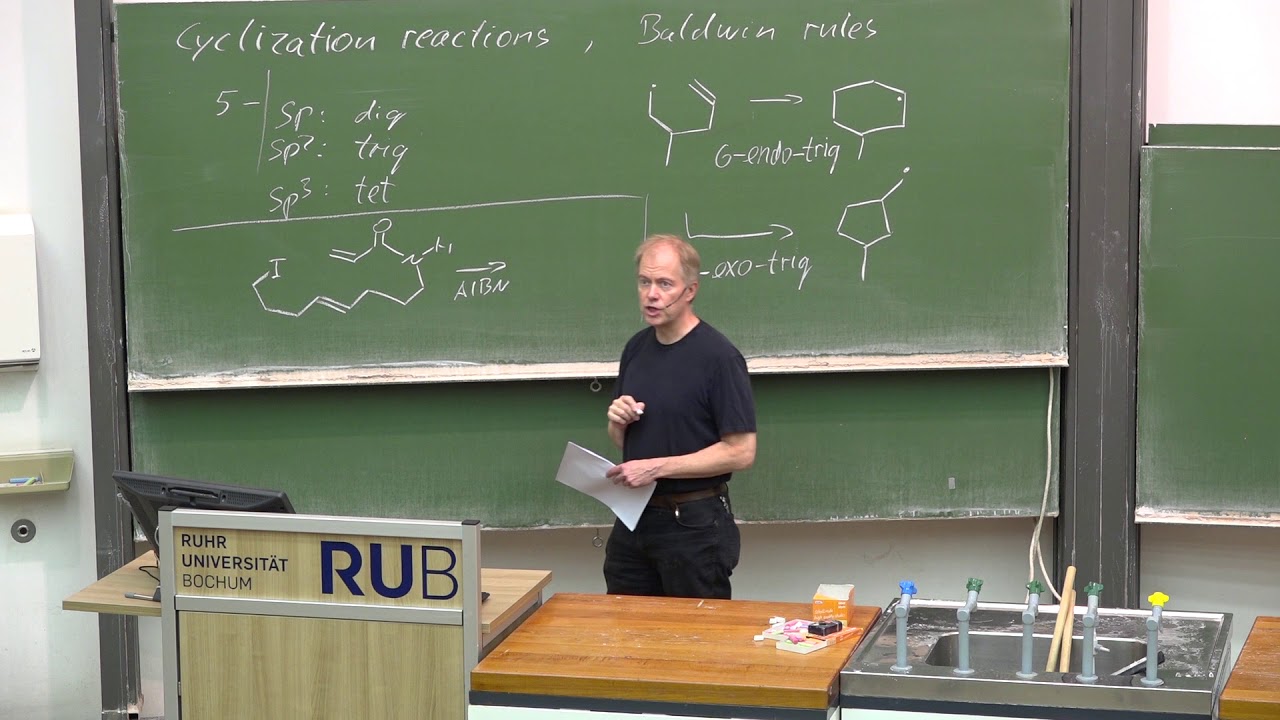
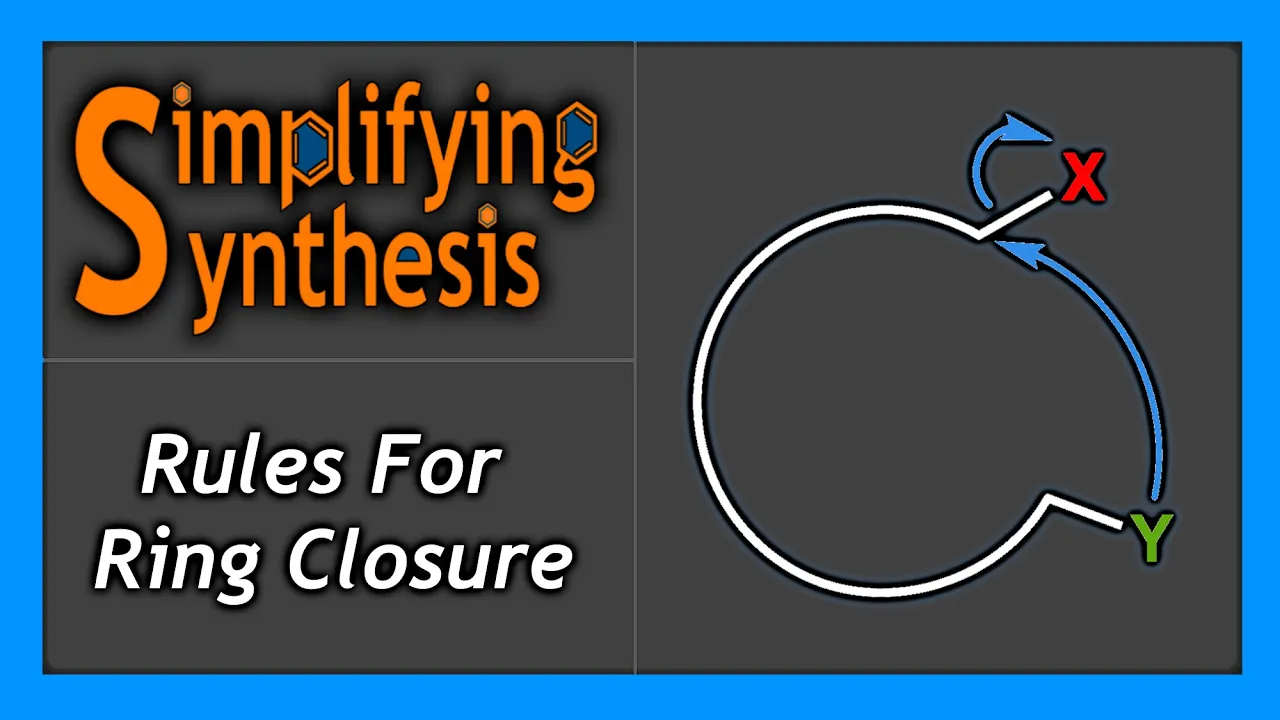
welcome back to simplifying synthesis the channel where we look at complex organic chemistry and explain how it works this week we are going to look at rules for ring closure this will be a general overview of ring closing reactions and the factors that govern them the rules describing ring clause and reactions are most often referred to as baldwin's rules after jack baldwin who first described them these are not absolute rules but more guidelines for determining if a cyclization is likely to occur while they typically hold true exceptions do exist baldwin's rules assume a nucleophilic ring
closing and as such are not applicable to other kind of ring-forming reactions they are not applicable to cationic reactions or reactions involving atoms of the second row and above this is because these atoms are larger and are not subject to the same stereoelectronic restraints as smaller atoms baldwin's rules are concerned with kinetic effects which are how fast transition states form reactions which are reversible and can form a thermodynamic product will often disobey them so let's look at how we classify reactions according to baldwin's method this classification takes into account three different factors the first is
the ring size this is the number of atoms in the ring being formed the next is concerned with where the bond breaks this could be a reduction in bond order from a double to a single bond or could be the breaking of a bond such as when a leaving group is liberated if this bond breaking event happens inside the ring it is termed an end or reaction whereas if the bond breaks outside of the ring it is classified as an exo-reaction the final term is the electrophile geometry in this case tet which stands for tetrahedral
which is the term used for an sp3 hybridized carbon there are other terms used which we will see later so here we have baldwin's rules as they were originally formulated if a reaction is likely to occur it is known as favored while if it is unlikely it is called disfavored this reflects the fact that these are not absolute rules but more generalizations drawn from empirical data from this table we can see that end or reactions tend to be much less favored than their corresponding eggs or counterparts particularly those involving a tetrahedral carbon center trig reactions
which have an sp2 hybridized center can be favored when the ring has six members or more likewise dignal reactions which involve an sp hybridized center are always favored for end-all ring closing reactions meanwhile eggs or ring-closing reactions are generally favored with the only exceptions being dignal reactions which form three or four membered rings so with this overview of what the rules are and how to use them let's explain their origin and why they work the physical basis of these rules lie in the stereo electronic requirements necessary to form the transition state favored reactions are those
in which the length and nature of the linking chain allows the terminal atoms to come together at the correct trajectory in order to react and form a transition state these reactions have a low activation energy disfavored reactions on the other hand require bond angle distortions and strained conformations in order to form a reacting transition state these reactions have a high activation energy for a cyclization reaction to occur the highest occupied molecular orbital of the nucleophile must overlap with the lowest unoccupied molecular orbital of the electrophile in order to form a transition state the energy of
this transition state is described by the gibbs equation delta g is equal to delta h minus t delta s delta g is the gibbs energy of activation it is the energy of the transition state relative to the energy of the starting reactant delta h is the enthalpy of reaction t is the temperature and delta s is the entropy of activation it is these barriers which must be overcome in order for a cyclization to occur first let's look at the enthalpy of activation this describes the energy needed to overcome repulsive forces and ring strain in order
to bring the reacting ends of the chains together perform the translation the entropy of activation describes the energy needed to form an ordered transition state from a disordered open chain so let's look at the factors which affect these terms and the overall energy of activation first let's look at ring size there are several different effects which influence the strain which is felt by ring relative to its open chain analog the first is bayer strain bayer strain is a strain that arises from the deviation of bond angles in a ring relative to the ideal bond angles
of an sp3 hybridized carbon an sp3 hybridized carbon will have bond angles of 109.5 degrees due to the geometric constraints of the ring these angles are often distorted the more that these angles are distorted in the ideal value the more strain will be present in the ring it is important to note however that these values assume a flat planar structure molecules will distort their shape in order to reduce this ring strain such as in six membered rings which will form a chair-like conformation with almost no bare strain as this shape allows the bond angles to
more closely resemble the ideal value of 109.5 degrees the next effect we will look at is torsional strain also known as pitzer strain in an open chain alkane the molecule will adapt a conformation where there is an anti-periplanar relationship between a filled carbon-carbon sigma bond and an adjacent carbon-carbon sigma-star anti-bonding orbital this conformation allows for hyperconjugation between these orbitals this reduces the overall energy and stabilizes the molecule ring structures can force bonds to take on different conformations and twist away from this ideal anti-conformation this twisting reduces the hyperconjugation and destabilizes the molecule and is known
as torsional strain closely related to torsional strain is van der waals repulsion this is repulsion between eclipse substituents and consecutive carbons this can contribute to torsional strain but it is not as significant as the loss of hyperconjugation in terms of the destabilizing effect ring structures can also be destabilized by 1-3 diaxial interactions these are the repulsive interactions between axial substituents and a cyclic molecule with a 1 3 relationship it is this diaxial repulsion which often determines the more stable conformation of a ring structure where possible rings will often flip to adopt a confirmation where the
largest substituent is in the equatorial position this is especially important in the chemistry of six membered rings all of these ring strain effects contribute to the enthalpy of activation which is the delta h term in the gibbs equation we can also look at the factors which affect the entropy of activation which is the delta s term one of these factors is the ring size the open chain precursor to larger rings have longer chains with more atoms and therefore have more degrees of freedom to rotate compared to shorter chains this means that there are more possible
confirmations for a longer chain molecule relative to a short one because of this it is less likely that it will adopt the confirmation necessary to form the transition state one effect which can help overcome the entropy barrier to forming a ring is the thorpe in gold effect also known as the geminal dimethyl effect this effect is the acceleration of cyclization reactions by substituents on the chain forming the ring one explanation of this effect is angle compression repulsion between the bulky substituents and the chain reduce the internal angle hear the knot at a and by reducing
this angle it brings the reacting ends of the chain closer together this is an enthalpic effect and was the explanation offered when this effect was first discovered while this is a factor in some reactions it is not generalizable to all cases in which the effect is observed more recent research attributes this effect to conformational rigidity due to the steric repulsion of the substituents on the chain there is a restriction on the freedom of some bonds to rotate and adopt certain conformations reducing the number of conformations available to the molecule this increases the likelihood that it
will adopt the conformation necessary to form the reacting transition state this is an entropic effect and lowers the energy of the delta s term which we saw in the gibbs equation we can summarize these effects and make general rules on how fast certain rings will form as with all of these rules these are not hard and fast and there are many exceptions in general three membered rings will form moderately fast as they are small they have high strain which has a high enthalpy barrier however they have a very low entropy barrier as there are very
few confirmations available to the chain four membered rings form quite slowly these have high ring strain and also mother's entropy barrier five and six membered rings form the fastest these have low ring strain as they can adopt envelope and chair conformations which reduce the ring strain on the molecule they have a moderate entropy barrier but this can be overcome for seven membered rings and larger they tend to form progressively slower as these rings are large they tend to have low strain however they have increasingly high entry barriers which must be overcome in order to form
a reacting transition state now that we have covered ring size we can take a closer look at the second factor involved in baldwin's rules which is where the bond breaks in an exos cyclization the bond breaks outside of the ring system we can see this in the examples shown here the electrons from the breaking bond leave the ring system either on a leaving group are still within the molecule but on a bond which is outside the ring system endo cyclizations on the other hand proceed with a bond breaking within the ring system though not formally
a cyclization reactions involving an intramolecular atom transfer are often modeled using endocyclization rules from looking at the table of baldwin's rules we can see that exocyclizations are generally more favored than endo reactions we can explain this by looking at the formation of the transition states due to the significant twisting of the molecule and the distortion of the reacting orbitals more energy is required to form a transition state where the nucleophile homo can overlap with the electrophile lumo with sufficient overlap in order for the reaction to occur exocyclizations on the other hand typically form much easier
with the more favorable orientation of the reacting orbitals they can approach from the correct trajectory with much less energy the final term in classifying a cyclization is the electrophile geometry the geometry of the electrophile relates to the hybridization and the orientation of the reacting orbitals an sp3 hybridized carbon center which has a tetrahedral geometry is referred to as tet an sp2 hybridized center with trigonal geometry is called trig while an sp hybridized center which is linear and dignal is called dig these different geometries have different ideal trajectories from which a nucleophile can approach a tetrahedral
center requires the nucleophile to attack at an angle of 180 degrees relative to the leaving group this is disfavored for endocyclizations of rings with seven members or less this is because this trajectory is not possible for smaller rings due to steric hindrance from the ring itself a trigonal centre on the other hand requires the nucleophile to approach from the bergie duna's angle at 107 degrees this is disfavored for endocyclizations of rings with five members or less this is less restrictive than the reactions of tetrahedral centers and this is because the lumo orbital lies outside the
plane of the ring and is more easily accessed by the nucleophile for a digital center the nucleophile preferentially approaches from an angle of 120 degrees relative to the leaving group this is favored for all endocytosations and and disfavored for exocyclizations of three and four membered rings this value of 120 degrees is revised from the value initially proposed by baldwin which was 60 this revision is based on more recent research and computational studies whereas baldwin derived his value from a limited data set of x-ray crystal structures several years after the publication of his initial paper baldwin
extended these rules to enolates an extra term is added for cyclizations involving enolates enol endo refers to reactions which leave the carbon atoms of the enolate fragment inside the ring as shown in the example on the right which is an inner endo endotest localization enol endo which refers to the blue fragment of the enolate which is inside the ring exo because the bond breaks outside the ring and tet because it's a tetrahedral center with sp3 hybridization on the other hand enol xor refers to reactions which leave the carbon atoms of the enolate fragment outside of
the ring shown on the right is an enol exo exotic reaction analogous to the previous example here however the inlet fragment lies outside of the closed ring in the reactions of enolates we do not just consider the orbital of the reacting atom but the orbital array of the enolate fragment as this array is extended across three atoms it has more demanding stereoelectronic requirements to form a reacting transition state as such more energy is required to form an enol endo transition state relative to the corresponding enol exile reaction the rules for enolates are shown here and
are quite simple to remember all enol exile reactions are favored while enol endo cyclizations to form three four and five membered rings are disfavored for both tet and trigonal centers finally we can look at the rules for radical cyclizations which were proposed by beckwith like baldwin's rules these are derived from the stereoelectronic requirements to form a transition state four intermolecular radical additions under kinetic control where the ring is five-membered or less cyclizations tend to occur preferentially in the exile mode this is because more energy is required to form a transition state where the radical homo
can approach the electrophile lumo from the correct trajectory this is due to the more favorable orientation between the reacting orbitals the substituents also play a role in influencing radical reactions in this case substituents on a possible reacting center disfavored cyclization at that point beckwith attributed this to steric effects which make it more favorable to form a transition state at the less substitution center finally there are some neighboring group effects in radical cyclizations the cleavage of a carbon-carbon bond into two carbon radicals which is known as homolytic cleavage is favored when the bond which is breaking
lies close to and in the plane of an adjacent semi-occupied orbital a filled non-bonding orbital which could be a lone pair on a heteroatom or to a pi orbital these effects arise from the hyper conjugation between these orbitals and the bond being broken which stabilizes the radical and reduces the transition state energy so that brings us to the end of the rules for ring closure in summary cyclization reactions must be planned with a consideration for the stereo electronic requirements necessary to form the transition state both enthalpy and entropy contribute to the energy requirements to form
a transition state substituents on the chain can greatly affect the favorability of a reaction such as through the thorpe in gold effect which can accelerate reactions or substituent effects in radical reactions which can alter the regiochemistry of the cyclization with an understanding of these rules most cyclizations can be achieved with careful planning to overcome these stereoelectronic barriers that's everything from this week's simplifying synthesis if you enjoyed this video please like and subscribe and if you enjoy these type of lectures please let me know in the comments down below i'll be back next week with the
more usual content looking at the total synthesis of capsicodendron by the hand group you