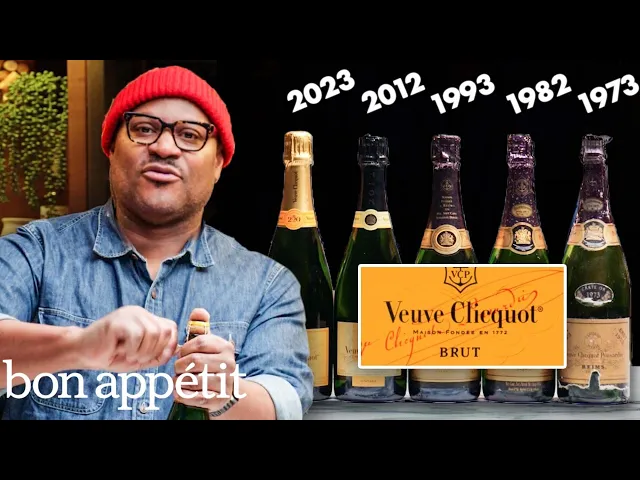
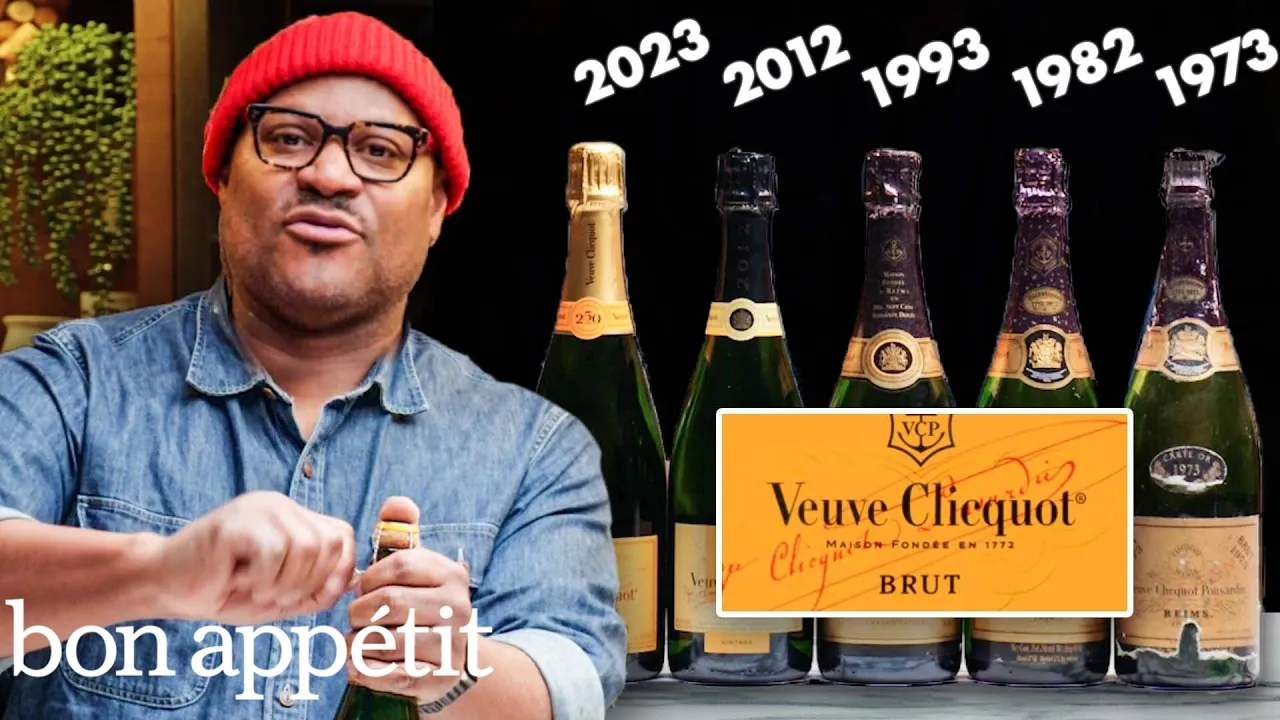
vintage champagne makes me very happy there's just not a lot of it available it's pretty expensive whenever I come across it and I don't have to pay for it you can Count Me In hey I'm Samuel Andre Houston Mack and today I'm going to be tasting champagne from the same producer from five different ages over 50 years champagne totally transforms in the bottle and today we're going to take a look at it we have champagne by vuv Cuco it's probably one of the most readily available and most recognizable Champagnes it goes back to Mid or late 1700s so it's been around for quite some time today we have 1973 we have 1982 1993 2012 and we have a non-vintage and these are considered some of the best vintages in Champagne so first up we're going to take a look at the labels and the bottles and see how they've changed over the years so when you see champagne on a bottle that should indicate to you that this comes from the region of champagne located in France there's lots of rules that govern the use of the term champagne I think mainly The Grapes that you can use you can use a blend of Pinot Noir Chardonnay or Pinot mune I think one of the first things that you'll notice or look for on the bottles here is a vintage so you'll have a year when you see a vintage listed on a bottle that means that the majority of that wine was Harvest and produced that year one does not have a vintage on the label and actually it goes by non-vintage but technically it's not a non-vintage it's just a blend of many different vintages that could be two years it could be three it could be four and not one of those vintages is a majority or enough that you can actually put a vintage they've only make Vintage Wines when they're great vintages otherwise it probably goes into the non-vintage wine and these are all representations of great vintages and champagne and they wanted to bottle them singularly to capture that expression Prices range and fluctuate through these particular bottles least expensive starting with the non-vintage ranging all the way to 645 dollars what you're paying for is time you're paid for a moment in time so the non-vintage here has the signature orange I do believe that they trademark this orange when you're looking at the labels from 1973 1982 and 1993 they have this purple with this kind of really kind of Regal one Gold Label in 2012 there looks like there was a label change so they moved away from the purple foil that you normally see in you know some of the older vintages it's black and it does have the a little bit of the signature orange on it as well Green Glass is what was used in Champagne just so a dark glass that kind of protects the champagne from UV light if you look at 1973 it does have some scuffs on it nothing to kind of really be alarmed of this would be a reason why it probably wouldn't be as expensive as something with a more perfect label but all in all this looks intact to me actually there is something floating around in the bottle to me it feels like it would be you know some type of sediment or Fallout as the wine ages I wouldn't be too alarmed about it I don't think it'll hurt you take it straight to the Dome now we're going to open these bottles and take a look at the quirks so we're going to start with the non-vintage we can just cut underneath the cage here so the cage is a safety mechanism for one it ensures that the cork won't shoot out due to the pressure that's in the bottle champagne actually starts off as still wine and then at some point once it's in Bottle you add more yeast to the bottle and that starts a secondary fermentation so a byproduct of fermentation is carbon dioxide and that's actually trapped inside the bottle and that produces the bubbles and then they have these little tabs here we're on 1993 and I don't know if that thing was invented in 1973. so it's a little sticky here and as I'm starting to smell it it smells somewhat sappy if you look at my hand there has been some leakage that doesn't mean it's bad or crossing our fingers here I don't know if the bottle was overheating but you can actually smell it too where it's like like where it smells like caramelized or matarized like through Heat this indicates that gas has escaped from the bottle along with some of the champagne so we're going to go ahead and open the non-vintage I think people joke around a lot but you should really be serious about opening champagne it could definitely put somebody's eye out I think the first thing you want to do is always keep your thumb on top of the cork the little lever here pull down and this is basically six half turns pretty Universal now it is so it's one two three four five six and then keeping my thumb on top I want to grab the bottom of the bottle and I just want to twist the bottle slowly and then kind of let the pressure push the cork out and that's it you're not supposed to make a big popping noise I think you see that in movies and they shoot it across the room and all that kind of stuff and that's a little bit Reckless and this is actually Madame gluco so that's her there she was a revolutionary and a Visionary within the champagne world she was the first woman to actually head up a champagne house a champagne cork is different than the wine cork in its shape so it almost kind of looks like a bell then it'll start shaped like that the court goes in halfway and then because of the pressure that is supplied here on the on the cage and how it's tied in the pressure up against the bottle makes this A little nudge here so we're going to go ahead and pour a little this non-vintage here so the mousse is kind of the head as you pour it there's bubbles in the glass so you very these very tiny small bubbles and I think that's what's really great big bubbles I think get in the way this is like a straw with a golden hue they don't do any type of masturbation for champagne it gets its color from the actual juice of the grape so now I'm going to open up the 2012. what we noticed here about this cork is that it's a little bit Slender on the part that it's inserted in the bottle because it's actually been in the bottle locker and it will slowly start to take on the shape of the neck so times you want to match up the Vintage data on the cork with the Vintage on the bottle just to authenticate in some way it is a vintage State on here so 2012 does match the one on the bottle anytime I think that there's anything of value there is room for counterfeit so you just want to make sure that those things match up it just seems a little bit more Crystal Clear if you will it has a Sheen or shine to it that's a little bit different than the non-vintage so now we're moving on to open 1993.
oh so there wasn't a lot of pressure even if you look at the cork it looks like a very old champagne cork where it's not you know inflated on the bottom the portion that goes in the bottle is pretty straight I don't see anything moving in the bottle but we don't know but look at that looks like pear juice compared to the others 19-year difference it's definitely going to pick up some color here as more oxygen has seeped into the bottle over the aging process it makes the wine darker there are small bubbles starting to propagate and pop up here so it's still ticking you know I'm excited to taste this all right so we're traveling back in time 41 years this is 1982. we're gonna pop this puppy open I can feel a little gas coming out right now and that was it I would say a little less pressure than the 1993 but pressure nonetheless I do see bubbles in the bottle so this looks like this is still ticket that looks like some kombucha so very short-lived mousse a very small bubbles very dark color looks more like apple juice really golden hue fascinating 41 years all right so now we're moving on to 1973 I'm going to go ahead and open this 50 year old bottle of champagne we do know that some wine has escaped through the bottle so we're kind of on the lookout for that so back in 1973 it's still Universal the cage is still six half turns this cork is just spinning around no real pressure at all all right I don't see any bubbles being produced in the bottle it does look cloudy I don't know if that's the glass it's definitely a different style glass that they use in the other vintages what I'm a little worried about is you know the cork is brittle so that kind of raises some suspicion and the courts tend to just kind of spin around in the bottle which tells me that this part of the cork that's inserted in the bottle was smaller than the bottle and that's where we were getting our air coming in from and the seepage from the cork will shrink just over time like at some point it could be heated up so it can expand and then get kind of contract what you don't want in wine is these big temperature swings you want a steady temperature and the ideal temperature somewhere around 55 degrees the only way we're going to know if it's still good to go is the port foreign okay so it's really dark there's no bubbles there should be some Lifeline you know some effervescent maybe there should be one or two bubbles popping up but uh I'm not getting anything this could have been stored improperly and could have left this a long time ago it does have some debris and you can see that it's pretty granular on the bottom of the glass on the right hand side over here there's particles of the wine that start to fall off and die pigment from the skins or from the grapes I'm not afraid to to to give it a taste in a whirl you know I've had wine from 1944 that was brown and it was great I'm very excited to taste these wines this is right up my alley champagne every damn day so now we're going to move on to do a smell and taste of the non-vintage wow this is a smell that's all too familiar to me like marzipan there is like a minerality so like wet Rock Lemon lilacs it is a little kind of toasty minerality Rock there is a little bit of pear and a little bit of some acid I am salivating a little bit medium the full body you can definitely tell that it's not flat you put it in your mouth it starts to Fizz and bubble again and this is pretty standard and basic entry-level champagne non-vintage for uh I think it's a great starting point so now I'm going to move on and taste the 2012. all right so I'm getting a little Apple in a weird way it smells like onions not pungent onions like onions that have been cooked down slightly caramelized buttery brioche so it's green apple apricot a little bit of like citrus and then you get like all of this kind of like kind of hazelnut thing happening on the finish some of the things where it's starting to show its age and taste his age for me as it starts to get a little bit more nuttier it's starting to show what bottle maturity looks like as it ages the primary fruit and the primary notes that you get start to like change into these secondary notes that you get through aging now I'm going to taste the 1993.
whoo yeah so that uh definitely smelling more butterscotch more kind of reduce cooked down apples pears a little bit more of like nutmeg some white flowers it smells like it's been in the bottle for quite some time caramel apple all the way Halloween trick-or-treat cooked down has been in the pot stewing you know and it tastes like old white wine and this is where I think the tasting of champagne and the experience changes drastically between 2012 and 1993. this has very very small bubbles this is just a total complete different experience you know it's not going to be sparkly and bubbly the way that you know something that that's younger is and you know you got to drink it quickly so now we're going to taste the 1982. 82 was a good year for wine overall it's more like a caramel chew to be honest with you this smells like an old closet and the best of ways like almost has like a little faint of like cocoa nibs or like chocolate it's a very very slight prickling of the tongue it's from the bubbles very very slight I think within the next five minutes or so there'll probably be no more gas in the wine a lot of the primary fruit especially as wine ages and in the 1982 in particular have kind of fallen way to the background they're a little bit faint you know so I get like just small like whiffs of like pear but like on the Apple side it's like cooked down reduce so it's still there but it's like it's changed its form this definitely drinks more like a wine than actually champagne you want to open it for people who you think that would appreciate it you know I probably wouldn't open at a New Year's party and the Big Moment of Truth is now we're going to taste the 1973.
oh yes we're tasting yes I'm kind of nervous to be honest with you uh it smells slightly corked there's a kind of a wet cardboard thing happening underneath so when I say court it's Court taint so it smells like a but newspaper wet animal there's a disease that's passed on through corks that aren't treated properly and it's believed that one bottle in every 12 bottle case is affected by Court tank it smells like pear juice out of a can it tastes like butterscotch kombucha it tastes like old white wine that's uh past this Prime but nonetheless I think this is all educational and it's definitely drinking a wine and understanding the wine that's kind of past its prime there's caramelization thing happening this butterscotch happening and then that's it there's nothing else there's no Nuance to it that's all you get across the board this ship has set sail here it won't make you sick or anything like that but it is a fault in wine so there's a lot of different things that can happen and you know buying old and rare wine there is a risk associated with it there's no recourse to get your money back buy at your own risk this is the game I love the game love the game you win some you lose some hopefully you win more than you lose what really stood out to be in my favorite was 1993.