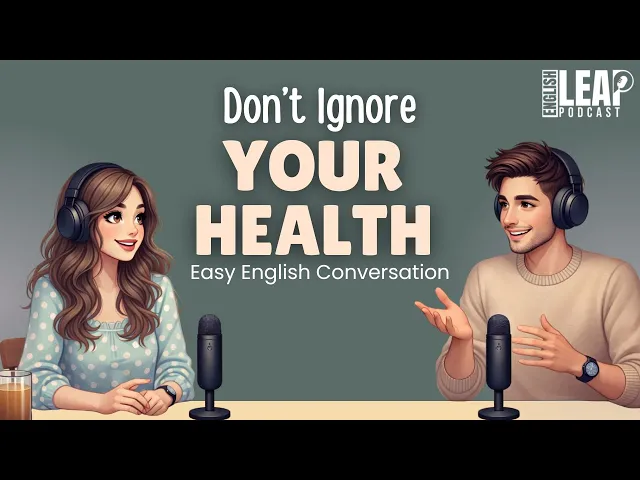
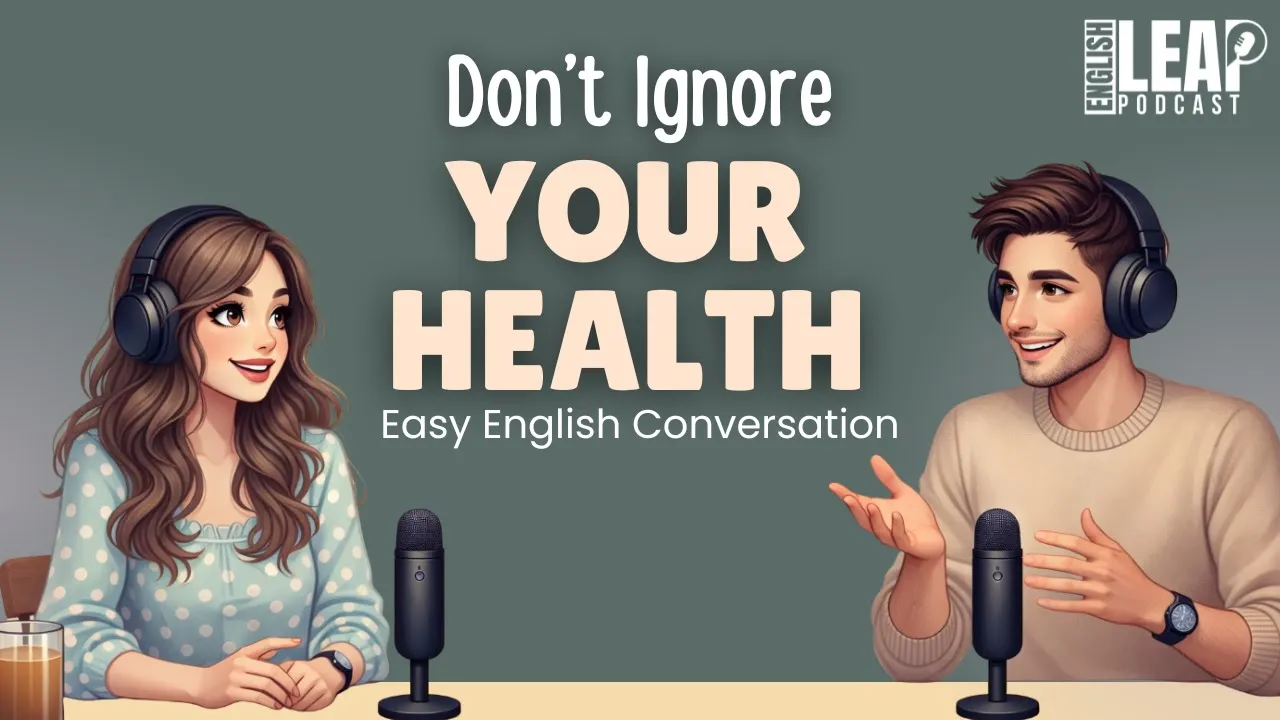
English Leap Podcast >> from Speak English with Class. Hey English learners, welcome back to the English Leap Podcast, your cozy place to learn easy English through real life conversations. I'm Anna >> and I'm Jake.
Maybe your day has been loud and busy, but right now it's just you, your headphones, and our voices. However you're listening, we're really glad you chose to spend this small piece of time on yourself. Okay, before we start, how are you today, Jake?
Not the podcast answer, the real answer. >> Ah, the real answer. H I think I'm a good mix of grateful and tired.
Grateful because I love doing this. Tired because my week has been a little bit too full. >> Too many things in your schedule.
>> Yeah. work, calls, messages, and somehow I still feel like I didn't do enough. My body is like, "Please slow down.
" And my brain is like, "No, keep going. " >> M, that feeling is so familiar. It's like your body and your mind are not on the same team.
>> Exactly. And you, how are you doing today? Really, >> honestly, I feel a bit heavy.
Not sad, just heavy. My eyes feel tired. of my shoulders feel tight and there's this little voice saying, "You should have slept earlier, Anna.
" >> Yeah, that should voice. It's very good at giving comments after everything is finished. >> True.
It never comes before. It always comes after with a long report. >> Very critical report.
>> And if you're listening and you feel something like this too, tired body, busy mind, a lot of should in your head, you're not alone. We're right there with you. >> And that's actually why we chose today's topic, not to talk about perfect diets or gym routines, but to talk about this quiet fight we have with our own body and how we can make that relationship softer.
And we'll talk about it in B1 level English. calm, simple sentences. No heavy medical terms, no big psychology words, just things you can really feel and use in your own life when you wake up tired or when you feel guilty for resting, >> right?
If you don't understand every single word, that's okay. Really, just relax, listen, and let the ideas sit in your mind. You can always listen again later, maybe on a walk or before you go to sleep.
>> And near the end, we'll do a small word tour. We'll take a few useful words from today and explain them slowly with examples so they can stay with you and you can use them in your own sentences. >> And if you enjoy learning English like this, calm, real, a little bit personal, don't forget to like this episode and subscribe to the English Leap podcast.
It really helps more learners find us and feel less alone with their tired minds and tired bodies. And later, we'd love to hear from you in the comments. When you feel really, really tired in life, what do you usually do first?
Keep pushing, lie down, scroll on your phone, or try to ignore it? And what is one small kind thing you wish you could do for your body? >> All right, take a deep breath, >> let your shoulders drop just a little, >> and let's jump in.
So Anna, you said something before we started recording and it really stayed in my mind. >> What did I say? I say many strange things.
>> Yeah, that's true. But this one you said, I don't feel ugly. I just feel tired.
>> Oh, that one. Yeah. >> Can you tell that story slowly?
I think a lot of people will feel it. >> Okay. So, a few months ago, I had one of those mornings.
You know the type. Yeah, those mornings >> I slept late again. My phone and I had a very long and very unnecessary relationship until 2 a.
m. >> The toxic relationship, >> right? So, I woke up already late, already annoyed at myself.
I went to the mirror and I was ready. >> Ready for what? >> Ready to attack myself.
You look bad. You look so tired. Why did you eat that last night?
You should be more disciplined. >> Yeah, that script. >> But this time, something strange happened.
I looked at my face and I didn't feel ugly. I just felt tired. Deep tired.
Not I need coffee tired, more like my whole life is heavy tired. >> Like tired in your bones. >> Yeah.
And in my mind, the word that came was frazzled. >> Frazzled. Frazzled means tired and stressed and messy altogether.
Like your thoughts are little pieces of hair going in every direction. >> Yeah. Like when you wake up and your hair is doing its own experiment.
>> Exactly. My brain felt like that. And for a second I stopped blaming my face.
>> Oh. >> I looked closer and I thought my body is not the problem. My body is just showing me the story of how I am living.
Hm. >> It felt like my body was a small friend standing in front of me saying, "Hey, I am not okay. I am doing my best, but I am tired.
Can you please slow down? " >> Right. So, it wasn't an attack.
It was a message. >> Yeah. It was like a wakeup call.
>> H a wakeup call is a moment that shakes you and says, "Hey, something needs to change. " >> Yeah. I realized for years I was angry at the mirror, but the mirror was innocent.
It was just reflecting the way I treated myself. >> That's big. >> And maybe if you're listening, you've had that moment, too.
You look at your face and think, "I don't hate how I look. I hate how I feel. " And you can't even find the right words.
You just know this is not how you want to live. >> If that's you, we see you really. And you know what makes it worse?
>> What? >> The good girl or good boy mode. >> Oh, that mode.
>> Yeah. When your body is screaming, "Please, no more. " But your mouth is still saying, "Yes, of course.
No problem. >> Sure, I can help. Sure, I can finish that.
Sure, I can join that meeting. Sure, I can come to that dinner. " >> And inside your body is like a tired employee going, "Excuse me, boss.
Can we sit down? " And the brain answers, "No, we have standards. >> We do not sit.
We only excel. " >> Yeah. And then at night, you lie down and think, "Why am I so tired?
I didn't do that much. " >> But actually, you did a lot. Not just in your schedule, but in your heart.
You carried everyone. >> There's this idiom, carry the weight of the world on your shoulders. >> Carry the weight of the world on your shoulders.
It means you feel like you have all the problems, all the responsibilities, everything is on you. >> Yeah. And when you live like that, little by little, you become depleted.
>> Depleted. So, not a little tired, but more like empty. >> Exactly.
Like your phone on 1% battery and there's no charger near you. That's depleted. When your energy tank is almost zero.
And if you're always being the good girl or good boy, saying yes to everything, you don't even notice. You just keep adding. >> Yeah.
You pile on more work, more promises, more plans, even when you're already tired. >> Pile on means keep adding more and more on top. Like putting extra bags on someone who is already full.
And maybe your body has been trying to talk to you for a long time with headaches or tight shoulders or that heavy feeling in your chest when you wake up, >> but we push it aside. >> Push it aside. >> That means we ignore it.
We say, "Not now. I'm busy. " >> Right?
But your body is actually your first friend. It has been with you from day one and it will be with you to the last day. >> Maybe it doesn't need a stricter boss.
It needs a kinder friend. >> So, what do we usually do when we finally see, "Okay, I'm tired. Something is wrong.
" >> Uh, we make the plan. >> Yes. Big capital letters.
The plan >> from Monday. New me. From Monday, I wake up at 5:00 a.
m. , run 10 kilometers, eat only perfect food, answer every email, meditate, learn three languages, and never feel tired again. >> Also, clear skin, no sugar, no snacks, no fun.
>> Exactly. And on paper, it looks amazing. >> But it's not a plan.
It's a fantasy. >> Yeah. It's like asking a tired person to suddenly become a superhero in one night.
>> And then what happens? Monday morning, real life arrives. >> Work, kids, boss, emails, traffic, mood, hormones, bad Wi-Fi, everything.
>> And you oversleep or you eat something outside your perfect planned or you're too tired to exercise >> and suddenly your brain says, "Ah, see, you failed. " Same story. You will never change.
>> And then you give up until the next Monday. >> It's like you are stuck in a loop. >> Stuck in a loop.
>> That idiom means you are repeating the same pattern again and again. Like a song that never moves to the next part. >> Strict plan.
One small mistake. Shame. Give up.
New strict plan. Repeat. >> And every time you do this, you feel a little more disappointed in yourself.
Yeah. You don't just feel tired, you start to feel broken. >> But actually, you're not broken.
The plan is broken. >> Yes, the plan is too heavy. >> It's like putting on five big winter coats and then asking, "Why am I so hot?
" If you're listening and thinking, "Yep, that's me. " Please hear this. You don't need a bigger plan.
You probably need a lighter one. Yeah, maybe this is the year you don't push harder, you scale back a little. >> Scale back.
>> That means make things smaller, easier, lighter. Not give up, just carry less. >> So you can actually walk, not run yourself into the ground.
>> You know what really changed things for me? >> What? >> I realized I was treating my health like a 30-day challenge.
But my body is not a challenge. It's a relationship. >> A relationship.
>> Think about a good friend. You don't say, "Okay, for 30 days I will be nice to you and after that back to normal. " >> 30-day good friend challenge, >> right?
You show up again and again. Some days you're full of energy. Some days you're quiet.
But you don't disappear just because one day was not perfect. >> That's what a resilient friendship is like. >> Resilient.
Resilient means it can have problems but it doesn't break. It can come back. >> And I thought I want that kind of relationship with my body.
Resilient, not perfect, not dramatic, just steady and kind. >> But for many of us, our relationship with our body is very lopsided. >> Lopsided.
>> Lopsided means not balanced. One side is too much. For example, all work, no rest.
All criticism, no kindness. >> Yeah. We expect our body to sit, work, answer, smile, carry, and then we are surprised when it feels weak.
>> It's like expecting your phone to work for 3 days with no charger. And when it dies, you say, "Wow, what a lazy phone. >> Poor phone.
>> Poor body. " >> Maybe health is not, "How can I fix this body? " Maybe it's how can I be more nurturing to this body?
>> Nurturing. >> Nurturing means caring in a warm way like watering a plant or hugging a child or making soup for a sick friend. >> And imagine if you used that same energy for yourself.
>> Yeah. If you talk to your body like a tired friend, not like a lazy employee. >> You don't have to turn your life into a boot camp.
You can turn it into something softer. but still strong. >> And that's what we want to do next.
We want to share three small, gentle habits that feel like care, not like punishment. >> Soft rules, not prison rules. >> Yeah, soft rules.
>> So, let's walk slowly through those three habits one by one. >> Okay. Habit number one, we call it the plate peace rule.
>> Yeah. Because your plate doesn't need a war, it needs peace. >> Right?
For many years, my health plan was just attacking my plate. No bread, no rice, no sugar, no fun. >> No joy, just lettuce.
>> Yes. And of course, I could do it for maybe two days. >> Mhm.
And then pizza. >> Yeah. And then pizza.
And then guilt. And then I am the worst. >> So what's different with plate piece?
>> With plate piece, we don't start by removing. We start by adding one good thing. Just one.
>> Add. Don't attack. >> For example, you have your normal lunch, your normal dinner, and you add a handful of salad or some vegetables or some protein or simply a glass of water.
So the question is not what can I cut. The question is what small thing can I add that future me will be happy about. >> Yeah.
Future Anna loves when I add something green or something real not from a packet. >> Yeah. Future Jake is very grateful when present Jake doesn't eat chips for dinner.
>> And this way it becomes more sustainable. >> Sustainable. >> Sustainable means you can continue it for a long time.
It doesn't feel crazy or extreme. It feels normal. >> And that's the goal.
Not a perfect week, but a gentler life. >> So maybe tonight you don't change everything. You just ask, "What is one small kind thing I can add to this plate?
" >> That's it. That's plate piece. Habit number two is very simple.
We call it the water plus walk rule. >> It already sounds friendly. Yeah.
It's like a tiny spell. First, drink one glass of water. Then walk for 8 to 10 minutes.
>> That's it. >> That's it. No 1 hour in the gym.
No 10,000 steps or you were a failure. Just water and walk. >> I love that.
You can walk in your house, in your hallway, in front of your building, or maybe just around your office parking. >> Yeah, the office parking walk of peace. And the interesting thing is it doesn't only help your body, it also helps your mind when it feels messy.
>> Yeah. When I feel overloaded, >> overloaded >> overloaded means there is too much in your head, too many tasks, too many thoughts. Like your brain has 27 tabs open.
>> Yes. All playing music at the same time. >> Exactly.
When I feel like that, a small walk is very soothing for me. >> Soothing. >> Soothing means calming in a soft way, like gentle music, a warm bath, or someone saying, "It's okay.
I'm here. " >> M I think many listeners need soothing, not more go energy. >> Yeah.
So, here's how you can try it. After a meal or after a long work block, tell yourself, "Okay, water plus walk. One glass, 10 minutes.
" >> You don't need expensive clothes or a perfect route. You can walk slowly. You can even listen to us while you walk.
>> Yeah, we can be your walking friends. >> And step by step, your body starts to feel less like a machine and more like a friend you spend time with. >> Not to punish it, but to help it feel alive again.
>> Habit number three. This one is very tender for me. We call it the sleep respect rule.
>> Yeah, we really need this one >> because sleep is not just nice. It's the time when your body repairs you. Like a secret night team doing quiet work.
>> The night repair team, >> right? But we often treat sleep like it's extra, like it's a bonus if we have time. >> Yeah.
We act like sleep is a gift, not a basic need. >> So our rule is small. very small.
Put your phone away 15 minutes earlier than usual. >> Just 15 minutes. >> Not 1 hour, not a perfect night routine from some influencer.
Just 15 minutes. >> And in that 15 minutes, you can do something that helps you feel more anchored. >> Anchored.
>> Anchored means feeling steady and safe, like a boat that doesn't move away because there is an anchor holding it. >> Yeah. For me, being anchored before sleep is washing my face slowly, maybe putting cream and breathing like 10 deep breaths.
>> For me, it's my grandpa mode. >> Grandpa mode. >> Yeah.
Soft t-shirt, dim light, maybe a simple book, no drama, no late night news. >> I love that. >> And when I don't do this, my day just drags on.
>> Drgs on. >> Drgs on means something continues for too long. and feels slow and heavy.
>> Yeah, your day doesn't end. It just stretches into the night with Tik Tok and emails. >> So, if you're listening, maybe tonight you can try this.
Choose a time and 15 minutes before that time your phone goes away. Another room, another side of the room, whatever. >> Then just ask yourself, how can I be a little kind to my body before I sleep?
Stretch, breathe, soft music, quiet prayer, anything. That's the sleep respect rule. Not sleep perfectly, just show respect.
>> Now, we need to talk about something a little heavier. >> Yeah, the guilt part. >> There were so many nights when I lay in bed completely tired and my mind was still talking.
You didn't do enough today. You were lazy. You don't deserve rest.
>> M I know that feeling. My body was almost at breaking point. >> Breaking point.
>> That means you are very very close to not being able to continue. Like a thin line that is almost breaking. >> Yeah.
And instead of giving yourself a hug at that moment, you give yourself a report card. >> Yes. A bad one.
>> But here is something we really want you to remember from this episode. Rest is not a reward. Rest is a need.
>> Rest is not a reward. Rest is a need. >> You don't have to finish all tasks to deserve to sit down.
You don't have to be perfect today to deserve sleep. >> You are not lazy for needing rest. You are alive.
>> And sometimes you need to cut yourself some slack. >> Cut yourself some slack. >> That idiom means stop being so hard on yourself.
be a little more forgiving. >> Talk to yourself the way you would talk to a friend. You would never say to your friend, "You don't deserve to rest.
" >> Right? You would say, "Hey, you look tired. Go lie down.
I'm proud of you. " >> And maybe you need to hear that today. So, let us say it softly for you.
You did enough. You can rest. You're allowed to be tired.
>> Yeah. You're allowed to be human. Okay, before we go to our little word tour, we want to end this part with one small promise.
>> Not a big challenge, just a small soft promise. >> If you can say this with us, today I will do one kind thing for my body. >> Today I will do one kind thing for my body.
>> That one kind thing can be very small. a glass of water, >> a 10-minute walk, >> leaving your phone a little earlier, >> eating a simple real meal instead of just snacks, >> or even lying down for 10 minutes without feeling guilty. >> And if tomorrow you forget or you eat junk or you scroll late again, >> you don't need a new punishment.
>> Yeah, you just need another small promise. >> You don't need a perfect body. You need a life that feels good >> and a relationship with your body that feels softer.
>> All right, let's take a small word tour before we finish. Just a few important words from today. >> Yeah.
Walk with us through these words. You don't have to remember everything perfectly. Just feel them.
So, the first word is frazzled. >> Yeah. Frazzled means you feel very tired, very stressed, and your mind is a bit messy.
It's like your thoughts are sticking out in every direction like crazy morning hair. >> For example, after a long day of meetings and messages, I felt completely frazzled. >> Or when I don't sleep well, my brain feels frazzled and I can't think clearly.
Next word, depleted. >> Depleted means your energy is empty. Your battery is not 20% or 10%, it's almost zero.
There is nothing left to give. >> For example, by Friday evening, my energy was depleted and I just wanted to lie down. >> Or if you never rest, your body becomes depleted and even small tasks feel very heavy.
Another word is nurturing. Yeah, nurturing describes a warm, gentle kind of care that helps someone grow, like watering a plant, making soup for a sick friend, or talking kindly to a child. >> For example, I want to have a more nurturing relationship with my body instead of always criticizing it.
>> Or a nurturing teacher makes students feel safe and confident, not scared. >> The next word is lopsided. Yeah, lopsided means not balanced.
One side is too big and the other side is too small. Like a seessaw in the park where one person is very heavy and the other person is very light. >> For example, my life felt lopsided.
I was working all the time and never resting. >> Or if you only give to others and never take care of yourself, your life becomes lopsided. >> Another word we used is anchored.
Anchored means steady and safe, like a boat that doesn't move away because it has an anchor in the ground. You feel stable, not lost. >> For example, a small night routine makes me feel anchored before I sleep.
>> Or when I write my plan for the day, I feel more anchored and less confused. >> Another word is autopilot. Autopilot is when you do things without really thinking, just by habit, like a plane that flies by itself.
You are moving but not really choosing. >> For example, I was saying yes to everything on autopilot and didn't notice how tired I was. >> Or sometimes we eat on autopilot, not because we are hungry, but because we feel stressed.
>> Now, an idiom, carry the weight of the world on your shoulders. This means you feel like you have all the problems and all the responsibility like everything is your job. >> For example, she felt like she was carrying the weight of the world on her shoulders.
Work, family, money, everything. >> Or you don't have to carry the weight of the world on your shoulders. It's okay to ask for help.
>> Another idiom is run yourself into the ground. Run yourself into the ground means you push yourself so hard that you become extremely tired or even sick. You keep going until your body can't do it anymore.
>> For example, he ran himself into the ground by working late every night for months. >> Or if you never rest, you will run yourself into the ground and your body will stop you. >> The next phrase is stuck in a loop.
Just stuck in a loop means you repeat the same pattern again and again. Like a song that never moves to the next part. >> For example, I felt stuck in a loop.
Strict plan, one mistake, shame, give up, start again. >> Or if every Monday is new start day, maybe you're stuck in a loop, not really changing. >> Another useful phrase is cut yourself some slack.
Cut yourself some slack means stop being so hard on yourself. Give yourself more kindness and more space. >> For example, you had a difficult week.
You can cut yourself some slack and rest tonight. >> Or instead of calling yourself lazy, cut yourself some slack and remember you're doing your best. >> Now, a phrasal verb, pile on.
>> Pile on means keep adding more and more things on top. More work, more tasks, more pressure. For example, even when I was tired, I kept piling on extra projects.
>> Or don't pile on more promises when your energy is already low. >> The next phrasal verb is scale back. >> Scale back means make something smaller, lighter, or less.
You reduce your plan so it is easier to do. >> For example, I decided to scale back my goals and focus on just three important tasks. or if your routine feels too heavy, you can scale back and keep only the basics.
>> Another phrasal verb is push aside. >> Push aside means ignore something or try not to think or feel it. You don't deal with it.
You just move it away in your mind. >> For example, I kept pushing aside my tiredness and telling myself to work more. or instead of pushing your feelings aside, you can stop and listen to them for a moment.
>> The next one is tune back into. >> Tune back into means start paying attention again to something like your body or your emotions. It's like turning the radio to the right station.
>> For example, this year I want to tune back into what my body is trying to tell me. or when you slow down, it's easier to tune back into your real needs. >> And our last phrasal verb is drag on.
>> Drg on means something continues for too long and feels slow and heavy. Time feels like it is moving very slowly. >> For example, my day dragged on because I was exhausted and couldn't focus.
or when I stay on my phone at night, the evening drags on and I don't sleep enough. >> So, these were some of the words from today. Not just for your English, but also for your life.
>> Yeah. And remember, you don't need a perfect body, you just need a softer way to live in the body you already have. >> In the comments, tell us when you feel really, really tired, what do you usually do first?
And what is one small kind thing you want to start doing for your body? >> If this episode made you feel a little less alone or helped you learn something new, please like this episode and subscribe to the English Leap podcast. It really helps more learners find us.
>> Take care of your body like it's your friend >> because it is. >> We're sending you a soft hug wherever you are. >> And we'll talk to you in the next episode.
>> Right. This is Anna >> and this is Jake. and you've been listening to the English Leap podcast.
Bye. Your progress doesn't end here. To continue advancing your English skills, click on the next video or explore the additional videos we've thoughtfully selected for you.