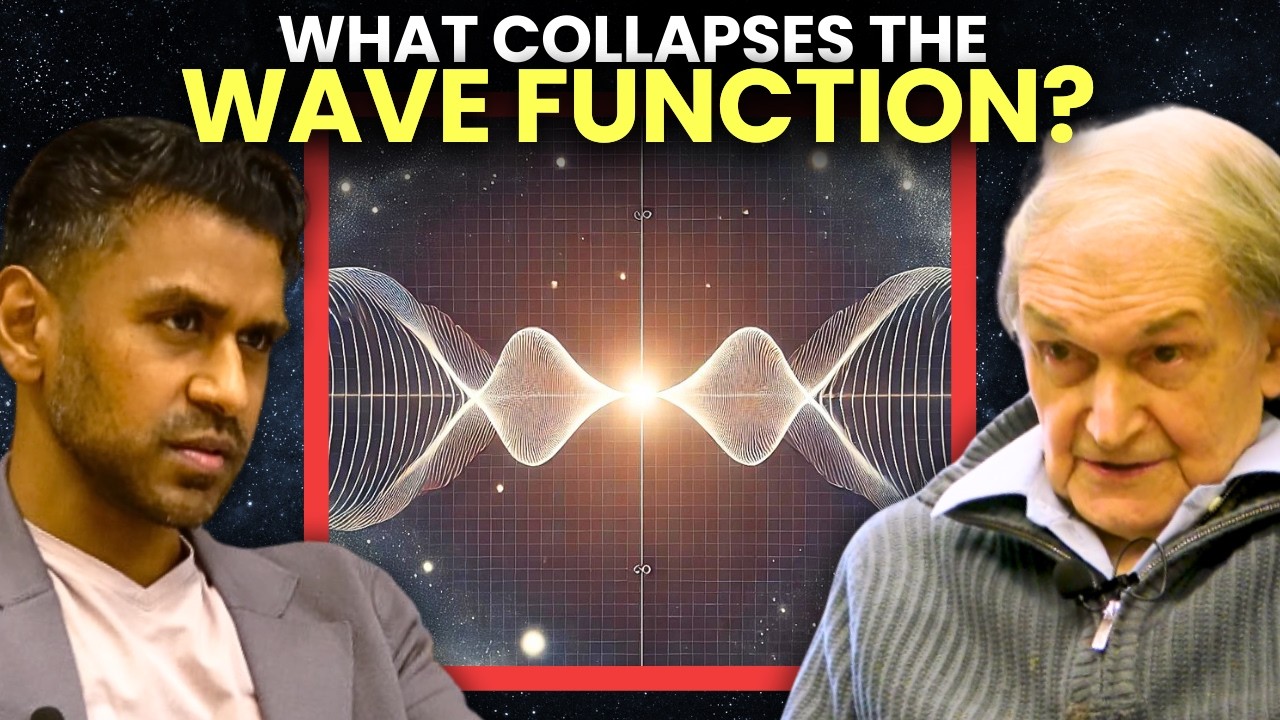
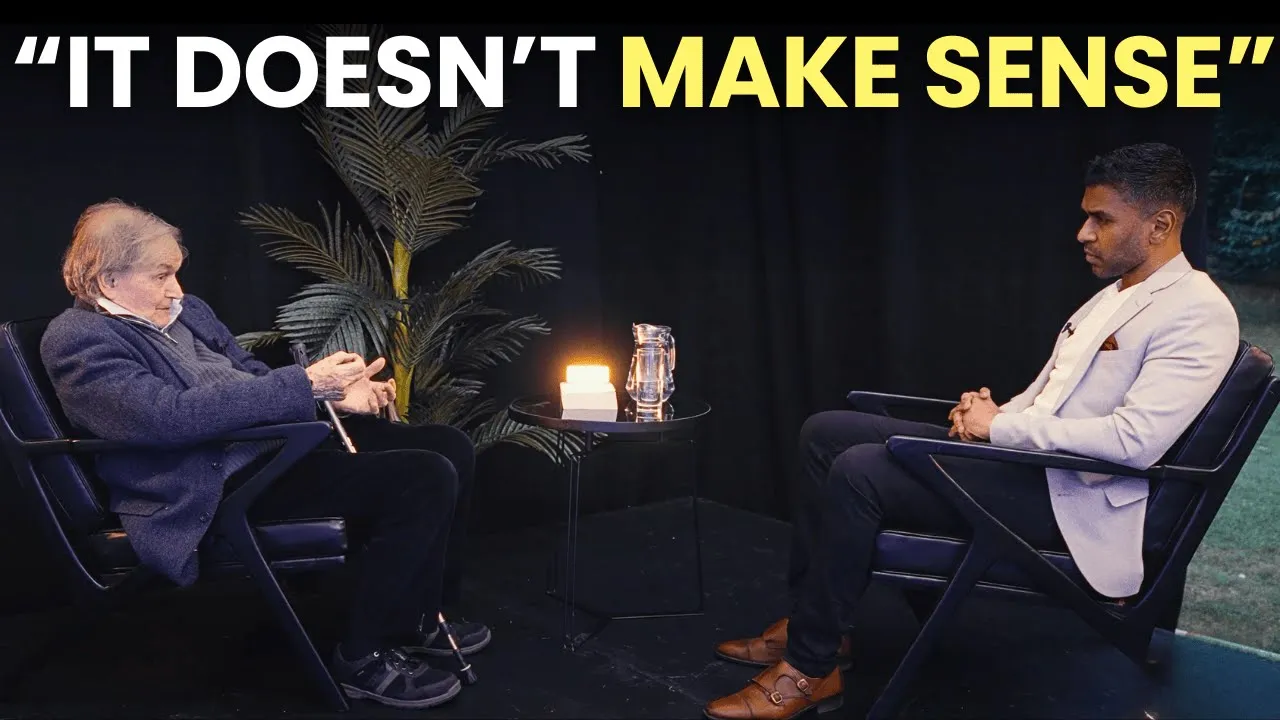
Quantum mechanics has a huge flaw, and the flaw is the collapse of the wave function. Most physicists say, "well, it's a function of things getting big and complicated. " My view is the opposite of that.
Trouble is that these procedures fundamentally cheat. You have to gravitize quantum mechanics. Sir Roger Penrose, welcome.
It's good to have been spending almost the entire day with you since you've been here. My pleasure. What are you most proud of in your career?
I think twistor theory would be the thing which probably I'm most proud of, in the sense that there's more in it. I mean, it was an idea that I had basically in 1963, I guess. And now, just now, there is a workshop in Cambridge which is devoted to twistor theory.
All sorts of people, and there are different aspects of the subject which is spread out into pure mathematics and into some areas of particle physics and things like that. So it's spread out. Not necessarily the form of the theory which I initiated, but nevertheless, the same sort of idea.
Now, to explain what twistor theory is would be a little technical. It's an area of mathematics, I might even just say that, which was developed specifically to treat certain fundamental issues in quantum theory in relation to relativity theory too. So it's all tied up with that.
But let's not go into that because it's a bit too technical. But on the other hand, I would say that there are two things. One is what people call the D.
O. C. Penrose model.
It's a different model exactly, but it's the same time scale. You see, there's a thing called the collapse of the wave function, which tries to make sense of quantum mechanics. Quantum mechanics doesn't make sense when you talk about macroscopic objects.
What I mean by that is, it's a theory of small things, of particles and so on. And people sort of say, well, big things are made up of small things, so a theory of small things must be more fundamental than a theory of big things. Well, the best theory of big things that we have is general relativity, which deals with black holes and stars and galaxies and the way the universe as a whole behaves and things like that.
And since people think that small things are more fundamental than big things in a sense, there's a big project which is to quantize gravity. That means use the rules of quantum mechanics and apply them to gravitational theory. And since quantum theory is the more fundamental, so the argument goes, that's the way you've got to do it.
Now, my view is almost the opposite of that. You have to gravitize quantum mechanics because quantum mechanics has a huge flaw. And the flaw is basically the collapse of the wave function.
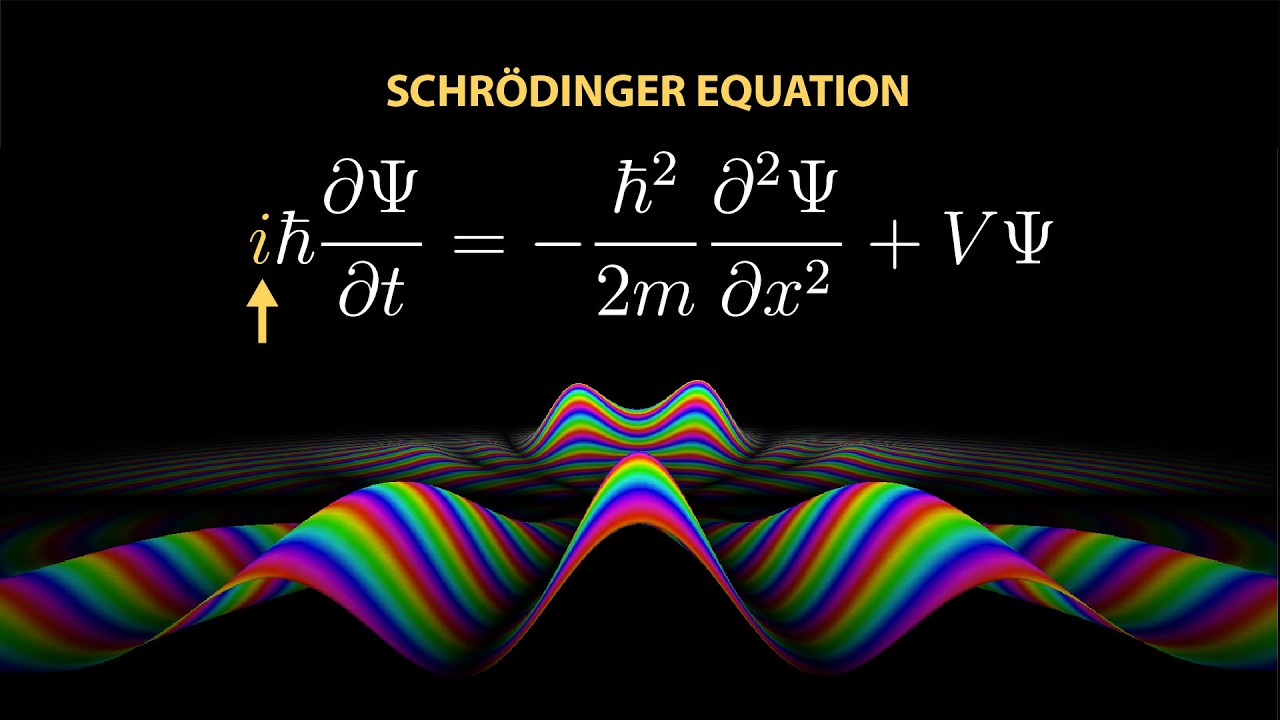
What do I mean by that? Well, you see, there's a thing called the wave function, which evolves according to a very famous equation, the Schrodinger equation. The wave function describes the quantum system, the quantum state, if you like.
So the state of the world, according to quantum mechanics, can be described by this kind of wave function. Now, the Schrodinger equation tells you how this evolves in time. So if you knew what the wave function was now, it would tell you what it was in 10 minutes, what it was in 20 minutes in the next day, and so on.
If it was completely isolated. Of course, it's not. It tends to get perturbed by the outside world, and people seem to regard that as the important thing, why you can't really use the Schrodinger equation.
But that's not my view. See, what you do is you develop the system according to the Schrodinger equation, and then you cheat. You do what's called you collapse of the wave function, which means you make a measurement on your system, and this measurement has a certain view as to what the alternatives can be, and the state may not be in one of those alternatives.
And so you have a rule for how you proceed. And this involves the system evolving not according to the unitary evolution, as it's called, or the Schrodinger equation, or whatever you want to call it, but another phenomenon which is called the collapse of the wave function. Now, most physicists seem to say, well, it's a function of things getting big and complicated, and you can't really apply the Schrodinger equation because the system's got too complicated.
So you develop systems, mathematical formalisms, to try and deal with that complication and sweep it under the carpet. The only trouble is that these procedures slightly cheat, or really fundamentally cheat, I should say. They change the view as how you regard reality.
Is it described by the wave function, or is it something else? And you introduce this something else, which is called a density matrix, and that density matrix is supposed to be a better description of the world because it includes all the random things. And then you go back and say it describes a probability mixture of different states, different quantum states.
In there is a little glitch of logic, which people like to sweep under the carpet. And what you have actually collapsed the wave function without saying it out loud. And the collapse of the wave function does not follow the Schrodinger equation.
And I think most people in physics, certainly in the old days of physicists, I'm not sure what they think now, would think that the collapse of the wave function is not a real phenomena. It's something to do either with the environment getting mixed up with it, or more plausibly some people would argue, by a conscious being coming and looking at the system, or doing an experiment on the system, measuring the system. In fact, the word measurement is used in quantum mechanics.
You measure the system and that involves secretly the collapse of the wave function, but you shovel that under the carpet. So none of these arguments really do explain why quantum mechanics works. And when I say gravitizing quantum mechanics, the solution to this problem, in my view, has to involve gravity.
Because the collapse of the wave function, in my view, is a real physical process. It's nothing to do with a conscious observer looking at the system or anything like that. It's a real physical process, which takes place when the system gets too big, in the sense of gravitation.
And I can describe it as being, well, the sort of stage when people argue that things go classical beyond quantum, is the Planck mass. And the Planck mass is the mass of a flea's eye, roughly speaking. So it's pretty small, but not ridiculously small.
In fact, it's not really very small, because if you had something of the mass of a flea's eye and you moved it into a superposition here and here at the same time, you can do that with protons and electrons and things, it can be here and here at the same time, and that's a perfectly good quantum state. Why don't you see a stone, why don't you see a pebble here and here at the same time? Well, people say, well, it's all to do with measurements and all that stuff.
Well, I would say, no, there is a phenomenon, which is the collapse of the wave function, which actually happens at a certain level, and you can work out how fast it happens using this formula. And this formula was independently and earlier than me, done by Lajos Djosi, and he had a different argument. I don't even remember his argument.
He was about two years earlier than me. I didn't know about his argument. I produced my argument later on as rather surprised to find that he's already done it.
He hadn't done it in the sense of the argument that I presented. I don't think his argument was necessarily a gravitational field argument. So what was the same about it?
It's the same lifetime. You see, it says that the decay time, you put a grain of sand into a superposition of here and here, how long will it take before it becomes one or the other? And the formula that he came up with is basically the same as the formula I came up with.
And I'm arguing this from this tension between the gravitational theory, Einstein's gravitational theory, which it has to be Einstein's theory, and this superposition principle. See, Einstein's theory was based fundamentally, which really a principle goes back to Galileo. Galileo stated it very clearly, that if you fall freely in a gravitational field, the gravitational field disappears, in effect, locally.
And I almost like the example he gave of fireworks. The fireworks go up, bang, and then the sphere of sparks, the sparks accelerates downwards as it falls, but it remains a sphere. So it remains the same shape as though there were no gravity.
And he talked about big rocks and little rocks falling, and he knew that if you drop a feather it won't fall so fast because of air resistance. He really knew all these things. He was extremely insightful on these issues.
But the main point he was making was the principle of equivalence. That is to say, if you fall freely in a gravitational field, you've got rid of it. We now know, we see the astronauts going around and they float around.
They don't even worry about the Earth sitting like, well, there's that Earth, why don't I fall down to it or something? Field of drag of the Earth's field, I mean, no, it's the principle of equivalence says when you fall freely under gravity, it eliminates the field altogether, locally. And Einstein played on that thing and made, you see, you can get rid of it in Pisa, if you like, by just falling freely, but that doesn't get rid of it in New York.
You've got to have a theory which allows this freefall aspect of the theory to be global. And that led Einstein into this non-Euclidean geometry picture. Great tremendous insight that he was able to see that you had to discuss non-Euclidean geometry to describe the theory.
And I don't really understand where he got that insight from. I mean, he's right. Absolutely right.
I mean, a lot of the motivations he had weren't right. You had this rotating disk or something, and that argument isn't right. Various arguments he had, when you look at it, you know, they're not really quite right.
But the general idea, the need, you had to go to a non-flat theory was absolutely correct. And theory is now determined to a precision comparable with quantum mechanics. They sort of, I don't know what the details are now, but they're about as well tested as each other in the sense of precision.
Were you ever led to a conclusion or a result or a theorem that is correct, but when you look back, your reasoning was also similarly muddled? The full video is from the Institute for Arts and Ideas. The link is on screen and in the description.
It was an honor to speak with Sir Roger Penrose for hours, both off air and on air. There's also a longer, separate interview at the Math Institute at Oxford on this channel, if you're interested. I also hosted some of the panels at this year's festival at the Institute for Arts and Ideas, one on consciousness slash the present moment, and the other about the end of evolution.
Those videos may already be available in full if you search the Institute for Arts and Ideas.