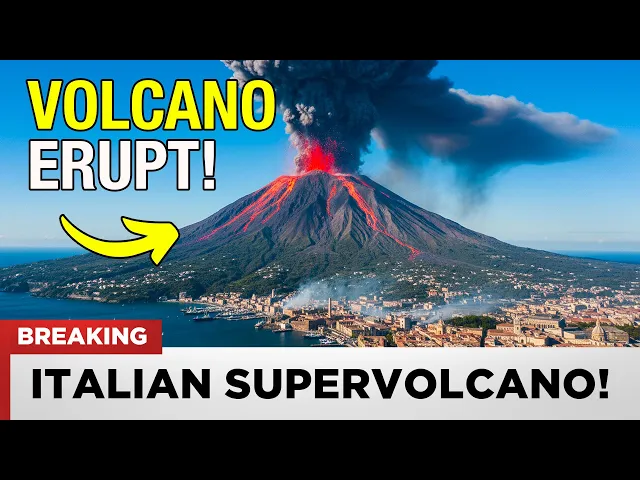
The ground just opened up right under my house. That's what Maria Santoro told emergency dispatchers at 3:47 in the morning from Poti, Italy. [music] But Maria was not calling about a sinkhole or a broken water pipe.
She was staring into a crack that had torn through her garden, releasing superheated steam and the smell of sulfur. A crack that scientists now confirm runs directly above the magma chamber of Europe's most dangerous volcano. Campy Flegre, the super volcano that has been silently inflating beneath 500,000 people [music] for decades, just announced its presence with the largest earthquake in its recorded history.
A magnitude 4. 6 jolt that was not just felt. It was heard.
Residents describe a deep groaning sound rising from beneath the Earth, like the planet itself was screaming. But here is the terrifying part. New seismic data released just hours ago reveals this was not a random quake.
It was structural failure. The volcanic crust that has held this monster in check for 487 years is finally giving way. So, when Maria's garden cracked open this morning, was she witnessing the first breath of a volcanic awakening that could blanket Europe in ash?
Or was that fisher the beginning of a collapse that will send tsunami waves racing across the Mediterranean in under 20 minutes? The last time Campi Flegray truly moved, it did not stop for 8 days. September 29th, 1538.
What started as ground cracks near the Bay of Poti erupted into a geological nightmare that literally rewrote the map. For over a week, this massive caldra blasted ash, rock, and superheated water into the sky, building an entirely new mountain, Monte Novo, in [music] just 8 days. Half the population of Naples fled toward the eruption to witness the spectacle.
The other half fled away from it in terror. Contemporary accounts describe the terrifying progression. Ground uplift that had been occurring for decades accelerated dramatically in the weeks before the eruption.
Residents noticed the shoreline expanding as the ground rose, pushing back the sea. Then on September the 28th, approximately 20 tremors shook the region between daybreak and nightfall. By the next day, the ground began to split open.
Witnesses reported that the fractures first released cold groundwater, followed by increasingly hot water and steam. The hydroagmatic eruption violently began when superheated water flashed to steam upon contact with rising magma. A surge of pyrolastic material buried the medieval village of Tripug completely.
So thoroughly that its exact location can no longer be identified. But that 1538 eruption was just a hiccup compared to what this system is truly capable of. 40,000 years ago, Campy Flegre produced the companion Ignimbrite.
One of the most devastating volcanic events in human history. 200 cubic km of molten rock exploded from an 8-m wide crater, blanketing Europe in ash and plunging the continent into volcanic winter. Modern estimates show that the eruption released energy equivalent to 550 million Hiroshima bombs.
Scientists say the conditions that triggered that ancient catastrophe, magma chamber inflation, ground uplift, and seismic swarms are exactly what satellites are detecting now. The same forces that once turned summer into winter across Europe are stirring beneath the towns and cities of southern Italy. History reminds us that Campi Flegri does not follow the rules.
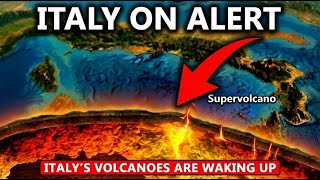
Unlike Mount Vuvius with its iconic cone, this super volcano hides in plain sight. No towering peak to warn of danger, just rolling hills, coastal towns, and a massive depression filled with half a million people who have no idea they are living inside one of Earth's most powerful volcanic systems. For 75 years, Campy Flegi has been breathing, slowly, inhaling as its magma chamber inflates.
gently exhaling through earthquake swarms and ground subsidance. A predictable rhythm that scientists have monitored, measured, and modeled. But this morning's magnitude 4.
6 earthquake broke that pattern forever. Dr Maro Devito, director of the Vuvius Observatory, put it bluntly. This is the largest earthquake recorded in Campi Flegre's modern monitoring history.
The seismic signature does not match the usual tremors this system produces. It matches structural failure. Global positioning system satellites have tracked 1.
46 m of ground uplift since the current unrest began in 2005. That's nearly 5 ft of vertical movement across an 8 m wide area. The town of Poti has risen so dramatically that its harbor is now too shallow for boats to dock.
Ancient Roman columns that once stood at sea level now tower above the water line. What makes this alarming is how the pattern of deformation has accelerated beyond all historical precedent. In May 2024, scientists were already reporting ground uplift of 2 cm per month, a worrying rate that has since increased.
The magnitude 4. 6 6 earthquake that struck on June 30th, 2025 came after months of escalating seismic activity, including swarms of hundreds of smaller earthquakes. According to new research published just months ago, these burstlike sequences are concentrated in the exact area where ground [music] defamation has accelerated beyond all previous patterns.
the same area where carbon dioxide emissions have spiked to 4,500 tons per day, levels typically seen only at actively [music] erupting volcanoes. Stamford University researchers made a groundbreaking discovery in 2025 that challenges previous assumptions uh about Campi Flegre's activity. They found that much of the recent unrest might not be driven by rising magma at all, but by pressure in a massive geothermal reservoir, a sealed system of superheated water that could trigger steam explosions without any volcanic eruption.
Professor Christopher Kilburn of University College London, who has been tracking Campy Flegro's behavior since the 1980s, warns that decades of cumulative stress have pushed this system nearly to the breaking point. Each episode of unrest weakens the volcanic crust. Each earthquake adds another crack to an already fractured system.
And the most disturbing discovery is that the earthquake swarms are not slowing down. They are accelerating. Recent AI analysis revealed a previously undiscovered ring fault beneath Campy Flegray, a structural weakness that could unleashed a magnitude five earthquakes and potentially serve as a pathway for pressurized fluids, fluids or magma.
The chain reaction from this morning's earthquake will not stop at Italy's borders. Within hours of the magnitude 4. 6 Six jolt seismic stations detected sympathetic tremors rippling across the Mediterranean.
Mount Etnner's monitoring stations recorded unusual micro earthquakes. Vuvius showed subtle changes in gas emissions. Even distant volcanic systems in Greece and Turkey registered [music] faint vibrations.
Scientists call it stress transfer. the way major geological events send shock waves through connected fault networks. Southern Italy's volcanic arc is more connected than anyone realized.
Emergency planners have always focused on individual volcanic threats. Vuvius gets its evacuation plan. Etna gets its monitoring network.
Strombbley gets its tourist warnings. But no one prepared for what happens when Europe's largest active calera starts talking to its volcanic neighbors. The economic implications alone are staggering.
Naples International Airport, a critical hub connecting Europe to Africa and the Middle East, sits directly in the potential ash zone. The Port of Naples handles over 400,000 cruise passengers annually and serves as a gateway for Mediterranean shipping. A major eruption here would not just shut down southern Italy.
It would sever trade routes that connect three continents, but the infrastructure failures could cascade far beyond transportation. Southern Italy's power grid relies heavily on geothermal energy [music] drawn directly from Camp Flegre's underground heat. A volcanic crisis could trigger blackouts across multiple regions precisely when emergency services need power most.
And then there is the Mediterranean itself. Computer models show that a sudden collapse of Campi Flegrey's coastal sections could displace enough seawater to generate tsunami waves reaching 20 m in height. Malta would have 15 minutes of warning.
Sicily would [music] have 8 minutes. Coastal cities across North Africa would face waves arriving faster than evacuation orders could be transmitted. The ripple effects wouldn't stop there.
Europe's grain imports flow through Mediterranean ports. Middle Eastern oil transits these same shipping lanes. A single volcanic event could choke supply chains that feed 400 million people.
What makes this particularly concerning is the shift in scientific understanding of what's driving Campy Flegre's unrest. Recent studies indicate that the pressure buildup might be occurring in a shallow geothermal reservoir rather than deep magma chambers. This means that traditional eruption warning signs might not work as expected, [music] and the transition from unrest to explosion could happen much faster than previously thought.
Picture this. 3:47 a. m.
becomes ground zero for Europe's fastest moving natural disaster. Within minutes of the initial structural collapse, fissures tear across poti like zippers [music] ripping open the earth. Superheated water and volcanic gases blast from the cracks, [music] turning morning mist into toxic clouds that roll through sleeping neighborhoods.
Emergency sirens wail, but cell networks crash as communication towers topple. Highway 29, the main evacuation route connecting [music] Campy Flegry to Naples, buckles and splits. As the ground beneath it liquefies, thousands of cars jam the few remaining roads while ash begins to fall, turning day into night and clogging engines, aircraft, and human lungs.
In Naples, 12 km away, the university hospital's emergency rooms overflow with burn victims and people suffocating from volcanic gas exposure. Power stations shut down automatically as sensors detect ground failure. The city that survived Vuvius for 2,000 years plunges into darkness just as its biggest evacuation in history begins.
But the worst is yet to come. As Campy Flegre's coastal sections collapse into the Bay of Potui, the Mediterranean Sea rushes in to fill the void. Within 8 minutes, walls of water 15 m high, slam into Sicil's northern coast.
Within 20 minutes, Malta's Grand Harbor, a UNESCO World Heritage site, vanishes beneath waves that toss cruise ships onto the streets of Valleta like toys. Across Europe, air traffic control centers watch helplessly as ash clouds climb to 30,000 ft, grounding every flight from London to Istanbul. The volcanic plume carried by prevailing winds begins its march across the continent.
What started as a crack in Maria Santoro's garden becomes the event that turns a beautiful Italian morning into the beginning of Europe's darkest geological chapter. And all of this could unfold faster than anyone anticipated. Unlike traditional volcanic eruptions that provide weeks or months of warning signs, steamdriven explosions can transition from unrest to catastrophe in hours or even minutes.
The same geothermal reservoir that has been causing ground uplift since 2005 could suddenly destabilize without the typical precursors vulcanologists rely on to predict eruptions. To understand why Campy Flegre terrifies scientists, you need to understand what makes it different from every other volcano on Earth. This is not a mountain built by lava flows.
It is a calera, a massive crater formed when the roof of an underground magma chamber collapsed after catastrophic eruptions. The entire 8m wide depression is essentially a thin crust of rock sitting above a partially molten reservoir that extends deep into the earth's mantle. Recent deep drilling projects have revealed the terrifying architecture beneath southern Italy.
The magma chamber is not a single balloon of molten rock. It is a complex network of interconnected reservoirs, some as shallow as 3 km below the surface, close enough that residents can literally feel the Earth's heartbeat through their floors. According to new research from Italy's National Institute for Geoysics and Volcanology, the current unrest phase shows all the characteristics of what scientists call critical degassing.
As magma rises and pressure increases, dissolved gases separate from the molten rock, like bubbles forming in a shaken soda bottle. When those gas bubbles reach critical mass, they do not escape gradually. They explode.
The Stamford University team that published groundbreaking research could in 2025 discovered something even more unsettling. Much of Campy Flegrey's recent activity might not be driven by. This is not rising magma at all, but pressure in a massive geothermal reservoir, a sealed system of superheated water that could trigger steam explosions without any volcanic eruption.
Think of it like a planet-sized pressure cooker. For decades, groundwater has been seeping into this underground reservoir, building pressure as it heats to temperatures exceeding 300° C. When that pressure finally exceeds the strength of the overlying rock, the result is not a lava flow.
It is a steam explosion powerful [music] enough to launch house-sized boulders several kilome. What makes this system particularly dangerous is its three layered structure. At the bottom lies a dense, stable basement.
Above that sits a gasenriched reservoir filled with water and steam that acts like the lungs of the calera, slowly building pressure. capping it all is a protective fryive fibrous layer just below the surface that normally keeps the pressure contained. This caprock has been weakening with each earthquake, bringing the system closer to critical failure.
Current monitoring shows all the warning signs of critical pressure buildup. Ground deformation is accelerating beyond [music] historical patterns. Gas emissions are spiking to dangerous levels.
Microearake swarms concentrated in areas where the underground pressure is highest. But here's what keeps vulcanologists awake at night. Traditional eruption forecasting methods don't work for steamdriven explosions.
The warning signs can collapse from months to minutes without notice. The geological signature that took decades to develop can trigger catastrophic failure in the time it takes to drink a cup of coffee. Maria Santoro's cracked garden sits at the epicenter of Europe's most densely populated volcanic system.
Within a 5 km radius of where she called emergency services this morning, 150,000 people sleep, work, and raise their families directly above an active magma chamber. The ancient city of Poi, built on Roman foundations, houses, schools, hospitals, and retirement homes filled with residents who have no evacuation plan because no one expected them to need one. But the danger extends far beyond Poti's boundaries.
The red zone, the area Italian authorities say must be evacuated to survive a major eruption, encompasses 500,000 people across 24 municipalities. The yellow zone, where volcanic ash and toxic gases could prove deadly, [music] contains another 800,000 residents. These are not rural farming communities that can just pack up and move.
This is metropolitan Naples, Italy's third largest urban area, home to international businesses, major universities, and critical infrastructure that serves all of southern Europe. Naples International Airport alone processes 10 million passengers a year. The Port of Naples is the Mediterranean's fourth largest cargo hub.
Emergency planners face an impossible logistics nightmare. How do you evacuate 1. 3 million people from a region where the main highways run directly through the volcanic danger zone?
Where exactly do you relocate 500,000 refugees when neighboring cities lack the housing mech facilities and infrastructure to support such an influx and the evacuation timeline keeps shrinking? Previous emergency plans assumed weeks of warning before a major eruption, but this morning's earthquake pattern suggests the transition from unrest to explosion could happen in hours, not weeks. When Italian authorities tested their evacuation plan in 2017, the estimated time to evacuate the red zone was 72 hours, that is three full days to move half a million people along roads that could be damaged or blocked by the very event, triggering the evacuation.
And according to INGV researcher Jeppe Mastrolorenzo, even that plan is absolutely not sufficient to manage a real volcanic emergency. Local residents like Pina Tester, the artist who paints volcanic eruptions from her Potzu studio speak of living in harmony with the volcano. But harmony depends on predictability.
Campy Flegre just announced it no longer follows the rules. For the children attending schools built on volcanic soil for the elderly in care facilities with no transportation. For the families who call this [music] ancient landscape home, this morning's crack in Maria's garden might be their first glimpse of a future where home no longer exists.
Right now, as you watch this video, seismometers across southern Italy are recording the earthquake sequence that started with [music] this morning's magnitude 4. 6 jolt. The Vuvius Observatory's emergency monitoring protocol has escalated to level orange.
Heightened surveillance requiring 24-hour staffing and realtime analysis of every tremor, every gas emission, every millimeter of ground movement. Satellite data streams in every 12 minutes. Seismic stations transmit readings every second.
But even with this unprecedented monitoring network, scientists admit they cannot predict when structural failure becomes catastrophic collapse. The pattern they are seeing matches theoretical models of Calera destabilization, but no one has ever observed this process in real time at a volcano threatening half a million people. In the past week alone, the monitoring network has recorded over 227 earthquakes in the Campi Flegre region.
The strongest, the magnitude 4. 6 event that split Maria Santoro's garden had its epicenter directly above the area where scientists have detected the most significant ground defamation and gas emissions. [music] Data from AI enhanced seismic monitoring revealed that between 2022 and 2025, the volcano experienced more than 54,000 earthquakes that traditional methods failed to detect.
This hidden activity defined a previously unknown ring-shaped fault system that could serve as a pathway for pressurized fluids or magma to reach the surface. Dr The Jeppe Denital, former director of the Vuvius Observatory, summarized the terrifying uncertainty. We can measure what is happening.
We cannot predict when it the transition from current unrest to volcanic eruption could take decades or it could happen tomorrow. As emergency services in Potzu continue investigating reports of ground cracks and gas emissions, as scientists analyze this morning's seismic data, as families like Maria Santoro wonder whether it is safe to sleep in their homes tonight, the question hanging over southern Italy is not whether Campy Flegre will eventually erupt. The question is whether Europe's most dangerous volcano has already begun the final countdown to an event that will rewrite the map of the Mediterranean.
Maria Santoro's cracked garden might be the first warning sign of Europe's next great geological catastrophe. [music] Or it might be just another tremor in a volcanic system that has been rumbling for decades. What would you do if you woke up to find your backyard had split open above an active super volcano?
Would you pack up and leave? Or would you trust that scientists can predict when 500 years of pressure finally reaches its breaking point? Drp your thoughts in the comments below.
And if you want to stay ahead of the geological forces reshaping our planet, make sure you are subscribed to Earth attacks because sometimes the ground moves before anyone hears the warning.