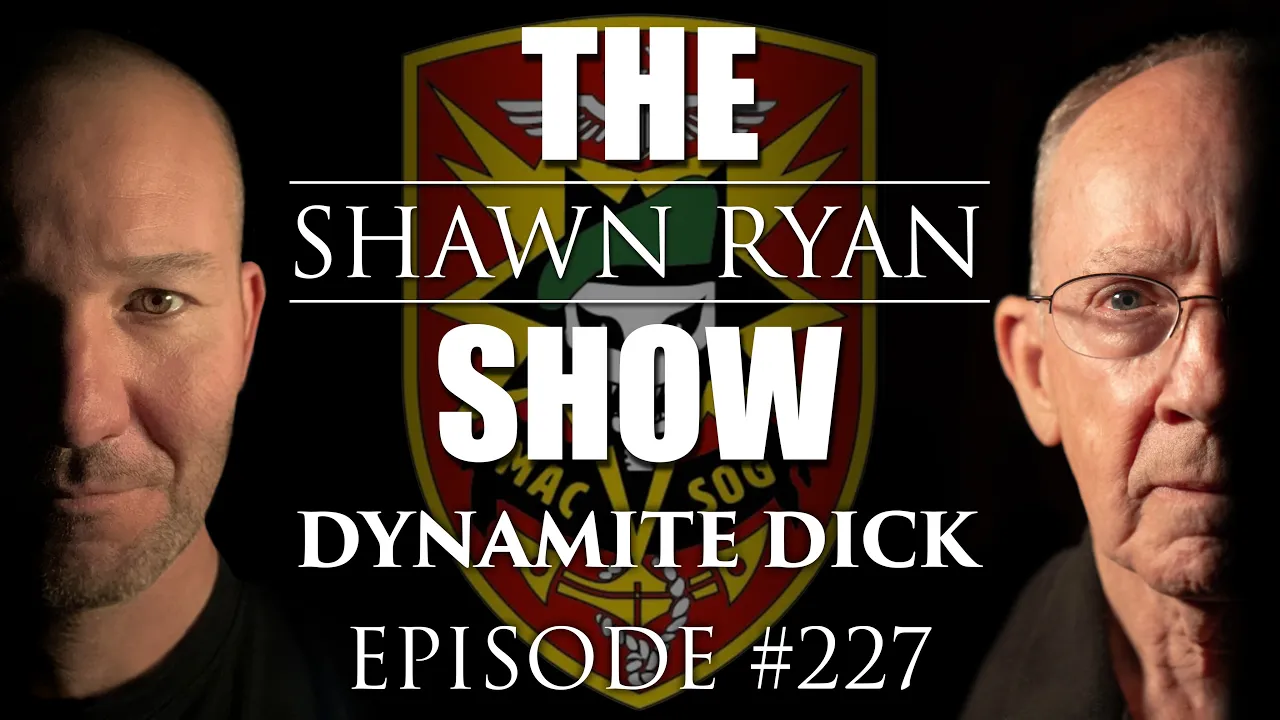
[Music] Dynamite Dick Thompson, welcome to the show. >> Thank you. Honored to be here and I really appreciate the opportunity to uh sit in this chair and in this room particularly as you're getting ready to transition to the new one. So honored to be here, honored to be a SAG guy on your show. So >> honored to sit across from you and I I Truly mean that. Um came highly recommended from uh our mutual friend John Striker Meyer >> and uh he's told us a lot about you and and uh you know I just this
is the last interview in the studio and uh I wanted the perfect guest to to shut the lights off with and it is a real honor to be sitting here with you. So, thank you for making the time to be here and um and and uh I'm really honored to document your story and your history and it's Going to be good. It's going to be a powerful interview. You ready? >> Really looking forward to it. >> Me, too. Me, too. So, every guest starts out with an introduction here. Dynamite Dick Thompson. Last interview in the
studio. 21-year retired Army Lieutenant Colonel Green Beret Ranger and MACV SOG operator who ran over 20 crossber recon direct impact missions into Laos, Cambodia, and North Vietnam. Awards include four bronze star medals, two With V for valor, two air medals for aerial combat, one with V for valor, Vietnamese cross of gallantry with gold star for valor. Naturalborn tracker raised on your grandparents farm. You could smell the NVA in the jungle. Distinguished member of the Airborne Ranger Training Brigade. Served as a professor of military science at the University of Georgia. author of SOG codenamed Dynamite, a
twobook series about top secret missions that were once Classified for 20 years, a PhD in psychology, founder of high-erforming systems, and author of the stress effect, teaching leaders how to make decisions under pressure. Among your hobbies, you are a master scuba diver. You've made over 1,200 freefall halo parachute jumps, earned a black belt in karate, and you're an Iron Man. You're a husband, a father, a grandfather, and most importantly, a Christian. >> Thank you. I'm sure I'm missing some, >> but >> but um yeah, like I said, it is an honor to be here with
you. And so I just want to do a life story with you, document everything you've been through, and um and hopefully bring a lot of hope to veterans that are coming home from war and and that are that are trying to find their new way in life. So once again, it's an honor. >> Thank you. And um one of the things that we started doing in our company back in The '9s was we traveled all the time. You're always going through an airport. So, um, I implemented a a policy that said if you see someone
in uniform or you can tell they're a veteran standing in the Starbucks line, pay for their coffee, thank them for their service. And then, so everybody had a special credit card from a company card, you know, to pay for that with. Um and then a little bit later we bumped it up some more. And What we started doing is also giving them um challenge corn. >> Oh man. So thank you. That basically says thank you for your service. Um we care about you. Welcome home. And you know, we'll give that out. We've been doing that
now for a long time. It's not the big fancy one like you know the coin Jo John gave you, but it's one that um we could share with a lot of Veterans who had never never been welcomed home. So, you know, I'm a little biased along that line because uh you know, when I came home, people literally spit at me. Yeah. >> Coming through the airport. >> And you know, I I also talked later on that my my biggest challenge in the beginning coming home from Vietnam was restraint. coming through the airport and listening to
somebody yell uh baby killer, Murderer or whatever, but noticing that, you know, they were not close like you and I are now. They were back at a at what they considered a safe distance. And I used to think they have no clue. I can close the distance between us and less than a second because I'm not carrying 90 pounds of gear, you know, and I could be real ugly to you when I got there. So, I have to restrain myself know that I could do that, but I don't have to do that. and just a
lot of things just based on coming from the wild west back to a country that has some laws and is civilized. You know, I've got to come back to this world. And one of the things that I I try to work with veterans on is understanding the skill set you have and how to use it. Because most veterans think, well, you taught me all this war stuff and tactics and I don't, you know, I can't use that stuff back in the civilian war. Yes, you can. You know how to plan, make decisions, organize. I mean,
you have a whole skill set that can help you be successful. and you got to apply some of the SOG techniques that we'll probably talk about in a little bit um to keep moving forward and and you can be successful. So anyway, >> I love that. I love that. Thank you. Thank you. Everybody starts off with a gift. >> Thank you. >> Vigilance League gummy bears made here. Made right here in the USA. It's just candy. There's no marijuana in it. No CBD. Just candy. So, they're legal in all 50 states. >> John Meyer said
there might be something in here. >> He said he he noticed some kind of of charge after he ate something. Yeah. >> So, I I'll put it right there and and if I start to run down after a while, I'll Consume a couple of Well, thank you. I really appreciate that. >> Hey, my pleasure. My pleasure. And then one more thing before we get going. So I I have a Patreon account and uh that's a subscription account and we've turned that into quite a community. I think we're at 85,000 patrons now. And um and they're
the reason that I get to be here and that I have this amazing team uh that I'm surrounded by. And and so one of the things that we do is uh we offer The Patreon community the opportunity to ask each and every guest a question. So this is a question from somebody you might know. John Striker Meyer. Please explain how you carried seven claymores, bu 15 rounds, hand grenades, and M79 rounds. I believe you carried it on most missions. Oh, and I forgot your pistol. How did you carry all that? >> After the first mission
that I went on where I carried the normal load out, uh I used up so much ammunition in the ambush that we uh went into this this is not going to work. So once I became the team leader, then instead of carrying five frag grenades per person, per team member, I upped it to 10. So what that did was, and I usually went out with six or seven people. So if I had seven men on the team carrying 10 frag grenades a piece, that's 70. With 70 frag grenades, you can do some serious damage. So,
I also up the claymore to three per person. So, some people, you know, like the M M79 man usually didn't carry a claymore because he was carrying so many um grenades with him. So, but everybody went to three sevenman team, 21 claymores. >> Wow. And then I also started at night on the most likely avenue of approach coming into our remain overnight position. I would put out seven claymores daisy chained. One click, seven claymores go off. 10 12 lbs of C4. 4,900 steel balls traveling at 4,000 ft a second. The blast the steel balls would
just shred whatever was out here. And if you were far enough back or happened to be behind a tree and survived, you would say, "This guy's crazy." Nobody sets off all of their claymores at one time. So now the survivors, we can go down and get them and they start to come. That's when they run into three more daisy chain and that goes off. So you catch them by surprise with that. >> Wow. >> And then they start running into claymores on time fuses that are randomly going off as they're trying to come and Yeah.
So in their dossier that They put together on me, it was this guy's a nut. You don't go charging after his team because he's going to run into all those claymores. And at night, you want those area weapons like the claymores and those frag grenades. You could start chunking frag frag grenades at them. They don't know where they come from. >> Yeah. >> And they're just going off everywhere, >> man. Um, and then I like, well, let me say if you shoot at me, I'm going to shoot back. I I really don't like people shooting
at me. So, I will shoot back. So, I found I needed to carry more ammunition and most guys were carrying, you know, 800 rounds or so, or maybe 700, some 600. I went to a,000. And I carried 50 20 round magazines. >> 50 20 round magazines. >> And in my 20 round magazines. I put 20 rounds because I used brand new magazines every mission. I would draw new magazines. So everybody had new magazines. So they'd only been loaded for three or four days. So the springs were fine. They were working good. Um, so I I
never in a firefight had my CAR 15 jam. Not not from uh the number of rounds in the magazine, But you know, so my people had a lot of them. I didn't force them to put 20 if if the 18 rule had been ingrained in them. Uh, but I encouraged them to put in 20 because when you run against up against the NBA, you've got you're sitting there with a 20 round magazine for initial contact. The NVA NBA's got a 30 round magazine. They've already got 10 more rounds than you do. You run out first
and then the firepower shifts totally over to them Now. >> Yeah. So until we finally got the 30 round magazines, we were a disadvantage every time as soon as we started. So you needed to be able to load faster and, you know, shoot longer. >> Man, I never thought about that. 20 round magazine versus 30 round magazine. >> It's a big difference. >> Yeah. Yeah. How long did it take him to get you guys 30 round magazines? >> We didn't get I got there in ' 68. We Didn't get the 30 rounds until um 69.
And and when we first got them, it's they couldn't get many. So I could go draw one 30 round magazine u per car 15. >> Oh man. >> So we all have one, you know, in our weapon to start with. That was after they made a tweak. I discovered early on as as did a lot of other people that if you have that 30 round magazine and your car 15 and you you jump off the skid of the helicopter, When you hit the ground, your gun got lighter all of a sudden because the magazines laying
down in the mud because the the spring on on the magazine retainer wasn't strong enough to hold that extra weight. >> Wow. So the shock of hitting the ground, the magazine would fall out. So we had to take the weapons back in, have the spring changed, excuse me, to a stronger one. So the magazine was staying there. >> Jeez. >> But at least you had you had a 30 round magazine to start with. But you know, I guess I guess my teams just had problems, discipline problems. Maybe it seemed that we lost our 30 round
magazines almost every time we were in contact and I'd have to go back to you S4 and draw some more 30 round magazines to replace the ones we lost. >> Wow. >> And What you know, but then that um somebody noticed one day, how are you guys getting so many 30 round magazines? You're only supposed to have one per gun. Your guys are all carrying more. Well, I guess they found some of the ones they lost. So, >> what kind of pistol were you carrying? >> I tried different ones. Um, I carried a, you know,
1911 45 caliber pistol. It was heavy. only held seven rounds, but man, if you hit somebody with that, it would put them down. I mean, it hits hard. Um, but then I I changed to um a Browning High Power 9 mm cuz now I, you know, double the amount of ammunition, number of shots in there. Um, so I I played with those a little bit and then I started carrying um uh a high standard 22 caliber long rifle with an integrated silencer because that thing was so quiet. >> Little hush puppy, huh? >> Yes. And
you know, you got to be careful where you shoot them. you know, 22 if it hits a vest or something, it's it's not gonna penetrate. So, I tried to go for softer spots like the temple. Um, I did a lot of practice and trying to get a guy in particularly a tracker. If you were tracking me, then I would tell those team, you guys keep going. I'm going to drop back. Somebody's behind us. I'm going to drop Back here and have a little chat. So I could go back and take out a tracker. I could
take out a dog. I could do things without, you know, a big disturbance. And particularly at night, there were times when we had people walk inside our little perimeter. I mean, we were all within arms reach of each other in a little circle, and sometimes you'd have somebody walk right through the middle of it. Uh, you couldn't open up with a car 15 because it just light the Whole area up. But with that 22, I could tap you. Particularly if I set off a claymore, made a little noise, shot you at the same time. Nobody
ever know I took you out. >> Wow. You hit people inside the perimeter when you guys were at arms length distance and you're only six to nine people. >> How many times did that happen? >> Several. and and We can talk maybe in a little bit about where I had a or longer experience of someone inside that. Uh pretty cool. >> Let's talk about it. Now, >> we were I had 22man team. I we had put two uh of our recon teams together uh cuz we we were going after a group of NBA that had
a group of American prisoners that they were trying to take through count through Mal into um North Vietnam and we're trying to stop them And we had stopped for an RO. had 22 people. So, it was a circle almost as big as this room in here and they were ready arms lengths apart. I was in the in the center uh with my assistant team leader and it was about 2130. It was dark. You couldn't see your hand in front of your face. And I was really tired and my eyes were starting to roll back in
my head. I was leaning against a tree And I heard a twig break. And I opened my eyes and I was thinking to myself, that sounded like a twig break inside the perimeter. And then I heard another one. And I realized someone was inside our perimeter. and was coming directly toward me. I'm laying back. I have car 15 laying across my lap. And I can hear this person moving. And I knew all of our people knew the rule. Once you go down, you don't get Back up at night. Anybody moving is a bad guy. And
this guy's coming right toward me. And I was thinking he's going to step on me. I slid my selector switch over the full auto and I'm laying there and he's coming and the air is so thick. And at this point I can mentally see a silhouette coming at me. Although I can't really see the silhouette. I know where it is based on the sound. And now I'm starting to hear And breathe. I'm starting to hear his heartbeat because he realizes he's inside the perimeter and he's probably about to get killed. So, his heart is thumping.
He's coming right at me. Uh, I can't open up cuz that'll light the whole perimeter up and we'll be in trouble. So, I couldn't get to my knife. So, I decided just as he gets to me, I'm just gonna shoot my left hand up. I'm gonna grab a hold of his chest, whatever He's got there, and I'm going to pull him at the same time, raise my leg up and trip him, I'm going to pull him down to the ground. I'm going to hit him in the side of the head with the muzzle on my
KR15. As I'm bringing him down, if he yells, if he fires his weapon, I won't pull the trigger. So, he's coming. He got into position. I grabbed him. I jammed the muzzle into the side of his head. Just cut a big gash in his head. I bring him down face First into the mud. And he didn't say a word. Didn't make a sound. It scared him so bad he didn't even grasp when I uh grabbed him. And then I started thinking, "Now what? I'm sitting here holding this guy face down in the mud. What am
I going to do with him and then I heard a whisper and the whisper was Trungwe? He was lieutenant in Vietnamese. Lights, lights, What? And he said, "Lights, lights." And I looked up the ridge towards the top of the mountain and you could see lights, lanterns coming down the mountain. Um about 400 people, if you counted one or two people in between each lantern, probably 400 people coming down the ridge line toward where we were. And that's not good. We're on a ridge line like that. We picked it so people couldn't get around us, but
they're Coming straight at us. But then I I turned and I looked down the ridge. They was that same number coming up the ridge and they were going to come right to us. We were going to be right in the middle when they got up here about, you know, estimated 800. >> Whoa. So then I realized the guy that I've got face down in the mud is the Vietnamese captain that we took on this mission With us. He didn't, you know, he didn't have the experience. He didn't realize it when he got up to come
tell me there were lights coming that I might shoot him or somebody might shoot him or knife him. But anyway, you know, he did call that to our attention. And so these guys are all coming at us. They're going to intersect right on us. So my RTO crawled over and said, "Sir, you wanted on the radio." And I got the radio and this is this was a KY um 38 with the KY 28 um manual code loader in it and all that stuff. You had to have that daily code set in this um uh coder.
You had to be on the right frequency. All that this was the highest security radio that you could manually carry around. But anyway, so I was talking, you know, answered it and it was Saigon and they were they said, "You are now a prairie fire emergency." Meaning everything in that part of Southeast Asia now belongs to you. Everything, every asset that's within range of you. Every asset that still has armament left is being diverted to you to try to get you out. And I'm looking up and down. I can I can see how we are
our prayer Fire emergency. So I, you know, copied that. I got my assistant team leader over and said, "Here's what's going on." And then the RTO says, "Sir, you got to hear this." And I said, "WTF Schaefer? What? You know, I've got 800 people coming. What else you going to tell me?" I picked up the radio, the handset, and there's a Vietnamese woman on the Radio classic. There's no way that she can talk to this radio, but she's talking to to this tactical radio secure one. And she's reading our orbituary. >> What? >> She's reading
our orbituary that we were all killed in action that night. She's reading name by name of everybody who's laying in that parameter. and she reads My name. She reads off Dick Thompson and and keeps going monitoring and they heard her read my name off as Dick Thompson and they said, "Okay, she made a mistake. She doesn't even know his name. He's Who Who is Dick Thompson? His name's Henry." No one at that point on that side of the world knew me by Dick Thompson except for Elden Bargewell, later Major General Bargewell. And we'd Been on
the same team before. But somehow she knew my name that no one else knew. And as I'm listening to it, there's music in the background. Not just music, but I I realized this is the same music that as a little kid at 12:00 every day at my grandmother's house, she would say things like, "Boris, Boris, quietening down. I I need To hear the obituaries in the county." And there's a southern kind of music that they played in the south when they would read obituaries, read about somebody that had died. And they're playing this in the
background as they're reading our names off as being killed in action that day on a super encrypted radio that they couldn't possibly be talking on. So it kind of got our attention, >> I would imagine. So, I got a team leader together and we put our clan together. Um, and I mean we were we were armed. We had four machine M60 machine guns with us, you know, four grenaders with us. We had all those claymores. We we were loaded for bear. Um, but that kind of kind of got all of our attention and that started
at 9:00 at night almost 1700 the next day when we got out And we just banged it out with them right and left and had one catastrophe after another. Uh, but but we got out and we got everybody out with us. He got everybody out. Wow. >> There were a lot of bad guys that were were left, but >> holy [ __ ] What was the radio? Did you ever figure that out? >> Somehow they'd gotten a hold of one. They'd gotten a hold of one of those. They got the radio. They had to have
Gotten the the codes and the frequencies, you know, from the compound. We think part of what happened was eight days before we were at the launch site um getting ready to uh launch on this mission and a team was overrun and you know the uh launch site commander came in and said look your mission's just changed you're now bright light uh your team's going to go in to try to uh recover the team that just got Overrun. So, they changed our mission and we went out there and fought it out for a couple days. Um,
and when we came back, we had to have some recovery. We had to replace some people that were when we did the firefight. So, it was 8 days before we could go back and run our uh original mission. So, they had eight days to get more intel on us and figure out what was going on. And we had some spies there at CCN in the camp that we didn't know about. So, >> man, >> well, I got another gift for you. >> And the the uh the KY38 radio and the that's 54 pounds of radio
plus all the batteries, the big batteries that it goes through. Nobody wanted to carry those things. You had to have a PRC77 to hook two this KI and KY38. So you half of it was on your front chest, half of it was on your back. >> Oh man, >> it was unreal. I'm sorry I interrupted you. Go ahead. >> No, no, no. Well, not much has changed today. Nobody wants to carry the radio, but it's not 50 lbs. Oh, but hey, since we're talking about everything you've carried, I got you a little present here. So,
I got a friend over at Sig Sour. His name's Jason, and I told him you were coming on, and he is just fascinated With MacB guys. So, he wanted me to present this to you. >> Oh, wow. >> Go ahead. Hold it up. So, that is the Sig Sauer P365 Macro Legion and uh hold 17 rounds plus one in the pipe. It has that red dot. We were talking about red dots at breakfast. It has the uh slide cuts in the front to help you with the muzzle flip and recoil. It's made out of all
metal and Um that is the the latest and greatest everyday carry handgun from 6 hour. So, >> wow. >> We wanted you to have that. >> That is awesome. >> Thank you. You're welcome. Wow. Fortunately, I'm driving home so I don't I don't have to try to carry this on a plane. >> But, uh, yeah. So, we wanted you to have that. So when When you get your your new studio completed, including your firing range, hopefully I can get invited back up to see if the thing works on the on your range. >> We'll invite
you back. You and John. >> Yeah. >> Maybe we'll have a little shooting competition. >> Oh, yeah. He'd love that. >> I'm sure you'd whip John's ass in Shooting competition. Oh, yeah. I'll tell I'll tell him you better start practicing. >> That's great. Thank you. >> You're welcome. Every day it becomes more obvious. The world is changing fast and the systems we were taught to rely on can't be counted on anymore. Whether it's institutions, governments, or supply chains, when things go wrong, most People are caught completely offguard. That's why it's up to you to take
responsibility for yourself, your safety, and your family's well-being. Preparation starts with the basics. For me, that includes long-term emergency food. That's why I use and trust My Patriot Supply because when the unexpected hits, I want to know I've done everything I can to be ready for myself and the people I care about. Go to myatriotsupply.comsrs And shop a curated collection of my favorite products. From long-term food storage to water filtration, medical kits, and portable power solutions. With lightning fast shipping, your supplies can be at your door in as little as 48 hours. Go to myatriotsupply.com/srs
right now. That's myatriotsupply.comsrs. There are a lot of choices out there for cell phone service and new ones seem to pop up all the time, but one company continues to stand out. Patriot Mobile. The best part, you don't have to sacrifice quality or coverage to make the switch. Patriot Mobile gives you access to all three major US networks. So, if you have service now, you'll have just as good, if not better, coverage with them. Worried that switching is a hassle? It's not. You can keep your number, keep your phone, or upgrade, and their 100% US-based
team will walk you through everything and get you activated in minutes, all from home. Still in Contractor own money on your current phone? No problem. Patriot Mobile even has a contract buyout program to help you make the move. They're good people running a good company, and they actually care about American values. That's hard to find these days, so check them out. Visit patriotmobile.com/srs or call 972 patatriot. Use promo code SRS for a free month of service when you make the switch. I'd like to get into your story story Here. So, we always start with where
did you grow up? Grew up in uh a little town called Wall Hollow, South Carolina up in the north uh western tip of South Carolina. right up above uh Clemson University and um spent a lot of time outside and you know I uh my my mother's family had four sons and when World War II came along all Four of them were deployed you know in in World War II view uh my father was deployed along with him. So there were five men you know from the family uh there and they three of the brothers four
brothers came back um my father came back and then when Korea came along you know my father was called back in so served in Korea and they talked about some army stuff Mostly at my proddding and saying, "What does this mean? What is a platoon? What do you mean have a reserve? What's a reserve? What excuse me, all kinds of questions, you know, I was just full of questions about army stuff. And then when I was about 7 years old, I decided I'm going to have an army." So, I got with my cousin Carl and
I said, "You're the first member of of uh My army and I had heard about Rangers. I'd heard them talk about what the Rangers did." Um, so I decided it was going to be, you know, Ranger Company. So I formed the 69th uh Ranger Company and it was commanded by General Thompson of course and so but we needed more than one other member. I needed to command more than one person. Uh so I started recruiting my other cousins that are about the same age. We got, you know, All the close ones in the ones I
liked. Got those guys in. Uh, brought in one um female cousin, Pat, which was actually cousin Carl's sister. We brought her in. So, we had a whack in in the army. Um, then we started letting people outside the family in. So, it, you know, it grew bigger. And I've I still got the the log book uh for Thompson's Rangers at home, the actual log book. Are you serious? >> And you can open it up and you can it's getting pretty faded now, but you can See notes. You can see people's names. You can see the
note. You can see information about uh the only court marshal that we had. So there was one of the members of the company that um gave me some lip and um he ended up getting court marshaled and booted out of the Ranger group. But anyway, I still I still have that book. I mean, you know, I I cut two pieces of cardboard for the covers and and taped it together and put the paper inside and Uh it's it's pretty pretty cool. So, but I still have it after all these years. So, really got into uh
rangers and and it, you know, the family did a lot of hunting. My father liked to hunt. So, I I was brought up with weapons and shooting and hunting and tracking. And every time I my parents both worked uh as I was getting older. So every opportunity I got uh I was in the woods by myself hunting, tracking uh tracking Deer, tracking whatever animals I could find um and studying them. You know, what do they do? How do they move? Um and then I got this idea, I need to be invisible. How can I be
invisible? Excuse me. So to be invisible, what it's it's not just that you are not visually seen. If I'm invisible, you can't hear me. You can't smell me. You know, I just don't exist. I'm just I'm here, but I I'm not here. And how do You do that? outside, practiced slipping up on on deer or rabbits or whatever I could find out there. Um, and then my cousin Carl started coming over and we'd take we had a little army pup tent. We'd carry that thing a couple hundred meters up on the hill in the woods
and put it up. Um, it would go out and once I got a BB gun, we'd go out and shoot some birds and, you know, little birds and build us a fire and we would roast them and we would we would say, "What Else do rangers eat?" You know, let's let's get us some ranger food. Let's go kill us something else and let's come eat it. And, you know, we'd camp out there and pretend we were rangers and we'd go on missions and different things like that. And you know, we we got older. Um and
and then when I was 13, um my parents sabotaged me cuz I knew I was going to be a ranger. And Santa Claus came and brought me a chemistry set. You know, I used to watch Shock Theater uh at midnight on Saturday night. you know, they build Frankenstein and werewolfs and change people's brains out. And I said, "They can do that. Why can't I do it?" So, I started, you know, catching rats. I'd catch rats and bring them into my lab. Um, and I'd knock them out. At that time, if you went into a pharmacy,
we called them drugstores at That time. If you went in there, I mean, if if you could get permission from your parents to buy a syringe, a real syringe, which was a big deal at that time because only drug users and medical people had access to syringes, but uh talked the pharmacist into to letting me buy one. So, I had a syringe and then I could shoot the rats or the birds or whatever up, knock them out, and I could go in, take their brains out and see if I could swap them and and bring
them Back. Swap swap their hearts, things like that. Uh, and try to, you know, from shock theater with Frankenstein, you know, the electricity from lightning went in him. I would plug them into the outlet. Tended to fry their little hearts and stuff. I never could get one to start back. I could put them in there. I just couldn't get them to work again. Um >> the psych test must have been a lot Different to get into uh the Green Berets back then. >> Yeah. So, I I really got into chemistry. And then at some point,
I got into well, let's build some rockets. you know, Thompson Rangers need some rockets so to launch at the bad guys. So, I studied rockets and rocket fuel and the chemistry around it. And again, back to the pharmacy. I I need some I need some I need some potassium nitrate. I need some charcoal. And I need some sulfur. What are you going to do with that? I said, "Oh, I'm I'm, you know, building some bottle rockets." Okay. I had so much of those chemicals in a foot locker in in the house, if my mother had
realized what that was and what it could have done to our house. Um, but anyway, you could build rocket fuel out of that and then discovered later you could build bombs out of that, too. Um, so I built a launch pad. I built a lab In in the in the uh barn and built a an actual launch pad out behind it. I had a window so I could look out there and see it so I didn't get hit with uh shrapnel stuff if that exploded on the the launch pad. And I'd launch them off of
there. One day I built a big one. Uh, it was almost three feet high. Um, exploded on a launch pad, actually broke windows in my neighbor's house. So, uh, I decided I needed to go back down to smaller ones so they didn't Do so much damage as they didn't work. But, you know, so I I played with explosives. I did all kind of chemistry stuff. I mean, um, when I was in in high school, I I took, you know, the advanced chemistry course. I didn't even have a book. I just basically showed up for class,
took the exams and maxed out the course cuz I was going down to Clemson University to the library, reading all the articles, reading chemistry books. >> Wow. getting and if I found that if you got um if you got the older chemistry books around the turn of the cent around around 1900 they were like recipe books they didn't just talk about theory and how you know if you mix these two components then then you get this it was a recipe this is how many grams uh of of whatever it was that you're going to use
and mix together and this is how you mix it together they told you how to do all this stuff. So, I was learning that and And um really really into chemistry. I got a scholarship to University of South Carolina on chemistry. >> You had a pet, too. >> I'm sorry. >> You had a pet? >> Um I had I had several pets, but I I had one when I was, you know, really young. Um, that was a particular interest. I was in third grade and my parents came got me out of school and and took
me Home and said, "We've got a surprise for you." What is it? Well, you have to wait till we get home. So, we got home and got out and and there was a spider monkey. So, so it's a monkey, you know, he's on a he's on a little chain, a leash. So he running around doing things and I thought that's cool. I snatched that little joker up. I found out about monkey teeth really quickly. I mean he about bit my finger off. Um so anyway I Didn't I kind of liked him but I I was
careful with him because I knew he would bite. Um, we ended up building a a small house that was outside close to the barn and he would sleep in that at night and we put a light bulb in there to, you know, for heat because it winter time. And I went out one morning and looked in there and, you know, I could see his tail sticking out the little door and I grabbed his tail and I thought, "Wow, this is strange. He's not Moving. And I pulled him out and he was literally just straight out.
He looked like a monkey on a stick. And he was frozen. And >> a monkey on a stick. Huh. >> He was frozen. And his little mouth was open. All his little teeth were showing. You know, when I was not happy, you know, I mean, I forgave him for all the biting, but you know, I ran back in the house in the house and I gave him to my mother and said, you know, he's dead. He's dead. and she said, "I don't know if he is or not. Let's try this." She wrapped him up in
a little blanket and put him on top of a little oil heater that we had. So, the heat was coming up to try to warm him up, throw him out a little bit. And then she heated up some milk and took an eyropper and squirted that warm milk down his little mouth. And I mean she kept working with him and after a while now you know his little mouth started moving And she thought that Joker out. She thought him out and all of a sudden he came back to life. Oh I thought this is really
cool if you can freeze somebody to death and then just thaw him back out. I mean how cool is that? But anyway, they had the monkey and what he caused so much trouble that uh we ended up swapping him for a dog. So, he had to go away. >> You didn't take that and uh ask for volunteers from uh from your army to Freeze, did you? >> No, I'm not saying I didn't think about it. But >> maybe the guy that got court marshaled Cook had a uh ultimatum. I I did take college students. >>
Oh [ __ ] I I have to be careful how much I tell you about. But I I did take college students and I was interested in what happens If I put you into sleep deprivation. If I don't let you sleep for a while, what will happen? So I got permission to do some research University of Georgia using college students. And so I got a group of volunteers from the ROC department. These guys were all in the the ROC, you know, ranger company there to uh University of Georgia. you know, of Course they they can
do anything and you know, u so they volunteered to do it. So they had their full gear on. We took them out in the national forest full gear. Um carrying a 40 lb rucks sack and continuous movement. We stopped for 10-minute break every once in a while, but continuous movement. Um no sleep. every four hours they had to take a a test. Um, one of the tests they had to take was a cognitive test. You know, it's basically addition and subtraction, Just a couple sheets of of addition and subtraction. Um, and then they would rate
after they finished it. I would say, "Compared to when we first started, when you were fresh before you'd lost any sleep, uh, compared to that, how well you think you did this time?" And they would say, "It's pretty easy. I did just as well well this time, just as accurate uh, as I did on the first one." I'm looking at the scores and thinking that didn't happen. One of the things that that I discovered was that after 24 hours with no sleep that you lose about 25% of your cognitive ability, particularly to be able to
do things like math. The scary thing is you don't know it. you think you're still just as good as you were when you started out >> and and you know it doesn't stop at 24 hours. It keeps on going down >> um and you don't see things. Um things happen in front of you, you Don't see it. Things things you see sometimes didn't happen. You know, you hallucinate. You do all kinds of things. And you know, as a ranger instructor for a number of years, you know, with the ranger students, we we didn't feed them
much. Uh we didn't let them sleep. We kept them running up and down mountains all the time. Um, and you know, they would hallucinate. You know, you lose them. You're going through the woods and all of a sudden You say, "Send up the count." They start sending the count up and you realize you're missing about 10 or 12 people. You stop. You go back. You know, it's night. You go back and here's a guy standing behind a tree just standing there thinking that tree in front of him is is his buddy. Is he supposed to
be following? His buddy's not moving. So, he's just standing there and nobody behind him's moving. They're all waiting. Uh are they And when when I Went through my Ranger buddy and I, you know, we were already SFqualified and everything. So, we like we got to have some fun, you know. So, if you're if you're walking along, you had your little patrol cap on. And you had had the little ranger eyes in the back, the little fluorescent tabs in in the back of the of the hat so the guy behind you could see you in the
dark. You take your hat off and kind of put it over to the side. And as you're walking along, You just you just you just start, you know, getting yourself lower and lower and you're lowering that hat around and the guy behind you, he's following you up now. He's fiddling around trying to where where's the drop off? Where's he going? And you know, we we found that we found if we did stuff like that, it was hilarious to us and it kept us motivated. >> You know, we could do all kinds of things and uh
we had fun in Ranger School. But anyway, >> humor keeps it going. >> Yeah. It keep it keeps you moving right along. Um >> especially in the darkest hour. >> Yeah. So anyway, with the sleep research, uh that was a major study that the military used because one of the one of the things When I was put on the airline battle 2000 team to figure out how are we going to go 100 hours straight with the ground war when we move into the 21st century. How can we go 100 hours straight, leaders be able to
lead, soldiers be able to function, aviators be able to fly, you know, without 100, you know, 100 hours of that sleep. So I did a lot of research around that and and then I started going to NATO nations and briefing the army staffs. Here's here's what we found. here's what you need to do to be able to function. Um, and I remember very clearly when I briefed the uh the the commander of the UK forces, I gave the presentation and this is what special ops are going to have to do. Um, and and then what
the soldiers and aviators had to do. And I finished that presentation and he the general got up and he said, "Thompson, that was a good briefing, but I can tell you now we're not doing Any of that crap. These guys are just going to have to drive on. We're not doing that." Okay, it's a price to pay. And then shortly after that, Faulland Islands came along and all of a sudden they ran into problems because they didn't have enough pilots down there to meet the uh safety requirement, the sleep and rest requirement between missions. Uh
they tried different chemicals to um you know, help them be able to to do that Because when a pilot comes back from a mission, you know, his eyes are like that. He's wired from all the stress and everything. He can't go to sleep to start with. When he finally does go to sleep, he can't wake up. And if you give him a chemical that knocks him out right away, then you can't get it out of his system, you know, 6 hours later or 4 hours later when you wake him up and say, "You got to
go. You got to fly another mission." He still trying to Figure out who who he is. Um but there there are ways to do some of that that we worked on uh getting ready because when the Gulf War you know the ground war started the ground war went 100 hours. Now, my my brother was an Apache pilot and you know, he was telling me all the time about, you know, I go fly a mission, I turn around, I come back, I'll land. While I'm rearming, refueling, I'm sitting there in the Cockpit eating a sandwich, drinking
a coffee. Uh because soon as they they get me rearmed, I'm going back out. I got to go fly another mission. And um so, you know, that stuff was going on all the time. and you're just not as effective. >> And somewhere uh somewhere around five hours or five days without any sleep, zero sleep, uh people start to die. And the university Said, you know, we can't keep supporting your research if you have your students dying. So, you got to stop keeping them up that long. They didn't actually die, but you know, they were getting
close enough that they were concerned about it. >> Wow. >> So, I hear people all >> How long were you keeping these people up? >> Holy [ __ ] >> We ended up we ended up uh stopping them after uh I think it was 72 hours as far as we we would go. But uh I hear people tell me all the time, man, I can I can go five days without a problem. Young guys, I tell you that you think you are. I remember in Ranger school sitting in the bleachers and an instructor standing in
front in front of us. It was a creek there. He's standing in front of us and he's talking and it Seems like mids sentence mids sentence he says Thompson in the creek and I think what did I do you were asleep and I think no I wasn't asleep in the creek do push-ups until I get tired make sure your face goes under every time you know so I'm in the creek trying to drown myself you know doing push-ups and I was and my ranger buddy said, "Yeah, you were sitting here, but you were asleep. You
were setting up. Your Eyes were open, but you were asleep." And I I began to realize, yeah, you go to sleep and you don't realize it. In fact, some of the research shows that there are more people killed in traffic accidents with with drivers falling asleep than there is with drunk drivers. >> Interesting. Almost everyone that drives or been driving for a while can tell you, you know, you've had an experience late at night and and you're sleepy and Your head's bouncing around and all of a sudden just before you hit the bridge abutment, you
feel a car run off your shoulder and you jerk it back into the road cuz you were asleep and you didn't you didn't know it. And you know, if you're driving a drone, you're driving whatever uh and you go to sleep. Mhm. >> The drone's on its own now. There's no telling where you're going to put that thing. If you're, you know, watching a radar screen, you don't see the aircraft Coming. You don't see the blips. You're looking at it. Your eyes are open, but you don't see it. There's a whole series of things like
that that uh I did a lot of research on and particularly using it with special ops. And still now I I go out I do a lot of presentations and with different groups particularly high stress groups, special ops groups on uh sleep deprivation things to help you get around it to be able to function better Longer um and what's going to happen if you don't. So that's a long answer to whatever you ask about a monkey or something like that. We I want to get into that what you're doing nowadays uh towards the end, but
you you went to school. You dropped out of school, correct? >> Yeah. I I was in school and at that time every night on the 5:00 national news, you know, there'd always be a segment about what was happening in Vietnam. And interestingly enough, very different from what we have today, you know, the reporters would be saying, "Man, we're crushing those guys. I mean, we're we're just crushing the NBA and we're doing this and we're doing that." And I started thinking, "Well, I wanted to go to Vietnam, you know, so I could, you know, do my
patriotic duty like my uncles and father and everybody's done." Um it's going to be over. If I wait until I finish school, it's going to be over. So, I decided to uh take a break from school, go in list for three years, go do my thing, come back, pick back up where I was in school, and you know, continue on. No, no intent, no desire to really uh be a career person. And I wanted three years and then I wanted to get back to chemistry and do my thing. And so I stopped. My mother was
not Happy. Um my father supported it. My mother kind of freaked out over it. I told her, "I'll go back to school." She said, "No, you won't." I said, "Yeah, I'll go back to school. I'll get a doctorate, but I I need to go to do this first." Um, and then, you know, I get to the recruiting station and and went down to Fort Jackson, South Carolina, and you know, we they put us in in the Barracks, went to sleep about 3:00 in the morning. All the lights come on and there's some guy yelling and
screaming the top of his lungs to get up and get the attention in front of the your bunk. And then I hear bunks being pushed over, you know, double bunks pushed over, people falling out on the floor, and this guy yelling and hollering. I got my buns up and got to attention in front of my, you know, bunk There. And I looked and I said, "He's my size. He's got a big smoky bear hat on. He's my size and he sounds like a giant coming through here. And what is that on his shoulder? A ranger
tab. So I thought that's it. You got to do that. And then he took us uh took us on a a run and you're singing all this stuff about I want to be an Airborne ranger. I want to live a life of danger. All this kind of stuff. And I thought this is cool. If I'm gonna be in three years, I might as well, you know, this is what I want. I get a chance to, you know, be a real ranger now, not not just, you know, what I used to to play at. Uh, so
all of a sudden, you know, I still didn't have I still didn't intend to stay in beyond the three years, but I wanted to be a Ranger while I was in and, you know, go to Vietnam as a ranger. You know, why not? So, >> what was the sentiment of Vietnam at the beginning of the war? Terrible. >> It was terrible. >> Terrible. >> And you know the the country my country is divided now you know >> for in America >> but uh yeah it in in America it was divided. So uh they they had
you and I for example um Soon as people looked at our heads they could say well he doesn't have hair down to his shoulders. His hair is not a parted in the middle. Um, he's in in this group over here. You and I are in this other group. And we're much more likely to be patriotic, support the war, and go do it. These other guys, these long-haired hippie guys over on the other side, they're against it. They're all smoking marijuana. They're doing whatever. I'm Kind of exaggerating, but it was divided. those people anti-war, going to
protest, do all this kind of stuff. Um, so there were some people who were for it, most people were against it and they were out protesting. So, um, and you know, I had some good friends that had moved over on the other side. They were total anti-war, But some of the stuff you were hearing was, you know, we're killing babies. We were killing old women. We're doing all kinds of things like that, which wasn't necessarily true. >> Mhm. >> But, you know, I I got really excited about the army and what we were doing and
kept thinking, they're they're paying me to do this. Can you imagine uh what it would cost if you just wanted to go jump out of an airplane and have a Thrill like that? they paying me to go do that and all all these other things. And the more I got into it, um the more I enjoyed it and they when I finished AIT, they just said, "You're going to OCS." >> You went to OCS right away. >> Yeah. So, you need to go to OCS. Um and I said, they talked me into it. Said, you
know, you can still get out the end of your three years. because you'll be your your two-year requirement That you'll get from uh OCS will be over and you can still get out of the army. You'll still get to go to Vietnam. Um and you can probably do some of these other neat things like airborne ranger stuff like that. U so I started volunteering in in OCS to to go to airborne school and to go to special forces. So when I finished OCS then uh I just went from there to airborne school. I was already
at Benning. I went to Airborne school and then uh they sent me uh to Bragg and went through the uh officers Q course up there and you know became SF and then from SF I went to Rangers and and then went to fifth group in Vietnam and did what my buddy said or didn't really do what he said. I did the opposite. He said, "Whatever you do, do not volunteer for SLAB." >> Why is that? >> And when I asked that question, he said, "If you do, you're going to die. And if you don't die,
you're going to come home uh with the crap shot out of you uh in a nutcase. That's if they find you. Do not volunteer for the sock." I said, "What do they do?" I said, "Nobody knows. You have to get there." uh and you know volunteer and get there and then you'll find out what you're going to do, but you you're going to die or come back as a nutcase. I was 21 years old. At that time in in history, we thought that your prefrontal cortex up here in the front of your brain, we thought
that the only thing it really did was hold up your cranium so that your front end, your head didn't kind of cave in. Um, and we thought it was fully developed. By the time you know you're 20 years old, you had all your prefrontal cortex um abilities really you got to be about 30 before It's fully developed. So before it's developed, you tell somebody you're going to volunteer to go anywhere and do anything any time and never say a word about it for 20 years. I can do that. I mean, that's a recruiting poster to
a 21-y old. >> Uhhuh. >> And if you if you look at the SOG pictures of the Americans on those teams, Almost all of them are little babyfaced guys. You look at T at John Striker Meyer, you look at his little baby face, you look at my little baby face, you you look at, you know, Elden Bargewell's little baby face. I mean, all three of us within two or three months of of the same age and and we're we all look like little baby faces because we'll go charge that hill. We'll go to another country
and do things. >> Mhm. >> By the time you're 30, you're saying, "Let's let the younger guys do that. I don't need to have that kind of action anymore." >> Mhm. Uhhuh. If you stay, if you're still there at 30, you're still doing missions like that, you know, as as you you saw with with some of the seal work you were doing, you know, it's starting to have a bad effect on you. >> Mhm. Mhm. >> I mean, there's a limit to how much stress you can take and recover from it, you know, easily. So,
we don't take good care of our special operators in particular. >> Yeah. >> Who are we keep throwing them back out there in the middle of all the stress with no break when with no opportunity, you know, to to heal some >> and and then we put we put all these restrictions out there. They don't mention the word mental health. Don't say you're getting a little stressed. because we'll take you off the team. >> You tier one guys, you know, like you, like the SOG guys. >> I mean, I had to pass, you know, the
flight physical. I mean, just blow it out of the water every year. Uh, or I couldn't be on a team like that. You can't be tier one. You can't be Halo, You know? You got to have perfect ears, perfect eyes, perfect everything. um or they'll take you off the team and what do you do? Same thing in in sock. I mean, I used to come back and take forceps and pull pieces I've got scars all over. Pull pieces of shrapnel out and not say anything about it, you know, because I didn't want to get taken
off the team. >> You know, and civil guys do it all the time. Dangerous guys still do it. >> You're not going to report anything. >> Yeah. >> But you don't have to. So, >> so did you go right into SOG >> from the Green Beret? >> Yeah. When >> when I when I got there, um when I got to Vietnam, um I met a buddy of mine in the bar that first evening when I got there and he's the one that told me, "Whatever we do, don't volunteer for SOG." Um cuz he'd Been there
a month before me, so he knew all kind of stuff, right? Um, so the next day went through all in process and at the end end of the day then I ended up Colonel Bazatz's room and he said, "I'm looking through your folder here. You volunteered for the army. You volunteered for OCS. You volunteered for airborne. You volunteered for Ranger. You volunteered for special forces. You volunteered for Vietnam. I got the most important job that you will ever have an opportunity to do, but you have to volunteer for it. And I said, you're you're trying
to get me to volunteer for SOG. And he said, "Yes." I said, "What do I do? What does SOG do?" He said, "I can't tell you." >> He couldn't tell you. You'll have I can't tell you what they do. >> I just tell you you're going to have to Volunteer uh and and sign the volunteer paper to go to SOG. You're going to have to sign a a non-disclosure agreement, 20-year agreement that you won't say the word SOG. You won't say anything about what you guys did for 20 years or you're going to receive the
full punishment of the law. Um, but if you'll do that, you can get in the SOG and you can do things that nobody else can do. So, the next day I was supposed to be at the airfield. They sent me down to the classified end of of the airfield where the black birds, the black C130s and C133s were all parked that, you know, nobody could go down there. So I went down there um got on an aircraft to uh go up to in the train and uh there were no seats in the plane when it
got there, just seat belts on the floor. So the crew chief came by and he said, "Sit on the floor and buckle in." And there were three or four of us. sit on the floor and buckle in because when we take off, we're going to climb as fast as this thing will climb so that we don't get hit on the way out. And then when we go to land up in the train, we're going to dive toward the ground like we're crashing so we don't get hit on the way down. Uh and you guys just
hold on. You're going to have a great ride. got there, got off the plane, And they told us to where to move to, and they said, you know, there's a a SOG bus there that's going to pick you up and drive you on up to Dang. So, we went over to where the bus was supposed to be, and there's a black school bus sitting there. All the windows are shot out of it. There must have been 200 bullet holes in in the bus. the seats are all ripped apart where bullets have been hitting and there's
a a driver there. Um went up To him and said, "Is this the is this the bus to up to Daang?" He said, "Yeah, what happened?" And he said, "Well, there's this one pass that we have to go through. Um, and the NVA like to ambush us up there, you know, on a fairly regular basis. So, you know, kind of shoot the bus up and the people are in it. Uh, we're going to pick up a SOG team in a few minutes. Soon as they get here, um, then we'll we'll leave. All you have to
do is just Do what they tell you to whatever they tell you to do, you do, and you'll live. If you don't, you'll probably die before you get there. and all of a sudden just out of nowhere here's a a line of of about seven or eight guys headed toward the bus. I mean it just they disappeared and I'm looking at them and said I I never seen anybody like this before. I mean I've been special forces. I've been through Rangers. I don't recognize the equipment They have. I don't recognize the uniforms they have on.
And they're scary. I mean, if they had this little short, like a little short M16. Some of them have, you know, grenade launchers that have been cut down to that long. They camouflaged. They had on bandanas around their heads, hand grenades all over them. Scary looking dudes. They got on the bus and and said and and they immediately took up Defensive positions on the bus. The team just arrayed itself around the bus and they were all at the windows ready to uh shoot in whichever direction the fire came from. And the guy who was the
team leader, he said, "If we run into trouble, you get face down on the floor of the bus and don't move until we tell you. Copy that." We didn't get ambushed, but wow. You know, you start thinking, "What did I Get into?" >> Jeez. >> Yeah. I was talking I'm talking to Elden Bar 12, you know, several years ago before he passed and he said, "Oh yeah, I still can see that bus in my mind all shot up like that and wondered what have I gotten into." >> Is that what you were wondering? >> Yeah.
So, this is this is different than what I thought. But, you know, it's going to be exhilarating because I'll be on a team like that in a few days. >> I'll start becoming one of those guys. I mean, those guys made the hair stand up on the back of my neck. >> And when they get around other people, you can see everybody just kind of backs away, gives them room. They don't get close to them. They don't make eye contact with them. I mean, if you look them in the eye, for the most part, you
see death. I mean, they're just They've seen things nobody else has seeing, and you can't not see it once you've seen it. So, so I thought, you know, that part's probably pretty cool. So went went on up got to uh Daang >> and um the little guy that picked us up there said uh I'm going to take you to your quarters where you'll stay tonight. Tomorrow you'll get your assignment. You'll get briefed. Um and you might want to we have a movie Theater set up kind of out here. Um you know we put a couple
pieces of plywood together. We got a movie projector and we showed John Wayne and other kind of movies out there and we have some bleachers up. You might want to go out there and watch the movie. This will be the last chance you get to take a break and relax a little bit. Been in the bleachers about it's dark. Bleachers about 15 minutes. Marble Mountain is behind us and all of a Sudden it looked like the 4th of July. Red tracers, green tracers, flares, stuff going everywhere. Now I'm face down in the sand. And the
guy sitting in the bleachers said, "Oh, I'm sorry, sir. I I should have warned you. This happens every night. Just watch the movie. They won't shoot down here, you know, and in a few minutes all those green tracers will be gone cuz they're dead. The team's up there on top of the Mountain. We'll take them out. Everything will be fine. Just enjoy the movie." Right. Yeah. My heart's pounding. Holy [ __ ] >> So, you know, the next day >> and and I, you know, you pick a code name. So, I picked the dynamite code
name. Then I went to up to Fubai. Uh where, you know, John Myers already up there. Uh I went to to Fubai. We got off. It Was about five or six of us went up there and uh the sergeant major came out and he had a little list. He got us all together and he said, "All right." He read the names off and he said, "All of you guys uh are going to leave tomorrow to go uh back down toward the train to one zero school to learn how to be a SOG team leader." I
said, "What? You didn't read my name off." Uh Thompson. Oh. Oh. Uh, no. You're not going down there. You're SF qualified. You're Ranger qualified. I'm putting you on a team this afternoon. You don't need to go down there. What you don't know that's going to be taught down there, the team's going to teach you over the next few days before you go on your first mission. Wow. And then he said, "You know, tomorrow morning I need you to report into the to the S4. Um, Sergeant Jones has a mission he'd like for you to help
him with that I need an officer for. If you would help him for that and then we'll link you up with your team and you can get started." Okay. They put me in quarters. went to ask for the next morning and uh the sergeant said, "We've um we've had some casualties and we have their personal effects here. They've all been packed up in duffel bags. um before we can ship them back to Their families, their personal effects back to their families, um the the effects need to be um sign, you know, reviewed and signed off
by an officer. So, I need you to just go through each of these seven duffel bags. um make sure there's nothing in there that would be classified, no pictures, no um you know, anything that could be uh classified and pack them back up, sign the sheet, and we can get them out of here. Um First duffel bag I picked up friend of mine home for a break. He he went um sorry it's okay. >> He went he went about 30 days you know before me and you know just disappeared. Nobody knew what he where he
went, what the assignment he got when he got there. He just went into a black hole. And you know, so he's been there 30 days And I'm inventorying his personal effects to send back to his family. And S got real. So did that went linked up with the team and you know went to work started training with the team because we had a mission coming up in a few days and trying to learn everything I could before we went out. But anyway, that was a long story of how I got to >> What was in
the bag? Um he had you know some civilian clothes um letters you know to his parents. I mean you know people's personal kinds of things like that. There were you letters that you know that they had come from their families. Um they were letters they had written that they hadn't mailed yet. um things they had in their hooch that personal kinds of of things that they would put in there. So I mean probably Half to twothirds of it you know I took out um but I had to read the letters you know to their families
and you know that was brutal just brutal and you were close with them. Yeah, I I just Anyway, >> what was his name? >> Uh, Staxs. Um, Lieutenant Stacks. Stan Stacks. And um, yeah, you know, I we went through uh the officer CSF course up there and, you Know, hung out some after that. So, but it was just a shock to my system. All the first bag, you know, the the duffel bag with your name stencled on the side of it and I picked that up and it just holy cow, man. >> Now I know
where he went. He went to SOG like my friend had told me, you know, a couple of days before, don't volunteer for SOG. You're a dead man walking if you do. And then, you know, here's here's stacks all of a sudden. >> I'm sorry. >> So, um I mean I I got put right to work, which you know, I'd rather get to work. Let's go do it. I I learn fast. If you show me, I'll learn it. Um and wasn't expecting to get ambushed first time out. But >> let's take a quick break. >> Sure.
When we come back, we'll get into your first mission. >> Okay. >> Have you ever dug into your budget and realized an app or a subscription has been living rentree for months or even years? I know I have. And the only reason I was able to find them and take action was because of Rocket Money. Rocket Money is a personal finance app that helps find and cancel your unwanted subscriptions, monitors your spending, and helps lower your bills so you can grow your savings. If you've got a goal you'd like to save for, Rocket Money can
Help analyze your accounts to find the best time each month to put extra money aside. They'll even try to negotiate lower bills for you. The app automatically scans your bills to find opportunities to save and works to get you better deals. Rocket Money's 5 million members have saved a total of $500 million in cancelled subscriptions with members saving up to $740 a year when they use all of the apps premium features. Cancel your unwanted Subscriptions and reach your financial goals faster with RocketMoney. Go to rocketmoney.comsrs today. That's rocketmoney.comsrs. rocketmoney.com/srs building. What do you think, Sean?
We're high. [Music] You know, before Helix sent me a mattress to try, I had trouble sleeping, felt groggy in the morning, and never Slept comfortably. And now I honestly can't believe how much of a difference just getting a good night's sleep has made to my overall wellness. And it's all thanks to Helix. Helix mattresses are amazing. I don't wake up with stiff muscles or joints anymore, and tossing and turning is no longer an issue for me. Helix is the award-winning mattress brand and is recommended by many for improving sleep. Helix can match you based on
your body type and sleep Preferences. And right now, you can save when you decide to buy your own Helix mattress. Go to helixleep.com/srs for 20% off sitewide. That's helixleep.com/srs for 20% off sitewide. Make sure you enter our show name after checkout so they know we sent you. Helixleep.com/srs. All right, Dick. We're back from the break and we're getting ready to get into your first mission with SOG. But You know, something that I found interesting that that um that you didn't mention is SOG did not fall under the protection of the Geneva Convention. Correct. >> Right.
>> Why is that? >> Well, we were not supposed to be in the countries we were going into. >> We didn't have permission to go into those countries. So We all missions were conducted without ID cards, which you can't do, and be covered with the Geneva Convention, no dog tags, nothing uh in the beginning, nothing that said US on it. Now later on um M16s and CAR 15s and and those types of weapons became so ubiquitous in in that area that anybody could be carrying something a weapon that said US on it. So they took
the restriction of that. In The beginning, you carried a you know a Sten gun or Swedish K or something like that rather than American guns. So they took that off. But um because we had no identification of any type on us, then we were considered spies if we were caught. is that >> and it was also um gave the US government plausible deniability that they didn't have anything to do with us. >> That's that's what prompted the different uniforms and different gear And everything. >> Wow. >> No. Yeah. Like I said later, um I mean
we went to the regular jungle fatigues or Tiger Stripe or whatever. >> Very interesting. Let's get into your first mission. >> Okay. We had kind of started it before where they assigned me right off the bat. Um so even the SOG rule was even if you come in as an officer like I I did uh when you went to a team, you could Not go as the team leader. you had to go out as an assistant team leader or a certain number of missions until the team leader that was vetting you said, you know, this
guy's ready to to lead a team. So, um, so I went out with team RT Alabama to start with, um, to to get to learn really what it was like and get vetted cuz it's it it's just a a river, but there was something about when you cross that river into that other country, Everything was different. I mean, you didn't make contact with with 20 or 30 guys and have a gun battle. You made contact with 500. You know, it's like kicking the top off of an antill. I mean, they would just swarm once they
figured out where you were. They were coming from everywhere to try to get you. And the other the other thing it was kind of reminds me of jiu-jitsu in that with jiu-jitsu you you and your opponent kind Of lay down in the floor and you get your best hold on each other and then they say go and you try to fight your way out of it with us. They would take us into Laos or wherever, set us down, put the NVA all around, just hundreds and hundreds of them all around us with us in the
middle and then they'd say, "Go accomplish your mission and then see if you can get out." So you you started off surrounded with every mission. >> Sheesh. and and just there just so many of them when you did and then I worked mostly up north with Laos, you know, North Vietnam. The uh terrain up there is very mountainous and double triple canopy jungle, thick vegetation. I mean, most of the time when I made contact, you would, you know, this close to me. maybe 10 meters, maybe 15 meters. That's when we made contact. And I probably
Couldn't see the other 20 people who were with you because they were standing a couple meters further back in the vegetation. I could I could hear the gunshots. I could see the bushes moving as you know the the blast came and things like that. So, a lot of times I was shooting at just movement, shooting at sound, shooting at the one or two that I could see and and bullets were just coming from everywhere. You were never shooting At one. You might think you're shooting at one person, but there's 30 or 40 shooting back at
you. And it it was when you made contact in in Vietnam, which we'd go do a lot just for practice so you can have a live shoot back target, you know, you you run up on five 10 guys and and have a gunfight. But when five or 10 turns into 100 and 200 and there more coming um it becomes difficult. So the the the hardest or the easiest thing Is to get inserted and sometimes that's a real problem. But still getting inserted seems to be the easiest part. Accomplishing the mission becomes really difficult. Getting out
becomes almost impossible. And you know it's like that almost every mission. And you get in trying to accomplish the mission with everything going on, but then how do you get out? I mean, it can go on for hours and hours and hours Trying to get out cuz you can't get the fire suppressed enough to get a helicopter in. And I mentioned Prairie Fire Emergency earlier. If we were about to be overrun, uh, if I call on the radio and declare prairie fire emergency, everything within range that has ordinance is getting diverted to me to try
to help get me out. Um, so all of a sudden, I mean, there are times when I'd have 14 gunships in orbit Waiting their turn to come in, you know, five or six F4 Phantoms in orbit ready to come in. and some uh you know other types of aircraft all in orbit just waiting their turn to come in and expend their ordinance on the bad guys so I could try to get out. So anyway, >> what was it like when you I mean you show up as an officer to the most elite unit at the
time and they want you to lead one. I mean how Are you received by those guys? um >> young guy, 21 years old, only been to the schools, you know, qualified SF, qualified Ranger, but you know, even in today, that doesn't mean much. When you show up to the team, I can't imagine what the reception's like for a for a junior officer to show up at a team like that of those type of men to be led. >> I John Meyer might have told you what the perception was. >> He did. >> Yeah. Uh he
he told me one time that um he said you you were one of the few officers that actually wanted to go out and was not afraid to go out and could perform when you were out there. And he said, you know, that made you different than most of the officers. And most officers, they went out a few times and they didn't go back out again. You know, they they found another job. Um, but you know, enlisted NCOs's did that too. I'm telling you, when you go over there and experience what it's like, you have to
think long and hard before you say, "I'm I'm ready to go back." because it was just so different when you went out there and you know I was I thought I was given a a fair chance. Um Sergeant um Gentry Deck um he didn't seem to have any qualms. He Just you know we'll see what you can do. it's my team and you know I'll tell you what I want you to do and you do it and you know I was okay with that. Mhm. >> Um and you know the the guys in um when
you when you went into the lounge the club um you know you could sit with more senior guys there people with more experience and you know they would chat with you and they I think first or second day I was there Um this E7 was talking to me came over met me and and we we started talking and and uh at one point he said, "Uh, let me let me tell you something, Lieutenant. Never ever shoot an NVA less than three or four times. Every time you shoot one, you shoot them three or four times.
If they twitch, you shoot them three or four more times. Don't ever assume that you've shot Somebody and they're dead because we've had a lot of SOG people kill shot in the back because they walked past the NVA that they had shot and thought was dead. >> Damn. >> And he said, "You make sure you do the job the first time." And you know, that was that was a rule I adopted. There's no single shots. There's no double tap. If I shoot you, I'm going to shoot you. I'm gonna You're Going to get hit a
lot of times. And most of the time I shot short bursts on automatic. I shoot you, you know, three or four round burst cuz I want to make sure I hit you. I want to make sure you're going down. And you know, if you don't go down fast enough, I'm going to hit you with three or four more rounds. And you know, that was one of the reasons I carried a lot of ammunition. So, um, Deck was very open to having me on There, particularly, um, after, you know, we had the first mission, we'd go
out, we're doing a last light, um, insertion and we're going to go do a wire tap once we get on the ground. So, we we go out, it's starting to get dark. Um, we circle around and we come in on our run uh toward the LZ. You deck gave a thumbs up. That means get out on the skids with 30 Seconds out. I climbed out on the skids. Um, the other American climbed out on my side with me on the door gunners right next to me. We were on a Huey. Um, and we're coming in
really low and we're just going across the tree. I mean, the skids are almost dragging into the top of the canopy and we're going slow and I was thinking an NVA could knock me off of the skid with a rock. I mean, we're just barely moving. I'm I'm exposed to the world Standing out here. And wow, there's a little village over there. Looks like six or seven hooches in a little village. That that wasn't in our briefing. There was nothing said about a village being that close to where we were going in. So we come
on up and and they had blown a hole in the canopy and it was just barely big enough for the chopper to Just set straight down in. So, we're settling down in there and I'm I'm scanning uh you know the tree line and um still thinking I I just you know a setting duck out here and we get down it looks like as far as we're going to be able to go. We're still about 6 ft from the bottom of of the bomb crater. Um, and I'm thinking we I've got to jump off the skid
down in this thing with 80 lbs of gear on. I'm Going to break both legs. They want to hit down there. And while I'm I'm having that thought, you know, it's time to suck it up and just jump. So, you know, I bent my knees so I could, you know, kind of hop off. And as I bend down, this guy NVA pops up right there 10 feet away from me, you know, in the bomb crater, AK-47. Holy cow. So instead of jumping in, I straighten my legs up and hop back up on the edge of
the floor of the aircraft. As I do that, he pulls the trigger on the AK. My legs move just in time. They went right across in front of me and hit the American that was on the other side of me. They hit his legs and took him out from under him. He started to fall. I grabbed the back of his harness with my left hand. I put a half a magazine into that guy. Um I drugg him back up into the aircraft, you know, but he's yelling and hollering, you know, by his legs. Blood's going
everywhere there. the two um indig behind me both open fire uh out going out of the helicopter one on each side of me and I'm getting powder burns from their muzzle flashes going death as that as that's happening and you know the door gunners opened up and it's just unbelievable the number of bullets that all all of a sudden are coming crisscrossing inside the aircraft um hitting the aircraft you can hear the metal clings as they hit. Um, I see another one now. I finish off my magazine on him. Now, I've got to reload. And
that's when I discovered what stress does to you motor coordination. So, I reached to try to get a magazine out of my pouch. My hand is just soaked with the blood that's squirting out of his leg. I'm trying to get the magazine out. I couldn't get it and it was stuck in there. My hand was slick. I finally got it out. Um, but when I went to put It in, my hand was shaking so much I couldn't get it in the magazine weld at first. I finally got it in there so I could start returning
fire. Um, the next one, you know, came right out of the pouch. It wasn't that big of a deal, but uh, it went in a lot easier. Um, but I had never experienced that level of fear before. I mean, I just and I it's hard to believe today that that many bullets could come at you uh that Fast and none of them hit you. So, start returning fire, knock some guys that who were in the trees, knock them out. At the same time that's happening, you know, we had two covert gunships that were coming in,
you know, right beside us. They opened up with their miniguns. And so you have, you know, 4,000 rounds a minute coming down from from the Cobras, uh, hitting right next to us, ricochets going everywhere. You know, there's traces all over the place. They're firing. The next two cobras right behind them are firing 40 mm. you know, that's exploding all around us. Um, everybody in the aircraft on both sides are shooting. You can see the cr treasures crisscrossing on the inside. And you know, the pilot I think I think that's the first time he'd been ambushed
like that with people that close. And it seemed like he just froze or stopped or something because We're just sitting there, you know. I always think we we need to be going up, getting out of this hole. Um, and finally we started moving. The aircraft shaking, trembling all over, going up. Uh, the bad guys are all shifting their fire up. The Cobras are coming in. Uh, you know, they're just circling around and and coming in. And then we had some uh Sky Raiders, A1 Sky Raiders coming in, flying across in in front of us and
dropping 250 lb bombs. Not right there, But off to the side. I found out later those hooches in the village over there were not hooches. They were tanks with thatch put around them to make them look like, you know, they were thatched houses over there. They were actually tanks and they started moving when all this started happening, you know. So the A1s went after them and started putting the bomb. So with all the other stuff that's going on, when those things start the bomb Start going off, now you're getting these blast waves coming across that's
trying to knock the helicopter into the trees. you know, and and we're getting hit with the blast, but finally, you know, we we got up and we're able to start moving and flying away from it and we're still getting 51 calibers and things coming up at us and and I looked over, you know, at at Sergeant Deck and and he looked around at me and he's Grinning like a horse eating saw briars and giving me a thumbs up And I was think, "Oh my god, he thinks that's the coolest thing he's done lately." He enjoyed
that. And and he did. And I thought, "Wow." You know, he he's done this, you know, quite a few times, so it's not his first radio, but um he enjoyed that. Scared the crap out of me. Um then we get back and we had the conversation of uh you know, Lieutenant, if you don't Learn to change magazines faster, you're going to die. Um, but every time, except for the last time, every time we went out on a mission, as we would be extracted, when I'd look over at him, I see that big grin and thumb
up. He was so excited about that. So, yeah, that got my attention. >> I bet it did. Unfortunately, before uh before the mission, the camp commander up there had Called me over, wanted to talk, and he said, "I just I know this is your first mission. I want you to understand, we're not going to put you out there where we can't get you back. If we put you in there, we're going to bring you back." Said, "Okay." So when I got back from that mission and got to the hooch and spent some time with Jack
Daniels, I decided to go talk to the camp commander Learning experience, you know, to go to the camp commander and tell him his baby is ugly. There's some problems with the process. Um, but you know, he didn't fire me. That was good. He he recognized, you know, had had a, you know, significant experience there and then compounded it with a little Jack Daniels. And so I didn't do that. I learned definitely learned from that. But >> what did you think the problems were? >> I thought part of it was uh it flea we we had
a range. We had a big open area, huge open area that we would go to to do immediate action drills to, you know, test fire different weapons and things and there were no you could shoot in any direction out there and I mean he could practice but it's not the jungle. The jungle is very different. you know, When I'm out where I can I can see 1,000 meters out in front of me, that's different from where I I'm, you know, 10 m, 15 m out. It is about the range of my vision and and then
after that mission, you know, the next one we got on the ground and just moving through the jungle and particularly moving once um contact is made, it's very different. So when we got down to Daang, we had a jungle we could go practice in. Monkey Mountain. We could Go over there and you were in a real jungle. So you could practice moving, falling over logs, stepping in holes, and all that kind of stuff. But but I learned a lot from that. One of, you know, one of the things was I want more ammunition and I've
got to be able to get the magazines out. So had had the magazine stuffed in the uh canteen pouch. So what I I did was I took a piece of parachute cord and some Duct tape and I made a loop, taped it onto the side of the magazine. So there was a loop sticking up on that center magazine. I could just stick my finger in and I could jerk that magazine out. And once it was out, the rest of them were loose. It was they were easy to get out. You came up with that yourself.
>> I had heard somebody talk about, you know, putting a loop on it or a string on it or something >> and I thought that makes sense. So I I tried that and yeah, you know, when I was practicing that first one would come right out. So I started, you know, doing them all like that. Um, but just, you know, that was part of it was learning that, making sure I had them in the right place, making sure, uh, since I was right-handed, the grenades were in the pouch on the right hand side. Um, magazines
on the left hand side, you know, so you could you could go with Them. Uh, water was in the back. Um, and then after a couple of times on the ground, I started to flatten out what was on my waist. Uh to me it seemed like the closer you could get to the ground, the the better your chance of surviving because I'd be laying on the ground and my rucks sacks getting hit. So I thought if I could get a little bit closer that gets me, you know, >> wow, a little ways further. I mean,
I'd come back by my ruck shot, a rucks sack Shot up on just about every mission. I'm laying down, but the bullets have come in that close. better side picture too. >> Yeah. And so you know I started making little changes like that and then once I became team leader then I you know implemented those changes to the to the whole team. But some of them along the way, you know, I would make suggestions to to Deck and Say, "What if what if as soon as we get in, excuse me, we get into our remain
overnight position, um, quick meeting before everybody goes down. This is the direction uh, we're going to go if we get hit. This is our avenue of escape. Here's where we think they're coming. the claymores are out there. Um, you know, so we we started having that little quick debrief um, you know, like that and then started the Afteraction reviews where we we did kind of a formal afteraction review with the team. Um, a running I put I implemented our talk deck into implementing a a running password. Uh if we got scattered and you're running and
you coming up on somebody, uh we would have a running password. Um example, uh bug fuzz. You think that makes sense. Well, not only does it not necessarily make sense, it was hard for them to say. So if if I don't speak the language and I hear you say something bug fuzz, I can't understand what you're saying. I don't know what it means. So it's hard for me as as the NBA to use that same word to come running into you. So every time we were compromised and and had to use a running password, the
next time we went out, we had a different one. So I Kept, you know, changing those and um yeah, so just putting things in like that. And Deck was pretty good about um going along with that. And and then uh Christmas Christmas we went out and it was going to be uh the last mission that this team ran out of FUA. They were going to close it. close fub by down. Um then we got in really heavy contact and um When we got finally got on the helicopter and they were just really pummeling the helicopter
and we got on it and we started lifting off. I looked over at Dick expecting, you know, the big grin and the thumb up and he just looked up at me and then he looked back down. I was, "Oh crap." you know, he he must have gotten hit. I mean, he's never done that before. He must have got hit. So, I kind of crawled over there to him and grabbed him by the Shoulder and said, "Are you okay?" And, you know, he said, "No, I'll talk to you when we land." So, when we got on
the ground, I grabbed him up and I What's going on? And he said, "I'm done." I I'm done. When we get when we get to Daang, I I'm going to have a different job. Don't tell the team. I'll tell the team, but I don't want to tell them right now, but I won't be on the team after this After we get to the name. And you know, I thought that was good. He he had recognized it was time to do something different. And sometime I found some some people couldn't or wouldn't recognize that you've got
to know when you you've gotten up to the edge where you're now dangerous. dangerous to yourself, dangerous to the rest of the team, and you need to take yourself out because Even though you you had to sign up for six missions or six months, after the first mission, if you went to the one your team leader and said, "I'm done. I don't want this any I can't do this anymore. I want out." That was fine. you know, you would be taken out and either put somewhere else in in the D the Nang or wherever you
were or back to special forces, go to, you know, regular special forces unit or something Because you didn't need to be going out there if you know once you had decided that you couldn't do that because it the volume of fire was so heavy, so intense. events when you were out there. Um, all decisions had to be made quickly and you had to continue to adapt cuz those suckers were coming at you and just, you know, with with me it was now I'm going to be the leader. I need to be learning more. And I
started watching the NBA. What did what did they do when we make contact? Is there a pattern to how they behave when we make contact? And I started to see a pattern. And just the simple example, um, if you're an NVA and and we make contact and you go down behind a tree, 95% of the time when you decide to return fire back at Me, you will come around the right side of the tree. from your perspective, the right side of the tree. The muzzle of the AK will come around your forehead will be right
behind it if I know that. So, I'm out here from my perspective. I watch the left side of the tree and I'll see you start to come around it and I've already zeroed in on it and I'm ready when I see that muzzle come around. I know your forehead's right behind it and I'm ready to, you know, launch three or Four rounds at you. And I told my my team, I implement it with the next team and I said, "They'll do that every time." I said, "Watch. Just watch. They'll do that." And you can take
them out. And we came back and we debriefed it and they said, "Wow, they do. They shoot around that side of the tree or rock or whatever it is." said, "Okay, here's here's the big thing you got to realize. We do that, too. We're humans. We're Going to shoot around that right side of the tree every time unless we train it out of ourselves." >> Or you're left-handed. >> Or you're left-handed. So, we've got to practice doing that. But we know where they are. When they go down almost without fail, they will shoot from where
they went down. When we go down, we've got to roll one way or the other. Don't shoot from where you went down because they're going to shoot Right where they saw you go down last time. You got to move before they start shooting and they get you. And there's a whole series of things like that that I call the the human reaction to uh combat that humans do instinctively and they don't even realize they're doing it most of the time. But if you know how they're going to react, you know which way they're going to
run and what they're going to do, that gives you the advantage. Um, It gives you the advantage with uh close quarters combat. You know, when I I watch people, you know, from the catwalk, I watch people go through the rooms clearing them and everything and I think, "Holy cow." You know, if that joker was in there with live ammo shooting at you, he's going to take you out. And you know they're just in in the US uh for example if If you come into this building and I I know you're coming in as a SWAT
team for example or as a stack with the military you're coming in I can take you out but just by shooting a row across the wall there I'll get half your team because you're all leaning up against that, you know, drywall and that bullet's going to go right through it. So, I can take out a bunch of you right there. There there's a whole series of things. And don't Stand close to the wall. If I shoot at the wall and I hit the wall, even drywall, a lot of times you can get a ricochet that's
going to come off that wall just a little ways. And if you're standing a couple feet from me, it's going to hit you. Uh how you hold your weapon when you go in there. And I won't go into all that right now, but I really started working with them on um what I was what was called quick kill when I went through The training, how to shoot from the waist and hit your target every time. You don't have to aim. Uh we went through a whole course of brag on that with BB guns and then
graduated the M16s. Um I and some of the work I do with you know active shooters and stuff like that and um showing the police you and I both turn into the hall at the same time. I'll hit you three times before you can Get your weapon ready to fire because I'm I'm already ready to fire. I just need to see a target and I can hit you without moving my weapon at all. and you've still got yours at a downpour and you've got to try to bring it up. And what'll happen in that situation
is as you're bringing it up, you'll be able to spend the rest of your life thinking about why you did it that way. Of course, the rest of your life is going to be about a half a second, but I know there are lawyers. I know they're safety things, but you got to think about your opponent uh and about how to take them out. >> But anyway, but we did all kind of practice on the range of pictures in the in the books out on the range of us shooting from there, putting the silhouettes out
and practicing hitting those things. If you're 20 m or closer, I'll hit you every time without aiming. I used to put five silhouettes out there And you know let one of the team members say go and as I was falling to the ground I'd hit all five targets before I hit the ground and you can do that but you got to practice. >> Mhm. >> Um and they loved it when you you gave them techniques they could use that would work. They loved it. How did it feel to take over the team? >> I was
excited. I really was. Um a little nervous because I didn't know this team. Uh I took over the team when we moved to Daang. that they actually split up um Alabama and kind of sent them to different places and coach Deck was going to different job and I took over uh RT Michigan. The one zero had been wounded. He was gone. There was a guy spec 4 on the team. Uh, Elden Wardwell, um, hard dude, good dude, you know, so Legend, delta force commander forever. I mean, just you name it, special ops wise, he did
it. Um, but at that time he was my assistant team leader. Um, so working in working with him was was good. We got another American in for a while. Um, and it was a mineard team, good team. Um, and Elden and I worked together, you know, really well. So, >> what was your first mission as team leader? >> Uh, The first one, oh, uh, it was one where we were going to try a new insertion technique. There was a a company in the 101st that had moved up right up next to the border, Laian border.
So the plan was they were going to insert us into the that 101st company. So on one of their resupply missions and where they were bringing in some additional um new recruits in there, we were going to put The team on those helicopters dressed like the 101st steel pot, all that kind of stuff. We were going to fly in, get off just like we were new people coming in. Uh and then we would spend the night there uh in their perimeter. And at first light, we would go down to the stream, big stream that was
down there, uh, on with the water supply. So, we would go down with some 101st guys, dress like them to get water. Except when we got down there, we would change Into our Superman suit, stuff the 101st stuff in a bag. those guys would get the water and go back uh you know to the perimeter and we would move out across the river uh into the into the jungle. So we we would make you know that clandestine insertion. First time and really the only time that I ever had a chance to have to be within
range of of artillery had set up a fire base out there to support them. Um, so once we we got Inserted and had a conversation with the uh company first sergeant coming over and saying, "All right, I want you guys to dig in around here." And my interpreter looked at me and said, "We know dig." I said, "Tonight we do. We know dig." I said, "Look, they're probably going to get hit really hard tonight. Bullets are going to be coming from everywhere, And you guys look like the guys who were shooting at them. You need
to be down in a hole or you're going to get shot from inside the perimeter." We did. So, okay. So, they dug in. Sure enough, we got pounded that night. and you know the hole saved us. But that was cool. But I had you know that evening I had met with the company commander and a fire support officer and couple of lieutenants and I kind of laid out for him this this is what we're Going to do and here's here's what I need. I want uh target, you know, artillery targets plotted on these areas right
here at these coordinates. And I want them named Monday, Tuesday, Wednesday, Thursday. I want to be able to just call up and say from Monday, you know, right 200 down 100 fire for effect. And it was funny, you know, he was Company commander and he looked at me like, "Wow, that sounds I never heard of that before. That sounds cool." I said, "When I need it, I need it." So, um, we went in, crossed over, and we were doing there was a hatchet force that was across the road on the other side, and we were
supposed to make sure no one approached them from the side of The road we were on. Um, so we had the targets plotted out there and we heard some mortars that first night firing, you know, at the hatchet force. I could tell they were close to one of our targets. So I just called it in and they dropped, you know, some 105 rounds over there and that shut the mortars up from that position. So, so we started doing that, but after about 3 days, Um the launch commander decided we needed to be resupplied ammunition and
water and I Kobe said they were coming. I said, "No, I we don't want to resupply. Don't Well, he needs your grid coordinates so they can just they can hover and drop the supplies down through the camp." I said, "No, I'm not going to tell him where I am." So, few minutes, Cubby came back and he said, "If you're not going to tell him Where you are, he's going to drop them at the last set of coordinates we had on you guys." No. When you do that, they're going to know right where we are. It's
too late. I can see them coming. So, sure enough, they dropped all that stuff down. So we ran down and grabbed most of it and hit it. Took the water with us and moved out quickly, but boy, they were they were on us shortly after that. And You know, things didn't go well. Our worked pretty good, but there were just too many of them. And now they knew where we were. And we um where I got that big insight about if you stop moving they're going to surround you. We got into those rocks and I
stopped us. I thought we could defend from there. Big mistake. They just circled us just like a big amoeba and we were there supper. The only way We could get out was go up. So eventually got the fire suppressed enough they could drop McGuire rigs down for us and and pull us out. So I sent Bargewell and the other American and a couple indig out on the first aircraft. I stayed there uh with the other two indigen place and die. we could try to run and escape someplace and get away or we could go up
those ropes. Um I decided we we'll go up the ropes, but we had nobody To go as far support from the ground. So man, they're just shooting away at us as we were going up. I got couple rounds in the the radio. Killed killed my radio. big chunk of shrapnel went into my survival radio that I was wearing right over my heart. Um the buried itself in there, killed the killed that radio. Um and you know both the indig got wounded as we were we were going up and we're flying along 7,000 ft 100 miles
an hour oscillating back and forth. I could see my rope fraying on the edge of the floor of the helicopter. No radio, no way to call and say, "I'm developing a little problem up there." Um, I couldn't tell him that the other guys were wanted, but we we made it to a fire support base. And um in the book you there's a picture in there of a Helicopter coming in um to a fire support base and you can see three guys hanging on the end of the ropes down below him. Um the guy that's the
lowest on the rope uh is me and the other two are hanging right above me. So what had happened is Bargewell and and his little group came in first. these guys on the fire support, but they never seen anybody coming from that side of the border or hanging under a helicopter like that. So, there was a guy there who had bought a brand new mini Polaroid camera before he came over to Vietnam. He brought it with him. So, he saw Bargewell and his group, you know, come. He ran and got his camera, came back out
in time to see me and my two guys coming in and took a picture of it. So they set us down. They got us in the helicopter and they started just as they started lift off the ground. This guy comes running over holding his arm Up in the air with something in it. I reached down and took it as we as we lifted off and it was a picture that um he took as we were coming in. Have no clue who he was but he he took an actual picture of us live coming in hanging
on those ropes. >> Jeez. >> So that's pretty cool. >> Yeah. >> So still have it put it in the book. But anyway, we got back good um good Debriefing and one of the the things that I had figured out by then was doing an afteraction review is not just to figure out what went well, what didn't go so well, what you might want to change, but it's psychologically it gives me an opportunity if I'm upset about something you said, "I think you left me hanging out. You didn't have my six or whatever." It Gives
me a chance to bring that up and let's get it settled right here. Get it off the chest. It gave me a chance to, you know, I could facilitate what was going on so you guys didn't go duke it out after a while. Um, but we could get that resolved uh and get your stress level back down and, you know, we could move forward. And then we also did um and these are the post training things we're going to do based on what we did out there. One of them in this case was Why did
we not have those stupid harnesses on to start with. I mean you could wear a swift seat. You could have it on. You could have it, you know, just wear it a little loose if if you wanted to. All you have to do is tighten the knot up and you can snap onto that joker and go, but to try to put on a Swiss seat when you got bullets coming at you from every direction, then you're trying, you're flat down on your back trying to Get that thing on and you're trying to, you know, return
fire. I mean, that's not easy. Why not put it on beforehand? I mean, you know, just little things like that that you can think of. Now, let's go practice that. Let's implement that as a SOP. So, we started doing things like that and it was pretty good until Dick Meadows came in and said, "Can BS take over the team?" Said, "Sure." No problem. He He knows exactly what he's doing. So anyway, >> where did you go from there? >> Uh, that's when I did the run on the beach with um Dick Meadows the next morning
and and did the let's review all the people. Um, and then he put me on a this other super top secret mission to go into the MIGA pass. And actually, John Meyer had also been given that mission. And they counled it at the last minute. They gave it to me. I told the people in Saigon when I went down for a briefing, I said, "This is not going to work." I said, 'I know you think there's no one up on that ridge that's going to be protecting uh those convors going through there. I said, I
guarantee you there people up there. Why do you think they're not up there? Well, we fly over There all the time and nobody shoots at us. I said, of course they're not going to shoot at you. They don't want you to know they're up there. But when you put a team up there, they're going to walk right into them. So here here's my recommendation. land a target thousand meters away on that ridge line. Let's hit that target about, you know, with the L4s about 2:00 in the morning. While that's being hit, let's fly a Huey
At about 300 ft. Lights out, full blast coming across this little clearing that's uh on that ridge. I'll slide out of the helicopter. No reserve because won't need it. It's too low. I'll just ease out. I'll be on the ground within a minute or so. Pack it up. Hide it. I'll move up there to the ridge. They'll never know I'm there. I'm one person. They're not going to find me. And worst case is they do find me. And What do you lose? You lose one crazy SF guy, not a whole team, not some helicopters trying
to get him out. You know, I can go do that. It'll be a lot more secure and easier to do if you just let me go do it myself. Holy cow. I mean, they just went bananas. I was crazy. They had no way they were going to let me go out by myself. So, uh, but that mission ended up getting cancelled. Anyway, >> you volunteered for a singleton mission in Vietnam. >> Yeah. I mean, it just looked to me like there were a lot of SOG missions where the mission was to go set on a
ridge line or go find the location of a battalion. Just go do something. Nothing kinetic about it. Just sneak and peek and and find out. get the information, get it back in, get out. Um, that I could just go do. I mean, drop me out there in the middle of the night. Nobody's going to be expecting it. Helicopter comes across that low, nobody's going to think you're going to parachute in. It just screams across through there. They don't see it. It's dark. They hear it. They just don't know what happened. They know it didn't stop.
And, you know, I just carried a survival radio. not even carry the PRC 25, all that garbage. I don't need all that weight. I just need to get in there. I need to Send you a signal when I is I'm ready to come out and you know if things are too hot or too bad around that area, I'll start walking. You can pick me up somewhere else. And if you can't find me, you know I'm walking toward the border. might take me a while, but eventually I'll get there. And Meta Meta said, "No, you're crazy.
I'm not putting you out There by yourself." He said, "No." Camp commander said, "No." SOG chief said, "No, you can't do that." And then fate said, I'm going to activate RT Dynamite. Everybody else has said no, but fate is about to say yes. You are about to be activated, dude. So that's when I did the R&R mission. >> Holy [ __ ] Let's go into it. So yeah, I mean I felt I I was I was convinced I could just I could move quieter, farther, more effectively. And with some missions, you know, it was just
me. I didn't need a team with me to because I wasn't going out there to make contact or to fight anybody. I was to be silent, hidden, collect the information I needed and get out. So when I did go out, it wasn't all that silent, but still worked. >> How many times did you do that? >> Only got to do it the one time. But, you know, it ended up I had to go. There were a bunch of people in trouble and somebody needed to go get them and lead them out. So, I did that.
>> Can you be a little more descriptive? >> I I just come back from a mission uh rough mission and they were going to give me two days. um let your team have two days, take a break before we give you your next mission. So I decided I was going to leave camp, go downtown for a couple of days cuz if I stayed in camp, somebody was going to find me, give me something to do. I was heading for the gate. Heard a helicopter coming. Helicopter landed on our pad. a lot of activity Going on
around it. And uh one of the one of the people there bumbling around with the helicopter saw me walking toward the gate. He started yelling. I couldn't understand you, but so I moved closer to him and he ran over to me and he said, "Do do you know how to rig uh Magguire rigs to the floor of a helicopter so that we can use them? We got an emergency going on." Uh I said, "Sure. Done that lots of times. I can Rig that up." So I I ran over. I had a had my car 15.
Had a bandelier with me. set that against the condent container, jumped in the helicopter, started, you know, making all the appropriate ties and fasten it down, getting them rigged and ready to go. And then the helicopter started to move. Told the crew chief, I said, "Hey, I'm still on here." And he said, "Sorry about that. Um, we got to go. We're in trouble." So he said, "You just have to go with us." So, okay. I mean, I don't know what you're going to do or anything, but yeah, I guess I I'll go with you. So,
I sat back and I just kind of started thinking about what was going on. Uh, and I had this one vision just started playing over and over in my mind, and it was that the helicopter in front of us got shot down. When we got there, the only way to get to the helicopter was to go down the Magguire rig. I drop the Meguire rig and go down the rope, but it was like I was looking into a black hole. I couldn't see what was really going on. Anyway, I pulled the crew chief over and
said, you know, I had this crazy vision. you know, helicopter in front of us is shot down and now we're there. And I think I might have to go down and do something. And he said, "You're crazy." Said, "Yep." And about 10 minutes later, he pulled me over and he said, "You're not going to believe this. They just shot down the middle of helicopter in front of us." Said, "Okay, that's interesting." In my mind, I started thinking, I think RT dynamite might have just been activated. Somebody's going to have to go down there. So, when
we got there, the first helicopter That they shot down, it crashed and burned. Um, three three survivors, the pilot, uh, the co-pilot, and NTO that was on there with him. Um this the medevac got there uh dropped the Magguire jungle penetrator down. They put the um the co-pilot and the sergeant on the jungle penetrator. Medevac started pulling it up. It got hit. Lost power. It went forward. And the jungle penetrator is just like a big grappling Hook that you're sitting on. So it was they were about 100 ft in the air and it got caught
on a big limb. The cable snapped and it was just like, you know, the medevac had been shot out of a slingshot or something. It just fired it right through the canopy. Um and into a ravine. So when we got there, we circled around. I could see the helicopter was face down into a ravine and you the crew was still in it. You could see the Fuel spilling out over them. I could see, you know, 40 50 NVA coming up the ridge toward that. It is going to take them out. Plus any, you know, a
tracer, anything ignite that fuel. They were all going to burn. and and they were so banged up and everything they couldn't get out of the ship. So I told the pilot circle around uh hover, you know, close to that hole and I was going to drop a Magguire rig and go down there. So I borrowed the Crew chief's M16 and stepped out on the the skid. We're about 400 ft high in receiving fire. And Magguire went rig went down. It was 150 ft long, but it was still up above the canopy that was 150 ft
high, but uh I told a crew to get him to lower it some cuz I've got a I'm going to go down. No, I didn't have any gloves or anything. turned out to be a brand new Nylon rope. And I thought, you know, if I squeeze really hard and I wrap my feet around it, I can slow it down enough it's not going to burn that much. And about 30 ft down, I realized the flaw in my plan. I couldn't squeeze it that hard. The rope had already turned red. It was just taking everything off
both ends. I was bleeding, blood running off my elbows, people shooting at me. Right on down. When I got to the Magguire rig, I was able to, you know, cuz it was pretty big, I was able to to stop. But, you know, I was 20 or more feet up above the canopy at that point. And he was taking enough fire he was going to leave. So, I knew I needed to go ahead and just drop into the canopy before he carried me off. and I'd be too high to do that. So, you know, I dropped
went into the canopy and um I discovered It's really hard even in a jungle canopy to be able to grab a hold of something and hold on to it uh when you're falling through. So, took me about 100 ft or so, bouncing off limbs and things before I finally managed to hit with my stomach and kind of wrapped around a big limb. Got my breath and broke a couple ribs and things as I was falling through. No meat on my hands. Climbed down. Soon as I got to the ground, two NBA standing there, so Terminated
them. >> How'd you do that? that technique I was talking to you before where I put five silhouettes out and I just go full auto as I went down to the ground because I I still had the the M16 that I took from the crew. I lost one of the magazines, but I put another one in it. He'd given me a bandelier with five magazines. Um, so I took those two out and then started moving toward the the crew that was Still trapped in the helicopter. Um, the pilot started shooting at me cuz he didn't
know anybody else was down there, you know, where I was coming from. Um, I could hear that little 38 popping as he was shooting at me. Um, so I'm yelling at him and telling him, "Hey, I'm the rescue team." And finally he had to reload and when he reload I charged him and you know he once he saw me and he was kind of in shock because he's looking at me and thinking you're The one that needs to be rescued. You know you're all bloody from head to toe and torn up and everything. But anyway,
um I managed to get all of them out of the aircraft and move them to a safe space. Um so if it exploded, you know, it wasn't going to get them. So then I had to go there was a SOG team that the initial helicopter had went out to try to uh pick some of the members up. So I went to where they were and I heard I heard American voice speaking kind of Loud. So at that point I thought, well, they must not be captured. I mean, there's an American talking and I got a
little closer and I could see the uh the one zero, the team leader. So I yelled at him and, you know, told him I was I was coming in not to shoot. Tell his people not to shoot. He said, "Come on in." Um, I kept with the, if I back up a minute, I kept telling the pilot of the other Crew, I said, "I'm going to get you out. You just need to do what I tell you. I will come back and get you. Don't move from where you are right now." I go up to
the team. So I go in and there's a an Air Force lieutenant colonel standing there talking to the team leader telling the team leader that he's in charge of the operation now. He's the senior man on the ground and he's in charge. So when I got there and heard him saying that I told I said You're not in charge, you're on the ground now. I'm the senior ground commander and I'm in charge. He said, "You're a lieutenant and you are not in charge." And I said, "You need to look around." Cuz all of a sudden,
all the indage had turned their weapons toward him. They had figured out what was going on. And I said, "They are about to make you disappear, and your body is never going to be found. You need to be quiet and do what I tell you." So, he quietened down. I went down and got the the two guys off the jungle penetrator, brought them up, um used the radio, call for for help, um and told them I needed uh explosives. So, a Marine CH46 came out, dropped 50 lb blocks of C4 and some fuses and fuse
lighters, blasting caps. So I blew a big several trees down to create a hole in the canopy. Got some gunships out. Started working the gunships and eventually I got everybody up the jungle penetrator into the CH46. I got up, went up last, and uh we flew away. So >> Holy [ __ ] >> So that was >> You had a premonition. >> Yeah. And that was that was a long day. I get back To camp and the camp commander is in there with some aviation colonel. Um and they're upset about something. And I I said,
"I'm back." And he's he aviation guy said, "You didn't get everybody." I said, "I got everybody that was there. You didn't get the crew chief from the CH34. What crew chief? I got everybody that you know the pilot said was his said you didn't get the crew chief. You got to go back out and get him. The pilot didn't tell me that the crew chief on his helicopter was missing. The Air Force guys still didn't tell me. Oh god. You know, I'm still I'm bleeding like a stuck pig. And I said, "You need to go
back out and get him. I need to get my hands treated first and then, you know, I'll I'll go back out there." But uh we decided to wait and you know let Me take some of my new team and go out there the next morning and get him. But came a storm that night. It was 2 days before I could go back out there. But I took my new team and went back out. Um went to the helicopter where the the body was supposed to be. And sure enough, with all the rain, you could see
his femur sticking up out of the wreckage on the ground. Uh, plus all the flies and the smell and everything. We got him. I was also supposed to blow up the the Huey medevac. So, I got the rest of the C4 that I had left out there. Um, in inside the the aircraft, packing the C4 and here come the NVA again. So, now I'm inside. The bullets are starting to come in cuz they realize I was in the helicopter doing something. And, you know, they're hitting it's hitting the C4, but you know, it's not going
to bother the C4. I'm safe until I put the blasting cap in, you know. So, got everything ready and decided, okay, this is it. Stick the blasting caps in, set the two fuse igniters on, jumped out, and managed to climb up the ridge. I had put the team up on this bridge up above the helicopter. And as I was going up the bank, the NVA assaulted the helicopter. They thought I was still in there. I got up on top. I'm looking down and Think they're standing next to the helicopter with the time fuse burning. Told
my guys to get down. 40 lb of C4. Fortunately, it was down in that ridge. So most of the blast went linearly, you know, down the ravine and then the rest of it went straight up, but it still hurt, you know, the blast and then the rest of the NVA attacked. We had a big firefight for hour or so and finally we managed to withdraw using the gunships and the stuff. Then it Started pouring rain. We stayed out there another two days. We came back in and then the aviation guy flipped out because I blew
the helicopter up. I said, "You told me to do it." I told you the story. I didn't tell you to blow it up. I said, "Well, it's in a million little pieces along with body parts right now." So, anyway, >> wow. I I know that was a long story, but I did get to go out that one time initially by myself and do some things. >> Holy [ __ ] >> When I told when I first told the um the medevac pilot, I said, I he said, "Where's the rest of you?" And I said, "It's
me. I'm your rescue team." "Yeah, but where are the rest of you?" I said, "It's just me. You know, just just do what I tell you. I get you out of here. We can do this. And they were just really disappointed. There's one guy came in here to get us. >> Jeez. >> So anyway, I could have done, you know, some other missions where I didn't have to fight out there, you know, if I'd gone in alone. >> Did you like the fighting? I I mean it it was exciting, but I I I didn't have
a problem with going in and not fighting if I could Accomplish the mission. I I thought we had missions on a fairly regular basis. They came up. They didn't need a team. We just needed somebody to sneak around out there, gather the information we needed, and come out. >> [ __ ] Work boots that are as comfy as sneakers. I didn't think it was possible either until I found Brunt work boots. They're like I'm walking on a cloud Right out of the box, and they deliver the protection and durability you need on the job site.
The bestselling Marin and Omen work boots from Brunt check every box. They're lightweight, slip and oil resistant, heat resistant, electrical hazard rated, and so much more. Join over 500,000 other Brunt boot warers. And Brunt offers a full range of high-performance gear built for tough jobs. From heavyduty work pants to weatherresistant jackets, Brunt designs Reliable work wear to keep you protected in any condition. Brunt didn't just make a durable work boot. They reinvented comfort for the hardest workers out there. For a limited time, our listeners get $10 off at Brunt by using code SRS at checkout.
Just head to bruntworkware.com and use code SRS and you're all set. Even better, Brunt lets you try all their products on the job. After you purchase, they'll ask you where you heard about them. Please Support our show and tell them we sent you. You know what? Everybody dreads the inbox. I've gone through thousands and thousands of emails and I hear you loud and clear. So, we're making it official. The Vigilance Elite store is fully stocked. We're dropping new gear more often. Some limited edition, some permanent staples. We've got hats, TE's, and even Vigilance Elite tumblers.
And yes, before you ask, I'm still booze Free. It's been 3 and 1/2 years. Relax. It's just water. If you were one of those emails, consider this your green light. Head over to shaunryshow.com and stock up. If you're like me, health and wellness is extremely important to you. But how do you know who to trust when it comes to the supplement industry? We have all these companies. They pop up every other day. They're all selling snake oil. How Do you know who to trust? Well, here's the most important question. Who wants to take the biggest,
most massive [ __ ] of your entire life? Bubs is a company I've used and trusted for a long time. They make great products, have rigorous quality standards, and they are a longtime supporter of this show. And they have the recipe for the biggest [ __ ] of your entire life. I love their collagen peptides. This Isn't just any collagen. It is a benchmark of trust and performance. It's crafted with integrity and backed by NSF for sports certification, giving you their assurance of its purity and potency. Bub's collagen peptides help support your joints, help enhance
recovery, and help revitalize your hair and skin. And yes, it will help you stay regular. Bubs was founded in honor of Navy Seal Glenn Bub Dhy. And every product supports veterans with 10% of All profits going to help military men and women transition back into civilian life. And now for the recipe for the biggest and best [ __ ] of your entire life. Bubs collagen peptides mixed with Bubs apple cider vinegar gummies and you have a recipe for success every day. Bub's Collagen Peptides. Bubs apple cider vinegar gummies. Ready to upgrade your life? Visit bubsnaturals.com
today and use promo code shan for 20% off your order. Bubsnaturals.com/shan. >> Did the killing bother you? >> No. And I think what happened was on the very first mission, you know, I kept saying to myself, it's okay. I mean, this is war. They're bad guys. They're going to kill me if I don't kill them. And it's okay to kill them. It's okay to shoot at them. You know, I got to remember that. And I kept saying that over and over is I I have to do this. It's okay. And when that first One jumped
up and shot at me and then, you know, I didn't think about that anymore. I just started, you know, defending and shooting back. >> Did the killing ever affect you as time went on? >> Yeah. >> How so? >> I you know, just the fact that you had to do it and If if you're over there at the wall and you're shooting at me, That doesn't bother me. I can, you know, shooting back at you doesn't bother me. If you're standing there and you're not shooting at me to just take you out without you realizing
it, um like some of the trackers that I did with the 22. um you know that I had to think more about you know particularly afterwards um that I would just do that. Um there also sometimes where Um I had to take people out really up close that kar that you have over there. Um, I found I started carrying that and I found really close quarters stuff. You know, that was quick and easy. You know, it's it's about as up close and personal as you can get. Um, >> how would you do that >> in
through the in through the side of the neck? If you go in straight in right There and go out, you'll get the juggler, you'll get the corateed, and it's over. It's over in a minute. I mean, it's it's unreal how fast you bleed out like that. And you can do that quietly. And I think I mentioned to you before that those are some of the things that I talk to special ops guys about. Not I won't Talk to, you know, law enforcement about that. But with the special ops guys, if you have to do things
quietly, you don't have night vision, you you don't have all your electronics, there are ways to get right up next to someone. And if you need to do it quietly. >> How many times do you think you had to do that? >> Four or five. And just Yeah. And you know, sometimes it's quiet, sometimes it's not. First time I did it, you know, I was just, you know, fighting for my life and, you know, I was about to lose, but I needed to >> How are you about to lose? >> Because a friend of his
showed up. I mean, I'm on the ground with this guy. Um, And his friend showed up and saw us down there and realized that, you know, what was going on, that I was a bad guy and and uh had his friend. So, I had to deal with his friend and then, you know, take care of him. I had to shoot him. But just there were a few times where I just got caught up in a I'm going to take a prisoner. I'm going to get this guy and take him back in and for whatever reason
wasn't able to do It. So >> [ __ ] Yeah, I I changed to the KBAR. I don't know about midways, I guess. I tried the SOG knife. I just for me it was it just felt too small. If I cuz I I I wanted something that if I wanted to cut down a you know a limb for a pole or to do something with I wanted to have enough weight that I could hack through it or a piece of cane. Um, but I also Wanted something big and strong enough that if I pushed it
hard, it was going to go uh particularly, you know, when you get around the soft tissue in the neck and it goes fast. And and a KBAR with a big enough blade uh that when it goes in, it's hard to miss one of the arteries in there. You could get in quickly. But I am a nice guy. But sometimes you have to do things. Does that stick with you? >> Yes. Yeah. I There are some things that you just you can't unsee, you can't undo, you can't get rid of. you can you can start to
you deal with it. Um, but it's so far it's always been there and it's not where I like to spend a lot of time. When we were talking to John about you before the interview, he had mentioned that your only regret was not closing Your mouth when you killed people up close. Well, I think I think what happens or happened um was I became so focused on what I was doing. I mean, it's life or death. It's a fraction of a second here. You got to do something. and I was so focused on um doing
the termination thing uh that for some reason my mouth would be Open. I don't know if I was talking about their ancestors or what, but um if you're using a cable bar, you're you're and you're up that close, you're going to get hit with a rush of of blood. And if you got your mouth open, you you're going to get a mouthful of blood. Um, there were at least two or three occasions where uh I put a five or six round burst into somebody's face right up close to them. When I'm right there with them
and you know their Head just explode, brain matter, tissue, bone, everything's going to hit you. you're going to be covered with it. And and the blood, if you got your mouth open, it's going into your mouth, too. And I've had, you know, that happen on a few occasions because I didn't have my mouth closed. But [ __ ] >> Yeah. There are not a lot of people out there that have that experience. >> Most people probably smarter than me. They they didn't get themselves into that situation. You know, >> when you're looking at taking somebody
out that close and you're thinking about it, I mean, how the hell do you get that [ __ ] close to him and think about it exactly what you're going to do? >> Yeah. Well, The opportunity, you know, presents itself. It's it's not in most cases is not that that's what I start out to do. Unless unless it's dark and I'm sneaking up on you because I need to take you out um without making any noise. Um, then I'm I'm thinking mostly about how do I get from where I am to where you are without
you knowing I'm coming and knowing that I'm there. And you know the what I'm trying to do is get from here Over there and now I'm next to you. You don't know I'm next to you and you're gonna feel a sting on the side of your neck. You're going to feel warm blood go out and everything's going to fade to black and your knees are going to start to crumple and I'll catch you as you're going down so you don't make noise. But it's over very quickly. But I'm spending Most of my energy and thought
process about how do I get to you? I've got to get over there without you knowing that I'm there if I'm going to do something like that and be quiet and not discovered. So, there are things that I'm going to do depending on the terrain. I may do a distraction. And I may toss something over in another direction for you to hear just to redirect your attention for a second while I can get closer to you. Um, depends on how much I know about what the terrain's like. Is it raining? Has it been raining? I
mean, if it's raining, I'm going to be all over you. You, you know, I don't have to work hard to get close to you. So, if it's not raining and everything's really quiet, I have to be very careful cuz I can't see the ground and I'm going to step on something twig's going to break or something and You're going to hear it. And one thing is to if I've got a pebble, if I've got something that if I do break a twig here, I can launch that little pebble off to the other side of you
over there. So you hear that louder than you heard this and now you you will turn that way and that gives me a chance to get closer. >> Did you come up with that? >> You are a [ __ ] master >> in that case. Right. some my friends. >> How can I argue that? >> But you know, I it just is still really on topic, but but how you walk um typically we put our heels down first and then the rest of the foot comes down. Uh, but what I had read about decades ago
was that American Indians slipping up on their prey, whether it was another Indian tribe or animal, whatever, is that they went toe first. If I go this way and I step on a trig, a twig, it's like there's a little amplifier there and it's throwing the sound out in that direction. If I step on it and break it with my toe, the sound's coming back this way, so you don't hear it as much. So, I used to have my my little guys toe down, toe first, toe first. Let's practice that. Toe first, and you'll be
quieter. Uh I I had a thing that I call invisibility. I used that hand signal. If I did that, go invisible. Be invisible right now. Be invisible. Nobody can hear you. Nobody can smell you. Nobody can uh you know anything about where you are. Change how you walk. And we started changing how we move through the woods. I don't know if you hunt deer or not, but if if you watch a deer, he's the hardest to see when he's coming Directly at you until he stops. And when he stops, what he he screws up with
is he starts looking right and left. And when he starts moving his head, you'll see it cuz the different color in the skin and there any movement like that, you'll see horizontal movement is much easier to see than vertical movement. So instead of the pointman walking through the jungle, you know, moving his weapon and twisting his body back and forth so he thinks he's going To be ready to fire. Um, you know, if he encounters somebody that's just giving him away. Don't move the weapon. Scan your your eyes are not you won't see him the
eyes move. Keep your weapon here because you don't know if he's going to be over there or over here. So if you could do it like this now he's but he's actually over there. By the time you can get back around to him you're dead. >> Split the distance. >> So So teaching teaching them how not only for the point man to do that move the whole team straight. You start zigzagging that you're easy to see as you're coming. I started teaching them all kinds of invisibility. No soap, nothing that you can smell for the
last 3 days before we go out. I don't want them to smell us when we're out. They'll smell the soap cuz they're Not used to soap and soap just stands out when you go out there. In fact, I only got to the point where I started making them eat North Vietnamese type food because I told them if if we're out there and we're out there four or five days, eventually you're going to have to poop. And when you poop, I want it to smell like NVA poop. And if they find it, I want them to
say, "Oh, that's that's one of us." Sweat. My my father told me when I was a little kid one time there's a a a dog strange dog and the dog was growling at me and you know my father was went over and petted him and I now it's just kid I's growling at me and he's not growling at you and my father said he knows you're afraid of him. How does he know that? He he just does. He knows you're afraid of him and he's intimidating you. He knows I'm not Afraid of him. It took
me, you know, a couple of decades to figure out what was going on. When you all sweat is not the same. You go out and do some exercise or it's hot in here and you sweat. Yeah, sweat smells. If you sweat because of fear, fear sweat smells very different. It's much stronger and it smells different. So if you're laying in an ambush site Waiting to ambush me and you know when you ambush a SOG team, those jokers are coming after you. You're laying there sweating with fear sweat. I'll smell you. On more than one occasion,
I've stopped the team. stop. You know, they're there. I can smell them laying up there in the woods. I can smell the sweat. Dogs can smell the difference between fear sweat and normal sweat. So, they it's easy for them to tell that you're Afraid of. So, um they want you to relax. I want you to your poop to smell like NBA poop. I don't want any soap or anything like that on you that people can that the NVA can smell. So that's all part of being invisible. Jump up and down. Nothing should make a sound
on you when you jump up and down. You should have nothing on you. Uh that's bright. All the the buckles and metal things on your harness Need to be painted black or wrapped in black friction tape. Um so they don't shine. Uh, you need to be camouflaged. All the stuff counts. Um, take pictures of them and say, "Look, what does this look like? That looks like Ben laying on the ground." Cuz you can see all the buckles on him. Or you can see he's got two yellow smokes on him. The bottom of the yellow smoke
is what color is yellow and it's got a a kind of a a light white band Around around the thing. You can't have that. It makes you show up and how you walk, uh, how you approach people. It's all part of being invisible human in the daylight and ways to do that. maybe giving you more than you want to know. But >> you know, something I didn't say at the beginning is the Vietnam generation is what inspired me to go into the SEAL Teams. And hearing you talk, I'm just realizing so many of our TTPs
and SOPs and all that kind of stuff came came from from you guys. pretty surreal for me. >> I think a a lot of it did came, you know, from SOG guys, but because of the intensity of the missions and where we were going if you're going to survive, there were things you had to do and we learned things. You know, I I felt stupid. Um, when I realized that some of the people who came after me in 70 started using the earplugs that we use on the range when they'd get on a helicopter because
you ride on a helicopter, unprotected ears, it'll be 2 hours plus when you get off of that thing before you get your full hearing back. So you you do a security stop and you're out there trying to listen and see if you Hear anybody moving. You can't hear yet. And I I discovered that for me um when uh I saw a a headset hanging in the helicopter. We were on the way out. I saw a headset and I asked the crew chief, "Can I use that?" And he said, "Sure." So I got the headset. I
put it on and discovered I I used to watch the door gunners. They're sitting there and we're going out and their heads bouncing up and down and I I thought, "Wow, it's rough riding On those outside where the door gunners are." I put that headset on and I thought he he's listening to Credence Clearwater Revival. You know, their head is moving with the beat of a stupid the pilots have got the the radio station on. I mean, I didn't know that. And then then I I realized that when I got off the helicopter, I could
still hear. But later on, some guys realize just pop The earplugs in before you get on the aircraft. when you get off, pop them out, put them in your pocket, you can hear. So, there are a lot of things like that that people will discover. You know, kind of irritated me that I didn't think of something that simple, that obvious. But there are a lot of things you can do. >> Did you have any Personal premission rituals or anything that you would do before you go out on an op? Some guys pray, some guys write
a letter, some guys listen to music, some guys I used to watch this video of terrorists stripping gear out of the guys from Rudwings. They would video it. They would video stripping an RKIA of their rifles, their helmet, their night vision, their IDs, their magazines, everything. I used to watch that before every op. Did you do anything? >> Um, some of mine was mental. Um I and I'll just start with once I got on the aircraft while we're waiting to take off. Um you know I'd always say a prayer I and let me preface this
with I can't carry a tune in a bucket. you know, singing that you would not you'd think it was a dying camp in a hell Storm or something if I tried to sing. Um, but mentally, you know, I can't, you know, so I would always do Amazing Grace and uh and then, you know, I may mix some other little things in with it as as then I transition over to the mission focus. What do I have to do when the countdown starts? What do I have to do? What am I looking for? Um what's the
plan? Who's going going first? Which way are you going? What do I need to send do with the team? Uh I'm reviewing the plan. Uh then I may throw a little more Amazing Grace in there just before we get there. And then then it's back to um box breathing. So, by the time I'm by the time I get out on the skid, uh I've already been doing it for a while, but doing the box breathing um because that will uh relax your arteries. It has an impact on you. Uh Vag nerve, it calms you down.
Uh because they know that when we get there, if we if we engage right away, all of that stuff's coming at me. And I'm standing out on a skid because I'm getting ready to jump off and I've got to think about the other things that we're going to do, not those bullets coming at me. But the bullets, at least to me, bullets can be a real distractor. notice you hear those things cracking by you, um it can distract you from what You're supposed to do and you I had to find a way to turn loose
of the bullets and see what's going on, see the battle space, know what I needed to change, make sure I was going to tell you guys what the difference was. I was going to give you the signals. Um, and same, you know, on the ground once you make contact. The disadvantage we had was then you couldn't hear. Car 15 so loud. AK-47s are so loud and you're so close to each Other. And I'm you're there and I'm trying to tell you go left. You can't hear what I'm saying. Not that you even this close with
with all the car 15s and everything firing grenades going off, rockets coming at you, you know, and and I'm I'm horning, you know, I'm I'm having to do, you know, hand signals and stuff to get people to move. And then once you dropped down out of sight and then you know I'm trying to remember You went there, he went there, he went over there and telling all my people this if you get hit and I'd make them practice. If you get hit, start yelling hit. I need to know someone's hit. I need to know a
general direction of where they are. If you're hit, I will come get you, but I need to know the vicinity to look for when I come over there. So, start yelling hit. I Know you're alive. I And I can eventually find where you are and I will get you. But if you don't yell, I don't know where you went down. I don't know that you've even been hit. So, there are things like that. just making them yell, "Hit, hit, hit," cuz they could say that close enough that I could understand it and and loud and
just practicing those. made them more confident that if something happened to them that I would get him and and they saw it on the different occasions where you know I snatched somebody up and I made sure we got him on the helicopter and you know the word spreads you know Thompson might be a nutcase but he'll put you on the helicopter anyway. How many friends did you lose over there? >> I have a list of 34. >> 34. And I didn't lose, you know, Bargewell over there. Um, but I put him on the list when
he passed away a few years ago, seven years ago. You know, the reason I'm asking is there's a lot of people that struggle with lost friends in combat. >> And that that's not how many people were killed. >> That was just the guys I knew. and we were either on the same team together or We knew like Tilt, you know, Tilt would have been on my list, you know, because I I knew him well. Lynn Black would have been on my list. So, u it's not a list you want to be on. Um, obviously, but
it was there were a lot of other people who were killed. I just didn't know them. >> How did you compartmentalize that in the middle of it? >> Difficult. um you know trying to trying to realize That um I couldn't do anything about it. They were gone. I could remember them. Could make sure, you know, they wasn't forgotten. Um I couldn't bring them back. Um in some cases I could, you know, contact their family, you know, later. Um it it's just very difficult and um I think I think in at times in some cases it
probably influenced my thinking of just let me go by myself and that way I don't have to worry about losing you. >> Makes sense. >> And in fact, you know, if you read the book, when you get in there, you'll see that, you know, I would keep having that discussion uh with Meadows where I wanted to go alone. You know, I I would you use when when he would just deny that, I'd finally come back and say, "Well, um, at least I I'll just be the only American on the team. I'll take the little guys.
I'll be the only American. Don't put another American on the team with me, you know." So, he he would do that most of the time. Um, and I think some of that was influenced by, You know, I don't I don't want to lose you. >> Jeez. >> So, it's just so many. And John and I have had this um conversation, you know, recently is it's almost like now today it's almost like being back in talk. >> How so? >> Every day there's um every every day Um there's a list that comes out on the phone.
So we we have a a lady Bonnie Cooper who worked for the uh special ops association uh in various ways particularly the website but she monitors um SF and particularly sod people um obituaries and I've told her before honey take a break you know try not to let so many people Go away like that. I mean, it it's like every few days you're seeing somebody's name, you know, cuz we're in that age group now. >> No, I mean, I can relate with us. It's suicide. >> Yeah. And you know then you know it's I can
I think I can understand why they do it, what they what's going on. Um but you I mean I got people I talk to Every day. Um and you know what I'm trying to do is prevent that. >> I mean you have a PhD in psychology. it what? Everybody's trying to get to the bottom of this. And I've had so many friends that have killed themselves. I I just I I can't even count them all. I quit counting, you know. I think And you know about the struggles with addictions and booze and opiates and Everything,
you know, and I think it just takes one second. It does, >> you know, and >> and there there, you know, there's there are some decisions that you can't take back. I I think about it sometimes and share sometimes, you know, when I was standing on the hill the skid of the helicopter holding on to that that rope. Once I stepped off, That decision was made and there's no changing it. I was on the rope and on my way down, you know, that there was no opportunity to say, "Well, take I don't think I want
to do this." Uh, and that decision to pull the trigger, do do whatever it is that you're going to do. Um, once you make it and and and you can make it very fast. I mean, I you know, I I talked to uh a guy who had decided This is it. I'm going to hang myself. And he went in his bedroom and tied a rope up, climbed up on a stool, and was getting ready to put the noose around his neck. And his little daughter walked in. What are you doing, Dad? And you know, he
came back down. If she had have been a few seconds later and it and it's hard to tell sometimes where People are. They can they can change into that mode and make that decision so quickly. How do you honor your friends that have been killed >> or taken their own life? >> Well, for 50 years or so, um I I run uh in their memory. Well, when I was when I was active doing Iron Man, I would, you know, today swim is for these people, the runs for this, the bikes for that. Um, and still
do That uh on the the what I call the angel vers of their death. So on on that day, you know, we do the the names of all the people and and then um I let that person whoever's angel vers is I let them lead the run and u you know so and I post it. I put it out on social media. so that you know people remember And been doing that and you'll see in the back of the book and in the book you'll see every month uh there's a section in there the guys
of those 34 here are the ones that died this month that of you know my friends and even though there are a lot of other people that that died I I've got them in there. Uh at the end, well, every day uh when when I post, I've got the list of the 34. So, I post all of Them, post the pictures, uh and then highlight the one that died that day. And some with people, sometimes it's three or four that died that day. Maybe the whole team got wiped out. And um you know their their
parents are gone. I mean your parents would be overund 100 years old you know so they're not there but you know they they still have you know brothers, sisters, wives, whatever some of them. Um, I get a message every Once in a while, but I also have um a group of uh, you know, Afghan and and you know that that whole group of people. I've got about 35 of those. So, I I interact with uh their families, but you know, I post them on the days that they died. So, I mean, as a as a
Saga operator who's been through this a long time ago and and and have navigated your way through it up to this Point, what advice do you have for my generation who's dealing with this? How do you move past it? >> Some of it is I tried to put some principles, SOG principles in in the book. um the moving forward. I mean, in the book, it's related initially to combat, but it's still combat when you're not in combat. Things happen. Um you got to keep moving forward. You got to do it. And once you stop, all
kind of things happen And and moving forward is moving forward mentally as well as physically. Um, and like like old guys like John, you know, he's an old guy. Um, we have to uh kind of watch each other and take care of each other and contact. And I was talking to a a teammate of mine um earlier this week and he was telling me he's afraid to call people now. You know, our SAG guys. He said, "I'm afraid to call him. I'm afraid they want out, sir. I'm Afraid I'm going to get a family member
or something and then and they're going to tell me, you know, he's gone." Uh but you got to keep you got to keep checking you keep keep moving forward and keep remember in the book it talks about um you know people die people die twice. The first time they die is when their heart chs. Uh the second time they die is when People stop saying their name. So that's why I use the the list. I go down that list and say it their families and then particularly you know the your group. Um their families are
still alive, their parents are still around. Um and you know I get emails from them all the time saying thank you. you know, so It's not easy, but applying some of those principles like that and just you got to you can't bring them back. you got to keep moving forward. And then and sometimes you think about um like barge well for example um remembering that all of God's angels don't sing in the choir. Some of them are warriors. I figure I figure Bargewell worked Himself up pretty high into the warrior group. So, you know, so
some of us are going to end up there, I think. And you know, that's good. Um, and you know, at some point, you know, most of us will see each other again, hopefully in the right place. So, >> I'm with you. if we haven't talked about it yet, what what mission in Saab sticks out more than all the rest of Them for me or mission I went on? Um the a real contender for that would be um the one where had the woman on the radio. Um the the gunfight went on so long almost 24
hours and just one thing after another. I mean, in in that mission after, you know, saw the Lights coming, the weather had socked us in. I couldn't get air support in. Um, so we had to use something called combat uh sky spots. You know, an F4 is coming by. He's going to he's going to drop a a a bomb just based on the radar saying you're in the right place. and you know so working with that and you know the first one he dropped was like 3,000 meters off and and but you know we worked
so we had to work through All of that um and then you know we were in contact daylight and we're in contact and I I saw a um in the book I just call it the grim reaper coming in you know think the devil showed up and said, "Now I'm coming for you." Um, so some discussion back and forth like that. Um, and got to the point where we were being overrun and you know why I called a com um, you know, CBU in right on top of our Position. I just said if if you
guys are going to overrun us, I'm going to take as many of you with it with us as I can. So I had CVY find a plane that that had CBU. And so we're in this full circle of this size. you know, a canister of CVUs has like uh 250, you know, grenades in it with explosives in it that come raining down. So, out of the 250, 15 of them landed either inside this perimeter or just outside. 15 of them. and you know, explosions everywhere, people screaming, all this kind of stuff. And I saw some
of them hit. And I thought it hit, but I didn't hear it explode. I must be dead. I'm still seeing stuff, But I must be dead. And then I realized, yeah, I'm not dead. They didn't go off. Wow. Oh, I obviously got some help from above. You You just You can't You can't have 15 duds all been in the same place at the same time. >> Holy [ __ ] >> And not go. You just can't do that. I mean, that That's not going to happen, you know, without some divine intervention. So, um, the old
the old, uh, image came back again and he's just shaking his head and walking off into the vegetation. It was like, I thought I would get you, but I didn't. Um, we go, we're trying to fight our way Down. We get ambushed trying to go toward the LZ. We managed to survive that and get through it. We got down to the extraction LZ and my point man, you know, stopped us. I went up to see why he stopped us and he looked at me and he said, "Bomb, what bomb?" And I looked out at the
LZ. Over on the left side of it, sticking up out of the mud, was a 500 pound bomb, Unexloded. That That's the one that we didn't hear explode last night when we were trying to adjust them. It went into the to our landing zone. Now, there's a 500 lb bomb sitting there. That's the only place we can get out. The NVA don't know it's there, and we're going to be in a firefight with them. And if somebody hits it, it's going to take all of us out and whatever aircraft we're coming in to get us.
So, we got a Real problem here to deal with that. So, I got, you know, hold Cubby and had him put the word out, don't put don't put any ordinance on that side of the LZ when you're trying to help us. Um, and so finally we're bringing the aircraft in. I'm out. I'm having to stand up with a VSS17 paddle. Um, bringing the aircraft in, trying to get them to where I wanted. I got down to the last aircraft and I'm trying to to throw the last People up there and that's where I heard the
the loud drop. Everything went silent and there's, you know, booming voice that says drop. I just got to my knees and when I did a stream of machine gun bullets, RPG bullets came across and cut a hole that big side of the helicopter. >> She know where I was. So, >> another premonition. >> Oh, I said, "Yep, I'm I'm getting a lot of help to try to get me out of this." And uh so finally got the last threw the last guy up on a helicopter and off we went. Thought, man, that was a a
a long mission. >> As a team leader, when you're calling Air Power in on yourself to take you and as many of them as you possibly can, is that a team decision or is that a personal decision? In my case, you know, I I told Bruce and I who was acting as my assistant, I told Him, the other American, this is what I'm doing cuz I mean, they're coming across us. I mean, we got a few few seconds to make a decision. Get down. Get all the team members down cuz it's coming. And I told
Cubby, you make have them make one pass. Put the CBU on top of us. If I don't come right back up on on the radio, then have him make the second pass. But listen for me, because if I come back up saying I'm still here, he's Going, "Don't let him put another one on us." So, we didn't have to use the second one. >> Did you support Hamburger Hill? No, >> no. >> Oh. Oh, I No, I'm I'm thinking support in another way. Yes. There was um there was an NBA division that was being moved
around that they were going to bring up there and just crush the 101st. And I was assigned a mission to go find them and stop them. So I figure with six people, how hard can it be to find 10,000 people in a group? So surely I could find them, but they didn't cooperate. Well, that's when they shot the helicopter down. I was in broke my back. Um, some ribs and one of my guys got uh in my helicopter shot through the thigh. I got them and finally got them into a Bomb crater and spent most
of the day there fighting and putting in air strikes and eventually got out and they said you got to go back tomorrow morning. We don't have we don't have the division what's left of the division which we figure was down to about 7,000. We don't have them pinpointed enough for the B-52 strike. We need you to go back In and get some more data. Um they want they they put pistol belts around me with a piece of wood behind it and a little pad. Um I didn't carry my rucks sack cuz I couldn't I couldn't
lift any weight like that and went back out there. Um, but got the coordinates, gave it to the B-52s that evening and they came in and wiped the rest of them out and um they they dropped 66500 Lb bombs in that little rectangle I gave them. Oh, when um we mentioned my grandson grandson-in-law uh at lunch, his father's no other his mother's father flew B-52s in Vietnam. Interesting guy to talk to. And at one point we we thought we had pinpointed the date uh that he might have actually flown that mission that came in and
took These guys out, but he he was flying a different mission. But u that would have been cool. >> Wow. What was the final op? the final one there. Uh it came right after shortly after that. Um that one we were talking about the um there was a little one we went and knocked out a underwater bridge. They couldn't figure out how they kept getting the trucks on down the trail. They were going off the trail under the canopy and they had built a bridge that was just below the water. So you you couldn't see
it. They were driving across it and coming back on the road, you know, cuz we and they still still work on this bridge that you could see. But we keep bombing that, but somehow they were still getting across. So we went out, we took that out, Dropped a bridge, another on a different mission right in there. Um, I, you know, the one where we were going to drop the big bridge, I had to I had to crawl on my hands and knees across an open field to get to where I could really see the supports
and things on the bridge. There was a bush out in the center of the field about that high. So if I peaked my head up a little bit in the grass, I could see the bush. So I used that to Navigate, crawled under it, uh went about 10 m and then caught on fire. That bush was covered with big fire ants and they got all over. I had to strip out there in the middle of the field, you know, thinking how many NBA are on that bridge are going to go across that bridge when I'm
laying out here almost neaked, you know, and my team, they don't know what's going on. They're back there in the edge of the wood line thinking, "What is he doing? He's taking His clothes off out there in the middle of the field." Oh, I mean, I almost died from that. >> Okay. >> I mean, cuz we didn't, you know, we didn't care. antihistamine with us. I I was so loaded with all their venom, man. Yeah, there were there's two or three short ones like that toward the end and then, you know, the commander plucked me
out And they plucked you out. >> Pull me pull me off the team and say, "I'm going to move you into operations here for a while." So >> did you want to do that? >> No. And I didn't want to work for him either. So So I because I had my plan was to extend for 6 months. But after working for him for a while, I decided no, I'm not going to do that. I'll go ahead rotate back to the States. you know, give him six months or so to go away and and then I'll
come back and have a new commander polish my skills up for six or eight months and then come back and be better. So, but then I didn't get a chance to come back either. So, >> did you get addicted to the adrenaline, the killing? >> Oh, yeah. >> The combat? >> Yes. How did you? >> And that's a I mean that's a real issue because that happens to special ops guys. You get so addicted to the adrenaline finding something else that'll give you the adrenaline rush that's not maybe not quite as dangerous. Um, in my
case, one of the things was, um, you know, freef fall halo, Particularly if you can burn it on down a little closer than what you're supposed to do. And I was I was in a situation where, you know, I put the Halo team together. I was the leader of the Halo team. And you know, I could do just about anything I wanted to. So I could I could look at the terrain and and see this little tiny opening on a ridge line uh there in the Mountains and say, "H, I wonder if I could hit
that at 2:00 in the morning and land right in that little a little opening. put ranger students out there on their back holding the flashlight up with a red filter on it in the shape of a T or whatever letter I wanted and see if I can get in there. So I was doing, you know, a lot of different things like that that would give you a rush and and that I was also very fortunate that you know when I when I came back From SOG uh I went to to the Rangers and everybody had
to have combat experience to be there as one of the instructors. So, you know, I had 40 guys in the air that we were all talking with each other and helping each other. Everybody kind of understood about combat. They didn't know I'd been with SOG, but still people were shooting at them, too. So, um, so we had we had a, you know, support group there and we Were doing things that could give you adrenaline adrenaline rush. So, that helped. >> Well, let's take a quick break. When we come back, we'll talk about what it was
like coming home. >> Okay. I know everybody out there has to be just as frustrated as I am when it comes to the BS and the rhetoric that the mainstream media continuously tries to Force feed us. And I also know how frustrating it can be to try to find some type of a reliable news source. It's getting really hard to find the truth and what's going on in the country and in the world. And so one thing we've done here at Shawn Ryan Show is we are developing our newsletter. And the first contributor to the
newsletter that we have is a woman, former CIA targeter. Some of you may know her as Sarah Adams, call sign Superbad. She's made two different appearances here on the Shawn Ryan show. and some of the stuff that she has uncovered and broke on this show is just absolutely mind-blowing. And so I've asked her if she would contribute to the newsletter and give us a weekly intelligence brief. So it's going to be all things terrorists, how terrorists are coming up through the southern border, how they're entering The country, how they're traveling, what these different terrorist organizations
throughout the world are up to. And here's the best part. The newsletter is actually free. We're not going to spam you. It's about one newsletter a week, maybe two if we release two shows. The only other thing that's going to be in there besides the intel brief is if we have a new product or something like that. But like I said, it's a free CIA Intelligence brief. Sign up. Links in the description or in the comments. We'll see you in the newsletter. All right, Dick, we're back from the break and you know, I'd like to
document what it was like for you, not in the military, but what was what was it like for you coming home from Vietnam, seeing how Americans were acting towards veterans? And I want to cover this. I was not happy. You know, it started as I was coming through the airport and seeing that, you know, people in general were not reacting favorably toward, you know, the soldiers coming home. Um I think in in my case just coming through the airport um you know I had a had my beret on so that was kind of like a
force factor that was just people were getting out of the way. They just let me through. Uh They didn't want to get close to me. Um, and the ones that yell something were always, you know, at at a distance. Um, but it was it was there. Um, and you like I I mentioned earlier, I think I had friends that had been friends at one point, but um kind of went away uh because of war and and some of them never came back in in terms of of coming back and being a friend. I mean, they
just once they separated from me, they Just stayed that way, you know, because I stayed in the military. So, um, I was dis disappointed with that. I think staying in the military helped me. It did >> because I was around obviously people who believed in being in the military. military went through a lot of changes, you know, going going forward because once you stop the draft, um then getting people in, it really Changed the people who were coming in. Um but the general attitude, I mean, it still out there. When I when I got out
of the military and started the consulting company, I didn't tell people I'd been in the military clients. I never mentioned the military. >> Really? >> What the hell do you think you were doing for the last 20 years? being a Consultant, going to school, doing whatever, but you know, the military just had a bad name. And if I mentioned I'd been in the military, um it's interesting. One of a client that I had for years started out with um they flew me out to meet with the executive team. So, I'm I'm before they hired me.
So, I'm I'm talking to him and the the CEO looked up at me and he said, "What are you going to tell me about how to be a CEO and run this? What do you know?" and he knew that I had been in the army uh because he had hired somebody that knew me um that had been in the army. Um and he said, "You all you know how to do is tell people what to do to yell at them and you know I don't know how you're going to help me out at all." And
I said, 'Well, You have people in the organization and when you have people in the organization, uh there are certain difficulties and problems that will come up just because you have people. Doesn't matter who the people are or what they are. Uh and I know how to help with those types of problems. And it's not yelling at people. It's not doing anything like that. not being a dictator. Uh that's not my philosophy. I Don't believe that that's the way to be a leader. And you know, I'm going to be working with you to see what's
going on and help you find solutions uh that will work with your people. So, we talked like that a little bit and he met with his team for about 20 minutes and called me back in and said, "Okay, let's get started. and I worked for him for years until somebody else bought the company. So, but uh I just didn't tell people. But once 9/11 happened, yeah, tell people you're in the military, that's a good thing. Oh, yeah. Appreciate you, sir. I mean, you're just >> You didn't get that way until after 9/11. >> I'm sorry.
You didn't experience that until >> I mean there there were people who I knew or had known or grown up around um Older people who would say uh you know thank you for your service and things like that. But people who hadn't known me before um find out I was in the military. It wasn't necessarily, you know, congratulations or thank you or anything. Um, for a long time it was just we had a we had a bad reputation because you because of Vietnam. Uh, but then, you know, because of going to the All volunteer army,
you know, that was a disaster. Um, do you want to go to jail or you want to join the army? Oh, I'll join the army. Um, you know, I can put you in jail with the drugs use or you can join the army. I I'll go in the army. And, you know, it was just different. But 9/11 all of a sudden punishment instead of an act of service. >> Yeah. And I'm um it everybody wasn't like that, but a a lot of the people I ran into were and I would you may have already asked
John about that, but I I would just see what um most vets say, the Vietnam vets say. When did it change? Uh, and there there are Vietnam vets out there right now that are still angry, very angry. And if you try to tell them, you know, Thank you for your service. I mean, it'll bite your head off because they're so angry about, you know, when you tell me that 50 years ago. But, you know, it's it's worked out, you know, for me. I think I've been very fortunate. So, >> do you carry any animosity from
that? >> I hate that it that it happened. I I think we screwed up Vietnam royally. I think there are a lot of Things we could have done to make it better. I don't think we as soldiers, I don't think we went over and did the kinds of things that most people thought we were doing. I don't think we were running around killing women and babies and doing things like I'm sure some got, you know, killed. It's war and, you know, shrapnel and bombs and thing, bullets, they don't care if somebody gets in the way
of it is is going to hit them. Um, And it's it's hard to have a war uh and not have someone, you know, killed or wounded >> that's innocent. >> Yeah. >> What prompted you to get your PhD in psychology? psychology came about because as I as I watched what was happening on the battlefield and trying to understand like with with my indigenous team Leaders. They'd been going out on so missions, you know, for two years or so and now they're going out with me for a year and when I leave they're going to go
out with the next team leader for a year. Why would they do that? I mean, some of these guys were 50% scar tissue. Why would they keep going out and getting shot up or killed uh on a regular that we paid them, but it wasn't enough money uh to make it, you know, Worth getting killed for or or mangled like a lot of them did. Um, and then why would the Americans go out, the operators, why would they go out and do this? Why not go to a regular unit or why not come to SOG
and and go to a staff job and not go across the fence? >> The addiction, >> it was dangerous to do that. Yeah. Once once you got out there and survived it a time or two, Yeah. you could start to Get addicted to it. And you know, there are cases that I talk about in the book where I could see they were addicted to it. And >> how could you tell? >> Well, my my roommate, you know, we were for the most part put in in rooms with, you know, two people to a room in
the recon company. Um and my roommate uh came back from a mission and he he told me that um wow uh they thought they were going to get Me this time. They thought they were I outsmarted those guys and you know so they they're not as good as they think they are. I said, "Dennis, they are good. You know, um, and if they almost got you, you know, you you need to be careful. You need to think about it." Um, and then he came came back to me uh a couple of missions. Well, before he
Came back a couple missions later, I woke up, you know, in the middle of the night cuz I just I could feel somebody looking at me. And I woke up and and Dennis is standing right there, lights out, looking down at me. my car 15 hanging on the wall right next to me. I grabbed that, you know, and I was ready to shoot him and I I realized it was him. Dennis, what are you doing? Said nothing. I just thinking um and he wouldn't wouldn't talk about it. He got back to bed, went to bed,
and then then he wanted to talk cuz he was getting ready to go out on another mission. And he said, "I I don't have a good feeling about this one." And I said, "I thought you felt like you were doing pretty well." He said, "There's something about this one. I don't know what it is. I can't shake it. I just feel like I'm not coming back from this one." And we chatted uh about that feeling. And I told him just my thought talking to you. It's not over to it's over. And I don't know where
that's coming from. I'm just telling you if I were you, first of all, I wouldn't go on the mission. I would go turn it down. I know you're not going to do That, but that's what you should do. But if you go, just keep in mind it's not over until it's over. You know, be very careful. You know, very careful, not realizing that his assistant team leader was talking, you know, to to my buddy that same thing. He's saying, you know, I I think the captain is is really good. He's a really good operator And
team leader, but I'm scared. There's something about this mission. I'm scared. And so, we were having these two separate conversations. And and Bruce didn't know that I was talking to Dennis. I didn't know he was he was talking uh to the other guy. Um, and they went out and got to they came back to finish the mission supposedly. Um, got back to the extraction LZ undetected. They were waiting on the helicopter to come get them and all of a sudden, you know, you you heard that um call on the radio. Um, prayer, fire, emergency, prayer,
fire, emergency. you know, we're overrun and then it goes off. Cubby can't make contact with them and you just radio silence on their part. So, we realize we're going to have to send a a bright light team out there and and this was one where I was already at The launch site. So they changed my mission to bright light to to go out there. But about 30 minutes after the message that we heard that was where they were overrun then on the emergency radio on the guard frequency there was a a voice um that came
on and and saying God help me. Please somebody help me. Uh an American voice on the the guard frequency. Um the CVY that was out there didn't know um didn't know these two guys personally. So he did he couldn't tell if that was one of their voices or somebody else. He couldn't tell which one of them it might have been on the radio. Um but sent a team out. They they recovered um two survivors of the indigenous. They got them back in and I was on standby to go back out there to try to Find
um Dennis and the one and listening to these two guys tell what happened uh and what they did after it happened. Bruce was there with me and and we were talking it something's not right. something just doesn't sound right the way they're telling it. Um, so when we did go in, it didn't didn't take long and I told Bruce, I mean, we were in contact, you Know, continuous had to fight our way in, continuous contact the whole, you know, the time we were there, didn't get back out until the next day, but continuous contact. And
I told Bruce, I said, "Nothing where we are looks like what they described." I mean, this just this is just not the place where it happened. I think they were wounded. They were scared. Um, and how far they ran, which way they ran was just not correct. Not That they were intentionally, you know, doing it, but I think they were so stressed out they just they didn't know where they had started from and how far they went. I said, I think we're, you know, 2,000 mters probably away from where it actually happened. But we were
in such heavy contact. We were in the middle of a bunker complex. Um, we couldn't really stop and do anything about it, you know. Then never found them. She were eventually declared um presumed dead and, you know, so the families could get some closure. Have you ever gone back to Vietnam? >> No. I've been invited a few times by people. Um I I probably and Bargewell went back. Um I probably should have went when he went, you know. Um he actually went back and he found um the interpreter that we had on the team that
we were on together. Actually found tracked him down and found him. Um terrible story. I mean the guy's just living in poverty. His family's in poverty. uh you know the NBA put him in you know re-education camp all those guys they they killed them put them in re-education camps for years took everything they had Um you know like a lot of the stuff in Afghanistan >> sounds almost identical >> if if you if you're supporting the Americans and the Americans pull out and leave you know it's it's not going to be a good thing for
you I mean Yeah, Afghanistan was just a repeat of what we've already done. We did the same thing, you know, Vietnam. So, What did you learn in your studies for psychology? >> Uh, it comes to war. Well, I I think it helped me um to have a framework for looking at uh how people uh respond in combat, how they can get addicted to different things, get addicted to the you know adrenaline rush. um you know those kinds of things that help Me to understand I think you know the impact of fatigue, sleep loss, um getting
wounded, stress, the different um changes. It just it's interesting. We we take soldiers and we train them and we train them and train them on the range. Here's what the site pictures got to look like. here's here's how you do all this stuff. Um, front sight focus on and on and on. And then we put you out there and have those targets start shooting back at you. Stress level skyrockets. And now you discover you can't see the sights. Your vision changes. You don't have up close vision anymore. Everything is blurry. you know, within the range
of your weapon sights, everything's blurry. You can't get that sight picture when your stress skyrockets. So now you're you're trying to hit something and don't realize that you can't focus, you know, like you've been Trained. Um, so there are a lot of things like that that I had the framework to go back and look at, think about, uh, and then, you know, go test out, see what works and what doesn't. And so that's one side of it. The other side is how do you help people move forward, start moving forward again? What is it? What
is it that you can do for them? And everybody's a little different and you got you have to Understand that they're starting at different places. They're a little different. Um your approach needs to be different. And I found that, you know, when I'm talking to vets who are struggling, um, particular if it's combat related, that one thing that they seem to be looking for is I want someone that I can talk to who understands what I'm saying. I don't care how much book knowledge you have. I don't care how many books you've read or stories
you've heard. You you just don't know what it's like and you can't understand me and and I tell you and you say, "Yeah, I want to you know that's the way war is and I said you're not hearing me." Yeah. and and you know, John and I were having a discussion a number of years back and I said, you know, one of the things One of the things that's different about you and I and and the rest of most of the other world out there is when you and I read one of these SOG books
and we're reading about um the gunfights that's going on. It's not nice and quiet like it is here and we're just reading the words and and hearing it, you know, seeing what's going on. We hear it. You know that we see that F4 coming. It's silent. It's not making a sound until it passes us. And once it goes past us and that sonic boom hits us and that bomb comes in or the napom comes in and the heat and and the smell and everything is I mean it's so loud right now. We we can't read
that book and not hear it. You know other people can read it. They don't hear that stuff. They don't smell the nape. you know, people who have been there do. And when they're talking to somebody who hasn't been there, they realize it. And I always I was telling I I did a Podcast with um Mike Glover and a few minutes into it uh you know, I realized he knows what I'm saying. He's been there. He's done it. And we're communicating. We're on the same wavelength here as we talk about what's going on. You know, it's
like you and I, you you've done it. You've seen it and and we can talk about it and and we're connecting while we're doing it. But if you're some Doctor in a VA hospital somewhere or or therapist and you haven't experienced it, it's hard to connect, you know, cuz the vet realizes it right away. It it doesn't take him or her but a few minutes to realize you got some book knowledge, but you don't know what I'm talking about. You can't you can't really empathize with me. You can sympathize, but you can't empathize. >> Anyway,
Did you feel a lot of resentment towards regular everyday Americans that had not served, who were calling you baby killer, woman killer, whatever. in it. >> I didn't I don't resent that they haven't served. You know, I'm okay with that. I mean, it's serving um I don't think is necessarily good for everyone. Um I don't resent That. If they haven't served and they want to call me a baby killer, then, you know, I'm not happy with that. If he wasn't there, don't tell me what I did. >> I think a lot of vets in different
generations feel that type of resentment. What advice do you have for them? >> That there are different generations and accept that we're not going to send Everybody. everyone is not going off to serve. Um, that's not the way we're set up. Um, and even if we were, I think because of the different generations that we have and the outlook and philosophy of the different generations, um, it would be difficult. Um, you know, when we were doing the all volunteer army and we were just dragging people in right and left and putting them in the army
whether they wanted to be there or not, it created so many Problems, you know, to go in the service and do what needs to be done. And I'm not talking about war, just to serve, uh, to be a good, you know, soldier or seal or whatever. Um, it takes the right attitude. You've got to want to do it. You You have to believe in it at least to some degree. Um, and I think it's good that we have a program where you can get out, you know, you go sign up. I mean, you don't have
To stay 20 years. You can get out before then. And I think that's good. Um, a lot of people I I I had a basic training company one time and and I had a guy um that just at first he said he really wanted to be in the army and then he got he just kept getting into trouble uh and he'd go talk to the chaplain the chaplain would call me up and say, You know, um George, not his name, but George, George is a good soldier. You got to you got to give him a
chance. I mean, he's a good soldier. And he kept we had several conversations about George, and I was just misunderstanding. I mean, he was a good guy. And then I got a call from the from the chaplain saying, "Is George there? You know where George is?" I said, 'I sure he here in the company area somewhere. Why? is that low life Stole my boom box while he was up here talking to me yesterday and he oh man he flipped an art he's so anyway went to the barracks and sure enough there was at the chaplain
boom box and took it back to him and then finally we I decided to go ahead and process the paperwork to to let him go get him out of the army. So, um, the day of of the company graduating, he was still in, but he Wasn't going to be able to graduate. And he came to me and he said, "I I know you're going to have the graduation ceremony this morning, and I'm not going to be there, but I stayed up most of the night last night." Uh, and I wrote a poem and you know
I I'd be honored if you would read this poem at graduation today. Said, "Let me see it." And I said, "This is the poem you wrote last night." Yes, sir. Okay. So, it it's the title is I am the emp uh infantry. I said, "Yes, sir." He's standing here. I'm looking on the wall right behind him. And I'm not reading what he wrote. I'm just reading off the the picture that's hanging on the wall back there with this poem on it. I am the infantry. Yes, sir. I I wrote that. Yeah. I'm the queen of
battle. Follow me. Word for word off of that. He copied on this piece of paper and he given it to me. Told me he wrote it and he wanted me to read it. And some people don't need to be in the service. Even if they want to, some of them don't don't need to be. >> So I don't know. I've looked at um Korean army mandatory two years. You know, when you hit a certain age, You've got to go into the army for two years. Uh when I was in Korea, I had 32 kusas. 32
Koreans uh who for whatever reason they were able to get uh to serve their two-year oper uh obligation in the US Army as long as they they did well uh they could do their two years of the US Army and then move on because the rock army is hard and they're hard on the young class. Um, so I had 32 of them And all I had to do was mention I think you're going to have to go back over to the rock army. What do you want me to do? I do anything. In fact, I
actually sent one back. They came got him yelling, screaming, drug him into the jeep and he was yelling out the back. I'll do anything. I'll do anything. Just don't send me back. Um, so they do it two years. The North Korean army I think is seven years. So It might be that we have some kind of service program whether it be military or some something else that that people do. I don't know. Everybody's just not cut out for it, I think. But >> how did you meet your wife? I was uh stationed at Delana, Georgia
uh in the the Ranger camp up there now the called the fifth ranger battalion um as an instructor And a friend of mine had set up a date with her my wife's roommate uh but she told um my friend that she wouldn't date him unless it was a double date. So, he needed to get someone um get someone to, you know, go out with her. So, it would would been a blind date. So, he got one of our other friends that was uh said he would go, but something came up and he the last minute
he wasn't going to be able to go. So, my friend came to me and Said, "Would would you fill in for him? I really want to, you know, take this girl out and she won't go unless I have somebody for her roommate. So, I volunteered to to go and and we got it approved that, you know, it was going to be a different person. It was going to be me showing up. But um when I got out of the car uh to go in with my friend to pick him up, somebody on her hall looked
out the window, saw me coming across the the Parking lot and um I was on crutches. Uh I had I had a really bad landing and screwed my knee up on parachute jump. Um, and somebody on the the hall yelled that he's got a wooden leg and word spread fast that, you know, I I had a wooden leg. Um, and she wasn't going to go, but convinced her that I didn't have a wooden leg. I was I had a real leg. Um, so we went out, we had a, you know, really had a good, really
good time except for She did have to sit on parachutes that we had in the back of my friend's car that, you know, the trunk was full. We had a bunch of other parachutes there. You know, if you got a bunch of parachutes and and you got a helicopter that you can use for, you know, short period of time, you don't want to have to stop and repack. You have several parachutes, you go jump, you hit the ground, you put on a new one, you go jump. Um but anyway, um so we kind we Kind
of hit it off from there. Once I didn't go back to uh Vietnam, then we decided to to get married and 51 years we're still here. So >> congratulations. What's the secret to a successful marriage? >> She's always right. and and I would I would do well to remember that whether I think so at the time or not that she's going to end up being Right. I mean, cuz she really is right. Um, so I need to I need to listen more. and uh yeah and you know she went to graduated from college at North
Georgia Military College. So she understood you know about the military and uh the ranger camp was right there. She knew about rangers and and I I just one quick thing. Her family for the most part they had there was one section of of road and land around it that her grandparents I Guess had owned at one time and so you're giving it to her kids. So most of the family lived in that one spot and I told her when I went over there to pick her up I said one hand grenade take out most of
your family. They're all right here together. Um but anyway, they would have this big Christmas party, you know, family would all come in and um get together every, you know, few days before Christmas. And um so this year I got invited. We're not Married yet, but um I got invited to it. And I mean the the house is full, but you know like at that time um most of the men are gathered in one room and you know so I went in to kind of meet him and um one of her uncles said um Gne
says um you're a ranger. No, but for he asked me he asked me a question about uh invasive species. He said, "You know, the pine needles are just killing the pine trees out here. What do you think about that?" I said, "That's not good having, you know, an invasive species like that." And a little bit later, he asked me another question about trees. And I I said, "Why do you keep asking me questions about trees?" He said, "Well, you know, Gren said you were a ranger." [Music] I I said, "I am a ranger. I I'm
a [Laughter] I'm an army ranger." You could have heard a pin drop in the whole room. you're in the army, you're an army ranger. They did not have a good reputation in that area. But and it it was like, "Holy cow, she's dating an army ranger." And then then somebody in there just I didn't get to see exactly which one it was. How many people you kill? And it was just silenced. But then they decided, you know, they they would let me in the family. But yeah, I thought, why am I getting all those questions
about trees? I don't >> Oh, man. What are you doing to keep busy today? >> Today, I'm I'm really enjoying spending time with you. And this has been great from start to finish. Very impressed with what what you've done, what you're doing. Uh with Your new facility that you've got set up, having the opportunity to come up and spend some time uh to get to know you better. Uh I mean, this has been awesome. So, >> well, Dick, it's been a real a real honor to interview you and I would love to get you and
John out there here pretty soon and we'll have a range day, break that new sig in, tell some stories. >> Hey, >> have a fire. >> I'm all for it. >> Me, too. Me, too. But >> man, I'll tell you, >> I couldn't think of a better person to close this studio down with than having you here. And um it just means the world to me. And thank you for being here. >> Well, I appreciate it. It is a great honor to be able to come in and do this and and be the last person.
But even if I wasn't the last part, just to to get To come in and and spend the day with you and chat about all these different things and you know meet you so and be able to uh put you on a friend list and say I know this guy. So I really appreciate that. And there was some discussion uh this morning when when we ate breakfast. Um, so John, I tell you, I got your back. I'm here. You need me, you call me. And I appreciate it. Appreciate everything You've done. >> Well, I extend
that same to you. Thank you so much. Seriously, >> it's been an honor. >> God bless. Nice. [Music] No matter where you're watching Shawn Ryan show from, if you get anything out of this, please like, comment, subscribe, and most importantly, share this everywhere you possibly can. And if you're feeling extra generous, please Leave us a review on Apple and Spotify podcasts.