[Music] [Music] in this video lecture we will discuss how to translate english into its equivalent equation let's start with this example every student in this class has studied calculus the subject is a student so let x represent the student in this class and the predicate is started calculus so let's see at x be the professional function propositional function which means x studied calculus and based on the given it's for all students in this class therefore the equation is universal x c at x but in case we change the domain from student of this class to
all student or anyone so what will be the equation so if the domain is bigger than the subject domain but the subject is part of that bigger domain we need to create a function to denote that this subgroup is the subject of this statement okay so for example so let x is anyone so from there we define the subgroup from anyone which is being a student in this class so s at x x is student in this class so now using this function we define this subgroup this subgroup is the topic of this statement okay
and see at x still studied calculus so the probable equation would be universal x s at x and c at x but is this correct definitely no it's incorrect it's wrong why what does it mean when you read this in english being a student and studied calculus okay it means there are some students in this class didn't study calculus okay that's the meaning of s and c okay you're not saying that stood if you're a student in this class automatically you studied calculus but rather you're pertaining to a student and studied calculus at the same
time which is not the same as the original statement so therefore we don't use and to connect the subject and predicate under universal quantifier but instead we use implication so it should be s at x implies c at x it means if you're a student then you studied calculus that's a better logic okay so when we have a universal quantifier to connect our subject to predicate we use implication don't forget that okay next example let's have these two some students have visited mexico every student in this class has visited canada or mexico so based on
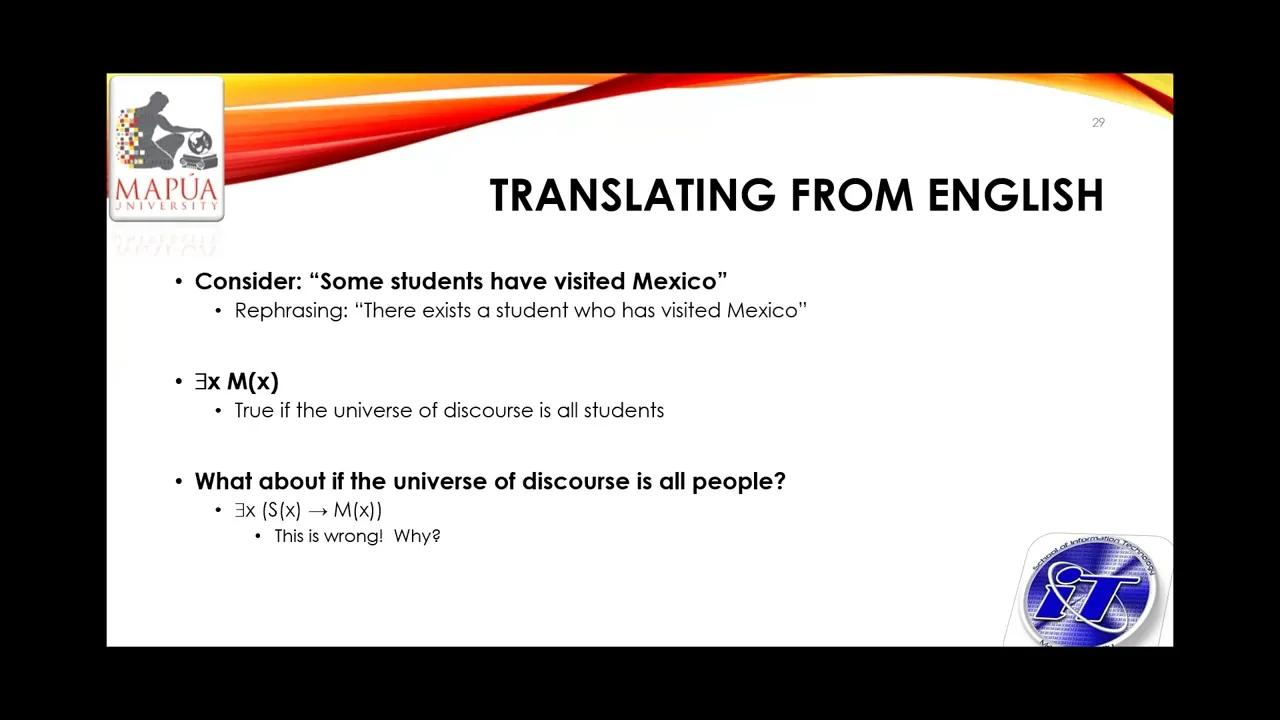
these two examples we could derive three function being a student in this class as at x visited mexico emmett x and c at x4 visited canada so let's start with some students have visited mexico or you could write is it as there exists a student who has visited mexico so if that's if the domain is all about student in this class we don't need to create a function so the answer should be a simple exponential xml text since x is student in this class but in case we don't know in case the the domain is
bigger okay we're in student in this class as part of we need to define or we need to create a function to define the subgroup okay which is the s attacks which is already defined based on the previous light so the possible answer will be extension x as imply x at x implies m at x this is wrong why because it means if you're a student you visited mexico they automatically visited mexico but it's not correct not all visited mexico only some therefore instead of implication we should use and operation okay so it means we
are defining the subgroup of the students in this class okay so being a student in this class and visited mexico okay if we have this statement it means there are students didn't go to didn't go to mexico there our student went to mexico or visited mexico okay so we pertained to this subgroup that being a student in this class and visited mexico so therefore when we use existential x extension as quantifier the connection between the subject and predicate will be and or from yeah from subject to predicate should be added okay so don't forget that
okay another example the second statement every student in this class has visited canada or mexico so our subject is student for all and our predicate is canada or mexico so we have two functions in predicate site okay so the answer if the domain is student in this class this is the simple answer universal x m and x you see at x but in case x is all for all student or anybody we need to define d and define the function that define the subject the subgroup okay so which is s at x so the answer
will be universal x s at x implies m at x u or to c at x so why implication because the quantifier is universal subject to predicate should be implication if you're a student then you have visited mexico or canada okay that's the logic of this statement okay so that's it for this video lecture see you on the next more example we'll be discuss on the next video lecture thank you for listening [Music] you