if you're preparing for case interviews and either don't know what an issue tree is or are struggling to craft the perfect issue tree for cases we have you covered in this video we'll quickly cover everything you need to know about issue trees including what they are and why they are important we'll teach you a simple but powerful three-step approach to create the perfect issue tree every time we'll also cover five essential tips for creating issue trees that you absolutely need to follow if you want to impress your Consulting interviewers with your issue tree we're going
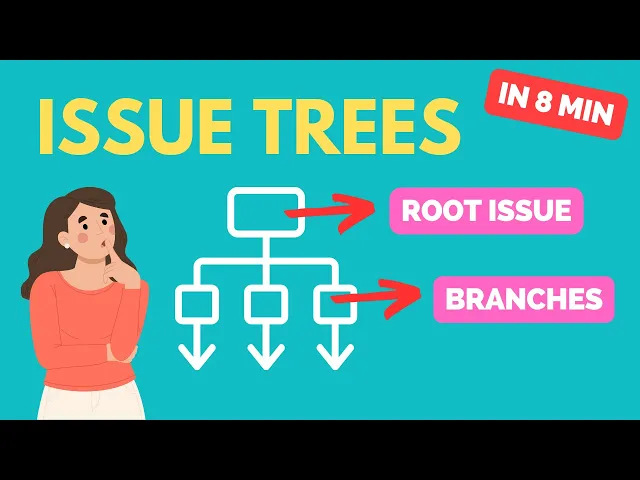
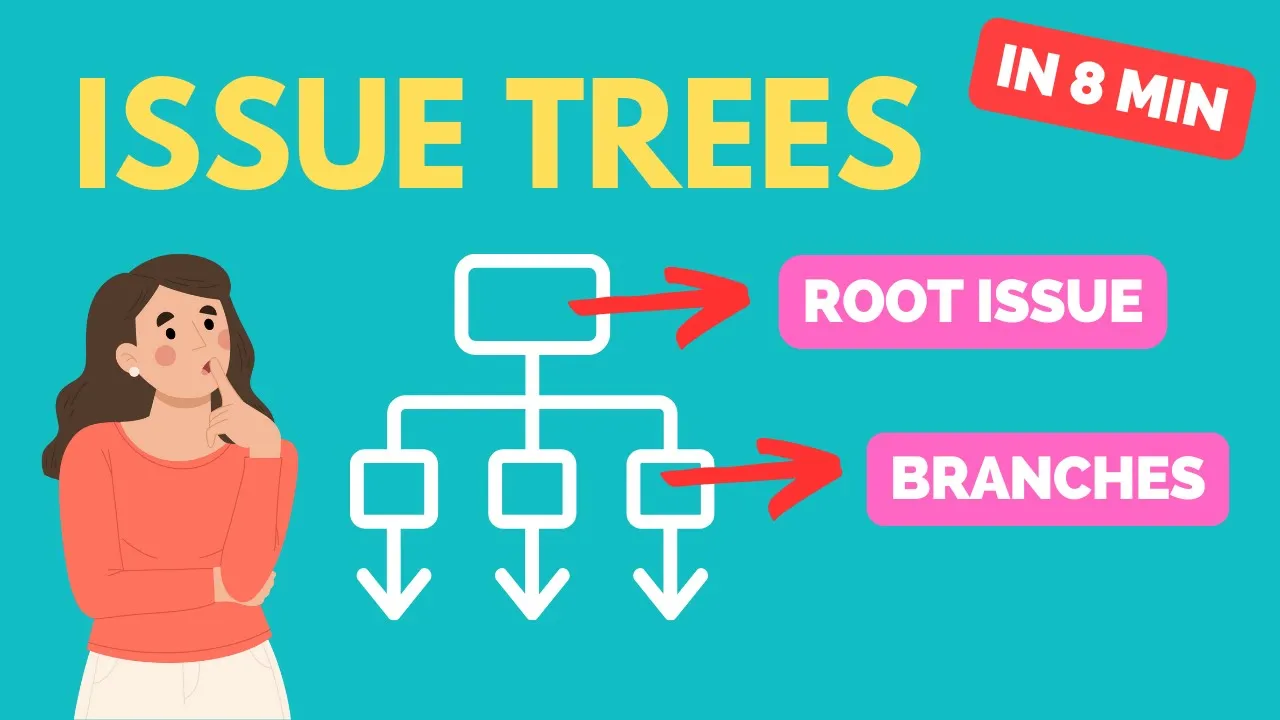
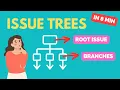
to cover a lot of material in a short period of time so let's get started what is an issue tree an issue tree is a visual representation of a complex problem or question broken down into smaller more manageable components it consists of a top level issue visualized as the root question and sub isues visualized as branches and subbranches top level issue or root question this is the main problem or question that needs to be addressed it forms the root of the issue tree sub isues or branches underneath the top level issue are branches representing the
major categories or dimensions of the problem these are the highlevel areas that contribute to the overall problem further sub isues or sub branches each branch can be broken down further into more specific sub-issues why are issue trees important issue trees are helpful for a number of reasons they help facilitate systematic analysis managing complexity priority ization generating Solutions identifying root causes and effective communication how to create an issue treat there are three major steps to create an issue treat here's a step-by-step guide to help you through the process step one Define the top level issue start
by clearly articulating the main problem or question that you want to address this will form the root of your issue tree make sure that you clearly articulate the main problem or question this sets the foundation for the entire issue tree if you're are addressing the wrong problem or question your entire issue tree will be useless to you step two identify the branches or sub isues consider the major sub isues that contribute to the overall problem these will become the branches of your issue tree brainstorm and list them down there are four major ways that you
can break down the problem by stakeholder process segments or by math stakeholder break down the problem by identifying all stakeholders involved this may include the company customers competition suppliers manufacturers Distributors and retailers each stakeholder becomes a branch for the top level issue process break down the problem by identifying all of the different steps in the process each step becomes a branched for the top level issue segment break down the problem into smaller segments this may include breaking down the problem by geography product customer segment Market segment distribution Channel or time Horizon each segment becomes a
branch for the top level issue and finally math break a problem down by quantifying the problem into an equation or formula each term in the equation is a branch for the top level issue step three break down each branch for each branch ask yourself if there are further components that contribute to it if so break down each branch into more specific components continue this process until you've reached the level of detail that allows for Meaningful analysis before we move on to looking at examples of issue R please take a second to give this video a
like And subscribe to our channel so that you don't miss any of our new case interview content the strategies and tips we provide could make the difference between Landing a Consulting offer and getting rejected issue tree examples here are three highlevel issue trees for three common types of business situations for case interviews profitability issue tree profitability cases ask you to identify what is causing a company's decline in profits and what can be done to address the problem a potenti poal issue tree template for this case could explore four major issues what is causing the decline
in profitability have revenues decreased have costs increased why is this happening are there changes in customer preferences or behaviors are there changes among competitors are there changes among suppliers distributors or retailers are there new technologies or are there new regulations and finally what can be done to address this issue Market entry issue tree Market entry cases ask you to determine whether a company should enter a new market a potential issue tree template for this case could explore four major issues is the market attractive are competitors strong does the company have the capabilities to enter and
will the company be profitable from entering the market merger and acquisition issue treat merger and acquisition cases ask you to determine whether a company or private Equity Firm should acquire a particular company a potential issue tree template for this case could explore four major issues is the market that the target is in attractive is the acquisition Target an attractive company are there any acquisition synergies will the acquisition lead to high returns essential issue tree tips to follow issue trees are powerful tools to solve complex business problems but they are much less effective if you don't
follow these five important tips the fifth tip is the most important tip that you absolutely need to follow tip number one have three to five branches your issue tree needs to be both comprehensive ensive but also clear and easy to follow Therefore your issue tree should have at least three branches to be able to cover enough breath of the key issue additionally your issue tree should have no more than five branches any more than this will make your issue tree too complicated and difficult to follow by having more than five branches you also increase the
likelihood that there will be redundancies or overlap among your branches which is not ideal tip number two order your branches logically whenever possible try to organize the branches in your issue tree logically for example if the branches in your issue tree are segmented by time arrange them as shortterm medium-term and longterm this is a logical order that is arranged by length of time it does not make sense to order the branches as long-term shortterm and medium-term this ordering is confusing and will make the entire issue tree harder to follow tip number three branches should be
parallel the branches on your issue trees should all be on the same logical level for example if you decide to segment the branches on your issue Tre by geography your branches could be North America South America Europe Asia Africa and Australia this segmentation is logical because each segment is a continent it would not make sense to segment the branches on your issue tree as United States South America China India Australia and rest of world this segmentation does not follow logical consistency because it mixes continents and countries tip number four b820 the 8020 principle states that
80% of result come from 20% of the effort or time invested in other words it is a much more efficient use of time to spend a day solving 80% of a problem and then moving on to solving the next few problems then to spend 5 days solving 100% of one problem the same principle could be applied to your issue treat you do not need to solve every single issue that you have identified instead focus on solving the issues that have the greatest impact and require the least amount of work and tip number five be Mei
Mei stands stand for mutually exclusive and collectively exhaustive when breaking down the overall problem in your issue tree the final list of smaller problems needs to be mutually exclusive and completely exhaustive mutually exclusive means that none of the smaller problems in your issue tree overlap with each other this ensures that you are working efficiently since there will be no duplicated or repeated work collectively exhaustive means that the list of smaller problems in your issue tree account for all possible ideas and possibilities this insur that your issue tree is not missing any critical areas to explore
now you know everything you need to know about issue trees when done right they will make your Consulting case interviews much easier to solve if you found this video helpful for your case interview preparation make sure to check out our comprehensive case interview course and books links are in the video description we teach the most robust effective case interview strategies in the least time-consuming way to save you hundreds of hours of prep time and help you land multiple consulting jobs offers