Welcome welcome we usually take about three minutes or so to let people join uh I've had some pretty good attendance to these letter form lectures and really excited about this one and so we're going to wait just a few minutes for everybody to join us as you're coming in please let us know where you're joining from we love to get an idea of the reach of this Program uh in letter form archive has really an International Community that we uh serve and uh we're always happy to hear where you're coming from in the chat uh
keep in mind that uh you may have in the chat a host and panelist uh setting there at the bottom if you change that to everyone then everyone will be able to see what you're saying and you're welcome to discuss things as we go through the lecture in the chat but We'll also have the Q&A section that everybody uh has access to and that's where you should put your questions for our panelists today actually put your questions for the panelists in the Q&A please yeah that's yeah that's that's right welcome Lincoln great to have you
here just got to visit his amazing archive recently of uh posters uh political posters protest posters from All over the world great to have him here Louise who's on our board great to see you we'll give it about a minute more let us know where you're joining us from we've got folks from La Pennsylvania London Munich great hanada represent we'll um just remind you all that the chat is default set to uh the host and panelist if you'd like everyone to see your messages then change it to Everyone there in the setting in the bottom
of your chat and if you have a question for the panelists uh please put it in the Q&A section so that's a separate window you can open that up in the um in the buttons on your screen the Q&A welcome from Chicago Brooklyn Fresno awesome well we'll uh get started with the introductions I have a few kind of uh news items from the archive and then we'll introduce the panelists uh I am really uh fortunate to Kind of fill in for grindle who is out today and uh grindle list is our education director usually leads
this letter form lecture series um uh wishing her well and hopefully we'll be back soon to lead these also thank thanks to Priscilla skila zini who helps run the education program with grindle and does a lot of work behind the scenes to help this uh lecture series happen this is our 2023 season we welcome you all this is a Um program that is associated with type West which is our type design education program it's a full year certificate in type design uh and we are now U about Midway through the 2023 year it's a calendar
year program and very soon we'll be uh announcing a open house so you can learn about applying for the program for next year so stay tuned on that we have a few great workshops coming up and there's so many we can't get them all in the uh In the slides here but we'll just highlight a few for you and then make sure you go to the website to see more uh but this is going to be an excellent one for for those who um have some typography knowledge but need to bring that online to the
web so Maria atsuka is gonna teach this uh Workshop over four Thursdays really nice deep uh introduction to typography on the web we'll also uh have a wonderful lettering workshop with Kelsey gray uh Her very popular book on lettering is is well known and it's exciting to have her bring some of that to a online Workshop so that is also a four-week workshop in September and yeah as I mentioned we'll have this openhouse coming up where you can learn about type West the postgraduate certificate program uh you'll get to to uh meet some uh existing
and former students instructors learn more about what the program is all about and uh how you should Apply so join us for this you can register uh for this on our website at let ar.org events where you'll also see a lot of the other um workshops and lectures that are coming up and we also really uh would love your support as members we are dedicated to preserving and sharing and educating about uh graphic design typography lettering um research like the kind of research we're going to hear about today And the way that that happens is
through your support so please check out uh the membership at Le ark.org jooin and you can also follow us on on uh Instagram uh the letter form archive uh handle is there and the type West handle where you can see what's going on in the uh type West uh classes I'll also add that we're on other platforms too including Mastadon which I seem to be the only one Advocating for these days but there's a lot of type Community there and check it out we're really grateful to the San Francisco Public Library for uh co-presenting this
with us um the book arts and special collections uh Department there at the library has been our long time co-presenter of the letter form lecture series and we're also grateful to Adobe to for their support in helping us record these uh lectures and you can Always check out the website or our Vimeo page um for past recorded lectures so now I'm really pleased to welcome Amy and Jessica and they're really interesting Research into um the black scholar and radical Journal design this is a part of the archive that we often um often gets overlooked we
have a lot of original artwork a lot of um really special uh graphic design material but we also have an amazing research Library including uh Journals and periodicals and it's great to to draw more attention to that side of design research um um really happy to have uh Amy here because I've known her for almost 20 years met her at typon back in 2004 and uh she's a wonderful person really great educator and also to meet Jessica and they uh Al gave us a little story that tells you about how they met which was in
a dimly lit hallway of the modern languages Association conference in Milwaukee in 2013 they were some of the only graphic designers presenting at the conference where showing visuals was so unconventional that the moderator had to bring their own projector and screen as is 2013 after their session which was attended by a fewer people than presented they decided to ditch the conference in Wander the city where they began scheming their world takeover of academic Journal design and I'm so glad That they did because as I said this is a subject that is uh not well covered
but super fascinating and I'm so grateful to have Amy and Jessica with us so with that I will turn it over to them thank you Stephen that was a great intro um and thank you uh to the letter form archive as well as type West for the opportunity to share our work um I am Amy pelas and I'm Jessica uh and today we're going to be talking about radical Journal design and The black scholar um and like many research projects this work has L us down countless uh New Paths what we like to call research
rabbit holes as we have been calling them lately um and in some ways this entire presentation is a is a research Rabbit Hole the more we looked the more paths we found and in a good way of course um so thanks for joining us today so what do we mean by radical scholarship uh and radical academic Journals our use of the term radical scholarship refers to academic journals that establish or explore new disciplines often through activist motives and limited resources um and why study uh the design of academic journals we get this question a lot
um our ongoing collaborative project what scholarship looks like investigates the role of communication design in scholarly publishing um our research has involved Walking through Library basement stacks of bound journals unearthing boxes and materials and special collections interviewing Journal designers and editors conducting reader surveys and writing uh and presenting on the state of academic Journal design we became interested in looking at Publications with richer visual histories uh which is lacking in more conventional academic disciplines as you can guess uh we can say that we have likely looked at more Uh academic journals acoss cross more disciplines
than anyone should probably ever look at um but shown here are some of the papers we've published um and you can read them on our website what scholarship looks like.net so back in 2019 uh we presented a paper at the American printing history annual conference on the early design of three uh academic journals shown here uh antip a radical Journal of geography feminist Periodicals a current list of contents and the black scholar these Publications all represented the broad shifts occurring in the academy new paradigms reflected the intersection between traditional Aesthetics of Journal design with the
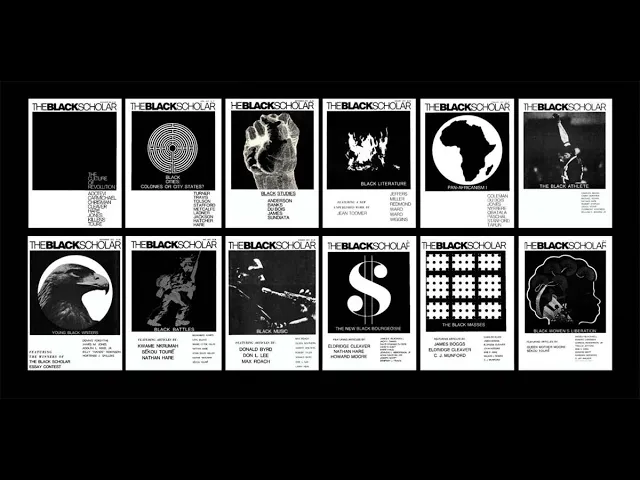
activist ethos of emerging scholarly disciplines but the one that really stuck with us was the black scholar um it stood out from other academic journals radical Publications and Popular press of the time shown here are covers from the first few volumes of the journal it didn't look totally academic its cover is Iconic and bold it also didn't quite look radical it was professionally types set and expertly restrained this led us to wonder who designed this journal how did a new radical Journal have access to highquality printing what was the visual relationship between this journal and
other black studies Periodicals that preceded it this talk is based on an impr progress article that we're working on uh and focuses on how the early design and printing of the journal and the unique relationship between editorial and printing staff impacted its goal of what co-founder Dr Nathan hair described as quote uniting the black Academy and the street as a means to shift disciplinary Focus launch new branches of thought or make scholarship more accessible the Radical Journal must balance its counterculture presence alongside its academic standing these journals inevitably navigate the politics and economics of academic
publishing with the urgency of circulating Progressive knowledge with leaner budgets and a desire to challenge the established conventions of Journal publishing radical journals that stemmed from social movements and civil rights activism tend to embody visual Aesthetics that are more raw immediate and created with DIY and handmade approaches to illustration and Publishing this slide shows a few early issues of some other radical journals women a journal of Liberation the radical teacher and science for the people all first published between 196 9 in 1979 and again all other research rabbit holes that we wanted to follow yeah
radical teacher I know that transfer that lettering um radical Journals stand to uh tend to stand out amongst established scholarly journals as tools for the revolution both within the academy and Beyond as Brad Duncan states in the book finally got the news the printed Legacy of the US radical left 1970 to 79 for leftist movements printed works such as post posters pamphlets and broadsides were quote tools maybe even weapons end quote uh the letter form archives own recent exhibition strike through typographic Messages of protest curated by silus Monroe showcases the Aesthetics of activism through as
they describes on their website quote typographic anger and urgency and in Lincoln Cushing's uh 2012 book all of us are none social justice posters of the San Francisco Bay area there's a great great quote uh where there is radical ISM there is a need for visual identity and propaganda the black scholar a journal of black studies and research began Publication after the F month third world Liberation Front strikes at San Francisco State College now known as San Francisco State University in 1968 to 69 and showing here on screen are images from those protests the student
and faculty protest resulted in the formation of the Department of ethnic studies and a black studies Department which was the first in the nation Dr Nathan hair chairman of the New Black studies department and San Francisco Estate English faculty member Bob Chrisman teamed up with Alan Ross co-owner of a union print shop graphic arts submarin to create the black World Foundation a nonprofit organization and the original publisher of the black scholar the visual qualities of the black scholar played a significant role in legitimizing the discipline of black studies this was done through the collaborations between
ha Chrisman and Ross as well as overlooked editorial Design and production contributions from their wives Julia hair Mary Chrisman and Jane Ross the conceptual approach to the journal's design was a Grassroots effort there were limited funds no art director and no professional publisher the editors chose a path of self-sufficiency according to an interview with Bob Chrisman as he says we felt we'd stick with the basics which was print and good type at the start articles were intentionally not peer-reviewed out of a Desire by the editors to be more inclusive and open to new voices and
writers and artists outside of Academia as an academic discipline black studies was just beginning but as we'll show in the next section the cover and interior pages of the black Scholars early issues give the impression of a well-established discipline 1,000 pounds of lead in order to understand the visual impact of the Publications design we will start with a Detailed description of the typography and layout of the early issues of the black scholar shown here is the cover of volume 1 issue one published in November 1969 the black scholar name plate is set in all cap
sand serif type spanning the top of the page frame the wordsthe and Scholar are set in helvetica light and the word black is set in helvetica Black creating a stark visual contrast the ubiquity of helvetica in many 1960s And70s corporate branding and signage project are associated with qualities such as trustworthiness modernism and authority of course helvetica was also used in many radical Publications as well thanks to its availability as dry transfer lettering giving it a feel of immediacy power and activism and just to show some examples of what I'm calling activist helvetica these are all
activist posters and Publications likely using dry transfer Lettering uh and showing helvetica and all its tight space and slightly wonky aligned Glory uh for more information and examples you can check out the 2017 book lret The DIY typography Revolution these DIY uses of helvetica contrast with helvetica's usage on the cover of the black scholar so let's go take a closer look so the black Scholar's uh name plate included several unique customizations for example the r in Scholar is not recognizable not the recognizable curved leg helvetica R but a straight-legged r the name plate is uh
tightly is set tightly with no spaces between the words so that the letters are touching or nearly touching the th andth is shortened and connected the middle arm of the E is elongated the LA in Black uh are touching and all other letters in the name plate are tightly spaced below the name plate a large black Square covers over half of the Page with the words the culture of Revolution set tightly spaced all caps helvetica light uh in the lower right corner of the square each word a separate line below the large black Square includes
the last names of all the authors featured in the issue tightly spaced while the while the traditional curved helvetica R is used in the cultural revolution in this column the author's names the straight R is used throughout another research Rabbit Hole here but the straight-legged r was not a particularly used or well-known feature of helvetica at the time um and I know there's a question about the hot Type U in 1969 and I I think that this was photo composition this cover I I talked to a few folks about that um yeah the the customize
e there's a lot going on here but but ultimately these typographic customizations point to a sense of thoughtfulness and skill of train type Setters access to tools and Technologies of the time and a desire to PR present itself as a serious and credible publication on the interior left page of the first issue white text in the type face news Gothic is set Justified on a black background with generous margins the text introduces the new publication and proclaims the journal as quote the first Journal of black studies and research in this country it goes on to
describe a Black scholar the reader as quote a man of both thought and action a whole man who thinks for his people and acts with them the image at the bottom right shows uh the interior spread of the first issue including the table of contents so the table of contents here is set on a white background with two columns of type the black scholar logo stands at the top right corner headings are set in bold sand serif while the body set type is set in small but Readable serf the staff section lists publisher is Nathan
Nathan hair the editor as Robert Chrisman and the coordinator as Alan Ross this page also includes a formidable list of contrib Ting and advisory editors including Emory Douglas minister of culture Black Panther Party overall the interior page layout of the first issue is not unlike scholarly periodicals the design and type setting of articles in these issu In these early issues is readable and restrained article headlines are set in all cap San serif I think it's Bower grotesque body type is set in serf type in two columns drop caps and small caps are used in the
first paragraph of each article and to indicate new sections of longer texts for a publication with a small budget and limited staff Graphic Arts of Marin's contributions are evident by these typographic decisions and Details so this gets into the question about Metal type um in the third issue of the black scholar volume one issue three and four an image of web Deo is on the cover to honor his recent passing as uh Chrisman described in some interviews a filter was added to make the image appear historic and grainy uh the interior left Page declares that
the publication takes quote 1,000 pounds of lead for setting type 6,000 pounds of paper 3,000 man hours of Labor and 20,000 Staples it also describes the black scholar as a quote heavy publication this is one of the only examples that we've seen of an academic Journal that makes such a direct connection to its Printing and production and we'll discuss more later in the talk why this was the case in addition to long form scholarly articles and book reviews early issues included letters to the editor a Classified section related to employment and other professional opportunities and
advertisements for other new Publications and events giving insight into the range of new opportunities in this burgeoning discipline some of the ads were created in-house uh While others were not likely the case with the Pathfinder press ad on the right uh from the main 1970 issue of the black scholar I haven't seen much other use of Cooper black um in looking at lots of Issues typographic consistency as well as some slight variations can be seen in the table of contents over time shown here are four issues uh from the years between 1975 and 1993 and
while not much changes in the layout we can see the evolution of the name plate in the top left the straight R of helvetica in scholar changes to a curved R then to A variation with Optima instead of helvetica then a variation with helvetica but no longer the tight Customized spacing these changes may also align with some of the technical changes in printing and layout from hot type to cold and photo type setting to digital type setting by the mid to late 80s in future issues of the black scholar the black Square which was known
internally as the Blackboard becomes a container for a spot graphic uh photography line artart or other other illustrations pertaining to the issues contents by the mid-70s spot color was Added to some of the covers and the Blackboard graphic became a striking symbol of the issue through 2012 shown here are a range of covers uh between 1972 and 2012 using spot colors and showing the work of many black artists inclus including Elizabeth catlet Aaron Douglas Eileen Abdul rashed and Jacob Lawrence to to name just a few the covers of the black Scholars are a Hidden Gem
of publication designed history that absolutely deserve a Spotlight um and definitely a whole other research Rabbit Hole these covers in both their graphic consistency and variety led us to look back further into the history of periodical design that preceded the black scholar our research is the visual in the visual shaping of a discipline is full of rabbit holes as Amy mentioned um every single hisorical publication we looked at could launch an entirely new study and we had to keep ourselves from Getting too far away from our main focus um though the black scholar is considered
the first academic Journal of the emerging discipline of black studies there is a rich history of Publications about and for black culture and study these range from academic journals to arts and popular culture magazines many of these are known as little magazines which is a term used to describe quarterly literary Arts magazines Our intention here is to Contextualize a history for exploring the visual design and mission of the black scholar not to form a timeline or establish a direct lineage we'll provide an abbreviated design- centered account of these periodicals and please note this is an
incomplete history there were so many things that we found that needed more study and we couldn't include everything here uh we got lost many times and ultimately we began looking at what what we're about to show you um Because we began to see the black scholar as a visual hybrid of an academic journal and a little magazine at the turn of the 20th century the work of web Deo and Booker T Washington provided a foundation for scholarly literature focused on the issues of black Americans shown here on screen are du Bo's the Negro Artisan on
the left and the Negro problem edited by Washington on the right these are both scholarly literature with single column Page layouts centered headings and quiet serif type faces from a visual standpoint these images could be books from any discipline on any topic and they fit very well with other books books published at the time incidentally the Negro problem on the right was published by James potton company which was a house that did substantial business printing Bibles and other materials related to social justice in 1910 Deo founded the crisis a Record of the darker races in
one room of the Saturday evening post offices and this is still the magazine of the NAACP this is considered the world's oldest Black Magazine and as you can see over time the visual language of the crisis changed alongside publishing and magazine design Trends the crisis covers used a rectangular frame to feature artwork and photographs and this is an approach later used by the black scholar the Similarity is most evident in the 1937 issue which is shown second from the left which is by Harlem Renaissance artist Raymond E Jackson Harlem reneson era Publications continued to play
a significant role in shaping what black journals looked like the magazine opportunity Comm Journal of negro life began in 1923 and was published by the National Urban League to address according to its first issue quote efforts to raise the standards of Living among Negroes end quote the early covers for this sociological Forum were illustrative and by the late 1920s as shown here the covers became more stylistically varied those on screen feature covers by winold rice wendeln Bennett and Aon Douglas the interior pages of opportunity resembled most other journals with standard two column layouts centered head
headings and carefully placed artwork Elaine Lock's 1925 special issue Of the magazine survey graphic titled Harlem Mecca of the new negro was also notable for helping to define the visual character of black intellectual Publications also in 1925 lock produced the new negro through Albert and Charles bony New York who were known for publishing political and controversial titles these Harlem Renaissance Era Publications included and acknowledged the work of black artists most notably a Douglas locks Publications also featured German immigrant artist winold rice who was known for his earlier work with opportunity magazine Aaron Douglas further developed
the visual aesthetic of black periodicals Harlem Renaissance titles fire and Harlem a form of negro life were both single issues featuring his cover designs fire and Harlem both aimed at intellectual communities show a sensitivity to form and typography throughout Douglas's cover artwork Furthers the graphic approach developed earlier in his career according to John Key and Silas Monroe Douglas showed a quote abstraction with the figure and the voice an African inspired articulation of geometric form the Black Arts Movement began in the 1960s and this time period marks politically motivated arts and literature emerging during the Black
Power movement according to kohi nishikawa the Black Arts Champion the Development of quote a blackowned and black operated network of presses that facilitated the movement spread through print media such as books chatbooks pamphlets Flyers journals magazines newspapers newsletters and even broadsides and posters this included both smaller presses and Publications as well as larger commercial titles such as negro digest which we'll look at shortly the little magazines shown here are black dialogue and the Journal of Black poetry black dialogue was started by students at San Francisco State University and there was no designer on staff the
cover feature bold typography and compelling graphics and the interior type setting resembles that typical of radical Grassroots Publications some of the little magazines became quite popular shown here are the first issues of negro digest Ebony and Jet which aim to connect with middle class black readers Through general interest content using bright spot colors and images to Spotlight a range of topics these magazines had a consumer-friendly aesthetic intended to attract a broad audience they were all founded by John H Johnson of Chicago based Johnson printing these magazines celebrated black culture and issues starting in 1950 Leroy
Winbush was hired as art director and in 1967 Herbert Temple Jr became art director Temple was a Chicagoan associated with the Southside Community Art Center and he was responsible for the design decisions of these magazines and he would later on play a critical role in developing visual Aesthetics for the news of protests during the Civil Rights Movement Herbert Temple was also on board as art director when negro digest became black World in 1970 which coincided with the start of the black scholar this changed The Magazine's focus and visual look from derivative mainstream content to topics
that according to nishikawa quote interlined Black Arts and black power with an internationalist pan-african discourse of racial unity and diasporic Consciousness the first issue of black World which is shown here second from the left on screen features a photograph of of a mask from benine Temple and managing editor Hoy W Fuller aimed for the magazine to have quote a black Arts Visual aesthetic that small presses and little magazines had already made made popular in their own formats in addition to the Black Arts magazines and little magazines uh academic journals also played a role in shaping
what black scholarship looked like through the first half of the 20th century shown on screen are the covers of five black academic journals that existed before for the black scholar and these are shown as they would have Appeared in the late 1960s um at the far left we have the Journal of negro history which is now known as the Journal of African-American history and it's still in publication uh next to journal of negro education still in publication the name has not changed and I should note that both of these journals look very much the same
today as they did when they started uh Freedom ways in the center um first general the first general editor Of Freedom ways was was Shirley Deo wife of web Deo um Amy and I realized this is a fascinating Journal um it was difficult not to keep digging into it um and we uh would encourage everybody to learn more about it it is no longer in publication it ended in 1985 uh race Journal is now known as race in class and um at the far right Negra American literature forum is now known as African-American review and
is still in Publication for all of these uh using publisher house styles and page layout conventions the visual design of the titles aligned with other academic journals of the time readable traditional and nearly identical from one issue to the next these journals work to build Authority and Trust in varied areas of study such as black education and social sciences culminating in what would eventually become known as black Studies the black scholar wasn't the only new journal to be realized in the late 1960s and early 1970s the Journal of black studies and the black Academy review
were in similar stages of development Journal of black studies on the left was published by sage and still is uh using their house style and had a cover approach similar to opportunity and Survey graphic the front matter of each issue contains a note saying the Cover artwork adapted from Mumba Village Belgian Congo Motif by George H H was a white faculty member at Art Center College of design who was commissioned to create African motifs for the cover artwork today to the journal appears much the same as it did in 1970 black Academy review shown at
the right devoted to major issues confronting the black plers opted for a geometric modern two-color cover with the title at the top left bounded by Bold horizontal and vertical lines the cover also served as a table of contents and no designer is [Music] credited the second issue of black Academy review contains on its very last page an auspicious advertisement for the black scholar uh in this next section A labor of love we will discuss the people who printed and produced the first issues of the black Scholar in 1969 Professor Bob Chrisman walked into Graphic Arts
of Marin a union print shop based in selo California and met graphic arts co-owner Alan Ross at the time Chrisman was looking to print a student newspaper in early conversations Ross a types Setter and printer for over 50 years told Chrisman about an idea he had to teach printing quote to a group of black youngsters and my hope to be of value in the Black Liberation struggle End quote a few days after their initial meeting Chrisman brought Nathan hair to a dinner at Ross's house and the concept for the nonprofit the black World foundation and
its journal the black scholar were formed with initial funds of $1,250 from hair Ross and Chrisman they rented an office from graphic arts next to the print shop har and Chrisman served uh as President and Vice President of the foundation and Ross served as the Treasurer Ross's journal entries from 1970 published in the 50th Anniversary issue of the black scholar in August 2020 pointed to his passion and excitement uh at the time quote too often I have been disappointed when I developed some projects and they fell through at Inception because of lack of cons continued
interest this time the project was enormous a publication on a national scale without the means to print even a letterhead and with Complete strangers in a field as hazardous as War itself after the dinner ha remarked to Chrisman pointing at Ross quote he is some printer and he was some printer Alan Ross born in 1907 was a Jewish immigrant who escaped Ukraine as a teenager with his brother and came to the United States although Ross had no formal education he started his career in New York at Union print shops including Prompt press in the 1930s
shown here on the left is the book the ruling Clause printed at prompt in the 1930s I don't know that Ross had anything to do with the printing of it but I just wanted to show some examples uh from prompt Ross was also a typographer at the daily worker a newspaper published by the Communist Party USA shown here is the name plate and headlines for an issue of the daily worker from the 1930s and I appreciate that the Cubs are beating the Tigers in the 30s uh Ross was also a longtime member and for a
time Secretary of the local six International typographic Union that was based in New York uh this uh uh this local six uh in in New York was one of the largest and most active of the itu which was a major force in labor unions in the late 19th century to Mid 20th century and another complete research Rabbit Hole the document on the right is a letter requesting donations For bread for our brothers a campaign to help union members in war torn areas of Europe signed by alen Ross executive secretary uh for the itu local six
in this letter to the UN relief Rehabilitation Administration Ross writes quote the Trade union movement in Europe today is a force which properly nourished will become the guaran of democracy during his time as a trade Union organizer and active for labor rights Ross wrote reconversion security Or crisis published by the communist political Association of New York state in August 1944 the printed booklet is types set by Ross and illustrated by daily worker staff cartoonist Fred Ellis the author's biography describes Ross as quote an authority on trade unionism and quote uh is intimately acquainted with the
problems facing American labor in this essay Ross describes the important role American laborers played during the war and The crucial role played by black Workers and women for 13 years Alan Ross also worked as a compositor and typ Setter at the Long Island star Journal a daily newspaper based in Queens New York shown here uh a day at the LI star Journal it's set on a linotype machine by Ross describing a typical day work typical day's work likely uh in the 1950s this is a quote from from this it is a special trait of linotype
operators to set item after item and sometimes not Even pay attention to the contents it is this particular trait that makes it possible for operators to set copy they don't understand or do not care to understand follow copy is the motto of the printer um however according to a 1960 article found in the satirical newspaper the realist I'm not entirely sure if this is satire I couldn't find Union records or course cases related to this but um in this article it says that Ross Was fired from the lii Star journal for a quote typographical error
for replacing the word freedom in an article with the word fascism the article describes Ross's discharge from the LI star journal and protest by the local six itu quote the union argued that the star Journal should have employed more proof readers to catch such changes in copy end quote in interviews with Ross's daughter Elizabeth she described her parents Alis Allan and Jane as immigrant working-class intellectuals lovers of the Arts with a strong commitment to social activism at the same time the Ross family was greatly impacted by McCarthyism in the 50s the family's phone was tapped
and they were watched by the FBI for years uh this document is part of the FBI file on Ross's affiliation with the black scholar and the Communist Party USA uh and this is a quote from the memo subject was Interviewed in 1962 and at the time did not wish to discuss his activities with the FBI other than to State he was a loyal American citizen of the United States given the challenges on the east coast in 1958 Ross moved with his family to San Francisco and worked as a linotype operator at the San Francisco Chronicle
in 1960 he co-founded Graphic Arts of Marin with his wife Jane and Bernard and Marie Moss like Ross Bernard Moss was trained as a linotype operator In New York and was active in labor organization and served on the Bo of the local ACLU Marin graphic arts printed work for social and Civic causes creative Industries um including the San Francisco Museum of Modern Art as well as posters for the Black Panther Party designed by Emy Douglas this one is shown on the left Rock posters by psychedelia artists such as uh Victor Moscoso shown in the middle
and the Right image is the graphic arts of Marin's uh Union stamp that can be found at the bottom left of of these posters and others Graphic Arts of Maron was a union shop and was dedicated to social causes as well as bringing in more underrepresented groups into the printing trades despite the broad lack of support for black membership in the itu Allan corresponded with officials at the San Francisco itu offic uh San Francisco itu officials to adjust the test in 1967 in order to place more black apprentices in the union however the union would
not change the rules prior to meeting Bob Chrisman Allan proposed to build a shop for the Black Panthers according to Ross they liked the idea but didn't follow through graphic art Civic involvement include project breakthrough a California Department of Education Program at Tamil PES High School uh to quote increase Black student confidence the report described a 48-page magazine uh written by students published quote with the aid of several Artisans and a local print shop Graphic Arts of Marin in salao challenges of exclusion by the it echo's concerns from 50 years prior in web deo's essay
the black man and the unions where he criticized the international typographic typographical Union in an essay published in March 1918 issue of the crisis Deo States Quote I carry on the title page for instance of this magazine the Union label and yet I know and every one of my negro readers knows that the very fact that this label is there is an advertisement that no negro's hand is engaged in the printing of this magazine since the international typographical Union systematically and deliberately excludes every negro that it dares from membership no matter what his qualifications end
Quote although the itu was one of the first unions to technically admit women in 1869 and black people in 1879 after lengthy battles to limit their admissions racism and exclusive policies continued well into the 20th century um this is another kind of side research rabbit hole that again totally deserv deserves some more attention the first black member of the Los Angeles itu chapter uh local 227 uh was O'Neal Cannon and he was Accepted in the early 1950s however continued to experience ongoing racism within the union he was often shander refused jobs even after he was
accepted into the Union this this slide shows the the 20 20120 oral history book on Canon's 100-year life and some of the work printed by his print shop in La called Fidel educational press and both of these include the the union stamp which he was apparently very proud of 227 again another wonderful research Rabbit hole at one point uh Graphic Arts of Marin did have young black printing Apprentice but unfortunately he was drafted to Vietnam shortly afterward uh it's also worth noting the number of women involved in the editing and production of the journal itself
including Janet chetam sa saxs Gloria Bevan and Cyn the edings shown here are also several issues of the many that were devoted to black women and feminism On the left is the December 1971 issue which published an essay by Angela Davis during her incarceration uh as well as essays by Shirley Chisum and other prominent voices women involved with the first issue of the black scholar wives Julia Mary and Jane as well as daughter Elizabeth according to the uh 50th Anniversary issue quote all acted as translators editors printers graphic designers and primary readers and like Ross
were mostly working-class Individuals intellectuals who were always mindful of the racial politics of the time and the delicacy of their position working with a black Journal end quote their contributions were rarely credited but were undoubtedly a part of the journal's early success Chrisman later recalled that he took part in setting type for the black scholar issue Pages uh and the value of that experience quote when we did our first issues they were set in the Oldfashioned way on lype hot type it was called it gives you a very satisfying texture because the typographer is actually
the individual adjusting the length of the line the spacing so what you got was a Consciousness with working with the material as a distinct from a rather cold and impersonal computer I had to learn that and how to do layout how to dummy meet deadlines so all of that was part of my production process shown here is an article written by Chrisman in the first issue of the journal so perhaps he set the type for his own article the art Direction and production of the journal like the concept and content of the journal itself was
a collaborative Endeavor the design and the layout of the first issue was left to Ross uh to Alan Ross Elizabeth and Jane and according to Ross Jane was the designer of the original logo this is a sketch an image of a promotional mailer Along with an early sketch of the black scholar cover on the back of an envelope and while a lack of resources is common uh in many academic journals more broadly Alan Ross preferred to downplay their Collective expertise as well as his personal contributions the black scholar was a labor of love for Ross
he made no money on the Endeavor and preferred to stay in the background of the process his journal notes quote Today A year later we sent the December issue to press with speed and sophistication like experts end quote shown here is the cover and interior first pages of that December 197 issue the black scholar was the uh black world foundation's first instrument for the enhancement of Black Culture as they said and establishment promoted itself as the academic journal for this new discipline the first volume of the black scholar which was November 1969 to June 1970
issues were produced on almost a monthly basis in its first year of publication The blackx Scholar had nearly 3,000 subscribers this included 20 College library subscriptions and a total distribution of 12,000 though Graphic Arts of Maron printed the first several issues the printing was later outsourced to a web pressed in 1970 as alen Ross beli believed they needed a better quality press this slide shows some self Self-referential advertisements as well as some of the Box Scholar's other endeavors including its speakers Bureau and the prisoners fund these activities extend the visual language of the journal to
its promotional pieces in the introduction to the February 1971 issue a plea for subscribers states with a possible exception of shivas Rego the black scholar is the best thing you can buy nowadays for $10 and it's better for you too in these moments we see a sense Of legitimacy and agency in the journal it's no longer trying to establish itself as credible but seems to be comfortable in its tone and place in 2006 numerous FBI files on black Scholars and Publications were Declassified through the us freedom of Information Act this was done at the request
of William Maxwell a professor at Washington University in St Louis among these were files on the black scholar and the black World Foundation The FBI documenting the people involved and their connections with black nationalist movements described the black scholar as quote a black militant magazine end quote which discredited the journal's goals I should note that these FBI files are all freely available on the internet archive it's a four-part PDF um it's definitely looking through while the FBI was investigating the journal as a militant magazine um the black scholar was also featured in Newsweek and the
New York Times the Newsweek feature included photos of the first issue cover which is quite notable in that a black academic feature was being given national attention in the writeup Nathan Harris quoted as saying quote blacks have never thought of themselves as Scholars he explains they haven't written or researched much a PhD was thought of as an endr model to help develop our concept of the black scholar and that model must be determined by Blacks their aspirations and needs the New York Times on the right describes the black scholar as a monthly Journal recognizing it
as a notable intellectual publication and quote the most important Journal devoted to Black issues since the crisis end quote only later was the black scholar described as an academic Journal as it established itself in 1972 Ross resigned from Black World foundation's board of directors the he continued to work on the black Scholar and the book club this slide shows the first three pages of the book club's 35-page pamphlet and we can see how the book club extended the black scholar logo and look for its brochure alen Ross passed away in March of 1974 at the
age of 67 and an inmemoriam was published in the April 1974 issue describing him as the treasurer and coordinator from November 1969 to October 1972 Jane Ross continued to run the Books Behind Bars program through the 1970s Nathan harir departed in 1975 following ideological differences and shown on screen in the center is a New York Times article about that story Bob Chrisman remained editor of the journal until 2012 and Robert Allen also served as a longtime editor from 1973 to 2012 chrisman's daughter Dr Laura Chrisman served as editor-in Chief from 2012 to 2014 Chrisman passed
away in 2013 at the age of 76 in 2015 Le chisi began serving as editor and chief coinciding with Taylor and Francis taking over the publication of the black scholar this included a new visual approach to the cover design and at this time the black scholar name plate concept designed by Jane Ross was retired he says the journal still conveys its quote accessibility iconicity boldness and intellectual Independence but as its Prestige has grown and as prestig of black Scholarship has grown we've been able to engage more color covers and plates in order to speak to
the new hyper visual nature of contemporary media and Contemporary Art culture and activism end quote the institutionalization that ACC companies Prestige was not necessarily a goal of the black Scholars Founders as choki notes this would likely have been considered been considered quote a tragic success the black scholar continues to Accomplish his Founders goals and this is partly due to it enduring visual language although its logo and cover design has changed artwork by black artists continue to be featured on black scholar covers and within its Pages it is today considered to be the premier journal in
the discipline of black studies for the 50th Anniversary issue published in August of 2020 the theme what was Black studies uh the cover pays homage to the original Blackboard and Name plate demonstrating the iconic nature of the Blackboard and the tragic success of its or original design alen Ross's journal entry which we referenced earlier was published in this issue through its design and production this radical Journal legitimized black studies while developing a visual language of its own editors and Publishers of the black scholar understood the power of controlling the printing and the production in the
from The Publishers essay of the September 1970 issue Dr Nathan har States Quotes no black studies program should be without some study of the use and methods of the apparatus of publishing and propaganda the history of the design of the black scholar raises more questions than it answers we have many questions uh but some of these are um you what is the success or even a tragic success for a radical scholarly Journal how does Visual design help it achieve that goal and in what ways can designers act as collaborators and allies scholarly publishing today faces
many issues such as access subscription costs for-profit publishing models and conservative skepticism and so new disciplines face even greater challenges the design of the black scholar is a culmination of people history and circumstances as we have attempted to show today understanding the design Histories of academic journals and having the ability to control the means of production is critical for guiding new generations of emerging disciplines and Scholars thank you so much thank you Bravo thank you so much this was fantastic uh really impressed with how many details about the production that you were able to uncover
um and as we wait for some Questions to come into our Q&A panel I uh that's that's kind of what I wonder is uh what were some resources and some um tools that were useful to you in in doing this research because so often some of these uh production stories and origin stories uh especially with with journals like this are so hidden um well I think it's those personal connections uh and trying to connect with the people you know that were involved of course Google kind of Only does so much and so you know it
was kind of finding people we could reach out to and and you know reaching out to people and and the generosity and and willingness of folks to share their you know personal stories and personal histories was like a Beyond I mean just getting the Goosebumps so that those personal connections was was pretty amazing um but we got those personal connections through I mean even the letter form archive you know grindle Hooked us up connected us with Lincoln who you know connected us with folks and so that was just wonderful um Jessica what else am I
missing here um Beyond personal connections just loads and loads of digital archives I mean we combed through so much and I have to say uh J store inter internet archive Google other archives just finding a lot of these um clippings articles and um a lot of what we were looking For doesn't necessarily exist in in most archives like the covers of things and front matter and fortunately we got access to um a it's it's not public but a private Archive of the black scholar um from Laura Chrisman which was has been amazing to look through
and and also um I was going to say too you know some of our Google searching had to be a little bit like tricky so for example Alan Ross is spelled a l Lan but a lot of times his name would come up as Al Lan or alen or alen you know just trying different spellings and and seeing what would come up but um you know yeah it was it was a lot I mean we've been working on this really in depth since about two 20 9 yeah on and off yeah as teachers what kinds
of um instructions or tips or guidelines do you give to your students for doing this kind of research I mean it you started it with like Google can only go so far what are some other things that you have found uh Helpful for your students in doing their own research I often encourage our students to step away from Google and try the library and so you know honestly it's I think um we're so quick to just Google search something instead of looking through Library databases and literally I mean in Amy and I were're digging through
many Library based databases um as well uh and there are Treasures to be found there but it's um I feel like it might be becoming like a lost art to look for a lot of these things in library sites right and also going I mean one of the things that we were talking about before was the difference between between seeing a journal online versus going and actually seeing it physically so you know I had the opportunity to go to Yale has a full run of the black scholar um so I was able to go to
their special Collections and actually see Them you know and and like hold them and see like wow the the paper that was used for the first couple issues was a lot thicker than you know and I would have never been able to see that in a digital archive either so there is you know just a pump what the letter form arive does I mean there really is something valuable about yes you know doing the online work but then also if you have the opportunity or ability especially if You're a student you know with a library
there's lots of all libraries have special collections um that that are invaluable yes Ray for libraries great yes yeah yeah well we've got some questions coming in from our audience so Philip Clayton asks are there any connections from these Publications to the Caribbean are there any interests in extending This research beyond the United States and he adds that he's particularly Interested in the design printing sensibilities that may have made an impact on the Caribbean Publications yeah Graphic Arts of mar I believe um we came across and again like this was a rabbit hole we had
couldn't include everything in this presentation but there was also a journal um it's a Puerto Rican um scholarship uh journal on Puerto Rican scholarship that was also published by printed it was printed right by Graphic arts the Ron yeah yeah the ran yes and that was printed um I'm guessing there was probably some overlap between that in the black scholar but again that's that's a a journal we have not yet studied yeah and there's there's just so much I mean I think and and I know that there are some some scholars in the digital Humanities
that have done some incredible work um on Caribbean studies I'm I'm drawing a blank on the name but I know there's some folks at Yale that are doing some pretty amazing stuff yeah and there were some issues that the black scholar focused on um like Caribbean studies yeah it's there in the uh in the archives you could you know do a search that way and a great point from from Lincoln in the chat is that uh a lot of images on the covers of black Scholars uh came from posters created by UL which Is the
organization of solidarity of the peoples of Asia Africa and Latin America we have a few uh posters from them in our collection I know Lincoln has many and they're they're fascinating because they're they're often multilingual uh including you know Arabic and uh other languages on the posters and um yeah a lot of work being done in Cuba and other parts of Latin America for for those so there's a connection to um the Caribbean um Brandon burkel uh asks what Got you into this research in the first place why pursue this particular RAB this particular Rabbit
Hole rather than so many of the others you mentioned you know there was just something about the covers that was just so fascinating and I think yeah you know the way that we just started out you know we were looking at philosophical transactions and all of these really uh I had an opportunity to go to the Royal Society and go to look at you know the Notes from like the 1600s of the Royal Society and stuff and and that stuff was really fascinating to see journals that had a lot of histories already recorded um but
then I you know I was just looking at you know what are the top journals in you know women's studies women and gender studies what are the top journals in Black studies and I just came we came across the the black scholar and the the black Scholars website had a lot of the examples of the Past covers and it's was like wow this is there's something like different about what's going on here and then just as we discovered more about it and we discovered the stories and we learned more about you know Alan Ross and
and graphic arts and and just the connection to the like just such a deep connection to like the design of it that was so unique from almost any other Journal we've seen so far that we've looked at you know in the past few Years and there was so much that we we were um discovering and connecting you know I think the more dots we connected the more excited about it we got and so this became the really big rabbit hole that that we stuck with but there are um we even uh Amy and I met
yesterday um to talk about this talk and we we're still finding things that were're like oh did you see this oh my gosh I found this and it it's like all these things can Branch out from um this particular study and That was that's pretty exciting and and just to like even just why academic Journal design like we the way that we kind of even got interested in this is that Jessica and I had the opportunity to co-edit a special issue of visual language uh visible language journal in 2015 and we were given the opportunity
to you know not only edit an issue but also to design it yeah um and so we labored over the design you know we like You know spent hours designing the covers and you know just getting it everything perfect and the printed you know journals came to our offices and it was like so beautiful to have these you know beautiful printed journals and then we saw the journal on proquest and it was just text right everything was gone there was no design like all of the design was just and it was like why is this
happening how is this okay and that kind of led us to ask what is it about Journal design that is s that makes it such this like invisible invisible publication design maybe more so than others I mean we had carefully watched hyphens we were carefully placing artwork next to where it should appear with a text and yeah as soon as something is stripped of that layout it become something else and um we had so many conversations where we just kept saying why does it look this way why does academic scholarship look The way it does
why does it have to look this way so yeah we're still there I really like how you opened up the conversation about the design of of this publication and and others that were trying to have a particular personality or voice and how design has an impact on that and Kim asks a question about you know you mentioned the paper that was used do you think the materials that were used could have Affected how the journals were perceived definitely I mean and in some of the interviews that we read and you know some of the folks
that we talk talk to like the fact that their the the this academic journal's offices were located next to a print shop you know that they had connection to the print shop like there was such a connection to you know what it looked like and and the decisions that were made were so intentional um that that I think it very Much kind of set a standard or a tone um that other journals just couldn't achieve you know even something like the the other Journal that Jessica talked about that was published by Sage around the same
time Sage is a big academic publisher that's just kind of churning stuff out um and I I think that like you you can see some of that difference for sure oh we have a question from Louis sandhouse I'm particularly interested in the relevance of the past on the present It seems that the black scholar was trying so hard to gain quote trust and legitimacy through Visual form and through the graphic means available but what are your Reflections on today's academic journals especially ones that challenge the status quo of knowledge when so many academic journals are
still trying to replicate a standard look of trust and legitimacy you want to take that one Jess pause I'm Thinking that's a such a great question but I think you know today we have online publishing which adds another layer of complication you know you could say okay part of that trust and legitimacy is the quality of the paper and the printing and the design but even but now that might not even be seen or experienced in an academic Journal they may just appear as proquest with no style whatsoever um I think it's a huge challenge
especially With more like predatory journals out there too um I mean as much as that's a challenge I think it's also an opportunity though to actually circulate things more broadly um right I mean and and if anybody is interested in the world of academic I mean if you want to get angry about something like check out what the profits are for like uh for academic Journal Publishers you know the big ones it's it's mind-blowing it's obene it's Obscene and so you know because again there's Open Access journals and most journals are under you know very
hard to get access to to anything because you have to have an academic subscription to get to it and libraries are paying exorbitant um fees in order to have like subscriptions to journals so so the whole thing is is like a racket it's it's a academic publishing is very interesting politically and the way that design plays into that it you know again It goes back to that like holding the means of production like being able to control how you produce and disseminate that's another Rabbit Hole um yeah oh sorry go ahead we found with um
a study we did a few years ago um that we ended up uh publishing an article on we we surveyed Scholars across disciplines about the whole trust and legitimacy and um I kind of wonder if maybe it's a case of changing what Authority looks like you know or maybe just challenging that sort of very typical standard maybe Bland academic look to things and just changing what that looks like maybe it'll be more difficult to replicate if it does have more personality um are you seeing any examples of this you know within academic journals of like
trying to change what what that means visually there are some you know again it's it goes back to you know kind of Why does an academic Journal exists right it exists in order to and then of course like the whole peer review process like the reason is for you know Scholars to be able to get tenure right but of course like that even tenure itself is is something that's roting in the United States right there's like you know states are getting rid of tenure so what will an academic Journal even look like or mean or
neat be needed in 20 years um why couldn't you or I start an Academic journal and call it that I mean that's kind of what the black scholar did that's what they did yeah and um honestly and maybe people will disagree with this but there's really not much to stop people from just starting an academic Journal um you know you could just put PDFs online you could just mail out paper copies you know it's it's these start in some these start somewhere in some way and they have to look the way They do for a
reason whether it's to stand out or to fit in you know the other um academic journals in our talk that were um like black journals around the time black scholar was launched um very much kind of fit in alongside other disciplines they didn't really stand out at all and that's another question of like how do you gain sense of visible presence right in kind of a saturated uh Market right and Louise adds that Joanna Dreer has been advocating for designers to take on the model and look of academic Journal so it sounds like there's some
there's a push for this and all can be behind it um Sahar asks uh is this research published or in the process of being published somewhere speaking of do your own thing well you know we're um yeah so so we are this this talk is based on a um on a on a article that we're writing Right now and um you know we're we're in the process of of working with folks that are writing a a bigger and broader history of the black scholar right that's not what we're doing at all um but uh if
we can tell this little piece of the story um you know we're we're happy to to to be a part of that but um yeah yeah it's an impress article maybe a couple right right yeah and um I think that's our next and our next step is probably to be you know wrapping up Finishing up those pieces and and getting them published excellent good to hear uh Austin asks in projects such as this that require serious amounts of delving into years worth of work how do you keep from getting lost down these rabbit holes you
speak of instead of sticking to the main focus of your research additionally how do you keep yourselves from being dissuaded when the trail goes cold and I'll just add another thing to That which is sometimes the rabbit hole ends up being the thing you should have researched in the beginning that you don't realize that maybe that's where the real story is so are there examples of that too yeah hi Austin I think um I think Amy and I kept each other from getting lost on too many rabbit holes um so I think if you have
a collaborator obviously can keep each Other on task I mean the black scholar our our work with the black scholar began kind of as a rabbit hole we were looking at the three journals that um were on screen earlier um antip uh feminist periodicals and the black scholar and um we just kept leaning a little more into the black scholar we're like this is a rabbit hole we're like what day I think Amy I think you messaged me you're like let's do it you know so you're right those things Those things do then become the
main focus but and it's hard to it's hard not to um you know we do a lot of uh literally striketh through texts and stuff because we know we're going to come back to it at some point and that might be another Avenue for a future study or a note that we took at some point we're going to keep everything and I think too you know just something I like suggest to anybody that's either early career Academia or Thinking you know going into this crazy world like creating situations in which you have to present your
work in front of like people and like the fear of embarrassing yourself in front of people is like always a really good motivator of like I don't want to mess up I don't you know like this is people's histories that are not mine and I want to do this as like credibly and accurately as possible so feeling a sense of you know like that you want to that you want to Do as good of a job as possible and and I think like creating you know deadlines or just applying to conferences and just starting with
the little like here's what I think I'm going to do right and and submitting that thing and if it gets accepted it's like well now you actually have to do the thing so um I think giving yourself those little mini assignments um Can can be a really good motivator deadlines deadlines Austin deadlines Um but your question about how to be how to keep yourself from being dissuaded when the trail goes cold that can be frustrating there were moments when I think we found things that um we couldn't find um we found like Snippets of things
that we just couldn't find enough evidence for to keep around um to to be able to even go further with it and so we just you know kind of circle back to another Point kind of take a few steps back maybe find Another Direction because there are plenty of things when you're doing online research um that may or may not be valid or you may not be able to find a good source for it or you know a good authoritative Source on something uh Ann Barry great to hear from her she visited the archive recently
is asking if you see yourselves reaching out to Black design historians at any point to share and Collaborate um so yeah when this project started right we were looking at these three journals um and we presented at the American printing history association's conference that was really about um you know kind of underrepresented voices that was kind of the focus of the conference um and you know we we had these three examples that we were kind of looking at and and there I was able to connect with some folks that you know kind of encouraged us
to Continue working on this project um and like I said you know we've been in touch with Dr Laura Chrisman who's um you know working on some like larger research related to the black scholar um so yes I mean the the answer is yes of course um and Jessica I don't know if you want to add more to that I was gonna say yes please okay yeah I think we'd love to we'd love to collaborate more yeah and and I mean again you know like I think this is Something that as like white design like
white Educators people like it was I think a bit challenging at first of like is this our place to research this project like is this is this the right thing to do should should this like are we the people to be doing this and that I mean that's something that I think is not like of course we're we are thinking about that um and I think the fact that the um the designer the printer of the of the publication Alan Ross I think Also had there was a lot of these kind of considerations and concerns
um of and in general right I mean even of what WB de was talking about in 1918 or 1910 with the crisis of like how how these collaborations happen um I think is really challenging and needs to be something to think about um for sure great answer I think always is you know as I was working with on um striketh through at the archive uh one of the things was just having him there In the room to um recognize what spoke to him that may not speak to me was a huge you know benefit of
that collaboration I'm sure you've experienced it with your collaborators too um any other questions uh from the audience we have about 10 minutes more if there's there's more from um our attendees here uh if not then uh we'll go off to do more of our own research and to dig up the Undiscovered in [Music] journals you all for your contributions in the chat as always we'll uh distribute this to all of our attendees um as well as a link to the recording of the lecture and uh you'll be able to share link to a recording
a public recording later on as we publish this to our Vimeo and to our website uh so everybody will get an opportunity to share it with folks who didn't get to attend I than you so much thanks Everybody and Jessica this was fantastic thank you for joining us