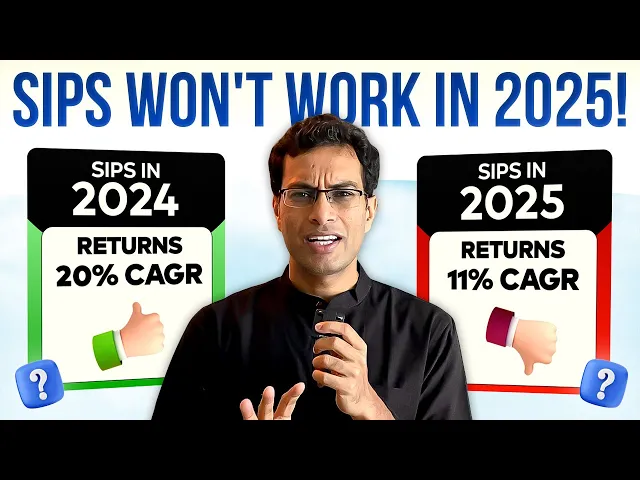
Everywhere you could hear that you should do SIP. You can build 100 crores of wealth. I have built 100 crores of wealth, this, that stuff.
And you'll get very excited start doing SIPs. Please listen to this video. It's going to be critical.
There are five central points that I will teach you. I will show you the reality of SIPing. And five points that I will teach you is that number one, why I don't do SIPs, no SIPs at all.
Number two, why do I do bulk investing? Number three, what are some other strategies that I use in order to generate some alpha? Number four, who is SIPs right for?
Because SIP is a very popular strategy. It's used by a lot of people. So who is the right candidate to do SIPs?
And finally, who is SIPs wrong for? This is something that literally no one is talking about. So I will take you through all of these five points.
So let's begin. And first and foremost, many of you might be doing SIPs in the market. What is the meaning of SIP?
That you get one-lack-rupee of salary. Let's say that every month you are investing, let's say, 30,000, 40,000, in mutual funds or in certain number of stocks or one or two stocks. Then irrespective, whether that stock is going up or down, mutual fund is going up or down, market is going up or down, you continue to invest.
That style of systematic investment is called a systematic investment plan or SIP. Very easy, all of us get it. This is one of the most popular strategies that people are using in the stock markets.
Now comes the question that, okay, why is it that SIP is, you What I'm saying is not working out. See guys, this is my perspective. It's not as if that I'm trying to push you.
It's your money. What I'm trying to present to you is a different way of thinking. If it aligns with you well and good, if it doesn't align with you, so be it.
Investors are supposed to be different. That's how markets function. See, my perspective on SIP is very simple, and it has got less to do with finance and more to do with psychology.
And this quote here beautifully captures why I don't do SIPs. Basically, let's imagine that there are only 100 stock market participants. People who invest in the stock markets, let's say, assume the number to be 100.
Now, out of this, how many people do you think would be SIP in the market? Well, a major chunk of them. Here, we are not talking about general Janta.
We are talking about people who are already investing in the stock market, not trading in the stock market, investing. They would be doing in SIP mode. Now, if a strategy is very common, and if it has become very common over time, a natural question to ask is that, why is it that you'll be making additional alpha on that strategy.
That's basically it. If any strategy in the world becomes very communistic, why would you be making money on it? You might make average returns out of it.
You might make sometimes above average returns out of it. But as a system which you are going to execute, let's say for the next 5 to 10 years, why would that system allow you to generate true wealth? So according to me, it would not help you generate true wealth.
Now, you'll say that, okay, that is your perspective. You might be wrong, this, that stuff. Because in the past, SIPs have given exceptional returns.
. When you think the true adoption of Indian stock market happened, I would argue that after 2020, okay? And when you think SIP market picked up, well, after 2020, why?
Because one click buying of stocks, one click buying after watching YouTube channels, one click buying after buying news channels, buying stocks became really easy. . If you buy 10 stocks, you are going to miss staying on two, three.
That's normal. There's nothing wrong. Every big investor understands that, and every big investor has lost money on some stocks.
That's not the point. But when general Janta starts to do that, they burn their hand and then they think,. So SIP started to become more and more common.
. from . 5 to 2 percent commission.
Depending on the type of product that they are selling you. Of course, it's a beneficial soda for them in terms of the more SIPs there are, the more money they control. That's what the entire AUM game is.
That's the bottom line. This market is only picking up. That's point one.
Point two related to this is that see, this has become an over common strategy. If you go back like 15, 20 years ago, hardly anyone was doing SIP in the market. .
People were just randomly buying things. Cricketers are telling you, mutual fund managers are telling you, big, big celebrities are telling you, entire campaigns have been built around it. Is this something that will generate like returns?
Of course it will generate returns. I'm not saying that to your returns will go to zero. What I'm saying is that will it generate alpha?
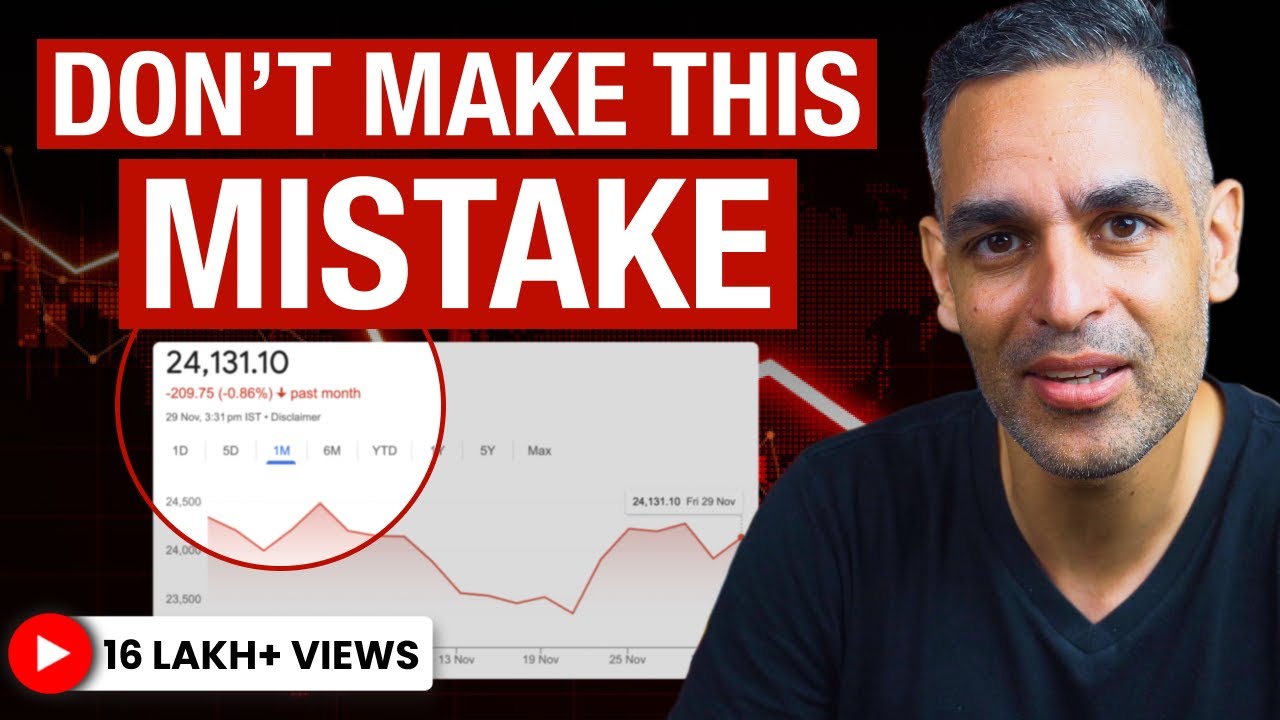
Which brings me to the second point as to why I do bulk investing and why that strategy, according to me, is much better than doing SIP. First example of nifty Because this is something that I've been saying over and over again. For example, if you take a look at this chart, this I have shown at least on 10 of my videos.
Just go and check in the last 10 odd videos. At least I have shown you exactly this. I've tried to predict what is going to happen and why it will happen.
Explained all the rational logic. This is Nifty50 chart. This is a channel that is being respected over a long term.
I had said, Buy in bulk. I also purchased a lot. You keep saving something called as cash positions.
Usually, if you invest from months on the sidelines. If you get an opportunity like this, bring it here. That is going to generate more returns for you.
This is like one strategy that I had followed over the last seven, eight months. And it has given me very good returns. This is something that I followed on even something like HDFC Bank.
As you can see, I had invested close to 1 CR, and my returns on that is close to 25%. Now, how did I make 25% and General Janta is only making 15, 16%? Why?
Because I bought HDFC Bank on technical when it was trading low. That was another bulk buy. Which other bulk investing means,.
That style of investing is called as bulk investing, versus,. This line will reveal that also along the video if you watch the video till the very end. But the major point that I'm trying to explain you is very simple.
invest when opportunity arise But if you get an opportunity to invest in bulk, then this is what I would typica lly do, and I am doing on a series of investments. Now comes a very natural point. If we SIP, then we don't have to use our brain, and we can continue to invest.
We have like job, all that stuff. Okay, great. I'll address this point that we have no time.
Therefore, SIP is a great strategy for us. I'll comment on this. Number 2, that how much alpha will you make if you do bulk?
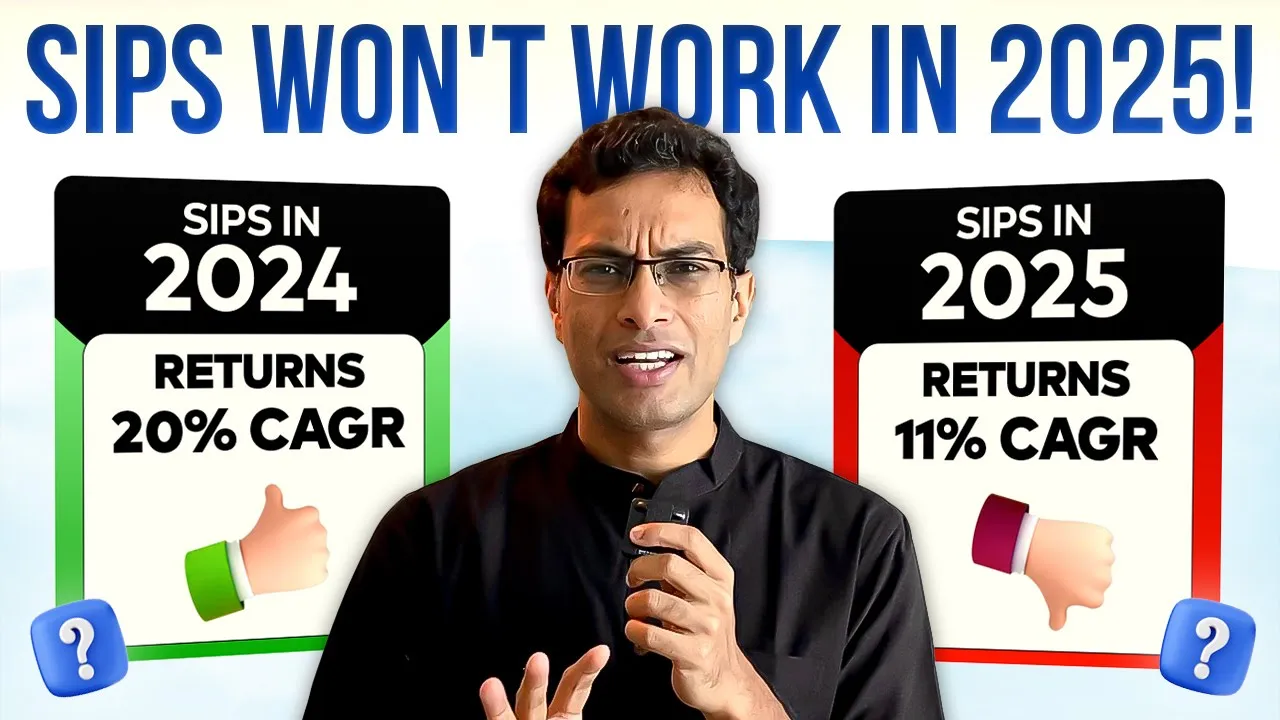
Number 3, that why are you saying that SIP in the future will not work that much? Why will it go sideways or it will not give you much returns? Let me discuss each of these three points and let me start with point number three.
In the Indian ecosystem or Indian taxation system, what is happening is that LTCG, long term capital gains tax on equities, has been brought to 12. 5%. When we invest, for example, let's say, today, you have to invest 100.
That's 1. 30 after two years. What will we assume?
In two years, we have made 30% returns. But is it really 30%? The short answer is no, because you have to pay LTCG on it.
The returns that you need to understand in context of the broader market is that, for example, Nifty50 is broad market. This is somewhat managed by the government. The government decides how much returns to give you from Nifty50 in a way.
Parliament. Now this market, it is likely to give you, on an average, in the last 20 years, Nifty50 has given between 12% to 13% returns on a 20-year CAGR basis. Just because you are a market participant, you used to change, but what is likely to change is the taxation structure.
So this is going to go up and up and up. Now this applies both for bulk investing also and SIP also. But what I'm trying to tell you is that see, if you did this 20 years ago, there was tax alpha capital gains on quity was lower.
It's not as if that you will make additional alpha in the market. It's not as if this is going to rise exponentially. But taxes have gone up.
So this will give you the illusion that, okay, fine. I was SIPing and I was growing my money at this pace only. Now also I'm growing money at this pace only.
But after tax, this strategy is not working out. Because you're effective after tax, returns comes out to be maybe 10. 5, 11% if you're doing in Nifty 50.
So this is the future of SIP, 10, 10, and a half %. So it's mathematically,. So I hope that all of us get that why am I suggesting that if you continue to SIP in the broader market, your after-tax return or the benchmark return that you need to beat is somewhere around 10, 10, and a half % after-tax basis.
Now, which brings me to the concept of bulk buying. Now, for example, here, if you check, for example, how much opportunity did you Here the market itself corrected by 10, 10, and a half %. Now this is not the only point where the market had corrected by 10, 10, and a half %.
For example, 10, 10 % fall,. This was another 10, 15 % fall. This was another 10, 15 % fall.
This was another 10, 15 % fall. This was another 10, 15 % fall. This was another between 10 to 15 % fall.
And you have a. So from October of 2021. So in the last three odd years, you have found 1, 2, 3, 4, 5 situations or 5 points.
In fact, this is. This is like 5%. So this is a lot of fall.
At least five or six periods. In the last three years, on an average, two periods per year, where you will get to capture this 10% alpha. This becomes like your alpha generation points.
Alpha means you're generating above market returns of 10. 5%, which we have calculated from the previous section. This is what we need to beat.
Now, if you are buying the market here itself, now many people will say that you're trying to trade the market. No, I'm investing in the market. I'm following a broad trend.
This is not just like technical investing. I'm looking at the broad trend, guessing that I'm getting to buy the asset at a good price and then I'm pressing the execute trade. I'm still holding this asset.
It's just that I'm buying the asset at the right point. Taking advantage of these type of opportunities becomes critical. If you're not taking advantage of these type of opportunities, then generating alpha on the market becomes close to impossible.
This is the most important point why I am a bulk investor. I'm not an SIP investor. Now then comes the next very critical point.
You see, SIP is a very easy investment strategy to execute. That I have a job, I don't have the time to study the market, figure out when this fall is happening, all that stuff. .
You see, again, coming back to the It's not as if that you will not be able to buy an asset. Similarly, stocks, if you want to throw money at something, it's very easy to spend crazy amount of money any day. Buying is not the problem, but selling is.
So whenever we start giving arguments like, Boss, who will put time in terms of investing in the stock market? I. When do you exit?
Tell me a normal, common, sensical response to that. You would not know when to exit your stocks. This is the precise problem with SIP doers.
For example, here there was a clear opportunity to sell. Another example, nifty it. This is a consolidation point.
The chances are that it will break out, it will come back, or it will make a new channel, for example, and this is something like this, it will get formed. Of course, that strategy might change, but does it make sense to hold too much Nifty50 right now? According to me, it doesn't make much sense.
. This is a chance where you can lower your positions. Can that strategy go wrong?
Of course. But the point is that it's not as if you will take a loss. When you have no idea about when to sell a stock or when to sell an asset.
So that is when real problem actually begins. And SIP doers really struggle with when to sell a stock or when to stop their SIPs or take a break from doing SIPs. So that start-stop approach hardly ever works.
So let me now show you what loss to SIP do us actually suffer with. For example, take a look at Equitas Small Finance. This was in my portfolio.
I had invested close to maybe 40, 50, I doubled my money, and then I cut almost 50, 60% of it. Somewhere here. Why?
Because this channel was being respected. . Now, was I able to withdraw all my money?
Absolutely not. But let's say that That's the point. This is the advantage, even if you consider that small finance banks were great to SIPs in.
By the way, I still feel that Equita small finance or Ujivan Small Finance are good stocks. It's just that they are going through a temporary problem because there is higher credit risk in the economy right now. That does not make these stocks bad.
What happens is that every stock goes through a cycle, and you have to go through that cycle in order to make money. Now, SIP doers, because they don't understand when to sell a stock, it becomes a problem for them to even fathom when to upward average things or downward average things. Now, if I.
Then comes the next point that, okay, what are some other methods that we can talk about? Because you have already spoken about bulk buying method. Are there other things, other stocks that you're looking at?
I'm just discussing it for education purpose. if you see hindustan uniliever stock. This is India Unilever long-term trading channel in a way.
If you extend it, this is what the trading channel would look like, roughly. Okay. India Unilever stock, if it returns back to this trading channel, there is almost 34% alpha on it.
Now, Is this in a bulk buying zone? Yes. Have I made money in the past by trading India Unilever stock in a way?
Yes. So this is a bulk buying zone. There is no way I would be doing an SIP on Industhan Unilever stock and all that stuff.
Right now, there is massive problem that is happening in terms of what the consumption is. Consumption slowdown is there, volume growth is there, Indian economy is not growing. Industhan Unilever type of stocks getting badly hit, Nestlé getting badly hit.
This becomes the time to bulk buy these type of stocks. So this is the first strategy that you need to trade the channel and buy in bulk buying zones. This is something that I explained earlier on my videos also, and this is something that I'm emphasizing even now.
This is your strategy number one, that within good stocks, you figure out good stocks in the market, buy them at bulk buying zone. Tomorrow on my member community, I'm going to talk more about this. This is one.
In case you are a serious investor, serious learner, please consider joining my member community. Very serious community. They learn from each other, understand contrary opinions.
That's one. Second is that you can go to a different asset class altogether. For example, here's a video that I had done on Swiggy.
At that point in time, I had purchased Swiggy at Rs. 360. Go and check the price now.
It's somewhere around Rs. 520. When was this video made?
Check the date. What am I trying to tell you? When I did this video, there was so much negativity, so much negativity.
. Is Zomato not a good company? Was it not loss making when it IPOed?
It was loss making. Everyone understood how the trajectory of Zomato played out. Swiggy is exactly on that trajectory.
It's not as if I said something genius on that video. It's just that I had conviction and I live invested close to 40 Lakhs. Therefore, I feel that my second strategy right now, which is working is that I'm going to the unlisted space.
I'm picking a lot of assets there now. Very good assets in the market, for example,. There are very good set of companies.
This is not a recommendation that you go and buy. All I'm simply trying to tell you is that at least study good stocks in unlisted space that matches your investment theme. Because why?
Because there is hardly any talk that is happening on unlisted space. . You use it, business is growing,.
This is like very important point that I will highlight. Of course, your bets can go down. I'm not saying that my every bet will work out, but there is a system that you can create in order to not take these type of hits.
This is second strategy that you go to unlisted space. Your third strategy is called a Cash Hedge strategy. Cash Hedge means, for example, and this you play on really safe assets.
For example, Banknifty is a safe asset. Why Banknifty is a safe asset or safer asset? Because it's not as if Banknifty is going to correct by 70, 80%.
It's unlikely. Equita small finance can or Ujivan can or even HDFC can. But Banknifty, which is the collection of all banking stocks in India, that is not going to fall by 70, 80% or get crushed, unless the entire Indian economy falls for some reason.
This is something that I did also. For example, you can see here Banknifty, I had more than one CR position, which is substantial position for me also, all bulk bought. This is Banknifty.
Now, is it at a great level to buy? No, this is somewhere in the middle. .
So you just analyze your risk reward. If you see a 10, 11% return, this is something that you could potentially consider. Right now, there is a return potential of 11, 11.
5%. So it makes sense to do this strategy on a safer asset. Now, the fourth and final point is that you need to understand macro cycles.
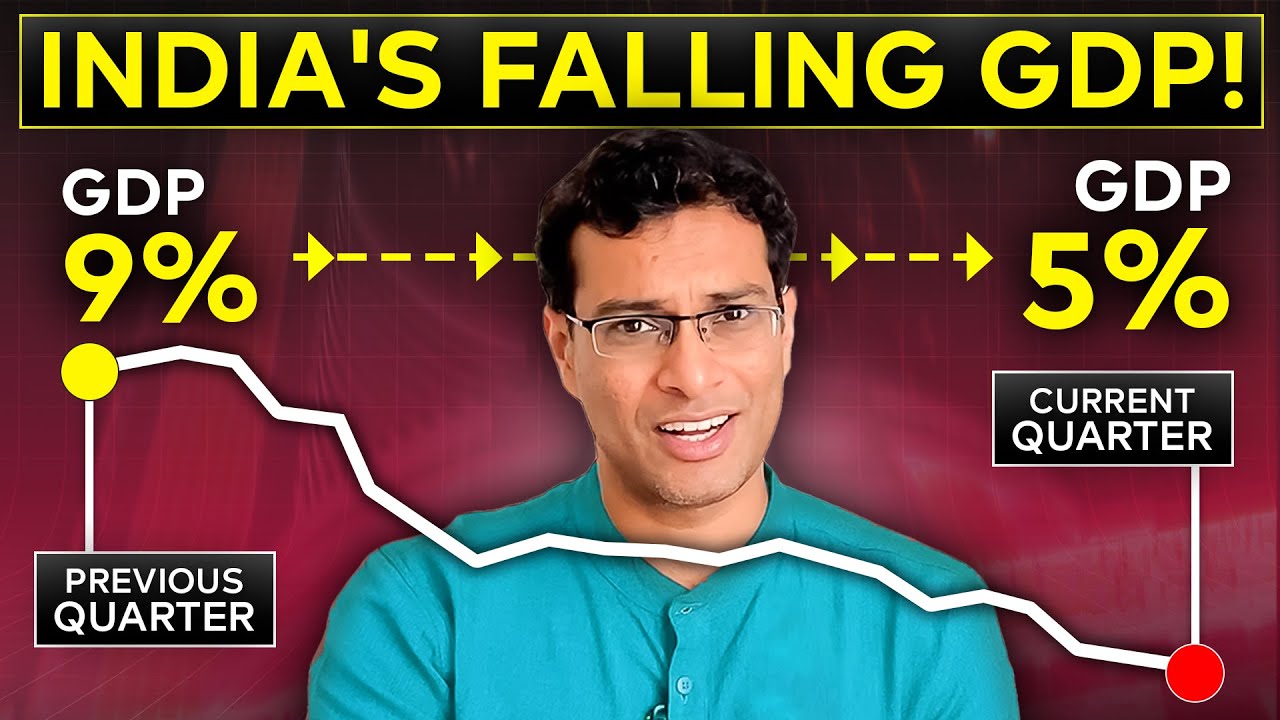
For example, there is a video that I made, and I will link it here somewhere, where I explained why government spending is slowing down. And this was before the GDP release data video. The government spending is coming down.
There is going to be a sector rotation. In fact, it is already happening from government to private spending or private consumption segment. Right now, there is a lot of noise that India.
Companies like Swiggy are going to benefit. A lot of unlisted stocks are going to benefit. Hul, Nestlé type of companies are going to benefit.
Series of other luxury players are going to benefit. So now it's time that you rotate within these macro themes early and take the hit over the next 6, 8 months. And that's how real alpha will be made.
Now, final point, many of you get scared, the stock market,. Please remember the math that you are going to make not more than 10, 11% consistently in the market if you're a pure SIP doer because you have zero understanding of rotating capital, taking opportunistic bets, cash hedging your portfolio. The important point is find balance.
No one is asking you that you invest 10, 10 hours, 20, 20 hours learning about the stock market, but at least on the basic sense of picking basics of stock investing and figuring out a way to make these things work for you. Now, in case you guys are interested, I'm running a course. This is a live course which will be completed over two weekends, completely online.
You'll get access to recordings as well. It has a bath size of 200 people. The seats are filling out fast, so you can check the links in the description and comment box, and everything will be taught to you from scratch.
So in case you feel that you can benefit from it, you could consider joining. Thank you so much for watching, and I'll see you soon.