You will recall, I hope, that when discussing welfare theory I identified five ways in which a government can seek to offset the under production of public goods, such as literature, art, and scientific innovations. To review, those five strategies are-- first, the government can provide the public good itself, as it does with respect to navigation, AIDS, and space research. Second, the government can select and subsidize private innovators, as it does with respect to much research involving health related sciences.
Third, the government can offer prizes to successful innovators an increasingly popular approach. Fourth, the government can adopt laws that reinforce innovator's self help strategies, such laws include protections for trade secrets, and the kind of ant-circumvention rules I mentioned a minute ago and that we will examine in more detail next week. Fifth, and not least, the government can protect producers against competition in the reproduction, distribution, and performance of their works.
As you know by now, copyright law is an example of the fifth approach. The topic for today is cultural theory, not welfare theory, but the same five options are relevant when we cast about for ways to advance the kinds of society commended by cultural theory. Some might be more efficacious than reforming copyright law itself.
For example, if we believe that this set of cultural products being produced today is too thin to sustain the kind of culture and the set of opportunities for artists that we want, we could, as we've done in the previous segment of this lecture, tried to tune the copyright system. Or instead, we could supplement the incentives created by copyright protection with government subsidies for the type of work at issue. Several European countries already do this with respect to cinema.
European national governments and some regional governments offer grants to filmmakers, typically new filmmakers or filmmakers pursuing unconventional projects, that supplement the revenues they can make by selling or exhibiting copies of their films. Where does the money come from? Typically from taxes, either general tax revenues or taxes on other forms of entertainment.
The result is increased diversity in the films available to consumers. Whether the net result is unbalance attractive is perhaps a good test of the merits of this approach. An even more radical possibility is the one I considered briefly in lecture number four.
If we despaired of relying on the copyright system to compensate fairly the creators of musical compositions and films, we might consider replacing the copyright system altogether with respect to online distribution of sound recordings and films with an alternative compensation system. The gist of such a system, you'll recall, is that fees would be collected, directly or indirectly, from businesses that capitalize upon consumers demand for digital recordings, but currently pay nothing to the creators of those recordings. Such businesses include internet service providers, manufacturers of consumer electronic equipment, and media related application programs.
The funds collected in this manner would then be distributed to the creators. The formulas by which they were distributed would likely vary by country. In the United States, where suspicion of government is intense, the money would likely be parceled out among copyright owners in proportion to the relative popularity of their works.
In Europe as Philippe Aigrain has argued, relative popularity would likely be alloyed with other criteria when determining how the money is divided. Once such a system were in place, online distribution of movies and recorded music would be legalized. Viewed from the standpoint of cultural theory, such a system would have two main advantages over our current regime.
First, it not only would provide consumers lawful access to many more cultural products at low cost, it would free them legally to modify and redistribute those artifacts, thus enhancing semiotic democracy. No longer would YouTube's copyright sniffing software suppress mash-ups that happen to contain snippets of other people's material. Incidentally, YouTube's software has balked at some of the lectures in this series, forcing us to appeal those rejections on the grounds that the snippets that I employ are shielded by fair use.
Whether such appeals, however well founded, will continue to work remains to be seen. Back to main story. Second, by enabling artists to earn good incomes by providing their works directly to the public, such an alternative compensation system would sharply increase access to the variant of the good life associated with the creation of art.
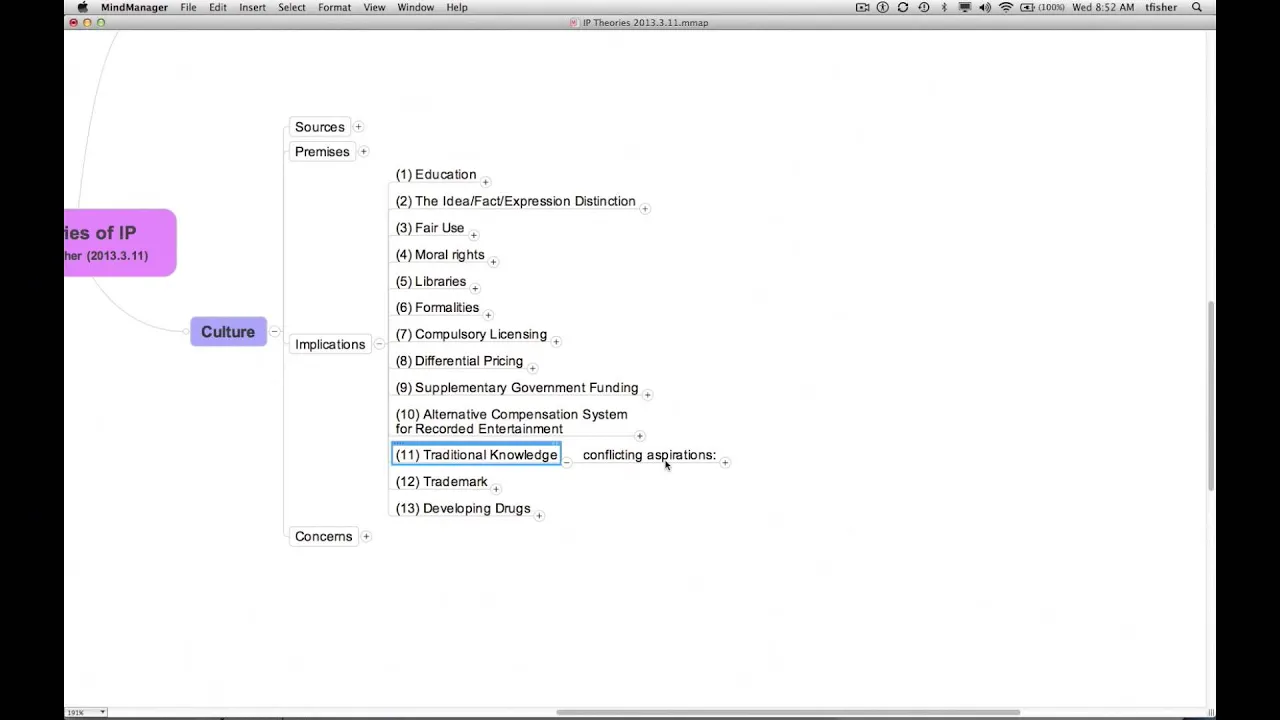
As we've seen, an alternative compensation system would not be perfect. Its disadvantages are cataloged on the map, but it would have great strengths. One of the most difficult issues currently confronting lawmakers throughout the world is how, if at all, to shield so-called "traditional knowledge" against unauthorized uses.
Roughly speaking, the term traditional knowledge refers to cultural products developed over long periods of time, typically by the members of indigenous groups. Examples include traditional music, dances, fabrics, costumes, folklore, and religious icons. Such things do not fit well the template of copyright law.
In part because the authors of such things are usually collective, hard to identify, and long dead. In addition, the concerns of the groups who object to the non-permissive use of traditional cultural expressions-- sometimes abbreviated as TCEs-- are usually quite different from the combination of economic and personhood interests implicated by most copyrighted works. If copyright law doesn't work well in this setting, what would work better?
That's far from clear. Countries continue to experiment with a wide variety of models. Various insight into those possible ways of dealing with traditional knowledge might be derived from the cultural theory we have outlined here.
Unfortunately, those insights conflict. Cultural theory is thus arguably helpful in identifying some things we should strive to achieve or protect, but not particularly helpful in telling us how to do so. Here are some of the competing considerations.
The use or performance or TCEs is one of the ways in which some communities define and sustain themselves. Because preservation of communities is one of the things commended by cultural theory, we should strive if possible to protect these practices from corrosion or dissipation. Protecting TCEs from appropriation by persons or firms outside the indigenous groups that created and sustained them would also promote cultural diversity by helping to resist the trend towards global cultural homogenization.
Allowing indigenous groups to charge, or otherwise be compensated for uses of their TCEs, would also provide them a source of funds that would mitigate their impoverishment and promote distributive justice. Note however, that this third consideration is in some tension with the first and second, which seemed to presume that the TCEs would not spread. On the other side of the ledger, protections for traditional knowledge are hard to reconcile with the value of semiotic democracy.
The merit of enabling all persons, both members of an outsider's to the indigenous groups, to refashion cultural artifacts of all sorts. Such protections are also hard to reconcile with the value of autonomy, of enabling all persons to choose for themselves the cultural forms through which they will define themselves. More broadly, the impulse to protect TCEs against unauthorized used or modification, seems rooted in a static conception of identity that diverges from the more dynamic conception of identity that figures in the conception of the good life offered here.
So what's the right approach? It's very hard to say. That question seems best left to the seminars that will accompany this lecture series.
All copyright theories have weaknesses, sore points. The theory I've outlined today is no exception in this regard. Cultural theory has two main weaknesses, both of which are likely apparent by now.
The first is commonly referred to as the perils of paternalism, or as it's sometimes called parentalism. Whichever term you prefer, it means efforts by governments to limit people's freedom or otherwise channel their behavior, not to protect the interests of others, but for their own good. Legal rules of this sort are not unknown.
Familiar examples are rules requiring motorcyclists to wear helmets, rules forbidding people to sell organs, bans on self enslavement, prohibitions on the use of certain drugs, and the non-waivable character of the implied warranty of habitability in landlord tenant law. Nevertheless, such efforts are hazardous and controversial. The reason why the specter of paternalism arises in the present context is that the vision of the good life, upon which this variant of cultural theory is founded, does not align exactly with what most people currently subjectively desire.
Thus to the extent the theory commends modifications of copyright law that will afford people more access to a life of the sort, and seeks to stimulate their appreciation of such a life, it does not defer entirely to people's own assessment of their best interests. But instead, pushes them in directions they might not be inclined to go for their own good. Three factors mitigate the troubling implications of that admission.
The first, is that the gap between the vision outlined in the first segment of this lecture and people's subjective desires is not as large as one might think. The findings of the group of scholars sometimes known as the Princeton Group concerning the ways in which people assess their own well being are reassuring. In particular, the so-called day reconstruction method, pioneered by this group and applied to the members of many classes and to the residents of many countries, reveals that people take more pleasure in some of the things commended by the good life, such as intimacy and friendship, and less pleasure in consumption and the trappings of status than has traditionally been assumed.
Second, none of the possible reforms I've outlined force people to do anything. You're not coercive. Instead, they're designed to alter incentives in an effort to invite or nudge, to use the term popularized by Thaler and Sunstein, people into better lives.
Third, it's not the case that adoption of these proposals would introduce paternalism into copyright law for the first time. As we've seen, extent copyright law already contains some even more coercive rules that constrain people's freedom for their own good. The clearest examples are the non waivable termination rights in sections 203 and 304 of the US statute, which I discussed in lecture number six.
Why are those rights non waivable? Because we wish to prevent artists from signing away their entitlements foolishly. In other words, we disable them from acting in ways that we think are not in their own best interests.
These three factors in combination may assuage our unease somewhat, but not entirely. Two arguments against initiatives of this general sort remain worrisome. The first is the fundamental argument made by liberal political theorist and leaders, the government's aught to remain neutral concerning alternative theories of the good.
The second, is a prudential consideration. Even if paternalistic rules are not objectionable in principle, it's foolhardy to entrust government officials with the power to override people's own conceptions of their best interests. This brings us to the second of the two major sore points and cultural theory.
It would increase the degree to which the shape of our culture is determined by government officials. The risks associated with that strategy are familiar. Bureaucrats are not famous for wisdom.
The persons and firms who stand to gain or lose from the decisions of the bureaucrats would dissipate scarce social assets, trying to persuade those bureaucrats to take one tack or another. In the worst case scenario, the official's decisions might be corrupt, either in the strong sense of being purchased by the affected parties, or the softer sense of being motivated by a desire to please the parties upon whose favor, and donations, the officials depend. These risks can be reduced by carefully selecting the officials in whose hands power is placed or by instituting checks on their authority, but they cannot be eliminated altogether.
Whether they are fatal to this enterprise, I leave to you.